Your ShelfYour Projects

The Youth’s Instructor, Vol. 59, No. 8.

Singing in the Rain

The Youth’s Instructor

Feb 21, 1911

Review and Herald Publishing Assn. · Takoma Park Station, Washington, D. C. · Feb 21, 1911

Singing in the Rain

It is very dark and dismal, And our heads are tired and throbbing; We are weary with the patter on the pane: Hark! we hear some distant music; Something glad in nature's sobbing; Ah! the birds are singing in the rain.
We have longed so long for sunshine, Though we're warm and under covers, While the many have to work and not complain: But the songsters, wet and hungry, Build their nests like cooing lovers; They are happy, singing in the rain.
Which are wiser, we that murmur At the things the Father sendeth, Be it joy, or be it poverty or pain, Or the song-birds, all unknowing How or where the journey endeth? They are always singing in the rain.
— Sarah K. Bolton.

Reading the Instructor Every Week

Do you read the INSTRUCTOR thoroughly every week?
To keep silver bright when not in use, lay a piece of gum camphor in the drawer or box in which the silver is kept.
ONE should never appear to be thinking of his own personal rights to the resenting of a little slight, whether real or imaginary.
THE age of a fish can be determined with accuracy by inspection of the otoliths, or bony concretions which are found in the auditory cavity of the ear.
PIE crust, if desired to be brown when baked, should be brushed over with sweet milk just as it is to be put into the oven for baking.
THE two large active volcanoes of Kilauea and Mauna Loa of the Hawaiian Islands, will probably form a part of the contemplated national park for Hawaii.
THE House Committee on Naval Affairs has come to the decision that Peary came within one and six-tenths miles of the north pole, near enough to establish his claim to having been there.
THE ten largest cities in order of their size are: London, New York, Paris, Tokyo, Chicago, Berlin, Vienna, St. Petersburg, Philadelphia, and Moscow. Three of the ten, it is seen, are in the United States.
BREAD from cottonseed flour is one of the latest additions to the culinary art. Flour from sugar-beets is also now being used acceptably in making cakes and puddings. It contains more than eighty per cent of pure nutriment.
“THE cost of a single battle-ship would establish fifty manual training-schools teaching a trade to seventy-five thousand people a year. It has been figured that the cost of one of these ships would practically wipe out tuberculosis from New York City.”
A COPY of the Indian Bible, translated by John Eliot, was recently sold at auction for twelve hundred fifty dollars. It is dated 1685, and it is believed no person now living can read it. It previously belonged to the library of Dr. Wm. Everett, of Quincy, Massachusetts.
Two gifts of twenty-five thousand dollars each have been made toward the first Young Men’s Christian Association for Negroes, which is being projected in Chicago. The total fund to be raised is one hundred fifty thousand dollars. It is estimated that there are twenty-five thousand colored men and boys in Chicago who might be reached by this new institution.
INSTEAD of the old-time canal mule for moving the shipping through the Panama Canal locks, giant electric motors will be used. The ordinary locomotive would “spin its wheels wildly and ineffectively upon the usual form of steel rail when compelled to attempt the towing of a twenty-thousand-ton ship. The electric motor will be geared to the tracks by a middle rail cut in the form of a rack, giving enormous traction power.”
THE following lines were written by the late Mark Twain for the epitaph on his wife’s monument:—
“Warm summer sun, Shine kindly here! Warm southern wind, Blow softly here! Green sod above, Lie light, lie light!”

Mathematical Surprises

BY a little juggling with figures it is possible to tell the number of any one's near relatives. Ask the person to double the number of his brothers, add three, multiply this sum by five, add to it the number of sisters, multiply the sum by ten, add to it the number either of his uncles or his aunts,—as he may prefer,—and then announce the final sum.
If this should be two hundred fifty-three, for example, you say at once, “Then you have one brother, no sister, and three uncles,”—or aunts, as the case may be,—to his great surprise; for you will have stated the exact facts.
To do this trick, you subtract one hundred fifty from the final sum; then the first unit in the remainder gives you the number of brothers, the second unit the number of sisters, the third the number of uncles. For example, one brother equals one, multiplied by two equals two, plus three equals five, multiplied by five equals twenty-five, plus no sister remains twenty-five, multiplied by ten equals two hundred fifty, plus three uncles equals two hundred fifty-three; subtracting one hundred fifty from this leaves one hundred three, or one brother, no sister, three uncles.
This trick also astonishes. By it any one can tell the exact numeral struck out of a number containing six or more figures. Let some one write down a number not containing a cipher, add together all the digits, subtract this sum from the original number, strike out a certain figure, reckon the sum of the remaining digits, and announce the result. The difference between this sum and the next largest multiple of nine gives the correct figure. When the figure removed is a nine, the result will be an exact multiple of nine.
For example, in case one hundred twenty-three thousand four hundred thirty-two is the original number, subtracting the sum of the units,—fifteen,—one hundred twenty-three thousand four hundred seventeen remains. Let us suppose that four is the number struck out, then the sum of the remaining units will be fourteen. The nearest product of nine is eighteen, and the difference between fourteen and eighteen is four, the unit struck out.—Selected.

New Zealand

G. B. THOMPSON
TO the ordinary student in school, New Zealand is but a dot on the map, an island, or islands, in the southern hemisphere, little thought of and little studied. Like other parts of the world, one really needs to visit the country to fully appreciate its extent, resources, and people.
The dominion of New Zealand consists of a group of islands. There are three main islands, known as North Island, Middle Island, and Stewart Island. There are also some islands to the east, of which the Chatham group is the most important.
The southern extremity of New Zealand is about the same distance south of the equator as the northern boundary of the United States is north of the equatorial line, though it is not so cold.
North Island is divided from Middle Island by Cook Strait, twenty miles wide at the narrowest point. Stewart Island is separated from Middle Island by Foveaux Strait, eighteen miles wide.
The three islands are eleven hundred twenty miles long, and one hundred ninety miles at the greatest breadth. The total area is given at 103,658 square miles, or a territory as large as the States of New York, Vermont, New Hampshire, Massachusetts, Connecticut, Rhode Island, New Jersey, Maryland, and the District of Columbia. The population at the present time is about one million. In addition to this there is a Maori population, which in 1906 was 47,731.
Since 1840 New Zealand has been a colony of Great Britain, with a parliament; the members of the house are elected by the people. In 1907 it was declared a dominion. The capital city is Wellington. The largest city is Auckland, which has a population, including the suburbs, of more than one hundred thousand; it also has a most excellent and beautiful harbor. Christchurch and Dunedin are large and important cities. Nearly all the towns, lakes, mountains, and rivers bear Maori names, which to the traveler making his first trip through the island, are quite unpronounceable. As a sample I submit the following: Whakarewarewa, Ngongotaha, Waikorowhite, Pipiriki, Taumarunui, Waikaremoana, etc. Imagine yourself trying to purchase transportation to some of these places! The best the ordinary stranger can do is to point at the place on the map, and tell the agent to give him a ticket to that city or town.
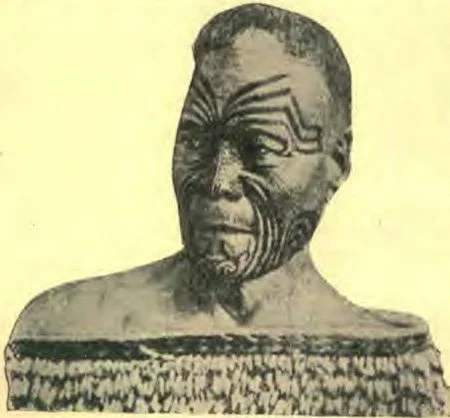
NGATIMARU CHIEF
NGATIMARU CHIEF
The following facts, gleaned from what I deem a reliable source, will give some idea of the resources of this far-away country:—
It has a coast line of 4,330 miles; the highest mountain peak is Mount Cook, 12,349 feet high; the largest lake is Taupo, covering 238 square miles; the deepest lake is Manapouri, which has a depth of 1,458 feet, the bottom being 861 feet below sea-level; the highest waterfall is 1,904 feet. The longest navigable river is the Wauganni, which is ascended by steamers and launches for a distance of 140 miles. This beautiful river is called the “Rhine of New Zealand.”
In 1907 there were more than twenty-two million sheep in the country, from which more than thirty-five million dollars in wool was realized. There are also large numbers of horses and cattle of a superior quality.
In 1908 there were 2,471 miles of government railway. This is all narrow-gage, but the road-bed, as a rule, is good, and traveling is comfortable. About ten million passengers were carried during the past year. There are excellent coal mines, nearly two million tons of coal being mined in 1907. There are also some gold and silver mines. There are extensive forests, from which valuable timber is secured and exported. The educational system is good, primary education being free, secular, and compulsory. There are two hundred thirty-six registered newspapers, sixty-six being dailies. The climate is excellent, resembling that of Italy. The south and middle islands are quite cold in the winter, snow being frequently seen.
New Zealand is indeed a beautiful country. Numerous scenic views greet the eye of the traveler. One writer thus describes the island:—
“Unequaled fjords, Awe-inspiring geysers; Forests filled with deer; Unrivaled Alpine scenery; Matchless lake country,— Boiling lakes in the north, Ice-cold lakes in the south; Hundreds of trout streams; The home of the Maori; The anglers’ and deer stalkers’ paradise.”
Flowering shrubs and beautiful flowers adorn the hills and the homes. There are beautiful lakes, girt about with bush-clad hills, and filled with the most lovely fish. There are mountains which frown down from the clouds, whose peaks are capped with eternal snow. The eye is charmed with fertile fields, on the bosom of which feed large flocks and herds. There are gorgeous landscapes, nooks in secluded beauty, inspiring views of mountain, lake, river, and volcano.
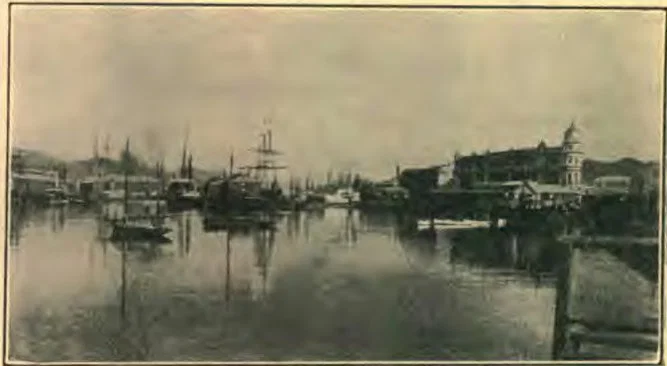
WELLINGTON WHARVES
WELLINGTON WHARVES
Among the most interesting places to visit is the thermal spring at Rotorua. To the writer this place seemed one of the wonders of the world. Hot sulphurous springs of water over an extended area boil from the earth in quantities beyond computation, varying in temperature from 110° to 212° F. From rocks gurgling water and steam hiss. Geysers of boiling water shoot into the air, sometimes to a great height and in tremendous quantity, and one is awed by the terrific forces at work beneath one’s very feet as one walks about to view the scene. Great pools of gurgling hot mud, like vast caldrons of porridge, bubble and sputter here and there. Mud volcanoes are constructed before your eyes, down the cones of which slides the lava-like hot mud in splashes perhaps an inch in diameter. The whole vast region steams and boils as if an angry volcano slumbered beneath your feet, ready, at any moment and without warning, to break forth and spread ruin and death in its wake. This place is called the “Safety-valve of New Zealand,” and to me it seemed well named. The region is volcanic, and the puffs of steam, and the hoarse sound of bubbling water deep below, betray a fierce, tempestuous energy of imprisoned forces, which some day will produce an eruption. Having viewed the sight, I was ready to depart without delay to a spot where the evidences of coming destruction were not so manifest.
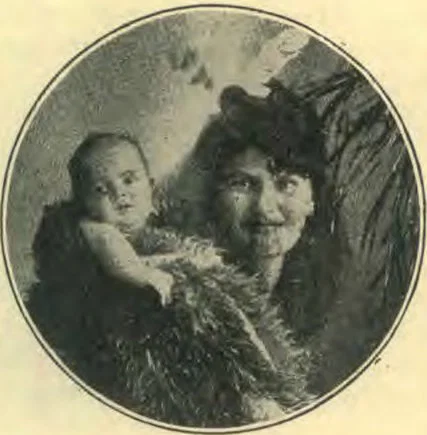
MAORI MOTHER AND CHILD

Three Pictures

PEARL WAGGONER
A CONFLICT sorely waging, A struggle not to yield; O’er all a tempest raging,— A heart, the battle-field.
An accidental meeting, A glance from kindly eye, A simple, sunny greeting From one just passing by.
A hostile army smitten, A storm-cloud passed away; In an angel’s book was written A victory won that day.

Special Grace Amid Trial

[The following is the conclusion of Elder W. A. Spicer’s article in last week’s INSTRUCTOR. This number consists of the young man’s own story of his prison experience.]
“As the prison term was expiring, I sought the Lord earnestly to deliver me, so that I might not come a second time into this prison; for during these two months I was shut away from all others, so that I had no opportunity whatever to speak to any concerning the truth. Other prisoners were together at times, but I was kept alone. I felt that it could not be the Lord’s will that I should be such a long time shut away from any opportunity of being a help to others.
“The last day of my imprisonment I prayed: ‘Lord, if it is thy will, do not let me come back into the prison; but thy will be done.’ Almost as clearly as if I could see it, though really I could not, there came to me mentally a view of the cross lifted up on Golgotha, overspread by beams of light; and with the thought came very clearly the conviction that I must endure yet another time of punishment.
“As I stepped out of the cell on my release, I could not help turning and saying, ‘Now, farewell, beloved cell;’ because I had experienced there so much of the blessing of the Lord.
“The sergeant said to me, ‘What are you saying? No one has ever said such a thing as that before.’
“‘I say it,’ I replied, ‘because I have experienced the blessing of the Lord here.’
“That night I was allowed to return to my room in the town near the barracks, where I had been living in the home of one of our sisters in the truth. Next day I was to report again at the barracks. I had again to prepare my clothing for the return to service, and as I expected it would be a return to punishment, I felt as if preparing the instruments for my own suffering. I thought of Isaac carrying the wood for the offering.
“Next morning I reported at the barracks. I was not looking very well, as I had not slept much the previous night; also I had been considerably burdened owing to the grief that my family felt over my conduct and experience. None of my own family being in the truth, it was naturally a great hardship to parents and brothers and sisters to see me taking a course which they could not understand, although they knew I was conscientious.
“The officer to whom I reported suggested that I announce myself sick, so I would be excused for a time. I said, ‘No, I could not do that.’ However, when the doctor came to examine me, he found that I was somewhat feverish, and sent me to the hospital.
“I was left in the hospital until a petition which I had sent from prison to the war office had been replied to. In the petition I had requested to be allowed to serve in the sanitary corps, where, in the care of the sick, I would be able to regulate Sabbath duties in such a way as not to infringe upon the requirements of the regular military régime. However, the minister of war denied the application.
“Again as the Sabbath came, I was upon the drill ground, and had to refuse to serve at the cannon. The officer in command laid his hand upon my shoulder, and said, ‘You are arrested.’
“This time the officers were very angry. In due time I came before the court. It is the rule that the officer who makes the complaint make also the request for punishment. Now the officer demanded a punishment of four months and fourteen days. The military court went still further, and the sentence was to six months’ imprisonment.
“As I walked from the court-room, I felt a measure of gratitude to see that the newspaper reporters were present, and I thought that possibly by their presence the testimony given before the court would make known the Sabbath truth to many people. And sure enough, the report truly went out generally to the press. [The reporters said that ‘the condemned man walked from the court-room with head erect, his confidence in his God.’ At this time the biennial council of the General Conference Committee was in session in Switzerland, and we saw accounts of the trial in the Swiss press.]
“However, when I reached the prison, the cold sweat stood on my forehead, as I thought of my parents and the experiences that might be before me. I knelt down and prayed the Lord that through the newspapers and by other means he would make known his Sabbath truth, and turn all things to his glory. This brought comfort to me.
“I spent some days in prison while the sentence was being confirmed. During these days I did not experience the blessing of the Lord in the measure that I had felt before in the prison cell. This brought grief to my heart. ‘What does this mean?’ I asked myself. ‘Is it that I have done something of which the Lord does not approve? Why does the Lord not help?’ One moment only Satan came with his doubts, but I prayed to the Lord: ‘Lord, it is thy cause, and not mine; and because it is thy truth, it can not be defeated.’ As I prayed, the blessing of the Lord came, though not as fully as before.
“Soon the sentence was confirmed, and I was taken to the military fortress at —, and ushered into a cell. The moment I found myself again shut in alone, that instant there came flooding into my heart the grace and the love of God, and I was filled with joy and with courage as in the former experience. I can never cease to praise the Lord that his grace came, so all-sufficient in the time of trial.
“This time the circumstances were yet more unfavorable. The chief of the prison could offer no mitigation of the sentence. I felt indeed that the only hope was in the Lord.
“The Sabbath came. That morning I had prayed very earnestly, and felt at peace. I felt that there was some experience coming in which I would need help. In a short time I heard the doors of the prison opening and shutting. As the sergeant came to my door, each time I had to call out,—
“‘Cell number eight! occupied by prisoner R—. He has six months’ imprisonment.’
“This time, although I was not working, the officer gave me no order.
“Shortly afterward came the lieutenant, and said, ‘Where is your work?’
“I replied, ‘This is the Sabbath of the Lord, and the Lord forbids me to work upon it.’
“‘You must show your work,’ he said.
“I told him it was there, pointing to the floor, and he passed it, entering his signature on the record, as if I were doing the work.
“Again and again during these months of imprisonment, officers threatened to report, and assured me of still more severe punishment; but somehow the Lord prevented any order being given, so that I escaped further difficulties that might have come on account of keeping the Sabbath while in the prison.
“After four months I was one day ordered to dress in other than prison garments, for removal to the hospital.
“‘Why is this?’ I said; ‘I am not ill.’
“‘I do not know,’ said the officer; ‘you will probably have your head taken off and another head put on.’
“‘No,’ I said, ‘only another heart.’
“He said, ‘Your heart is good enough; what you need is another head.’
“So I was taken away, accompanied by two men with guns, and put into a hospital, where I learned I was to be held under observation to ascertain whether I was mentally sound or not. Asked if I had any special wishes, I requested only that I might be allowed to have a Bible.
“‘Yes,’ said the sergeant, ‘give this man a Bible. He shall have a Bible; but no one shall try to speak or converse with him about religion.’ If I endeavored to talk with any one about religion, I was to be isolated.
“A yet higher medical officer often spoke with me, and as he was a man greatly interested in literature, we became very friendly together. In college I had studied literature, and was well acquainted with works of which the medical officer was fond.
“After six weeks in the hospital, under observation as to my mental soundness, a report was made in my case, and I was returned again to prison, where I remained for some days, working as before. Eighteen days later a medical officer came, asking me various questions, which I answered, maintaining simply my duty to obey God and to keep the fourth commandment of his law.
“‘Now,’ he said, ‘if you like to be here your whole life, you may remain here if you will.’
“I told him that it was not my wish to remain there, but that I was only telling him what the Bible plainly commanded men to do.
“‘This is logical nonsense,’ he said.
“I felt that hope for release was gone, and that I was to be left indefinitely.
“Four days later the sergeant came to me with orders to put on my better dress, and report to the captain. On reporting to him, I was told that they were resolved to investigate thoroughly my mental responsibility, and for this purpose I was to be sent to another city, to undergo observation in a clinical hospital.
“Before leaving, a superior officer said, ‘Now, R—, when you get free from military service, I suppose you will say that God looked upon your martyrdom and helped you.’
“I said, ‘Yes; I certainly believe that God does help.’ And so I left for the clinic at —.
“The day after my arrival at the clinic, the physician in charge, a well-known professor, came with his staff and spoke with me.
“‘You are an intelligent man,’ he said. ‘You must remember also your obligations, and relate yourself to circumstances. We will help you. We do not want your young mind crumpled up and shattered.’
“A few days afterward he talked with me in his office, urging that I drop these notions which had brought me into trouble. I explained to him that I could not do otherwise and be true to the plain Word of God, which all Christians profess to believe.
“‘Then you must bear the consequences,’ he said. ‘The responsibility is your own.’
“I was given to understand that my behavior was on test, and I prayed the Lord that he would give me grace before this man and before others.
“For a fortnight I went in and out with the work, having been assigned duties in the fields along with others under observation for various physical ills or mental weaknesses.
“One day an assistant in the physical laboratory came into the ward where I was. He had in his hand a parcel, that by the wrapping seemed to me a little mathematical device with which I was familiar, used by mechanical engineers and others in working out the finest measurements of spaces and capacities.
“I said, ‘Have you not there a device for reckoning logarithms?’
“‘Yes,’ he replied, and wanted to know if I understood the use of it, saying that the chief professor was looking for some one to show him how to use it.
“I told him that I understood its use, so he asked me if I would come that afternoon to the laboratory. I told him that I had been ordered to work in the fields, and moreover my misfit working clothing was hardly appropriate for the laboratory.
“‘Well,’ he said, ‘I will tell the professor.’
“He reported to the professor, and brought back orders that I was to be released from field work, and was to come to the laboratory to assist this young man in certain investigations and mathematical estimates on which he was engaged.
“As I had had my training as a mechanical engineer, I was familiar with these things. The head professor came also, and as we worked on the investigations and experiments, I came into very friendly contact with him.
“Six weeks passed in this way, and I had been invited to visit the professor at his home. One afternoon as I had refused the offer of a cigar, he said, ‘You do not smoke?’
“‘No,’ I replied, ‘Seventh-day Adventists do not smoke, believing it to be a harmful practise, and that we should conserve all our powers for the active service of God.’
“Well, he said, he did not smoke very much, but now and then he used tobacco because he had found his friends testifying that it was a help to drive away sad thoughts.
“I, however, was glad to suggest that I found solace and comfort in all difficulties and trials in the Lord.
“At last he asked me if I would like to have my liberty. I said, ‘Certainly; there are only two things, freedom and the prison, and the choice is not difficult.’
“‘Well,’ he said, ‘we will find a way. I will direct this thing so that you shall become free.’
“I went from the interview with my heart singing for joy. My friend, the mechanic whom I had been helping, let me know that the professor was trying to secure my release from the army, and to arrange so that I would not have to go back to the prison for the remaining time of my sentence. He said the professor had asked the authorities if I could not remain four weeks longer helping him, until I should be released.
“The reply from the authorities, however, denied the professor’s request, so it was settled that I must return to the hospital where I had first been under observation, until all my papers were ready. It was apparent that some report had been made on which it was expected that I would be released altogether from army service.
“Before I left the clinic, the professor called me, and said: ‘We are sorry you must go. We have telephoned twice to —, to get permission for you to remain here for a few weeks, but did not get a favorable answer. Now as you go, keep the clinic always in remembrance, and also bear us in mind when you no longer wear the king’s uniform.’
“As I returned to the hospital, he sent with me a letter instructing the authorities that I should not be treated as an evil person. And four weeks after that I was free.
“Of course, I never was shown the report that had been made by the professor on my case. By the assurances of his friendly determination that I should not be compelled to suffer punishment for conscientious convictions, and by the fact that I had been assigned to the clinic to have my mental responsibility investigated, it is evident what the report must have been. Owing to the fact that I was compelled to maintain unwavering loyalty to the Lord in the matter of keeping his holy day, a thing looked upon as quite unnecessary and abnormal, the professor could readily set forth the case as one indicating a peculiar mental bias.
“But I was not yet quite free, being subject to call to military service at some later time. When I had returned to my home, however, I became ill from the effects of the experiences passed through, and was compelled to undergo a serious operation. Now by the medical reports in this case I am quite free for all time from the call to enter the army.
“In some ways this sickness was a greater trial even than the imprisonment; but through it all the blessing of the Lord has been mine. Looking back to the prison experiences, and the special help that came in time of trial, when one could never tell what the next step might be, I must testify that the Lord’s grace was every day sufficient. His strength is made perfect in weakness. Even the weakest could have endured all by the love of Christ which was shed abroad in my heart so abundantly through his grace.”

John Randolph on His Mother's Childhood Teaching

THE testimony of John Randolph was: “I should have been an atheist had it not been for the recollection and memory of the time when my mother used to take my little hand in hers, and cause me, on my knees, to say, ‘Our Father which art in heaven.’”

Living Within Your Means: A Franklin Maxim

If you know how to spend less than you get, you have the philosopher’s stone.— Benjamin Franklin.

The A B C of the Gospel for the Sinner

ALL have sinned, and come short of the glory of God. Rom. 3:23.
Behold the Lamb of God, which taketh away the sin. John 1:29.
Come unto me. Matt. 11:28.
G. B. Starr.

The A B C of the Gospel for the Believer

ACCEPTED in the beloved. Eph. 1:6.
Blessed us with all spiritual blessings. Eph. 1:3.
Complete in him. Col. 2:10.
G. B. STARR.

The Straightest Path to Respect and Success

“The straightest, surest path to respect and confidence and success is through truth, and the straightest, shortest path to failure is through falsehood.”

Regret as One of the Deadly Sins

“REGRET,” George Ebert said, “was considered one of the forty-two deadly sins by the ancient Egyptians, because it consumes the life, and does no good.”

Aluminum: The Abundant Silvery Metal

Aluminum — No. 12

ALUMINUM, the silvery white metal of commerce, which we can readily identify by its remarkable lightness, is said to be the most abundant element next to oxygen and silicon.
Perhaps in no part of the world of knowledge are we more often confronted with the fact that “things are not what they seem” than we are in chemistry. A common clay brick, either before or after burning, does not bear any semblance to a bright aluminum dish that we might place by its side. Yet the chemist could quickly prove to us that nearly one half of that brick is pure aluminum; and were he given time, he could make or have made from the aluminum which he could extract from the brick a vessel exactly like the other.
Aluminum is the most abundant of metals. It is found in most rocks and soils. It is contained in clay, marl, and slate, as well as in feldspar, mica, and many other common minerals.
This metal has waited for centuries for due recognition. Its existence has long been known, but not its worth. Fifty or sixty years ago it cost more than a dollar an ounce; now it can be purchased for a few cents a pound. Its high price was dependent upon the small demand for it, and upon the fact that no satisfactory method of separating it from its ores was known. Now that a rapid and cheap method of extracting it by electricity has been discovered, and people are becoming acquainted with its unique and valuable properties, the demand is constantly increasing.
The production of aluminum in this country last year was forty-three hundred tons, while the world’s annual production up to 1890 had not exceeded forty tons.
It is durable, lighter than glass, takes a high polish, does not tarnish in air, can be easily cut, hammered, and cast, but not readily welded, except by electricity. It alloys with most metals, and is almost as malleable as gold and silver. It is somewhat ductile; that is, it can be drawn out into wire quite easily. It conducts electricity better than iron, and heat better than silver. To know what a good conductor of heat silver is, you have only to touch a silver knife soon after putting it in hot water. Aluminum is also remarkably sonorous. A high heat — 650° — is required to melt it. Its tenacity, however, is only about one fifth that of steel, so it has no chance of displacing the latter for structural purposes. It rather has increased the efficiency of steel; for it has been found that when a little aluminum is added to melted steel just before it is poured into the mold, the casting obtained is solid and free from “blow-holes,” little cavities which have a very bad effect on the strength of steel.
Perhaps you have never thought of associating common alum with aluminum. The formula for alum (Al₂(SO₄)₃ K₂SO₄) shows that it is an aluminum compound. It can be made by treating roasted clay with sulphuric acid, and adding potassium sulphate.
You may not have associated the ruby, the sapphire, emery, and the emerald, with aluminum, but all these are aluminum compounds.
So easily does this unique metal fit into the world’s economy that it is already put to a great variety of uses. It serves for boat-building, surgical instruments, cooking utensils, the barrels of opera-glasses and telescopes, for flying-machines, automobile bodies, thimbles, horseshoes, balloon fittings, bicycles, and electric conductors. In the form of powder it is mixed with other substances and used as a detonator for firing explosives. It forms with copper a valuable alloy, known as aluminum bronze. This has a golden color, and takes a high polish. With gold it forms a purple alloy. It serves for the beams of balances and other instruments. Various compounds of aluminum are used as mordants in dyeing. The word mordant means to bite, and substances that act as mordants bite into the fiber of the cloth, and at the same time take hold of the coloring-matter and precipitate it on the cloth, thus making a fast color. The fiber of cotton, when impregnated with alum, or aluminum sulphate, can be made to retain colors which the cotton itself has no power to hold.
This versatile metal also lends itself admirably to the work of the surgeon, being used to repair fractures and to fasten bones together. It is used in the making of books for the blind — books which are read by passing the fingers over the embossed letters printed upon the pages. It is said that these books are much easier to read than the best paper books, especially by those who have become blind late in life, and whose fingers are not very sensitive.
Aluminum through its silicate compounds produces our earthenware, bricks, ordinary pottery, and hydraulic cement. Through its oxides it furnishes some of our most prized gems. Altogether it is deserving of a high place in the role of useful metals.

Jesus Christ, the Sun

A VISITOR, staying with the poet Tennyson at his home on the Isle of Wight, one day ventured to ask him what he thought of the Lord Jesus Christ. The two were walking in the garden when the question was asked. For a moment the poet made no reply, but seemed lost in reverie. Then he stopped before a beautiful flower, every petal of which seemed to be drinking in the enlivening rays of sunlight, and said, as simply as a child: “What the sun is to that flower, Jesus Christ is to me. He is the Sun of my soul.”—Home and School.
Continue reading: Arouse to Action, Volunteers!