A Work That Belongs to the Middle Ages — Protestant Ministers Are Pushing It — A Catholic Priest Denounces Them
By S. B. HORTON
THERE is a very interesting situation developing in the state of Pennsylvania, at the present time, in connection with the enforcement of the Sunday blue law. Two cities of the Keystone State, Norristown and Altoona, are treated to a system of espionage that would be in keeping with medievalism or the celebrated "holy" Inquisition of the Dark Ages. Norristown is noted as the largest "burg" in the United States, having a population of thirty thousand, and yet unincorporated as a municipal commonwealth.
FINED FOR WORKING ON SUNDAY
At the behest of the "Welfare League," the burgess of Norristown, who is the committing magistrate of that community, was called upon to arraign four business men before the public as criminals, the charge against them being violation of the Sunday law, the celebrated "blue law" of 1794. Of these, two were obliged to pay fines and the costs of prosecution, one was discharged, and one was held to await a further hearing.
The vice-president of the "Welfare League," a prominent church worker, appeared as the prosecutor in all of the cases; and Mr. William F. Dannehower, a local attorney, represented the defendants.
The first case was against Peter Nemphos and his employees, who conduct a candy store. The star witness testified that while looking into the store owned by the defendant, on the Sunday night preceding, he saw a man purchase some candy. Upon cross-examination, the witness admitted that he was taking a walk for the purpose of seeing who was violating the Sunday law. Another witness testified that he had gone into the defendant's store for the purpose of buying chocolates. While there, he saw a young woman purchase a drink of something. He had later purchased five cents worth of candy.
WITNESS HAD BROKEN SAME LAW
The witness, in response to a question from the attorney for the defense, said that he did not expect to be paid for his work of securing evidence. Asked by the attorney whether he did not think he was violating the law by making a purchase on Sunday, the witness said: "I was violating the law. I do not expect to be fined for so doing. By saying that I was violating the law, I mean I was violating the law of God."
The burgess adjudged the storekeeper guilty, and imposed a fine of $4.00 and costs, $3.95. The attorney for the defense charged the burgess with acting illegally, saying: "As burgess, you have no jurisdiction whatever in such prosecutions. That has been decided in 1888 by the Court of Common Pleas. Judge Newman directed that a 'burgess has no jurisdiction in such cases,' and his decision has never been questioned."
The burgess replied, "And I will give notice now that if these stores are kept open next Sunday, the charge against the offenders will not be 'violating the Sunday law,' but will be that of conspiracy to evade the law."
The other case adjudged guilty was that of a druggist. The star witness, the aforesaid vice-president of the "Welfare League," testified that while standing in front of the defendant's store, "before going to church Sunday evening," he had seen two men purchase cigars, and had seen the clerk take the cash.
Attorney Dannehower called the magistrate of the fourth ward to the stand. He showed by his docket that the defendant had been arraigned before him the previous forenoon on the charge of violating the Sunday law, and had pleaded guilty. The burgess asked the witness, "What did you do with the case?" The magistrate replied, "I fined the defendant $4.00, and remitted the costs." This caused the burgess to remark, "Even a magistrate can help people evade the law." Quick as a flash came back from Magistrate Clarke the remark, "Go as far as you like, Mr. Burgess."
The third case was against the keeper of a store who sold ice-cream. The chief witness testified that he had entered the store and asked a clerk whether or not the store was open for business. Upon receiving a reply in the affirmative, the witness, he himself testified, had "preached a little sermon to the man." The witness testified that another man and a clergyman — naming them — had accompanied him to the store, and he said the visit had been made "after church services."
EARNED HIS MONEY, BUT REFUSED OTHERS THE RIGHT
Attorney Dannehower turned to the witness, and asked, "You sing in a church choir on Sundays, and you get paid for it, do you not?"
The witness replied: "I do. The court has decided that it is not a violation of the law to do so. That is considered a necessity."
The attorney said: "That is very true. Then you admit that after you have earned your money on a Sunday, you go around spying on other people trying to earn a living, for the purpose of getting them into difficulty."
The witness said, "That has nothing to do with this case."
The attorney replied, "Nothing, absolutely nothing; but I want the court to know just what kind of a man you are."
The witness became angry, and retorted loudly, "Your wife sings in a church choir on Sunday."
Smilingly the attorney said: "Yes, I am proud to say she sings in a choir, but she does not go around spying upon other people. She is not selfish. Then again, she attends to her own business."
A great deal of feeling has been engendered because of the fact that the burgess has discriminated in prosecutions for Sunday law violations, having said on one occasion, "I am the burgess, and I will use my own judgment as to who shall be prosecuted and who shall not be." The Business Men's Association is interesting itself, and further developments are expected in the near future.
THE SUNDAY NEWSPAPERS AN ISSUE
Following a meeting of the Altoona ministerial association, a crusade against so-called Sunday law violators has been begun. The ministers' association is seeking to make Altoona a newspaperless center. The news agents are preparing to defeat the work of the ministerial association. Officials of all the Philadelphia and New York newspapers, as well as the Pittsburgh papers, previously informed the local news agents that they would assist in fighting the preachers if their business were molested; and once the fight is taken up, these men declare, they will remain in the thick of it until the ministers are made ridiculous throughout the country.5Several court decisions have been handed down setting forth that Sunday newspapers (Continued on page 8)
Enforcing a Religious Law
(Continued from page 4)
are not luxuries; but an attorney has informed the local ministers that the blue laws, if enforced, will prohibit the sale of the papers. The ministers have also decided to get after the oil dealers who sell gasoline and oil on Sunday.
Photograph by Underwood & Underwood, N. Y.
CHAMBER OF COMMERCE JOINS THE FIGHT
It is reported that the Chamber of Commerce is considering an effort to devise ways and means of quieting the ministers. Lately Altoona has gained considerable unsavory advertising out of the activities of the preachers; and as a result, many traveling men who formerly spent Saturday and Sunday in this city, go to other cities, where some tolerance is shown.
CATHOLIC PRIEST DENOUNCES IT
The rector of St. John's Catholic Church is evidently not in sympathy with the Altoona ministerial effort to have a blue law Sunday. He took occasion recently to denounce the activities of the ministers who spend a portion of Sunday scouring the city to find hapless violators of the archaic "blue laws."
He took issue with the ministers on two points: He declared, first, that the first day of the week, Sunday, was never divinely ordained as the Sabbath, and, as a matter of fact, was first designated as the rest day by the Catholic Church; second, that the Scriptures designate the Sabbath as a day of rest, and that rest does not imply the rest found in a graveyard, but rather a healthful and stimulating rest, which does not interfere with the rights and liberty of others.
He pointed out that "under the old Hebraic law, the seventh day of the week was set aside as Sabbath; but that early in its history, the Catholic Church, on account of many leading events in the life of Christ that occurred on the first day of the week, made the first day Sunday, and that this has since been followed by the Christian world."
The rector maintained that it was not the prerogative of any clique of men to dictate to individuals the day they should observe as the Sabbath, and that any individual would have the same right to designate a day in the middle of the week as his Sabbath, as the ministers have to say that the city shall close up tight on the first day of the week.
He also declared that the very word "Sabbath," which is derived from the Hebrew, indicates the uses to which the day should not be put. He declared that it was far from right that the "healthy, red-blooded man of to-day, who toils for an existence six days in the week, should be compelled to spend his only day of leisure in the rest of the graveyard."
This Catholic priest's comments are certainly to the point, and we would commend them to the careful consideration of all who believe that the Bible teaches that Sunday is the Sabbath for Christians.
The ORIENT COMBINING AGAINST the WEST
By T. E. Bowen
Leading Statesmen See the Conflict Coming — The Prophets Have Foretold It and Given Its Meaning — Important that We Be Ready for It
By T. E. BOWEN
AFTER the door of the ark was closed, with Noah and his family shut in, and a rebellious world shut out, time went on as usual, and several days passed before the actual Flood began to come on. Noah's faith was tried severely as a world outside rejoiced at his apparent deception.
But their rejoicing was indeed short. On the eighth day, the storm Noah had so faithfully told them of for one hundred and twenty years broke upon the unsheltered heads of those sinners of old. Then their mirth was quickly turned into the despairing wail of the lost.
WHEN TURKEY IS FORCED FROM EUROPE, WHAT THEN?
When Turkey is forced to make Palestine its seat of government, what then? In actual fact, the familiar proverb will become literally true, that she has "jumped out of the frying pan into the fire." Do you ask, Why so? — Because the world's religions will then be touched. Nominal Christianity of the west, holding this territory as very sacred ground, and the heathen east, among whom are hordes of Moslems, who take delight in showing their disregard and contempt for that which to the Christian nations seems very sacred, are very likely to come into conflict right away when the Turk makes Jerusalem, or this "Holy Land" territory, his governmental seat.
That events are shaping rapidly for this more general world division, the undercurrent of which is quite possible to be a very strong religious one, is shown by the following scriptures and statements of eminent men.
THE WAY PREPARED FOR THE KINGS OF THE EAST
Among the judgments to fall on the earth during the day of God's fierce anger, John speaks of a way being prepared for the nations of the east to become involved in the general world strife: "And the sixth angel poured out his vial upon the great river Euphrates; and the water thereof was dried up, that the way of the kings of the east might be prepared. And I saw three unclean spirits like frogs come out of the mouth of the dragon, and out of the mouth of the beast, and out of the mouth of the false prophet. For they are the spirits of devils, working miracles, which go forth unto the kings of the earth and of the whole world, to gather them to the battle of that great day of God Almighty." Rev. 16: 12-14.
THE WHOLE WORLD INVOLVED
To use plain terms, we here have decadent Protestantism and Roman and Greek Catholicism of the west, and Mohammedanism and the heathenism of the east, brought in array one against the other, led on under the cult of spiritualism by Satan himself. And this scripture says that not only the kings of the earth are involved in this mobilization, but the people of the whole world as well will be involved. It does not need a prophet's eye, friend, to see plenty of trouble and anguish and distress in this commingling of worldly powers, led on by strong religious sentiments.
THE OCCIDENT AND ORIENT ALIGNMENT
That this array between the nations making up the east and the west, permeated by religious sentiments, is not a fancy sketch, as one looks out upon the world to-day, let us read a few statements. In the Literary Digest of March 5, 1910, appeared this significant statement: "A league of influential Japanese and Hindus to consolidate the Asiatic people against the domination of Europe is attracting notice and concern. High officials at the court of the Mikado and chiefs of the Japanese aristocracy are at the head of it; and the constitution is from the pen of Count Okuma. On the other side there are many of the most influential people of India enrolled among its members."
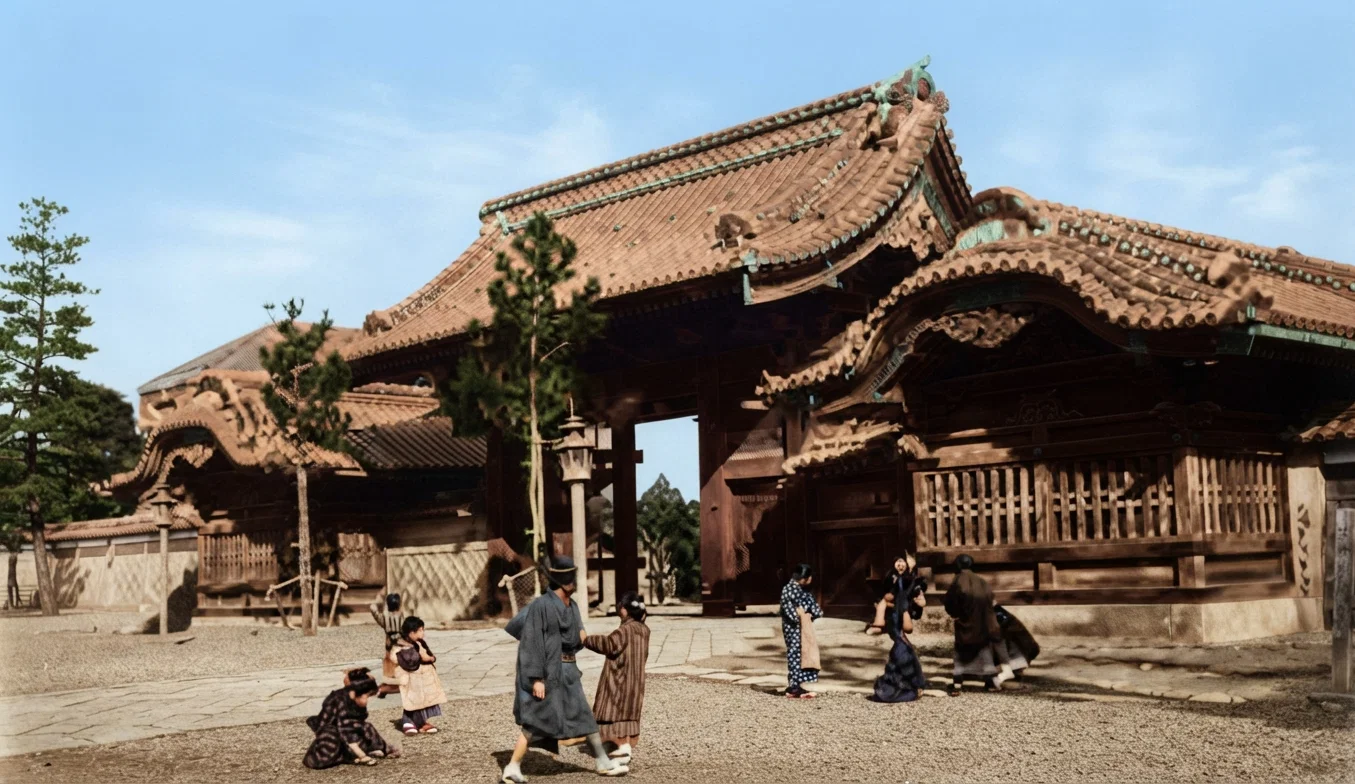
GATEWAY TO TOKIO IMPERIAL UNIVERSITY
Here is another, as reported by the London Daily Express of April 25, 1905, regarding a statement having been made in the Japanese House of Peers, which throws some light upon the real object in the minds of those of the east entering into the above mentioned league:
"The sacred [notice the term] duty is incumbent upon us as the leading state of Asiatic progress to stretch a helping hand to China, India, Korea, to all Asiatics who have confidence in us, and who are capable of civilization. As their more powerful friend, we desire them all to be free from the yoke which Europe has placed upon them, and that they may thereby prove to the world that the Orient is capable of measuring swords with the Occident on any field of battle."
PREPARING TO MEASURE SWORDS
These statements are very significant indeed, indicating clearly that the Orient is rising to that place where it shall not fear to "measure swords with the Occident on any field of battle."
And that powerful nations of the west are not ignorant of what is brewing across the seas, we cite an extract from a recent speech in the House of Representatives, at Washington, D. C., by Representative Mann, as reported in the Literary Digest of October 17, 1914:
" 'Close to Japan, lying like a sleeping child of the world, is China, with her vast territory, with her immense population, and that which was going on in Japan a few years ago is now going on in China. The awakening of China is more marvelous, perhaps, than was the awakening of Japan; and as these great people in China arise to the civilization of our modern days, and engage in the manufacture of products, we will enter on a series of competitive efforts with the far east which have never yet been equaled in this world. . . .'
" 'And we who are now legislating, if we do not bear in mind possibilities not merely of to-day or to-morrow or one hundred years from now, of the inevitable conflict, commercial or otherwise, which we will meet in the far east, have forgotten the principles which ought to actuate us.'"
"The speaker then emphatically affirmed his belief that 'it is as certain as the sun will rise to-morrow that a conflict will come between the far east and the far west across the Pacific Ocean. All that has taken place in the world during the history of the races up to now teaches us that avoidance of this conflict is impossible.'"
" 'I hope that it may be only a commercial conflict. I hope that war may not come. I hope there will be no conflict of arms, but I have little faith that in this world of ours people and races are able to meet in competition for a long period without armed conflict. A fight for commercial supremacy leads in the end to a fight with arms, because that is the final arbiter between nations.'"
While Mr. Mann hopes this may be only the strife of commercial activities, we are led to conclude, in view of what John the revelator points out, that the antagonism engendered by conflict of religions will play the greater part in this terrific struggle for world supremacy, which culminates in Armageddon immediately prior to the personal appearing of Jesus in great glory. And proof is not lacking that that power which once ruled the world, the papacy, is gaining political power to the extent that she will play no small part in this final struggle.
The Bible does not leave us ignorant of the outcome. This titanic struggle, involving as it will the790whole world, is ended by the personal appearance of Jesus Christ Himself leading the armies of heaven.
He is "called Faithful and True, and in righteousness He doth judge and make war. His eyes were as a flame of fire, and on His head were many crowns." An angel was heard to say to the fowls: "Come and gather yourselves together unto the supper of the great God; that ye may eat the flesh of kings, and the flesh of captains, and the flesh of mighty men." "The beast [the papacy] was taken, and with him the false prophet that wrought miracles before him [understood to mean false Protestantism], with which he deceived them that had received the mark of the beast, and them that worshiped his image. These both were cast alive into a lake of fire." Rev. 19: 11-20.
"And the heaven departed as a scroll when it is rolled together; and every mountain and island were moved out of their places. And the kings of the earth, and the great men, and the rich men, and the chief captains, and the mighty men, and every bondman, and every freeman, hid themselves in the dens and in the rocks of the mountains; and said to the mountains and rocks, Fall on us, and hide us from the face of Him [Jesus] that sitteth upon the throne [only one throne now], and from the wrath of the Lamb: for the great day of His wrath is come; and who shall be able to stand?" Rev. 6: 14-17. "And then shall that wicked [or lawless one] be revealed, whom the Lord shall consume with the spirit of His mouth, and shall destroy with the brightness of His coming." 2 Thess. 2: 8.
HE WILL SAVE HIS OWN
From God's word, dear reader, we may believe that the events so rapidly and thrillingly taking place in the world to-day unerringly portend that the end is right upon us. We should not defer seeking, through humble prayer and the study of God's word, for that preparation of heart and life necessary to be like our Lord in character. The test is upon all alike. It is only in becoming like Jesus that any soul shall escape these things coming upon the world, and to be able to stand at His appearing.
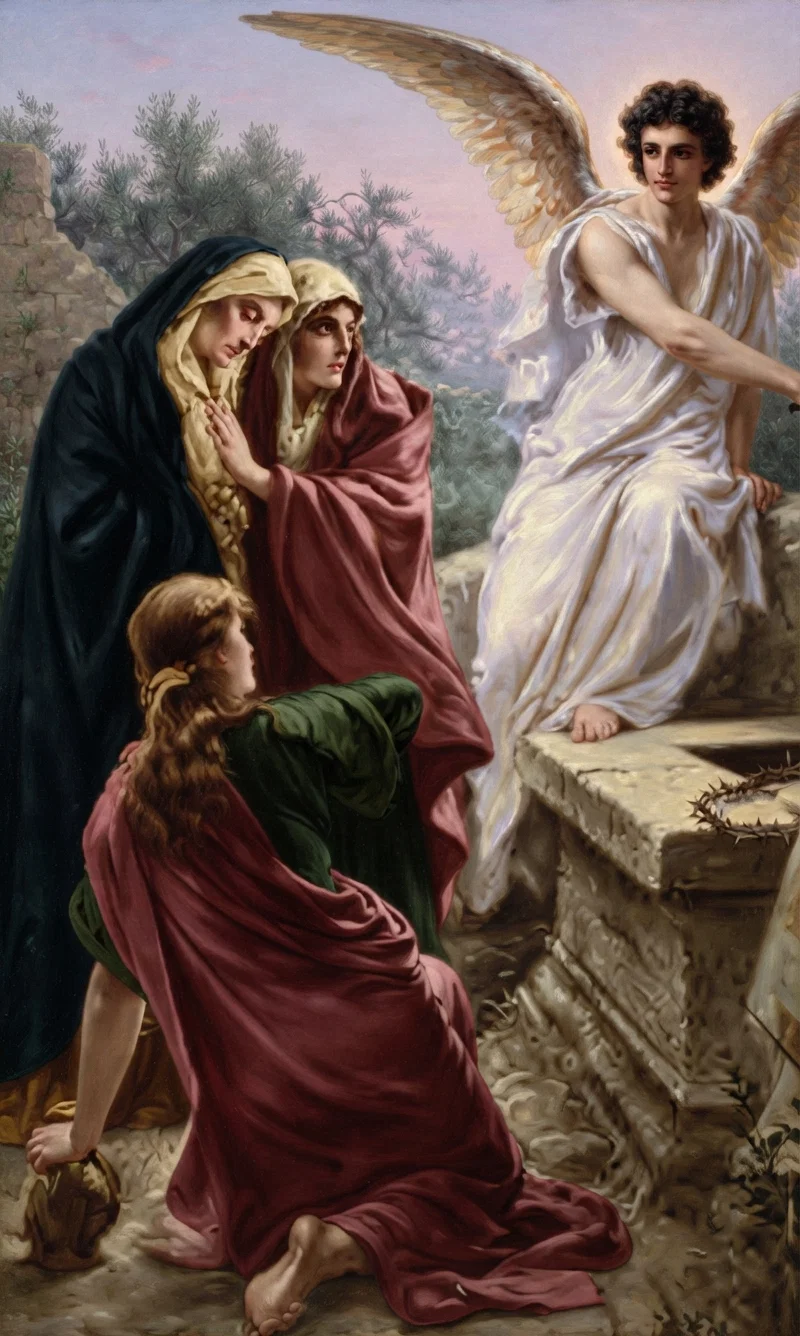
He is not here: for He is risen.
The true child of God will not put his trust in any forms of ritual service, but rather by faith accept the righteousness of Christ's life in place of his own. A remnant shall be saved. Christ comes as the deliverer of every one whose name is found written in His book of life. No soul that humbly trusts in the merits of that one perfect life, shall be left to perish. Christ will separate the wheat from the chaff in that day. Not a kernel will fall to the earth ungarnered.
"Then they that feared the Lord spake often one to another: and the Lord harkened, and heard it, and a book of remembrance was written before Him for them that feared the Lord, and that thought upon His name. And they shall be Mine, saith the Lord of hosts, in that day when I make up My jewels; and I will spare them, as a man spareth his own son that serveth him. Then shall ye return, and discern between the righteous and the wicked, between him that serveth God and him that serveth Him not." Mal. 3: 16-18.
Is your name in His book? Are you a commandment keeper? Are you in character like Jesus? To have these questions settled, and settled right, assures you an entrance into that kingdom which Christ is soon to receive of His Father.
Absolute Confidence in a Future Life
By Calvin P. Bollman
The Resurrection a Foundation-Stone — Time Not Measured in the Tomb
By CALVIN P. BOLLMAN
IN no other scripture in the word of God is the absolute confidence of the apostle Paul in a future life shown more clearly and forcibly than in 2 Cor. 5: 1-4. He says:
"We know that if our earthly house of this tabernacle were dissolved, we have a building of God, an house not made with hands, eternal in the heavens. For in this we groan, earnestly desiring to be clothed upon with our house which is from heaven: if so be that being clothed we shall not be found naked. For we that are in this tabernacle do groan, being burdened: not for that we would be unclothed, but clothed upon, that mortality might be swallowed up of life."
The apostle calls the fleshly or carnal nature "the old man" (Rom. 6: 6); while the new, spiritual nature, begotten by the renewing of the Holy Ghost, he calls "the new man" (Col. 3: 10). In a similar way, in the text quoted above, the apostle describes the present, mortal state as "our earthly house of this tabernacle"; while the future, immortal state he calls "a building of God, an house not made with hands, eternal in the heavens."
HOW WE HOLD ETERNAL LIFE NOW
By faith in Christ we have this eternal life, or "building of God," now. "He that believeth on the Son hath everlasting life." John 3: 36. To have by faith this "everlasting life," or this "building of God, an house not made with hands, eternal in the heavens," is to be "risen with Christ," as says the apostle: "If ye then be risen with Christ, seek those things which are above, where Christ sitteth on the right hand of God. Set your affections on things above, not on things on the earth. For ye are dead, and your life is hid with Christ in God. When Christ, who is our life, shall appear, then shall ye also appear with Him in glory." Col. 3: 1-4.
Here, then, is the "house from heaven" spoken of by the apostle in the scripture under review. The sinner is dead, his mortal life is forfeited; but what does it matter, if he be in Christ? For he then has by faith "an house not made with hands, eternal in the heavens," or, in other words, he has in Christ "everlasting life." This is the life which "is hid with Christ in God," and which will be given to the believer when Christ shall appear. It is with this life the believer is "clothed" at the coming of Christ, as the apostle puts it in one place. In 1 Cor. 15: 52-54 he uses the terms "changed," "put on," and "swallowed up," all referring to the same event, namely, the change from mortality to immortality, or from the "earthly house of this tabernacle" to the "building of God, an house not made with hands, eternal in the heavens."
The longing of which the apostle speaks is only natural. Yet nobody desires death for the sake of death itself. The apostle did not. He says: "We that are in this tabernacle do groan, being burdened: not for that we would be unclothed [that is, deprived of the mortal life which now envelopes or clothes us], but clothed upon [with immortality], that mortality might be swallowed up of [or clothed with immortal] life."
WAS WHOLLY IN THE RESURRECTION
To understand this scripture fully, we must look at the subject from the apostle's standpoint. His hope of a future life was wholly in the resurrection. "If there be no resurrection of the dead, . . . then they also which are fallen asleep in Christ are perished." 1 Cor. 15: 13-18.
Being familiar with the Jewish Scriptures, the apostle was well aware that "the dead know not anything" (Eccl. 9: 5); and that in the day of one's death, even "his thoughts perish." Ps. 146: 4. He knew, therefore, that however long might be the time to elapse between one's death and his resurrection, in effect it would be but a moment. Hence he did not ordinarily refer to the time that would elapse between death and the resurrection, but spoke of the two events as though closely connected in point of time.
WE PERISH IF NOT RESURRECTED
However, as already noted, in 1 Cor. 15: 12-18 we find the apostle basing all hope of a future life upon the resurrection, and recognizing unmistakably the truth that the dead are really dead, perished, in fact, if there be no resurrection. Again, in 1 Thess. 4: 13-18, the apostle states clearly that only by the coming of the Lord and the resurrection, or change to immortality, can anybody be with the Lord; and here he recognizes the lapse of time between death and the resurrection, but in this case he wrote from the standpoint of the living, and for the comfort of the living.
While to the living, time goes on, moments grow into minutes, minutes into hours, hours into days, days into years, and years into centuries, and living men note the flight of time, the dead know not anything, not even the passage of centuries. To-day a man lives. He is old. To-morrow he dies, and791his years cease to multiply. He comes up in the resurrection no older than when he died. With him, time ceased at the moment of death, to be resumed only at the moment of his awakening at the last trump.
DELUSIONS UNDERMINED
The Scriptural view of the condition of man in death cuts the ground from under a host of both ancient and modern delusions, among which are ancestral worship, the veneration of saints, baptism for the dead, prayers for the dead, purgatory, and spiritualism. But it gives in exchange for these delusive things, something a thousand times better in Him who declares: "I am He that liveth, and was dead; and, behold, I am alive forevermore, amen; and have the keys of hell and of death." "Because I live, ye shall live also." Rev. 1: 18; John 14: 19.