The Youth’s Instructor, Vol. L, No. 42

The One Thing Needful

The Youth’s Instructor

October 23, 1902

Review and Herald Publishing Company · Battle Creek, Michigan · October 23, 1902

The One Thing Needful

Not palaces nor acres broad, Nor serfs to tremble at his nod, Nor lordship over boundless sod, May win man favor with his God.
Not flocks and herds to dot the plain, Nor laden ships upon the main, Nor coffers filled with golden gain, For in his sight all these are vain.
Not ancient lineage, spotless fame, Nor beauty rare, of face or frame, Can win for man in heaven a name; For God regards all men the same.
Not days of labor, nights of prayer, Nor deeds of penance strange and rare, Nor tears, nor toil, nor anxious care,— All these with God no value bear.
But from the earliest time and place That man begins his earthly race, Until, at last, he sees Thy face, The one thing needful is thy grace!
ELIZABETH ROSSER.

The Lake of Geneva

Attracted by the pure air and grand scenery of Switzerland, multitudes flock here summer after summer, coming from far and near to admire this spot, which is favored with some of the best gifts of nature.
Truly there are few landscapes at once so charming and majestic as those of the shores of Lake Geneva. Its basin, fed by the Rhone, which flows in the east from the Alps, extends in a broad, fertile, semicircular valley, slightly marked by the Jorat Hills, and bounded, to the east and south, by the Swiss and Savoy Alps. The almost straight summits of the Jura chain separate the valleys in the west, and also divide Switzerland from France.
In the west, where the crystal-clear waves of the Rhone glide rapidly from Lake Geneva to Savoy, is the city of Geneva,—a lovely sight, as if blown down above the azure-blue waters of the Rhone, the brilliant rows of its new buildings reflected in the mirror of the wide lake, and picturesquely overreached by the black contours of the Dome and the old parts of the town.
“Like an army with crimson banners,
The forest in silence waits
For the faithful, bounteous autumn
To pass by the old year's gates; “Fair is her story,
Told in the glory
Of gorgeous coloring woven in bands,
And streamers hung by invisible hands.”
“Like an army with crimson banners, The forest in silence waits For the faithful, bounteous autumn To pass by the old year's gates; “Fair is her story, Told in the glory Of gorgeous coloring woven in bands, And streamers hung by invisible hands.”
Geneva appears in history as the seat of the Allobroges, thence the Roman name Aurelia Allobrogum. It first belonged to Burgundy, and was then a free imperial city. Oppressed by Savoy, the town still preserved its liberty and wealth, which increased through the Reformation; and after the fall of the first French empire, to which it belonged for a time, it entered the Swiss Confederacy as an allied member.
The fate of other places on the shores of this lake was less happy. After the dominion of Burgundy and feuds of the Middle Ages, the country came to Savoy, and later into the possession of Berne, which, however, kept only the northern shores of the lake, the canton of Vaud, which entered the Swiss Confederacy in 1803. The southern shores remained to Savoy, and with it were annexed to France in 1859.
Along the Lake of Geneva, French is spoken, and even with a certain elegance at Geneva.
The finest sights at Geneva are the Mont Blanc bridge and the splendid Quais du Mont Blanc, des Paquis, du Leinan, with the monument of the duke of Brunswick, and the Grand Quai with the Monument National. The streets of Mont Blanc, Corraterie, and Rhone are the principal business thoroughfares.
Five other bridges unite the main town on the left shore of the Rhone with the industrial quarter, St. Gervais, on the right. In the Rhone is an interesting island bearing the name of the essayist Rousseau, and at the bridge of the Bergues is a bronze statue of that author.
I was happy to have the privilege of attending services in Calvin’s Cathedral at this place; but the handful of persons gathered there for worship seemed sadly void of the life and energy with which their founder was so thoroughly afire three hundred and fifty years ago.
The charming shores of Lake Geneva are best seen and admired by steamer.
Behind the city of Geneva the two mountain elevations of the Saleve disappear,—a farewell greeting from Mont Blanc and its gigantic ice-clad satellites,—and one turns toward Versoix and Coppet, renowned through their association with the names of Necker and Madame de Staël.
Soon we get to the Vaudois shores: there are sunny hills, large, unbounded vineyards, everywhere gardens, and glittering villages. Here also is Nyon, the largest town between Geneva and Lausanne, with its castle and high terrace.
On the other side stands the promontory of Ivoire. The lake appears in full splendor in the east. Rolle and Morges, two little towns on the shore, as well as the picturesque Castle Wufflens, scarcely attract the attention; for the eye already perceives Lausanne, with its Episcopal Castle and the grand Gothic Cathedral. From the shore rises a high hill, upon which towers the town. Innumerable villas cover the sunny slopes, blooming with luxuriant vegetation. From the Dome-terrace is presented a most remarkable sight. Below lies Ouchy, the port of picturesque Lausanne; farther on are Vevey, Clarens, Montreux, and Territet; in the background are lovely hills, dotted with chalets and beautiful villas; and suddenly appears from the blue waters before us the far-famed Castle of Chillon, where Bonnivard was imprisoned six years, its towers and white walls reflected in the glittering water. Then comes Villeneuve at the entrance of the beautiful Valley of the Rhone. On the left shore rise the rocks la Meillerie overreached by the Dent d’Oche, and lastly the village of St. Gingolf. Deeper in the Rhone Valley, and always toward the east, are Aigle and Bex.
The coast of Savoy extends in wild, picturesque rocks. Back from the coast are the largest chestnut forests in Europe, and many ruined castles tell of past splendors. Near Evian, the lovely bathing-place, cultivation begins again, and the population becomes more dense.
MRS. B. G. WILKINSON.

“Look Up”

SEVERAL years ago, while journeying from Christiania, Norway, to Göteborg, Sweden, I was favored with a sight of the most glorious sunset it was ever my privilege to behold. Language is inadequate to picture its beauty. The last beams of the setting sun, silver and gold, purple, amber, and crimson, shed their glories athwart the sky, growing brighter and brighter, rising higher and higher in the heavens, until it seemed that the gates of the city of God had been left ajar, and gleams of the inner glory were flashing through. For two hours the wondrous splendor continued to light up the cold northern sky,—a picture painted by the great Master Artist upon the shifting canvas of the heavens. Like the smile of God it seemed, above all earthly homes, above the rock-bound plains, the rugged mountains, the lonely forests, through which our journey lay.
Angels of mercy seemed whispering: “Look up! This glory is but a gleam of the light which flows from the throne of God. Live not for earth alone. Look up, and behold by faith the mansions of the heavenly home.” This scene was to me as the bow of promise to Noah, enabling me to grasp the assurance of God’s unfailing care, and to look forward to the haven of rest awaiting the faithful worker. Ever since that time I have felt that God granted us this token of his love for our encouragement. Never while memory lingers, can I forget that vision of beauty, and the comfort and peace it brought.
As God’s children, it is our privilege ever to look up, keeping the eye of faith fixed on Christ. As we constantly keep him in view, the sunshine of his presence floods the chambers of the mind. The light of Christ in the soul-temple brings peace. The soul is stayed on God. All perplexities and anxieties are committed to Jesus. As we continue to behold him, his image becomes engraved on the heart, and is revealed in the daily life.
But if, after conversion, we allow worldliness to creep into the heart, if we cherish it as a welcome guest, there is an entire change. The view of Jesus is eclipsed. The vision of his purity, his goodness, his matchless love, is dimmed. Peace is gone. No longer is the soul committed to him in simple, perfect trust. The whole Christian life seems uncertain.
My dear young friends, ever keep Christ in view. Thus only can you keep the eye single to God’s glory. Jesus is your light and life and peace and assurance forever. By beholding him you are changed from glory to glory—from character to character.
“If therefore thine eye be single, thy whole body shall be full of light. But if thine eye be evil, thy whole body shall be full of darkness. ” “Take heed therefore that the light which is in thee be not darkness. If thy whole body therefore be full of light, having no part dark, the whole shall be full of light, as when the bright shining of a candle doth give thee light.” In Him is no darkness at all.
When the soul is illumined by God’s Spirit, the whole character is elevated, the mental conceptions are enlarged, and the affections, no longer centered upon self, shine forth in good works to others, attracting them to the beauty and brightness of Christ’s glory.
MRS. E. G. WHITE.

The Goodness of the Lord

DAVID exclaims, “Oh how great is thy goodness, which thou hast laid up for them that fear thee; which thou hast wrought for them that trust in thee before the sons of men!” It is worth while, then, to fear the Lord in a way that will not permit us to do any wrong thing; to reverence him and his word with such filial love that we shall keep his commands. It is worth while to trust in the Lord “before the sons of men;” to be calm when others are perturbed; to be confident in danger; and hopeful in drought, in flood, or in tempest.
His goodness has wrought out something for such, and has laid it up. They are to be hidden in the secret of his presence from the pride of man; to be “kept secretly in a pavilion from the strife of tongues.”
“Whosoever therefore shall confess me before men,” says Jesus, “him will I confess also before my Father which is in heaven.” We make confession of him not only by our lips, but by the whole tenure of our lives. We may go regularly to church, and pray, and speak in meeting, and be faithful in giving and in all lines of church work, and yet not “confess Christ” as he desires us to confess him, nor “trust in the Lord before the sons of men” as he wishes to be trusted. The doctrines of Christ must affect our lives in a way that will testify to his power over us; this is true confession, and the only confession that will give weight to our words, our gifts, and our prayers, and win others to Christ.
“Trust in the Lord and do good, . . . and verily thou shalt be fed,” is another text with the same thought. Do good, even when you can not see the way. “The Lord will provide.” “The salvation of the righteous is of the Lord: he is their strength in time of trouble. And the Lord shall help them, and deliver them: he shall deliver them from the wicked and save them, because they trust in him.”
The crown, the honor, the glory, the inheritance, the life, has the goodness of the Lord laid up for the upright. S. ROXANA WINCE.

His Work

“My meat is to do the will of him that sent me, and to finish his work,” said Jesus. To finish his work, not my work. Some of us love to work. It is meat and drink to us. Not infrequently we hear of people who neglect their food, who eat too hastily, or who eat less than the health of the body demands, in their eagerness to accomplish some task on which their heart is set. Much of our work is really important; but what about His work? Can we have a part in his work? Is it still unfinished? Can we finish his work?
Christ said, “It is finished,” as he died on the cross. In one sense God’s work is ended; but there is a sense in which much yet remains to be done. Not till his kingdom shall come, and his will be done on earth as it is in heaven, will there cease to be work to do for him.
Let us not become so absorbed in our own work as to forget his, which is of infinitely greater importance; but let us remember that it is our privilege also to say, “My meat is to do the will of him that sent me, and to finish his work.”
MARY M. CURRIER.

The Lesson

God set a book within mine hand one day, And bade me read the lesson written plain: But wearily I turned my eyes away. “Ah, Lord,” I said, “what need to trace again The old, old lines of pain?”
“Yet read,” I heard him answer, very low, “Though all thy days were filled with pain’s increase.” I looked, I marveled on the page to know, Writ out in lines of gold my soul’s release. “Thy lesson, Lord, is peace.”
“Yet read,” once more I heard the Master call, When all the world was dim at day’s remove. I saw a light along the pages fall; I lifted up my eyes and looked above. “Lord, in thy face unveiled I read it all; My life’s deep lesson—Love.”
—Selected.

The Difference the Tide Made

I HAD an experience the other day under a bridge. It was a bridge over a tidal river running into—and out of—Buzzard’s Bay. A few hours before, my boat had shot under the bridge with the speed of an arrow, borne on the rush of the incoming tide. No oars were necessary to keep the boat in the middle of the current, and away from the rocks. But as I went to return, twelve hours later, things had changed.
The river had changed. It was an incoming tide once more. And my relation to the river had changed. Then I was with it, now I was against it.
And dear me, what a tug it was! Bend to the oars, pull frantically for ten minutes, and lo, I was opposite precisely the same boulder on the shore as when I began! Turn to the quiet waters along the bank, and row up to the bridge, then dart into those rushing waters, and—pff!—they catch the boat, and whirl it around like a cork, and send it back where it came from. The incoming tide was swift as any mill-race, and the usually silent river was noisy in its turbulence.
After many vain attempts, we took the long anchor rope—my friend and I—and tied it to the further end of the bridge, floated the loose end through, tied the boat to it, and by dint of much pulling and boot-soaking and arm-straining, got the skiff ingloriously through, and made our difficult way up the still hostile river on the other side, and so out into the bay.
But I had earned a lesson—bought it with an aching back and blistered hands.
There is a tide in all the affairs of men. It is the great current of God’s will. It does not rise and fall like the ocean’s tides. It sets always in the same direction, and it moves with steady force.
It flows, I say, through everything. The ancient Greeks had a philosophy whose central maxim was, “All things are flux;” that is, there is in all the universe no such thing as rest. Everything is in constant motion. Modern science has come to the proof of this old philosophy. It shows that there is no stone, however solid it appears, but its particles (could some powerful microscope disclose them) are whirling in wonderful orbits in and out among themselves, with chasms between like the interstellar spaces. The massive globe to its ultimate atom is in continual movement.
And it is precisely thus, as I have said, with the higher universe of mind. Through it all flow the tidal currents of God’s providence. We may move with it, and our boats glide along without our effort. We lay our hands to the oars, and every stroke tells grandly. We are in perfect control of the boat, and can turn it with a touch. O, it is glorious, rowing with the tide!
But once in a while—foolishly enough, for no worthy goal lies that way—we turn against the tide. At once our swift speed changes to a snail’s pace. At once our easy control of the boat has become a difficult one. At once the way grows hard and fierce and desperate. By this device and that, we manage to get along, but ingloriously enough. O, but it is hard work, rowing against the tide!
And I won’t try to do it—in my spiritual life— any more,—Amos R. Wells.

Gratefully Rejoicing

ROBERT MOFFAT, the great missionary to Africa, told the following touching story, which shows how God’s word is prized by the native converts:—
“Not long ago a woman came to me, having traveled fifteen miles, and said that she wished a New Testament. I said to her, ‘My good woman, there is not a copy of it to be had.’
“‘What! Must I return empty?’
“‘I fear that you must.’
“‘O,’ said she, ‘I borrowed a copy once, but the owner came and took it away, and now I sit with my family sorrowful, because we have no Book to talk to us! Now we are far from any one else. We are living at a cattle outpost, and we have no one to teach us but the Book. O, go and try to find a Book! O my elder brother! do go and try to find a Book for me! Surely there is one to be found; do not let me go back empty!’
“I felt deeply for her, for she spoke so earnestly, and I said, ‘Wait a little, and I will see what I can do.’
“I searched here and there, and at last found a copy, and brought it to the good woman.
“Oh, if only you could have seen how her eyes brightened, how she clasped my hands, and kissed them over and over again!
“Away she went with the Book, rejoicing, with a heart overflowing with gratitude.”

Can You?

“Do you think you could be pleasant—not speak a cross word, or grumble, or pout for a whole month, if you could earn something very nice by it?” That was asked many years ago of a little girl who lived in the great backwoods of Ohio. “Some things nice” were not found everywhere then as they are now, and “something nice” to that little girl of fifteen meant the ambition of years—an organ.
Her eyes grew big and round at her uncle’s words, and she blushed at the remembrance of past failings as she answered, “I don’t know, sir; but I would try hard.” And try she did. Poor, little, sensitive, quick-tempered child—how could she succeed? One mistake would mean the loss of her organ. You may think it strange; but that organ stood up in her mind so strong, so dear, that it was stronger than temper and everything else, and she won!
We never know what we can do till some great cause calls us to strong endeavor. True, some natures respond only to prizes and pay, but other nobler and grander natures there are that find their highest incentive, to good in love. Such are they who pass through this world as Christ did, inspired by steadfast love, which overcomes every trial and hardship and temptation, and can say, even to death, “Stand aside.” Blessed are they who draw their inspiration from nothing less. Their word through all the ages has been, “I can,” and their lives are glorious witnesses of its power. EDISON DRIVER.

A Glimpse of a Great Chautauqua Assembly

THE Chautauqua summer assembly idea endeavors to combine religious instruction, educational advantages, and wholesome entertainment. There are many persons so situated that they can not take a summer outing, but who are glad to improve the opportunity of camping out a few days on some beautiful assembly grounds.
The management of these summer assemblies arrange, months beforehand, an elaborate program, which ordinarily includes a number of noted speakers, whose ability has earned for them a world-wide reputation. In addition to the great lectures, entertainments, concerts, and stereopticon exhibitions that are daily given in the large auditorium, there are also held a large number of classes, and various demonstrations, such as schools of art, agriculture, astronomy, fancy-work, cooking, and health culture.
These occasions furnish ideal opportunities to impart instruction in reference to hygienic cookery, healthful dress, physical culture, the rational care of the sick, and how to preserve the body in health. For a number of years some of our trained workers have had a place upon the programs of a number of the leading Chautauqua assemblies, and their instruction has been received with deep interest and great enthusiasm.
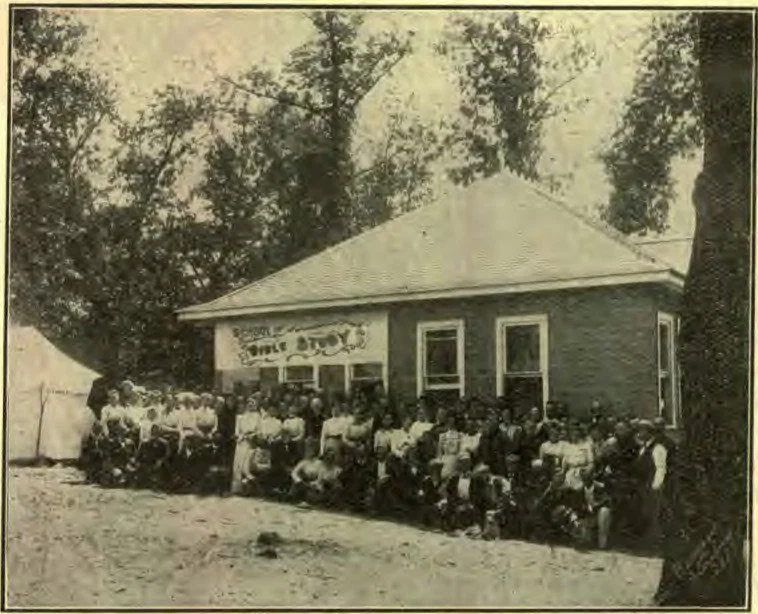
The Old Salem Chautauqua, near Petersburg, Illinois, ranges second in size and importance to the original New York Chautauqua. This year there were about four thousand people encamped on these grounds, which are of interest to every American citizen from the fact that for a number of years Abraham Lincoln made this his home, and here surmounted many of the obstacles with which he had to contend in his youth.
On the day that Ellen Stone, the ex-captive missionary heroine, spoke, there were eight thousand five hundred people in attendance. It seems almost impossible to conceive how a woman, after having wrestled with all the difficulties incident to twenty years of most trying missionary experience, could live through six months of such exposure and dangers as she was compelled to undergo while in the hands of her semi-savage captors.
The amount of Turkish gold that was required to ransom her was equal to a third more than her own weight; and none who heard her will ever forget the impression made by her words when she said that every man, woman, and child present had been bought by a still greater price, even the life of Christ.
Miss Stone, although now a middle-aged woman, and after having passed through this terrible experience, expects soon to return to her old missionary post.
Sometimes we foolishly imagine that we have sacrificed for the cause of the Master, and shown some real devotion for humanity; but how all that we may have done sinks into insignificance when compared with such an experience.
DAVID PAULSON, M. D.

In the Laboratory

“THIS is a very great treasure,” said the chemist, taking from his collection of minerals a tiny stone, which he placed on a bit of pale-yellow velvet. The stone was highly brilliant, and of an exquisite, clear, deep-blue color.
“It is a sapphire, is it not?” I asked.
“Yes,” answered the chemist; “and, though it is very small, it is a choice specimen.”
When I looked closer, seeking the cause of the gem’s value, I saw, glimmering within it, a tiny, symmetrical star, with slender, threadlike rays, like something imprisoned in the crystal and yet really a part of it.
THE BIBLE CLASS AT THE OLD SALEM CHAUTAUQUA
I said something of this to the chemist, and he answered, gazing affectionately at the intense blue gem: “Yes, it is as you say, something imprisoned in the crystal and yet a part of its very substance. Long ago, when the stone was a-making from the yet liquid material, a particle of foreign substance dropped into the clear matter; the intruder could not be removed, and the noble sapphire essence straightway gathered it to itself, and crystallized about it in a perfect form, making of the threatened blemish its choicest beauty. “That’s the way star sapphires are made; and,” added the chemist, with a look in his face as if he were seeing and rejoicing over something strangely beautiful, “there are souls who take a pain or sorrow which comes to them, and grow about it, until they are infinitely more beautiful than they would ever have been without it. God knew they could do this great, noble thing, when he let the sorrow come, and I believe he rejoices especially in his star-sapphire souls.”—S. Alice Ranlett, in Well Spring.

Climbing the Hill

HAPPY-GO-LUCKY and Faint-of-Heart Set off on a journey with Only-Try; Each was ready to do his part, While the sunny hours went merrily by; But when the shadows were growing long, And the crickets chirping their even-song, Up rose, like a barrier steep and strong, A rocky hillside nigh.
Said Happy-go-Lucky, “Suppose we wait, And somebody passing may give us a ride!” “We shall break our necks if we climb so late!” Poor Faint-of-Heart in a panic cried. But Only-Try, with a resolute eye, Looked up at the hill and the sunset sky. “There is plenty of time,” said Only-Try, “And the moon is full, beside.”
So Only-Try, without stay or stop, Went clambering up over rock and root, Till he stood at last on the hill’s green top, In a beautiful clearing, with flowers and fruit. But the other two are waiting still, For nobody lives, or ever will, That can reach the top of the smallest hill By sitting down at the foot!
— Blanche T. Heath.

— Mabel Earle

To-day

THOU wilt not call me forth this day To seal my faith by sword or flame; Yet keep me, help me, Lord, I pray That in my lot, and as I may, I glorify thy name.
No place is mine with those who stand In open war to wage thy strife; But set thy sword within my hand, To smite and overthrow the band Of sins that thwart my life.
No mighty works thou hast for me, No glorious deeds to gain me praise; But, humble in fidelity, Lord, let me walk and work with thee, This day and all my days.

— Mabel Earle

Battles Between Truth and Falsehood

STUDY PREPARED FOR THE YOUNG PEOPLE'S MEETINGS
Lesson XXV—The Proud Little Horn
(October 26 to November 1)
HOW TO STUDY THESE LESSONS.—(1) Read the lesson story; (2) try to recall or find scriptures in proof of each statement; (3) study the texts; (4) see how many missing links you can supply; (5) give the lesson to some one else. You will keep only what you give away.
The four beasts that came up from the sea waves represented the great world-powers that ruled from Daniel's time to the end. The lion was Babylon; the bear, Medo-Persia; Grecia was seen in the leopard; and the dreadful fourth beast symbolized the mighty power of Rome.
Rome's division into ten parts was seen in the ten horns. These ten divisions were developed during the fourth and fifth centuries, and were known as the Goths, Vandals, Franks, Heruli, Anglo-Saxons, etc.
The next important symbol in this chapter is the little horn. This was the papacy, or Roman Catholic Church. Seven proofs are given by which we can clearly identify this power:—
1. It was to come up among the ten, after they were developed. The papacy was not established till 538 A. D.
2. It would be a different power from the ten. The papacy was a religious power, while the ten were political.
3. It would pluck up three of the original ten. The papacy was not fully set up until the three that opposed were rooted out; namely, the Heruli, Vandals, and Ostrogoths.
4. He would speak great words against the Most High. The papacy has spoken great (proud) words against (in opposition to) the Most High, in claiming the titles, attributes, and worship of the Most High.
5. He would wear out the saints of the Most High. The blood of millions of martyrs testifies that this specification has been fully carried out.
6. He would think to change times and laws. The papacy has thought himself able to change the times and laws of God. As proof of this, he claims to have changed the Sabbath commandment.
7. The times, laws, and people of the Most High were to be in his power for a definite time,—“a time and times and the dividing of time.” This same time is used in Rev. 12:14. It is also said to be 1260 days. Verse 6. In prophecy a day represents a year. See Eze. 4:6. So the little horn must have power for 1260 years. The papacy was fully established in 538 A. D. The pope was made a prisoner, and his power taken away, in 1798, thus making the period of papal supremacy exactly 1260 years.
All this long prophecy has become history, except the very last. The judgment is closing. The beast will soon be given to the burning flame. Then the saints will take the kingdom.
All those who will “take the kingdom” then, must now “take it by force.” Matt. 11:12.

Three Measures

Of all things far, I love the best The distance from the east to west; For by that space, and all within, God’s mercy parts me from my sin.
And best I love, of all things high, The space between the earth and sky; For by that height beyond all ken God’s love exceeds the love of men.
I love, of deep things undefiled, A father’s pity for his child; For by that depth, so far, so clear, God pities all that faint and fear.
O Father! Father! endless kind, I thank thee for my human mind, But chief of all my praise shall be That mind can not encompass thee! —Amos R. Wells.

Responding to God's Call

THE Young People's movement is a growing factor in our work. Its influence is already felt in the field. The development has not been so much by any molding influence working from without as by the growth of an idea from within.
We are not rallying around any phrase, or pressing on in this movement because it is the customary thing nowadays to have young people's societies. Implanted within the hearts of the youth of this denomination by the Holy Spirit is the deepening conviction that there is a definite work for the young people to do in ushering in the glorious coming of our Lord. The movement truly is of God at this time, and to meet the call of the hour.
The same word comes from all the camp-meetings, so far as I have heard. The young people are lining up for service. As companies of our youth have, by a common inspiration, risen to pledge their lives to carrying this message to the world, parents have thanked God, even amid tears, and have pledged themselves to send them forth with hearty Godspeed. Divine grace has seemed to be calling especially for the wandering feet and the backslidden among those who have been brought up within the sound of this truth; for now there is no more time to be lost if we are to have a part in preparing the way of the Lord.
And now for service! It is to be no sentimental crusade and a waving of banners. Sensible, straightforward work is to be the watchword. If there has been in any sense a summer holiday in the young people's work, let us now press on with it more enthusiastically than ever.
Soul-winners we must ever be. Keep the love of Jesus so in the heart that it will be natural to talk of it to sinners who do not know the Lord. Even our own sense of this love grows by telling of it.
Everywhere there is work, just such as we would do if in the lands abroad; and we learn by doing. Then, too, we must keep in touch with the needs of the fields by watching the reports from our workers, and the study of the literature of missions. Thus the young people can help to keep the flame of missionary interest burning brightly in the church. The work thus done may have a very appreciable effect upon the weekly offerings for missions, and upon the special annual offering just before us.
We have on hand a glorious work. Let us be “all at it, and always at it,” as John Wesley said of the early Christians of the book of Acts.
W. A. SPICER.

Young People's Work at College Place

SINCE our last report the Young People's Society at College Place has been doing nicely. Our regular meetings each week have been well attended, and a good interest is manifested in the work.
The last meeting of the school term, in May, was one of special interest. Instead of the regular study that is usually conducted, a short Scripture lesson was read, and a few remarks were made by the leader on what has been accomplished in our young people's work, and the opportunities that still lie before us. Every one seemed to realize that this was the last meeting of the kind that many of us might have the privilege of enjoying together, and a feeling of deep solemnity pervaded the service. Most of the many testimonies that were borne were reiterating the work and blessings of the past, and laying plans for broader work in the future. While we do not see accomplished in the last two years what we wish might have been done, yet there are some who have worked untiringly in their efforts for souls, and results have been obtained that will tell in the kingdom of God. Many who may never again attend our school, and take part in the work here, will yet remember the blessings that they have received, and rejoice in the strength that has been gained to lead others to the truth.
The work for the young people at the spring camp-meeting seemed a little slow in starting at first; but before very long this branch was one of the best features of the meeting; and many will testify to experiences there gained that were not heretofore known.
Since school closed at the college, our attendance has been necessarily smaller, numbering now only about thirty or thirty-five, but we are glad for the presence of the Lord with us each week as we gather for Bible study, and to talk of the goodness of God, and pray for those who are more actively engaged in the work. Encouraging reports are received from some who have gone away to labor in the cause in other places.
We are glad to see so many of our young people taking hold of the “Object Lessons” work, which is now being carried on by the church here. Our desire is to be faithful in the small part that is ours to perform now, that we may be prepared for greater usefulness in the future.
CLAUDE CONARD.

Items from the Field

THE Young People's Society at College Place, Washington, has one hundred and four members, and reports a good interest.
AT Spokane the Young People's Society has raised fourteen dollars and thirty-five cents, which has been used in the local work. Meetings are held weekly. Membership, twenty-five.
A SOCIETY of eighteen members has been organized for about three months at Mt. Vernon, Indiana. Weekly meetings are held, and the INSTRUCTOR lessons studied. There is quite an outside attendance, and all take an interest in the Bible studies.
THE eleven members of the Boise City, Idaho, Society are actively at work. Their work includes distributing of the Signs, filling reading-racks at the railway station and State House, and the placing of The Life Boat in the jail and penitentiary.
THE Secretary of the Society at Antigo, Wisconsin, reports a membership of nineteen. Bible readings are held weekly. The Society has circulated a number of papers, and has raised two dollars and ten cents for Christian Help purposes. At one meeting, eight made a new start in serving the Lord.
THE Wichita, Kansas, Society has twenty-seven members. Five new ones have been added during the last quarter. Weekly meetings are held, and the regular Bible studies used. The following work is reported: Papers given away, six hundred seventeen; pages of tracts distributed, two hundred forty; papers sold, thirty-eight; two missionary visits made; one missionary letter written; one Bible reading held.

Read the Call on the Last Page

READ the call on the last page of this issue.
Continue reading: Giants and Grasshoppers