“What is the matter?” asked Mrs. Hamlin. “What is hindering the work?” Mr. Hamlin glanced up from his paper.
“The work?” he said. “O, the old story; there are ‘giants’ in the land, and the committee feel like ‘grasshoppers.’”
It was Earle’s turn to look up. Earle was reading, but he generally had one ear for any conversation that was going on about him. His eyes went back to his book, but he kept wondering just what his father meant. Of course there were no giants in these days! He waited until his father was turning the paper to another page, then put in his question.
“Father, what do you mean about ‘giants’ and ‘grasshoppers’?”
Mr. Hamlin laughed. “Your ears heard that, did they? Why, I meant what the ten spies did when they whined about giants, and called themselves ‘grasshoppers,’ instead of seizing their chance as the other two wanted them to do. Don’t you remember the story? I’m afraid you are not as well up on Old Testament history as you are in your school history. The Report of the Spies makes very interesting reading; you would better look it up.”
“I remember about it now,” said Earle, “and I can guess what you mean about the committee. There are lots of such giants around nowadays, aren’t there?”
“Plenty of them!” said his father. “Look out that none of them scare you away from an opportunity.”
Earle laughed, and went back to his story. He knew he was the sort of boy of whom the other boys said that he didn’t “scare worth a cent!”
It was nearly twenty-four hours afterward that he was in the dining-room, which was his evening study, bent over his slate, his pencil moving rapidly. His friend and classmate, Howard Eastman, sat on the arm of the large rocker, tearing bits from a newspaper wrapper and chewing them, while he waited for Earle.
“I do wish you would come on!” he said, between the bites of paper. “The boys will be waiting for us; I told them I’d bring you right along, and the fun will all be over before we get there.”
“Bother!” said Earle, consulting his book; “that isn’t anywhere near right.”
“Of course it isn’t. I knew it wouldn’t be. There isn’t a fellow in the class, nor a girl, either, for that matter, who has got that example. Why, I know, because I heard them talking about that very one; and haven’t I done that seventy-five times myself? My brother Dick tried to do it for me, and he didn’t get it, either; he said there was some catch about it.”
“I’d like to find the catch,” said Earle, wistfully.
“Well, you can’t. I tell you there isn’t one of them who can. You needn’t think you’re smarter than anybody else. We won’t get marked on that example; they don’t expect us to have it. I heard Professor Bowen tell Miss Andrews that there wouldn’t be a pupil in the room who could conquer it.”
“Is that so?” said Earle, running his fingers through his hair, and looking wearily at the long rows of figures on his slate.
“I haven’t got it, that’s certain; and I’ve tried it in every way I can think of. I don’t know as there is any use in my going over it again.”
“Of course there isn’t! It is just one of those mean old catch problems that nobody is expected to get. So just put up your tools, and come on. I know the boys are out of all patience with us for being so late.”
It happened that Cousin Carol was in the library, which opened from the dining-room. Cousin Carol was seventeen, and her thirteen-year-old cousin Earle admired her extremely. He had known her but three weeks, and already they were the best of friends; he valued her good opinion next to his father’s and mother’s. At that moment her face appeared in the doorway, and she said, in the sweetest and gentlest of tones,—
“And there we saw the giants.”
Howard Eastman made haste to take the wads of paper out of his mouth, and to get off of the arm of the chair; but Miss Carol’s face vanished, and they heard her open the hall door and pass out. Earle’s face, meantime, had reddened to his hair.
“What did she say?” inquired Howard, his eyes big with wonder.
“O, never mind what she said. She was talking to me. Look here, Howard Eastman, you may as well cut down to Timmy’s, and tell them I can’t come; they needn’t wait for me any longer. There’s no use in talking; I’m going to conquer that example if I have to sit up all night to do it. I’m no grasshopper, and it has got to be done!”
“O say now! I think that’s mean!” growled Howard. “There won’t be half as much fun without you; and besides—why, you almost got started. You began to put up your books.”
“I know I did; but I’m not starting now, and there’s no hope of me. Skip along, and tell the boys I’m sorry, but it isn’t my fault; it is this old giant of a problem that is trying to beat me; and he can’t. I don’t feel a bit like a grasshopper.”
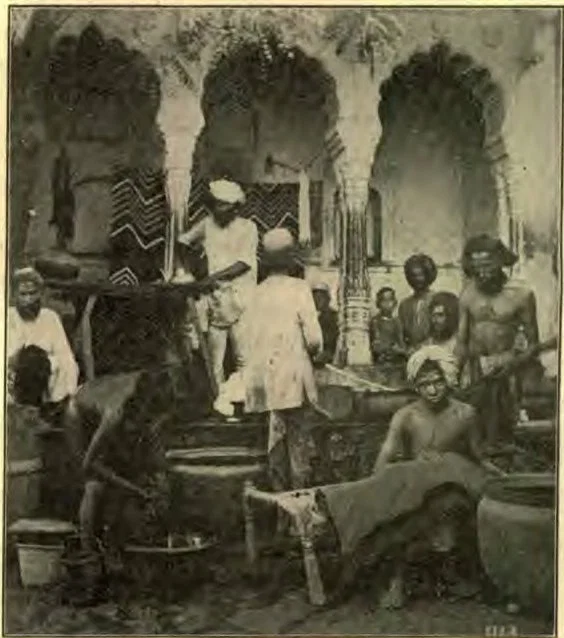
MOHAMMEDAN DYERS AT WORK
“Say,” said Howard, “what have giants got to do with that example? She said something about them.”
“They haven’t got a thing to do with it,” said Earle, with energy, “and I’ll prove that they haven’t. Now you skip, Howard, that’s a good fellow; and let me alone. I’ve got a battle to fight.”
Howard groaned, and growled, and “skipped.” Next morning, just as the hour for recitation arrived, and the arithmetic class were filing in, company was announced.
“Just our luck!” muttered Howard Eastman. “Any other morning this term I should have been ready for them. Did you know they were coming, Earle?”
No, Earle didn’t. He looked in surprise. There were his father and Cousin Carol, not only, but a stranger, a fine-looking man who, it was presently telegraphed through the class, was Judge Dennison, of Buffalo, who used to attend this school when he was a boy. And then, behold, came Principal Bowen, who stood talking with his guests a moment, after which they all took seats and stayed through the entire hour.
Work went on well until that fatal thirty-ninth example was reached, and Howard Eastman was called upon to go to the board and perform it.
“I can’t do it, Miss Andrews,” he said, “I tried it as many as fifty times, I think, in fifty different ways, and I couldn’t get near the answer.”
“That is very sad!” said Miss Andrews, trying not to laugh; “if you had not tried so many ways, but worked faithfully at one, you might have done better.” However, she called on the boy next to him, with no better success. A long row of downcast eyes and blushing faces. Some of the pupils confessed that they had not even334attempted the problem, but had been discouraged by the reports of the others. “Is there no one who is willing to go to the board,” said Miss Andrews, “and attempt the work, carrying it as far as he can?”
At just that moment she caught sight of Earle Hamlin’s face, and spoke to him.
“Will you try it, Earle?” And Earle went. Silence in the classroom. All eyes on the blackboard and the quick fingers of one boy handling the crayon. How fast he worked! Had he multiplied right?—No! Yes! that was right. O, but he had blundered in subtracting! No, he hadn’t! every figure was right. Ah! now he had reached the place where none of them knew what to do next! But he knew! Without pause or confusion he moved on, through, to the very last figure, which he made with a flourish. Moreover, he knew how to explain his work; just what he did, and why he did it. As he turned to take his seat, the admiring class, whose honor he had saved, broke into applause, which the smiling teacher did not attempt to check.
“I think we owe Earle a vote of thanks,” she said. “I will confess my surprise as well as pleasure in his work; I did not expect any of you to succeed. In truth, I gave you the example rather as a trial of patience than in the hope that you could conquer it. You remember, however, that I gave you permission to secure help if you utterly failed. Will you tell us, Earle, if you had any help?”
“Yes’m,” said Earle. “My Cousin Carol helped me.”
And then Cousin Carol’s astonishment suddenly broke into laughter.
“I haven’t the least idea what he means!” she said, in her clear, silvery voice. “I was so far from helping him that I tried all by myself to do the example, and failed!”
The class began to cheer again, but hushed suddenly to hear what Earle was saying.
“All the same she helped me,” he said, sturdily. Then, seeing that he must explain, he added, hurriedly: “We had been talking about the giants, you know, and the grasshoppers, just the night before; and I thought so myself then that I wasn’t a grasshopper, anyhow, but I never thought about the example being a giant; and I was just going to quit it when Cousin Carol came to the door and spoke about the giants, and then I went at it again.”
Some of the pupils looked hopelessly puzzled. Mr. Hamlin’s face was one broad smile. “Students of Old Testament history have the advantage here to-day, I fancy,” he said.
“Earle,” said Miss Andrews, “are you willing to tell us how long you worked on the example?”
“I began it at six o’clock,” said Earle, “and I got it just as the clock struck eleven.”
There was no use in trying to keep that class from cheering! They felt that their defeat had been forgotten in Earle’s victory.
Mr. Hamlin and Judge Dennison stood talking together after the class was dismissed.
“Do you know I like best of all that word of his about his cousin’s helping him?” said Judge Dennison. “It was plucky in the boy to keep working, and it took brains to study out that puzzle; but that little touch which showed that he wasn’t going to accept the least scrap of honor that did not belong to him was what caught me. You have reason to be proud of your son, Mr. Hamlin.”—Pansy.
Three Gates
By Elizabeth Rosser
Two little gates have you and I,
Curly, pinky, and queer,
Standing open the livelong day
That we may be swift to hear.
One little gate have you and I,
Lying ’twixt cheek and cheek,
With coral doors, and bars of pearl,
That we may be slow to speak.
ELIZABETH ROSSER.
“As Scarlet”
By W. A. Spicer
THE Orient is the land of bright colors. Among old-time ways and customs preserved in the East, the primitive love of gay-colored clothing has been brought down from the days when the world was young. You will remember how fondly Sisera’s mother anticipated her share in the spoils of war, in the days of the Judges, in her imagination feasting her eyes upon the “prey of divers colors, a prey of divers colors of needlework, of divers colors of needlework on both sides.”
The style of dress lends itself to the taste for combinations of color. On a holiday, particularly, the crowded street or bazaar is often a brilliant scene of shifting hues.
The dyer plays a large part in the coloring of the “gorgeous East.” His outfit is a very primitive one. There is a profusion of earthenware vats and tubs, and metal vessels for boiling the liquid dyes. He needs no very extensive quarters, and his little shop may overflow onto the pavement. All this helps the stranger who wishes to see how the work is done. The workman evidently takes pride in bringing out the bright-hued fabrics, in all the colors of the rainbow.
Of all the dyes the scarlet is the most enduring. No art that is known, so far as I have heard, can bleach out this color when once it has been steeped into every fiber of the cloth. It is the symbol of sin, wrought into the life, which no human effort can remove. But thanks be to the dear Lord for the promise that though our sin be as scarlet, it shall be made as white as snow. It is this story of love and power that we must tell to the people of the East. In spite of the bright apparel and the momentary gaiety, their lives are dark and clouded.
W. A. SPICER.
First Lessons in Geography
By Floyd Bralliar
Lesson III
As there was no rain, there was not a great amount of water to be carried off, yet in order to preserve the circulation of water, Rivers were made. These were to carry water, both for beauty and better to distribute the moisture. The dew that formed, and the water that in places flowed in springs from the ground, flowed into little Brooks that danced in the light and sparkled like crystal. These collected into Creeks, and these again into rivers that flowed into the sea. This water was, in turn, carried up into the air, and floated to all parts of the earth, where it fell as dew every night. Things were so perfectly balanced that rains never fell. As the streams flowed through the land, they were to be fountains of life to the soil.
In one place there was a beautiful river, formed of four rivers, whose waters bathed the sands that were mixed with pure gold. Other precious stones were among its pebbles. The other rivers were all beautiful, but this was the most beautiful of all.
When all was ready, God caused the earth to bring forth all manner of trees and plants. These grew all over the earth, but the best of each variety was planted by the side of this river that was formed of four rivers. Here grew beautiful grass of all kinds, of richest green, and as it reflected the light, it gave a color as of gold. Beautiful mosses carpeted the banks, and flowers grew in profusion everywhere. Ferns grew as large as trees; while every sort of tree that God had made grew where it would be the most beautiful. Grapes hung in great clusters of various colors, weighing the branches down. Trees were loaded with fruit that looked like gold and silver. Fruit was not as we know it now; but was beautiful and delicious beyond our imagination. Flowers that never faded filled the air with sweetest perfume. This place God called the “Garden of Eden.” It was prepared for the home of the first man when he should be made, and was an example to show him how he could make the whole earth.
QUESTIONS.—Was there rain before the flood? Were there rivers? How were they formed? What is a brook? A creek? Where did the rivers empty? Where did the waters that fell as dew come from? What kind of place was prepared for the garden of Eden? What life was first made? Did the trees and flowers die as they do now? Why was the garden of Eden planted? What grew in it?
Lesson IV
Now that day and night were established, and plants were growing in the earth, on the fourth day God set two great lights in the firmament. One of these was very bright. God made it to rule the day, and he called it the Sun. From the sun the earth receives light and heat. By its power the plants grow, and water is lifted up into the air, and carried from place to place. Sunshine destroys disease, and brings life, and light, and joy wherever it goes. Neither plants nor animals could live if there were no light.
But the sun has no light in itself. It is the “light-bearer.” Whose light does it bear, do you wonder?—All the light that it sheds upon the earth comes from the Heavenly Father,—“the Father of lights,”—and Jesus, his Son, who is the “Light of the world.” So when we see the sunlight making the earth bright, causing the plants to grow, painting the fruit and flowers, and drawing the water upward to form clouds to refresh the thirsty earth, we know that it is God who is doing these things. As we notice how he works,—how constantly, lovingly, patiently, freely,—we shall learn how to work for him.
God made the sun to rule the day; when the earth turns so that the sun appears to sink below the horizon, it is night. A day is the length of time from sundown to sundown. It takes twenty-four hours of sunlight and darkness to make one Day. The Horizon is the place where the earth and the sky seem to meet.
On the fourth day, too, God made the Moon to rule the night, and he made the Stars also. The moon reflects the light of the sun. Did you ever hold a mirror in the sunlight, so as to throw the bright beams into a dark place? The moon, hung in the heavens, catches the light of the sun, and makes it shine on the earth.
Some of the bright stars are like the moon—they reflect the light of the sun. These stars are called Planets. Our world is a planet. Its name is Earth. The earth, like other planets, reflects the light of the sun to distant planets. Other stars are, like the sun itself, “light-bearers.” They have planets and moons. But all the light with which they shine comes from God. This is the reason that it is true that “the heavens declare [show] the glory of God.”
God said the lights in the firmament of heaven should be for signs. In our times there have been three great signs in the heavenly bodies,—the darkening of the sun, the moon appearing red as blood, and the falling of the stars.
The earth revolves around the sun. It takes just 365 days, 5 hours, 48 minutes, and 46 seconds for the earth to pass around the sun, and come back to the place from which it started. We can tell this place by the stars. The time that it takes for the earth to pass around the sun is called a Year.
As the earth passes around the sun, the change of seasons is made. Before Adam sinned, there were not the extremes of heat and cold that are seen to-day. The earth is now so placed that the sun shines directly on certain parts of it during one part of the year, and on other parts during another time. The sun shines more directly on our part of the earth in the summer than it does in the winter. There are four seasons in some parts of the world. In others there are but two. Where there are two seasons, they are called the Wet Season and the Dry Season. Where there are four, what do we call them?
REVIEW.—When was the sun made? For what purpose? Was there light before the sun was created? Who is the source of all light? Then whose light and life does the sun give forth? When were the moon and the stars made to shine in the heavens? Where does the moon get its light? Where do the stars get their light? What is a planet? What is the name of the planet on which we live? What great signs were placed in the sun, moon, and stars? Where does the Bible speak of them? How long is a day? How long is a year? How is the year marked? What causes the seasons?
College View, Neb. FLOYD BRALLIAR.
Child Labor in Belgian Factories
In the factories of Belgium more than seventy-six thousand children work for an average wage of less than ten cents a day, girls receiving less than boys for the same class of work. In some of the textile factories, indeed, more children than adults are employed—and all for the merest pittance. How thankful the boys and girls of this land ought to be for good homes, good food, good clothes, and good schools.
THE YOUTH’S LESSON
V—The Perversion of Christianity in Modern Babylon
(November 1)
LESSON SCRIPTURES: Inserted in synopsis.
MEMORY VERSE: “Forasmuch then as the children are partakers of flesh and blood, he also himself likewise took part of the same; that through death he might destroy him that had the power of death, that is, the devil.” Heb. 2:14.
Synopsis
The real basis of Christianity is the living of the righteousness of the law in the flesh. Rom. 8:3, 4. God saw that man could not do this of himself, and so he sent Jesus, his own Son, to become also the Son of man, and live this life for us. Jesus took upon himself the same flesh and blood that we have. Heb. 2:14. This union of divinity with humanity is called the “mystery of godliness.” 1 Tim. 3:16. It is the foundation upon which the church of God is built, and must be the experience of every Christian.
At one time when Jesus would teach this truth to his disciples, and through them to us, he asked them, “Whom do men say that I the Son of man am?” He then made the question more personal, asking them, “But whom say ye that I am?” When Peter answered, “Thou art the Christ, the Son of the living God,” Jesus knew that he had grasped the great truth that he wanted the disciples to see. Read Matt. 16:13–18. Any religion that teaches that Christianity is based upon any other foundation is false; “for other foundation can no man lay than that is laid, which is Jesus Christ.” 1 Cor. 3:11.
In the book of Galatians it is plainly stated that there is but one gospel (1:6–9), and that the gospel of justification by faith. Gal. 2:15–21; 3:6–14. Now justification by faith simply means Christ dwelling in our flesh, Christ living over again a sinless life in our sinful flesh. “I am crucified with Christ: nevertheless I live; yet not I, but Christ liveth in me: and the life which I now live in the flesh I live by the faith of the Son of God.” Gal. 1:15, 16; 2:15–20; 2 Cor. 4:10, 11. A religion that teaches that man can be justified in any other way than through a Saviour who has taken the same flesh that we bear, and who dwells in our sinful flesh, is a perversion of Christianity.
We have already learned that the paganism of ancient Babylon, instead of teaching that God dwells with flesh, taught that the dwelling of the gods was not with flesh. Dan. 1:11. This same pagan idea is taught in modern Babylon. The Roman Catholic Church believes that Mary, the mother of Jesus, was, by special favor, preserved free from any taint of original sin (see note ), so that Jesus did not take the same sinful flesh that we have. For this reason they seek access to Jesus through the mediation of saints, angels, and the Virgin Mary.
Having removed Jesus so far from us, by giving him an entirely different kind of flesh than we have, this modern Babylon naturally must find some other way to be justified, and so it substitutes justification by works for justification by faith. See note .
Knowing that our only hope of salvation rests upon the Saviour who was to be born of our flesh (Gen. 3:15), and thus bring into our flesh power to conquer sin, a power which is received by believing on him (Rom. 1:16), we can see how completely Christianity has been perverted by modern Babylon.
Questions
What is the real basis of Christianity?
When Jesus came to redeem man, what kind of flesh and blood did he take upon himself?
What is this union of divinity with humanity called?
What relation does it sustain to the church?
How did Jesus teach his disciples that this truth was the foundation of his church?
How strongly is it emphasized that there is but one gospel?
What do we learn from the book of Galatians that this gospel is?
What is the difference between justification by faith and Christ dwelling in our flesh? Give proof of this from the Bible.
What falsehood in opposition to this truth was taught by ancient Babylon?
How has this been perpetuated in modern Babylon?
Having removed Jesus so far from his people, how are they taught to approach him?
Where is the sinner taught to look for justification?
What is our only hope of salvation?
Then how completely has Christianity been perverted in modern Babylon?
MEMORY VERSE: “He that saith he is in the light, and hateth his brother, is in darkness even until now.” I John 2:9.
(The chapter given as the Lesson Scripture is the lesson to be studied. Read this every day, and think over it until you know just what it teaches. Then the following notes, which should be read several times, will help to a fuller understanding of the lesson. Lastly, go over the questions carefully, and be sure that you can answer each in the words of Scripture.)
Jacob stayed with his uncle Laban for twenty years, doing the work of a shepherd. Fourteen years he served for his two wives, Rachel and Leah, and six for wages. Then God told him to return to Canaan, the land of promise. He reached there in time to see his aged father again, and to bury him with Abraham in the cave of Machpelah, when he died at the age of one hundred and eighty years.
While Jacob had been away, he had learned to know God and to trust him fully; and so his name was no longer Jacob, a supplanter, but God had changed it to Israel, an overcomer. This change in his character gave him a power over men that quite overcame Esau, and changed him from an enemy into a friend.
Jacob had now twelve sons: Reuben, Simeon, Levi, Judah, Dan, Naphtali, Gad, Asher, Issachar, Zebulun, Joseph, and Benjamin. From this week’s lesson we can see what was the character of these sons.
Joseph, his father’s favorite, was pure of heart and life, and because of this his brethren hated him, and tried to get rid of him. In this he was like Jesus, whose holy life condemned the sins of the people so that they determined to kill him.
All that Joseph’s brethren did to try to keep his dreams from coming true, God used to bring them to pass. In the same way, when Satan inspired the Jews to crucify Jesus of Nazareth, he was only helping forward the plan of salvation.
Perhaps it would have been better for Joseph if he had not told his dreams to his brothers. He might have waited quietly for God to bring them to pass without boasting of them to his brethren, and thus making them more jealous and angry. Even Jacob reproved him for talking about them.
The coat that Jacob gave to Joseph was a long one with sleeves, a special kind worn only by princes. This made his brothers think that his father meant to set Joseph over them all as ruler of the family. Perhaps if Jacob had not so openly favored Joseph, and if Joseph had kept his dreams to himself, he would not have been separated from his father, and sent as a slave to Egypt. But God worked all these things together for their good, as we shall see in future lessons.
Once again Jacob’s sin was brought home to him; for in letting him think that Joseph was dead, his own sons deceived him as he had deceived his father Isaac.
Questions
1. How long did Jacob stay with his uncle Laban? What work did he do all this time? Why did he go back to Canaan?
2. How many sons did Jacob bring with him to Canaan? Tell their names in the order of their birth.
3. Who was the favorite son of Jacob, and why? How did he show his favor? How did Joseph’s brothers feel about this? How did they show their feelings?
4. What dream did Joseph tell his brethren? Verses 5–8. What did they do because of this?
5. What other dream did Joseph have? Verse 9. How did his father rebuke him for telling it? Verse 10.
6. Where did Jacob send Joseph, and for what purpose? Verse 14.
7. Were his brethren glad when they saw him coming? How did they show their anger? Verses 18–20.
8. How were Joseph’s brethren kept from killing him? Verse 22. What did they do instead? Where was he taken? Verse 28.
9. What did Jacob’s sons take home to him? What did he think when he saw the blood-stained coat? Verses 31–33.
10. How bitterly did Jacob mourn for Joseph? Verses 34, 35.
11. Of whom was Joseph a type? Tell the different things in this lesson that foreshadowed the history of Christ’s life on earth.
BABY'S RECORD BOOK FREE
With every new annual subscription to
The American Mother
A monthly magazine devoted to the mother and the baby. Edited by a mother,—Dr. Mary Wood Allen. Its 68 pages are full of help for the mother, not alone regarding the baby, but all other matters pertaining to the home and its management.
SEND $1.00 FOR A YEAR'S SUBSCRIPTION and receive a copy of the beautiful BABY'S RECORD BOOK FREE.
This dainty volume 5½ x 8 inches, with place for baby's photo, birth record, parentage, description of birthday, weight at different ages, gifts, first smile, first tooth, first outing and other interesting data will be of priceless value. Sample copies of magazine, 10c.
THE AMERICAN MOTHER CO., Ltd., Box 70 BATTLE CREEK, MICH.
SOLID THROUGH TRAINS OF WIDE VESTIBULE COACHES and PULLMAN SLEEPING CARS BETWEEN
Battle Creek and Chicago, Buffalo, New York, Philadelphia, Toronto, Montreal, Boston
For time-tables, descriptive matter, and information, apply to any representative of the company.
Bookkeeping at Home!
THE QUICKEST; THE BEST!
A FULL course in “Fireside Accounting and Business Training” by correspondence, $3.00.
One valuable feature, given in the examination set, is a Special Column Journal illustrating how the transactions common to any family may be accurately and easily recorded by the Double Entry method of bookkeeping.
Upon completion of the course, the student receives a Certificate.
Solicitors engaged on commission or salary.
“Your ‘Fireside Accounting and Business Training’ is the most complete thing I have yet seen.”—Prof. F. M. Wright, Principal Tilsonburg Business College, Tilsonburg, Ont.
For particulars address:—
FIRESIDE ACCOUNTING INSTITUTE,
Battle Creek, Mich.
The Courtesy of the Postage-Stamp
A POSTAGE-STAMP is a trifle,— just one is that,— but to a person of large correspondence, or in an office where many inquiries are received daily, a two-cent stamp, in the aggregate, is “no trifle.” When, therefore, you write a letter of inquiry, or any note whose reply will in anywise be a favor to you, always inclose a two-cent stamp, with your plainly written name and full address. You will not only be more certain to receive the desired information if you observe this little formality, but the busy person at the other end of the line will feel that you regard the answer to your question as really worth having, and will give it more careful attention.
There is another matter in regard to the use of the postage-stamp which needs to be emphasized,—fully prepaying all postage on letters sent to foreign lands. Many missionaries in distant fields have found themselves looking forward to the monthly or semi-monthly “mail day” with very mingled feelings of longing and vexation, knowing by experience that they would in all probability be called upon, as the result of carelessness on the part of writers at home, to expend from twenty-five cents to a dollar or more—and often for matter of little or no real value. As this occurs month after month, the sum total is an amount that our self-sacrificing workers can ill afford to lose. A case in point is furnished by a traveler who spent the summer in Europe, and who, in the course of a few months, had to make up fifteen dollars of unpaid postage. In one instance he paid fifty cents postage for a sealed envelope, which was afterward found to contain nothing but advertising matter. If our friends are to be robbed in the name of business, surely we should be doubly careful not to despoil them in the name of friendship!
There are three things—yes, four—that those who write or send papers to friends in foreign lands should remember: (1) that only one-half ounce of sealed mail-matter can be sent abroad for five cents; (2) that the postage on papers and all other printed matter is one cent for every two ounces or fraction thereof; (3) that when insufficient postage is paid by the sender, the receiver must pay double the full amount, the stamp affixed at the home office being regarded as of no value by the postal authorities when it does not fully prepay the postage.
Number 4 deserves a paragraph by itself:—
Remember—that the only absolutely sure way to know that your letter is prepaid is to weigh it, or have it weighed, and then affix the required sum. Attention to this small detail is the best aid to following the spirit of the golden rule in sending our messages of sympathy, courage, and good cheer to loved ones in distant lands. Let us, therefore,—
Weigh and prepay.
Looking for the Good
THERE is a quaint old Persian parable that tells of a man who saw only the evil in the lives of his fellow men, and was always sure of some dark motive behind their fairest deeds. The ruler, knowing his habit, one day called his discontented subject into his presence, and said:—
“I charge you hereafter to look carefully about you, and whenever you see any man do a worthy deed, go to him and give him praise, or write to him about it. Whenever you meet a man whom you regard as worthy to have lived in the ‘good old days,’ tell him of your esteem, and of the pleasure you have had in finding one so exalted; and I desire that you write out an account of these good deeds for me, that I may share your joy in knowing them.”
So the man was dismissed; but before many days he returned, and prostrated himself before the calif. When ordered to explain his presence, he wailed: “Have pity on thy servant, and release him from the necessity of complimenting men upon their worthy deeds, O my master! And O Son of Mohammed! I pray thee absolve thy servant from the duty of reporting to thee all the good that is going on in the world.”
“And why, O slave! dost thou come to me with this prayer?” the calif asked, in feigned surprise.
“Since I have been looking for what is good,” the man replied, “I have had no time to do aught but compliment men for their splendid works. So much that is glorious is all around me that I may not hope to be able to tell thee half of it. My tasks lie neglected because I have no time—”
“Go back to thy work,” said the calif. “I perceive that thou hast learned.”
The One Door to Salvation
The doors to sin are legion; they stand open on every hand, alluring to destruction. But there is only one Door to salvation. “I am the door,” said Jesus; “by me if any man enter in, he shall be saved.” Who would not gladly “enter in,” and with the sheep of his flock, freely “go in and out, and find pasture”?