The Youth’s Instructor, Vol. 33, No. 5.

ANCIENT BRICK-MAKING

The Youth’s Instructor

Feb 18, 1885

S. D. A. Publishing Association · Battle Creek, Mich. · Feb 18, 1885

ANCIENT BRICK-MAKING.

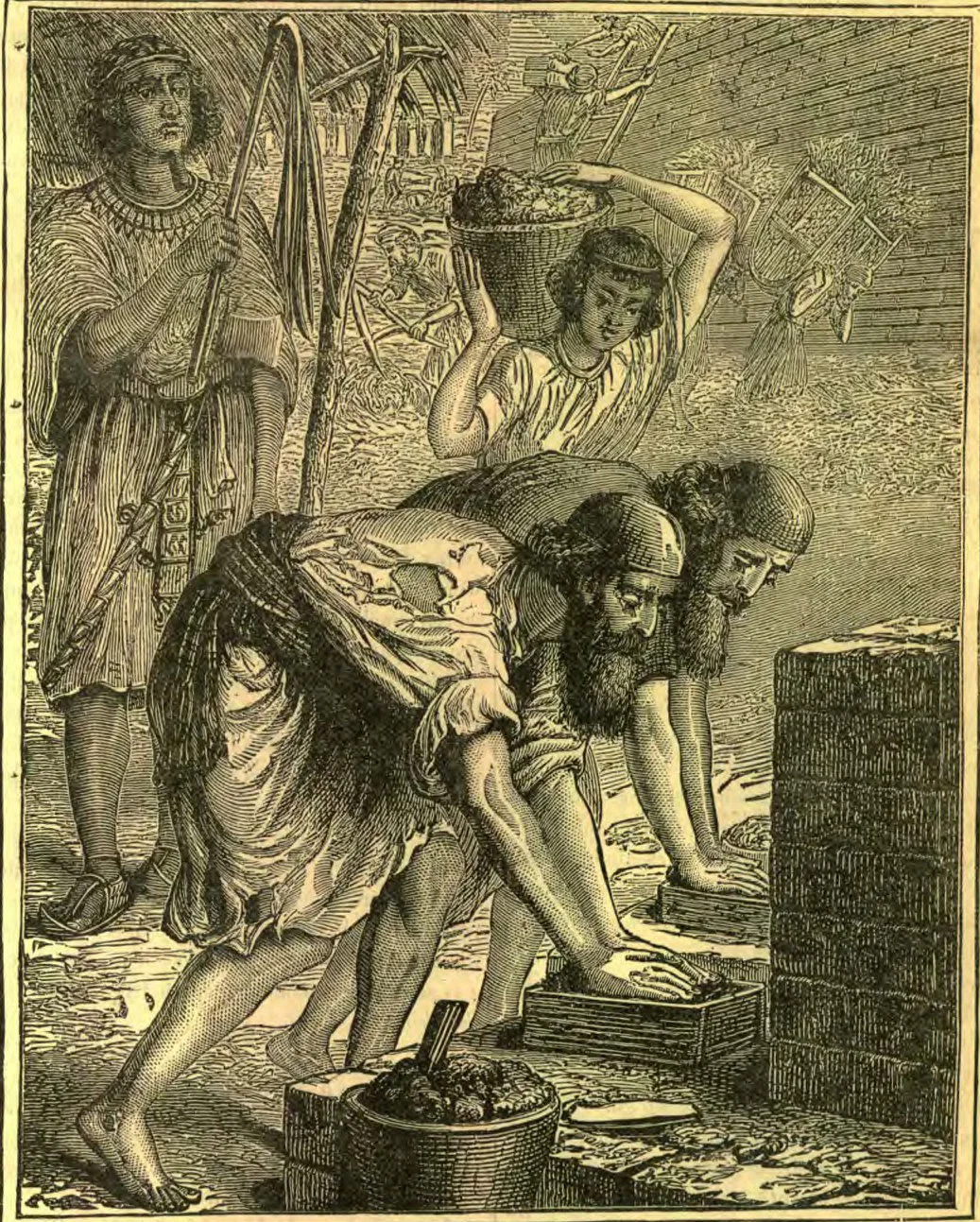
At first glance, one might decide there was nothing very attractive in our picture of brick-making; but to the Bible student, as a representation of some of the burdens placed upon God’s ancient people, it has much of interest; for it tells the story of their hardships during their long sojourn in Egypt.
The word “brick” has its name from the whitish clay of which bricks were made. The earliest Bible record of their use is in Gen. 11:3; in the building of the Tower of Babel, more than four thousand years ago. “And they said one to another, Go to, let us make brick, and burn them thoroughly. And they had brick for stone, and slime had they for mortar.”
The second Scripture record of brick-making is not until several hundred years after the Tower of Babel was built, when the children of Israel were slaves in Egypt. It may be found in the first chapter of Exodus. “And Joseph died, and all his brethren, and all that generation.” After this a new king arose, “which knew not Joseph;” and because the children of Israel were multiplying so fast, the new king feared they might sometime join themselves with the enemies of the Egyptians, and overthrow them. So he proposed to be very severe with the Israelites, and to try to wear them out. And he set taskmasters over them, to urge them forward in their work, and to afflict them by making their burdens heavier. “And they made their lives bitter with hard bondage, in mortar, and in brick, and in all manner of service in the field; all their service, wherein they made them serve, was with rigor.”
The Israelites learned the art of brick-making in Egypt. The Egyptians usually made their brick of the mud, or clay, from the Nile River; and it was so free from sand that the bricks did not need to be burned to toughen them. Their manner was to mix straw with the clay to prevent the bricks from cracking, and then to dry them in the sun. The longer they dried, the more excellent was their quality. For some special purposes they would let them lie four or five years.
Brick-making in Egypt is still conducted in the same manner as when the children of Israel manufactured the brick, and built the treasure cities of Pithom and Raamses, except that the ancient bricks were more carefully made. Recent digging has exposed the walls of the store-chambers which the children of Israel built; and an examination of them shows that they were excellent brick-layers.
There are yet some relics of Hebrew bricks in existence. One brick may be seen in the museum in Berlin, with the name of Raamses II. stamped upon it, and with the straw still visible in it. How we should all prize such a relic, such a volume of Hebrew history, as it might truly be called!
In the engraving, the artist has attempted to portray the bitter servitude of the Israelites,—representing them as engaged with their work in the several parts of the brick maker’s trade, from the mixing of the clay to the shapen bricks arranged in the sun to dry; and as being unceasingly urged on in their work by the whip of the cruel taskmaster.
It was not the ordinary labor of brick-making which was so severe upon the Israelites; but it was the rigor with which they were made to serve, and that they were allowed no rights or privileges, not even time to worship God. Do you not think their tears sometimes helped to moisten the clay as they were making the bricks?
The children of Israel feared God, and cried unto him in their sore distress. God heard their groanings, and respected their tears. He remembered his covenant with Abraham, Isaac, and Jacob. He met Moses, and spake to him from the burning bush, telling him that he had come down to deliver his people out of the hand of their oppressors, and to establish them in a land flowing with milk and honey.
The readers of the INSTRUCTOR will be interested to read the story of the deliverance of the children of Israel; of Pharaoh’s determination not to let them go, and all the while increasing their burdens more and more. The story may be found in the first fourteen chapters of Exodus. But theirs was a wonderful deliverance, and it was a wonderfully sublime song they sung unto the Lord in return for it.
The Lord has, at many different times, given deliverance to his people, and he will yet once more set his hand to recover the remnant of Israel. The remnant does not include those who are taking their fill of this world as they pass along; but rather, those who are pleading, with strong crying and tears, to be freed from the cruel power of Satan’s increased wrath. Those who share in this deliverance will sing the new song, which only they can learn. The song will be so very like that sung by the Israelites at their deliverance from Egyptian bondage that it is called the song of Moses. Dear readers, how many of us will join in that song of triumph? M. J. C.

LIGHT

Be not much troubled about many things; Fear often hath no whit of substance in it, And lives but just a minute; While from the very snow the wheat-blade springs. And light is like a flower, That bursts in full leaf from the darkest hour. And He who made the night, Made, too, the flowery sweetness of the light. Be it thy task, through His good grace, to win it. —Alice Cary.

“BY THEIR FRUITS YE SHALL KNOW THEM.”

Tiny Strong and her friend Rachel were sitting in the parlor of the boarding-school where they were pupils, talking very earnestly over their work. They had chosen a quiet corner in the big room, quite apart from the merry groups of girls scattered here and there.
“I want to do and be something better than I have been!” said Tiny, soberly, pushing back the soft hair from her face. “I don’t feel a bit satisfied with living just as I used to! It seems as if a Christian girl ought to be about the ‘King’s business,’ for you know it requireth haste!” she said softly.
“And one has such chances here,” said Rachel, “to be kind and thoughtful, and to do a great deal for others.”
“Yes, and the girls are always watching, when we never dream of it, to see whether Christian girls are, after all, any different from other people.”
“There’s only one thing to be done about it, and that is to begin right away to do better,” said practical Rachel. “If we start together, we can help each other.”
Tiny was silent for a moment. She was asking God’s help, as well as Rachel’s; then she smiled one of her own bright smiles, as she answered:—
“Let us begin now, dear. There is Helen Rogers all alone over there. Suppose we go.”
A moment later Tiny’s arm had stolen about Helen, and the warm little squeeze she gave her brought a loving light into her dull face.
“We wanted you,” said Rachel, in answer to her wondering look, for she was not a favorite among the girls. “Didn’t you want us?”
“Oh, yes!” was the quick response. “I was thinking of mother, and feeling so lonely.”
* Whenever you feel that way, come and find us,” said Tiny. “You may always be sure of a welcome.”
“Oh, thank you; I shall be so glad to have some friends,” was the fervent reply.
“Suppose we all go and sit with Laura Stevens a little while. It must be forlorn enough up there,” said Rachel. “She has been sick all this holiday week; I feel so sorry for her.”
“Wait a minute, I have some fresh flowers which mother sent me to-day. Let me carry them.”
Already the “King’s business” was spreading, and there was work for three pairs of hands as well as two.
“It is a great deal pleasanter than doing our own work; why haven’t we begun before?” whispered Tiny in Rachel’s ear, as they waited for Nellie at the door.
Days followed, filled with kind words and looks and thoughts and deeds done by these two simple, every-day girls, starting like a heavenly strain of music in that school; and leading others, one by one, to swell the melody until it became a grand and thrilling chorus to which the angels in heaven stopped to listen.—The Well-Spring.

A SCHOOL IN INDIA.

INDIA is a heathen country, you say. Yes, it is; but a great many Christian teachers are there, trying to make it a Christian country.
A gentleman who has visited India tells us about the native schools there. He says: “A village school in India does not cost much. Except in the rainy season, it is held under the trees behind the schoolmaster’s house; and there are neither desks, benches, slates, nor books. The boys sit upon the smooth, hard ground, and the schoolmaster upon a mat among them.
“The school is divided into four classes, which are named after the writing material used by each. The lowest is called the chalk class, and sometimes the floor class, the pupils of which learn to write with chalk upon the trodden ground. The next is called the palm-leaf class, as the pupils write upon palm leaves, a material which is said to be much better for the purpose than our slates, as it never breaks, is very light, and costs nothing. The third is called the plantain-leaf class; and the highest of all, the seniors of the institution, write on paper, and are called the paper class.”
“For years the boys spend most of their time in writing, it is so difficult a language to write.
“A boy going to school in the morning carries under his left arm a bundle of twenty clean palm leaves. A pen of reed is behind his ear, and he carries in his hand a rude ink-pot of clay. As he spends most of his time in writing upon these leaves with ink, and rubs out his mistakes with his hand or wrist, he comes home at night pretty well smeared and spattered. This is reckoned honorable to him; and the blacker he is, the more his parents praise him for his diligence at school.”
And then those little Indian boys get whipped a great deal. The schoolmaster is very hard with them. And you notice I say boys. Little girls never go to school in India. They don’t care enough for little girls there to teach them to read. The Christian teachers receive the girls into their schools, and teach them; and by-and-by, when these are grown up, they will do a great deal of good among their people. Some day we hope the little girls in India will be as much loved and cared for as our little girls are here.—Sunday Hour.

ST. ANTHONY’S FALLS, AND ITS GROWING CITY.

The first white man who ever set eyes upon the Falls of St. Anthony, was Louis Hennepin, in 1680. He was a Catholic priest; and, in company with some French traders and others, traveled extensively through the region of the great lakes and the Mississippi Valley. The travels of these French explorers in that distant period, nearly one hundred years before the American Revolution, would afford us most interesting reading if we possessed an account of them. It may not be known to all the young readers of the INSTRUCTOR how extensively the country was explored at that early date. All the country west of what is now the State of Michigan and many hundred miles east of it was then a wilderness, inhabited only by the red-skinned savage and the wild beasts. Wolves, bears, buffaloes, and deer roamed in countless numbers over the prairies of the West, and in the vast forests of the East and the South.
La Salle, a prominent French explorer, in 1678 led a large party in the exploration of the great lakes, then almost unknown; crossed to the Mississippi River, and passed down it to the Gulf of Mexico. Others who had been in his party ascended the river to the Falls of St. Anthony. Among these was Hennepin. At different places, posts were established. Dubuque, Iowa, was named after a Frenchman who settled there at a very early period. In Lake Superior, on one of the Apostles’ Islands, a Catholic mission was established nearly two hundred years ago. These French people formed very friendly relations with the Indians; and even now, among some of the Indian tribes, there are persons of mixed blood who can understand the French tongue.
There was a time when France came very near obtaining possession of all the western part of what is now the United States; and it did possess a large section known as Louisiana, which embraced the State by that name, and an immense territory west of the Mississippi River, now known as Arkansas, Missouri, Iowa, Kansas, Nebraska, and a vast amount more. This was afterward purchased by the United States Government from France.
For four or five hundred miles below the Falls of St. Anthony, the Mississippi seems to have forced its way through rocky barriers at some period earlier than human history. High bluffs of lime-stone rock, often three or four hundred feet high, line its course from the falls to quite a distance below Dubuque. At the falls, the river rises above the rocky cliffs, and the bluffs recede; and here the river descends about fifty feet in the space of a mile. This affords the finest water power, perhaps, in the world. The amount of power at the lowest stage of the water is estimated to be 135,000 horse power. The friction of the water as it falls over the rocks has worn them, and caused the falls to recede quite rapidly, so that there has been danger of its interfering with its use in running the mills built there. To avoid this, the falls have been incased in plank, which causes the water to run down a long incline instead of dropping down perpendicularly. This interferes somewhat with the beauty of the falls, though it is still a beautiful sight, especially when the water is high, to see it pouring down such a long incline. At the present time, there is an immense amount of machinery run by means of this great water power.
The city of Minneapolis, built upon both sides of the river, is, because of the great advantage of its water power, becoming one of the most rapidly growing cities in the world. In 1860, it had a population of less than 6,000 people; in 1870, it had 13,000; in 1880, 46,000; and now it is estimated to contain 100,000 people. St. Paul, only nine miles away, contains nearly 80,000 inhabitants. Both of these cities have grown up in about half a life-time.
It would astonish the readers of the INSTRUCTOR to go into the large lumber and flouring mills in Minneapolis. The Washburn and Pillsbury flouring mills are among the largest in the world. One of these is said to have a capacity for making 5,200 barrels of flour per day. It is claimed that in Minneapolis there is as much flour made every year as in any two cities in the United States, and more than any one city in the world. The mills at Minneapolis turn out over 25,000 barrels of flour per day. Nearly 5,000,000 barrels were made there last year; and nearly 400,000,000 feet of lumber were sawed; besides, a large amount of other manufacturing was done. The logs float down the river, and are drawn up into the mill, four or five at a time; and it seems but a few moments before they disappear into slabs, boards, shingles, lath, and every other thing into which lumber is sawed. Everybody is busy.
Minneapolis is a beautiful city. It is a clean, nice, attractive place. The inhabitants are an intelligent, industrious class, and nearly every nation is here represented.
We must not forget to notice the Falls of Minnehaha, three miles distant from Minneapolis. Here the small river, by the same name, which, in the Dakota language, signifies laughing water, leaps down a limestone precipice of sixty feet. The rock underneath is worn away so that one can easily walk behind the beautiful, feathery, foaming, misty sheet of water, through which he can discern all the colors of the rainbow. It is not such a grand, majestic sight as the fall of Niagara, but it is indeed a beautiful one, and well worth seeing. Many visitors go there every year. Very likely many of the readers of the INSTRUCTOR may sometime have the opportunity of seeing these lovely little falls. UNCLE GEORGE.

Speak a Shade More Kindly

Speak a shade more kindly Than the year before; Pray a little oftener; Love a little more; Cling a little closer To the Father's love: Life below shall liker grow To the life above. —Selected.

BE COURTEOUS.

Some years ago, a gentleman was in a London omnibus passing from the heart of the city to one of the suburbs. The omnibus stopped to take up a passenger, who, from being welcomed by the others, was evidently well known and esteemed. Our friend admired the hearty old man, who had a kind word and a look of sunshine for everybody.
A poor servant girl sat near him in the omnibus. She was in some perplexity about finding a house at which she had been directed to call. As politely and as pleasantly as if she had been a lady, the stranger gave her all the information she wanted. Who could he be?
It was Dr. Chalmers, one of the greatest men and the most popular preachers of his day. Yet he had room in his large heart for sympathy and kindness to all; and his genial disposition shed sunshine on those around him.
Will you try to cultivate this cheerful and winning manner? You cannot be as famous as Dr. Chalmers, but you can, if you choose, be as courteous.
How pleasant it is, in a world full of troubles, and hardships, and disappointment, to meet with sunny faces, and tones of encouragement. “Good words,” says the old proverb, “cost little, but are worth much.” What a pity it is that most people are so sparing of them!
Some persons, who are really well disposed, spoil their efforts to show it, by the churlishness of their manner. “They resemble chestnuts, very pleasant nuts, but inclosed in very prickly burrs, which need various dealings of nature, and her grip of frost, before the kernel is discovered.” If they do you a kindness, it is so ungracious that you would almost rather have been without it. If they proffer you alms, it is done so uncourteously as to deprive the gift of half its value. What a pity that kind acts should sometimes be spoiled by cross words!—Selected.

Beginning the Day with God in Prayer

LET the day have a blessed baptism by giving your first waking thoughts into the bosom of God. The first hour of the morning is the rudder of the day.

CURIOUS FACTS ABOUT THE JAPANESE.

In Japan, every one has to carry a lantern. By day and by night, it is seen dangling to his belt, not in the form in which we see the lantern in England, but resembling a thin, flat box. Each end of this box is fastened to a sort of paper, which, lying in folds, forms, when drawn out, a lantern. Further, the Japanese carries a tiny wooden box, shaped like a cylinder, to hold his candle. He also carries a small medicine chest, a curious contrivance, which draws out half a dozen little boxes, each containing a small portion of some especial medicine. In appearance, it is like a small, carved box. Then he carries a fan, a pipe, and a short sword, and anything else that may or may not be useful to him. The belt of a Japanese is, therefore, a very important part of his dress. His slippers consist of a sole with a worsted thread at the upper end, through which the great toe is thrust to keep it on the foot. His pillow is unlike anything we should imagine, being a framework of whalebone, or some other such substance, into which the back of the neck near the head fits. This is to keep his knot of hair in order; for the Japanese does not have his hair dressed every day, and therefore is obliged to take care of the piece which is greased and bound into a cue, the rest of the head being closely shaven.—Selected.

IMPORTANT BIBLE SUBJECTS.

LESSON 32.—PUNISHMENT OF THE WICKED.

CONCLUDED.
[NOTE TO THE STUDENT.—Do not consider the lesson learned until you can give at least the substance of every text, with the correct reference for each. The references in black letters indicate those texts that should be committed to memory. A little diligent application each day will enable you to do this.]
1. What is given to those who believe on Christ? John 3:36.
2. What is to be the fate of those who believe not the Son?
3. What does the psalmist say will be the result to the wicked, if the Lord’s wrath is kindled only a little? Ps. 2:12.
4. Then what will be their condition if his wrath abides on them?
5. What contrast does the wise man make between the continuance of the righteous and that of the wicked? Prov. 10:25.
6. With what words of the psalmist does this agree? Ps. 1:1-4.
7. What is to be done with the chaff? Matt. 3:12.
8. To what other perishable substances are sinners compared? Hosea 13:3.
9. To what is their destruction compared? Isa. 5:24.
10. How has the beloved disciple described the fate of the wicked? Rev. 20:9.
11. In what manner will they be devoured? Nahum 1:10.
12. Into what shall the wicked consume? Ps. 37:20.
13. Of what material was man formed? Gen. 2:7; 18:27.
14. After the fire of the last day, what will the wicked be? Mal. 4:3.
15. In view of this fact, what does one of the prophets say of the wicked? Obadiah 16.
16. What corroborative testimony can you give on this point? Ps. 37:9, 10.
17. Quote another text which proves that a time will come when there will be no wicked in existence in the universe. Rev. 5:13.
18. Who was the author of the doctrine that the wicked shall not die? Gen. 3:4.
19. Who is the serpent? Rev. 20:2.
20. For what purpose did the devil invent that doctrine? Eze. 13:22.

HOME-HELP FOR THE TEACHER.

ONE source of help to the teacher is to be found in the scholars’ homes. A mother’s or father’s help is not to be slighted in the managing, or in the teaching, of a child in the Sabbath-school. If that help be freely proffered to the teacher in his work for his scholars, he should accept it gratefully. If it is not forthcoming without his request for it, he ought to seek it persistently. No teacher who finds a difficulty in managing his class, has yet done his best to secure a wise control of his scholars, if he has failed to seek the cooperation of the parents of these scholars in his endeavors in their behalf. There are very few parents who would not gratefully receive the courteous visits of their children’s Sabbath-school teachers. More parents than the teachers commonly suppose, would welcome timely and judicious suggestions as to the way in which they could co-work with those teachers. There is no good in complaining that the scholars do not study their Sabbath-school lessons at home, or behave as they should in the Sabbath-school class. There may be a great deal of good in going frankly to the parents, to ask if they will not kindly see that their children study their lessons, and that they go to the Sabbath-school with a purpose of good behavior there.
And all this can be done without any complaining on the teacher’s part against the conduct of the scholars. Teachers and parents ought to have an understanding on this subject. Some of them do so. If you have trouble in managing your scholars, you ought to be of the number of those who seek and obtain home-help in the scholar’s managing. It may be that you could do more for your scholars by one hour’s judicious work with the parents, than by a month’s work with the scholars without any help from the parents. You ought to have the parents with you as “fellow-helpers to the truth.” You ought to seek their co-operation persistently and in faith. It is your duty to want it, to go for it, to secure it. According to your desires and your faith—as shown in your wise and persistent work in this direction—so it shall be unto you.
As it is in the matter of personal behavior in the class, so it may be in any other line of your effort in behalf of your scholars. In punctuality of attendance, in reverence of spirit, in studiousness, in giving into the Lord’s treasury, in loving others and in doing for them, your scholars may be trained as well as managed. By taking up one point at a time, and pressing it patiently and faithfully with your scholars, you may raise the standard of your scholars’ being and doing at that point; and so you may “press on unto perfection”—go forward unto full growth, or completeness—with all in your class. Indeed, the term “managing,” as applied to your work in behalf of your scholars, must not be limited to the idea of controlling them in their behavior. It should be made to include all that goes to the forming and finishing of the scholar’s character; for that should be the scope of your desires, of your endeavors, of your prayers, and of your faith. And such a work is not easily nor quickly compassed. It is a tireless, and, in a sense, an endless task; for the work of character-finishing is a work that is never finished.—Teaching and Teachers.

The Philosopher's Garden and the Sabbath-School Teacher

A CERTAIN philosopher was always talking to his friends about the garden in which he was in the habit of walking, and where he carried on his studies. At length one of them came to see him; and he found this extraordinary garden was a patch of ground about twice the size of the floor of his own room.
“What!” said he, “is this your garden? It is not very broad.”
“No,” said the philosopher, “it’s not very broad; but it’s a wondrous height!”
And so I would say to you, Sabbath-school teachers,—your work in your classes is not a very large one, but “it’s a wondrous height.” It goes up to heaven.

Friendships Formed Between Teachers and Pupils

Some of the most delightful and satisfying friendships of life are those formed between teachers and pupils. We should never look upon the bond as a slight one, meant to be transient and temporary. It should rather take hold of the most endearing part of our nature, and reach forward to the beautiful world beyond this changeful one. When the great Teacher gathers his own beside the crystal sea, there will be many little circles around him formed of those who loved him here, and taught in his name.

Letter Budget.

CHARLES A. CLARK, writing from Columbia Co., Wash. Ter., says he attends Sabbath-school with his mother and sister, and learns his lesson in Book No. 3. He is trying to learn his lessons well, and to be a good boy. He is eleven years old. This is his first letter.
Charles is “trying.” This is well. It is by patient continuance in well doing, seeking for immortality, that you may all gain eternal life.
LENA M. NOURSE, of Oneida Co., N. Y., writes: “We moved here last July. It is a pretty place in the summer time. I am ten years old. I have one sister and two brothers. I keep the Sabbath with my papa and mamma. I go to Sabbath-school and learn my lessons in Book No. 5. We like the INSTRUCTOR. I do some missionary work with it. We have no school here now. I am trying to be a good girl.”
Just the very best time to do missionary work, isn’t it Lena, when there is no school?
SAMMY LASHIER writes from Todd Co., Minn. He says: “I am eleven years old. I have three sisters and two brothers. We have a good Sabbath-school. I learn lessons in Book No. 2. I went to the Mankato Camp-meeting last summer. It was an excellent meeting. I send my love to the INSTRUCTOR family, especially the editors for their good paper.”
The editors of the INSTRUCTOR are glad when its readers appreciate the paper so well as to extract the “good” it contains. We hope Sammy is one of that number.

OLD-TIME CARRIAGES.

Once people had no carriages, no carts, no wagons. Everybody who went on a journey either walked, or else rode on the back of a horse, camel, elephant, or some other animal. Roads were not in a very good condition, and railroads had never been thought of. Only really well, strong persons could take much comfort in traveling.
But after a time, people began to make wagons. These were rude, clumsy affairs, drawn by oxen. They had only two wheels, made of solid wood. I suppose the wagons that king Pharaoh sent up to Canaan, so that Jacob and his family could come down to Egypt, were some such carts as these.
The Egyptians built many wonderful monuments, that have lasted for centuries. When they made these monuments, they carved on them pictures of their every-day life; and you can still see, on the stones, the ancient Egyptians riding in their ox-carts, with a servant along, holding a huge umbrella over their heads. You can see, too, just how they looked when, dressed in their armor, and mounted in their chariots, their prancing horses drew them to war.
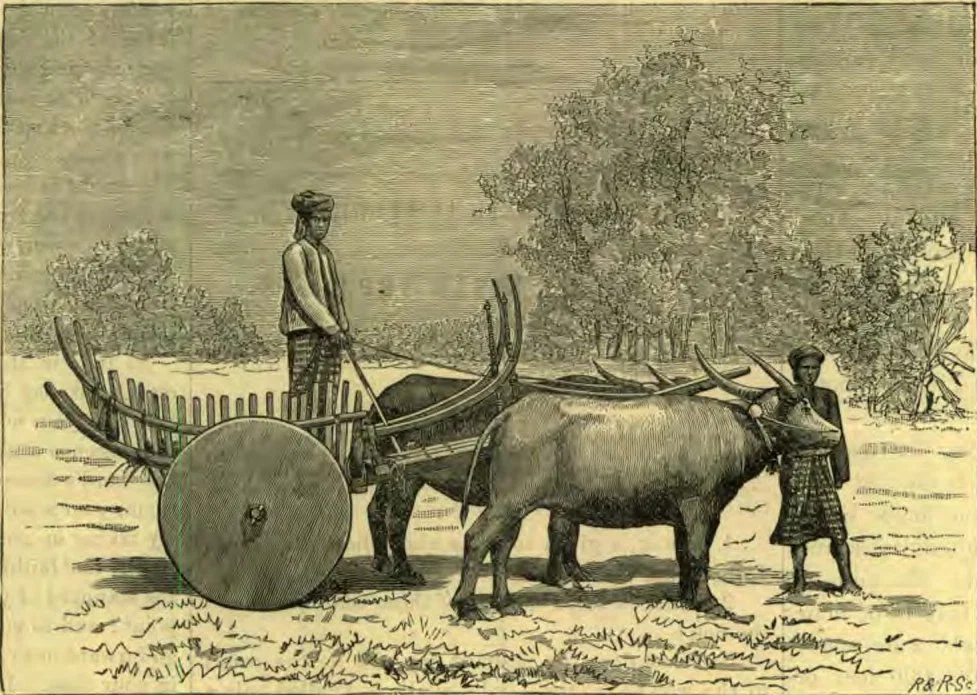
In some countries, the people of the present day have no better carriages than these. On this page is the picture of a buffalo cart that a lady missionary uses in her travels in Burmah. Burmah, you know, is a country in the southern part of Asia, and joining India. This is the only kind of a carriage that she can get in that country. The jungle roads are very rough; but the cart is strong, and it is large enough to carry what provisions, dishes, and bedding she needs in making such a trip.
Three centuries and a half ago, covered carriages began to come into fashion. They were kept for the ladies of high rank, like the princesses. Men thought it disgraceful to be seen riding in one; they always went horseback. The carriages were trimmed up in grand style, with gold cloth, scarlet satin, and perfumed leather. You can imagine how they looked when you read what the old poet wrote about the squire’s carriage,— “It shall be covered with velvet red, With cloth of fine gold all about your head, With damask white and azure blue Well diaper’d with lilies new.”
But for all their fine trimmings, they were not so easy as the carriages we ride in to-day. Now, instead of jolting in ox-carts over the rough country we can ride over smoothly-paved roads in vastly better buggies than our forefathers ever dreamed of.
W. E. L.

“HOW DO YOU SPELL ‘PREJICE’?”

At the home fireside, with other members of the family, sat Ossian and his cousin William. Ossian was writing a letter to a friend, when suddenly he called out, “Say, William, how do you spell ‘prej-ice’?”
“Prej-ice, prej-ice,” slowly repeated William, “I don’t know what you mean.”
“Why, yes, you do!” said Ossian, “I mean prejice.”
“I don’t know any such word; we shall have to find it out in your new dictionary,” William declared.
The dictionary set them all right,—the big word called for was prej-a-dice.
“After all, that new dictionary is worth having. I wouldn’t take any money for it if I couldn’t get another,” said Ossian.
“I wish I could have one; but they cost a dollar, and that is more money than I can get. I need one in school every day. The teacher says we should always find out what the words mean when we read or study. Lots of the boys and girls have them, and I notice they learn ever so many more things than we know, because they know what the words in the lessons mean. Now you have a new one, it makes me want one more than ever.”
“Why don’t you get one as Eugene Pickett did,” asked Ossian.
“How was that?” inquired William.
“Why, by canvassing. There is a paper called the YOUTH’S INSTRUCTOR, that will let you have a dictionary just like mine for three new subscribers. I never heard of anything so cheap before, did you? Most anybody can get as many as three new subscribers for such a paper as that. If I had known it a few days ago, before I bought mine, I would have saved my silver dollar. You can get one in that way just as easy as anything.”
The first part of this story is true, dear reader, and the latter part may be, as you will see by reading the publishers’ special notice on this page.
The dictionary, every school boy and girl needs who does not already have one; and who will not make a little effort to get the benefit of the publishers’ very generous offer? M. J. C.

READY BEFOREHAND.

“What are you doing now? I never saw such a girl; you are always finding something to do!”
“I’m only going to sew a button on my glove.”
“Why, you are not going out, are you?”
“Oh, no! I like to get things ready beforehand; that’s all.”
This little thing, if persisted in until it becomes a fixed habit, will save you more trouble than you have any idea of; more time, too.
Ready beforehand—try it, boys and girls.

ANOTHER OFFER.

To any one who will send us three New Subscribers for the YOUTH'S INSTRUCTOR for one year, at full price, we will give “WEBSTER'S PRACTICAL DICTIONARY.” This book contains 634 pages, 600,000 words, and 1400 illustrations, and is retailed by the publishers for One Dollar. We offer this valuable book as a Prize for three new subscriptions as here stated. Address, YOUTH'S INSTRUCTOR, Battle Creek, Mich.
PUBLISHERS.

“SUBJECT UNTO THEM.”

Dear little children, reading The Scripture’s sacred page, Think, once the blessed Jesus Was just a child your age; And in the home with Mary, His mother sweet and fair, He did her bidding gladly, And lightened every care.
I fear you sometimes trouble Your patient mother’s heart, Forgetful that in home-life The children’s happy part Is but like little soldiers’ Their duty quick to do; To mind commands when given, What easy work for you!
Within St. Luke’s evangel This gleams, a precious gem, That Christ, when with his parents, Was “subject unto them.” Consider him, dear children, Be like him day by day, So gentle, meek, and loving, And ready to obey.
—Margaret E. Sangster.

You have reached the end of this edition.

The Youth’s Instructor · Feb 18, 1885