AMONG the learned men who came to America in the eighteenth century was George Berkeley, afterward bishop of Cloyne, Ireland. He went to Newport, Rhode Island, to found a University, afterward giving his American estate and several hundred volumes of his library, to Yale College. It was while interested in America that he wrote his poem containing the oft-quoted stanza:
“Westward the course of empire takes its way,
The first four acts already past;
The fifth shall close the drama with the day;
Time’s noblest offspring is the last.”
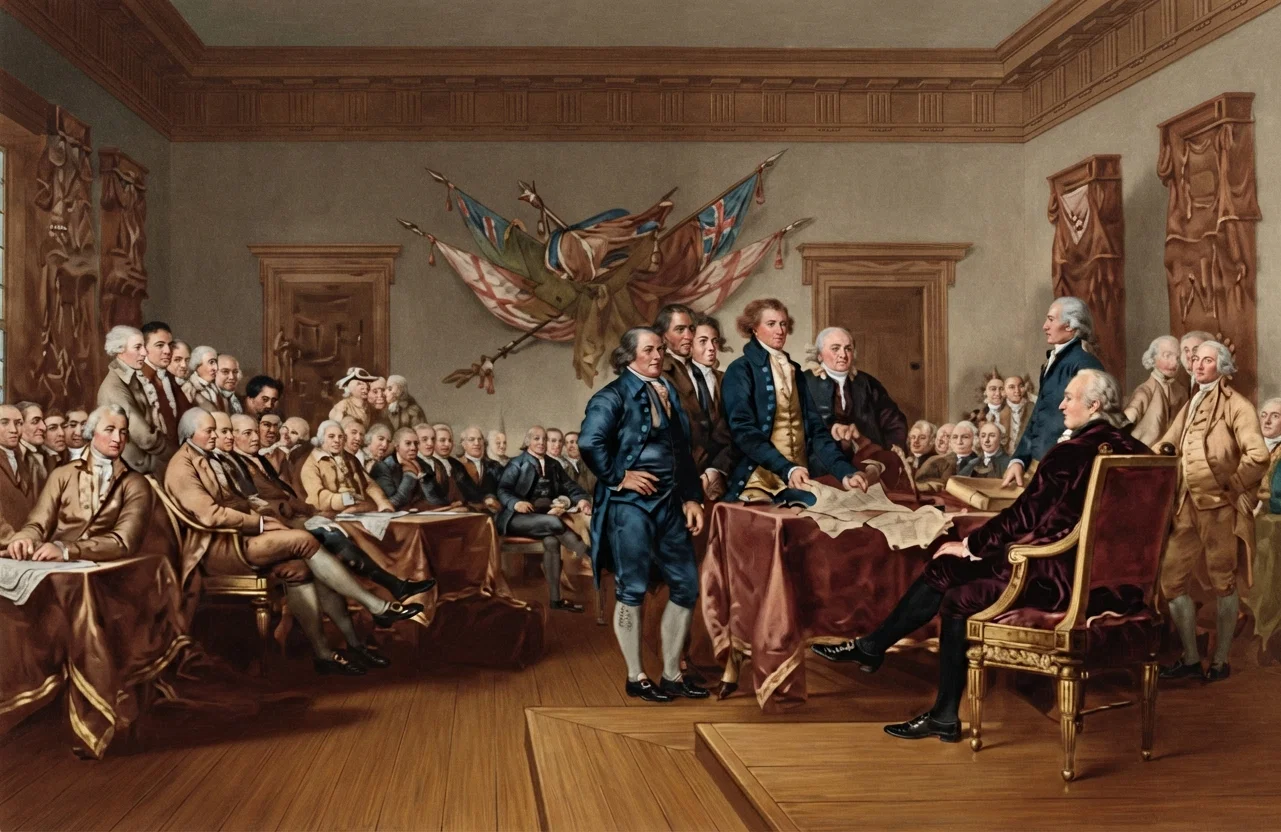
Signers of the Declaration of Independence.
The stanza has been quoted as prophetic. As a matter of fact, it is founded on Bible prophecy. The first four acts of the great world drama are the history and life of the empires of Babylon, Medo-Persia, Grecia, and Rome. Three of these, as world powers, had, for almost two millenniums, passed away. Rome had been for centuries in a divided state. But, when Bishop Berkeley wrote his poem, a new Star had risen in the horizon. A New World was opening before the nations. A new Flag was about to be unfurled to the breezes of heaven.
All this God had foretold in prophecy. The great church-and-state system of government, which, in different forms, has cursed and will curse the world, from Nimrod, the founder of Babylon, to the second coming of Christ, earth’s lawful King, is represented in Revelation 13 by a composite beast with seven heads and ten horns. It includes in its symbolism the great persecutors of the church for conscience’ sake in the great sad history of earth’s past, and this in a twofold sense, in both body and successive heads.
It possesses the mouth of a lion (Babylon, Dan. 7:4; Jer. 4:7, 13), the feet of a bear (Medo-Persia, Dan. 7:5), the body of the leopard (Grecia, Dan. 7:6), and ten horns of Rome (Dan. 7:7), and it is inspired and upheld by the dragon (the devil, Rev. 12:9). The heads represent the same powers, being successive (Rev. 17:9, 10), not contemporaneous, like the horns.
The animus comes from the seat of the mind, the head. The head controls the beast, and makes the beast what he is while the head exists.
The beginning of this persecuting régime, this great abnormal system, was Babylon, that power which has made all the kingdoms of the earth drunken. The first head is Babylon, represented as a lion in its civil aspect, as a gorgeously-arrayed harlot in its religious aspect. The second head is Medo-Persia, continuing the same Babylonian system in another form. The third is Grecia. The fourth is Pagan Rome, through which the dragon, Satan, wrought to destroy Christ. Rev. 12:4. The fifth, the head dominant during the “forty and two months” of Rev. 13:5 (see also Dan. 7:25; Rev. 11:3; 12:6, 14), is generally known by the designation of the Papacy.
A Symbol of the New World System.
Just at the time when the papal head is wounded to death (Rev. 13:3, 10), beginning with the Reformation, and culminating in 1798, John sees another power, symbolized by a beast, rising up out of the earth, having two horns like a lamb, yet speaking like a dragon. Rev. 13:11.
Note that this beast must symbolize a power rising to prominence about 1798; it comes up, not out of the “sea” (denoting peoples, nations, Rev. 13:1; 17:1, 15), but out of the earth, a hitherto unoccupied region by the historic nations; its growth is rapid, its progress in coming up is visible; it has two horns like a lamb; it speaks as a dragon, and the latter part of the chapter is the development of this dragon spirit.7
Two Horns Like a Lamb.
Note also that in this beast is combined two prominent apocalyptic symbols. (1) It has two horns like a lamb. In type and prophetic symbol a lamb stands for Jesus our Saviour. He is represented in Rev. 5:6 as "a Lamb having seven horns." A horn is an emblem of power, exaltation, strength. Seven would denote perfection in all things which would make the Lamb truly exalted and powerful. A beast with two horns like a lamb would denote a power professing to possess, holding in prominence, two Christian principles or characteristics, principles which, applied to civil government, would make that government characteristic, or distinguished from all other governments, even as they distinguished Christianity from all other religions. (2) A dragon is the symbol of Satan, operating through earthly governments, inducing them to persecute the children of God. "The dragon . . . persecuted the woman." Rev. 12:13.
Here, then, are the prominent characteristics or specifications concerning the power symbolized by the two-horned beast:
1. It must be rising to prominence in the world's affairs about A. D. 1800.
2. Its rise would be rapid and marvelous.
3. It must arise, not among the great nations of history—the sea—but in hitherto ungoverned, undeveloped regions, "the earth."
4. It will possess, as characteristics of strength and prominence, two principles, characteristic of Christianity alone among religions, and of itself alone among nations.
5. Nevertheless, it would speak as a dragon, or promulgate persecuting laws.
Search through all the centuries and tomes of history, and but one power, one nation, one government, alone, of all earth's governments, can be found, in which these specifications are fulfilled, and they are all fulfilled or fulfilling in that one.
That nation is our nation.
That government is these United States of America.
1. In 1798, when the papal beast went into captivity, this nation was just rising to power. July 4, 1776, its independence was declared. Then followed eight long, cruel, depleting years of war, not for conquest, but for liberty, for a principle. In 1789 its glorious Constitution was adopted. And at the time the prophetic vision applied, it was the one great young power in the world.
2. Its rise since its birth has been rapid and marvelous, a fact familiar to all observers and students and citizens.
3. It came not up in the Old World, the theater of the great drama enacted in its several parts by Babylon, Medo-Persia, Grecia, and Rome, but from a New World, a new continent, amid untrodden solitudes and virgin forests.
4. It possessed in its making two principles only dreamed of by the most sanguine statesmen who may have loved them in the past. In this nation they were crystallized into its charters of existence.
The first of these was the equality of man. This is preeminently the teaching of Christianity, but of no other religion which the world has ever known. It was Christ who said: "One is your Master, even Christ; and all ye are brethren." Matt. 23:8. It was Christ's apostle who said: "There is no respect of persons with God." "God that made the world and all things therein, . . . hath made of one blood all nations of men to dwell on all the face of the earth." Rom. 2:11; Acts 17:24-26.
The second great principle vouchsafed to men by Christian ethics, so far as interference of man is concerned, is the right and privilege of every man to worship God, or not to worship, how or when he will, providing he does not interfere with the equal rights of his fellow-men.
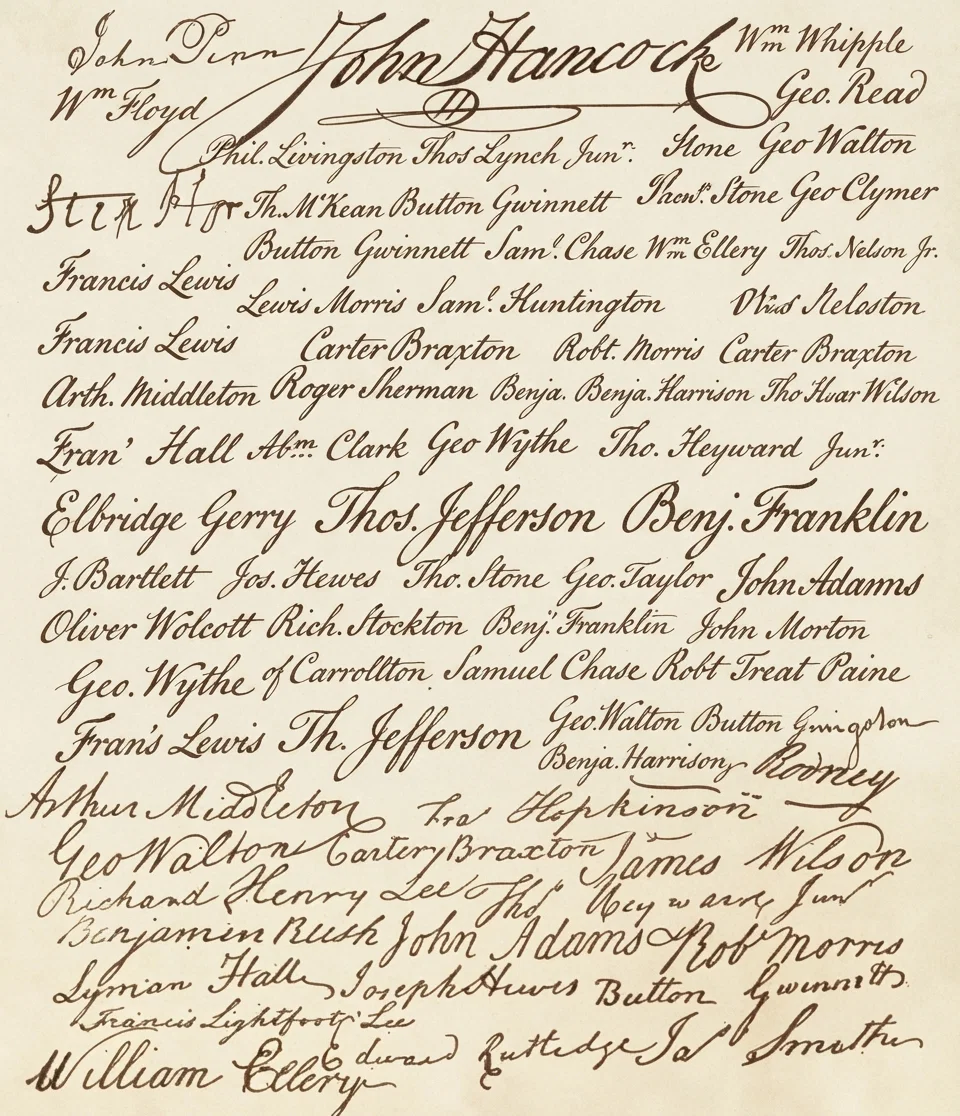
Facsimile Signatures of the Signers of the Declaration of Independence.
This principle may be termed religious liberty. The Gospel of Christ compels no one. It is not, "Thou shalt," or "Thou shalt not." Its language is, "Whosoever will" "let him come." Rev. 22:17. Listen to a chosen servant of the King of heaven: "Now then we are ambassadors for Christ, as tho God did beseech you by us; we pray you in Christ's stead, be ye reconciled to God." "Knowing therefore the terror of the Lord, we persuade men." 2 Cor. 5:20, 11.
And Jesus Himself said: "If any man hear My words, and believe not, I judge him not; for I came not to judge the world, but to save the world." John 12:47.
And that resolute apostle who was once so ready to use carnal weapons, writes: "Dearly beloved, I beseech you as strangers and pilgrims, abstain from fleshly lusts." "Neither as being lords over God's heritage." 1 Peter 2:11; 5:3. "Not for that we have dominion over your faith," says Paul, "but are helpers of your joy; for by faith ye stand." 2 Cor. 1:24. How different are the words of these apostles from the practises of those "lords spiritual" who now claim to be their direct successors! "If ye were Abraham's children, ye would do the works of Abraham." John 8:39.
Look over all the religions of the past—pagan or perverted Christian—and in not one do we find these two particulars. The curse of caste, the creation of offices and positions, a haughty, imperious, and ambitious hierarchy, religious dogmas enforced by royal edict or legislative enactment, one or all are present in all the religions of earth save that of Christ. They are present in all forms of perverted Christianity.
Both of these divine principles of equality and liberty are embodied in the charters of our freedom in this country, so far as they can be embodied in earthly government. In other words, the United States Government embodied the Christian idea of civil government, or, is in principle what a civil government ought to be. The first principle, equality of all men, is found in that document which sounded the birth-note of America's freedom, and which made Americans free men:
We hold these truths to be self-evident, that all men are created equal; that they are endowed by their Creator with certain unalienable rights; that among these are life, liberty, and the pursuit of happiness. That to secure these rights, governments are instituted among men, deriving their just powers from the consent of the governed.—Declaration of Independence.
The second principle—religious liberty—is embodied in this; but is guarded above question in the Constitution, the fundamental law of our government. The First Amendment reads:
Congress shall make no law respecting an establishment of religion, or prohibiting the free exercise thereof, or abridging the freedom of speech or of the press.
No other government of any note in the world holds these two principles. There are republics, like Switzerland and France, but they have their state religions, supported by many to whom they are intolerable burdens. The United States Government stands unique in this respect; and these principles have been the magnetic power which has drawn to our shores from the autocratic and intolerant, priest-ridden nations of the Old World the persecuted and oppressed millions. They found here religion "without a pope, and a state without a king," and the consequent privilege of worshiping (or not worshiping God) according8
to their own consciences and understanding of His will.
The identity of these Christian principles in this government, and the fulfilment of the divine prophecy, are well set forth by America's great historian, George Bancroft:
The Constitution establishes nothing that interferes with equality or individuality. It knows nothing of differences by descent, or opinions, of favored classes, or legalized religion, or the political power of property. It leaves the individual alongside the individual. . . . "Indicating the right of individuality even in religion, and in religion above all, the new nation dared to set the example of accepting in its relations to God the principle first divinely ordained in Judea.—"History of the Constitution of the United States," book 5, chapter 1.
More than this: the influence of this government has ameliorated the Old World conditions, so that dungeon and rack have slunk into night and obscurity, and the martyr's pyre is extinguished.
Later on the shackles of slavery were broken from the feet of the slave, and the principle of liberty and equality again crystallized into fundamental law the following:
No state shall make or enforce any law which shall abridge the privileges or immunities of citizens of the United States; nor shall any state deprive any person of life, liberty, or property, without due process of law, nor deny to any person within its jurisdiction the equal protection of the laws.—Fourteenth Amendment, Sec. 1.
Grand and noble sentiments and principles! Would God they might continue in the government and nation forever. They made the best civil government upon which the sun ever shone; and if held in the hearts of the people, would continue such a government.
But, alas! the beast with the lamb-like horns speaks with a dragon voice; it becomes a persecutor. It makes an image to the ten-horned beast; that is, it unites church and state. It enforces the mark of the Papacy, the sign which she claims of her power, the Sunday enforced by law. It enforces, under penalties of legal boycott and even under death, the image and the mark.
Is this possible?—Nay, it is probable. Read in proof of it the departure of this country from her basic principles as set forth in other articles in this paper. What means the religious legislation of the last few years? What mean the many court-made laws and prosecutions for conscience' sake?
God forewarned us of these things eighteen centuries ago. Who will heed this warning? Who will place his affections upon the heavenly land, whose inhabitants know no blight, no sorrow, no death; but glorious life forevermore?
THE "PURSUIT OF HAPPINESS."
By G.
AMONG the "unalienable rights" for which the Declaration of Independence stands are the rights to "life, liberty, and the pursuit of happiness." As the theory and the language of the Declaration aims to guarantee a protection in these rights to "all men," it logically follows that every individual citizen, and every individual accepting the guaranty even temporarily, is under obligation to acknowledge and respect the right of every other individual. This government was originally a compact of individuals for this very purpose. In no other way can the rights of all be made secure in a selfish, and, consequently, sinful, world. For this reason, purpose, object, "the powers that be [civil governments] are ordained of God." Rom. 13:1.
The obligation being mutual between individuals, the claim to security in what would ordinarily be deemed personal right is logically forfeited, or limited, when the individual fails to regard the rights of others. For instance, when a person's actions become a menace to the lives and liberty of others (not when his "persuasion, religious or political," is repugnant to them), it is the province and the duty of the government to restrain him, or to restrict his liberty of action (not of sentiment or conscience) to the extent that is necessary to the security of others in the exercise of their rights. "For rulers are not a terror to good works, but to the evil." This scriptural reference to "rulers" contemplates rulers imbued with a spirit of justice and a desire for the good of all.
Perhaps in no sense was there a greater necessity for reformation in governmental function than in the protection of men in their right to the "pursuit of happiness." And no element ever was so inclined to interfere with the free enjoyment of this right as the votaries of religion. Furthermore, this interference never has been carried to such an extreme as by those who have professed adherence to the Christian religion. This, too, in face of the fundamental Christian principle, "All things whatsoever ye would that men should do to you, do ye even so to them."
It has been in the matter of the pursuit of happiness that the advocates of civil-law religion have ever deemed it their prerogative, through the machinery of government, to dictate bounds of action on the part of their fellowmen. Religious zealots—whether Roman Catholic, professed Protestant, Greek Church, Mohammedan, or the generally-recognized heathen of whatever name—have always deemed it essential to good government to restrain the non-religionist in his idea of pursuing happiness, and to compel him to at least formally acknowledge the essential importance of their religious dogmas. So extensively grounded had this idea become that a government without an establishment of religion in its legal policy was indeed "a new order of things;" and, in the Old World, was looked upon as near of kin to anarchy.
But the Declaration of Independence paved the way for the Constitution of the United States, with its direct provision that "Congress shall make no law respecting the establishment of religion, or prohibiting the free exercise thereof;" and that forbids the government to "deny to any person within its jurisdiction the equal protection of the laws." And on this Fourth of July it might be well for the people to think soberly for a moment, and note the strong tendency to drift away from these fundamental principles.
A BID FOR RELIGIOUS INTOLERANCE.
By Editor
A Voice from the Supreme Court.
THE Presbyterian General Assembly met, in May, at Winona Lake, Ind. One of the speakers, on the evening of May 20, was Supreme Court Justice Harlan. The brief report which we have is from the Philadelphia North American, of May 22, written by the Rev. Dr. Chas A. Dickey. The heading given to the article reads thus:
CHRISTIAN SABBATH BY LAW, PLEA OF HARLAN;
Supreme Court Justice Points Out Duty of State Legislatures.
Talk to Presbyterians.
General Assembly Hears Stirring Addresses on the Observance of Sunday.
A meeting in the interest of Sabbath observance was held Saturday night. John H. Converse presided, and Justice Harlan made the chief address. Justice Harlan made it very clear that it was the duty of state Legislatures to sustain Christian sentiment, and preserve the Christian sabbath. He intimated very plainly that the Supreme Court would stand for such legislation.
The speech of Justice Harlan is thus summarized:
Poor Man's Day of Rest.
Justice Harlan pleaded for the sabbath as the poor man's day of rest, and deplored the tendency to imitate foreign custom, and make the sabbath the great day for receptions and dinners. He declared that railroads and rich persons had no right to rob the laboring classes of their appointed day of rest.
He said that the duty of Christians to observe Sunday as a day of worship and of religious service was not to be confused with the right of those who worked to have a rest one day in seven.
Presuming that special effort has been put forth to report correctly one occupying such high position among the counsellors of the nation, we wish to call the reader's attention to the following:
1. As a Christian, Justice Harlan knows, or ought to know, that Sunday is not the Sabbath. It is neither enjoined by divine constitutional, or divine statutory, law. It has no legal standing in the Christian's Book, the Bible. That stands for one day only, the seventh of the week.
2. Justice Harlan knows, or ought to know, that Sunday, as the Sabbath, has no divine or worthy example behind it in Sacred History. The one Example for all humanity was the blameless Observer of the seventh day; and so also were His servants observers before Him and after Him, so far as the Holy Record gives us account.
3. Justice Harlan knows, or ought to know, that Sunday, as a sacred day, came into the life of the church, not by any divine mandate, but with the worst apostasy the world ever knew. It is one of the products of the Second, Third, and Fourth centuries, built on the traditions of ancient pagan sun-worship.
4. Justice Harlan knows, or ought to know, that among the first steps in intolerant Christianity—if we may use the contradictory term—was enforcement of Sunday by law; that around that centered the growing union of church and state which culminated in the Dark Ages.
5. Justice Harlan knows, or ought to know, that around this counterfeit institution, this pseudo sabbath, at the present time, there is being built up a hedge of thorny statutory enactments which is in spirit as intolerant as any religious legislation ever enacted in the past. These laws result in elevating one class of citizens above another at the behest of a religious dogma, and in disfranchising and declaring criminal other classes in every way equal to the former, who differ only as regards religious dogma.
6. Justice Harlan knows, or ought to know, that true religion is not a matter of civil law, but a matter of choice and conscience, asking only the non-interference of the civil law; that the men who desire a9day of religious rest have, in a free land, the right to take it. If they lose something by it, that has always been one of the concomitant sacrifices of true religion. The fact is that the great mass of those who use the day use it in idleness and dissipation worse than the work. But however the day may be used, legislation is not necessary to its observance. Moreover, legislation would never be asked for were not the day a religious institution. Every other alleged reason for Sunday legislation is a subterfuge.
7. And, therefore, the plea for Sunday laws and the assurance, intimated, implied, or declared, is a bid, pure and simple, for religious intolerance, whether so intended by the learned jurist or not. If Justice Harlan would abide by God's constitution—the Decalogue—he would never make a plea for the Sunday-sabbath religiously; and if he would hold to the Constitution of the Federal Government, which he has taken oath to uphold, he would never advocate nor uphold any Sunday law or any other religious legislation.
The foregoing utterance of Justice Harlan is most significant. For years we have told Americans that this Sunday legislation, widespread, venal, iniquitous, and intolerant, would come. This was denied. We were told that it could not be in free America. We declared that it would come, because God's Word had predicted it. And it came, and is abounding more and more.
Then, when it came, our liberty-loving Americans told us that these cranky laws would be set aside by our highest court as unjust, unamerican, class legislation, and such ought to be the case; but, instead of that, we have a member of that court urging such legislation, and assuring its promoters thereby that the Supreme Court would uphold it.
What will our liberty lovers do? Will they yield conscience and their sense of justice, and stand with the law, right or wrong, or will they stand for right, for liberty, for truth, for God, and for that Book which has predicted the very things we see taking place? The people of this country are in the valley of decision. These are days of crises which are determining eternal character.
Doing the King’s Will
By S. S. Times
DOING the will of the King is the first step toward drinking the water of the kingdom.
Compassion and Human Misery
By Joseph Addison
HALF the misery of human life might be extinguished by mutual offices of compassion, benevolence, and humanity.—Addison.
UNION OF CHURCH AND STATE.
What Cardinal Gibbons Has to Say.
CARDINAL GIBBONS, popularly, and doubtless correctly, regarded as the most liberal of the "princes" of "the church," does not believe in the separation of church and state as a universal principle. He professes to indorse it in this country, but he does not approve of it in France. In a recent interview secured for the New York World by Miss Helen Jerome, traveling correspondent of the Melbourne (Australia) Age, which interview is said to have been authorized and revised by the cardinal, he had the following to say in answer to an inquiry as to his "feelings with regard to the separation of church and state in France:"
The separation of church and state in America I entirely approve, because, whilst there is a separation, the government of America does not antagonize Christianity. Moreover, there is this additional feature about it,—that, whilst the government of this country in no way interferes with the missions of the Catholic Church to preach the Gospel, it also holds over us the egis of its protection. If the French people were situated as we are, which unhappily they are not, I would wish the same state of things to exist among them. But as things are—and I feel very deeply about the question—I am sure that the separation of church and state in France, whatever may be the result in the near future, will involve the church in miserable perplexity and unhappiness. The separation of church and state in such a country as France is so much less desirable because there is absolutely no hope that the French Government will treat the Catholic Church with the same consideration as the American Government. I feel that all the old antagonisms will continue, and the vagaries of the human heart are sufficient for the church to cope with in themselves without any additional antagonist in the shape of the government.
The cardinal "seemed to feel very pessimistic about the outlook for France; the subject seemed to sadden him much." And all because there is "no hope that the French Government will treat the Catholic Church with the same consideration as the American Government." What is the consideration with which the Catholic Church is treated by the American Government which causes the cardinal to say that in addition to not interfering "with the mission of the Catholic Church to preach the Gospel" the government of this country "also holds over us the egis of its protection"? What more consideration or protection should the Catholic Church have from the government of this country than protection from interference in its mission "to preach the Gospel"? Elsewhere in the interview the cardinal declared that "we have a fair field in this country and no favor, and we don't want favor," but that "the government of the United States is entirely friendly to the Catholic Church."
In answer to the question, "Is not your eminence an American?" "the love of Cardinal Gibbons for his country was manifest in the pride of his voice" as he said:
I am, indeed, and I have this to say—that the government of the United States is entirely friendly to the Catholic Church. We have a fair field in this country and no favor, and we don't want favor. With Dryden, I firmly believe that—
"Truth has such a face and such a mein, That to be loved needs only to be seen."
If "we don't want favor" and are not receiving favor, why is it necessary to keep saying, "We don't want favor?" The thing has the aspect of too much protestation, which generally accompanies the sense of guilt and the fear of detection. The declarations that the Catholic Church is receiving no favor in this country, and that "the government of the United States is entirely friendly to the Catholic Church," are not without a suggestion of incongruity. The last thirteen years are full of evidence that the Catholic Church is receiving favor. In answer to the question, "Does your eminence think that America will ever be a Catholic country?" the cardinal "said sadly:" "Ah! I can not give an expression of opinion as to that, seeing the big discrepancy existing between the 80,000,000 of people in the United States and the 14,000,000 of the Catholics, but it is permitted me to cherish such a hope." With regard to the condition of the Catholic Church in this country he said:
The condition of the Catholic Church in America is most favorable. We have, of course, to contend with various forms of Protestantism, but I do not think that the animosity of these sects is half as acute as it is in your country of Australia, where I believe sectarianism has largely crept into the world of politics. The Protestants of Australia bring with them all the bitterness of the Old World, and it long remains fresh in their minds. With us here the great majority, or at any rate a substantial proportion, of the United States people are not attached to any particular form of religion, so that their hostility, if, indeed, they have any, is not so accentuated as it would be were there a strong sectarian impulse. I might go as far as to say that in this country, as far as my experience goes, we are received and treated very fairly by the non-Catholic laity, who are decidedly disposed to be just. Some of them, of course, have imbibed anti-Catholic prejudices from their youth; but, as a rule, the American spirit is entirely disposed to examine every side of a question and is, moreover, always open to conviction. The same is even true of many of the Protestant ministers. There are some, however, hopelessly unrelenting in their hostility.
The cardinal referred to the favorable results from Catholic missions which are held for non-Catholics. He further said:
Then at the present moment the Catholic population of the United States of America numbers about 14,000,000. If we add to these figures the Catholic population of the Philippines and Porto Rico, the Catholic population under the American Government would exceed 20,000,000. In the hierarchy of the United States the bishops number about one hundred, and these include one cardinal, thirteen archbishops, and eighty-six bishops, and every year we are adding new sees in the country, and I am happy to say that conversions are occurring in every direction.
And all this advancement of Roman Catholicism is because Protestantism has lost its power to protest. There ought to be enmity, not against a single Roman Catholic, but against the fearful, soul-destroying errors of Roman Catholicism. But this is impossible with the little faith which a dying Protestantism has in the Bible.
Laborers Killed in Lodz
Eighteen persons were killed and 100 wounded by troops during a procession of laborers at Lodz, Russian Poland, on June 21.
Europe on the Verge of War
During the past week Germany and France have been on the verge of war, and it was well understood that, in case a clash had come, England stood ready to assist France. Germany had demanded an international conference over Moroccan affairs. France did not care to join in such a conference, and, because of her attitude, neither the United States nor England accepted Germany's invitation to the conference. Germany then pressed the matter to such a point that war would have followed had France remained obdurate. Thereupon the French premier agreed to take the matter of a conference under advisement, providing the scope of the conference were outlined beforehand. There the matter now rests; but it is understood on both sides that the situation is still extremely delicate. A failure to agree on the part of the men having charge of arranging the scope of the conference, may precipitate war at any moment. As both nations are well prepared for war, both in trained men and modern equipment, and as the war would bring the great navy of England into action, there would be the most terrible struggle that Europe has ever witnessed. We thus see how ready the world is for the final conflicts.
The Lake Shore train, known as the Twentieth Century Flyer, was wrecked at Mentor, Ohio, on June 21. The train was running at about sixty miles an hour, and ran into an open switch. As a result of the wreck 19 persons were killed, and a larger number are more or less seriously injured. The train was running on an 18-hour schedule between Chicago and New York. It is reported that the train will be put back on its old schedule of 20 hours. On June 17 a wreck occurred at Patabisco, Md., in which 18 persons were killed, and about 20 injured.
Assistant Secretary of State Loomis has been exonerated by the President from the charges of Mr. Bowen, the minister to Venezuela. Mr. Bowen has been dismissed from the service for making the charges. Paul Morton, ex-secretary of the navy, has also been declared blameless by the President from any illegal act in the railway-rebate matter.
The Chicago strike has virtually come to an end. The employers have now refused to arbitrate the question of the demands of the men, and are conducting their places of business with new help. The Chicago grand jury has ascertained that large bribes have been received by labor leaders in connection with the strike.
A report from Kamchatka states that pirates recently landed at a small, unprotected place, and massacred all the inhabitants of the village, looting the place, and setting fire to the houses.
A COMMON FAILURE IN CIVIL GOVERNMENT.
By G.
MANY attempts have been made to establish government that would be void of tyranny; that would recognize the rights of the people. Every popular revolution against an established government that ever has taken place had that purpose in view, however mistaken the revolters may have been regarding the situation. But, prior to A.D. 1776, all such attempts fell short because some particular kind of religious faith was recognized in the civil law, and effort was made to enforce it by the civil law. The government, however liberal in other respects, would set up and endeavor to maintain at public expense some form of religion. And it has ever been a fact that the enforcement of the observance of religious creed by law has worked oppression and limitation of the exercise of civil rights by those who were conscientiously opposed to the state religion.
But through the ever-increasing light of the Gospel of Liberty, there at last dawned the true idea of civil government—the complete separation of church and state, and the recognition of the equality of men. This was the perfect ideal as seen by the framers of the Declaration of Independence, and, later, by those who constructed and adopted the Constitution.
That the ideal has not been fully put in practise is due to the innate selfishness and bigotry of individuals and classes who have been enabled to wield a certain degree of deteriorating influence. However, that ideal was set up by our forefathers, in the providence of God, for the first time in the history of nations. And it is yet (in the letter) held up by constitutional expression, and in the periodical heralding on state occasions. Its failure to hold place in spirit as well as in letter in this Republic must be due to the waning of the spirit of civil and religious liberty in the hearts of the people, and the consequent disregard of that principle in the halls of legislation and courts of justice. G.