The Youth’s Instructor, Vol. 31, No. 44.

THE FLIGHT OF THE BIRDS

The Youth’s Instructor

Oct 31, 1883

S. D. A. Publishing Association · Battle Creek, Mich. · Oct 31, 1883

THE FLIGHT OF THE BIRDS.

The withered leaves are whirled away, The fallowed field is brown and bare; The breath of autumn fills the day, And sounds of fall are on the air.
The squirrels call in beechen groves; The brown nuts patter on the ground; And in the woodland nook he loves The partridge drums a muffled round.
Beyond the hill, and up the lane That winds along the meadow lands; And ends upon the level plain Whereon an ancient oak-tree stands, A flock of silent travelers light To rest upon their winged way, Then follow in their leader’s flight, Seeking the land of sunlit day.
“O merry minstrels of the woods! O children of the field and sky! Cross not the mountain range and floods, But linger till the snows are nigh!”
So prays the spirit of the tree, But, high above the busy town, The travelers sail the silent sea, And leave the meadows sere and brown.
Into the southland flying, While autumn days are dying, Spread your wings, O fairy singers, For the snows are on the peak!
Blessings on your silent leaving, Though the lonely woods are grieving For the clear notes of your voices And the joy your sweet songs speak!
Soon the northern lights are burning On the hearthstones far and near; Soon the snows of winter cover Fields where bloomed the purple clover, And we watch for your returning In the springtime of the year.
—S. S. Times.

THE HILLS AND WALLS OF JERUSALEM

Written for the Instructor.

THE HILLS AND WALLS OF JERUSALEM.

Jerusalem may well be said to be a city fortified by nature. Stretching from the plain of Esdraelon on the north to the desert of Beersheba on the south is a broad mountain range, having for its eastern border the valley of the Jordan and the Dead Sea, and for its western, the plains of Sharon and Philistia. Two valleys begin amid the broken summit of this mountain ridge, and, starting as mere gentle depressions, deepen as they pursue their course, which is at first to the eastward. They soon diverge, and passing in opposite directions and then coming together again, inclose a sort of rocky island, which they cut off from the surrounding highlands. The ravine which passes west and south of the city is called the valley of Hinnom; the other, which passes along the eastern side, is known as the valley of Jehoshaphat, or the Kidron. On the broad ridge which they inclose, stands the city of Jerusalem. The ridge is itself divided by a third valley, called the Tyropeon, and sometimes the valley of the Cheesemongers. This valley passes through the city from north-west to south-east, and falls into the valley of the Kidron. That part of the inclosed ridge lying on the west of the Tyropeon is the Mount Zion, and that on the east the Mount Moriah, of the Bible. Thus the city is encompassed on all sides except the north by deep and narrow valleys, so that it stands like a giant fortress, with deep moats on three of its sides.
Higher summits surround Jerusalem on every side. “As the mountains are round about Jerusalem, so the Lord is round about his people.” Yet none of them can really be called mountains; they are simply rounded, irregular ridges, rising above the buildings of the city from fifty to two hundred feet. On the south is the so-called Hill of Evil Counsel, overhanging the ravine of Hinnom. On the east, just across the Kidron, rising six hundred feet above the valley, is the three-topped Mount of Olives, so rich in sacred memories. A few fig-trees are seen, but olives are still, as they were in our Lord’s day, the prevailing trees on the mount. Olive-trees dot it all over, most of them old, gnarled, and stunted. On its slope is the traditional garden of Gethsemane. Whether this be the real garden or not, it cannot be far away; for the whole mount is full of the memories of Him who so often sought its quiet, sunny slopes for rest and meditation. It is pleasant to think of him here and at the home of the gentle sisters in the village of Bethany, on the eastern slope of the mountain.
In the days of old, the hills about Jerusalem were covered with trees and fruitful vineyards, so that the whole country round smiled like a garden. It must have been a goodly sight to look upon when the thousands of Israel gathered there at the feast of tabernacles and other yearly feasts, and encamped in their booths and tents in the valleys and on the hills “about Jerusalem.” Moriah, crowned by the temple, rising proudly from the deep, dark Kidron; Zion, higher yet, away beyond it; then the great city, and the hills crowned with olive groves, fruit orchards, and terraced vineyards—beneath whose friendly bowers many a happy family or neighborhood group found shelter—rising rank over rank to the very top of the mountains. Who could witness it all, and not join heartily in the triumphal psalm: “Great is the Lord, and greatly to be praised in the city of our God, in the mountain of his holiness! Beautiful for situation, the joy of the whole earth, is Mount Zion, the city of the great King.”
Jerusalem is inclosed with lofty walls of hewn stone, strong in appearance, but really so weak as to offer no defense except against the Bedouins and the jackals. They are built of the material used in former walls, which have again and again been destroyed by invading armies. The circuit of the walls is nearly two and one-half miles. The area inclosed by them is irregular, so the walls are not straight nor at right angles. They are surmounted by battlements, and at many prominent points, towers rise to a considerable height above the walls. The height of the walls above the ground, on the outside of the city, varies from twenty to fifty feet, according to the inequality of the surface. On the inside of the wall there is a broad stone walk, reached by steps from the ground below, which was built to serve as a platform for the defenders in case of attack. This platform is one of the best points from which to view the city.
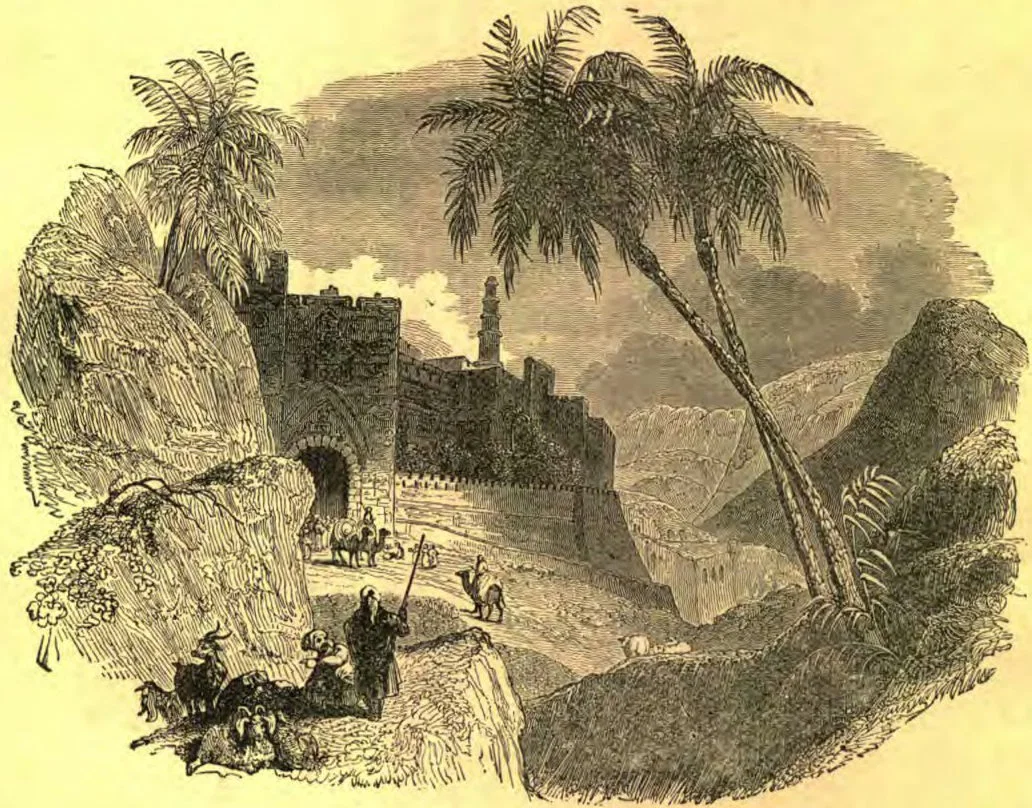
There are five gates in the city wall, all of which are closed at sunset, except the Jaffa Gate, which is left open half an hour longer. The first and most important of these gates is the Hebron Gate, usually spoken of as the Jaffa Gate, and situated on the west side of the city. It is a massive square tower of stone, and is entered by a large archway. A very good view of this gate is given in the picture on the preceding page. All the roads from the south and west of Palestine lead to the Jaffa Gate, which may be regarded as the principal entrance to the city.
The Damascus Gate lies on the northern side of the city. It is the most elaborate of all the city portals, and is quite strongly fortified. The great road to Nablous, Damascus, and northern Palestine and Syria leads from it.
St. Stephen’s Gate is in the eastern wall, a little more than half-way from the southern wall to the northern. A road leads from it through the valley of the Kidron, and thence over the Mount of Olives to Jericho. Herod’s Gate is also in the eastern wall of the city, but it has for a long time been kept closed. Zion Gate, or Gate of the Prophet David, as it is known by the Arabs, is in the southern wall, on the summit of Mount Zion. It is perfectly plain, and has apparently no other importance than to form an outlet to that part of Zion without the walls. This has sometimes been called the Lepers’ Gate, from the numbers of people afflicted with this loathsome disease who have their hovels just to the east of the gate.
But the present walls of Jerusalem are not those which inclosed the city when Jesus was there. It is thought that the city must then have been four or five times as large as it is now. Jerusalem is but a ruin of what it was even in the days of Christ; but so long as Olivet, Zion, and Moriah, Hinnom and Kidron, are there, it will be a sacred place to every Christian heart.
E. B. G.

ATTENTION, SHARP!

A FRIEND of mine was in the office of a gentleman in Philadelphia, when a young man came in for instructions with regard to some business he was to transact. The merchant stated the different points distinctly, but in rapid succession, repeating nothing the second time. There were quite a number of items, and the youth took no notes, but gave the sharpest attention, and then put on his hat and walked out.
In answer to an amused smile on my friend’s face, the other remarked,—
“You think that is rattling off business pretty fast, don’t you?”
“Yes, and the only wonder to me is that the boy can remember a single thing you said.”
“It is all in training. A boy may just as well learn to attend to what you say the first time, and remember it, as to look to have it repeated over and over again, and then quite likely forget half his directions.”
There was a great deal of truth in the remark, and it is well worthy the attention of every young person. It is a great disadvantage to any one to acquire the habit of half-listening, when he is told anything of importance. “Attention, sharp!” should be the motto of every wide-awake boy or girl when taking instructions. It will save many mortifying blunders, and help to win for them a name for ability, which is capital better than bank stock with which to begin life.
The same peculiarities are apt to run all through a person’s character. The inattentive listener is pretty sure to be the inattentive observer. It is an old saying that there are people who “can go through a whole forest and see no firewood.” People of this stamp lose a great deal that might be turned to account by way of personal improvement, and they miss many wayside springs of happiness.—Selected.

A BOY WHO BECAME FAMOUS.

A boy, only six years old, was sailing with his father down the Danube. All day long they had been sailing past crumbling ruins, frowning castles, cloisters hidden away among the crags, towering cliffs, quiet villages nestled in sunny valleys, and here and there a deep gorge that opened back from the gliding river, its hollow distance blue with fathomless shadow, and its loneliness and stillness stirring the boy’s heart like some dim and vast cathedral. They stopped at night at a cloister, and the father took little Wolfgang into the chapel to see the organ. It was the first large organ he had ever seen, and his face lit up with delight, and every motion and attitude of his figure expressed a wondering reverence.
“Father,” said the boy, “explain to me those pedals at the organ’s foot, and let me play!” Well pleased, the father complied. Then Wolfgang pushed aside the stool, and when his father had filled the great bellows, the elfin organist stood upon the pedals, and trod them as though he had never needed to have their management explained. How the deep tones woke the somber stillness of the old church! The organ seemed some great uncouth creature, roaring for very joy at the caresses of the marvelous child.
The monks, eating their supper in the refectory, heard it, and dropped knife and fork in astonishment. The organist of the brotherhood was among them; but never had he played with such power and freedom. They listened; some grew pale; others crossed themselves; till the prior rose up, summoned all his courage, and hastened into the chapel. The others followed, but when they looked up into the organ loft, lo! there was no form of any organist to be seen, though the deep tones still massed themselves in new harmonies, and made the stone arches thrill with their power. “It is the devil himself,” cried the last one of the monks, drawing closer to one of his companions, and giving a scared look over his shoulder to the darkness of the aisle.
“It is a miracle!” said another. But when the boldest of them mounted the stairs to the organ-loft, he stood as if petrified with amazement. There stood the tiny figure, treading from pedal to pedal, and at the same time clutching the keys above with his little hands, gathering handfuls of those wonderful chords as if they were violets, and flinging them out into the solemn gloom behind him. He heard nothing, saw nothing besides; his eyes beamed like stars, and his whole face lighted up with impassioned joy. Louder and fuller rose the harmonies, streaming forth in swelling billows, till at last they seemed to reach a sunny shore, on which they broke; and then a whispering ripple of faintest melody lingered a moment in the air, like the last murmur of a wind-harp, and all was still.
The boy was John Wolfgang Mozart.—Christian Intelligencer.

A STILL DAY IN AUTUMN.

I LOVE to wander through the woodlands hoary In the soft light of an autumnal day, When Summer gathers up her robes of glory, And like a dream of beauty glides away.
How through each loved, familiar path she lingers, Serenely smiling through the golden mist, Tinting the wild grape with her dewy fingers, Till the cool emerald turns to amethyst;
Kindling the faint stars of the hazel, shining To light the gloom of Autumn's moldering halls, With hoary plumes the clematis entwining Where o'er the rock her withered garland falls.
Warm lights are on the sleepy uplands waning Beneath soft clouds along the horizon rolled, Till the slant sunbeams through their fringes raining, Bathe all the hills in melancholy gold.
The moist winds breathe of crisped leaves and flowers In the damp hollows of the woodland sown, Mingling the freshness of autumnal showers With spicy airs from cedarn alleys blown.
Beside the brook and on the umbered meadow, Where yellow fern-tufts fleck the faded ground, With folded lids beneath their palmy shadow The gentian nods, in dewy slumbers bound.
Upon those soft, fringed lids the bee sits brooding, Like a fond lover loth to say farewell, Or with shut wings, through silken folds intruding, Creeps near her heart his drowsy tale to tell.
The little birds upon the hillside lonely Flit noiselessly along from spray to spray, Silent as a sweet wandering thought that only Shows its bright wings and softly glides away. —Sarah Whitman.

FUN WITH A SPIDER.

SPIDERS in many respects are just like other animals, and can be tamed and petted and taught a great many other lessons, which they will learn as readily as a dog or a cat. But you must take the trouble to study their ways, and get on the right side of them.
One day I had been reading how spiders managed to get their webs across streams and roads, and from the top of one tall tree to another. So I went out and caught a large garden spider, one of those blue-gray sprawling fellows, and fixed him up for my experiment.
I took a stick about eighteen inches in length, and fastened a piece of iron to one end of it, so that the stick would stand up on that end of itself. Then I put the stick in a large tub of water, and placed the spider on top of the stick. I wanted to see if he could get to the “land,” which was the edge of the tub, without any help. He ran down first one side of the stick and then the other; each time he would stop when he touched the water, and shaking his foot as a cat does, he would run up again. At last he came to the conclusion that he was entirely surrounded by water—on an island, in fact. After remaining perfectly quiet for a long while, during which time I have no doubt he was arranging his plans, he began running round the end of the stick, and throwing out great coils of web with his hind feet. In a few minutes little fine strings of web were floating away in the slight breeze that was blowing. After a little, one of these threads touched the edge of the tub, and stuck fast, as all spider webs will do.
This was just what Mr. Spider was looking for, and the next moment he took hold of his web and gave it a jerk, as a sailor does a rope when he wishes to see how strong it is, or to make it fast. Having satisfied himself that it was fast at the other end, he gathered it in till it was tight and straight, and then ran on it quickly to the shore—a rescued castaway, saved by his own ingenuity.
Spiders are not fools, if they are ugly; and He who made all things has a care and thought for all. The earth is full of the knowledge of God.—Selected.

THE HIDDEN SERPENT

One bright spring day I walked along the brook-side. All at once a little cluster of violets caught my eye. They were the first I had seen that year. I hastened to gather them, without looking for any danger at hand. But scarcely had my fingers touched them, before a little red forked tongue was shot out toward me. The serpent was there. “Ah,” thought I, “this is the way with many little charming pleasures—they hide a serpent. Every tempting sin hides something more than a snake. Watch, or you will be wounded.”

NEW-TESTAMENT HISTORY.

LESSON 159.—WISE BUILDING ON SURE FOUNDATION.

AFTER showing that the wisdom of men is foolishness with God, Paul speaks of a wisdom which none of the princes of this world can know,—even the wisdom of God, which has laid the plan of salvation, and prepared wonderful things for those who seek light and immortality through Christ the crucified. He tells them that, “Eye hath not seen, nor ear heard, neither have entered into the heart of man, the things which God hath prepared for them that love him.” “But unto us,” says he, “God hath revealed them by his Spirit; . . . which things also we speak, not in the words which man’s wisdom teacheth, but which the Holy Ghost teacheth. . . . But the natural man receiveth not the things of the Spirit of God; for they are foolishness unto him.”
This heavenly wisdom, or mystery of God, cannot be spoken in full, except to those who are perfect, or full-grown in their experience. It has to be revealed gradually, as the growth of grace in the heart fits the learner to comprehend it. So Paul says: “And I, brethren, could not speak unto you as unto spiritual, but as unto carnal, even as unto babes in Christ. I have fed you with milk, and not with meat; for hitherto ye were not able to bear it, neither yet now are ye able. For ye are yet carnal; for whereas there is among you envying, and strife, and divisions, are ye not carnal, and walk as men?”
Again he shows the folly of indulging in the party spirit which they had cherished. Although he has planted, and Apollos watered, it is God that has given the increase. He that planteth, and he that watereth, are one; they are laborers together in building up the church, which is God’s. As a wise master builder, Paul had laid the foundation of faith in Christ; others had built thereon. “But,” says the apostle, “let every man take heed how he buildeth thereupon. . . . If any man build upon this foundation gold, silver, precious stones, wood, hay, stubble; every man’s work shall be made manifest; for the day shall declare it, because it shall be revealed by fire.”
“The precious stones represent the most perfect Christians, who have been refined and polished by the grace of God, and by affliction which they have endured with much prayer and patience. Their obedience and love resemble those of the great Pattern. Their lives are beautified and ennobled by self-sacrifice. They will endure the test of the burning day, for they are living stones.”
“From worldly policy, many endeavor, by their own efforts, to become as polished stones; but they cannot be living stones, because they are not built upon the true foundation. The day of God will reveal that they are, in reality, only wood, hay, and stubble.”
“And the fire shall try every man’s work of what sort it is. If any man’s work abide, which he hath built thereupon, he shall receive a reward. If any man’s work shall be burned, he shall suffer loss; but he himself shall be saved; yet so as by fire.”
“The Christian teacher who faithfully presents the word of truth, leading his converts to holiness of heart and life, is bringing precious material to the foundation; and in the kingdom of God he will be honored as a wise builder. He who neglects to teach the truth in its purity, will gather converts who are not holy in heart and life. He is bringing material that will not stand the test. In the day of God he will suffer loss.”
Of judging one another, Paul says, “Judge nothing before the time, until the Lord come, who both will bring to light the hidden things of darkness, and will make manifest the counsels of the hearts.”
In speaking of personal pride, he warns them against being puffed up, and asks: “Who maketh thee to differ from another? and what hast thou that thou didst not receive? Now if thou didst receive it, why dost thou glory as if thou hadst not received it?”
Lest they should think their way hard, Paul contrasts their condition with his own and that of the other apostles. He says: “Ye are full, ye are rich, ye are honorable; but we are despised; we both hunger and thirst, and are naked, and are buffeted, and have no certain dwelling-place; we labor, working with our own hands; being reviled, we bless; being persecuted, we suffer it; being defamed, we intreat; we are made as the filth of the world, the offscouring of all things, unto this day.”
He says, “I write not these things to shame you, but as my beloved sons I warn you. For though ye have ten thousand instructors in Christ, yet have ye not many fathers; for in Christ Jesus have I begotten you through the gospel.”
He then beseeches them to follow in the ways he has taught them, and promises to send Timothy, his beloved son in the gospel, to help them in so doing. He speaks also of coming himself, shortly, when he will test the worth of them that are puffed up, judging them not by their words, but by their power in the things of God. Then he asks, “What will ye? shall I come unto you with a rod, or in love, and in the spirit of meekness?”

QUESTIONS.

1. What did Paul show with reference to the wisdom of men?
2. Of what wisdom does he then speak?
3. What has this wisdom done?
4. What does he say about the things that God has prepared for them that love him? 1 Cor. 2: 9.
5. Unto whom have these things been revealed? Verse 10.
6. By what means?
7. How do the apostles speak these things? Verse 13.
8. Why cannot the natural man receive the things of the Spirit of God?
9. To whom alone can the mysterious things of God be spoken in full? Verse 6.
10. How do they have to be unfolded to learners in the school of Christ?
11. What does Paul say of the manner in which he has been obliged to teach the Corinthians? Chapter 3: 1, 2.
12. What proof had they given of still being carnal? Verse 3.
13. What does Paul again show them?
14. How does he make it appear that neither he nor Apollos is entitled to the credit of their conversion? Verses 6–9.
15. What is the only true foundation for a Christian character?
16. What does Paul say about different ways of building on this foundation? Verses 12, 13.
17. How will every man’s work be tested?
18. What do the precious stones represent?
19. Who are represented by the wood, hay, and stubble?
20. What promise is made to him whose work shall abide the test? Verse 14.
21. What is said of him whose work shall be destroyed? Verse 15.
22. Who is bringing precious material into this building of God?
23. Who is bringing material that will perish when the test is brought to bear upon it?
24. What does Paul say about judging one another? Chapter 4: 5.
25. In speaking of personal pride, what warning does he give them?
26. What pointed questions does he ask? Verse 7.
27. Why does Paul contrast the condition of the Corinthians with his own and that of the other apostles?
28. What does he say to them?
29. What does he say of himself and those who labor with him in the gospel? Verses 10–13.
30. What does he say of his purpose in writing these things?
31. What does he say of his close relation to them?
32. What does he beseech them to do?
33. What help does he propose to send them?
34. When does he intend to come to them himself?
35. What work does he promise to do at that time?
36. How will he estimate the character of those who are puffed up?
37. By what questions does he impress upon them the importance of reforming at once? Verse 21.

WHAT WILL YOU BE?

We see two boys standing side by side. Both are intelligent-looking and kind-looking; but one becomes an idle, shiftless fellow, and the other an influential and useful man. Perhaps when they were boys, no one could have seen much difference between them; when they were men, the contrast was marked. One became dissolute, step by step; the other became virtuous, step by step; as one went up, the other went down.
It is a question of great moment, What will you be? One determines he will do right, and improve his powers and opportunities to the utmost. He is industrious, learns his business, becomes a partner or proprietor, and is known as a man of influence and power. Another does not determine to be bad, but is lazy, and neglects to improve his opportunities. He shirks work; he “fools around;” next he is seen with tobacco, and probably beer and whisky follow; his appearance shows that he is unhealthy; he does not do his work well, he loses his position, and becomes intemperate and probably a criminal.
There are many to-day who are standing at the parting-place. You can take one path, and you will go down as sure as the sun rises. If you prefer hanging around a saloon to reading good books at home, then you are on the road to ruin. If you do not obey your parents, if you run away from school, if you lie, if you swear, you will surely go down in life.
If a boy steadily improves his time, tries to learn his business, obeys his father and mother, is truthful and industrious, is respectful and pleasing toward others, he will succeed. No one can stop his doing well in life. He has determined that he will be a noble specimen of a man, and every good person will help him.—Scholar’s Companion.

A GOOD EDUCATION.

A good education is that which prepares us for our future sphere of action. A warrior or statesman requires a different kind of school. A lady who has many accomplishments, yet is deficient in the science of housekeeping, has not been well educated. A good education makes us contented with our lot. This was what an ancient philosopher said made him happy in an obscure abode, and, when he was alone, talked with him. A restless and complaining temper proves a bad education. A good education is a fortune of itself. I do not mean that it will always secure wealth; but it brings something better than the gold that perishes, for this may be suddenly lost. Fire may consume it. The thief may take it away. But that knowledge which enriches the mind, which moderates its desires, which teaches us to make a right use of time and promote the happiness of others, is superior to the elements. Fire, air, earth, and water have no power over it. It can use them as servants. It walks with us into the vale of years, and does not leave us till we die, if it does even then.—Selected.

THE TURNING-POINT.

It is easy to get into a wrong road. It is not so easy to get out again. It is said that there are limestone roads in Cuba where the ruts are worn so deep that when the wheels get into them, you cannot get them out till you reach the bottom of the hill. So there are many places where men cannot turn around without turning over.
Now it is much easier to keep out of such ways than it is to get out; and so it is important that the young take the right turning. One wrong step may blast a life; a right course will bring abiding blessing.

Example Is Tenfold More Powerful Than Precept

EXAMPLE is tenfold more powerful than precept.

THE CAT AND THE SMOKER.

We all know about pussy and her playful, prankish family; and many stories are told of the wisdom of the cat.
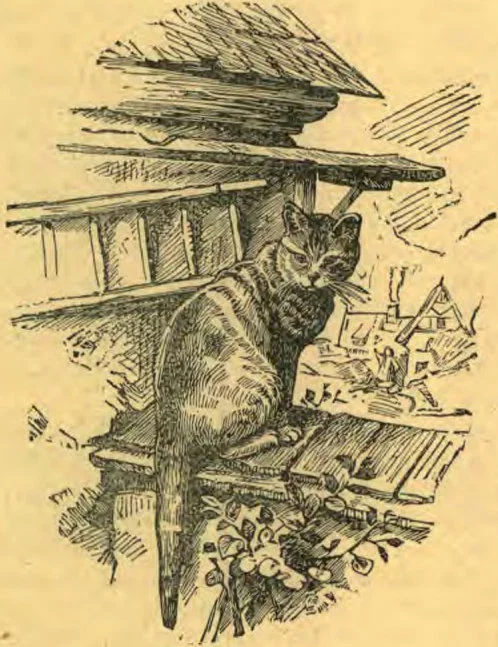
We can tell you a story about a very sensible cat which we know well. She had one kitten, and she had her home in a little room or closet, where her kitten stayed. It was a snug, cosey place, but she did not like her quarters very well.
A stranger came to the house who used to go into this little room every day and smoke. This pussy did not like, as she was a well-bred cat. One day her kitten seemed stupid, and puss thought something must be done at once. So she took her kitten by the neck, and carried it upstairs into a nice, large airy bed-room.
The people who lived there thought that was no place for a kitten, and carried it back. But puss thought differently, and pretty soon the kitten was in the bed-room again. He was carried back time after time, but the wise old cat had no thought of having her kitten learn to smoke; she was a minister’s cat, and was too well brought up to have a smoker in her family; and so she carried that kitten upstairs by the neck five times in one day; finally the people of the house were so amused that they let her put her kitten where she pleased.
So the little chap grew and climbed and frolicked about the house; and when the man who smoked heard about it, and found how the cat and all the rest of the family disliked tobacco smoke, he stopped smoking! So you see even a cat’s good example may be useful.
Did you ever think why we call the cat puss? A great many years ago, the people of Egypt, who have many idols, worshiped the cat. They thought she was like the moon, because she was more active at night, and because her eyes changed just as the moon changes, which is sometimes full, and sometimes only a little bright crescent, or half-moon, as we say. Did you ever notice your pussy’s eyes to see how they change? So these people made an idol with the cat’s head, and named it Pasht, the same name they gave to the moon, for the word means the face of the moon. That word has been changed to pus, and has come at last to be puss, the name which almost every one gives to the cat. Puss and pussy-cat are pet names for kitty everywhere. Who ever thought of it as given to her thousands of years ago, and that then people bowed down and prayed to her?
What a strange thing that the men who built pyramids, and great temples, and obelisks which astonish the world to this day, should worship cats! But the wisest men are but fools without the knowledge of the true and living God.—Sel.

Spiders That Pack Away Their Webs by Day

A GENTLEMAN living in the South says that by watching spiders on his piazza, he saw that they put out their webs at night, but in the morning the webs were gone. After watching early and late, he saw a spider just after day-light slowly wind up his web, pack it away in his mouth, and go off, just like a fisherman taking away his nets.

PLAYING STAGE-COACH.

“ALL wanting the same place makes a great deal of trouble in this world,” said mamma, thoughtfully. “Shall I tell you a little story about it—something I know is true?”
“O yes, do!” chimed the children.
“It is a very sad story, but I will tell it to you,” she went on, “and the next time that you are tempted to be selfish, stop and think of it. Once, long ago, there were four children playing stage-coach, just as you have been doing now, and just like you, they all wanted the first place. Instead of playing on a log, however, they were in the spreading branches of a willow tree.
“‘I want to drive,’ said Lucy, settling herself in the driver’s seat.
“‘No, let me drive,’ and Henry climbed up beside her. ‘Let me sit there.’
“But Lucy did not move.
“‘Let me there,’ repeated Harry, giving her a slight push, and crowding his way on the same branch where she sat. ‘You must let me drive.’
“A moment more, a sudden crash, and they were on the ground. The branch had broken.
“Harry was on his feet instantly, trying to raise his sister, but there was a sharp cry of pain, then she lay very still. Mother and father came running out of the house, and gently lifted the little fainting form, from which the arm hung limp and broken. There was sorrow and crying, but it was too late; nothing could turn aside the weeks of suffering and pain that must be borne before the little girl could take her place again among the other children. I think they all learned a lesson of loving unselfishness in those weary days, each trying who could bring the most brightness and happiness into the dreary hours. I was that little girl, and I learned to appreciate little kindnesses as I had never done before. It was then that I learned something else, too—something I want you all to remember,” and mamma looked long at the little group. “It is, ‘Even Jesus pleased not himself.’”—Selected.

MUSIC BOOKS.

Pearly Portals for the Sabbath-school. By D. S. Hakes. The music in this work is new. The words from the best authors. 160 pp. Boards, 35 cents per copy. Cloth, .50
Song Anchor for the Sabbath-school, praise-service and fireside. 164 pp. Boards, 35 cents. Cloth, .50
Temperance and Gospel Songs. For the use of Temperance Clubs and Gospel Temperance Meetings. Price, .30
Better than Pearls. A new collection of the best Gospel Songs, Hymns, and Tunes for use in Tent and Camp-Meetings, as well as in Revivals, Social and Praise Service. Cloth, 40 cents. Board, .30
Songs for Class and School. For Singing-School, Day-School, Convention and Fireside. 160 pp. $.35
Hymn Book. “Hymns and Tunes for those who keep the Commandments of God and the Faith of Jesus.” It has 537 hymns, and 147 tunes, 416 pages. Muslin Bound, $1.00. Morocco, gilt edges, $1.50
All of the above works will be sent by mail, post-paid, on receipt of prices named. Address,
REVIEW & HERALD, Battle Creek, Mich.
Continue reading: A GOOD RULE