Volcanoes: Causes of Eruptions and Earth's Internal Heat
Page 1
The Youth’s Instructor
June 19, 1902
Review and Herald Publishing Company · Battle Creek, Mich. · June 19, 1902
Volcanoes: Causes of Eruptions and Earth's Internal Heat
By A. Swedberg
Volcanoes
THE wonderful, ofttimes terrible and destructive, eruptions of smoke, fire, and lava from the bowels of the earth, which we call “volcanoes,” are still a mystery as to their immediate causes. It is generally conceded that the greater portion of the earth is a molten mass, surrounded with a hardened crust from ten to forty miles in thickness. In this respect we might compare the earth to an apple, the crust corresponding to the skin of the apple.
The theory that the earth is a molten mass inside is proved by the fact that in digging deep mines, the heat increases as the mine becomes deeper. One man has proposed to utilize this heat by boring two wells near each other to a depth of several thousand feet, and then uniting them at the bottom by an explosion of dynamite. By letting water run down one of these wells, it would be converted to steam by the heat at the bottom, and this steam would rush out of the other well, according to his theory, and could be utilized for industrial purposes.
Some scientists suppose the internal heat is caused by chemical action on a vast scale, due to the action of water on certain elements in the earth’s interior. Others suppose the heat is generated by friction and grinding, as the earth is gradually cooling, and that this grinding motion is severe enough in some places to generate a sufficient amount of heat to cause volcanoes.
Volcanic eruptions generally follow earthquakes, and this has given rise to another theory concerning the cause of volcanoes, which seems more probable. We know that earthquakes often cause fissures in the crust of the earth; and when these happen to be in the bottom of the ocean, large volumes of water rush down with tremendous force into the molten mass in the interior of the earth, and when they come in contact with this, the intense heat instantly converts the water into steam, causing, as we may well imagine, an explosion on a scale utterly beyond the comprehension of man. The tremendous force thus so suddenly developed finds a vent-hole through some already existing volcano, or breaks through the weaker places in the crust of the earth.
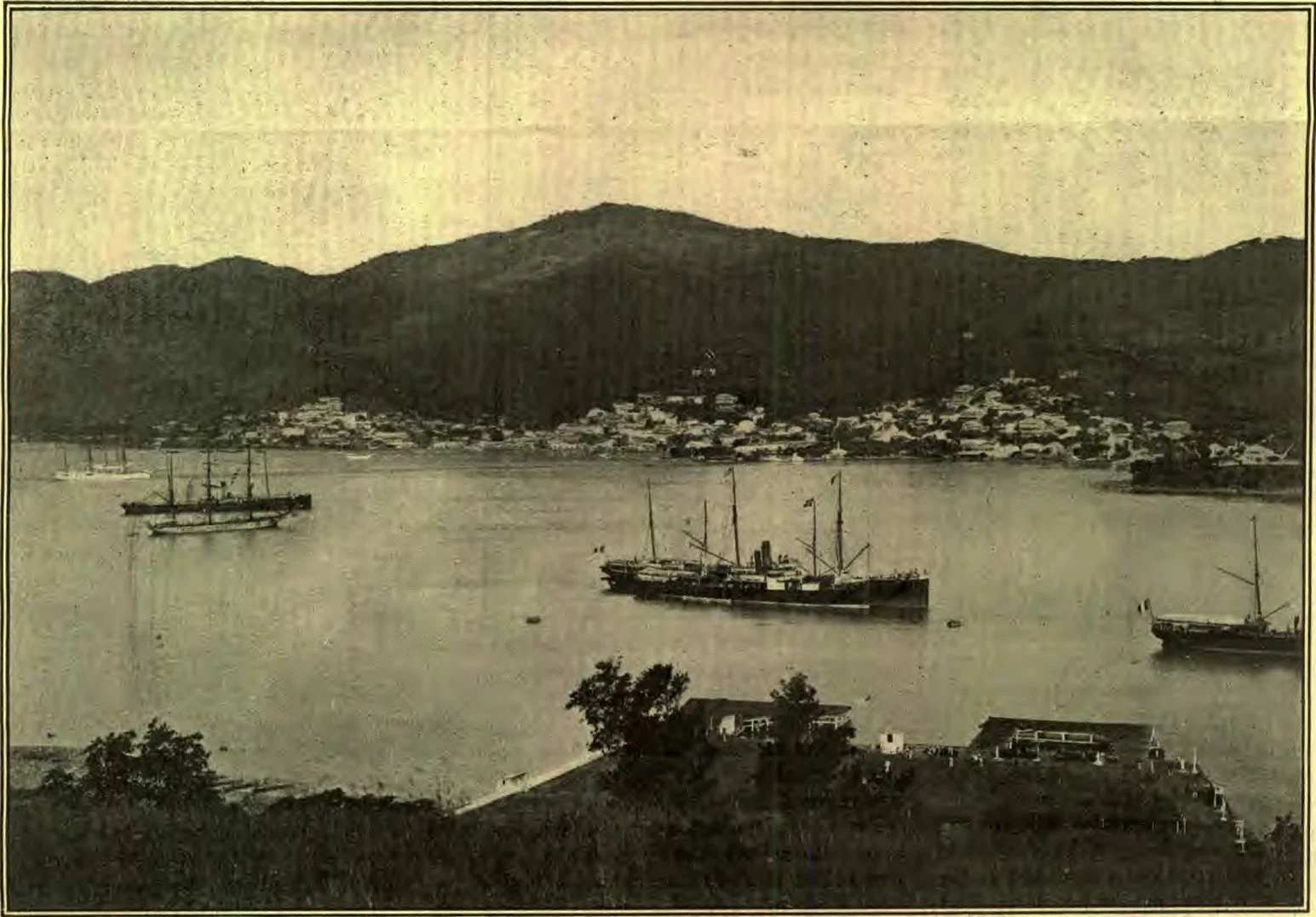
THE THREE HILLS OF CHARLOTTE AMALIE, ST. THOMAS
We have already heard of or read about the late eruptions of the volcanoes on the islands of Martinique and St. Vincent. So terrible and destructive have the eruptions from Mt. Pelée on the first-mentioned island been, that they exceed anything of the kind before described in this world’s history, with perhaps one exception,—that of Krakatoa, on a small uninhabited island near Java in the East Indies. In almost an instant the town of St. Pierre, on Martinique, was overwhelmed on the morning of May 8 by a dense volume of suffocating gas, immediately followed by a cyclone of fire, ashes, and stones from Mt. Pelée. Spectators say that the destruction was complete in from three to ten minutes’ time,—a city had been laid in charred ruins, and thirty thousand men, women, and children asphyxiated and burned to death.
An eye-witness gives the following graphic description of this terrible catastrophe:—
“I was in one of the fields of my estate when the ground trembled under my feet, not as it does when the earth quakes, but as if a terrible struggle was going on within the mountain. A terror came upon me, but I could not explain my fear.
“As I stood still, Mt. Pelée seemed to shudder, and a moaning sound issued from its crater. It was quite dark, the sun being obscured by ashes and fine volcanic dust. The air was dead about me,—so dead that the floating dust seemingly was not disturbed.
“Then there was a rending, crashing, grinding noise, which I can only describe as sounding as if every bit of machinery in the world had suddenly194broken down. It was deafening, and the flash of light that accompanied it was blinding, more so than any lightning I have ever seen.
“It was like a terrific hurricane; and where a fraction of a second before there had been a perfect calm, I felt myself drawn into a vortex, and I had to brace myself firmly. It was like a great express train rushing by, and I was drawn by its force.
“Transfixed, I stood, not knowing in what direction to flee. I looked toward Mt. Pelée, and above its apex formed a great black cloud which reached high in the air. It literally fell upon the city of St. Pierre. It moved with a rapidity that made it impossible for anything to escape it.
“From the cloud came explosions that sounded as if all the navies of the world were in titanic combat. Lightning played in and out in broad forks, the result being that intense darkness was followed by light that seemed to be of magnifying power.”
He hurried home, gathered his panic-stricken family, and all rushed to the seashore, and boarded a small steamship.
Continuing his description, he says:—
“I knew that there was no flame in the first wave that was sent down upon St. Pierre. It was a heavy gas, like fire-damp, and it must have asphyxiated the inhabitants before they were touched by the fire, which quickly followed. As we drew out to the sea in the small steamship, Mt. Pelée was in the throes of a terrible convulsion. New craters seemed to be opening all about the summit, and lava was flowing in broad streams in every direction. My estate was ruined while we were still in sight of it.”
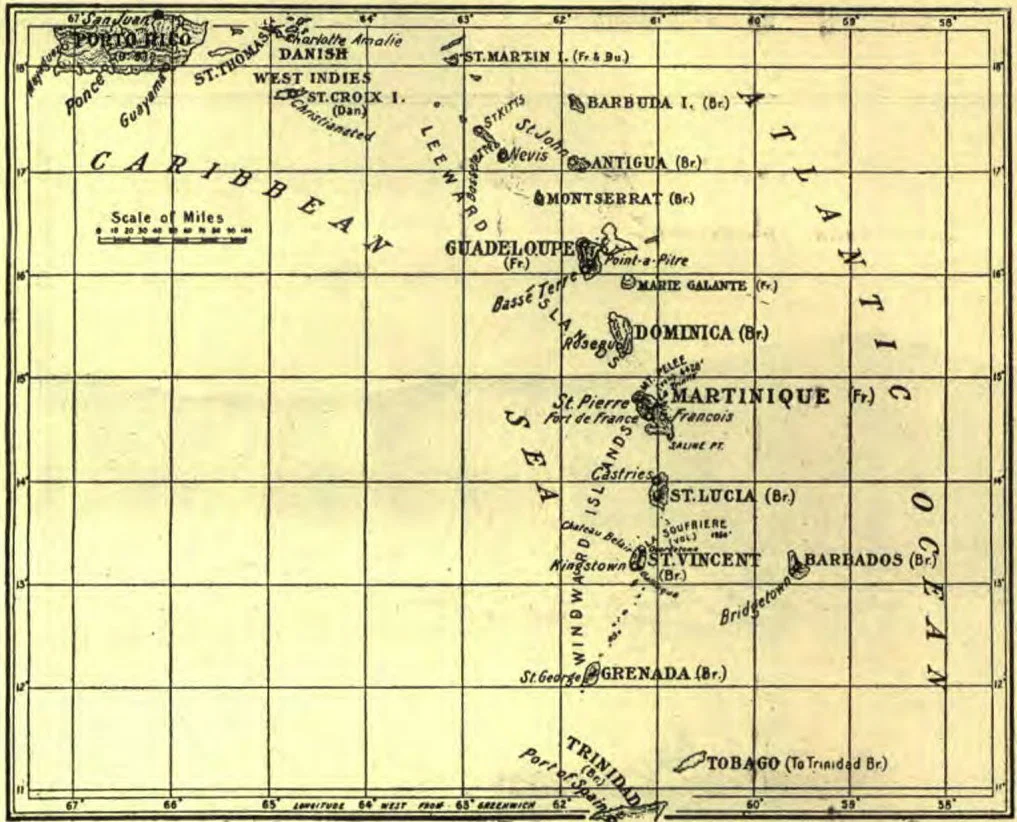
ISLANDS OF THE CARIBBEAN. THERE ARE SABBATH-KEEPERS ON THE ISLANDS OF ST. THOMAS, ST. KITTS, ANTIGUA, ST. LUCIA, ST. VINCENT, BARBADOS, AND TRINIDAD.
On this occasion, stones weighing thirty pounds fell in Fort de France, fifteen miles away from the crater. A later eruption is described as ten times worse, so frightening the people in Fort de France, that a general exodus from that place and, in fact, from the entire island, began to be seriously thought of; and even the French government, which has this island under its sway, has taken into consideration the depopulation of the island. The prospects now are that this beautiful island, the most densely populated of all the West Indies, having one hundred and ninety thousand inhabitants on an area only twelve by forty miles, will be entirely ruined and forsaken on account of this terrible revolution in nature.
It was the 27th of August, 1883, that the most terrible eruption ever recorded in history occurred on the island of Krakatoa. This island was only five miles long, situated between Java and Sumatra in the East Indies. For three months prior to the eruption, seismic disturbances had been of frequent occurrence in the regions referred to. On the date mentioned a fissure was caused in the vicinity of this island; and when the sea water rushed down, the resulting steam caused an explosion of such tremendous force that half the island to the depth of several hundred fathoms, consisting of millions of tons of matter, was literally lifted upward in the air to a height of two miles. The fragments descended ten miles away, and formed two new islands, called Steers and Calmeyer.
A column of lava and stones was forced twenty miles skyward, and the explosion was heard at points four thousand miles away, at Honolulu, Cape Town, and Auckland. So overwhelming was the noise, that it surpassed the hearing capacity of the human ear within a radius of many miles.
The immense opening caused by the removal of half the island was immediately filled with the inrushing ocean; but this caused a reaction that forced huge waves back on the islands near by. Many miles of shore-land were inundated by these waves, and thirty thousand persons were drowned. These waves pursued their course around the world four times before they became imperceptible.
The atmospheric disturbances were no less remarkable. The barometer rose and fell as never before, and the wave of disturbance went three times around the world before the equilibrium was restored.
For two years following this eruption there were brilliant red sunsets, such as were never seen before, caused by a gradual settling of volcanic dust, or “cosmic matter,” of which immense quantities had been forced into the upper regions of the atmosphere by this tremendous eruptive explosion.
Such are some of the forces of nature which have manifested themselves in small localities on this mundane sphere. What will it be when the general destruction occurs at the end of the world, when the thin, quivering crust of the earth crumbles all around the whole world, and the inner fires burst forth in one general conflagration, which shall melt the earth with fervent heat, and destroy all the inhabitants and works of man thereon! God grant that we, ere this occur, may have found a safe retreat in the heavenly city with God, our Father, and Jesus, our king.
A. SWEDBERG.
Battles between Truth and Falsehood
Lesson XI—Liberty Lost
(June 22–28)
How to Study the Lessons.— (1) Read the lesson story; (2) try to recall or find scriptures in proof of each statement; (3) study the texts; (4) see how many missing links you can supply; (5) give the lesson to some one else. You will keep only what you give away.
God intended man to be a king. Not only was he to have dominion over the earth, but he was also to rule himself. All the faculties of mind and body were in complete subjection. He possessed perfect self-control. He could do whatever he pleased. His power of choice was perfect. It was just as easy for him to do right as it is now for us to do wrong. He was given noble powers of mind, that could appreciate right, truth, and justice.
God would not rule men by force. He desired man to do the right from choice.
By his rebellion, Satan had lost all right to any place in the universe of God. He would not be allowed to rob man by force.
Man chose to disobey God, and yield to the leading of this stranger, who had accused the loving Creator. Thus man lost his freedom, and became a slave. His fair dominion became the spoil of a robber chief. Since then a tyrant has been prince of this world. For nearly six thousand years the earth has been cursed by the reign of a murderer.
THE gospel possesses both inherent vitality and aggressive power. That was no unmeaning petition of our divine Redeemer when he prayed for his disciples: “Sanctify them through thy truth.” Divine truth, applied by the Spirit of God, has elements to humble human pride, to alarm and subdue the sinner, to convince and convert, to sanctify and save the soul. As God liveth and is just, his truth shall never fail. Every enterprise for its vindication and victory shall grow, and gather strength, and finally triumph. The sympathy and efforts of those who love it, and the grace and power of him who gave it, are a certain pledge of victory.
Did not the Reformation of the sixteenth century begin with a cloistered monk? And yet it swept gloriously over Europe, and its genial, vitalizing power and results still meet us on every hand. Was not Christianity itself cradled in a manger, and crucified on Calvary? Yet to-day195it is fresh as the morning, and going forth in the strength of omnipotence to subdue the earth.
O, this mighty truth of God! Drop it into all soil; it will not be in vain. “By manifestation of the truth commending ourselves to every man’s conscience in the sight of God.” 2 Cor. 4:2. Thank God, too, all true-hearted service in the cause of Christ is closely linked with this divine truth. Like a sweet tone of music, it vibrates in harmony with divine purposes, and its melody will be prolonged forever.
This truth of God has elements fitted to vitalize heathen hearts, and animate them with spiritual life. Not only is it pure and elevating, just and holy, in all its requirements, but its effects on the human soul attest its divine origin. Shall we give our sympathies and prayers and means to carry this truth to every nation, and kindred, and tongue, and people?
O, if Christians but realized their privilege, if they considered what it is to give brightness to their crowns of rejoicing in the day of the Lord Jesus, who would not count it all joy to bear a part in efforts to win the perishing to Christ? Who would not pour out his money like water, and lay his choicest treasures, nay, even life itself, at the foot of the cross?
What a glorious work is ours!—to give effect to the yearnings of divine love; to be the organs and instruments of the redemptive purpose of God; to be associated with Christ in the salvation of the lost; to pluck men as brands from the burning, and to hold them aloft as torches for the progress of the King; to hasten the glad day of his second coming; to be his heralds and ambassadors! O, who would not, like the disciples of old, gladly “forsake all” to do this work which he has committed to our charge, and for which he holds us responsible?
Joseph S. Johnson.
Anemonella Thalictroides
By B. E. Crawford
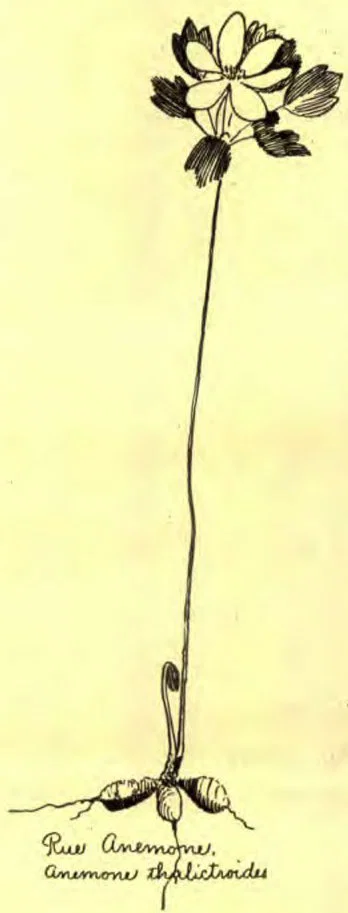
Rue Anemone
Description. — Corolla absent; sepals five to ten, white or pale-purple; flowers several, forming an umbel, surrounded by an involucre of two ternate leaves; stem six to eight inches high. All the leaves are radical except those forming the involucre, and biternate or triternate, with the leaflets roundish, and three-lobed at the end. Roots clustered and very fleshy.
The umbel is quite a common form of flower cluster. The flowers are all borne on separate pedicels, which spring apparently from the same point at the tip of the peduncle, and diverge more or less so as to resemble the rays of an inverted umbrella. It is this resemblance that has given the name “umbel” to this form of inflorescence.
The involucre of the Rue Anemone is apparently formed of simple leaves, usually six in number; but if carefully examined, it will be found that they are united near the stem into two sets of three each, or a third set may be found present in some cases.
As stated in one of our previous studies, a ternate leaf is a compound leaf consisting of three leaflets. If each of these three leaflets is divided into three other leaflets, the leaf is biternate, or twice ternately compound. If the same division again takes place, the leaf is triternate, or thrice ternately compound.
It should be noted that the expression “ternately divided” is used with reference to divided simple leaves, as explained under the heading “Anemone Patens,” while the expressions “biternate,” “triternate,” or “ternately compound,” are used with reference to compound leaves.
Radical Leaf
of
Anemonella
thalictroides
The Rue Anemone is a delicate plant of early spring, blossoming in April and May. It grows in the woods, and seems to prefer the neighborhood of the spreading roots of old trees. In appearance it quite closely resembles anemone nemorosa, or wood-anemone, but is easily distinguished by the fact that the flowers are borne in clusters instead of singly.
Anemonella is the diminutive form of anemone, and thalictroides means resembling thalictrum, or meadow-rue. Of the latter there are several species. Some are large plants ten or eleven feet high, while others are only a foot or two in height. They have small, greenish-white flowers, and leaves which are three or four times ternately compound. The leaflets bear a striking resemblance to those of the rue anemone.
It will thus be seen that anemonella thalictroides has been well named, meaning, literally, a little anemone resembling thalictrum, or meadow-rue. B. E. CRAWFORD.
The Difficulty of a Front Lawn
By Caleb Cobweb
DURING most of my life I have lived in the beautiful blue-grass region that stretches from the Blue Grass State of Kentucky up into Ohio. Until I moved to Massachusetts, I never knew how to appreciate grass. But now—O, the lovely blue-grass country! O, the long, delicate blades, so thickly set together, so fresh, so luxuriant, so dependable!
For now I live on a gravel bank in rock-ribbed New England. The lady from whose husband I bought the house told me before I bought it, that it would be much easier and cheaper to carpet the front yard with Turkish rugs than try to grow grass there.
Year after year the grass has degenerated. My front lawn is now a botanical museum, with samples of almost every plant except the proper grass, though there is wire-grass in vicious abundance. But daisies and dandelions, buttercups and wild strawberries, and especially moss, have made it their own. I asked a professional the other day to look over those few square feet, and estimate the cost of transforming them into smooth green turf, and he figured it at two hundred dollars. I must dig up the gravel to the196hard-pan, I must cart in some hundred loads of good loam. I must sow clean grass seed of a good variety. I must weed. I must cut. I must water. I must roll. I must enrich the soil to replace what the millions of little roots take from it. And if I do all this, and keep doing all this, I shall get and keep a good lawn. Not otherwise.
It is a parable, is it not? of what is happening all around us in numberless lives. What is the age at which the boys and girls drop out of our Sabbath-schools, and fall away from the influences of Christian homes? Whatever the age, it is when they are left alone, just as for the past few years I have been leaving my front yard alone, expecting it to run itself, like a blue-grass lawn in Ohio. The church has lost its grip on them. So has their Sabbath-school teacher. So has their pastor. So have their father and mother. The good soil is washed away by the cold rains. Good grass changes to wire-grass. The seeds of a thousand weeds find lodgment. Before long there is nothing but an unsightly expanse of dirt and stones and ragged plants—wild oats in very sooth. And we must tear up the soil. We must entirely reconstruct the lawn. At the cost of no one knows how many revivals, how many heartaches, how much pleading, how many agonized prayers, how many failures and tears, we must try to make these poor barren lives over again into gardens of the Lord.
And it would have been so much better to have kept on caring for them all along.—Caleb Cobweb, in Christian Endeavor World.
I Don't Pinch the Baby
A FEW months ago I heard a simple story that revealed to me some of the things we mean when we say, “Christianity is a life, not a profession.”
One of the international secretaries of the King’s Daughters was walking along one of the streets of New York when she saw a little girl coming toward her wearing upon her breast one of the society’s little silver crosses. The girl was poorly dressed, and it was evident that she belonged to the “slums.”
The kind-hearted woman stopped the girl, and said, “My child, what is that you have on your dress?”
“The silver cross, ma’am,” she answered; “I am a King’s Daughter.”
“You a King’s Daughter! What do you know about being a daughter of the King?”
“Well,” she replied, “I don’t pinch the baby any more, anyway.”
“You don’t pinch the baby?” said my friend, getting a little closer. “What do you mean by that?”
“Why, up to the mission our teacher wanted us to be King’s Daughters, and do good like the King wanted us to; and I joined the society. I mind the baby at home, and I don’t pinch him any more, now. I play with him good.”
This interesting testimony led my friend to get at the exact facts. It seems that this little girl used to “mind the baby” while her mother did washings. The baby was fretful; and in order to control it, this cruel-hearted sister had been in the habit of “pinching the baby.” But at the mission she had learned about the love of Jesus, and had become a “King’s Daughter.” The only way she knew of to demonstrate her sincerity was by refraining from pinching the baby. Certainly the Christ-Spirit had changed her, and she was doing what she could.
Here is something of value for us all to imitate in daily life.—Christian Endeavor World.
The Quest
By Eudora S. Bumstead
There once was a restless boy
Who dwelt in a home by the sea,
Where the water danced for joy,
And the wind was glad and free;
But he said, “Good mother, O! let me go;
For the dullest place in the world, I know,
Is this little brown house,
This old brown house,
Under the apple-tree.
“I will travel east and west;
The loveliest homes I’ll see;
And when I have found the best,
Dear mother, I’ll come for thee.
I’ll come for thee in a year and a day,
And joyfully then we’ll haste away
From this little brown house,
This old brown house,
Under the apple-tree.”
So he traveled here and there,
But never content was he,
Though he saw in lands most fair
The costliest homes there be.
He something missed from the sea or sky,
Till he turned again, with a wistful sigh,
To the little brown house,
The old brown house,
Under the apple-tree.
Then the mother saw and smiled,
While her heart grew glad and free.
“Hast thou chosen a home, my child?
Ah, where shall we dwell?” quoth she.
And he said, “Sweet mother, from east to west,
The loveliest home, and the dearest and best,
Is a little brown house,
An old brown house,
Under an apple-tree.”
— Eudora S. Bumstead.
A Chapter from the Life of a Wood-Duck
By Floyd Bralliar
As the sun began to warm everything into new life after the winter’s sleep, before the snow was gone, or even all the ice had broken up in the river, a steady procession of wild fowl began to move northward. The timber along the Skunk River had not then been cut down to any extent; therefore the ponds were full of water, and rushes and sedges grew in abundance. Snails and water-bugs abounded among the watercress, and even wild rice could be found in some places. There were shocks of corn still in the field, and acorns were abundant. Flock after flock of ducks passed over day and night, while every few moments could be heard the hoarse honk! honk! honk! of the wild geese as they steered their course to the nesting-grounds of northern Iowa and Minnesota. Now they must travel another thousand miles.
Of this never-ending procession it was no wonder that thousands stopped to feed and rest a while in the bottoms of the Skunk.
The Black Hawk mill had stood for years on the banks of this river, and ground feed for the neighborhood. Below its dam, where the water eddied, was a great deal of wheat and corn, washed there from the mill sweepings. Here came a flock of wood-ducks for their daily meal; and as other and larger varieties were in abundance, they were not disturbed.
On the bank opposite the mill stood a tree whose top had been broken by the wind. In this snag two of these ducks decided to rear their brood, instead of going farther northward. So they brought a little dried grass, plucked a few feathers from their own breasts, and made a nest. Here the mother laid a whole nestful of eggs.
By this time the other ducks had either gone on to the north, or chosen homes of their own, so this pair was left alone. From the house on the hill above the mill it was interesting to watch them. Every morning the mother duck would leave her nest, and fly quacking to the mill-pond, there to join her mate, and eat her breakfast. Then he was on the alert for anything to disturb the nest. If a hawk dared to come near, he would meet it in the air, and drive it far away. Things were progressing nicely, and the mother duck felt herself secure in leaving her nest at will, sure that it would be protected; but one day her mate disappeared. Whether he was shot, or caught by a hawk, or eaten by some wild beast, I never knew; but he was gone.
Now she was more cautious; and as the time for her eggs to hatch approached, she hardly left the nest. Finally twelve little ducklings climbed out of twelve eggshells, and in baby-duck language called her “mother,” and began clamoring for a good swim and something to eat. How to manage this was a problem. The water had fallen until it was a considerable distance to a desirable swimming place, and her babies could never walk there, even if she had them on the ground. If only her mate were there!
But something must be done at once. Her children had already been in the nest a day and a half; they must have a good feed before night, and it was now noon. So she flew out over the water, and selected a place that was comparatively still, yet deep enough to be out of danger of turtles,—the most dreaded foe of the mother duck; for they come unseen, and darting up from beneath, pull the helpless duckling under the water before he is aware of his danger. After taking a cautious survey of the situation, to be sure no hawk was in sight, she went to her nest; and grasping a duckling in her bill, by the back of the neck, flew out over the river, and dropped it into the water. She returned to her nest again and again until the twelve were in the place selected. As the ducklings splashed into the water, they huddled up into a little bunch, and swam round and round.
A hawk drew near, and his presence gave the mother considerable alarm, but just then her worst enemy, a man, stepped out on the mill porch, and the hawk withdrew. For once the duck was thankful to see a man. Nevertheless she feared that same man more than any other danger, so she hastened as fast as possible to get her last baby on the water. Then she alighted also, and together the little family paddled away down the river, and into the rushes around the bend. Here, where food was plenty, they joined the family of a widowed neighbor, and were safe.
FLOYD BRALLIAR.
Our Share
By Wells Spring
SOME one has recently written a paper on “What Our Homes Do for Us.” It might be well for many of us to turn the subject about, and inquire what we do for our homes. Have you ever thought to ask that question, you younger members of the household?
Home is a place to go when school is over; a place in which to study, eat, and sleep; a place to run into for repairs of torn garments and wounded feelings, where one can be sure of sympathy, appreciation, and comfort generally; a place to invite friends to talk over one’s plans or spend the night. It is the most desirable place on earth when one is sick, tired, or discouraged. Somebody’s love and work bring in money to provide all its comforts and conveniences. Somebody’s work and loving thought expend, arrange, foresee, and keep all the countless wheels moving.
All this, and a hundred times more, your home is to you, and has been for years. What are you doing in return? You turn to it for rest and cheer, but are you doing your part toward making it restful and cheerful for others? Do you bring your portion of brightness to the table and the hearth? Have you learned to leave your moods and your selfishness with your umbrella and your overshoes in the hall? Are you ready to give others the quick sympathy and encouraging word that mean so much to you? Think about it.—Wells Spring.
I Will Trust in Thee
By Elizabeth Rosser
MAN is born to trouble as the sparks fly up,
And in all earthly comfort it were vain to hope;
Yet there's one sure Helper in adversity,
“What time I am afraid, I will trust in thee.”
Though all comforts shall flee, and afflictions come,
Though my loved ones are laid in their long, long home,—
If the everlasting arms be under me,
“What time I am afraid, I will trust in thee.”
When my life is spent, and my strength doth fail,
And I walk through the shadows of death's dark vale,
Thy rod and thy staff, they shall comfort me:
“What time I am afraid, I will trust in thee.”
And when by Jordan's brink at last I stand,
If thou abide with me, and hold my hand,
I'll say, though all thy billows go over me,
“What time I am afraid, I will trust in thee.”
ELIZABETH ROSSER.
Wonderful Lenses
One day, a group of college students, visiting the unassuming shops in which lenses are made, stood, half carelessly, before a huge lens, forty inches in diameter and nearly an inch thick. The maker pointed to it with pride, but cautioned his visitors not to touch it.
“How long did it take the glass works to make this disc ready for polishing? Six months?” A student asked the question as if he himself was giving the information.
“It took four years,” said the telescope-maker, quietly. “The workmen failed many times before they succeeded.”
The boys uttered an exclamation of surprise and incredulity.
“And how long will it take to polish it?” asked another.
“Two years. This forty-inch lens has a fifty-foot focus; that is, it must catch the rays of a star upon every point of its surface, and refract them to a common point exactly fifty feet away. If one ray falls but the breadth of a hair from that focal point, the glass is defective.”
“But how can you do it?” asked one of the group, sobered by the thought of such a problem.
“With patience and without machinery,” replied the lens-maker. “It is all done with the trained eye and a deft hand. A dab of beeswax here, a bit of rouge there, or the pressure of the thumb on the defective spot—that is all.”
“Thumb!” exclaimed the thoughtful student. “Can you wear that flinty glass down with the bare thumb?”
The maker of the lenses, seeing that this student was the one in twelve,—the earnest boy, the real seeker after truth,—took him into another room, and, walking up to a table, showed him a lens that had been laid aside because it was imperfect. Then the master gave the tempered glass a few sharp rubs with the thick of his thumb.
“If that had been a perfect lens,” he said, with an authoritative smile, “those rubs would have changed its shape enough to ruin it, perhaps beyond remedy.”
A recent writer, telling this incident, says: “We find the heart of the telescope and the heart of man have many ways in common. It takes years of toil and patience to perfect either. Which needs the finer polishing—the lens or the soul? The one is made to reflect the stars; the other, God himself.”—Young People's Weekly.
The Missionary Potato
It wasn’t a very large church, and it wasn’t nicely furnished. No carpet on the floor, no frescoing on the walls; just a plain, square, bare, frame building, in southern Illinois. To this church came James and Stephen Holt every Sunday of their lives.
On this particular Sunday they stood together over by the square box-stove, waiting for Sunday-school to begin, and talking about the missionary collection that was to be taken up. It was something new for the poor church; they were used to having collections taken up for them. However, they were coming up in the world, and wanted to begin to give. Not a cent had the Holt boys to give.
“Pennies are as scarce at our house as hens’ teeth,” said Stephen, showing a row of white, even teeth as he spoke. James looked doleful. It was hard on them, he thought, to be the only ones in the class who had nothing to give. He looked grimly around on the old church. What should he spy, lying in one corner of a seat, but a potato.
“How in the world did that potato get to church?” he said, nodding his head toward it. “Somebody must have dropped it that day we brought things here for the poor folks. I say, Steenie, we might give that potato. I suppose it belongs to us as much as to anybody.” Stephen turned and looked thoughtfully at the potato.
“That’s an idea!” he said, eagerly. “Let’s do it!”
James expected to see a roguish look on his face, but his eyes and mouth said: “I’m in earnest!”
“Really?” asked James.
“Yes, really.”
“How? Split it in two, and each put half on the plate?”
“No,” said Stephen, laughing; “we can’t get it ready to give to-day, I guess; but suppose we carry it home, and plant it in the nicest spot we can find, and take extra care of it, and give every potato it raises to the missionary cause? There’ll be another chance; this isn’t the only collection the church will ever take up, and we can sell the potatoes to somebody. Shall we?”
Full of this new plan, the boys went into the class looking less sober than before; and though their faces were rather red when the box was passed to them, and they had to shake their heads, they thought of the potato, looked at each other, and laughed.198
Somebody must have whispered to the earth and the dew and the sunshine about that potato. You never saw anything grow like it! “Beats all,” said Farmer Holt, who was let into the secret. “If I had a twenty-acre lot that would grow potatoes in that fashion, I should make my fortune.”
When harvesting came, would you believe that there were forty-one good, sound, splendid potatoes in that hill? Another thing: while the boys were picking them up, they talked over the grand mass meeting for missions that was to be held in the church next Thursday,—an all-day meeting. The little church had had a taste of the joy of giving, and was prospering as she had not before. Now there was a big meeting, to which speakers from Chicago were coming. James and Stephen had their plans made. They washed the forty-one potatoes carefully; then they wrote out, in their best hand, these sentences forty-one times:— “This is a missionary potato; its price is ten cents; it is from the best stock known. It will be sold only to one who is willing to take a pledge that he will plant it in the spring, and give every one of its children to the missions. Signed, James and Stephen Holt.” Each shining potato had one of these slips smoothly pasted to its plump side.
Didn’t those potatoes sell, though! By three o’clock on Thursday afternoon not one was left, though a gentleman from Chicago offered to give a gold dollar for one of them. Just imagine, if you can, the pleasure with which James and Stephen Holt each put two dollars and five cents into the collection that afternoon. I’m sure I can’t describe it to you. But I can assure you of one thing: They each have a missionary garden, and it thrives.—The Pansy.