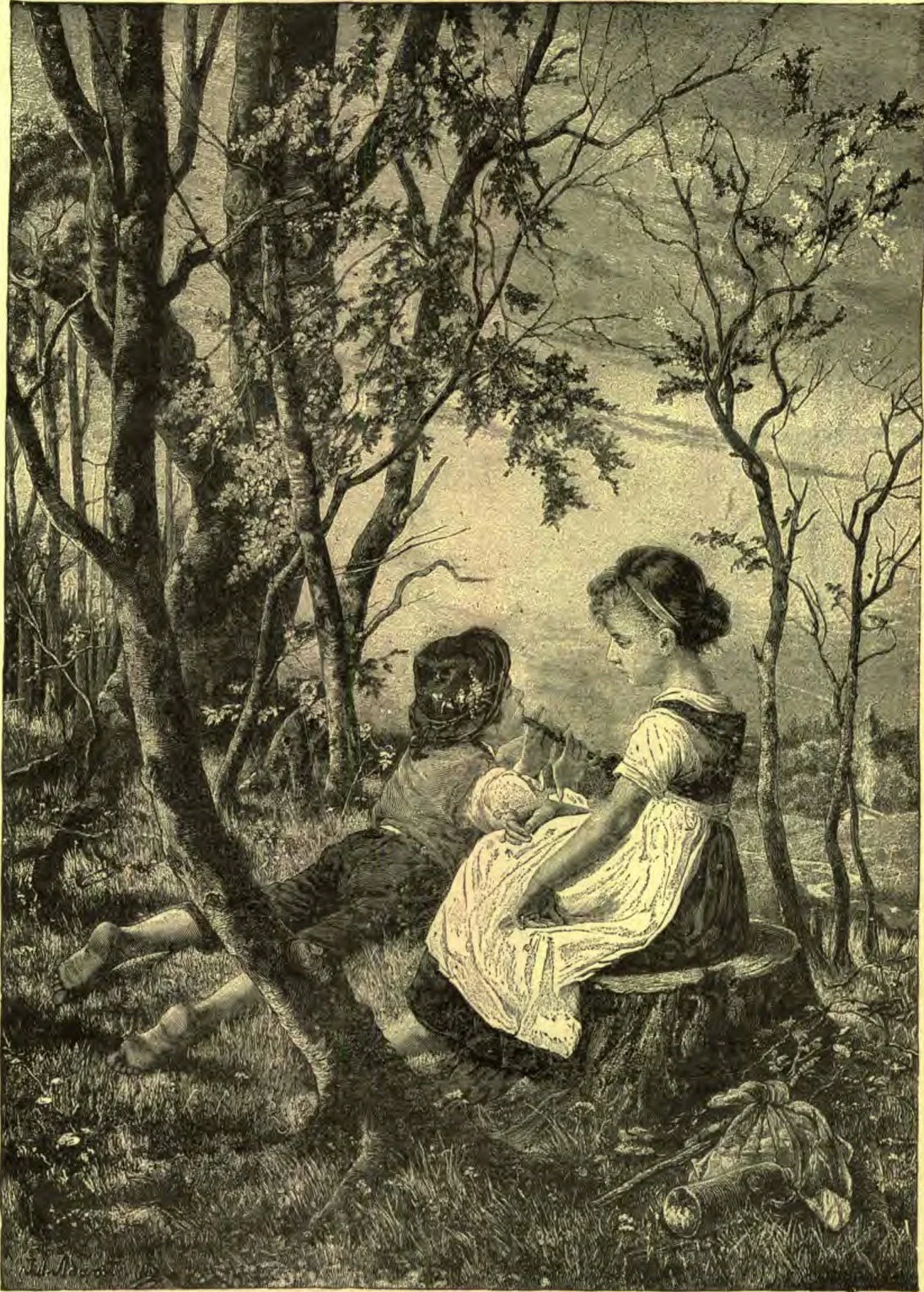
A GENTLE boy, a manly boy,
Is the boy I love to see;
An honest boy, an upright boy,
Is the boy of boys for me.
The gentle boy guards well his lips,
Lest words that fall may grieve;
The manly boy will never stoop
To meanness, nor deceive.
An honest boy clings to the right
Through seasons foul and fair;
An upright boy will faithful be
When trusted anywhere.
The gentle boy, the manly boy,
Upright and honest, too,
Will always find a host of friends
Among the good and true.
He reaps reward in doing good,
Finds joy in giving joy,
And earns the right to bear the name —
“A gentlemanly boy.”
— H. L. Charles.
A Sad Sight
By T. E. Bowen
NOT long ago, while passing a farmhouse on a cross-road running in the rear of the buildings, I saw a sad sight. A mother and twelve-year-old boy were carrying something in a large basket to the farther end of the orchard. It was very still, and I could hear all the boy said, and see his actions. The mother was talking in a low tone, but the rude lad’s replies were plainly heard: “I shan’t;” “You bring it in yourself;” “I won’t;” were some of the shameful words that fell from his lips. When the two had reached the place for emptying the basket, he jerked it from his mother’s hand, and threw it upon the ground, at the time uttering the expressions mentioned and others of like nature.
I passed on, yet the picture of that scene lingered. What a pity that a home should thus be despoiled, and its comfort and peace destroyed.
Young reader, may there never be recorded by your angel such unkind words spoken to your mother as this boy uttered to his. When you think no one hears, do not forget that God hears. The mother who watches over you, and lovingly spends her life in caring for you, should never hear from your lips an unkind word. It may not be too late to repair her broken spirit if it has thus been grieved. Christ has power for you to overcome this great evil if it has taken root in your nature.
As you are in your home, so are you regarded in heaven. If your presence in the home brings comfort and peace, you may safely be introduced into the heavenly home on high. Never think it “smart” to injure the feelings of your mother. Truly honor her. You can never pay the debt of kindness due her. Though you may have the advantage of a better education, it is very likely she will always know many things in advance of you. God marks well how children treat their parents. The command to honor father and mother is the only commandment containing a promise for eternal life.
T. E. Bowen.
JUNE DAYS
The Link Chain
By J. Edgar Ross
THE link chain, though very simple, is neat and serviceable; and if any of the boys of the INSTRUCTOR family wish to make a watch-chain for their own use, I would advise them to try this one.
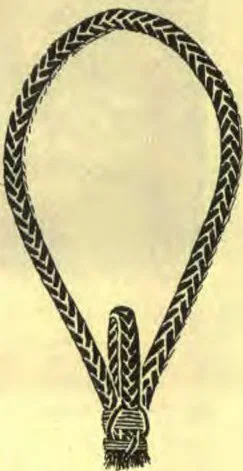
Make the braids of alternate black and white strands. Each strand should contain about eight hairs. That is rather indefinite so far as it affects the size of the braid; for horsehair varies not a little in size. But eight hairs of the average size will make the strands about right. The finished links, one of which is shown in Fig. 10, should measure about an inch and three fourths in length. To make them, a braid four inches long will be required, as the ends must be slightly overlapped in the middle of the link. A long braid may be cut into the required lengths; but you must remember to tie the braid on each side of the place where it is to be cut, to prevent the strands from unbraiding. No special directions for making this chain will be needed, as each link is made like the illustration, and they are linked together like any other chain. An extra link may be added for a charm, and it may be attached to the watch by springing the ring of the latter, or by putting a loop like that shown in Fig. 9 a few weeks ago on one end of the chain. The other end may be slipped over the vest button.
Fig 10.
The Heart-Shaped Fob
This attractive little ornament is simple in appearance, but somewhat complicated when you come to put it together. Fig. 11 shows the fob completed, but if no charm is to be worn on it, another heart might be added without making it too long, and the link at the end could be replaced with such a loop as that shown in Fig. 9.
Fig 11.
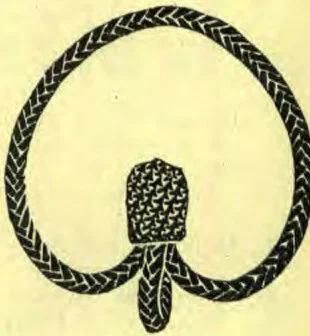
To make the heart itself, a braid five inches in length is used. This is doubled, and the ends are sewed together. Now take another piece of braid of the same size, but only an inch long, to make the loop upon which the second heart is hung. Pass this short piece through the loop made with the long braid, and sew the ends even with the ends of the latter, as shown in Fig. 12. Next cover the ends, where they have been sewed together, with needlework. Now take the braid that makes the long loop, and twist it half-way around, so as to bring the side that was on the inside of the loop to the outside. This will bring the small loop to the outside, as shown in Fig. 13. All that is now necessary to finish the heart is to bring the braid together at the point marked a in Fig. 11, and fasten it there with a narrow ring of needlework. The other heart, or hearts, as the case may be, are made in a similar manner; but before sewing the ends of the long braid together, it is passed through the small loop below the first heart. A charm may be attached to the small loop below the last heart.
Fig 12.
Fig 13.
In braiding hair for this purpose you must be careful not to let the braid become twisted, or the hearts will not “shape;” and if they are not true when they are first made, no amount of coaxing and twisting will make them so. J. EDGAR ROSS.
THE INTERMEDIATE LESSON
XIII — Review
(June 28)
READ carefully the first three chapters of the book of Genesis.
Jesus Christ is the Beginning of the creation of God, the Word that in the beginning created the heavens and the earth and all things therein.
He worked by the Holy Spirit, which moved upon the empty, shapeless world, and brought forth everything perfect and beautiful, according to his word.
The first day Jesus commanded the light to shine out of the darkness, and made the day and night. So he is the Light of the world.
The second day he breathed between the waters, and divided them, and spread out the firmament as a tent for his creatures to dwell in. “In him we live, and move, and have our being.”
The third day he gathered the waters together, making the seas and the dry land. His word is still holding the seas in the place he founded for them, and gathering the waters of the earth into them. On their way they refresh the dry land, and give drink to all creatures. Jesus is the Fountain of living waters.
On the third day also he sent his word into the earth, and from this living Seed the grass, plants, and trees sprang up all over the earth. These he made not only to beautify the earth, but also to be the storehouses through which he could give food to man and bird and beast. Jesus is the Bread of life, and all things live by the word that proceeds out of his mouth.
The fourth day God made the sun, moon, and stars, to be the bearers of his light to this world—to rule the day and night, the months and seasons. These are still preaching the gospel to the ends of the earth, declaring the good tidings that Jesus upholds and guides all things by his power and wisdom.
The fifth day God caused the waters to swarm with life. He made the fish and all that is in the seas, and also the birds that fly in the air. Jesus is the everlasting Father of everything that has life.
The sixth day he made the beasts, the cattle, and every creeping thing; and, as his noblest, crowning work, he made man in his own image, to be the king of the earth, and to rule everything in it. He put him in the beautiful garden of Eden,—the “garden of delight,”—to dress it and to keep it. The only thing man was forbidden to touch was the tree of knowledge of good and evil. His life depended on his obedience to God’s word.
The seventh day is the Sabbath of the Lord; for in it God rested from all his work. He blessed the seventh day, and hallowed it. It was199the seal of creation, showing that everything was perfect, and that it would remain so as long as man obeyed the law of God. Since sin came into the world, the Sabbath, “a delight,” still brings to those who keep it holy the joy of Eden. It is the seal of God upon them, his pledge that he will bring back to that lost paradise, to live there forever, all those who obey him by faith in Jesus.
The devil, who is the enemy of God and the father of lies, took the form of a serpent, and tempted man to disobey God. Adam and Eve ate the fruit of the forbidden tree, and brought death into the world. The earth became the kingdom of Satan, by whom they were overcome.
But God promised that his own Son, Jesus, who made all things, should come as the Seed of the woman, and destroy the serpent, that man and his kingdom might be delivered and made new again. It is through the cross of Jesus, because he who is stronger than death and Satan has taken the curse upon himself, that the earth still remains, and we have life to-day.
“In the cross of Christ I glory,
Towering o’er the wrecks of time;
All the light of sacred story
Gathers round its head sublime.”
Questions
1. Who is the Beginning of the creation of God? What did he create in the beginning? By what means did he do all his work? Where did the Spirit move?
2. What was the work of the first day? Who is the true Light of the world?
3. What did God do on the second day? What is the firmament that he spread out? Where do we live?
4. What two things were made on the third day? Where do all the waters come from? How did God beautify the dry land? Were the plants made only for beauty? For what other purpose were they created? What is the seed of every living thing? Then by what are we all fed?
5. Tell of the work of the fourth day. What do these light-bearers rule? What do they all declare?
6. What was made on the fifth day?
7. What did God bring from the earth on the sixth day?
8. What keeps the flowers, the trees, the birds, fish, and animals from dying out?
9. What was the crowning work of God? Where did God place man? What was he forbidden to do? What depended on his obedience?
10. What did God do on the seventh day? What did this make the seventh day? What did the Sabbath show? Of what is it the pledge?
11. Did Adam and Eve obey God? Why did they disobey? Who was it that tempted them in the form of a serpent? What did the earth become when they sinned?
12. How did Adam and Eve know that the serpent would be destroyed?
13. Who is the promised Seed of the woman? How did he overcome Satan?
14. What has he thus done for us?
“Thank You”
EVERYBODY likes little Carl Rosenbloom, he is so cunning and small and fat. He has lived in America just a little while, and he can speak only two English words. It sounds so funny to hear him say, “Thank you,” to whatever is said to him that no one can help smiling.
One day Carl was trudging along with a basket of clothes. He was a droll little figure, with his chubby legs and round, fat arms.
Some boys playing marbles on the pavement were quite amused at this comical sight, and they began to laugh and shout, “Sausage bags!”
Now, Carl did not understand a word, but he saw they were speaking to him, so he turned his dear little face to them with the sweetest of smiles, and said, “Thank you.”
You should have seen how ashamed the naughty boys looked then! One of them smiled and nodded at little Carl, another gave him a nice red apple, while another took his big basket, and carried it for him.
So the good-natured little fellow trotted off, thinking what kind boys they were, and what a pleasant world this is to live in. And perhaps we should all think so, too, if our tempers were as sweet as his.—Sunday Afternoon.
Two Workers
By Frank Walcott Hutt
CARE-NOT saw the days go by,
Watched the little minutes fly,
Heard the message of the clock
With its hurrying tick-tock;
And when others' work was done,
All at once the set of sun
Found him only half-way through
With the work he had to do.
Busy, bright No-time-to-waste
Did not see the moments haste;
Gave himself so much to do,
Keeping useful all day through,
That before he knew it quite,
Day had hastened out of sight.
But we knew at set of sun
All his work was nicely done.
— Frank Walcott Hutt, in S. S. Advocate.
XIII — The Sure Mercies of David
(June 28)
MEMORY VERSE: “After this I will return, and will build again the tabernacle of David, which is fallen down; and I will build again the ruins thereof, and I will set it up: that the residue of men might seek after the Lord.” Acts 15:16, 17.
Synopsis
In the eighty-ninth psalm David has written for us (verse 1) just what he understood by the covenant which the Lord made with him. Three times he repeats it that the Lord had taken his oath that his seed should be established forever, and his throne to all generations. Verses 4, 29, 36. This psalm was written during one of David’s bitter experiences, when it seemed as if the covenant which God had made with him was not going to hold. Verse 39. His crown had been cast to the ground, he was a reproach to his neighbors (verse 41), he had been defeated in battle (verse 41), yea, even his throne had been cast to the ground (verse 44), and evidently his time was very short. Verse 47.
Then with earnestness David cries to the Lord, saying, “Where are thy former mercies, which thou swearest unto David in thy faithfulness?” Verse 49, R. V. David began singing of these mercies at the opening of the psalm; but his troubles so pressed upon him that he forgot them for a moment, and probably he was tempted to think that his death would end the merciful covenant of the Lord. But in his heart he knew that his “flesh would rest in hope” (Ps. 16:10),—in the hope of the One who was not to be left in hell, and whose flesh was not to see corruption. This One is Christ, the seed of David (Acts 2:30); and according to the “sure mercies of David” was he raised from the dead now no more to see corruption. Acts 13:34.
Christ was also raised from the dead according to the gospel (2 Tim. 2:8); therefore these “mercies” and the gospel must be one and the same thing. When David saw that they were “sure,” he sang over and over again, “For his mercy endureth forever, for his mercy endureth forever.” Psalm 136.
The “sure mercies of David” are God’s everlasting covenant. Isa. 55:3. This covenant is not made for David alone; it is for every one that thirsteth. Verse 1. “Incline your ear, and come unto me: hear, and your soul shall live; and I will make an everlasting covenant with you, even the sure mercies of David.” What this covenant is can be seen from Jeremiah 31 and Hebrews 8. It involves the writing of the law upon the heart and the corresponding forgiveness of sin.
When David prayed that his house might continue forever (2 Sam. 7:29), he recognized that only the Lord’s blessing could bring this about. He describes this blessing in Psalm 32:1, 2,—“the blessedness of a man unto whom God imputeth righteousness.” Rom. 4:6. From Prov. 12:7 we find out that “the house of the righteous shall stand.” So when David asked the Lord for the blessing of righteousness, he asked for the very thing that would make his house endure forever.
David saw that the scepter of God’s throne is a righteous scepter (Ps. 45:6), and therefore if David’s throne was to be the Lord’s, it must be established in righteousness. Ps. 97:2. It was this for which he prayed.
Of Christ it was said, “And the Lord God shall give unto him the throne of his father David.” Luke 1:32. The Son of God became the Son of man to occupy David’s throne as David’s son. Thus David’s house became the Lord’s house, and divinity became united with humanity. We may all share in these sure mercies by becoming a spiritual house, too, as well as David. 1 Peter 2:4, 5.
Questions
In what psalm has David written for us his experience concerning the Lord’s covenant with him?
How many times does he repeat the covenant in this psalm?
What trials was David having when he wrote this psalm?
In despair what cry does David send up to the Lord?
What had made David forget these “mercies”?
Even though he should die, yet what hope could make his heart glad?
When was that hope fulfilled? and who was the fulfillment of it?
Upon what basis does Paul show that Christ is risen from the dead in Acts 13?
What shows that these “mercies” are the same as the gospel?
When David saw this truth, what did he do?
What does Isaiah say that the “sure mercies of David” are?
With whom will God make this covenant?
What does this covenant involve?
When David prayed that his house continue forever, for what blessing did he ask?
What did he recognize that this blessing would do for him?
What kind of scepter did he know God’s scepter to be?
What, therefore, prompted him to pray for the blessing of righteousness?
How did David’s house become the Lord’s house?
How may we also share the “sure mercies” of God’s covenant with David? Read Acts 15:16, 17, in connection with 1 Peter 2:4, 5. Note that the house of David is to be built up again, and that the Gentiles are to share in this work. Will you share it also?
Shorthand by Mail
Your spare time can be well improved by studying shorthand, and this may be done at small expense to you by taking a mail course at your home. We are using “The Rogers Compendium of the Graham System of Shorthand,” a method arranged especially for home study, and giving an epitome of a system of shorthand acknowledged to be the best, the briefest, and the most complete. The only presentation of Standard Phonography in which all shorthand outlines are written as first learned, thus greatly abbreviating the work on the part of the student. A complete course in thirty lessons, illustrated by facsimile notes, with key. The correction of all students’ papers given special attention by experts. Reasonable tuition rates. If interested, write for full particulars. Practicing stenographers wishing to prepare for rapid reporting work should secure the last twenty lessons.
FIRESIDE CORRESPONDENCE SCHOOL,
Battle Creek, Mich.
Making Goodness Agreeable to Others
By James Ussher
If good people would but make their goodness agreeable, and smile instead of frowning in their virtue, how many would they win to the good cause!—James Ussher.
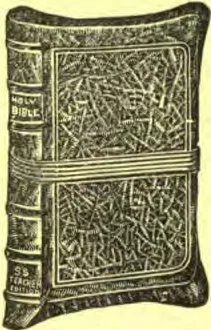
THE INSTRUCTOR PREMIUM BIBLE.
By Editor
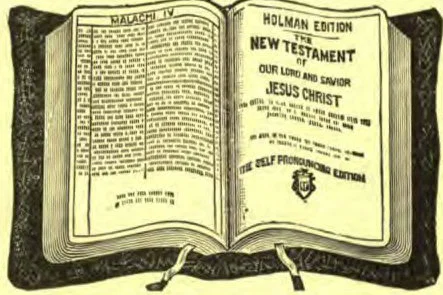
A Self-Pronouncing Teachers' Reference Bible, containing the celebrated Teachers' Helps, and comprising nearly 400 pages. Also a complete series of 15 new maps.
This beautiful book is bound in Imperial Seal Binding, Tuck Edges, known as *
“Divinity Circuit,” Rounded Corners, Full Red under Gilt Edges. *
We offer this Bible, postpaid, for only six new yearly subscriptions at 75 cents; or twelve new six-months' subscriptions at 40 cents.
We will also send it, postpaid, with the INSTRUCTOR one year for $2.25. For 20 cents extra we will stamp your name in gold upon the cover. Address—
THE YOUTH'S INSTRUCTOR, BATTLE CREEK, - - - MICHIGAN.
SOLID THROUGH TRAINS OF
WIDE VESTIBULE COACHES and PULLMAN SLEEPING CARS BETWEEN
Battle Creek and Chicago, Buffalo, New York, Philadelphia, Toronto, Montreal, Boston
For time-tables, descriptive matter, and information, apply to any representative of the company.