The Youth's Instructor, Vol. LI, No. 46

God Commanded the Light

The Youth's Instructor

November 17, 1903

Review and Herald Publishing Assn. · Washington, D. C. · November 17, 1903

God Commanded the Light

“Hail, holy light! offspring of heaven, first born, Or, of the Eternal, co-eternal beam! Bright effluence of bright essence increate: Whose fountain who shall tell! Before the sun, Before the heavens, thou wert; and at the voice Of God as with a mantle didst invest The rising world of waters dark and deep, Won from the void and formless infinite.”
BEFORE life or character had been given to the chaotic world, God commanded the light to shine. And this command marks the first step in the great work of creation. Light is the first letter in the marvelous alphabet of nature. It is the keynote in the great harmony of the universe.
God lays the foundations of a world, and frames it with the glittering beams of light. He spoke, saying, “Let light be,” and light was. This is God’s first commandment in the world. It contains the first recorded words of God, a simple statement, yet full of inexhaustible power and meaning.
And this brief account gives us the first example of perfect obedience. God commanded the light to shine; and, obedient to his word, light came, and the formless world lay bathed in glory. He said, “Light, be;” and light was.
This was the first entrance of light into the world. And concise as the account is, containing in all but two or three words, it tells us more about the cause, nature, and existence of light than do all the scientific treatises of all the ages. All that scientific investigation has done falls short of this great but simple truth from the word of God.
What is light?
“Knowest thou the place where light dwelleth, that thou shouldst take it to its bound, or understand the path to its house?” Job 38:19, 20, literal rendering. This is God’s challenge to the littleness of man’s knowledge; and the intelligent child, who first reads the question, knows as much of the true answer as the most scientific man of the age.
What is light?
All that science can do is to tell us of rays, or fluids, or projections, or vibrations, or undulations. And all this is but the conditions, if the statements of scientists are true, under which mysterious light manifests itself in the material world. Man knows light as an effect, as sensation, upon the nerves of sight.
Strange as it may seem, paradoxical as it may sound, light itself is invisible. That which makes all things manifest is itself unseen. It is made manifest to the senses only by making something else manifest. Light has much to say about other things of God’s universe, bringing to us messages and marvelous revelations from even far-distant stars; but it has practically nothing to say about itself.
Of course man examines the phenomena of light, but he finds more mystery there than fact. He may measure quite accurately the velocity of the transfer of light; he may consider light as a vibration, and count the number of these vibrations, though they amount to hundreds of millions of millions a second; and he may even learn the length and character of these waves. But all this is only answering the question of how light travels, and how it manifests itself.
What is this energy which we call light? How did it originate? How does it travel across the realms of space? How can it continue through the ages to pour its flood of light across the abyss of worlds?
What can science do with such questions as these? As common as light is, as well as we may think we understand it, light is, notwithstanding, a profound, impenetrable mystery. And into this dark mystery of the nature and origin of light comes the light of Revelation. It is a second light, throwing light upon even the subject of light itself, and clearing up much of its mystery.
God commanded the light to shine. 2 Cor. 4:6. God said, “Light, be;” and light was. These words explain the otherwise unexplainable.
Light is the garment of God (Ps. 104:2); and the fluttering fringes of his glorious robe forever irradiate the darkness of the world.
Light is God’s character,—a holy influence flooding the world.
Light is the life of heaven, flowing out in blessing to the children of men. L. A. REED.
(To be continued)

Wash-Day Reflections

MONDAY is wash-day at our house, and as I have opportunity, I help the washerwoman at her work. I do not understand her Portuguese-English, nor does she always comprehend my English-Portuguese; nevertheless we get along very well. I fill the boiler early; so that when she comes, there is plenty of hot water ready, and she can go right to work. After the clothes are rubbed and boiled, I make myself useful pumping rain-water. I work the washer, turn the wringer, empty out wash-water, put things away, and do such other odds and ends as may help along the good work of making everything clean.
But as I work, I keep my eyes open, and observe closely, so that, if necessary, I can do the washing myself some day. I notice that she washes out the white things first, when the wash-water is very clean. As the work proceeds, the water becomes darker and darker. If real white goods were washed in this dark water, they would come out stained and muddy—and that would never do. There are some goods, however, such as underwear and colored dresses, that will not be changed much in color even if the water is a little dark; and, again, there are some things that Mrs. Santos will not allow to come into contact with the other clothes at all. “Eet mak dem a’ brack,” says the conscientious woman; and they are saved to the last, and washed by themselves. After the washing comes the rinsing, then the bluing, and last of all the hanging out to dry.
Like the wash-water, like the bluing-bag, like the sunshine in its bleaching properties, like the dark clothes that stain the others, every one of us has an influence. “Surrounding every soul there is an atmosphere as real as is the air we breathe.” There are chill, dark souls as blue as the bluing-bag, into whose presence we come with dread. They are not only blue themselves, but they make everybody blue who comes near them. It is thought that a little blue makes the clothes look more fresh and clean on wash-day; but I must confess to a tiny suspicion of the clothes which are tinged with blue. Just so I am suspicious of the soul that has a tinge of melancholy in his disposition. It is the atmosphere of faith and love. Doubt is the great depressor. Let us throw it off, and come out of the cloud into God’s sunshine of love. If we know a thing to be true, let us believe it, and hold fast to it, and live up to our belief. God has not left us in darkness, that we should fear. The evidences of truth are clear at all times.
When a garment is stained so that it will not wash clean, my washer-woman wets it and spreads it out on the hedge or upon the grass, and lets the dew and the sunshine work out their bleaching powers upon it. In two or three days the spots come out, and the muddy color leaves it, and the garment is as clean and white as ever. The dew of repentance and the sunshine of God’s love and mercy will likewise change the darkest garment of character. “Though your sins be as scarlet, they shall be as white as snow.” This is God’s influence. This influence will fill our souls with the sunshine that will warm and cheer and help every one about us.
Not so the one who is content to wear the dark garment of sin; who turns his back on God’s sunshine of love and mercy, and lives for the gratification of self; who walks after the flesh; who is stained with sin himself, and cares little how much he may stain others. To come under his influence is to be stained by him. “Keep thyself pure,” was Paul’s advice to Timothy; but if Paul had seen Timothy seeking the company of a “hard set;” entering into the laugh at the unclean joke or story; taking part in games of strife for the mastery; he would have said, “I’m afraid that boy Timothy is not keeping his garments clean.” Now, if ever, we should “come out from among them,” that we be not partakers of their sins. E. L. PAULDING.

The Boy Astronomer

THE first transit of Venus ever seen by human eye was predicted by a boy, Jeremiah Horrox, and was observed by him just as he reached the age of manhood. He lived in an obscure village near Liverpool, England. He was a lover of books of science, and before he reached the age of eighteen, had mastered the astronomical knowledge of the day. He studied the problems of Kepler, and made the discovery that the tables of Kepler indicated the near approach of the transit of Venus across the sun’s center. This was about 1635.
Often on midsummer nights the boy Horrox might have been seen in the fields watching the planet Venus. The desire sprang up in his heart to see the transit of the beautiful planet across the disc of the sun, for it was a sight that no eye had ever seen, and one that would tend to solve some of the greatest problems ever presented to the mind of an astronomer. So he began to examine the astronomical tables of Kepler, and by their aid endeavored to demonstrate at what time the next transit would occur. He found an error in the tables; and then he, being the first of all the astronomers to make the precise calculation, discovered the exact date when the next transit would take place. He told his secret to one intimate friend, a boy, who like himself loved science. The young astronomer then awaited the event which he had predicted for a number of years, never seeing the loved planet in the shady evening sky without dreaming of the day when the transit should occur.
The memorable year came at last—1639. The predicted day of the transit came, too, at the end of the year. It was Sunday. Horrox could then be found intently watching a sheet of paper in a private room on which lay the sun’s reflected image. Over this reflection of the sun’s disc on the paper he expected momentarily to see the planet pass like a moving spot or shadow. Suddenly the church bells rang, and, being a very religious youth, he was accustomed to heed the bells as a call from heaven. The paper was still spotless; no shadow broke the outer edge of the sun’s luminous circle.
Still the church bells rang. Should he go? A cloud might hide the sun before his return, and the expected disclosure be lost for a century! “I must not neglect the worship of the Creator to see the wonderful things the Creator has made,” said the youth, leaving the reflected image of the sun on the paper, and going into the sanctuary.
When he returned from the service, he hurried to the room. The sun was still shining, and there, like a shadow on the bright circle of the paper, was the image of the planet Venus! It crept slowly along the bright center, like the finger of the Invisible.
Then the boy astronomer knew that the great problems of astronomy were correct, and the thought filled his pure heart with religious joy.
Horrox died at the age of twenty-two. Nearly one hundred and thirty years afterward, Venus was again seen crossing the sun. The whole astronomical world was then interested in the event, and expeditions of observation were fitted out by the principal European governments.
ARTHUR FOX.

The Manner of His Coming

The Second Coming of Christ — No. 3

The Manner of His Coming

It is important that we understand the manner of Christ’s coming; for many will be deceived on this point. While professing to believe in the coming of the Saviour, they are not informed concerning the manner of his appearing, and thus they are led away. A noted American clergyman once said that he would not be surprised at any time to receive a cablegram stating that Christ had descended on the Mount of Olives. Such a message might be received, of course; but if we believe the Bible, we shall know that it is not true. “For many shall come in my name, saying, I am Christ; and shall deceive many.” Matt. 24:5. Surely we need to inform ourselves on this point; the Saviour would not give the warning if it were not necessary. “Then if any man shall say unto you, Lo, here is Christ, or there; believe it not. For there shall arise false Christs and false prophets, and shall show great signs and wonders, insomuch that, if it were possible, they shall deceive the very elect.” Verse 24. A power will attend this deception to the extent that miracles and wonderful things of various kinds will be done; but we must not allow even these to deceive us.
“As the crowning act in the great drama of deception, Satan himself will attempt to personate Christ. The church has long professed to look to the Saviour’s advent as the consummation of her hopes. Now the great deceiver will make it appear that Christ has come. In different parts of the earth, Satan will manifest himself among men as a majestic being of dazzling brightness, resembling the description of the Son of God given by John in the Revelation. The glory that surrounds him is unsurpassed by anything that mortal eyes have yet beheld. The shout of triumph rings out upon the air, ‘Christ has come! Christ has come!’ The people prostrate themselves in adoration before him, while he lifts up his hands, and pronounces a blessing upon them, as Christ blessed his disciples when he was upon the earth.”—“Great Controversy,” Vol. IV.
This will be an almost overmastering delusion, and only those who, from a study of God’s word, understand the manner of the Saviour’s coming, will escape. Foreseeing the deception which the enemy would practise in this matter, is doubtless the reason Jesus made the manner of his coming so plain. His coming will be attended with glory such as mortal eyes have never seen since Adam crossed the threshold of his Eden home. “For whosoever shall be ashamed of me and of my words, of him shall the Son of man be ashamed, when he shall come in his own glory, and in his Father’s, and of the holy angels.” Luke 9:26. Think of the surpassing, indescribable glory which surrounds the eternal God, whose very throne is like a fiery flame. No finite man can behold it and live; for he is a consuming fire. Then think of the glory, light, and power with which the sinless Saviour is clothed,—a glory of which human beings can form no true conception. Then add to this the brilliant glory which attends the angelic host, who come with the King when he returns to gather home the reward of the travail of his soul. When Gabriel appeared to Daniel, those who were with him quaked and fled, and Daniel fell as one dead. So with John on Patmos. And when the angel descended to call forth the crucified Lord from Joseph’s new tomb, the Roman guard surrounding it fell as dead men. Then what will it be when all the angels come in glory! This, indeed, will be a grand and glorious event! And it is at this time that the graves will be opened, and every saint of the Most High will come forth. “For the Lord himself shall descend from heaven with a shout, with the voice of the archangel, and with the trump of God; and the dead in Christ shall rise first.” 1 Thess. 4:16. The sea gives up its dead; every cemetery is visited, and all the entombed saints arise. The voice of Jesus reverberates through the long galleries of hades, and all his children awake to immortality.
Picture to yourself this awful yet glorious scene! This is an attendant event of the Saviour’s coming, and any so-called appearing of Jesus without dead saints being brought forth from rent sepulchers, is a counterfeit. This is one thing Satan can not counterfeit,—he can not raise the dead. He “opened not the house of his prisoners.” Isa. 14:17.
It will need no cablegram to announce to the world that Jesus has come. He comes with a “shout,” with the voice of the Archangel, and with the trump of God. “And when he had spoken these things, when they beheld, he was taken up; and a cloud received him out of their sight. And while they looked steadfastly toward heaven, as he went up, behold, two men stood by them in white apparel; which also said, Ye men of Galilee, why stand ye gazing up into heaven? this same Jesus, which is taken up from you into heaven, shall so come in like manner as ye have seen him go into heaven.” Acts 1:9-11. This is plain instruction. The same Jesus, coming in like manner as he went away. He left bodily, bearing the marks of the crucifixion in his hands and feet, in his side, and upon his brow, and a cloud of angels received him out of sight. “Behold, he cometh with clouds; and every eye shall see him, and they also which pierced him: and all kindreds of the earth shall wail because of him.” Rev. 1:7. This is a personal, visible coming of the Redeemer. All see him; and the text shows that those who were responsible for his humiliation on the cross, and heaped shame upon him, will have a special resurrection to behold him coming in glory and power. Just who will comprise this company we do not know, except one. Jesus told Caiaphas that he should be one of the number. Matt. 27:64. When Jesus comes on the cloud, the resplendent glory which attends him will be visible to all. “For as the lightning cometh out of the east, and shineth even unto the west; so shall also the coming of the Son of man be.” Matt. 24:27.
Dear reader, the wicked on the earth then will pray for the rocks and mountains to fall upon them, and hide them from the glorious face of him who sits on the throne. Failing to hide while opportunity offered, under the shadow of the Almighty, they seek it, but in vain, in the holes of the rocks, and in caves of the earth, when the Lord arises to shake terribly the earth. “Seek righteousness, seek meekness; it may be ye shall be hid in the day of the Lord’s anger.”
G. B. THOMPSON.

The Climbing Sailor, and How Sailors Make Him
VERY often on board ships that ply between distant ports, the sailors find themselves without work. They have painted the decks, scoured the paint off, and painted them again, over and over; they have polished the masts; they have played games, told stories, tied knots, wrestled, and done anything and everything to keep themselves busy. With so many spare hours on their hands, it is not surprising that their ingenuity should manifest itself now and then in making ingenious mechanical contrivances. So it was that the “climbing sailor” came into existence. Given the side of an old box, a few nails from the same source, a scrap of tin, and some bits of rubber pulled out of an old pair of suspenders, many a sailor with sharp knife and cunning hand has fashioned these little climbing men, and made them shin up strings often ten, twenty, or even forty feet.
This week we will make one of these little fellows, exactly following the sailor’s model; and if any one asks us what we are making it for, we will answer something like this: “For the joy that comes in seeing him grow under our eyes; for the pleasure and entertainment he affords both ourselves and the children in ascending the string; and because, though his practical utility may not be inexhaustible, the making of him is excellent discipline, training our eyes to be more true, our hands to be more steady, and our judgment to be better. And he who obtains perfect control of his hands as a boy will certainly know how to make them useful when he becomes a man. That’s why!”
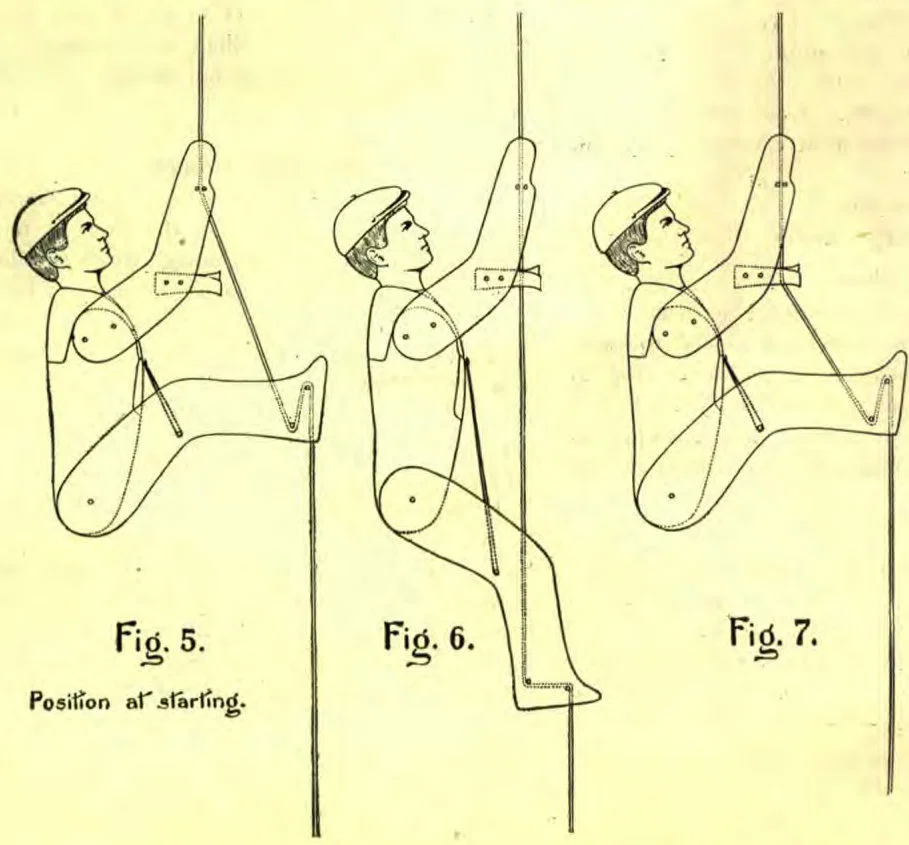
Position at starting.
First, then, as to materials. Some thin wood, any kind; some pins and a few tacks; a little piece of thin, springy tin; a small rubber band or two; some thin paper, and a piece of twine four or five feet long. Almost any boy can get these.
Next as to tools. A knife, a pair of old shears, a lead-pencil, a small nail to punch holes in tin,—these are all that will be needed.

Cutting out the Pieces

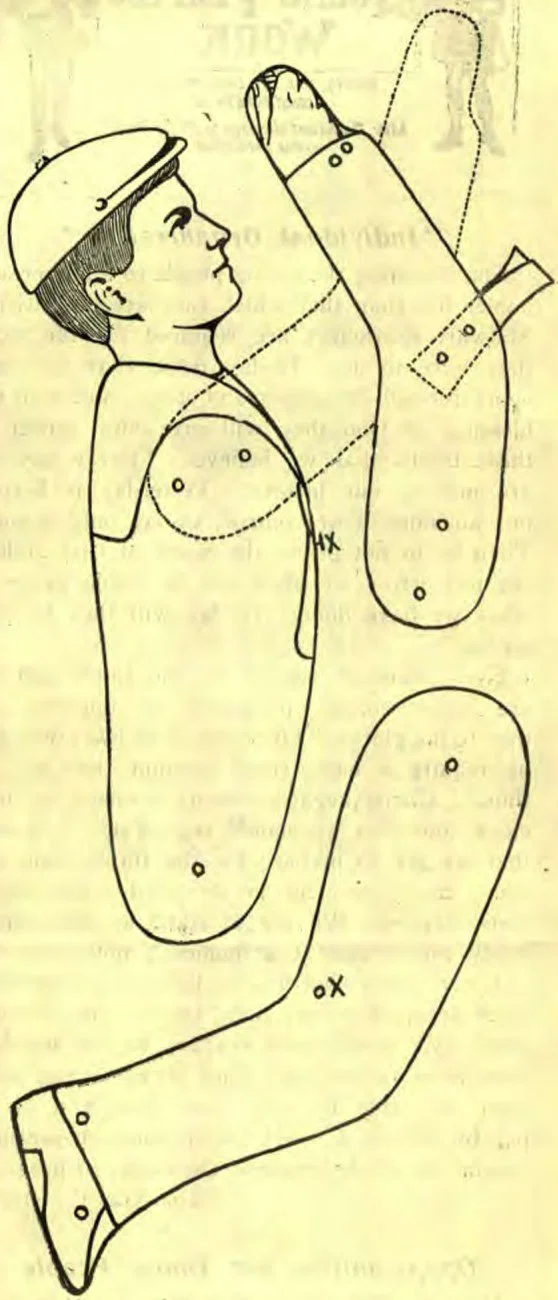
Lay a piece of thin paper over our patterns, and mark out the body, arm, and leg thereon with your pencil. Cut the figures out after you have traced them, and lay each piece on some thin, smooth wood, never over one fourth of an inch thick, and much better only one eighth, especially if the wood is fairly tough and hard. Lay the patterns on so as to take advantage of the way the grain of the wood runs, because it is very embarrassing to have a leg or an arm break in two after everything is put together.
Cut out one body, two arms, two legs; both arms just the same, and the two legs just alike.
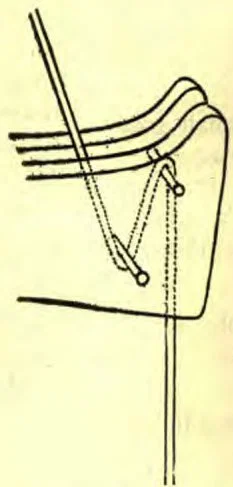
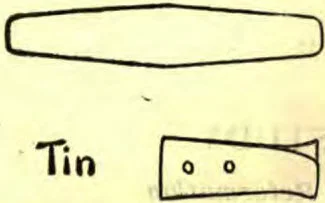
The gripper is cut out of our thin tin (or, still better, spring brass) just the size the pattern indicates. Then double it, punch two holes with a nail, and tack it on the inside of one of the arms, exactly where the picture shows it. The other arm needs none. In practise you will have to bend the gripper around some to make it catch the string just right.

Putting Together

For this purpose, tacks and pins are used. The latter should be stiff and strong; otherwise they will bend and cause trouble.
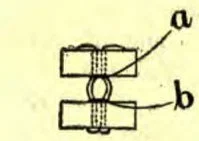
Tack the arms in place; then drive or push two pins through the hands, as shown; and double down. As you see in the figure, force a nail between the pins, to make a round hole, barely large enough for the string. If you want to be sure about the lasting qualities of this job, you would better wrap some strong thread about the pins at a and b. And, as much depends on it, I must caution you again not to make the string hole too large—just a nice loose fit is right.
Put the legs on in the proper place. These must work on a pivot, and it ought to be a strong one. A pin will do, but a small nail with two tin washers is better, driving the nail clear through, and bending down sharply. Rivet it if necessary, and work the joint till the legs move with perfect freedom.
Through the feet at the points shown pass two pins, small nails, or long tacks. Be sure to get these right as to place. Double them down if they are too long; and if weak pins are used, you may put two or three in each place instead of one. This latter suggestion applies to the hand hole as well.
Into the body’s edge at the point marked x drive two pins or a small nail to make a hook. On this fasten your rubber bands (if you have none, pull some elastic out of old suspenders or garters, and tie together). In the legs at x put another pin or two. This must be in such a place, and the rubber must be doubled so short, that it is constantly stretched, even when the legs are drawn up as far as need be.

The Artistic Work

With a lead-pencil or water colors or ink, or in any way you choose, make the little figure look more lifelike. You can make him a Chinaman, an American, or a monkey.

Stringing and Working

A piece of ordinary grocer’s twine is the thing for this climber. Pass it through the feet and hands, as shown in the dotted line.
Pull on the string, holding it by both ends; and if the gripper has been adjusted right, the little figure will climb nimbly and well.
Figure 5 shows the climber before the string is pulled.
Figure 6 is the result of a pull; the legs are drawn downward, and the string is forced into the gripper.
Figure 7. Lessen your pull; the rubber bands draw up the legs, but the gripper still holds fast to the string, and keeps the contrivance from slipping down the line,—just as a man’s hands grip a rope while he is drawing up his legs.
Figure 5 shows the result of a new pull; the string is released from the springs, the arms and body glide upward, the legs are then drawn downward, and the string is gripped again.
By fastening one end of a long string to some solid object on the ground, and passing the other end over a high tree limb, and back down to your hand, you can stand on the ground, and, by pulling the string, make the climber go as high as you wish.
EDISON DRIVER.

Opportunities for Young People

DURING the past three months I have had the privilege of meeting with many of our young people, both privately and in their Societies; and the increased interest they are manifesting in carrying forward the message is most cheering. In California and Upper Columbia a good force of bright young men have entered the canvassing field with the best of success. In Salt Lake I found our young people helping Elder Alway to make a success of his tent-meeting by singing and inviting people to attend. In other places they were taking hold of the Sabbath-school work with a determination to make it a success. In Missouri a good work is being done by mailing tracts and papers, and corresponding with persons living in towns where the truth for this time has no representatives.
At the Newton, Kansas, camp-meeting this desire to work for the Master was particularly noticeable. Brother N. P. Dixon, whom many of you know as a pioneer in the circulation of literature, districted the city. Leaders from the young people were selected to take charge of these districts, and a call was then made for volunteers to visit the people in their homes with invitations to meeting, and also tracts bearing on the subjects treated by the speakers. About every other day the city was thoroughly worked, and as a result the attendance was quite large. So far as possible we arranged so that each worker would only have from ten to fifteen houses to visit, so he would soon become acquainted with the inmates of each. Encouraging experiences were related by the workers, and we feel sure many of them secured an experience in house-to-house work which they have carried to their homes. From seventy-five to eighty-five young people took part in this work, and we always had more volunteers than we could use.
There is an opportunity just now for our Young People's Societies, which is as follows: The Labor and Capital number of the Signs of the Times will soon be ready. The publishers have made a price of only $3.50 a hundred for wrapping, addressing, and mailing copies of this paper to lists of names which may be furnished them.
Will not a large number of our Young People's Societies secure names of people living beyond the reach of our church-members, and send in their names for this special paper?
H. H. HALL.
Continue reading: THE WEEKLY STUDY