The Youth's Instructor, Vol. LI, No. 46

God Commanded the Light
Earlier text: God Commanded the Light

THE WEEKLY STUDY

The Elements of a Great Reformation

Definite, Strong Convictions
Scripture Study:—

PERSONAL EXPERIENCE

Conviction of sin. Luke 18:10-14; Rom. 7:24.
A definite knowledge of forgiveness and of God’s acceptance. Isa. 38:17; Ps. 40:1-3; Rom. 8:1-4; John 9:25.
A knowledge of personal weakness. John 5:30, first clause.
A knowledge of God’s strength — his victorious, all-conquering power in us. Phil. 4:13; Col. 1:9-13.

LIFE WORK

A conviction of duty. Dan. 1:8.
An ear that can hear the “still, small voice.” Rev. 2:7, 11, 17, 29; 3:6, 13, 22.
Recognition of the call. Gal. 1:11-17.
A definite knowledge of the work to which he calls. John 1:19-23; Luke 4:16-21.
Parallel Reading:—
Romans, chapters seven and eight.
“Great Controversy,” Chapter Nine.

To the Leader

In several lessons we have subdivided the reading lesson in the hope of assisting the leaders and all the members of the Societies in obtaining a clear grasp of the principal points, and in such form as to facilitate the presentation of them. It will be well to let your members try their hands at analysis. One week before this lesson is to be given, request each member to bring to the meeting on the following Sabbath an analysis of Chapter Nine of “Great Controversy.” Collect these at the beginning of the meeting; then, after the Bible study, conduct a general exercise on that chapter. Read several of the analyses that have been most carefully prepared.
Program for Study:—
Bible study, 25 minutes.
General exercise, 15 minutes.

Notes

It is not a pleasant experience to learn your own sins. We are more inclined to wish to know the sins of other people. It is humiliating to learn that we are vile and helpless; yet the dear Lord can not save us without first showing us our sins. By this means he urges upon us our need of salvation.
There are only two steps from helplessness to power, from the Old Covenant to the New:—
First, I can of mine own self do nothing.
Second, I can do all things through Christ which strengtheneth me.
“Lord, make me to know mine end, and the measure of my days, what it is; that I may know how frail I am.” Ps. 39:4.
“Acquaint now thyself with him, and be at peace: thereby good shall come unto thee.” Job 22:21.
Clear, deep convictions are a strong anchor. They are the Watchmen—the guardians of our spiritual stronghold. A conscience which has been trifled with and badly worn is not reliable as a sentinel. An old Indian chief once said that conscience is a three-cornered piece of steel in the human breast. When we do wrong, the piece of steel turns around, and pricks us. But if turned too often, the corners become worn until it does not prick.
Ears that have not been trained to listen to the Spirit will not recognize the true voice. It is a “still, small voice,” and the ear must, by long practise, learn to catch the sound. “He that hath an ear, let him hear what the Spirit saith.” It requires an ear to hear.
Several years ago, when a great international musical convention was held in Boston, and fully six thousand of the world’s best singers had assembled, an incident occurred which illustrates this spiritual truth. One man, the chosen leader, had labored untiringly to perfect arrangements for the great concert; but when leading in the grand opening chorus, his overtaxed mind gave way, and he was taken helpless from the hall. A new leader must be selected—a man who, without preparation, could fill a great position. A master of the art was elected, and took his place.
Before the first evening’s program was completed, when the six thousand voices were all united in rendering a difficult passage, the leader suddenly stopped the chorus, and, pointing to a singer, directed him to strike a certain note. He did so, and struck it flat. “Yes,” said the teacher, “I knew you were flat. We have no time now for practise. We will excuse you from the chorus.” What an ear was that, to detect that one discordant note among six thousand voices!
But there are many more than six thousand voices in the Babel of this world, and our ears must be so trained that we can distinguish the voice of the Good Shepherd, and the “still, small voice” of the Spirit, as it speaks to “the churches.”
John the Baptist knew that he was “the voice of one crying in the wilderness.” Christ knew that he was the One of whom the prophets had written. All the great leaders whom God had raised up have known their mission; and that knowledge has been a power.
God has called us to act in the closing scene of his greatest drama. Shall we recognize his call? shall we understand our work? and shall we do the work? E. R. P.

“Individual Organization”

GOD is calling the young people to a higher and nobler life than that which they are now living. Stalwart characters are required for the work they have to do. To-day those characters are being formed, by prayer and study; and with the blessing of God they will give vital power to these truths that we believe. “Every day we are making our history. Yesterday is beyond our amendment or control; to-day only is ours. Then let us not grieve the Spirit of God to-day; for to-morrow we shall not be “able to recall what we have done. To-day will then be yesterday.”
Every moment belongs to the Lord, and we are under solemn obligation to improve our time to his glory. “Of no talent he has given will he require a more strict account than of our time.” Christ regarded every moment as precious, and thus we should regard it. It is now that we are to prepare for the future immortal life. Every moment is freighted with eternal consequences. We are to stand as minutemen, ready for service at a moment’s notice.
Many whom God has qualified to do excellent work accomplish very little, because they attempt little. We shall never reach a higher standard than we ourselves set. Then let us set our mark high, and step by step, even though it be by painful effort, by self-denial and self-sacrifice, ascend the whole length of the ladder of progress.
FLORENCE P. RICE.

One-Cat Power

“AN engine of one-cat power,” said George William Curtis, “running all the time, is more effective than one of forty-horse power standing idle.” People generally do-not have forty-horse power ability; probably one-cat power would represent their capacity more nearly. The temptation of those who have this lower degree of power is to do nothing with it. That was the trouble in the parable with the servant who had only one talent given into his keeping by his lord. If he had received the five talents, or even two, he would also have tried to do something with them. But what can one with only one talent — one-cat power — do? So the one-cat power does no work at all, and in the aggregate the loss to the world is immense; for if the one-cat powers were all running, and running all the while, they would do more work than the forty-horse power people, inasmuch as they so greatly outnumber them. And a one-cat power alone can do a tremendous amount of work simply by keeping at it.—Well Spring.

Honey and Perfume

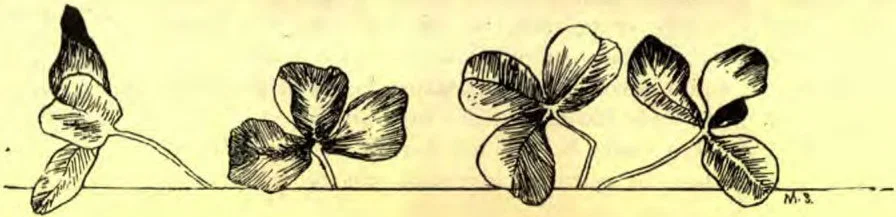
One dewy morning an ill-natured bumblebee flew grumbling over a clover field. Looking into so many cheerful faces, as the clovers turned their heads up to look at him, made him crosser than ever; and the bee finally made a spiteful dart at a jolly, red-faced clover, who seemed especially happy, and mumbled in her ear,—
“You ridiculous thing! You wouldn’t look so pleasant if I should sting you. What would you do, if such a thing should happen?”
The clover seemed not in the least disturbed. “I should give you a smell of the perfume of the meadows,” she replied.
“Perfume,” boomed the indignant bee; “perfume! What do I care for perfume?”
“Then I should offer you a taste of honey; it is good to sweeten things,” innocently replied the red-faced clover, bowing to a passing butterfly, who was a good friend of hers.
“Honey! honey! Do you suppose anything of consequence can waste time on such trifles? Honey and perfume, indeed! I shall have no more to do with you till you learn something of life.”
The red-faced clover continued to smile as serenely as ever, and began rocking the grasshopper that had settled on her stalk. But for all its color, her face bore a knowing expression, as she watched the bee disappear, and she nodded wisely to some of her neighbors who leaned their heads together with an air of understanding.
Meanwhile, the bumblebee winged his way out of the clover meadow, to the side of an old mossy well, where a great tabby cat was lapping water.
“Ah!” said the bee, “here is a creature worth talking to. He no doubt knows something more of life than honey and perfume. I think I shall take a sip of water with him, in order to make his acquaintance.”
But no sooner had the bee given his first obsequious hum in puss’s ear, than the latter started fiercely, and instead of the flattering welcome expected, gave his visitor a blow from his paw, which landed him, dazed and helpless, under a clump of ferns, growing where the water trickled from the spout. It was quite a moment before the bewildered bee recovered from the shock, but finally he gathered up wits and wings, and, much crestfallen, flew slowly away again, just in time to escape additional punishment for his impertinence.
Flight through the fresh air soon revived the strength and spirits of the conceited bee, and by the time he had reached the river bank, his ill-nature had returned to comfort his wounded pride.
“The rude beast, to treat a stranger so!” he droned, indignantly; “I shall never attempt to be friends with him again. But here is a kind-faced cow, sleeping in the shade. I’m sure she’ll be glad of my company, while I rest on her ear a minute, in this cool place.”
But he had only just alighted on his chosen perch when the mild-appearing cow uttered an angry snort, and, giving her ear a vigorous twitch, flung the bee into the water. He floated for a time helplessly, and no doubt would have drowned if he had not drifted near a bunch of leaves, upon which he crawled to regain breath. But when, at last, the sunshine had dried his wings, and he flew back to shore, it could be seen that he went more slowly.
Nevertheless, the proud fellow still had something to learn. He would persist in constantly striving to do that for which he was unfitted, or desiring something that could only bring him harm; consequently he was always in trouble. A hawk chased him into a tree; a cart jostled him in the dust; a teamster struck at him; a blue-jay pecked him, injuring one wing: then he was forced to lie idle for a time, nursing his hurt in a thistle-bloom hospital by the highway.
Being scarcely able to fly at all, he one day fell into the hands of a cruel boy, who wanted a swarm of bees of his own, in order that he might always have all the honey he could eat. He carried a large empty bottle, into which he put all the bees, of all sorts, that he could capture about the fields and waysides, and into which went our poor, humbled bumblebee, along with the rest.
Here, forced to mingle with creatures whom, in prouder days, he would have scorned, the bumblebee began to see how he had wasted the golden summer days, together with their greatest beauties and sweetest charms. An old honey-bee, whose work was nearly done, told him things he had never dreamed, of joys that were safe and innocent, but only found in buckwheat fields, the rose-tree thickets, the clover meadows, or other places where honey and perfume abounded. From her he at last began to understand that in such spots life was at its best, and that honey and perfume would bring him happiness and rest. Then he began to long for one more chance to fly in the balmy air, and see if it all were true.
For several days, the captured bees were imprisoned in a dark hive, under some trees, until they were so hungry, the boy said, that, when released, they would gladly proceed at once in search of the coveted honey. Then one evening, the hive door was opened, and the bees, smelling the fresh air once more, crept joyously out of their prison. The bumblebee’s wing had become quite well, and he was very happy as he made a short trial flight in the orchard, then rising high, flew swiftly off toward the pink evening sky. His conceit and arrogance were gone. He had lost all desire for the society of the proud and lofty. He was hungry, thirsty, and weary, and eager only to test the truth of the honey-bee’s tale of the clover meadows, so away he went, without a pause, and strange to say, without a grumble, but humming a little song of thankfulness for life and freedom.
In the clover meadows, the first thing the bumblebee did was to seek out the red-faced clover; who smiled at him as kindly as ever, but waited for him to speak.
“I’m so tired, dear clover,” said the bee, creeping close to her heart.
“Poor fellow!” she answered, softly; “smell the meadow perfume; it will revive you.”
“Thank you!” he said, gratefully; “and just a sip of your honey, dear clover, for I am hungry. O, how good it is!”
And the red-faced clover laughed, contentedly, and replied, “Yes, the honey is good, and so is the meadow perfume. I knew you would say so some day.”
“How did you know?” asked the bee.
“Because,” said the red-faced clover, “I have seen the same thing before.”
And ever since then, bees have loved clover meadows, and can not be happy without a share of their honey and fragrance.
MINNIE ROSILLA STEVENS.

To a Sad Little Girl

You say you are ugly, and you are afraid That nobody loves you, sad little maid; For people whisper, with lip a-curl As you pass by, “What an ugly girl!” Ah, well, dear, if you mope and fret, Your ugly face will be uglier yet.
Let me tell you the secret without delay, Of growing beautiful day by day. ’Tis a secret old as the world is old, But worth itself a mine of gold: Beauty of soul is beauty of face, For inward sweetness makes outward grace.
There is a secret, simple and true, Now prove what its wisdom can do for you. Fill up your heart with thoughts most sweet, Bidding all others at once retreat, And these sweet thoughts will grow like seeds, And bloom into beautiful words and deeds.
And soon, very soon, they will leave their trace Of loveliness on your ugly face; The lines will be softer on cheek and brow, Bright smiles will shine where tears are now, Your eyes will sparkle, and some blest power Will make you lovelier every hour.
Just try it, my dear; begin to-day To do kind things in the kindest way — To kindly think and to kindly speak, To be sweet-tempered, gentle, and meek. Then never again shall you need be afraid That nobody loves you, sad little maid. Opinions will change, with a pleasant whirl, And all will think, “What a charming girl!”
—Selected.

Island Missions in the South Seas—I

The Society Islands — Early Missionary Effort in Tahiti

LITTLE did Balboa, as he gazed with delight upon the mighty waters of the Pacific, or Magellan, who first launched the ships of Europe upon its smooth surface, have any idea of its vast extent or the numerous islands that studded its bosom. And yet these men were the forerunners of a vast army, who were both to prepare and to hinder the progress of the gospel among a people who had long waited for it.
The Society Islands were really discovered in 1767, by Captain Wallis, who took possession of Tahiti in the name of George III. But we are indebted for our best knowledge of the early history of these islands to Captain Cook, who visited them in 1769, 1773, 1774, and 1777. The accounts of these voyages were important factors in awakening in the mind of William Carey, the Father of Modern Missions, a sense of the great need of the island world. These accounts excited unprecedented and almost universal interest in the new lands. The salubrious climate, the cold of winter unknown, and the heat of the tropical summer alleviated by breezes from the ocean, the scenery enchanting, the productions wonderful, and the manners and customs of the inhabitants novel and peculiar — all these aroused an interest unparalleled.
Captain Cook called the group “Society Islands” in honor of the Royal Society, under whose auspices he sailed. The largest island, Tahiti, was by him included in another group, The Georgian Islands, although to-day all are parts of the one group.
When the news of the discovery of these islands reached England, the founders of the London Missionary Society decided to send the gospel to them. Their first effort was on rather an extensive scale. They purchased a ship, and after considerable effort secured thirty men who were willing to go, four of them ministers, and the rest tradesmen. Six of them were married. This memorable mission band left the Thames, August 10, 1796, in a ship called “Duff,” in charge of Captain Wilson.
Just at this point two facts are worthy of note. Scarcely six weeks prior to the date of the sailing of this party, a helpless baby boy looked for the first time into the eyes of his parents. This little one was destined to become the Apostle to the South Seas, and was none other than John Williams, who, when but a young man, laid down his life for some of these same savages. No doubt the missionary enterprise begun with his life history, had its influence upon his future work.
Another interesting circumstance in connection with this first party was the experience of “pious” Captain Wilson, as the historian calls him, in mentioning the personnel of the missionary party. Through a series of experiences in India almost incredible, a mighty Hand had preserved him; but he knew it not. Thrown into the company of Mr. Thomas, a Baptist missionary returning to England, he had frequent disputes, until Mr. Thomas was led to remark that the conversion of Mr. Wilson seemed well-nigh impossible. But God moves in mysterious ways, and these very conversations were doing his work. After a series of interesting circumstances, Captain Wilson was converted, and became a devoted Christian. Several years later the embryo plans of the mission to the South Sea Islands fell into his hands. These immediately gave rise to the suggestion that if his services were either needful or acceptable, he would sacrifice his comforts, and without any prospect of worldly advantage, embark once more upon the stormy ocean. Thus was this wonderful man raised up and prepared to assume command of this novel and important undertaking.
The ship “Duff,” with her precious cargo, sailed out of the harbor with a purple flag floating in the breeze, upon which were designed three doves bearing olive branches. As they set sail, the missionaries sang, “Jesus, at thy command we launch into the deep.”
“A seven-months’ voyage brought them to the shores of Tahiti, and they were welcomed by about seventy-five canoes, whence natives clambered over the ship’s side, having brought with them hogs and fruit to barter for knives and axes and other useful implements. But as it was Sunday, the missionaries neither sold nor bought.”
They found two white men already at Tahiti, one of whom had been shipwrecked, and the other had been put ashore a few years before. They were clad like the savages, and being able to speak some Tahitian, served at first as interpreters. Upon their arrival on the beach, the missionaries found themselves surrounded by many strange customs. The king and his queen were riding upon men’s shoulders, and when changing from one carrier to the other, the royal feet were not permitted to touch the ground, but instead, they jumped from the shoulders of one man to those of another. And when they visited the ship, they refused to go on deck. Later it was learned that the reason for this queer custom was that whatever they touched became their own, and so had they stepped on the ground in changing carriers, the land would have been theirs; or had they gone on to the ship’s deck, it would from henceforth have been their possession. Everything they touched became sacred to their exclusive use.
The first night after landing, in the presence of the natives the missionaries sang and prayed, and thanked God for inclining these strangers to receive them so kindly. And the next Sunday they turned their dwelling into a chapel, one of the men preaching, being interpreted by the Swede, one of the white men they found on arriving at the island. Although these men were wicked, yet through such a channel the Lord was opening the way for the missionaries to begin to preach the gospel to these natives after being with them but a few days.
ESTELLA HOUSER.

The Resurrection of the Dead

ABIJAH POWERS felt moderately sure nobody would recognize him when he registered under an assumed name at the little inn. It was more than twenty years since he left the town—a hard, reckless boy, running away from a good father and a devoted mother because he hated goodness and loved lawlessness and his own way.
For years he had led the life of a vagabond. Then the spirit of adventure was roused in him by the stories of the wealth in the Klondike. He joined one of the earliest parties in that hazardous search for gold, and succeeded beyond his dreams. Now he had come back, with his old instincts, but with the wealth of a millionaire, and some strange compulsion led him to the village where he first drew breath.
He did not even know whether his parents were living or dead. It was altogether likely they were dead. With that conviction, and without asking a question, he made his way in the August twilight to the graveyard, and to the spot where for three generations his ancestors had been laid.
Yes, there were new stones placed since he had been there. The sight moved him strangely. He bent to read the inscription on the first one. It was to the memory of his father. “Died, 1884. ‘Blessed are the dead who die in the Lord.’”
The date cut the man to the heart. His father had died a year after the only son had run away! And his mother had been left alone! But perhaps she had followed her husband mercifully soon. Again he bent to read, this time with tear-filled eyes. “Died, 1902. ‘And God shall wipe away all tears from their eyes.’”
His mother had been alone for eighteen years! She was but just dead—in poverty, perhaps; certainly in loneliness. He drew himself up as if to shake off a hideous dream.
But the other stone—whose grave could that mark? They had had no relatives except some distant cousins. Perhaps some one of them had done for his mother what he ought to have done in her long, desolate years. Again he stooped to read—his own name. “Abijah Powers. Born 1866; died—. ‘The only son of his mother, and she was a widow.’”
It was his own gravestone, set up by his mother when her hope of his return was dead. Out of the depth of his memory there flashed up the story of the widow of Nain, and the gracious presence which spoke the word of life to her dead son. How many times his mother must have read and reread the page, and how frequently she must have prayed that her boy, bone of her bone and flesh of her flesh, might be given back to her arms!
The thought was anguish to the graceless son, and it brought him to his knees beside his own empty grave. With his hand resting over his mother’s head, he wept as he had not wept since he was a child. They were gracious drops. Out of the mother’s love, which had found its cold comfort in the words of Scripture for the grave that was no grave, there came, indeed, the resurrection of the real, living soul.
The widow’s son went out of the graveyard that night a new man. The world wondered what had happened to him. Money did not often make a man over from a devil to a saint; but that miracle seemed to have been worked in Abijah Powers. Nobody knew that the transformation did not come from the touch of Klondike gold, but from the power of love—reaching from beyond the veil and speaking from the cold marble of a gravestone.—Youth’s Companion.

A True Helper

Is the work difficult? Jesus directs thee. Is the path dangerous? Jesus protects thee. Fear not and falter not; Let this word cheer thee: All through the coming year He will be with thee. — Selected.

Sweet Are the Thoughts of Content

SWEET are the thoughts that savor of content; The quiet mind is richer than a crown: Sweet are the nights in careless slumber spent; The poor estate scorns fortune’s angry frown. Such sweet content, such minds, such sleep, such bliss, Beggars enjoy, while princes oft do miss.
— Selected.

Come Ye Apart

THOU sayest, “The work is great, the night draws nigh,” And feverishly thy tired hands grasp the plow, Panting, “The rest comes after; here and now God must be served before the daylight die.” And so the trampling feet and strenuous cry Drown the sweet voice that with most loving grace Rebukes the energies which would efface The finer sense, and cloud the inward eye.
Listen, O worker, faint and overwrought! It is the voice that called the twelve of old, And led them where, upon their fret of thought, Peace from the lake’s calm and the sunset’s gold Slid softly, and the hillside whispers taught Deep things of God that words could ne’er unfold.
— Horace G. Groser.

INTERMEDIATE LESSON

IX—David and Jonathan

(November 28)
LESSON SCRIPTURE: 1 Sam. 18: 1-4 and chapter 20.
MEMORY VERSE: “In lowliness of mind let each esteem other better than themselves.” Phil. 2: 3.
The life of Jonathan, the son of Saul, is the most beautiful example given us in the Scriptures of unselfish love and faithful friendship. If Saul had been true to God, Jonathan would, at his death, have become the king of Israel. But because of Saul’s sin, God rejected his family, and chose another man. Yet there was not the least feeling of envy in the heart of Jonathan. From the time when David slew the giant, and delivered Israel, “the soul of Jonathan was knit with the soul of David, and Jonathan loved him as his own soul.” 1 Sam. 18: 1. He took of his own princely garments, and clothed David with them, giving him his own sword and bow. It may be that he saw in David one better fitted to rule the Lord’s people than he felt himself to be. And the giving of his garments to David was the sign that he willingly gave up all that was thought to be his.
God used the love of Jonathan for David to protect him from the anger of Saul. When he saw that David’s life was in danger, he warned him, saying, “Saul my father seeketh to kill thee: now therefore, I pray thee, take heed to thyself until the morning, and abide in a secret place, and hide thyself.”
Then Jonathan spoke good of David to Saul his father, and said: “Let not the king sin against his servant, against David; because he hath not sinned against thee, and because his works have been to thee-ward very good: for he did put his life in his hand, and slew the Philistine, and the Lord wrought a great salvation for all Israel: thou sawest it, and didst rejoice: wherefore then wilt thou sin against innocent blood, to slay David without a cause?”
When Jonathan talked thus to him, Saul saw his folly and sin in hating David. He swore, “As the Lord liveth, he shall not be slain.” Jonathan told David the word of his father, and brought him before Saul, and David was in his presence as before. But it was not long before the evil spirit again moved Saul against David, and he tried to kill him. Then it was that David left the court, and took refuge with Samuel at Ramah. Saul followed him there to kill him, but the Spirit of God came upon him, and prevented him. Although he promised not to do any harm to David, David was afraid to trust him again. He fled from Ramah, and went to see Jonathan. The Lesson Scripture is the story of their meeting.
Verses 13-15 show Jonathan’s faith in God and in David. David said, “There is but a step between me and death.” But Jonathan knew that David was to take Saul’s place; and he prayed that God would be with him as he had been with his father. He made David promise to spare his life, and to show kindness to him and to his house forever, “when the Lord hath cut off the enemies of David every one from the face of the earth.”
Saul’s hatred of David, and his jealousy of him, were now so great that he was very angry with Jonathan when he pleaded for him, and even cast a javelin at him. So Jonathan put his own life in danger for the sake of his friend. When he made known to David that it would not be safe for him to live at the court any longer, they were both very much grieved, and wept bitterly. We are told many times that Jonathan loved David, even as he loved his own soul, and it was like death to part with him. He might have left the court also, and gone with his beloved friend, to whom he knew God had given the kingdom. But he was true to his father, and stood by him to the last, to help him in the affairs of the kingdom.
Only once after this did David and Jonathan meet. When David was fleeing from Saul, and Jonathan knew where he was, he “went to David into the wood, and strengthened his hand in God. And he said unto him, Fear not: for the hand of Saul my father shall not find thee; and thou shalt be king over Israel, and I shall be next unto thee; and that also Saul my father knoweth.” In these words shone out the sweet, unselfish spirit of Jonathan, his love for his friend making him wish to see him in the highest place, and himself next to him. In his lament over Jonathan after his death, David said: “Thy love to me was wonderful, passing the love of women.”

Questions

1. If Saul had been true to God, who would have been king after him? Did Jonathan feel any jealousy of David on that account? How did he feel toward him from the first?
2. What did Jonathan give David? What did he make with him? How great was his love for David?
3. How did God use Jonathan’s love for David? With what words did Jonathan defend David?
4. What did Jonathan assure David that God would do for him? What did Jonathan ask David to do for him?
5. What sign did he give to David in the field, so that he might know if he was to flee? What did both Jonathan and David do when they found that they must part? Why did not Jonathan go with his friend?
6. Was this the last meeting of David and Jonathan? Where did they meet again?
7. What did Jonathan tell David at that time? What was it that made him willing that David should have the throne? What did he expect his own position would be?
8. What did David say at Jonathan’s death about his love? Why was Jonathan’s love for David more wonderful than David’s love for him?

IX—The Re-establishment of David’s Throne and Kingdom

(November 28)
MEMORY VERSE: “Behold, a king shall reign in righteousness and princes shall rule in judgment.” Isa. 32: 1.

Questions

1. How long did the Lord promise that David’s throne should continue? 2 Sam. 7: 16.
2. Whose in reality was this throne? I Chron. 29: 23.
3. Who was the last king to sit upon it? Jer. 52: 5-9.
4. How long did the Lord say it would be before that throne would be occupied again? Eze. 21: 26, 27.
5. Why was it that God could not fulfil his promises to literal Israel concerning the kingdom? Note 1.
6. Since their disobedience prevented it, what provision was made that these promises should be fulfilled? Acts 15: 13-16.
7. Where do we find this prophecy of God’s plan concerning the Gentiles? Amos 9: 11, 12.
8. What does the term “Israel” mean? Gen. 32: 28.
9. What is the character of a true Israelite? John 1: 47.
10. What is the chief characteristic of the company that will follow the Lamb whithersoever he goeth? Rev. 14: 5.
11. Who will compose this company? Verses 1 and 4.
12. Then when may we expect David’s kingdom to be re-established?
13. Who will occupy the throne? Luke 1: 32, 33.

Notes

1. Although because of the iniquity of his people, the Lord could not fulfil his promise to Israel, but had to remove the king from his throne, still he did not abolish his kingdom. We find the prophecies pointing forward to its re-establishment (Amos 9: 11), and the apostles understanding that the Lord would visit the Gentiles “to take out of them a people for his name.” But since true Israel had fallen, an opportunity was extended to the Gentiles to be partakers with God’s chosen people of his promises.
Continue reading: Special Holiday Edition of the Signs of the Times