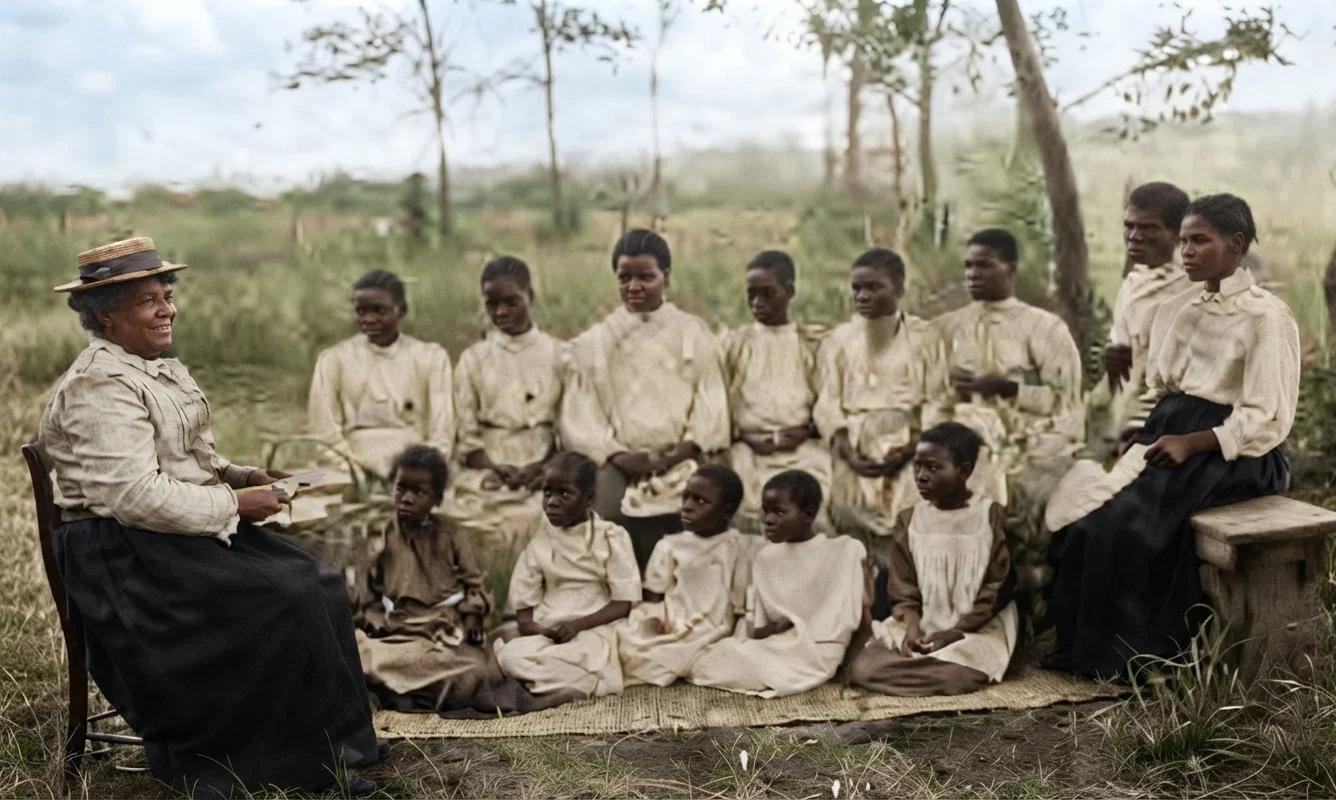
WE now have more than fifty children in the Home. Twenty board themselves and live in huts close by. These really belong to the mission family. All are in the night school, and under our supervision. So our mission family numbers over seventy natives. Tho Elder Hyatt has gone, Sister Hyatt is still with us, and helping in the teaching. Three children are with her, and they, with my wife and myself, comprise the family of workers at present.
There is plenty to do—so much that I find but little time to write. After I have arranged the daily work for all these children, seen to the stock, store, farm, home, studied my lessons, taught my classes, I am fully tired, and care for little more that day. And this is every day. From Elder Hyatt's report it will be seen that our Sabbaths are filled also. So in truth we know no rest. But we are as happy as can be, and really enjoy our work.
My wife has care of the Home work and the girls, and of the milk, butter, and poultry, with the washing and mending, and helps in the night school. Her health has been wonderfully preserved, and she has not had a sick spell since we arrived at the mission more than two years ago. How good the Lord has been to us! We love Him and desire to show it by earnest toil. We would not exchange our place for others.
Two of our native young men—James and Peter are their English names—were ordained to the office of church deacons, to help me in the care of this tender little flock. It was a solemn time, being the first ordination the natives ever witnessed.
We have found a young man and his wife to come and help here at the mission—Brother Albert White. He has just returned to Africa from Australia, where he has been attending school.
From our experience in teaching English to the natives, we now believe we are to find our translators right here among our native boys. We see prospects of this in our school this year. We also see all our future help by way of teachers here. To this end we are working. We can support and send out many of our native teachers for the same amount it would take to support one white teacher.
We are of the best of courage; and to the praise of God, the health of all is good. Our hearts are greatly cheered by the reports from the States, telling of the way the Lord is working at Washington. It makes us feel like redoubling our efforts here, and assures us that Jesus is truly closing the work and will come quickly to receive His people.
We rejoice for the awakening that seems to be coming into the ranks. O, if some of our people could only be with us six months, and see what it means to be a missionary, I think they could never again settle down to what we call "home life." The harvest is ripe. Corn is dying, and falling, and wasting to be gathered. O, who will come over and help us?
Native School in Zululand.
I have had and am having a difficult time to get the language. Tho now I can understand and talk to the natives and teach them in their tongue, I do not try public speaking yet. Besides we have good help now as interpreters, and we can get our thoughts better before the people in that way. M. C. STURDEVANT.
EASTERN TURKEY.
THE Eastern Turkey Mission includes a wide area of country, extending from Asia Minor on the west to Persia on the east, and from Mesopotamia on the south to the mountains skirting the Black Sea and the Caucasus in Russia on the north. It includes within its extended territory, besides the ruling Mohammedans, Armenians, two races of Koords, Syrians, Jacobites, and Nestorians. This embraces in many respects the most disturbed portion of the Turkish empire. It was in this region that the massacres of 1895 began, extending throughout the entire mission. Again, during the year under review, there have been renewed conflicts growing out of race prejudices, and hatreds intensified by bands of so-called Armenian revolutionists, who form upon the Russian and Persian side of the line and penetrate into Turkish territory. These bands sometimes seem to be only companies of marauders while in other cases they are more formidable, and are able to attack the Turkish troops with success. The country is thus kept in a state of political turmoil, while the government troops add to the distress by reprisals upon the people, and by attempting to collect alleged heavy arrearages in taxes. In the midst of conditions like these, the work of the past year has been conducted. It was undoubtedly expected by many there that the missionaries would withdraw from the country after the massacres of 1895. Many of the Armenians feared this and pleaded for them to remain, conscious that with the missionaries away there would be little or no restraining force in the interests of order. The missionary buildings then destroyed have been reconstructed, and in many respects the work has made a strong advance at once. This is especially true in the case of mission schools. A missionary overheard a13conversation between two natives of the country upon the subject of burning the mission premises. One of them said: "Burn every building they possess and they will not leave the country. They are here to stay." The missionaries did not enter that country to retreat as soon as it became difficult to continue. Every persistent attack upon the missionaries and their institutions has invariably resulted in a forward movement upon the part of the mission, and in a more firmly-intrenched position.
The massacres forced the missionaries to open orphan homes at every station, and provide for the children who were left homeless and destitute. Eight years have passed since then. These three thousand children have not only had the advantages of a Christian education, but the most of them have had regular and systematic industrial training. Many of the older boys are now entirely self-supporting as Christian teachers, while others are working at practical trades learned in the orphan schools. So long as political conditions remain as they are, many Armenians will flee from the country as opportunity may offer. In spite of the constant exodus from the churches and schools, the churches are strengthening and deepening their foundations, as the new buildings at Van and Harpout indicate. The poverty of the people is constantly increasing with the political uncertainty and government oppression, and yet they testify to their devotion by the large sums given for the support of the churches and the education of their children. If that country could have political rest and safety for person and property, so far as we can now see, the work would speedily become self-supporting. The three great departments of work carried on in this mission are: the medical work, with physicians at each one of the five stations; the educational, with the mission theological schools at Harpout and Mardin, the college at Harpout, high schools for both sexes at each station, and village schools all over the country; and the evangelistic work, which is the glory and crown of it all.—Missionary Herald.
THANKSGIVING.
By Mrs. Susan Birdsall Roberts
BY MRS. SUSAN BIRDSALL ROBERTS.
We will not sing of the "beautiful snow,"
As it kisses the lips of the sea;
We will not sing of the coming spring
As she gaily trips o'er the lea;
Of the flowers of May, and the roundelay
Of the bee, or the robin's wing.
A song more meet, for the flying feet
Bound for eternity's shore;
A song of praise in grateful lays,
While the heart leaps up to adore
The Hand above, that drops in love
The manna for all our store.
We will sing of the glorious sun that is given
To this beautiful world of ours;
'Twas given to ripen the corn and grain
Not less than to color the flowers;
We'll sing of the timely rain that distills
To gladden the pastures, and leap from the hills.
We'll sing of the blessings we never can count,
That no pencil or tongue can portray;
The blessings of health, of home, and its wealth,
The smiles and the loves of to-day.
These seldom we prize till they fade from our eyes,
With the oarsman, whose ensign is stealth.
Elmira, N. Y.
OUR WORK AND WORKERS.
By Editor
At the last quarterly meeting of the church in Cleveland, Ohio, three candidates were baptized by the pastor, Brother D. E. Lindsey.
A CHURCH of seventeen members was organized at Hamilton, Ohio, January 7, by Brother H. H. Burkholder, president of the conference.
On a recent Sabbath, seven members were added to the church at Omaha, Neb. The Reporter says that "more than twenty-five new ones have taken hold there during the past three months."
DECEMBER 31, a church of sixteen members was organized at Guthrie, O. T., by Brother A. E. Field. Sister Sophia V. Parker, who has been doing Bible work there, reported a good prospect for early additions to the church.
H. A. DIKE, of College View, Neb., solicits Braille copying for the blind, in English, German, Danish, Latin, Greek, and Spanish. Any blind in foreign countries desiring a key to their language, where none has yet been made, will be supplied free, if he can get an ink copy of the writing.
WE note with pleasure the recent improvement in Rarama, our Fijian paper, published at Suva Vou, by Brother J. E. Fulton. Rarama signifies "light," and the paper, whose establishment has been fraught with so much labor, is indeed a channel of light to that people. There are now about one hundred and fifty Sabbath-keepers in the Fijian group, with four organized churches.
THE brethren and sisters who attended the late bookmen's convention at Mountain View, Cal., were given interesting details of the work in Washington, D. C., by Brethren W. C. White and S. N. Curtiss. Brother J. E. White told of the work of the Southern Missionary Society in behalf of the colored people, in a way that called forth a substantial response. The wants of the cause in Alaska were presented by Brother A. M. Dart. The needs of British Columbia, especially among the Indians, were urged by Brother J. L. Wilson, and a donation was quietly raised to assist in the purchase of a tract of land on which to establish an educational enterprise adjoining the Tsimptean Indian Reservation. And Brother J. H. Behrens made an earnest appeal for a more aggressive work in the Hawaiian Islands. These were a few of the good things that came on as et ceteras to the original program.
A RATHER novel school is noted in the Wisconsin Reporter. It is a family school of nine children, with Sister Eloise Williams as teacher. The family are not Sabbath-keepers, but the father has given the farm and all the stock into the charge of Sister Williams, who will conduct it as a school for the children. The farm consists of 160 acres, 65 acres cleared, and the rest pasture. There are on it 15 cows, 10 horses, 14 calves, 60 chickens, and some sheep. The boys are able to do the work, and Sister Williams is to be overseer and schoolteacher. The father and mother decided that this was the best practical education they could give their children, and the school is conducted on the principle of our denominational schools. Since Sister Williams took charge, the Sabbath is observed on the place. Writing to the Reporter, this all-round teacher says: "I am of good courage, and know the Lord has sent me to this place to lift up the standard of truth."
THERE is published at Cincinnati a semi-monthly journal, entitled United States Trade Reports. It makes a specialty of giving information concerning the most reliable and efficient institutions in the country—where the best utilitarian articles are manufactured, and the best places to find various things that people want. In a recent number it gave an unsolicited notice of Union College, at College View (near Lincoln), Neb. It not only gave the notice free and voluntarily, but it asked for, and used, an illustration, showing the main college building, which is a Seventh-day Adventist institution. Here is a specimen utterance: "Having made a careful investigation of the standing and character of all the leading institutions of the country, and with due respect to all those which offer good advantages, we beg to draw our readers' attention to the Union College, of College View, Neb." This is followed by high commendations of the faculty, the courses of study, the moral tone, the character of the buildings, and the general efficiency of the institution. This unsolicited reference is a worthy notice of a worthy school, and indicates that the Journal's notices of various classes of enterprises are worthy of attention.
WANTED FOR MISSIONARY WORK.
By Editor
(Always prepay postage.)
SIGNS, Life Boat, Life and Health, and tracts. Address, Mrs. E. E. Parlin, 916 Laguna Street, San Francisco, Cal.
CLEAN copies of any of our periodicals and tracts; also German, French, Swedish, and Italian tracts on the Sabbath question, the coming of the Lord, and immortality. Address, Esther Levy, 535 West 110th Street, New York City, Beacon Light Building.
ANY of our denominational or health literature, for adults or children. Address, W. E. Whitmore, Redding, Cal.
SIGNS, Southern Watchman, and Life Boat. Address, D. T. Shireman, Toluca, N. C.
TOURIST CARS EAST
VIA
S. P. LINES
Personally ConductedCheapest RatesQuickest Time
Your choice of a dozen routes
Through cars to—
Portland
Omaha
St. Paul
St. Louis
Memphis
Houston
Atlanta
Los Angeles
Denver
Minneapolis
Louisville
El Paso
New Orleans
Washington, D. C.
Salt Lake City
Kansas City
Chicago
Cincinnati
San Antonio
Montgomery
Remember these cars run through to above named cities without a change from Oakland or San Francisco. Our fast limited trains in connection with the above mentioned service.
G. T. FORSYTH
Div. Pass. Agent
12 San Pablo Ave., Oakland, Cal.
PHONE MAIN 543
Without
MACBETH on it
what can you
expect of a
lamp-chimney!
You need to know how to manage your lamps to have comfort with them at small cost. Better read my Index; I send it free.
MACBETH, Pittsburgh.
"The most perfect dictionary ever made."
A. G. Wilkinson, Ph. D., U. S. Patent Office
The latest, most complete, most sumptuous dictionary in existence. 257 editors and specialists made it at a cost of $1,100,000. 100 universities and colleges, and 20 Government experts cooperated in producing
THE FUNK & WAGNALLS
Standard Dictionary
(DECENNIAL EDITION)
Contains 317,000 vocabulary terms (100,000 more than any other dictionary), and scores of valuable exclusive features. This superb dictionary will be sent free for examination. Inquire (mentioning this adv.) of FUNK & WAGNALLS CO., Pubs., NEW YORK
"Certain to supersede all other dictionaries."
A. H. Sayce, LL. D., Oxford University
BIG MAGIC
LANTERN FREE!!
Lantern Offered for Bluine Sales
Latest style Lantern. Has double adjustable lenses of great magnifying power which can be used as microscopes. Slides very brightly colored. Mostly funny pictures. Unequalled Selection of 50 single pictures and two series of continuous moving pictures. We give this handsome Lantern, Colored Pictures, Metal Lamp, Extension Top, Latest Patent Slide Support, Wood Base, and everything required, securely packed in grooved box.
Send us your name and address for only 24 packages of BLUINE to sell at 10 cents a package. Return our $2.40 received from the sale and we will send you the lantern and outfit at once. This lantern is more than a foot tall and it makes very large pictures. Write today.
A Pure Vegetable Shortening. No Animal Fat. No Taste and No Chemicals.
Like Olive Oil, and Keeps in Any Climate
Price, F. O. B., Cash with order
5 gal. can, $3.50; 10 gal. can (75 lbs.), $6.75. Write for circulars on Bbl. and ½-Bbl. lots.
(Refined Cotton Seed Oil, 10 Gallons, $5.50)
Address O. C. GODSMARK
2005 Magazine St. LOUISVILLE, KY.
"The Home Over There"
We have sung about it, but do we all know where it is to be? See what page seven of the "Scripture References" says about it.
The price of the pamphlet is 2 cents, or $1.40 per hundred.
ADDRESS PUBLISHERS OF THIS PAPER
INFANTILE DISEASE AND PROPER FEEDING.
By Lauretta Kress
[Lauretta Kress, M. D., in Australasian Good Health.]
IMPROPER feeding is the most active cause of infantile disease. A great deal of suffering and many premature deaths result from digestive derangements.
How many puny children with shrunken, wasted frames would quickly become happy, healthy, and well-nourished, if fed according to their requirements! There is rarely any lack of food, for mothers are only too willing to provide for their little ones; it is for want of food which they can digest and assimilate that so many suffer.
The pernicious habit of cramming something into the child's mouth every time it is opened is responsible for endless mischief. Regularity is a necessity in infant feeding, and the frequency of the meals must be determined by the physical condition of the child.
Few children cry from hunger; pain resulting from overfeeding is a much more likely cause, and a little warm water internally, or a warm application externally, will usually give speedy relief. Whatever is done, more food must not be crowded into the stomach merely to hush the child's voice. Many a voice has been forever hushed in this way.
Do not endanger the life of your child by feeding it on various condensed milks. Milk obtained from dairymen or milkmen should not be relied upon, as it is often a carrier of various diseases, and is always adulterated with preservatives which are injurious and especially dangerous to the structures of the feeble infants. As high as eleven grains of boracic acid have been discovered in a pint of milk. It has been acknowledged that the milk trade would have to be abandoned if the preservatives were not used, as the milk would spoil before it could be delivered at the homes in our large cities.
The best food for babies is, undoubtedly, mother's milk. Whenever possible, infants should be nursed for eight or ten months, but not longer. Children who have inherited good constitutions do not require more than five meals—four in the daytime and one at night—in each twenty-four hours, except during the first two months of infant life. Between the fourth and eighth months the interval should be prolonged to five hours, and at the end of the first year only three meals a day need be provided, the child being allowed to sleep soundly all night.
To break a child of night nursing, a little warm water may be administered in the bottle in place of the customary milk; the baby will drink freely and then drop off to sleep again.
Feeble or premature children must be fed rather more frequently than those of sounder constitutions, and they require extra care.
Never allow an infant to sleep at the breast or with a feeding bottle in its mouth; let it stop eating as soon as its hunger is appeased. This constant suction is responsible for the frequency of posterior nasal growths and enlarged, inflamed tonsils. Nor is it advisable to give sugar teats or sweets to soothe the crying child. Some mothers administer sugar and water the first few days of life, but this practise causes spasms and similar disturbances. Herb teas are unnecessary and often harmful. Plain water is by far the best drink for young children.
When the mother is unable to suckle her child, so that artificial feeding becomes a necessity, cow's milk, properly sterilized and diluted, is the best substitute. Nipples and tubes of feeding-bottles must be kept clean and free from germs.
At the third or fourth month, sanitarium infant food, zwieback (twice baked bread) finely grated or powdered, or pulverized granose flakes may be added to the milk. These products are much more easily digested than the majority of so-called "infant foods," and are certain to be pure and unadulterated.
HARRY'S MISSIONARY POTATO.
"I CAN'T afford it," said John Hale, the rich farmer, when asked to give to the cause of missions. Harry, his wide-awake grandson, was grieved and indignant.
"But the poor heathen," he replied; "is it not too bad they can not have churches and schoolhouses and books?"
"What do you know about the heathen?" exclaimed the old man testily. "Do you wish to give away my hard-earned savings? I tell you I can't afford it."
But Harry was well posted in missionary intelligence, and day after day puzzled his curly head with plans for extracting money from his unwilling relative. At last, seizing an opportunity when his grandfather was in good humor over the election news, he said:
"Grandfather, if you do not feel able to give money to the missionary board, will you give a potato?"
"A potato!" ejaculated Mr. Hale, looking up from his paper.
"Yes, sir, and land enough to plant it in and what it produces for four years!"
"O, yes!" replied the unsuspecting grandparent, setting his glasses on his calculating nose in a way that showed he was glad to escape from the lad's persecution on such cheap terms.
Harry planted the potato, and it rewarded him the first year by producing nine; these, the following season, became a peck; the next, seven and a half bushels; and when the fourth harvest came, lo! the potato had increased to seventy bushels; and, when sold, the amount realized was put with a glad heart into the treasury of the Lord. Even the aged farmer exclaimed:
"Why, I did not feel that donation in the least! And, Harry, I've been thinking that if there was a little missionary like you in every house, and each one got a potato, or something else as productive, for the cause, there would be quite a large sum gathered."—Selected.
PUTTING AN ELEPHANT TO BED.
MOTHER elephant had her trunk around her baby's neck, and seemed to be whispering, as he rubbed his head against her knee. He stood a moment, and then trotted off by his mother's side to the center of the yard. There she left him and went to a pile of hay that stood in the corner; this she took up, bunch by bunch, with her trunk, so nicely that she did not drop a wisp of it, and spread it around her child, who had not stirred from the spot where she had left him.
When the hay had been spread all around the baby, the mother stepped into the center and began to tread it down with her feet, the little one following her motions exactly, till a perfectly even space had been trodden down; then mama elephant stepped out again, went to the further side of the yard, and fumbled about the ground with her trunk.
As she came back her baby flourished his small trunk and flapped his ears, making at the same time a soft grunting sound, as if he knew what was coming and liked it. This time mama stood outside the baby's bed and, beginning with the back of his ears, blew a small cloud of fine dust into the folds of skin behind them; then into those around his legs and under him, till he was thoroughly powdered for the night. This done, she again put her trunk about his body, the little fellow dropped to his knees on a carefully-trodden bed, and he lay as a well-trained child of the elephant family should lie. The mother15took up delicately the hay from the edge of the bed and began tossing it lightly along his sides and up toward his back, till its ridge no longer showed.
When all was done a small girl who was looking on heaved a great sigh, and, turning to me, said: "I would like to know what they do it for!" So I told her, explaining the habit wild animals have of treading their beds to make sure there are no snakes in the grass; the necessity of dust-powdering the young, whose skin is tender in the folds, and who are troubled by insects; the piling up of the dry grass around them to conceal them through the night from the hunter.—Northwestern Christian Advocate.
I WOULD SEE JESUS.
By Ella Cornish
BY ELLA CORNISH.
'Tis not the streets of burnished gold,
'Tis not the glories there untold—
Not these ambitions lead me on
To run the race I have begun,
I would see Jesus.
'Tis not to meet the saints in light,
'Tis not to walk in robes of white,
That I endure the cross and scorn;
Upon the resurrection morn
I would see Jesus.
I trust in Him whom I would see
To work a righteous work in me;
And when my journey here is done—
The good fight fought, the vict'ry won—
I shall see Jesus.
"GOOD" LOOKS.
"I NEVER saw the truth of the assertion that love is blind," says one woman, "more strikingly illustrated than during a recent visit to an old friend. She is a peculiarly ugly woman, and yet, by one of those common tricks of family likeness, her eldest daughter is a beauty, and yet resembles her in features and expression. I remarked upon the likeness, feeling, as soon as I had done so, that it must strike them all as shocking to compare pretty Mary with her more than plain parent. To my secret delight—it was so loyal—the fourteen-year-old son assumed an almost indignant air:
"Mary isn't nearly as handsome as mother," he declared, loudly, and I noticed a general nodding of heads from the others, indicating the same opinion. Wasn't that charming? Not one of the family had the faintest idea how the mother looked. To them she was just mother."—Harper's Bazaar.
JAPANESE SURGERY.
The Japanese, in the case of wounds on the field, simply apply first-aid bandages and antiseptics, leaving the serious work to be done in the hospitals at home. This is always done except where the condition is precarious, or where there is danger of the wounded man's bleeding to death. In one hospitalship returning to Japan there were twenty-two hundred wounded men, and there was not a single death on the trip. The Japanese have treated Russian prisoners similarly, and they also show many recoveries. As to the recuperative powers of the Japanese soldier, authorities agree that his plain and temperate habits account for it. The Turks also recover in a similar manner and for similar causes.—Christian Advocate.
SUGGESTIVE QUESTIONS
INTERNATIONAL SERIES THE SUNDAY SCHOOL
LESSON 8.—FEBRUARY 19.—JESUS AT THE POOL OF BETHESDA.
Lesson Scripture, John 5:1-16, A. R. V.
(1) "AFTER these things there was a feast of the Jews; and Jesus went up to Jerusalem. (2) Now there is in Jerusalem by the sheep gate a pool, which is called in Hebrew Bethesda, having five porches. (3) In these lay a multitude of them that were sick, blind, halt, withered. (5) And a certain man was there, who had been thirty and eight years in his infirmity. (6) When Jesus saw him lying, and knew that he had been now a long time in that case, He saith unto him, Wouldst thou be made whole? (7) The sick man answered Him, Sir, I have no man, when the water is troubled, to put me into the pool; but while I am coming, another steppeth down before me. (8) Jesus saith unto him, Arise, take up thy bed, and walk. (9) And straightway the man was made whole, and took up his bed and walked.
"Now it was the Sabbath on that day. (10) So the Jews said unto him that was cured, It is the Sabbath, and it is not lawful for thee to take up thy bed. (11) But he answered them, He that made me whole, the same said unto me, Take up thy bed and walk. (12) They asked Him, Who is the man that said unto thee, Take up thy bed and walk? (13) But he that was healed knew not who it was; for Jesus had conveyed Himself away, a multitude being in the place. (14) Afterward Jesus findeth him in the temple, and said unto him, Behold, thou art made whole; sin no more, lest a worse thing befall thee. (15) The man went away, and told the Jews that it was Jesus who had made him whole. (16) And for this cause the Jews persecuted Jesus, because He did these things on the Sabbath."
Golden Text.—"A great multitude followed Him, because they saw His miracles which He did on them that were diseased." John 6:2.
SUGGESTIVE QUESTIONS.
(1) After the things mentioned in last week's lesson, where did Jesus go? Note 1. (2) What prominent place in Jerusalem is mentioned in verse 2? Note 2. (3) What classes of people were congregated there? Verse 3. (4) What particular case is mentioned in verse 5? Note 3. (5) What did Jesus recognize as he noticed this man? What did he say to the afflicted man? Verse 6. Note 4. (6) What was the invalid's pathetic reply? Verse 7. Note 5. (7) How did Jesus respond to this appeal? Verse 8. (8) What was the result of this comforting word? On what day of the week did this occur? Verse 9. (9) When the Jews saw the man carrying his bed, what did they say to him? Verse 10. Note 6. (10) How did the man reply to this reminder? Verse 11. (11) Then what question did the Jews ask? Verse 12. (12) Why could not the man point out the One who had healed him? Verse 13. Note 7. (13) Where did Jesus afterward find the man He had healed? What counsel did He give? Verse 14. Note 8. (14) What did the man do after discovering his Benefactor? Verse 15. Note 9. (15) What evil course did the Jews then pursue? Verse 16. Note 10.
NOTES.
1. "After these things" evidently means after the things mentioned in last week's lesson, namely, the healing of the nobleman's son, and the subsequent conversion of the nobleman's family. "A feast."—Had it been a matter of importance to designate what particular feast, it would have been done. So it would be useless to speculate on that point. The point in the lesson is what Jesus said and did on that occasion.
2. "Bethesda" means, according to Thayer's Lexicon, "house of mercy," or "place for receiving and caring for the sick."
3. Thirty-eight years is a long period of illness, and is significant as showing the apparently hopeless condition of the man whose malady had so long baffled all efforts to overcome. The time emphasizes the value of the miracle.
4. The long affliction and consequently discouraging condition of the invalid seems to have especially attracted the attention of Jesus, as being the most needy one of all the multitude of sick folks.
5. Verse 7 indicates further why Jesus selected this case; it was, at least in part, because the poor man had no one to help him. "When the water is troubled."—This expression is left without explanation by the A. R. V., from which we take the lesson scripture. This version omits the latter part of verse 3 and all of verse 4 of the Common Version. The omitted part reads as follows: "Waiting for the moving of the water. For an angel went down at a certain season into the pool, and troubled the water; whosoever then first after the troubling of the water stepped in was made whole of whatsoever disease he had."
6. Adherents of human tradition always make a great show of religious zeal in defense of their dogmas, just as the heathen become very demonstrative in their religious orgies. Before his conversion, Saul of Tarsus was "exceedingly zealous of the traditions" of his fathers. It is worthy of note that the traditions of which the Jews were most zealous were those concerning the Sabbath—its manner of observance; while in our day the zeal is in behalf of the traditional Sunday—a day which God never recognized as His holy day. Yet there is no church tradition in our time in behalf of which opponents of God's Sabbath are so anxious to secure state legislation, that they may punish those who disregard the tradition.
7. "Jesus conveyed Himself away" because of the multitude. How different from what an impostor would do! When pretenders succeed in accomplishing some "wonderful work" (Matt. 7:21-23), they court the applause of the multitude. But Jesus slipped away, apparently with the intention of letting the case develop results without His presence.
8. The man's presence in the temple showed his appreciation of being able to engage in the worship of God, after being so long deprived of that privilege. The injunction to "sin no more" implies that the man's disease, whatever it was, was the result of some wrong course, which, if again indulged, would bring a return of the disease.
9. "Told the Jews that it was Jesus."—It was far better to have the once afflicted man tell who had healed him than for Jesus to ostentatiously parade the matter Himself. And the work that He wants every one to do who has been healed of sin is, to tell how great things the Lord has done for him. It will have a far better effect on the people and on you than it would if the Lord Himself should tell it.
10. It is always right to follow the counsel and example of Christ, both as to the manner of Sabbath observance and as to the day which He observed. Persecution did not cause Him to swerve from the right, and it should not cause us to do so.
Sabbath School Lesson Quarterly
By Editor
The Sabbath-school lessons have been discontinued. The Lesson Quarterly may be obtained, containing three months' lessons and notes, for five cents. Address, Pacific Press, Mountain View, Cal. The Sunday-school lessons will continue.
THE "SIGNS" AS A SEARCHLIGHT.
By George A. King
ENCLOSED you will find money order for $50.00 to be applied on my account. I shall be sending in a list of names next week, with more money. My Christmas delivery of books went off well—100 per cent.
Could our people but know what a powerful searchlight the SIGNS OF THE TIMES is in these great cities, they would be more anxious to use it than they are.
New York City. GEO. A. KING.
TO OUR PATRONS.
By Editor
Please be careful to write all names of persons and places plainly.
Send money by Post-office Money Order, Express Order, or Bank Draft on New York, Chicago, or San Francisco.
Orders and Drafts should be made payable to the Pacific Press Publishing Co.
Paper money or silver should be sent in a registered letter.
Registered mail is safe. Unregistered mail is at the risk of the sender.
Postage-stamps in five or ten cent denominations will be accepted for small amounts.
The address label on your paper will indicate the time to which your subscription is paid. In case of non-receipt of papers, or any other irregularity, please notify us immediately.
When subscriptions expire, no more papers are sent to the party except by special arrangement.
You are requested to watch the date on your label, and renew early, and save the loss of papers. We can not always furnish missing numbers.
When requesting change of address, be sure to give both old and new addresses.
Important.—If you order SIGNS, Our Little Friend, books, etc., at the same time, use a separate sheet of paper for each. If this request is complied with, it will materially assist in the prompt and accurate despatch of the business.
When writing to the editor, be sure to use a separate sheet of paper.
CO-OPERATION CORNER.
By Editor
ONE of our missionaries in a large Eastern city needs a large club of the SIGNS OF THE TIMES very much. He and his co-workers can so arrange their work as to pay two-thirds of the cost. Are there not many SIGNS OF THE TIMES readers who will gladly make up the other one-third? It will amount to $20.00 a month. Send donations to the
SIGNS OF THE TIMES,
Mountain View, Cal.