It is a truth iterated and reiterated in the Bible that the Israelites had the Gospel. Not merely those who lived in the days of Christ, but those who antedated them by many centuries. For we read that "unto us was the Gospel preached, as well as unto them; but the Word preached did not profit them, not being mixed with faith in them that heard it." Heb. 4:2. By reading the last part of the preceding chapter it will be observed that the apostle refers to the Israelites who were in the wilderness for forty years. We have noticed some of the Gospel truths connected with the sanctuary. We will consider at this time some precious Gospel truths immediately connected with the most holy place of the tabernacle of the wilderness.
This apartment was separated from the holy place by a curtain of blue, purple, and fine-twined linen, and was not to be entered by any one save the high priest, and then at a special time in the year. This will be noticed later. The holy of holies contained very few pieces of furniture, but these were significant indeed.
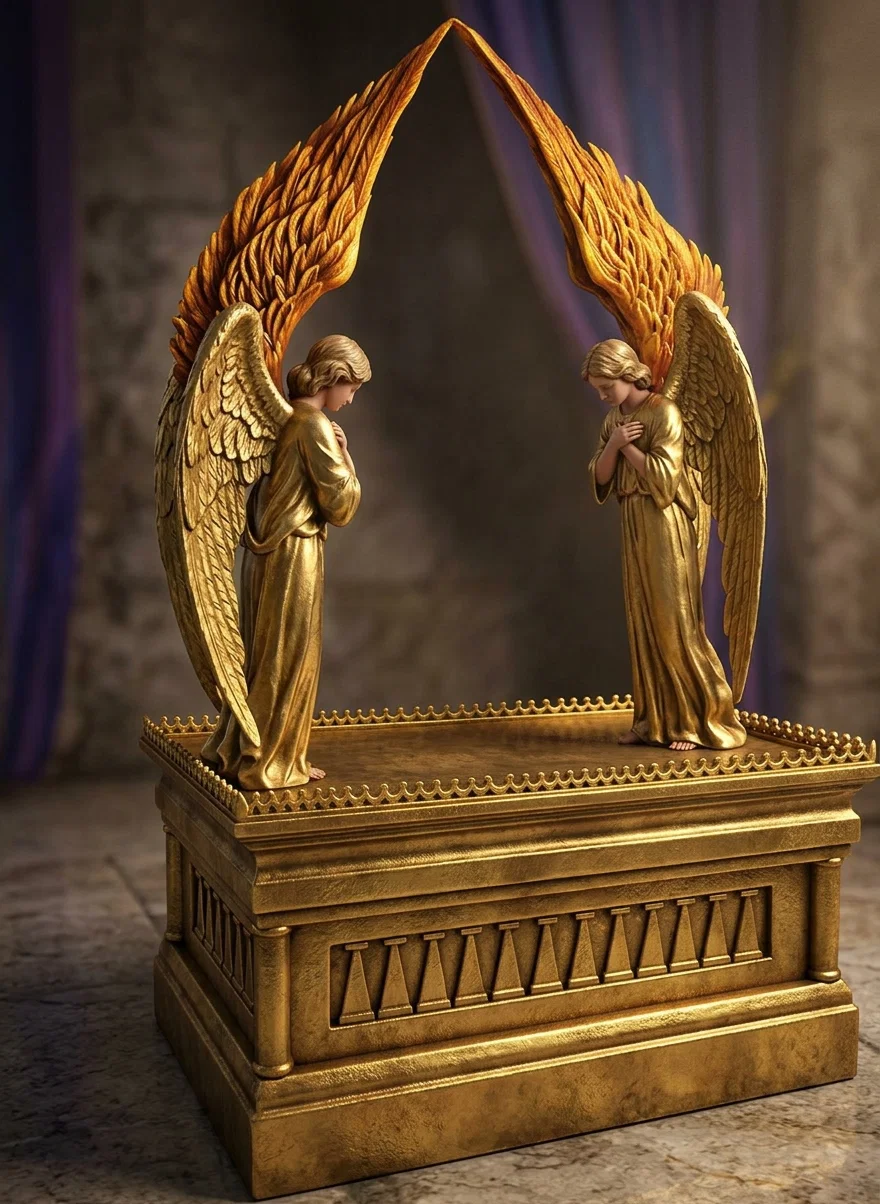
Directly inside the vail was a chest made of shittim wood, and called the "ark of the covenant," "the ark of the testament," "the ark of God," etc. It was covered with pure gold, and lined with the same material. Upon the top, and all around it, was a golden crown. In this ark were placed the two tables of stone, tables of testimony, upon which God wrote his sacred law with his own finger. And for this reason it was called the "ark of the covenant," because the Decalogue was God’s own covenant which he declared unto the children of Israel, and also was the basis of the covenant which God made with the children of Israel. Ex. 25:10–16; Deut. 10:1–5; 4:13; 5:22; Ex. 19:5. Above the ark, and covering the top, was to be a mercy-seat made of pure gold, where by his shekinah, or glorious manifestation, God would meet with the priest, and from that place commune with his servant. At each side of the mercy-seat, God commanded a cherub to be placed, made of pure gold, to be made of beaten work, with their wings stretched out, so that
they would cover the mercy-seat, and their faces looking toward the mercy-seat; thus making the mercy-seat the pivotal point. This was all the furniture for the holy of holies. No light was to be there of any kind save the glory of God resting on the mercy-seat.
How beautifully are Christ and his work manifested in this part of the tabernacle. This is not the only place in the Bible where an ark is mentioned. Before God brought the great Deluge into the world, he told Noah to prepare an ark for the saving of himself and as many more as would believe the word that the world was then to be destroyed. Gen. 6:13–22; 1 Peter 3:20. When Moses, who was to be the deliverer of the children of Israel, was born, his mother placed him in an ark of bulrushes, which, in the providence of God, was the means of saving his life. Thus all through the Bible we see that the ark was used as a means in God’s hands to save people.
Thus it is with this ark. Therein was contained God’s holy law. Man had violated that law, and had forfeited his life. The fiat had gone forth, "The wages of sin is death" (Rom. 6:23); and "sin is the transgression of the law" (1 John 3:4). Hence the law, while it was given to man for life, was found to be unto death. Rom. 7:10. Nevertheless God had the means of salvation there, for the ark contained a mercy-seat. And it was upon this seat that God dwelt to meet with the priest. And for what purpose?—To manifest his character, which is "The Lord, The Lord God, merciful and gracious, long-suffering, and abundant in goodness and truth, keeping mercy for thousands, forgiving iniquity and transgression and sin." Ex. 34:6, 7. "Who is a God like unto thee, that pardoneth iniquity, and passeth by the transgression of the remnant of his heritage? he retaineth not his anger forever, because he delighteth in mercy." Micah 7:18.
The ark indeed was a refuge to which men could flee, and be saved; for Jesus had prepared mercy with that ark. And not only prepared mercy, but much more. "Being justified freely by his grace through the redemption that is in Christ Jesus; whom God has set forth to be a propitiation, or mercy-seat. The Greek word hilastirion never signifies "propitiation," as rendered in our common version; but is always used for mercy-seat in both the Old and
New Testament, wherever it occurs. Rom. 3:24, 25. Thus Christ not only dispenses mercy, but is the Mercy-seat of God, the very essence of mercy, God having put him forth as the very characteristic of that divine disposition.
How beautiful it must have been for the priest to dwell in such a place! No one but the priest could tell what it was like; for none but he was allowed admittance. When the shekinah of God rested upon that place, and the whole apartment was filled with the effulgence of that glory, how grand it must have been to be there! The Lord came there to speak peace to all the people through the priest; and the latter was to declare to the Israelites that the God of mercy had met with them, and the very seat of mercy was the Christ. Truly, Christ is "the Alpha and Omega" of the Bible; the beginning and ending of the salvation of God. There is no place where we can turn, but what we find Jesus there; and every time he comes to us with a revelation it is to reveal some new phase of his love.
The cherubs placed at each end of the seat of mercy appeared as tho they supported the throne of God, and formed a beautiful arch for the glory of God. When the priest saw the glorious display, how it must have taught him the grand truth of the seating of God’s throne in the human soul, covered with the wings of the angels, and protecting him by their power. Isa. 57:15; Ps. 34:7.
This is the privilege of every Christian to-day. "But we all, with open face beholding as in a glass the glory of the Lord, are changed into the same image from glory to glory, even as by the Spirit of the Lord." "For God, who commanded the light to shine out of darkness, hath shined in our hearts, to give the light of the knowledge of the glory of God in the face of Jesus Christ." 2 Cor. 3:18; 4:6. And when we approach the Lord, we can look up to him to heaven, his dwelling-place, where he is seated upon his most glorious throne, having his seat of mercy between the cherubim, Christ anxiously waiting to dispense that grace. 1 Kings 8:39; Isa. 6:1; Zech. 6:12, 13; Ps. 80:1; 99:1; Heb. 4:15, 16.
This is a part of what God desired to teach Israel anciently concerning salvation, and we shall learn in future articles how Israel perverted these truths. But it is blessed to know that Jesus is pledged to abide in our heart and make it a seat of mercy, that we may dispense it to others, thus not only enjoying him for ourselves, but leading others to see him who is our Mercy-seat, and the Giver of all our good gifts.
F. C. GILBERT.
THE DOCTRINE OF BAPTISM.
By F. L. Favour
"MEN and brethren, what shall we do?" is the question that the people asked. "Repent, and be baptized every one of you in the name of Jesus Christ for the remission of sins, and ye shall receive the gift of the Holy Ghost," was Peter’s answer. Acts 2:37, 38.
Jesus said, "Go ye therefore, and teach all nations, baptizing them in the name of the Father, and of the Son, and of the Holy Ghost." Matt. 28:19. Thus we find the disciples obeying their Master’s command.
As Paul journeyed and came near Damascus, he was converted. "And he trembling and astonished, said, Lord, what wilt thou have me to do? And the Lord said unto him, Arise,6and go into the city, and it shall be told thee what thou must do." Acts 9:6. Paul said, "I was not disobedient unto the heavenly vision." So he went to Damascus. And one Ananias, after telling Paul that he should see that Just One, and be a witness unto all men, said, "Why tarriest thou? arise, and be baptized, and wash away thy sins, calling on the name of the Lord." Acts 22:16. Now, some teach that if you are converted, you need not be buried with Christ in baptism, but here we find Ananias commanding Paul to be baptized and wash away his sins, after he was converted.
Is baptism necessary for salvation?
Ans.—"The like figure whereunto even baptism doth also now save us." 1 Peter 3:21.
Then you will ask how the thief on the cross was saved. God has power to make exceptions. How do we know this? The Word says, "It is appointed unto men once to die" (Heb. 9:27), "For the living know that they shall die" (Eccl. 9:5). Yet we read that Enoch and Elijah did not die, but were translated. Thus we know that the Lord does make exceptions. Jesus said, "He that believeth and is baptized shall be saved" (Mark 16:16), and, "If ye love me, keep my commandments" (John 14:15).
When must I be baptized?
"The eunuch said, See, here is water; what doth hinder me to be baptized? And Philip said, If thou believest with all thine heart, thou mayest." Acts 8:36, 37. If you repent, and believe with all your heart that Jesus Christ is the Son of God, no one has a right to forbid water that you should be baptized.
But do you not see that an infant who can not understand the Word of God can not believe? For "how shall they believe in him of whom they have not heard?" Rom. 10:14. So a person can not lawfully be baptized until he or she is able to receive the Word. Paul tells us that no man is crowned except he strive lawfully. 2 Tim. 2:5.
How must I be baptized?
"Buried with him in baptism" (Col. 2:12), not sprinkled. Our hearts are sprinkled from an evil conscience, but our bodies must be washed with pure water. Heb. 10:22. Webster tells us that the word "buried" means "deposited in the earth or a grave." Did you ever see a dead person buried in the earth or water? But you will say, We are not dead. Well, if we are not dead with Christ, we shall not live with him. The Scripture says, "It is a faithful saying: For if we be dead with him, we shall also live with him." 2 Tim. 2:11. So true Christians are crucified unto the world (Gal. 6:14), "dead to sin" (Rom. 6:2), buried with Christ "by baptism into death" (Rom. 6:4); "but alive unto God through Jesus Christ our Lord" (Rom. 6:11). Can you say that you have obeyed from the heart this form of doctrine? Rom. 6:17. So remember that "there are three that bear witness in earth, the spirit, and the water, and the blood; and these three agree in one." 1 John 5:8.
When you are baptized, be sure that you go down "into the water." Acts 8:38. And see that you are "buried with him [Christ] in baptism." Col. 2:12. And when you come up "out of the water" (Matt. 3:16), be sure that you "receive the gift of the Holy Ghost" (Acts 2:38), and "walk in newness of life" (Rom. 6:4). For it is written, "If any man have not the Spirit of Christ, he is none of his." Rom. 8:9.
Jesus told his followers, "Go ye therefore, and teach all nations, baptizing them in the name of the Father, and of the Son, and of the Holy Ghost." Matt. 28:19. The one baptized must be willing; for "they that gladly received his word were baptized." Acts 2:41.
My last plea is, "O generation, see ye the Word of the Lord." Settle it therefore in your hearts to obey it, and not the words of men, who have defiled the earth and the inhabitants thereof; "because they have transgressed the laws, changed the ordinance, broken the everlasting covenant." Isa. 24:5.
F. L. FAVOUR.
THE SPIRIT IN RE-CREATION.
By H. F. Phelps
As THE Holy Spirit was the agency in the creation of man, making him in the image of God, how reasonable—for all of God's ways and works are reasonable and natural, and there is nothing that is unreasonable or unnatural except sin—how reasonable, I say, that the same Spirit of God should continue its office work of brooding upon the face of the world and over man during the reign of sin. How much this is like that God who is love and only love! So much is this the case that, according to the Scriptures, there is only one sin that can forever separate men from the influence of that Spirit, and that is the sin against the Holy Spirit, the utter rejection of that Spirit, in the face of its manifest workings. According to the words of Christ, all sins are forgiven except this sin. Matt. 12:31, 32. Therefore the Spirit of God will never cease its work of brooding over the lost soul, wooing it to God, until the individual himself shall, as in the days of Christ, attribute the workings of that Spirit to another power.
That the Holy Spirit is a positive agency in re-creation or conversion, is evident from the words of Christ to the learned Nicodemus, in John 3:5. He says: 'Verily, verily, I say unto thee, Except a man be born of water and of the Spirit, he can not enter into the kingdom of God.' And again in verses 6 and 8: 'That which is born of the Spirit is Spirit.' 'So is every one that is born of the Spirit.'
Again Made Alive, the Dead in Sin.
In the beginning man was made 'a living soul.' Gen. 2:7. But the fiat, 'In the day thou eatest thereof thou shalt surely die' (verse 17), has been fulfilled. By the one act of disobedience the whole race died in sin. 'Dead in trespasses and in sins,' are the words of inspiration. Eph. 2:1, 5. But here also are these words: 'But if the Spirit of him that raised up Jesus from the dead dwell in you, he that raised up Christ from the dead shall also quicken your mortal bodies by his Spirit that dwelleth in you.' Rom. 8:11. Which is equal to saying that, inasmuch as God has sent forth his Spirit into the hearts of men, and that Spirit is still in the world brooding over lost souls, wooing them to Christ, if they do not wilfully separate themselves from its divine influences, if they will only yield themselves to its influences, and let it dwell in their hearts, that same Spirit will quicken, or make alive from the death of sin, and bring them up into the image of God,—will give them a new birth. And then, being born of the Spirit, he is indeed 'a new creature.' 2 Cor. 5:17. And that is as sure as the words of Christ are true: for he was talking to Nicodemus of earthly things. John 3:12. This change in the life of a man, this new birth, must take place in this life. This is the entry-way into the kingdom of Christ. And, according to the words of the Lord, unless a man is 'born again,' 'born from above,' 'born of the Spirit,' he can not enter the kingdom of God. Without this, all hopes are vain.
The Darkness of the Mind.
Because of sin men are in darkness; the mind, the understanding, is darkened. Sin is but darkness itself, as the darkness of Egypt, that may be felt. 'Having the understanding darkened, being alienated from the life of God through the ignorance that is in them, because of the blindness of their heart.' Eph. 4:18. Thus we see there is a very great need that the eyes of the understanding should be enlightened, that men should turn away from the darkness of sin, and be turned again to that life of God from which they have been turned by sin.
A Guide-book.
To this end God has given a chart, a guide, a compass, containing God-breathed instruction. 'Every scripture inspired of God is also profitable for teaching,' etc. 2 Tim. 3:16, R. V. The original for 'scripture' is graphe, which signifies 'a writing.' Every writing God breathed is profitable; for 'holy men of God spake as they were moved by the Holy Ghost.' 2 Peter 1:21. Or, as the Revised Version has it, 'For no prophecy ever came by the will of man; but men spake from God, being moved by the Holy Ghost.'7
The Spirit in its brooding upon God-fearing men moved them to write those God-breathed words, the very thoughts of God, which are able to make one 'wise unto salvation through faith which is in Jesus Christ.' And these 'thoughts of God' are 'not in the words which man's wisdom teacheth.' 1 Cor. 2:13. Thus we see that the very words of the Bible expressing the 'thoughts of God,' are the very words of God given to 'holy men' by the agency of the Holy Spirit. It was the Spirit of Christ in these men; for the prophets themselves sought diligently, 'searching what time or what manner of time the Spirit of Christ which was in them did point unto.' 1 Peter 1:10, 11. And again, 'Yet many years didst thou forbear them, and testifiedst against them by thy Spirit in thy prophets.' Neh. 9:30. And still another prophet has spoken: 'Yea, they made their hearts as an adamant stone, lest they should hear the law, and the words which the Lord of hosts hath sent in his Spirit by the former prophets.' Zech. 7:12.
And so we see that it was 'his Spirit,' 'the Holy Spirit,' 'the Spirit of Christ,' that was in, and is still in, the very words of the prophets. And yet men will dare to tell us that we can not understand the prophecies! They do this when it is a living truth that the Holy Spirit was the agency in producing the written words of God. As the Spirit of God in the beginning brooded upon the face of the earth, bringing beauty out of chaos, and light and life out of darkness, so that same Spirit of God, in its brooding upon holy men of God, caused them to write, these God-breathed truths. And these words, these truths, were freely given to us of God. But how shall man understand these words?
By That Same Spirit of Christ.
Evidently this is so. By that Spirit the Bible was given. By that same Spirit it may be understood. 'As it is written, Eye hath not seen, nor ear heard, neither have entered into the heart of man, the things which God hath prepared for them that love him. But God hath revealed them unto us by his Spirit; for the Spirit searcheth all things, yea, the deep things of God.' 1 Cor. 2:9, 10. 'And we have received' that same Spirit. For what?—'That we might know the things that are freely given to us of God.' Verse 12. Spiritual things are 'spiritually discerned.' Verse 14. That is to say, they are understood by the selfsame Spirit of God which gave them, and those whom that Spirit possesses. Nor is this all: 'But ye have an unction from the Holy One.' 1 John 2:20. This is the anointing of the Holy Spirit. 'But the anointing which ye have received of him abideth in you, and ye need not that any man teach you; but as the same anointing teacheth you of all things, and is truth, and is no lie, and even as it hath taught you, ye shall abide in him' (margin, 'it'). Verse 27. But we are to remember this one thing: that Spirit will never lead a person away from the Word which it was the agency in giving to the world.
TRIUMPH OF THE REDEEMED.
By G. T. Wilson
CLOTHED in flames of brightest glory,
With a shining angel throng,
Christ will come and end the story
Of His people's cruel wrong.
A thousand years He binds all devils,
Chains them in earth's dark abyss,
Wicked men to earth He levels,
Takes His saints to heaven's bliss.
A thousand years in Zion's glory!
Pilgrim's hope from days of old!
'Tis the bright morn of holy story
Christian bards have long foretold.
On the thrones of judgment seated,
Where no "second death" can come;
Satan's forces are defeated;
There the ransomed are at home.
Hear the Lamb then sweetly saying,
"Come to supper; sit ye down;
You for this on earth were praying,
My redeemed, My joy, My crown."
O, the rapture of that moment
When we pass the pearly gates!
O, the blessedness of eating,
When the Saviour on us waits!
A thousand years in kingly glory,
There no tempting foe to meet;
Saints shall chant redemption's story,
Cast their crowns at Jesus' feet.
A thousand years of courtly brightness,
Jeweled crowns and harps of gold,
Robes that shine with dazzling whiteness;
Youthful beauty ne'er grows old.
Come, thou blest millennial morning!
Pilgrims wait and watch for thee;
Shake, O Lord, the earth with warning;
Come and set Thy people free;
Free from all their pain and sorrow—
Free them from oppression's hand;
End sin's night, dawn holy morrow!
Give us soon the heavenly land!
G. T. WILSON.
Hobart, Tasmania.
Maxims on Character and Rum
By Editor
“If you are told that another reviles you, do not go about to vindicate yourself; but rather say, My other faults I find are hid from him, else I am persuaded he would have told of them also; and if this be not true, no one will believe it long.”
“THE greatest hero is, perhaps, the man who does his very best, and still is not embittered by the failure.”
RUM is good in its place, and hell is the place for it.—Josh Billings.
A PROMISED REDEEMER.
By Augusta W. Heald
THE prophecies relating to our Lord and Saviour Jesus Christ form a golden chain whose links extend from that first promise in Eden. "I will put enmity between thee and the woman, and between thy seed and her seed; it shall bruise thy head, and thou shalt bruise his heel" (Gen. 3:15), down to the latest prophecy of the Old Testament, "Behold, I will send my messenger, and he shall prepare the way before me; and the Lord, whom ye seek, shall suddenly come to his temple, even the messenger of the covenant, whom ye delight in" (Mal. 3:1). Through faith in the promises, our fathers the patriarchs, and indeed all Israel, looked forward to the coming Redeemer, the "Hope of Israel." It is said of those ancient worthies: "These all died in faith, not having received the promises, but having seen them afar off, and were persuaded of them, and embraced them, and confessed that they were strangers and pilgrims on the earth." Heb. 11:13.
It is most interesting for us who live in this Gospel day to look backward and trace the prophecies of the Old Testament down to their exact fulfilment, as recorded by the evangelists. God called Abraham, the "Father of the faithful," from that far-off region, Ur of the Chaldees; he was commanded to leave his country and his kindred and his father's house, and to go into an unknown land, with this promise: "I will make of thee a great nation; . . . and in thee shall all families of the earth be blessed." Gen. 12:2, 3. This promise was renewed successively to Isaac, to Jacob, and to David, the king of Judah, in whose royal line the Saviour was to come. Even his birthplace was pointed out, and this miraculous sign was given by God, through Isaiah the prophet: "Behold, a virgin shall conceive, and bear a son, and shall call his name Immanuel." Isa. 7:14.
Isaiah, who is often called the evangelical prophet, described so accurately the life of humiliation, the sufferings and death of our Lord, more than seven hundred years before the events took place, that their fulfilment alone proves beyond doubt the inspiration of the sacred Word, for they are fulfilled even to the minutest particular. Infidels may scoff and cavil at God's Word, but who can "declare us things for to come," "and show us what shall happen"? Yea, "show the things that are to come hereafter, that we may know that ye are gods." Isa. 41:22, 23. "Who hath declared this from ancient time? . . . have not I, the Lord? and there is no God else beside me." Isa. 45:21. "Declaring the end from the beginning, and from ancient times the things that are not yet done, saying, My counsel shall stand, and I will do all my pleasure." Isa. 46:10.
"Watchman, tell us of the night,
What its signs of promise are.
Traveler, o'er yon mountain's height,
See that glory-beaming star!"
AUGUSTA W. HEALD.
WHAT ARE YOU SEEKING?
By W. H. B. Miller
MULTITUDES are engaged in a mad rush after worldly wealth, position, and glory. At the expense of many, one occasionally grasps the glittering prize, and becomes the envy of thousands. But the successful one sadly discovers that the possession of wealth and position does not insure happiness and contentment, and many an occupant of stately hall envies the condition of the lowly cottager; many an honored one longs for solitude, many a monarch for rest.
Another multitude, small, very small comparatively, have also sought for riches, and none have sought in vain. Unlike the possessor of worldly treasure, they have obtained their heart's desires without causing poverty and sorrow on the part of any. Unlike the mocking worldly search, all have found the sought-for treasure, and none have been disappointed with its value, for they would not exchange it for all the accumulated riches of earth. Its possession insures happiness, contentment, peace, and joy unspeakable.
Reader, through God's bounty and love, thousands who have sought him have become richer than the kings of earth, and still his treasure-house remains full. In our Master's name we invite you to share the blessings of his family. If you will hear the Saviour's voice and accept him as your Counselor and Friend, he promises that you will be:—
Rich.—"Wealth and riches shall be in his house." Ps. 112:3.
Of royal family.—"Of the household of God." Eph. 2:19. "Sons of God." 1 John 3:1. "Heir of God." Gal. 4:7.
Well spoken of.—"Be called great in the kingdom of heaven." Matt. 5:19.
Well fed.—"Verily thou shalt be fed." Ps. 37:3.
Well clothed.—"If God so clothed the grass of the field, . . . shall he not much more clothe you?" Matt. 6:30.
Wise.—"For God giveth to a man that is good in his sight wisdom, and knowledge." Eccl. 2:26.
Contented.—"My people shall be satisfied with my goodness, saith the Lord." Jer. 31:14.
Happy.—"Happy is that people, whose God is the Lord." Ps. 144:15.
Joyful.—"Ye rejoice with joy unspeakable." 1 Peter 1:8.
Healthy.—"Thine health shall spring forth speedily." Isa. 58:8.
Have long life.—"With long life will I satisfy him." Ps. 91:16.
Live eternally.—"He that believeth on the Son hath everlasting life." John 3:36.
Thousands can testify that he who has promised is faithful to fulfil. Come, dear reader, respond to his invitation and find treasure that the world can not give. Seek not for that which fades and dies, but make haste to secure the blessing of God, which maketh rich, and to which no sorrow is added.
W. H. B. MILLER.
Melbourne, Victoria.
The Spirit, the Word, the Mind, etc
By Editor
No. 561. The Spirit, the Word, the Mind, etc.
1 JOHN 5:7: "The Father, the Word, and the Holy Ghost; and these three are one."
John 1:1: "And the Word was God."
John 6:63: "The words that I speak unto you, they are spirit, and they are life."
(1) Does the Word contain the Holy Ghost? Are they the same in effect, or is there now a separate influence from him guiding and directing? (2) Is not our character entirely the result of the knowledge we have gained through the avenue of our senses? (3) Does God now ever act upon the heart otherwise than through the laws of the human mind?
(1) The text first quoted above is spurious, and is so considered, we believe, by all scholars. Alford says: "The words—'the Father, the Word, and the Holy Ghost; and these three are one. And there are three that bear witness in earth'—are omitted by all Greek MSS. (till the sixteenth century), all the Greek fathers, all the ancient versions, and most of the Latin fathers." And "there is not the shadow of a reason for supposing them genuine. Even the supposed citation in early Latin fathers have now, on closer examination, disappeared." The Word of God, however, contains the Spirit of God, tho the Spirit of God is by no means confined to that Word. "But ye are not in the flesh, but in the Spirit, if so be that the Spirit of God dwell in you." The Spirit works through the Word, and calls that Word to remembrance.
(2) Not entirely; heredity, or what we have inherited from our ancestors, has to do with it.
(3) According to his character of love, we do not see how he can act otherwise. Man must himself yield his mind and will to God. If he will do this, God will give him a new mind.
"REGULATING" THE LIQUOR TRAFFIC.
By W. N. G.
It would seem that men would sometime learn the utter impossibility of making the liquor traffic anything but an unmitigated evil. The efforts to "regulate" it only add emphasis to the fact that it can not be regulated. Its very essence is lawlessness, a selfish disregard of the welfare of mankind. The law-making powers might just as well try to regulate the entire work of Satan. The only checks that ever are placed upon the liquor trade are prohibitive as far as they go, and the effect of all liquor laws, short of absolute prohibition, is limited in the main to the desire of a small per cent. of dealers to9pose as law-abiding citizens. The only regulation that works any appreciative check upon the evil is prohibition. The State of New York has had its Raines Law, which, on its passage, was much lauded by temperance men and religious journals. But, notwithstanding its many so-called "good features," it has proved a failure, and the present Legislature has had a prolonged contest trying to patch it up. The New York Voice says of the original law:—
"Under the original law, as the courts construed it, hotels and incorporated clubs were permitted to sell liquors on Sundays. Hence nearly every saloon became a 'hotel' or a 'club,' and the officers were powerless to prevent it. Bedlam reigned in these thousands of dives. . . . When a criminal starts out to sell liquor, he is pretty sure to secure a Federal permit. The penalty for selling without it is very severe, and Deputy U. S. Marshals are watchful. Great numbers of clandestine liquor-sellers hold these permits who do not have a State license. Most of the Raines Law fake clubs, fake hotels, and genuine dives of New York City have these permits. The Voice has made a list of all the Federal permits held in New York City on Jan. 1, 1897, and also a list of all who have paid their State license. Only names of retailers were copied. These lists show that there are more than 4,000 persons in New York City to-day holding Federal permits to sell liquor at retail who have no State license."
The Raines Law is ostensibly a very stringent excise law, but the Voice has shown from the public records that more than 4,000 retail liquor institutions are run in the one city, in spite of its provisions. Such are the attempts to "regulate" the law-defying, soul-destroying liquor traffic. Yet professed Christian temperance men will dally with it, and compromise with it, and think they have gained a great moral victory if they get it in some way nominally "regulated" on Sunday. W. N. G.
Question Corner
By Editor
“Enquire, and make search, and ask diligently.”
NOTE.—We wish those who ask questions to take particular notice: (1) Only such questions will be answered here as we believe to be of general interest and information. (2) We can not undertake to explain from four to a dozen scriptures, as in one sentence we are often requested to do. (3) Do not ask to “explain” a certain text or passage. State clearly the point in question. (4) Give full name and address, not for publication unless desired, but as evidence of good faith, and to give us the privilege of replying by letter if deemed best. (5) Unsigned communications of any kind find the quickest way to the waste-basket. (6) It is always well to inclose stamp. (7) “Foolish and unlearned questions avoid,” also those that minister to mere curiosity. (8) Study the Scriptures yourselves.
Those Taken to Heaven
By Editor
No. 559. Those Taken to Heaven.
WHERE is the authority for saying, as the SIGNS has said, that the twenty-four divisions around the throne of God are of the multitude of captives that Christ took with him? I would like to know where to find a Thus saith the Word that he took any with him.
“And the graves were opened; and many bodies of the saints which slept arose, and came out of the graves after his resurrection, and went into the holy city, and appeared unto many.” Matt. 27:52, 53. “When he ascended up on high, he led captivity captive.” Eph. 4:8. That is, those who had been made Satan’s captives, Christ released, “a multitude of captives,” as the margin reads. Priests must be those who have compassion. So our Lord became flesh, and took with him as assistants those who likewise had been compassed about with infirmity; and these, it is reasonable to believe, constitute the elders around the throne.
Stones of the Breastplate
No. 560. Stones of the Breastplate.
PLEASE give the colors of the stones mentioned in Ex. 28: 17-20, and quote the best authority on the same. I. B. B.
The Common Version and margin of Revised Version differ, as do other “authorities.” See plate under “Gems” in Standard Dictionary. Adam Clarke, following the Common Version, gives as follows: Sardius, “fine deep red color,” “a blood red color;” Topaz, “pale dead green,” “sometimes of a fine yellow;” Carbuncle, “a deep red color,” in the sun “like a piece of bright burning charcoal;” Emerald, bright green color; Sapphire, “fine blue color,” “some blue or green, . . . and some white;” Diamond, he gives no color, for, pure, it is colorless; Ligure, “dead red or crimson color,” with “mixture of yellow;” Agate, “white agates have reddish, yellowish, greenish ground;” Amethyst, “a purple, composed of a strong blue and deep red,” some are dove colored, others purple, “and others white like diamonds;” Beryl, “a bluish green color;” Onyx, “darkish horny color,” often “bluish white spots are in it;” Jasper, “bright green,” “sometimes clouded with white, and spotted with red and yellow.” And then he gives fifteen different colors of it. No man knows the colors of the stones of the breastplate. For most of the stones we might as well ask the color of the modern rose, which varies all the way from white to black, or the pansy. These stones run through all indescribable shades and mixtures of colors.
How He Draws
By Alonzo T. Jones
No. 562. How He Draws.
“And I, if I be lifted up from the earth, will draw all men unto me.” John 12:32. In what way will he do this? Of course all will not be saved.
Jesus Christ always and ever draws all men to himself by his love. He gave himself, and of that complete giving the death on the cross was the culmination. It reveals, or should reveal to all, God’s wondrous love; and it does in some degree. Whether men will yield to the love is another question. If they will not in this life, they will all acknowledge it before the judgment-seat of Christ. Rom. 14: 10-12.
No. 563. The 144,000.
By Editor
ARE the children counted in the hundred and forty-four thousand that will be translated?
We do not know. When ancient Israel was numbered, only the males from twenty years old and upward were counted. See Num. 1:44-46; 26:2-4; Matt. 14:21; 15:38; Acts 4:4. However, it is not profitable to speculate upon these things. What God prizes is not number (altho the elect number will be gathered), but character; and he has made the required character possible to all through Jesus Christ.
Decalogue and Covenant
No. 564. Decalogue and Covenant.
Does not Deut. 9:9 seem to call the Ten Commandments the covenant made between Israel and God?
Perhaps so, under a strained construction, but not properly. They were the tables of that covenant, because they contained the will of God, on which the mutual covenant was based. There is nothing of an agreement between parties in the Decalogue. It is the expressed will of God, largely in negative form.
“And he that overcometh, and keepeth my works unto the end, to him will I give power over the nations; and he shall rule them with a rod of iron; as the vessels of a potter shall they be broken to shivers; even as I received of my Father.” This scripture has, primarily, reference to Christ, he who overcame for all. Ps. 2:8, 9; Dan. 2:34, 35, 44; Rev. 12:5. But through Christ it also has application to his church, the triumphant members of which share in his victories and glory. 2 Tim. 2:11, 12; Rom. 8:17. Of the execution of the final judgment it is said, “This honor have all the saints,” and to this time doubtless Rev. 2:26, 27 applies. See Ps. 149:5-9.
Book of Moses
By Editor
No. 566. Book of Moses.
How do you answer the argument so often brought forward that the Book of Moses, etc., was written thousands of years after the death of Moses, and that Chinese history is so much older than the Bible? MRS. A. H. MCA.
As a general thing, such statements are not worthy of answer, and they are put forth by those who know nothing of the subject by personal investigation, for the sole purpose of caviling. To the honest inquirer we would show that subsequent books of the Bible refer to the law of Moses as a book written before their time (Joshua 8:31; 1 Kings 2:3; 2 Kings 22:8, 13; 23:25; 2 Chron. 34:14; Dan. 9:11; Ezra 6:18, etc.); that the New Testament confirms this (Luke 24:44; Heb. 10:28, etc.). The brick records of Assyria, Babylonia, and other oriental people confirm the earlier writings of the Bible, as does also Josephus. As for "Chinese history," while doubtless ancient, it is exceedingly uncertain.