SUGGESTIONS FOR STUDY.—1. Read attentively the eighth and ninth chapters of Daniel, noticing particularly verses 14, 16, and 27 of chapter eight, and verses 21, 22, and 25 of chapter nine. 2. Read the chapters again, giving careful thought to the following points: Who was commissioned to explain the vision to Daniel? Did Gabriel not make a very clear explanation, so far as he went? Verse 25. Did he make it all plain? Verse 27. Did he explain the twenty-three hundred days? 3. Notice that the part of the vision relating to the twenty-three hundred days is the very part that was to be shut up for a time. The Revised Version makes this clear as it gives the literal translation of verses 14 and 26: “Unto two thousand and three hundred evenings and mornings.” Verse 14. “The vision of the evenings and mornings which hath been told is true; but shut thou up the vision, for it belongeth to many days.” Verse 26. Is it not clear that verse 26 points back to verse 14? The expression “two thousand and three hundred evenings and mornings” means twenty-three hundred days, and if the same principle had been employed in translating verse 26, it would have read, “The vision of the days . . . is true.” The connection between verses 14 and 26 would then have been plain. Daniel did not then understand concerning the twenty-three hundred days, because Gabriel had not explained them; yet Gabriel had been commissioned to explain the whole vision, and to make Daniel understand it. Did he ever do so? 4. Now read Dan. 9:20–23: “The man Gabriel,”—is this the same angel who had been commissioned to cause Daniel to understand the vision?—“whom I had seen in the vision at the beginning.” What vision? “Understand the matter, and consider the vision.” What vision? “Seventy weeks are determined upon thy people.” Then are the seventy weeks, or four hundred and ninety days, part of the twenty-three hundred days? Do they begin together? Do they both begin with the commandment to restore and build Jerusalem? These points should be dwelt upon till it is clearly seen that the ninth chapter of Daniel is a supplement to chapter eight, supplying just what was omitted there, or rather, taking up the explanation where the eighth chapter leaves off.
1. At what period of the world’s history must the judgment take place? (See note 1.)
2. What is God’s appointment concerning it? Acts 17:31. (See note 2.)
3. When was the judgment work to begin? Dan. 8:14. (See note 3.)
4. In connection with what vision was the vision of the twenty-three hundred days given? Verses 1, 2.
5. What symbols were shown Daniel? Verses 3, 5, 9.
6. What question led to the giving of this great prophetic period? Verse 13.
7. Who asked this question, and of whom?
8. To whom was the answer given? Verse 14.
9. What commission was given to Gabriel? Verses 15, 16.
10. To what time did he say the vision reached? Verses 17, 19.
11. What were the symbols explained to be? Verses 20–25.
12. What effect did the vision have upon Daniel, and how did he regard it? Verse 27.
13. What portion had been left unexplained?
14. Upon what portion of the vision was Daniel’s mind afterward exercised? Dan. 9:2.
15. To what did he evidently think the time referred? Verses 2, 16, 17.
16. What did he do? Verses 3–19.
17. How was his prayer answered? Verses 20, 21.
18. What did Gabriel say to Daniel? Verses 22, 23.
19. To what vision must he have referred?
20. On what part does he begin in explaining it? Verse 24.
21. What does he say?
22. Of what, then, must the seventy weeks form a part? (See note 4.)
23. What kind of time is used in symbolic prophecy? Ans.—Prophetic time.
25. What was to take place during the seventy weeks? Dan. 9:24. (See note 5.)
26. To what people is reference made in this verse?
NOTES.
I. In the very nature of things judgment must follow a time of probation. God’s judgment of this world must, therefore, come at the close of its history. This is also evident when we remember that the influence of a man’s deeds continues after his death, and will continue till the close of probation, when the decree goes forth which is found in Rev. 22:11.
II. His influence will, therefore, be considered in the judgment, because it is a result of his work. Eccl. 12:13, 14.
2. The day of judgment is not to be understood as a day of twenty-four hours. The Scriptures speak of the day of the Lord (Joel 2:1, 11), and the day of salvation. 2 Cor. 6:2. These are long periods of time, and the day of judgment which God has appointed involves work that extends over a period of many years, as the Bible plainly teaches.
3. We have already found that the cleansing of the sanctuary is a work of judgment. Hence when the Lord reveals the time when the cleansing of the sanctuary is to take place, he reveals the time when the judgment is to begin.
4. As the angel began on the subject of time when he came to Daniel to explain the vision, the seventy weeks must form a part of the time mentioned in the vision. And as the instruction concerning the seventy weeks would not aid in any way in locating the beginning of the twenty-three hundred days unless they were to begin at the same time, we are held to the conclusion that the two periods coincide at their commencement. “Seventy weeks are determined,” literally, “cut off.” (See “Sanctuary and Its Cleansing,” chapter 6.)
5. “To finish the transgression,”—that is, to fill up the cup of Israel’s iniquity. This condition was reached at the first advent of Christ. Matt. 23:29–38. “To make an end of sins.”—This Christ did, in the sense of the prophecy, by making provision for putting away sin by the sacrifice of himself. Heb. 9:26. “To make reconciliation for iniquity.”—This was done by Christ’s taking upon himself the penalty of sin, that the law might be honored and the transgressor reconciled to God. 1 Cor. 15:3. “To bring in everlasting righteousness”—the righteousness of God, which was seen in the spotless life of Jesus Christ, and which is given to every believer. Rom. 3:21–25. “To seal up the vision and prophecy.”—Evidently the words “seal up” are used in the sense of making sure instead of making secret. The seventy weeks were given to explain the vision, and not to darken it; to reveal truth, and not to cover it. They test every theory and view that is advanced concerning the twenty-three hundred days. They expose every false application, and make sure the true one. This will appear when its divisions are considered. Dan. 9:25–27. “To anoint the Most Holy.”—The earthly sanctuary was to be anointed before the ministration in it could begin. Ex. 30:25–30. So, after the death of Christ, he ascended to heaven to minister as our High Priest in the sanctuary, preparatory to which, according to the type, it would be anointed.
EVENING SHADOWS.
By Jonathan Spence
The course of day is almost run
When shadows fall ere set of sun.
While sunbeams linger to depart,
In pensive mood we ofttimes ask,
Have I to-day fulfilled my task,
Or cheered some sad and fainting heart?
So when life's day is almost o'er,
Its setting sun shall rise no more;
The night of death is drawing near;
Then fain would we with all our powers,
Improve the past and misspent hours,
Ere we before God's bar appear.
Then early in life's morn arise,
And seek to gain the lasting prize;
Ere life's swift-passing moments fly,
And evening shades shall spread their gloom,
May Hope's bright beams our way illume
To mansions fair beyond the sky.
There, in that land of sweet repose,
The gates of morning ne'er shall close,
But constant is the heavenly ray,
Where comes no shade nor gloomy pall;
There evening shadows never fall;
No twilights dim those realms of day.
Jonathan Spence.
Ask God to Give Thee Skill
Ask God to give thee skill
In comfort's art,
That thou mayst consecrated be
And set apart
Unto a life of sympathy.
For heavy is the weight of ill
In every heart;
And comforters are needed much
Of Christlike touch.
— Selected.
DO NOT NEGLECT THE CHILDREN.
By C. H. Castle
MUCH is said from time to time with regard to the children in the home and at school, but little mention is made with respect to them in the Sabbath-school. I say, Do not neglect the children in the Sabbath-school. They are the best material with which to build up the school, if they are given an opportunity to do something.
The young minds are easily influenced; and if a little interest is awakened in them, they will readily respond, and help to make the Sabbath-school what it should be.
Great possibilities are before the children; and I believe it is our duty, as officers of the Sabbath-school, to help to make their lives lives of usefulness.
We often see the children, during a review, playing, or doing something of that sort, being uninterested in what is taking place; and can we blame them? they have no voice in the exercises, in many cases.
Let me suggest that occasionally a review, especially for the children, be given, and I assure you they will take a lively interest in the lessons that are before them, and thus they will have planted in their hearts the principles of truth. I have been in Sabbath-schools where this works well, and it was pleasing to see the little ones eager to tell what was in the lesson.
Christ said (Mark 10:14), “Suffer the little children to come unto me, and forbid them not: for of such is the kingdom of God.”
Try it; it will be a blessing to the older ones as well as to the children, and the Sabbath-school cannot help but be interesting and grow. C. H. CASTLE.
“NOW LISTEN, AND I'LL TELL YOU.”
HARVEY'S CHOICE.
By Anna V. Ruthven
Harvey James and Clarence Field were firm friends. They attended the same school. It was difficult to decide which was the better scholar. They were both talented and refined. The tender love and consideration they had for each other was indeed beautiful to behold; it reminded one of Jonathan and David. But finally the time came when they must separate. The graduation exercises were concluded, and the young men left school with honors. Now they must go out in the great lonely world to earn their living.
Clarence and Harvey differed somewhat in their opinions, especially upon the temperance question. Harvey was strictly temperate, while Clarence would indulge in an occasional glass of soda or cider. Harvey would often say, “Clarence, I wish you were a strict temperance man.” Clarence usually replied, “I do not think it will hurt me. Thank you for your advice; I know you have given it in kindness.”
“Papa says most people use those things; but a Christian should not do so, as the habit often leads to a worse form of intemperance.” But in vain did his faithful friend and companion warn him.
Clarence was called to fill a position in a large drug store. Harvey chose a life of poverty and toil by giving himself in his best years wholly to the service of his Master. He became a missionary—not to a foreign land, but he labored for the fallen in a large city of his native country. His life-work served to show him the folly of intemperance, and the wisdom of his good father, who had fallen asleep in Jesus. His mother he could not remember, as she had died when he was a child.
But what of Clarence Field? What was he doing with the talents God had intrusted to his care? Well, he went into company. His leisure evenings were spent with “the boys.” He soon learned to play cards and billiards. The cider and soda were discarded for wine, and once in a while “a whisky.” His progress downward was very rapid. The God of his childhood was slighted and insulted. The widowed mother, who had taught him to pray, was forgotten. Sad, sad condition!
His employer said to him one morning: “Clarence, you cannot expect to retain your position if you do not cultivate steady, sober habits; the good character of my place of business will be questioned. People do not care to have prescriptions filled by intoxicated clerks.”
This warning did not affect Clarence. He was finally dismissed. He had no money, as he had lost it all by gambling; but the greater loss was his character.
There was nothing left for him to do but to return to his aged mother. He did not return as did the penitent prodigal. He grew worse and worse. One day, while staggering down the village street, he met a young man with a little red, white, and blue cross fastened on his bosom. Clarence did not recognize his old friend and schoolmate, Harvey; and as the young soldier of the cross looked upon that living temperance sermon, he again gave thanks to his God for keeping him in the path of duty.
Harvey James led his old friend home, but Clarence did not get over this dissipation. He became very ill, and died in a few days. God had warned him,—had stretched out his hand to Clarence Field,—but he had refused. The preparations for burial were completed. Sorrowing relatives and sympathizing friends gathered for one last look; but none of them suffered so keenly as Harvey James, as he recalled these words: “If any man defile the temple of God, him shall God destroy; for the temple of God is holy, which temple ye are.” 1 Cor. 3:17.
ANNA V. RUTHVEN.
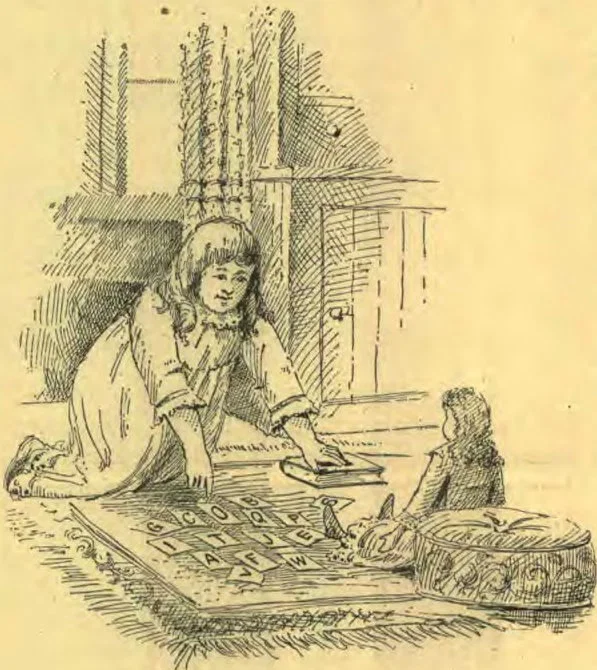
DOLLY'S LESSON.
Come here, you 'nigoramus!
I'm 'shamed to have to 'fess
You don't know any letter
'Cept just your cookie S.
Now listen, and I'll tell you:
This round hole's name is O;
And when you put a tail in,
It makes it Q, you know.
And if it has a front door
To walk in at, it's C.
Then make a seat right here
To sit on, and it's G.
And this tall letter, dolly,
Is I, and stands for me;
And when it puts a hat on,
It makes a cup o' T.
And curly I is J, dear,
And half of B is P;
And E without his slippers on
Is only F, you see!
You turn A upside downwards
And people call it V;
And if it's twins, like this one,
W't will be.
Now, dolly, when you learn 'em,
You'll know a great big heap—
*'Most 's much 's I — O dolly!
I b'lieve you've gone asleep!*
—Adapted.
BE KIND TO ONE ANOTHER.
THINK you kindness dwells alone
Where wealth and beauty act their part?
Then you mistake; for oft is found
’Neath coat of rags a loving heart.
And lest, on those less blest than we,
We let unkindly judgment fall,
That we are brothers, ne’er forget;
And God, our Father, loves us all.
— Selected.
Christ Knows and Will Reward Every Work
WHEREVER you may be, remember that the blessed Saviour knows all you think of him, say about him, and do for him, and never forget that he soon will come to reward every one according as his work shall be.
FILIAL DEVOTION OF THE CHINESE.
THE filial devotion of the Chinese is often very beautiful to witness, yet sometimes it is carried to an absurd extent. It would be well if all those who have the fifth commandment in their hands were as obedient to its injunctions as are the Chinese. Here, for instance, is what is said of one of their customs: “On every New Year’s morning, each man and boy, from the emperor to the lowest peasant, pays a visit to his mother. He carries her a present, varying in value according to his station, thanking her for all she has done for him, and asks a continuance of her favor another year. They are taught to believe that mothers have an influence for good over their sons all through life.” No doubt you often say “Thank you” to your mother, but would it not be well if once in awhile you told her a little more at length how grateful you are for her care and love? It would do you good, and you may be sure it would make her heart glad.—Selected.
SURGEON TO A WHITE BEAR.
“As a result of captivity,” says Herr Carl Hagenbeck, “the nails and teeth of lions, tigers, and other inmates of menageries often get into a bad condition.” One of his largest Bengal tigers was recently a great sufferer from toothache. The tooth troubled him for days, and at length ulcerated.
Herr Hagenbeck managed to extract it with a pair of pinchers; but the services of five strong men were required to hold the patient, and persuade him to open his mouth. The roar which he uttered when the tooth came out seemed likely to bring down the pavilion.
Herr Hagenbeck never saw but one living thing more touchy than a tiger with a toothache; that was a large white bear which he once had at Hamburg, five of whose great curved toenails had grown abnormally long, and entered the flesh to such an extent that maturation had set in. Three of the paws were much inflamed, swollen, and very painful. His keeper realized then the full meaning of the old adage, “cross as a bear.” It seemed as if the poor brute wished to annihilate the whole human family.
How to remove those ingrowing toenails proved to be a problem. Herr Hagenbeck devised various “slings” and “jackets” for confining the bear; but he was so big and savage that nothing would hold him.
At last, a stratagem occurred to the showman. He ordered the bear’s cage to be turned down upon the front side, so that the bars formed the bottom of it. Then a tackle was rigged, and the cage was hoisted to a height of seven feet, clear of the ground. All four of the bear’s legs were then down between the bars, at full length. In that position he was bound with ropes, so that he could not raise himself and draw up his feet.
Herr Hagenbeck then got to work as a surgeon, underneath the cage, with his patient over his head. There was a beautiful opportunity to operate; and one by one all five of the troublesome claws were pulled out. Indeed, so badly maturated had the toes become, that the nails came away without a great exertion of force. None the less the running comments made by the patient were of a most blood-curdling character.
After the operation, a shallow tank full of cold water was placed underneath the cage, for the bear to stand in, in order to reduce the fever in his feet. He made a good recovery.—Youth’s Companion.
GROWTH OF INDUSTRIAL LIFE.
By C. B. Morrill
3.—TOWN AND GUILD.
In Cincinnati and in some other cities of this country where the climate is not too severe, one of the important city institutions is the town market. In a very wide street, about twice as wide as ordinary, sheds and booths are built, where farmers and others bring hay, vegetables, fruits, fish, and like products of the country, and arrange them for sale. Two or three times in the week market is held, and at such times a sight is to be seen which is picturesque and interesting, especially to one who remembers that he has here, only a block or two from wholesale houses, banks, railways, and other features of the highest commercial development, a survival of the earliest form of trade.
Here is the Irish servant-girl with her market-basket upon her arm, and a red shawl about her shoulders. She trudges along past the man who has blackberries, the woman who displays green peas, string-beans, and young onions, and finds at last the stall she is looking for, where personal attentions to herself make up for the round price which comes out of her mistress’s pocket-book. There at the fish-market the intelligent and refined manner of the purchaser betrays the mistress who goes to market herself; and sure enough, there, behind her, is Nora with the basket. Farther up, where bags of oats and bales of hay fill the shed, Patrick is making his purchases for the dinner of the fine bays he drives so importantly of afternoons, through the avenues of Walnut Hills. Past the fish-market again— “Fi-ine Erie trout! Here’s your Lake trout, madam, only—” “Halibut steak! Fine fresh halibut.” Balloons, jumping-jacks, singing birds,—artificial,—running mice, jumping frogs, and innumerable catch-pennies throng the curbstone—the mountebanks of our humdrum days. The presence of the maid and her mistress also draws to the inner margin of the sidewalk the representatives of city trade, as the shed in the middle of the street draws maid and mistress. Fancy the street thronged with gaberdines, Saxon tunics, and Norman short cloaks, and you have a fair picture of a market day in an English town in the fourteenth century.
But you discover a very wide difference the moment you look below the surface at the principles upon which the market is conducted. The nineteenth-century market is filled with the competitive, struggling commercial spirit of the nineteenth century. The fourteenth-century market had its fixed schedule of prices, and competition and underselling were unknown.
The fourteenth-century market was controlled entirely by the guild merchant, or, as we would say, the merchant guild, of the town. Every one who sold anything at the market either belonged to the guild, or paid a license fee for the privilege of selling. More than that; every resident of the town who was financially able to belong to the guild was compelled to become a member.
The guild merchant controlled the manufacture of goods. In those times, there was no such thing as going to find purchasers, as is done at this day. Now, when a man has anything to sell, he advertises, sends out agents, and hunts up his customers. If the retail merchant does not come to buy of him, behold the drummer! Then, the merchant hunted up the manufacturer. The only way a town could draw trade was by acquiring a world-wide reputation for the excellence of some particular one of its products: So it happened that the lace of one town was everywhere in demand, and likewise the worsted of another, the sword-blades of a third, and the armor of a fourth. Who has not heard of Toledo blades, Brussels carpets and lace, Sheffield cutlery, or Dresden china? Accordingly the guild watched carefully over the products of its town. No work was to be done by candlelight, because it was not likely to be done well. Cloth was to be of a certain number of threads to the yard, and was to be fulled and dyed in a certain manner. No innovations were allowed; success depended on the dependence which could be placed on exact uniformity in all goods bearing the name of the town. Every piece of goods was inspected by the guild.
The evolution of this state of affairs is supposed to have begun in the commutation of labor dues for grain or money rent, which was the first step of the villeins out of serfdom. It must be borne in mind that there was very little reasoning about liberty or about rights in all these changes. Every man knew what he wanted, and got it if he could, and no one was conscious of a growth or a change till long afterward. The bailiff was disagreeable to the farmers, and they offered the lord a certain rent for the whole manor, if he would take his bailiff off. If it seemed to him a good bargain, the lord of the manor accepted the proposition. Those who entered the agreement were called burgesses. They received from their lord or from the king a town charter, and met to hold a court leet, or common council, at which the alderman—perhaps the most substantial, most influential, or the oldest, of the burgesses—presided. They also formed a guild merchant to take charge of the town market, since by this time other occupations than agriculture were becoming important.
Many of those who rented a part of the demesne or of the waste land, had not ground enough to enable them to live by agriculture alone. They therefore, if they had some skill in weaving, baking, brewing, fulling, or dyeing, produced as much more than what they needed as their neighbors would take, and exchanged this surplus for the things which they needed. The cotters, especially, eked out their living in this way. Thus arose a class of tradesmen, who disposed of their goods in the markets of the merchant guilds. As the market enlarged, the tradesmen devoted more and more time to their trades, until perhaps they, for the most part, gave up agriculture altogether. After about a hundred years, the tradesmen in the same lines of industry began to form guilds. Just why they did so is a much-disputed point. The first to appear of these craft guilds, as they were called, were the weavers’ guilds, and they were the ones that had the severest fight with the old and arrogant merchant guilds. In some cases there was no great opposition to the craft guild, but usually there was opposition. Sometimes the struggle was for a share in the government of the town; sometimes it was for a share in the market. But occasionally, the new guild applied for a charter from the king, and, selecting some favorable location for a commercial town, proceeded to found one of their own designing. Thus arose the manufacturing towns. The craft guild became the common council, and the master-workman,—maistre, or maire,—became the principal magistrate of the community.
The craft guilds, besides having many rules in regard to laborers and their contracts with their employers, the relation of the master to the apprentice and journeyman, and the disposal of wares, were great trust and mutual benefit associations. They received legacies in trust from their members, cared for the families of those who were sick, and honored the dead with respectable funerals. They also took the place of the sundry insurance companies of this day; that is, when a member met with loss by fire or accident to life, limb, or property, he or his family were given license to beg, so that all might know that they were deserving of aid. By the piling up of unusual funds these guilds became very wealthy, and after the guild system in labor had passed away, these funds were devoted to various good uses. Schools and hospitals were the enterprises most often endowed from the guild treasuries. The Merchant Taylor’s school, one of the best of England’s public schools, is an example. Some of the craft guilds still exist under their old names, having changed with the change of times into insurance societies and fraternal or charitable organizations.
C. B. MORRILL.
THE KNIGHTLIEST DEED.
By Myrta B. Castle
A GENTLE knight, in days of old, came pricking o'er the plain;
With grace he rode his charger bold — milkwhite, with flowing mane.
“I've ridden far from my castle home,” mused the knight as he rode along;
“I have come on a quest, the world to roam, till I right some grievous wrong.
Mayhap a princess in a tower I'll release from durance vile,
Held thrall in a tyrant's woful power, as she weeps and wails the while.
It may be a prince of high degree, hard beset by caitiff knight,
Whom I, with my goodly spear, will free in a hard and glorious fight.
O I, with my spear and blazoned shield, and my milkwhite charger bold,
Will win renown in battle-field, as King Arthur did of old."
The knight rode on, and in many a list he won a gallant fame;
He was known as Sir Knight of the Iron Fist, or the Knight Without a Name.
But once, as day shut down in the west, after a fight for fame,
The knight did a deed of deeds the best, though no honor with it came.
He had won in the fray; yet his life-blood flowed where he lay near his fallen foe;
And the sky with its parting redness glowed o'er the vale where the knights lay low.
Then the Nameless Knight drew his drinking-horn, for the fever of death raged high;
“Thou'rt athirst,” he said to his foe forlorn; “drink! 't will ease thee ere thou die!”
Then the western sky glowed red as flame, and these words rang over the lea:
“Thou hast righted many wrongs for fame; thou hast done this deed for Me!”
MYRTA B. CASTLE.
Farm Population, Electricity, and Lincoln Monument Facts
THERE are in the United States at present six million farms. About one half the population of the republic, or over thirty million people, live on them, and these farm-dwellers furnish more than seventy-four per cent of the total value of the exports of the country.
TWENTY-FOUR years ago electricity as a mechanical power was unknown; but now over nine hundred million dollars are invested in various kinds of electrical machinery.
THE monument erected to Lincoln in Edinburgh is the only memorial of the kind in Europe.
A SEASONABLE POEM.
By Annie A. Smith
There has always been a subtle charm about the shifting of the seasons—from ice-bound winter to spring, from spring to summer, the noontide of the year, from summer to the bounteous autumn, and from autumn to the frosty twilight of winter again. This changing of the seasons has ever been a fruitful source of inspiration to the poet, who, as it were, dips his quill into the running brook as it bursts its icy fetters, and indites an ode to the charms of spring, or, like Lowell, sings of the rare days of June, and so on through each of the four seasons.
But just now, while the snows of winter are deepest, and the winds about the chimney roar the loudest, there is no poem which it seems more appropriate to read than Whittier’s beautiful idyll, “Snow-Bound.” It has for me a never-ending charm, and I read it over again every year with the same regularity with which one dons his winter garments.
I remember one bitter cold night, when I was but a child, hearing my father say that he had a “chill no coat.” Being somewhat curious as to what sort of garment this might be, I made inquiries and learned that he referred to—
“A chill no coat, however stout,
Of homespun stuff could quite shut out.”
This was my first introduction to “Snow-Bound.” I read the poem through, and have loved it ever since.
It is a perfect picture of rural life in winter, and one which appeals to the heart of every country-bred boy and girl. What farmer lad has not had the experience spoken of in the first part of the poem, of shoveling paths in the early chill of a winter’s morning, feeding the cattle, and laying in a good supply of wood for the long, cold nights? And doubtless many of us have often heard our parents tell of the large, open fireplaces where—
“Ever when a louder blast
Shook beam and rafter as it passed,
The merrier up its roaring draught
The great throat of the chimney laughed.”
After describing the good cheer that is prepared,—the apples “sputtering in a row,” the mug of simmering drink, and the nuts “from brown October’s wood,” the poet falls into a bit of musing, sad yet sweet, and closes with the beautiful lines,—
“Who hath not learned, in hours of faith,
The truth to flesh and sense unknown,
That Life is ever lord of Death,
And Love can never lose its own?”
Then follow pen-portraits of each member of the happy group who sat “the clean-winged hearth about” on that winter’s night. We can see them all in imagination,—the gray-haired father, the gentle mother, the uncle, aunt, and sister, the “master of the district school,” and the “not unfeared, half-welcome guest,” who, we understand, was Harriet Livermore.
Perhaps in these pictures of old days we can recognize some well-beloved face of parent or friend who has sat beside our own home fire, but whose voice is now forever still,—hushed “beneath the low green tent whose curtain never outward swings.”
After an evening spent in story and song, the pleasant circle broke, each going to his rest, and at length, the poet says,—
“Sleep stole on as sleep will do
When hearts are light and life is new.”
But now the picture fades; the spell is broken. However pleasing the fancy, we may not always sit and dream before the glowing coals. We—
“Can but heed
The restless sands’ incessant fall,
Importunate hours that hours succeed,
Each clamorous with its own sharp need,
And duty keeping pace with all.”
ANNIE A. SMITH.
FEBRUARY
By Anetta M. Osborne
WITH swelling buds and melting snows
Brief February comes and goes,
And hastens in her course to bring
The coming miracle of spring.
Yet still the chains of winter hold,
And days return of storm and cold.
Though not for long their time shall be;
Soon ice-bound waters shall be free.
Then brooks will flow with tinkling sound,
And life now dormant in the ground
Will start to bless the earth once more,
And clothe with green the forest floor.
— Anetta M. Osborne.
WHAT WE OWE TO ANIMALS.
THOSE who have read the story of Robinson Crusoe, the sailor who was shipwrecked on an island not inhabited by white men, will remember how he soon made companions of the various animals he found there, and with their aid sustained life until he was rescued. If one of us should be shipwrecked on a desert island where no animals lived—no horses to draw us, no ox to toil for us, no cow or goat to give us milk, no sheep to give us wool, no hen to give us eggs, no dog to be our companion and guard us in the night, no cat to lie on the hearth, no birds to sing their songs, no living creature to keep us company, no sound of any living thing by day or night,—only solitude and silence everywhere, with nothing to eat but such roots as we could dig from the earth, and nothing to wear but such bark as we could pluck from the tree,—we should then know how much we owe to these creatures which God has mercifully provided for our use. And ever afterward, if we escaped from such a life, how grateful we should be to God for giving them, and how thankful to them for the service they render us!
THE RETREAT FROM MOSCOW.
Just now everybody is talking, reading, writing, about Napoleon Bonaparte. If you are not familiar with the history of his times, you must make yourself so this winter, if you wish to join intelligently in table-talk, and to take pleasure in the vast amount of Napoleonic literature and art with which we are flooded. Next to Waterloo, the most striking and important military movement in the great emperor’s career was the march to Moscow in the early fall of 1812, and the terrible retreat from that city, after its destruction by the Russians, in the following November and December.
In the Russian campaign, says one historian, France is believed to have lost about three hundred and fifty thousand soldiers, of whom one hundred and fifty thousand died of cold, fatigue, and starvation. For a thousand miles the broad track of the retreating army was marked by the bodies of famished and frozen dead.
Reading this, and remembering how the death of half a dozen persons in a city fire or a railway accident sends a thrill of horror throughout our country nowadays, we may realize what a terrible thing is war, and how truly thankful we should be that our days are days of peace.
MORE ABOUT STAMPS (PHILATELY).
ARE you still collecting stamps, or have you given it up? On the whole, I would not sell or give away my collection, if I were you; but if you are tired of it, put away the album for awhile, and the value of the stamps will increase night and day.
A recent paper on the stamp-collecting mania in this country and in Europe, contained some curious facts which will be interesting to American boys who make philately a hobby.
The most valuable collection of stamps in the world is here stated to be that of Herr von Ferrary, of Paris, which is valued at a half million of dollars. The collection now in the British Museum, which is worth three hundred thousand dollars, comes next.
There are, it appears, a dozen ugly little stamps which, if any boy could find them on some old letters, would bring him ten thousand dollars in the market. Of these, the one- and two-pence stamps of Mauritius of the first issue would be worth two thousand dollars each. As there are supposed to be only eight of each of these stamps in the world, no boy is likely to find them. An American stamp, the five-cent Brattleboro provisional issue, is worth twelve hundred dollars; some of the stamps of the Confederate States sell for large sums.
It is said that a stamp market is held on a certain morning of the week in the Champs Elysées in Paris. Tradeswomen with their aprons full of stamps, bonnes, boys carrying little baskets, gather in crowds in the shade of the trees, chattering, gesticulating, and laughing, to buy or exchange their flimsy wares. It is one of the most characteristic sights of Paris.
Two of the governments of South American States are known to be in the pay of wealthy stamp-dealers in Europe, and change their issues frequently to give their patrons profitable “corners.”
The stamp craze began only forty years ago in Belgium, and is now a vast business extending over all the civilized world. Every boy probably has made a small investment in it.
Whether it is safe to make large ones in stock so intrinsically worthless, is matter for consideration.—Sel.