Review and Herald, Vol. 14, No. 1.

SAINTS' INHERITANCE
Earlier text: DANIEL STANDING IN HIS LOT

The Lust of the Eyes.—1 John 2.

THIS 'is not of the Father but of the world.' Lust in the Scriptures, signifies eager or inordinate desire. We are taught in the above passage then that an eager desire after those things that gratify the sense of sight, is wrong. This includes every thing in our apparel, furniture, equipage or buildings that is designed merely for the purpose of display. It does not teach, however, that we are not to love the beautiful; for all nature is full of beauties, and the Maker of all has implanted the love of the beautiful in every human breast. But beauty always implies fitness and propriety. The verdure of the earth, the starry sky, the variegated rainbow are beautiful because they afford pleasure to the beholder. If the sight of them produced pain, they would not be beautiful. Nothing that is pernicious in its effects is beautiful.
What then is a beautiful dress? Certainly one that is becoming—one that best answers the purpose of a dress. Let the celebrated Plutarch answer: "The proper ornament of a woman is that which becomes her best. This is neither gold, nor pearls, nor scarlet; but those things which are an evident proof of gravity, regularity and modesty." Will a gaudy, expensive dress answer the purpose? By no means. It shows a vain mind; and that is not the design of a dress. It will be very likely to corrupt the heart of the one that wears it—it will surely be a bad example to others—it will consume the funds that might benefit mankind—are these the objects to be had in view in putting on apparel?
I write this, beloved readers, to call your attention to one of the great sins of the age. True, you have been already admonished on this subject; but suffer another word of exhortation. The Bible, reason, common sense, the wants and woes of a perishing world, all cry aloud and demand 'modest apparel.'
'The lust of the eyes is of the world.' But Christ's 'kingdom is not of this world,' and all who belong to his kingdom should be like their king. As Christ did not live to make a worldly display, to have a splendid mansion—to live in aristocratic style—to be 'clothed in purple and fine linen,' but to save the lost—to labor and die to raise men to happiness and heaven; so should his followers copy his example, and consider life spent in vain if souls are not blest and saved.
Every one knows, however, that there must be a mighty revolution in what is called the church, before it is Christ-like. Will the dear reader of this article ask himself, how much am I wasting, and worse than wasting, to gratify an unholy love of pomp and parade? How many of my fellow beings might be blessed, soul and body, by what I spend in extravagant buildings, furniture and apparel?
Do not say friendly reader, that you can afford it. No person can afford to waste God's money, and set a pernicious example before the world. If you are rich and feel independent, give, and continue to give, till your wealth is reduced to such an amount that you will not be able to be extravagant and to spend the Lord's money for mere show.
I have been reading in a New York paper that there are two churches in that city that cost about a half a million of dollars. What an example! Who can calculate the immense amount of evil that must result from such a misapplication of funds.
O the mighty sins of the churches of this nation! towering toward heaven and calling for divine rebuke. Let us escape the storms of coming wrath by repentance. J. McF.

The Beauty of Humility

"The bird that sings on highest wing Builds on the ground her lowly nest, And she that doth most sweetly sing, Sings in the shade when all things rest; In lark and nightingale we see What honor hath, humility."

Penalty of Evil-speaking.

The awkward predicaments into which persons are liable to be brought by being thrown into the society of those whom they have at some time abused, was illustrated in the case of a young man who had acted rudely toward a certain minister and his wife under circumstances peculiarly delicate, and a few months afterwards, being about to marry a young lady of that minister's congregation, was obliged to call upon him to solemnize the marriage, though he had made no reparation for the injury, not anticipating that he should ever be brought in contact with the person he had wronged. He confessed afterwards to a friend, that while he stood by his bride on the floor, and was taking from the lips of the minister the vows of conjugal fidelity, his mind was agitated by the recollection of what he had done, at a time when he little expected he should ever stand face to face with that minister. When the sinner shall stand face to face before God in the great day, how noisy will memory be and how upbraiding will conscience be? The man who now, in the midst of life, neglects Christ and does despite to the Spirit, little thinks what a meeting he will have with the injured Saviour—then his Judge.—Sel.

OBITUARY.

DEAR BRETHREN AND SISTERS: My dear son, James M. McLellan departed this life April 9th, 1859, aged 31 years and seven months. His disease was the bilious typhoid fever. He was confined to his bed 17 days, his disease prostrating him in three or four days so that he could not help himself. In much patience he bore all his sufferings, and would often be in secret prayer to God. I believe he sleeps in Jesus. I am weak in body, but bless God for the strong desire I feel in my heart to overcome and get where the Lord can own and bless me daily. We are living in a solemn time, when we need the whole armor to withstand the fiery darts of the enemy. I want to live in such a way that I may have the sympathy and prayers of the church. Our beloved Bro. Rhodes has come this way once more to cheer our drooping spirits. May his visit prove a blessing to us in our affliction, and his kind words of instruction long be remembered by us. I want to be thoroughly fitted for the coming of the Lord, the meeting of the saints, and the rest for ever of the redeemed.
Louisa M. McLellan.
Hastings, Mich.

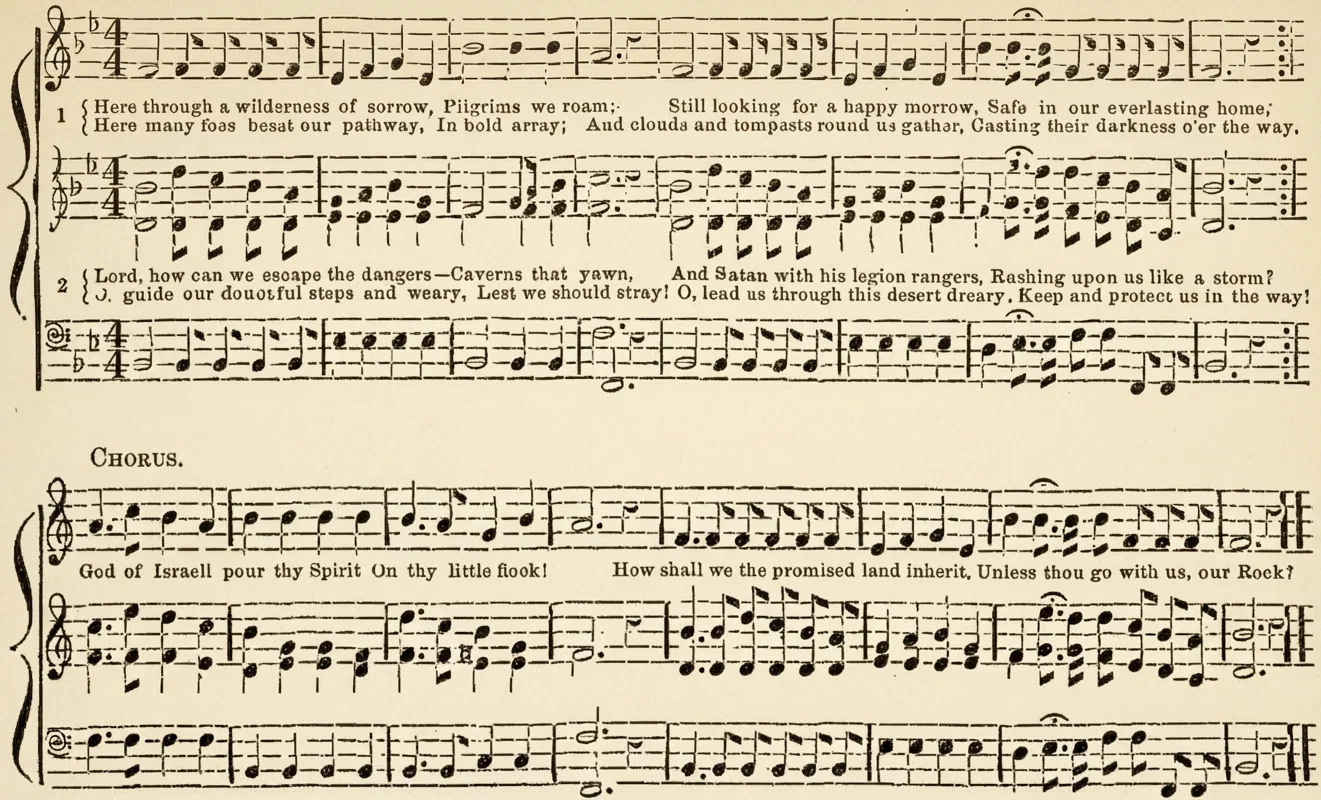
Lead Us Safely to the Shore

CHORUS.
CHORUS.
3 Now while the evening shadows gather, Dangers increase! Be thou our sure defense, our Father, Grant us the tokens of thy grace! O, let thy Holy Spirit's power On us descend, Distilling like the grateful shower— O, do be with us to the end! CHORUS.
4 O, let the cloudy pillar brighten, On Israel's side; And while it doth our path enlighten, From us our enemies divide. And when the angry floods upheaving, Against us roar, Almighty power the waters cleaving, Lead us in safety to the shore. CHORUS.—Then with harps we'll swell the chorus, To the Lamb once slain! While eternal day is beaming o'er us, With our Deliverer to reign. R. F. C.

The Cause.

Bro. Smith: I am tired of seeing statements of want among our preachers and appeals for funds in the REVIEW. I am tired of writing them. These general appeals to everybody, and nobody in particular, do not amount to much besides filling up the paper, and paining the reader. These things hurt the REVIEW, and are a blot on the cause.
To the above, the real friends of the cause will respond a hearty amen, and look about for a better way, while the careless and stingy will say amen, and do nothing.
Well, what shall be done? These general appeals, and this trying to raise means without form or order, seems to be proving a failure, and something must be done more definite and effectual.
While riding in the cars this morning from Jackson, and pondering over this matter, I soon got out paper and pencil and began to figure. Said I, there are at least 1600 Sabbath-keepers in Michigan. Should only 1000 of this number give—500 brethren 10 cents per week, and 500 sisters 3 cents per week—the amount for one year would be $3380. It will be seen that we have not reckoned 600 which we allow for the very poor, and those under 18 years of age. It is supposed that all the 1000 are fully able during the year to raise the small sum stated with perfect ease.
Then suppose that these 500 brethren possess on an average only $500 each, and pay each week only 2 cents per every one hundred, and the amount annually would be $2600. Total $5980, a sum sufficient to sustain the cause in this State, and to sustain five missionaries still further west. And this sum can be raised without the least sacrifice of property on the whole, or any privation of the necessaries of life. Let the readers of the REVIEW look at these facts, and act promptly, and let the unpleasant appeals for help cease for ever from the REVIEW.
Again, let each church manage their own funds, and apply only where there is need. We want no salaried managers or agents, as others have, requiring a large per cent for their services, and applying funds as they please. No, let each church apply their own funds as they see need.
And again, here are those among us who are worth from five to twenty-five thousand. The small rates stated, would not call for only about one tenth part of their interest money, or a small share of the increase of their property. For a moment consider what these brethren have to do before they can begin to sacrifice.
They will have to give from six to ten times as much annually as the above rates, before they touch the principal to begin to sacrifice, or to consume it. We as a people have professed to consecrate ourselves and our substance to the Lord, and have said that we were ready to sacrifice to advance the cause of truth. A very few have made some sacrifice of property; but as a body we have done no such thing. And it will be seen by the above statements, that with our present habits of industry and economy, the friends of the truth can meet all the wants of the cause ten times over, before they could begin really to sacrifice. Then, let the professed friends of the cause cease forever to bear testimony in regard to willingness to sacrifice, while there is want of means to sustain the cause. God knows all our vows and fair promises, and how we perform them. A record is kept in heaven, and by that record we shall be judged.
J. W.
Adrian, Mich., May 20th, 1859.

Constantine's Decree for Sunday.

The first decree made for the observance of Sunday by Constantine, and worded as follows, was published sometime since in the REVIEW in an article; but as it is liable to be overlooked in that connection, we give it in this form for more convenient reference.
"The first decree for the observance of Sunday, was made by Constantine, the second Christian Emperor, in the year 321, and was in these words:
"Let all the judges and town people, and the occupation of all trades, rest on the venerable day of the sun; but let those who are situated in the country, freely and at full liberty attend to the business of agriculture; because it often happens that no other day is so fit for sowing corn and planting vines; lest the critical moment being let slip, men should lose the commodities granted by the providence of heaven."

APPOINTMENTS.

GENERAL CONFERENCE.

Providence permitting, there will be a General Conference at Battle Creek, Mich., to commence June 3d, at 2 o'clock P. M., and hold over Sabbath, First-day and Second-day. A general invitation is extended to all, east, west, north and south, to attend this gathering of the people of God.
It is proper however here to suggest, that as this will probably be a very large gathering, most of those who attend this meeting should come prepared to nearly take care of themselves. It will be impossible to supply all with beds, or all their horses with stable room. Our sleeping-rooms will be given up to females to be made as comfortable as possible, in camp-meeting style. The brethren will have the next best chance in our barns, in the Tent, or on unoccupied floors in our houses. Blankets and Buffalo-robes will be in good demand. Those who will need them, must bring them.
It will be seen that in such a crowd, with such accommodations, will be no place for very feeble persons, for children, or for those who wish to come to gratify an idle curiosity. We want to see at this feast of tabernacles all the friends of the cause, who ardently desire its prosperity, and are ready to act upon the best plans for its advancement.
Let it also be understood that the brethren of the Battle Creek church are mostly day laborers and preachers, and that it is by close economy and industry that they obtain their daily bread. Each should provide grain for his own team, and those who possibly can, should bring a chest or trunk of provisions for themselves and others.
In behalf of the church, JAMES WHITE.

Produce Accepted for the Review

We would say to those in Mich. who lack ready means to pay for the REVIEW, or to help the cause, that we have made such arrangements with Bro. J. P. Kellogg (Grocer) that we can take maple sugar, syrup, and all kinds of produce, and allow cash prices. J. W.

Business Department.

Business Notes.

J. M. Santee: We send you Vol. xiv, free.
Elizabeth Phelps: The Instructor has been sent to P. & E. Eustis with the other papers directed to Lisbon, Juneau Co., Wis.

Letters.

Under this head will be found a full list of those from whom letters are received from week to week. If any do not find their letters thus acknowledged, they may know they have not come to hand.
J. Stillman, S. Pierce, J. C. & D. B. Dunham, C. E. Harris, S. Duncklee, A. Headley, C. Churchill, J. M. Santee, L. Martin, A. P. Patten, I. Gardner, E. J. Paine, S. Peckham, Geo. Wright, J. H. Waggoner, Geo. Busk, Z. Pitts, W. Brink, I. W. Lane, J. Bodley, A. Tuttle, J Wilson, P. R. Chamberlain, L. A. Wilson, Wm. S. Lane, W. T. Ashley, A. H. Robinson, H. Miller, Wm. Martin, P. Robinson, H. P. Wakefield, L. Chandler, J. M. Lindsay, S. Palmiter, A. Aldrich, L. B. Lockwood, A. & C. Austin, I. D. VanHorn, D. N. Fay, F. Gould, J. Clarke, H. J. Rich, H. M. Kenyon, Mrs. S. Eastman, J. Chase, E. Phelps, M. M. Leach, D. Smith, H. Smith, L. Hobart, Thos. Hale, E. Hough, A. J. Pambly, S. J. Voorus, S. J Seaman, S. I. Twing, J. Ralston, J. Taylor, J. A. Loughhead, D. Edwards, D. C. Elmer, M. V. Cole, Wm. Lawton, S. S. VanOrnum.

Receipts.

Annexed to each receipt in the following list, is the Volume and Number of the ‘Review and Herald’ to which the money receipted pays. If money for the paper is not in due time acknowledged, immediate notice of the omission should then be given.

FOR REVIEW AND HERALD.

I. J. Andrews 1,00.xv,1. P. R. Chamberlain 1,00,XV,1. P. R. Chamberlain (for J. Crump 1,00 xvi,1., for P. A. Gammon 1,00,xvi,1.) 2,00. C. Weed 1,00,xv,1. J. Holton 0,50,xv,1. S. Peckham 1,00,xv,1. Miss M. West 1,00,xiii,5. H. Miller 2,00,xvi,1. J. M. Lindsay 1,00,xv,1. L. S. Wetherwax 2,00,xv,1. I. C. Taylor 1,64,xv,1. J. Palmiter 1,00 xv,1. J. Palmiter (for F. F. Allen) 0,50,xv,1. D. N. Fay 2,50,xv,14. Mrs. S. Eastman 1,00,xiv,1. D. Smith 1,00,xv,1. H. Smith 1,00,xv,1. J. Ralston 1,00,xv,1. Wm. H. Loughhead 3,00,xvi,14. J. A. Loughhead 1,00,xv,1. L. Potter 2,00,xvi,1. C. Lawton 2,00,xvi,1. Sr. Wright 2,00,xvi,1. W, S. Fairchild 2,00,xvi,1. Wm. Lawton 2,00,xvi,1. C. Lawton (for N. M. King) 1,00,xvi,1. A. Tuttle 1,00,xv,1. S. S. VanOrnum 2,00,xv,1. N. A. Cunningham 2,00,xiii,19. J. Simonds 1,00,xiii,18. D. Miller 1,00,xiii,18. J. Newmire 1,00,xv,1. F. Shaw 0,47,xiv,1. T. R. Horner 2,00,xv,1. E. Nichols 1,00,xiii,22. J. Tillct son 2,00,xvi,1. J. Clarke 0,22,xiv,21. J. Huber 2,00,xvi,9. S. Bunnel 1,00,xvi,1. H. P. Wakefield 1,00,xv,1. H. P. Wakefield (for N. B Smith) 0,50,xv,1. L. Cnandler 0,51,xiv,14. L. B. Lockwood 2,00,xvi,1. E. Dana 1,00,xv,1. J. Chase 1,00,xv,1. L. Hobart 2,00,xv,20. Thos. Hale 1,00,xvii,1. S. I. Twing (for H. A, Brooks) 1,50,xvi,1. S. I. Twing 3,00,xvi,14. E. Richmond 1,00,xiv,20. D. C. Elmer 1,00,xv,1. E. Cobb 2,00,xv,1. H. Grant 2,00,xiv,1. S. Buzzell 1,00,xiv,1. S. Pierce 1,00,xv,1. I. Gardner 1,00,xiii,14. S. Jones 1,00,xiii,17. H. J. Rich 1,00,xiv,1. A. J. Pambly 1,00,xiv,1. S. J, Voorus 1,00,xiv,1. M. A. Cornell 0,50,xiv,14. W. A, Jackson 0,50,xiv,1. G. W. 0,20,xiii,16. J. Wilson 1,00,xv,1. S. Duncklee 1,00,xvii,1. Z. Pitts 1,00,xiv,1. J. P. Elting 0,25,xiv,7. B. Moore 1.00 xv,1. J. Hawkins 2,00,xiv,12. Wm. Carpenter, Jr. 1,50,xiv,1. W. Holden 1,00,xv,1.
FOR REVIEW TO POOR.—I. D. VanHorn $1,00.
FOR BRO. INGRAHAM.—Thos Hale $10,00, W. Holden $2,00.

You have reached the end of this edition.

Review and Herald · May 26, 1859