The Youth’s Instructor, Vol. 35, No. 6.

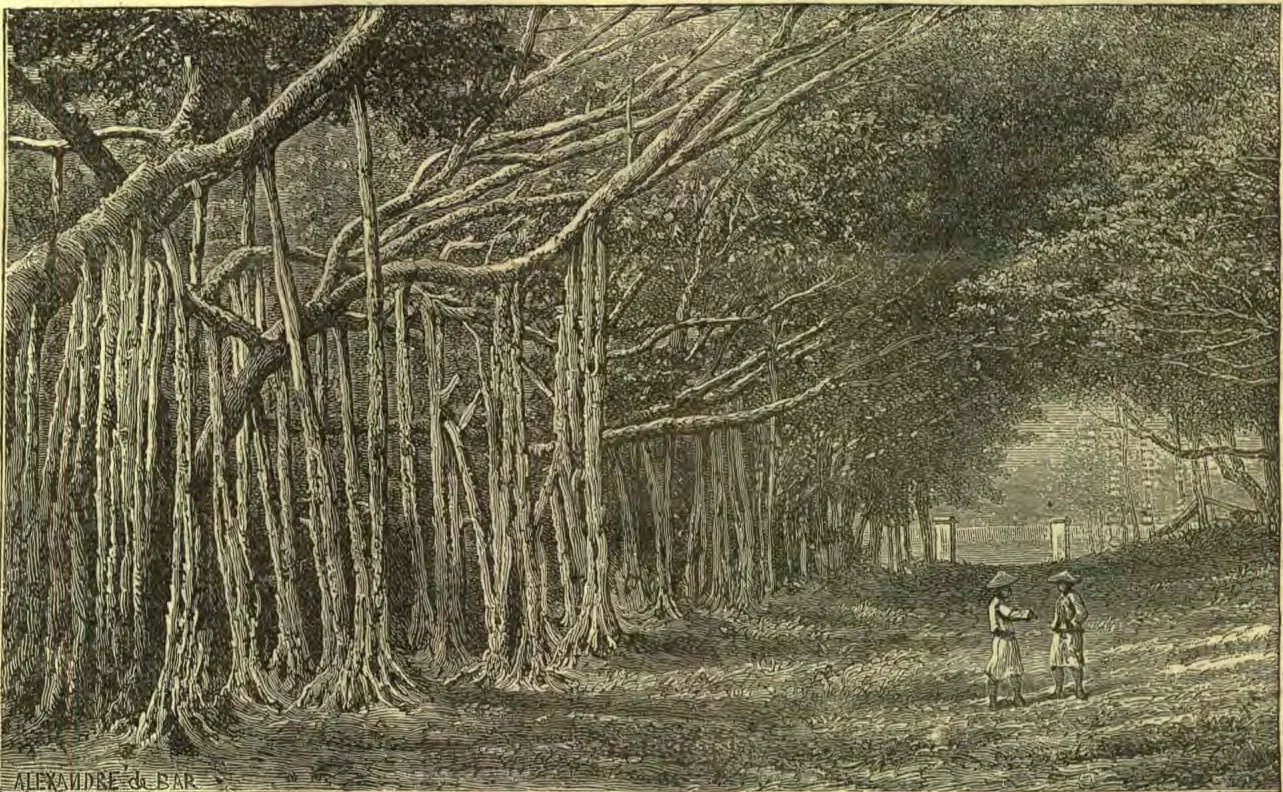
THE BANYAN TREE

The Youth’s Instructor

Feb 9, 1887

S. D. A. Publishing Association · Battle Creek, Mich. · Feb 9, 1887

THE BANYAN TREE.

Among the curiosities of nature may justly be reckoned the Banyan tree of India,—a tree which may be said never to stop growing. In some parts of India these trees are planted on either side of the road, and their thick branches, reaching out and interlacing, form a most delightful shelter from the fierce rays of the tropical sun. Deep twilight always reigns under the spreading branches, through whose thick mat of leaves not a ray of bright light can enter. The trees swarm with monkeys, who cut up all conceivable antics, to the great diversion of the traveler. The small, bright scarlet, fig-like fruit of this tree forms poor food, indeed, for men, but it finds favor in the eyes of the monkeys. A writer on “Ceylon” gives the following description of this remarkable tree, one of the wonders of the vegetable world:— “As we ascend the hills, the banyans and a variety of figs make their appearance. They are the Thugs of the vegetable world; for although not necessarily epiphytic, it may be said that, in point of fact, no single tree comes to perfection, or acquires even partial development, without the destruction of some other on which to fix itself as its supporter. The family generally make their appearance as slender roots, hanging from the crown or trunk of some other tree, generally a palm, among the moist bases of whose leaves the seed, carried thither by some bird which had fed upon the fig, begins to germinate. This root, branching as it descends, envelops the trunk of the supporting tree with a net-work of wood, and at length, penetrating the ground, attains the dimensions of a stem; but, unlike a stem, it throws out no buds, leaves, or flowers. The true stem, with its branches, its foliage, and fruit, springs upward from the crown of the tree, whence the root is seen descending, and from it issue the pendulous rootlets which on reaching the earth fix themselves firmly, and form the marvelous growth for which the banyan is so celebrated. In the depth of this grove the original tree is incarcerated till, literally strangled by the folds and weight of its resistless companion, it dies, and leaves the fig in undisturbed possession of its place. It is not unusual to find a fig-tree in the forest which had been thus upborne till it became a standard, now forming a hollow cylinder, the center of which was once filled by the sustaining tree, but the empty walls form a circular net-work of interlaced roots and branches firmly agglutinating under pressure, and admitting the light through the interstices that look like loopholes in the turret.” W. E. L.

THE GIRL IN THE CORNER SEAT.

“I HEARD Julia Park say something about you this morning,” whispered Sarah Curtis, looking down at Nannie Leach, who, seated at the most unattractive desk in the Cedar Hall school room, was as usual busily engaged with her lessons.
Nannie, with a pleased, questioning look in her blue eyes, glanced up at the tall, handsome young girl bending over her. Could it be that Julia Park, the acknowledged leader of the school, had by some good-natured remark expressed approval of her unobtrusive self? She was only left to harbor the pleasant delusion for a tantalizing minute, for then Sarah added,—
“She said that your father was not worth a dollar, and that so long as you had neither good looks nor good clothes to recommend you, she didn’t see why you must come to this school.”
“Did she say that?” queried Nannie quietly. “I am sorry she feels that way, but I don’t know how I can help it—only by praying for her.”
Sarah had expected, or hoped at least, that her communication would draw out an angry retort, and felt a little humiliated and uncomfortable as she returned to her seat after a prolonged look at the neat pages of Nannie’s open exercise book.
For an hour she was very busy studying from the same book with Julia Park, who was her seat-mate, and who in her turn had crossed the room to Nannie’s side and asked,—
“What did Sarah tell you when she was here a little while ago?” “Nothing at all worth repeating,” replied Nannie gently. Her blue eyes were full of unshed tears as she raised them to her school-mate’s pretty face, and it took a good deal of self-control for her to speak quite steadily; but a silent prayer brought strength and comfort, and she said nothing further while Julia stood by her side watching as she busily worked an example in arithmetic on her slate.
When at length she went away, Nannie drew a long breath of relief, and thought, “I must not forget what father told me when I decided to come to this school. He warned me that I was likely to have an uncomfortable time, and he said if I could not be pretty looking or well dressed, that I could be the most ladylike, the most obliging, and the best scholar in the school, and although I have tried to be that, no one will ever admit it; but I will not mind that. I will do my very best in every way, and will prove my right to enjoy the best advantages the village affords.”
All through the term, Nannie had indeed had an uncomfortable time in this school, where the children of poor parents were always made to understand that they were not welcome. She had nothing whatever to do with her classmates excepting to occasionally render them some assistance. She had her champions, however, for her loving thoughtfulness for the younger class won their love, and they stoutly maintained that she was the best and the handsomest girl in the whole school.
Just now the first class were preparing for an examination in arithmetic, and Nannie had but little time to think of the ill-will of the two girls who, with every blessing that wealth, indulgent parents, and health could give them, yet seemed to have no better pastime than to render this poor girl’s year at the academy miserable.
When the report of the examination was given by the teacher, as his method was, he instanced a certain problem that had been attempted by only three members of the large class, and said,—
“Will Miss Park and Miss Curtis, who always work their examples together, be so kind as to tell me how they arrived at that analysis?” “It brings the right answer to work it in that way,” replied Sarah stupidly, while Julia hung her head and was silent.
“Miss Leach has tested this original method as well as the rules given in the text-book; perhaps she can give us a more satisfactory explanation.”
“I do not know how the other girls found that rule,” replied Nannie cheerfully, “but that example was the only one in the lesson that gave me any trouble. I told my father about it, and he immediately solved it by what he called a common-sense rule; and after I understood it from his explanation, the other rules were perfectly plain.”
“Those two young ladies evidently stole that common-sense rule from your slate and exercise-book the other day. I noticed them intently scrutinizing your work as they passed your desk on their way to the cloak-room. They each crossed the room to speak to you afterwards. What questions did they ask you in regard to this problem, if you please?”
“Not any questions at all, Mr. Goddard.”
“What were they talking about? They each stood by your desk some minutes.”
“Oh, if you please, sir, I would rather not tell,” and Nannie’s cheeks reddened with earnestness.
“Then they shall report, for it is understood that all whispering done in this school room has some reference to the school work.”
“It was hard discipline for Julia and Sarah; but the teacher was firm, and they were obliged to repeat their foolish remarks in the presence of the whole school, and Mr. Goddard did not check the burst of indignation that arose from the pupils, all the older scholars now joining with the younger ones.
Julia and Sarah asked Nannie’s pardon for their continued rudeness, and acknowledged that they were jealous of her good scholarship, and were determined to drive her from the school.
For many years now Nannie Leach has had charge of the Cedar Hall school, and to what do you think she ascribes her success first and last? I will tell you. It is a rule I wish all school-girls would follow. She says, “I was a professing Christian. I tried to do honest work in the school and to do as I would be done by.”—The Christian Weekly.

HEALING

Grieving and worn, discouraged, Sick with the day-long strife, Buried with the restless tossing Over the sea of life, Hurt by the hands I trusted, Yearning for rest and home, Famished and faint and doubting, Unto the Book I come.
“One of the sweet old chapters,” Sometimes a verse or two, Falls on my troubled spirit Like to a healing dew— Binds up the broken sinews, Comforts the soul’s despair, Lifts from my path the shadows, Banishes clouds and care.
“Ye that are heavy laden.” Whether with doubt or fear, “Knock and the door will open— Resting and peace are here.” “Let not your hearts be troubled:” “Only believe and trust;” Gushes the living water Out of earth’s desert-dust.
—Nellie Watts McVey.

HALCYON DAYS.

If we, forgetting self, contrive to brighten Each instant day by some kind word or deed That tends sad, burdened hearts to lighten, Then all our days will halcyon prove, indeed.
—Sel.

COAST, LAKES, AND RIVERS, OF NEW ZEALAND.

The sea coast of New Zealand is romantic in the extreme. It looks as though nature had done her best to throw mountains from the depth of the sea, and split them in two, turning them endwise toward the sea. To the eye of the voyager the brown-colored coast appears bold and monotonous. It is generally hilly, and clothed with either forests, tall fern, or tussock grass. The clay hills are interrupted by deep gullies, and snow-clad mountains are seen in the distance. The coast line is so rocky that insurance companies charge more for insuring a vessel plying along the coast of New Zealand, than for much greater distance on the coast of Australia. There are many good harbors on the North Island, but they are mostly on the eastern and southern coasts. On the west coast are many sand bars. Auckland is situated on the harbor called Waitemata. On the east coast, is Hauraki Gulf, protected by Cape Colville and the Great Barrier Island. This secure body of water is said to be large enough to accommodate all the navies in the world.
The bay at Wellington is a completely land-locked bay. It would be very difficult for a navigator, uninstructed, to find the entrance to many of the bays. As I entered one, while going to Kaeo, I noticed a signal upon the mountain side, which, by the aid of a glass, could be seen for many miles. The captain said it was placed there by the government at his request, as he had once directed a friend of his, a successful navigator, to this bay for lumber, as there were many saw-mills there. He could not find the place, and after spending days in search of the entrance, he had given it up in disgust, declaring that there was no such entrance to be found.
At the foot of the mountains near many of these bays are flourishing saw-mills. Logs are floated down the rivers and small streams on the sides of the mountains to the bays during freshets or at high tides, and sawed by these mills; and the lumber is carried to Australia for building and other purposes. Blind Bay and Queen Charlotte Sound on the South Island, are safe anchorages for any number of navies. On the western coast of the South Island there are a few rivers which are navigable only by small steamers. The largest is the Molyneux, which pours down as much water as the Nile. There are a number of rivers in the North Island which are navigable by small steamers.
In the South Island, snow-capped peaks rise from twelve to fifteen thousand feet; and like the Alps of Europe the gullies are filled with glaciers, and massive fields of ice, which melt into rushing rivers, that plunge through the fertile valleys into the sea, so that, like the plains of Jordan, New Zealand is “well watered everywhere.” Red snow is said to be frequently seen in these snow fields.
Further south is Milford Haven Bay. The beauty of its scenery cannot be surpassed. “Here the steamers from Melbourne, which during the summer months bring crowds of health-seeking tourists to our cooler shores, often call; and the unqualified testimony of the Australians bears witness to the singular and favorable contrast between the green, tree-clad hills, the snowy mountains, and the impenetrable forests of the west coast of New Zealand, with their own parched and waterless plains.” The bluff harbor is at the lower extremity of the South Island, and is connected with Invercargill by railway. Invercargill is a city of about twelve thousand inhabitants, situated in a beautiful plain, surrounded by a fertile country.
In such a country, lying in the midst of the ocean, extending for miles to the north and south, and covered with hills and mountains, there is every variety of climate, with no extremes, unless we ascend seven thousand feet or more to the regions of snow. It is not oppressively hot in the summer, or cold in the winter. It is both healthful and pleasant. There are occasional gales, but no hurricanes. The sky is usually bright, and the air is pure. There are some dull, dreary, wet days in the winter, but this is principally in certain localities. Rain falls frequently, but seldom in such excessive quantities as in Australia. The heaviest rains seldom exceed two days’ duration, unless it be on the west coast, where it is rare for a fortnight to pass without a shower. In Napier and the surrounding country we find perhaps the driest, and in Westland the wettest, part of New Zealand.
The North Island is, for a long distance, quite narrow. On the tops of the mountains the sea breezes from either side meet, and for a short distance it is difficult to breathe, as there is no circulation of air. The Lake District on the North Island was among the wonders of the world until the recent eruption. Even now it is an outlet of many subterranean fires. This district covers an area about one hundred and five miles wide by one hundred and thirty miles long. Of the numerous fresh water lakes on this island Taupo, twenty miles in diameter, is the largest.
The appearance of this country in the midst of the largest body of water in the world, the two islands comprising less than two thousand square miles of territory, with burning springs and eternal snow and ice all in one neighborhood, as it were, is enough to cause one to revere and adore the Creator of the world.
S. N. HASKELL.

Sea Tales No. 15: A Water-Spout at Sea

SEA TALES.—No. 15.

I was straightening up my bunk, preparatory to a nap after dinner, when quite a commotion took place on deck. Pausing to listen, I heard calls for me, and soon the captain appeared at the cabin door and requested me to come up on deck as quickly as possible. I ran, or rather tumbled, on deck at a lively rate, in my haste running foul of several doors and barking my elbows. As soon as I appeared, every man pointed astern, where, about a half mile away, a mist was rising from the water, apparently covering a space of some fifteen feet, and resembling a light fog.
“Did you see her blow?” asked the captain.
“What was it, sir?”
“Why, a whale! There she blows again, sir!”
Surely enough the mist deepened, and at that moment raised perceptibly from the water.
“She’s a long time rising, but you’ll see her soon, sir!” said the captain.
We waited patiently, but saw nothing of the animal, although the mist deepened more and more, and as it rose, seemed to acquire a spiral motion. The captain, who had procured his glass, now sang out excitedly, “It’s not a whale; ’tis a water-spout!”
A profound silence followed this announcement, all realizing the danger should it reach us. In breathless suspense we waited to see which way it was traveling, as the wind had gradually died away, and there was then a calm. The cloud over the water-spout seemed hardly to move. In a few moments, however, it had crept past our lee quarter, we being on the port tack, and we were safe. Had it followed us up and raked the vessel fore and aft (as it would have done, it being impossible to put the brig about), it would, in all probability, have torn every sail and spar out, and the immense weight of water (about ten pounds to the gallon), reaching from the sea to the cloud, would have crushed and sunk the vessel.
In Professor Maury’s great work, in the chapter devoted to the subject of whales, I find much that is interesting and not generally known, and will therefore try to give you a sketch of the information gathered.
In the first place, then, the animal called the right whale in the northern hemisphere, is not identical with the one which goes by that name in the southern. The former rarely exceeds sixty feet in length, while the average size of a full grown right whale of the southern ocean is one hundred feet.
A whale weighs about a ton to each running foot. A boat and crew could be accommodated in the mouth of a right whale, yet its throat is not as large as a man’s. It lives entirely by suction, eating a species of jelly fish, squid, etc. The sperm whale, however, has a throat capacious enough to admit the body of a man. A whale does not attain its full growth until twenty-five years old, and is said to reach a great age. It has no ears, but under the skin is a small opening to admit sound. The eye is very small for the size of the animal, being no larger than that of an ox. The fins are directly behind the eyes, and are about nine feet long and four to five feet broad, having bones similar to those of the human hand, and the same in number. Beneath the skin is a coating of fat from eight to twenty inches thick, and yielding nearly its own weight of oil. This is called “blubber.” This covering is given to the whale to enable it to withstand the intense cold of the arctic regions, and to render the body light and buoyant. By its means the whale is enabled to leap its entire length out of the water. Right whales have no teeth, but instead, several hundred plates of whalebone, through which the water passes, leaving the small animals which form its food. In a large whale these plates weigh two tons. The head forms nearly one-third of the entire bulk of the whale, and the lips are about twenty feet long. From the crown bone of the head emerge the immense jaw bones, sixteen feet long, descending in a curve till they meet in the form of a crescent. In a large whale the surface of the tail comprises from eighty to one hundred square feet. It is only from five to six feet in length, but it is from eighteen to twenty-six feet broad. It is not vertical as in fish, but level, and of such prodigious strength that by its aid the largest whale can force itself entirely out of the water. The “blowers,” or nostrils, are from eight to twelve inches long, but very narrow. Through these the spray is sent.
“It is a very prevalent opinion,” says Captain Post, “that whales spout water. Morse, in his geography, tells us they spout to a great height, and other writers follow the same error. Whales never spout water, and their spouts, which are simply dense respirations, emitted with some force from their large nostrils, never ascend above twelve feet high, and when the whale is unmolested, seldom to that height, or half of it.”
“The spermeceti whale has but one nostril, on the left side and close to the end of the head. It is about fifteen inches long, and when expanded, from five to six inches wide.”
“On a clear, cold day, with a moderate breeze and unruffled sea, the spout of a whale can be seen from the mast-head, at a distance of nine miles, and these spouts appear at intervals almost as exact as can be measured with a first-class chronometer.” When a whale leaps out of the sea, the spray produced by its fall can often be seen for fifteen miles.
Large whales are seldom seen in groups; frequently four or five are found within as many miles of each other, but more frequently alone. In their several stages of growth, the males will be found in shoals, all very nearly of a size.
“Old whalers say that a whale rising from the depths will spout as many times as it will yield barrels of oil. Those whales we rank as large, yielding from fifty to one hundred barrels, will, if undisturbed, spout an equal number of times. As a general rule, they spout from sixty to seventy times, and yield from sixty to seventy barrels of oil. Large sperm whales will remain under water in search of food from an hour to an hour and a half, and on rising, if undisturbed, will be quite still, as though breathing was the ostensible object.” W. S. C.

PINE-NEEDLES

If Mother Nature patches The leaves of trees and vines, I'm sure she does her darning With needles of the pines! They are so long and slender; And sometimes, in full view, They have their thread of cobwebs, And thimbles made of dew. —St. Nicholas.

SNOW-SHOES

For traveling in deep snow, the snow-shoe, either as manufactured by the Indian or as made in some foreign countries, has become with its owner almost a necessity, and its use in snow-shoeing sports, even in our own country, is gaining in popularity every year. It may be that some of the readers of the INSTRUCTOR have never seen so much as the picture of a snow-shoe, while others have sported with them many an hour over the drifted fields. In either case, we think you will be interested in some things about them, gathered from Harper’s Young People for January 11. The writer says.—
“Three things have the ‘red children of the forest’ given to the white children of the cities which are so perfect in their way that it is hardly possible there will ever be an invention filed in the pigeon-holes of the Patent-office at Washington that will surpass them. The canoe for shallow water and what might be called cross-country navigation, the toboggan, and the snow-shoe for deep snow, seem to be the very crown of human ingenuity, even though they are only the devices of ignorant Indians. One cannot help a feeling of hearty admiration when looking at them, and noting how perfectly they fulfill the purpose for which they were designed, and are at the same time as light, graceful, and artistic in form and fashion as the most finished work of highly civilized folk.”
“To the Indian, the canoe, snow-shoe, and toboggan were quite as important implements as the spade, the plough, and the rake are to the farmer. Without them he could not in winter-time have roamed the snow-buried forests, whose recesses supplied his table, or voyaged in the summer-time upon the broad rivers and swift-running streams, whose bountiful waters furnished him their ready toll of fish. His white brother has in adopting them put them to a different use. He had no particular need for them in his work, but he was quick to see how they would help him in his play, and ere long they had all three become favorite means of sport and recreation.”
In the States and in Canada “the shoes are made in many shapes and of many sizes, ranging from two to six feet in length, and from ten to twenty inches in breadth. This is how they make a shoe of three feet six inches, which is a fair average size: A piece of light ash about half an inch thick, and at least ninety inches in length, is bent to a long oval until the two ends touch, when they are lashed strongly together with catgut. Two strips of tough wood about an inch broad are then fitted across this frame, one being placed about five inches from the curving top, the other some twenty inches from the tapering end. The object of these strips is to give both strength and spring to the shoe. The three sections into which the interior of the frame has thus been divided are then woven across with catgut, each having a different degree of fineness in the mesh, the top section being very fine, the middle section, upon which almost the whole strain comes, coarse and strong, and the end section a medium grade between the other two. The gut in the middle section is wound right around the framework for the sake of greater strength, but in the other two is threaded through holes bored at intervals of an inch or so. Just behind the front cross-bar an opening about four inches square is left in the gut netting, in order to allow free play for the toes in lifting the foot at each step. Both wood and gut must be thoroughly seasoned, or else the one will warp, and the other stretch and sag until the shoe is altogether useless.
“Simple as the snow-shoe is, I would not advise any one to try to make a pair for himself. Only the Indians can do this really well; and even in Canada, where snow-shoeing is a national winter sport, the vast majority of shoes are put together by dusky hands.”

SOBBING WRENS.

A STRANGER in the little cities of southwestern Texas, says the New York Dawn, is often awakened at early dawn by the beautiful but sorrowful song of the house or sobbing wren. If the stranger has been long away from home and friends, and is sensitive to impressions of external nature, he never forgets the peculiar, melancholy note of the tiny songster. It begins in a high, clear key, like the tinkling of silver bells, and descending gradually from one sweet chime to another still sweeter, it suddenly falters, breaks off and sobs like a child—the song dying away in a gasp. The listener is touched with sympathetic emotion, and may find it difficult to suppress the uncomfortable feeling that one of the little ones in his own family circle, far away, is weeping and sobbing for his return. The song is heard only in the twilight of dawn, and is repeated but a few times. Then the handsome little singer, with plump brown breast, speckled with shreds of black, retires through some crevice in the house-top, and is rarely seen during the day.

THE MINISTRATION OF ANGELS.

LESSON 4.—THEIR INTEREST IN MAN'S SALVATION.

1. What character is ascribed to the angels who have not fallen? Acts 10:22.
2. How does Jesus speak of them? Matt. 25:31.
3. Who is evidently referred to as doing God's will in heaven? Matt. 6:10; Mark 13:32.
4. Do these angels keep the commandments of God? Ps. 103:20.
5. What lesson should we draw from this for ourselves?
6. Did some of these angels disobey God? What was the result? 2 Pet. 2:4.
7. What warning should this be to us?
8. Then must not the angels have been placed on probation, the same as man?
9. Could even the purest of mortal men see God's face and live? Ex. 33:20.
10. But how is it with the holy angels? Matt. 18:10; Luke 1:19.
11. What does this indicate as to their character? Heb. 12:14.
12. Who else will finally be permitted to see God? Matt. 5:8.
13. What is the chief occupation of the angels since the fall of man? Heb. 1:14.
14. Who announced the birth of Jesus? Luke 2:8, 9.
15. Did they seem to have much interest in this event? Verses 10, 13.
16. What did they say? Verse 14.
17. If angels take so deep an interest in the salvation of men, how much interest should men feel in their own salvation? Matt. 6:33, first part.
18. How is the conversion of one sinner regarded by the angels in heaven? Luke 15:10.
19. Then must they not watch all men with interest, and know when one turns to God?
20. Where are the names of the righteous written? Luke 10:20.
21. By whom is it probable that these names are recorded? Eccl. 5:6.
22. What does Jesus confess before the angels? Rev. 3:5.
23. Then must not these names be well known and talked over in heaven?
24. Whenever the visits of angels are mentioned, is it not always assumed that they are well acquainted with the saints and all that relates to them? Luke 1:13.
25. Did Gabriel, when he came to Zacharias, know his name and the name of his wife? Same verse.
26. When the angel came to Cornelius, how did he greet him? Acts 10:3, last part.
27. Was the angel acquainted with the pious deeds of Cornelius? Verse 4.
28. Do the angels know the towns in which the saints live? Verse 5.
29. Do they know the streets on which they reside? Acts 9:11.
30. Do they know what business they follow? Acts 10:6.
31. How much do they know about us?
32. How should this influence us?

NOTES.

The character of the angels.—The scriptures referred to under the first eleven questions in this lesson plainly show that the angels were put on probation, the same as man; for none of them could have fallen (2 Pet. 2:4) if they had not been on probation. They must be subject to law, or they could not have sinned. Rom. 4:15. The fact that they “do his commandments” (Ps. 103:20), and do his will (Matt. 6:10), shows that they do keep God's law.
Recording angels.—Many have a form of godliness, their names are upon the church records, but they have a spotted record in heaven. The recording angel has faithfully written our deeds. Every selfish act, every wrong word, every unfulfilled duty, and every secret sin, with every artful dissembling, is faithfully chronicled in the book of records kept by the recording angel.—Mrs. E. G. White.

THE HOUSEKEEPER'S PSALM.

There are some psalms which, from their common fitness and use, take particular names. The 23d is spoken of as the “nightingale” among the psalms. The 121st has been called the “traveler’s psalm.” The 101st psalm may, with great suitableness, be called the “housekeeper’s psalm.” Read it with this thought in mind. A home reared on this psalm will be a home of song and right living. Note these words, “I will behave myself in a perfect way,” “I will walk within my house with a perfect heart.” Children often take their first lessons in lying from untruthful servants. How fitting, then, the words, “He that worketh deceit shall not dwell within my house; he that telleth lies shall not tarry in my sight.” Could all our homes witness to the exemplification of these principles, how truly would they be sweet homes, the dearest spots on earth, the truest types of heaven.—Selected.

THE SEAL SKIN.

The manner of catching and killing the seal has recently appeared in the INSTRUCTOR, and now we suspect our readers would like to learn how its skin is prepared for the manufacture of those seal garments which are worn so extensively at the present time. The information is given in the following clipping from an exchange.—
“There is a popular notion that the seal skin, as we see it at the furrier’s, is just as it is taken off the animal. Nothing, however, could be more contrary to fact. Few skins are less attractive than this at first, as the fur is completely covered and hidden by the dull gray-brown and grizzled over-hair. This mask has then to be removed, and this is an operation requiring a very great amount of patience and skill, with a consequent increase in price. The unhairing is effected by warmth and moisture, which softens the roots of the over-hair, and enables it to be pulled out, or by shaving the inner side very thin, which cuts off the roots of the hair, which penetrate deeply, and leaves untouched those of the fur, which are superficial. Whichever method is employed, the hair must be taken off uniformly or the fur will never lie smooth, but always have a rumpled look, which can never be corrected by any subsequent treatment. This will explain to some extent the cause of the high price of seal-skin jackets and cloaks, and also the cause of the differing prices one hears of, as a good many skins are more or less spoiled in the dressing. Another cause, too, is the quality of the dye, and the workmanship employed in its use. The liquid color is put on with a brush, and the points of the standing fur carefully covered. The skin is then rolled up, fur inside, and then, after a little time, hung up and dried. The dry dye is then removed, and a further coat applied, dried, removed, and so on till the requisite shade is obtained. One or two of these coats are laid on thick and pressed down to the roots of the fur, making what is called the ground. From eight to twelve coats are needed to produce a good color. No wonder a first-class seal skin is expensive; it is just as true now as ever it was, but in these days of universal cheapness one is apt to forget that, if you want a really good thing, you must pay a good price.”

WELLS IN INDIA

WELLS are naturally greatly prized in hot, arid parts of India, and many Hindus earn great renown by making them where they are much needed. Some religious people seek for merit in the construction of large wells in public thoroughfares and other places for the purpose of supplying travelers with water. Very often people use them for irrigating their fields. A large well, built of strong masonry, with a circular, white, smooth platform round it for people to sit on when they draw or drink water, costs from 2,000 to 3,000 rupees. Even the wants of the brute creation are not overlooked by the Hindus. They make reservoirs of strong masonry, about five or six yards long and a yard wide, adjoining a well, and in the hot season these are always kept filled with water. Returning from pasture or from the fields in the forenoon for repose, and retiring at dusk for the night, whole droves of cows, bullocks, buffaloes, and goats slake their thirst here. Land owners and wealthy men vie with each other in constructing these wells and reservoirs, and princes sometimes imitate the example of their opulent subjects. The average cost of an ordinary well has been estimated to be about three or four hundred rupees. Of course it varies not only according to the depth of water and kind of soil, but also to the kind of labor employed. Some peasants, who, with members of their own families, make wells themselves, have been known to construct them, especially where the water is near the surface, at a trifling cost of 100 rupees each. Nevertheless, even in those parts of the country where the cost is very moderate, the wells are insufficient. Wells have been objects of great endearment with some villagers. Not satisfied with wasting time and money in their own and their children's marriages and in those of idols and trees, they sometimes marry wells with great pomp and ceremony. In some parts of the country wells are worshiped and votive offerings are seen lying near them.
Continue reading: Better Budget