For the first day of our reading in the Old Testament we have the beautiful story of Ruth; four chapters, all of them brief, and wonderfully interesting, telling us of a little pastoral tale of the time of the judges, and bringing out in its close the ancestry of the Lord Jesus, into which is brought a Moabite woman. The book of Ruth was probably written by Samuel, or in the early days of David, perhaps by Nathan the prophet.
The first book of Samuel is really the last book of Judges; for Samuel was himself the last of the judges, an Ephraimite by birth, but one who was given to God as the first-born and so became a priest in Israel as well as a prophet. To the latter office he was called in his early youth. Very interesting indeed is the story of his birth and the devotion of his mother. The two books of Samuel are one in the Hebrew. The Septuagint divided them into two, calling the books of Samuel and Kings the four books of the Kings. The two books contain the history of Israel from Eli to the old age of David. The first book of Samuel was probably written by Samuel himself, or by some of the school of the prophets which he founded.
The week's lessons reach to the close of the 16th chapter. The first chapters are the history of Samuel in his call to the prophetic gift, together with the conditions of Israel, and the weakness of Eli. There we are told of the defeat of Israel by the Philistines and the capture of the ark of God; the death of the old priest; the affliction which followed the ark in the land of the Philistines; the return of the ark of God; the corruption of Samuel's sons; the asking for a king, thereby losing the conditions which would demand faith in looking alone to God as their King; the choosing of Saul, and the various events connected with it; the beginning of his reign, with Saul's rashness and weakness; finally, the Lord's rejection of Saul and his family, and the anointing of David.
Our New Testament lessons continue the Gospel of Luke from the first verse of the 8th chapter to the close of chapter 10. As with all other lessons on the Gospel, the week's story is filled with interesting miracles and teaching.
Sin and Its Cleansing.
THE root idea of sin is “missing the mark.” God’s mark of character is His own perfection. His requirement is, “Ye shall be holy; for I Jehovah your God am holy.” Lev. 19:2; 1 Peter 1:15, 16. As a rule of action, as a standard of character, God gave man His holy law; for “the law is holy.” Rom. 7:12. Missing this mark is sin; for “sin is the transgression of the law”—an inspired definition. 1 John 3:4. As the law covers all holiness, any departure from it is sin. The same great truth is expressed in these words: “For all have sinned, and come short of the glory of God.” Rom. 3:12, 23. The glory of God is His goodness, His holiness. Ex. 33:18, 19. Coming short of God’s glory is the missing of the mark.
No one paragraph can describe the satanic deceitfulness, the awful badness of sin. Suffice to say in the language of the Scripture, that “all unrighteousness is sin;” and “sin, when it is finished, bringeth forth death.” As the tempter presents sin, oftentimes clad in gorgeous beauty, oftentimes the picture of slumberous and dreamy ease, of great luxury and power, of fame and pleasure, it does not seem death. Its first deviation is so small, the stultification of conscience so slight, and the reward seemingly so great and full of possibilities for good to a self-blinded vision—sin does not look to be evil. And yet, the beautiful dress is but a cloaking of corruption. Under the fair mask of the tempter is the hideous, repulsive form of death. Its soft, pleading voice is but the breathing of incipient decay, luring to destruction as deadly as itself. Sin is the leprosy of the soul. It comes so stealthily, so deceptive, so insidiously, so paralyzing the nerves—thus stupefying those sentinels of warning—that the soul is loath to believe it present until its ravages are apparent; and then oftentimes leaden despair or damnable lust dooms the brightness of life remaining. Sin is satanic. Its fruit is a devil and his angels. All that Satan is in deception, in craft, in malice, in cruel malignity, to meet at last his end in eternal death, sin is responsible for.
There is but one detector of sin in the universe—God’s word, God’s law as it is in Jesus. “By the law is the knowledge of sin.” Rom. 3:20. “Nay, I had not known sin, but by the law; for I had not known lust [coveting], except the law had said, Thou shalt not covet.” Rom. 7:7. Man may by his own light search his own heart; he will return deceived and disappointed. “The heart is deceitful above all things, and it is desperately sick, who can know it?” Jer. 17:9, R.V. Only God, as the next verse declares: “I the Lord search the heart.” “For the word of God is living, and active, and sharper than any two-edged sword, piercing even to the dividing of soul and spirit, of both joints and marrow, and quick to discern the thoughts and intents of the heart.” Heb. 4:12. Would you know sin?—With open heart study God’s law, the great moral mirror. Let the living, active word reveal the condition. Take in simple trust the diagnosis of the Great Physician.
Not flattering to any soul of man is the result of the examination. Many an ailing body trembles to go to the skilful physician, fearing that the verdict will be tuberculosis,—the great white plague,—Bright’s disease, leprosy, or some other “incurable” malady. But if such a course is unwise in a physical matter, how much more so in the spiritual world! Go, then, to the great Physician. He will say first of all that you are “desperately sick,” with all the rest of humanity; for “all have sinned.” All are afflicted with the moral leprosy. And in many cases, “the whole head is sick, and the whole heart faint. From the sole of the foot even unto the crown of the head there is no soundness in it; but wounds and bruises, and putrefying sores.” Isa. 1:5, 6. Believe it; this Physician will not deceive; He points out your true condition that He may heal you; yea, your “incurable” disease He will heal, if you will only believe. He will save “to the uttermost.”
Will He do it?—Most surely He will. Speaking of the sinner, He declares, “I have seen his ways, and will heal him.” Sinful tho we are, how we naturally repulse the vile and the base and the criminal. Mankind in all ages have fled from the leper. But when Jesus Christ walked the earth He revealed His wondrous love and power in His treatment of this type of sinner. Among those who came to Jesus, in whose heart His name and work kindled hope, was a leper. Others were brought by friends; the leper was forced to come alone. Those who saw him approach, shrank from his presence, the disciples of Christ among the rest. But the leper sees but one person, Jesus, the great Physician. He presses forward as rapidly as his decaying body will permit. Jesus does not flee from him; hope kindles. He falls at the Master’s feet, with the half-doubting prayer, “Lord, if Thou wilt, Thou canst make me clean.” And the merciful Jesus puts forth His hand, ever intended to bless, and touches the leper, and with a voice that thrills every diseased fiber, responds, “I will, be thou clean. And immediately his leprosy was cleansed.”
For you, sinful soul, is this written. You are the leper; Jesus is the great Physician. Go to Him in all your uncleanness, and you shall have cleansing. “If we confess our sins, He is faithful and just to forgive us our sins, and to cleanse us from all unrighteousness.” You do not need to wait. The leper was immediately cleansed. The word of God cleansed him through and through. So Jesus said to His disciples, “Now are ye clean through the word that I have spoken unto you.”
God’s cleansing is yours now by the power of His grace, if you will appropriate it by faith. With open arms and nail-pierced hands He freely offers the treasures of His grace, purchased at an infinite price, that you might be free from sin; and if the Son shall make you free, ye shall be free indeed.”
Obligations of Church Membership
HE who intelligently becomes a church-member takes upon himself the obligations of a member of Christ’s body. He is not, so far as his own motive and purpose go, there to be pitied, or coddled, or lifted over hard places. He is there to help, to lift, to bear burdens, to fight as many of his own battles as he can, to gather strength from Christ to help others. He is to give all and find his greatest blessings and returns in the service he renders. A church composed of such members will be a living, growing, united church.
Liberty and Safety
They that can give up essential liberty to obtain a little temporary safety deserve neither liberty nor safety.—Patrick Henry.
Anarchy in India
Senate House, Madras, India.
Palace, Jeypore, India.
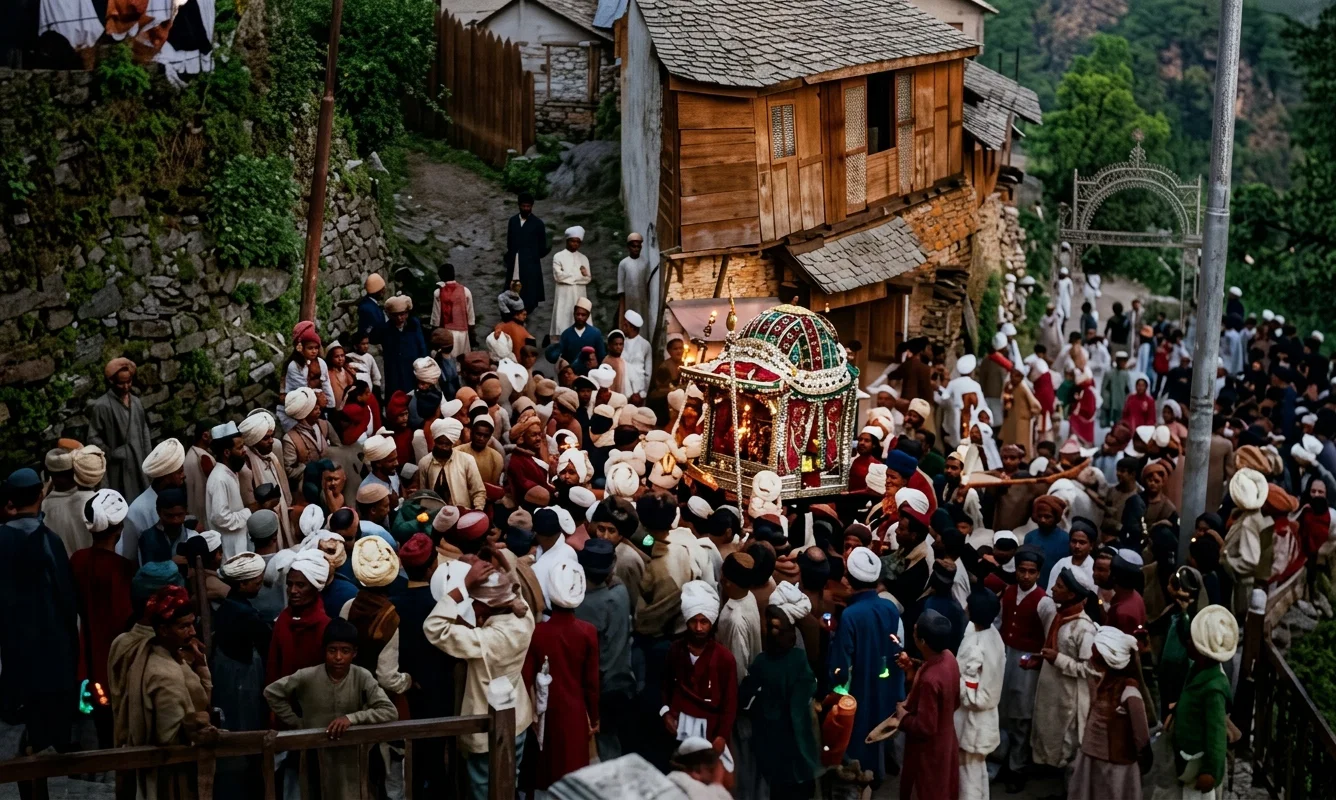
The Mohurrum, a Mohammedan Religious Procession at Mussoorie, India.
Calcutta, Burra Bazaar.
England is not having an easy time. First of all, she feels it necessary to keep up her tremendous war burden; to keep a navy that is up to date and equal to any other two European powers. This is a tremendous load on her resources.
Secondly, she formerly manufactured for the world, and especially for her colonies. These colonies are becoming powers in the world themselves now and are manufacturing for themselves, as to a greater extent is all the rest of the world.
Thirdly, Germany through selfishly wise laws has been able to carry a great deal of British manufacture and trade. She has taken English discoveries, inventions, and patents, manufactured them in Germany, and is selling them in England cheaper than England can make them. These conditions have brought great hardship upon the working classes in England, and the result is thousands upon thousands out of work, seemingly with little promise for work in the future.
This discontent does not stay at home. It would not be so bad if it did, but it spreads to other parts of the great Empire. One of the quarters that is feeling it now perhaps as much as any is India, represented in some parts to be great hotbeds of seething unrest and agitation.
We have been repeatedly told that there are two powers in the earth that are fostering this condition of things in India. One of these is Russia on the North through her secret agents, and the other is Japan from the Northeast, sending her emissaries down through China and Tibet, and working among the disaffected tribes subject to England, and in the principalities which are independent. For there are really but few English controlling the great territory and nations and principalities and tribes of India. If these Indian tribes and principalities were coherent and homogeneous, they would soon sweep English rule out of existence, and control the situation. Fortunately for England, this is not the case. India herself is divided into various idolatrous sects and cults, and there seems to be little if any tendency to unite their forces; yet the uprising and the constant ebullitions of rebellion against proper authority have indeed a menacing tone.
Not long ago four rebels were executed, and from all reports they were eminently worthy of it. Yet the Socialists of India, and the friends of those who died are counting them as martyrs to a noble cause for the freedom of India.
Difficulties in Governing.
India is a difficult country to govern. The system of caste divides it into as many different peoples as there are castes, and these have no union with each other. Corrupt though England's administration may have been at times in the past, and seemingly unjust though it may be in some particulars, yet at the same time it is a thousand times better than Indian rule would be. Among the most cruel, heartless landlords and rulers in the great times of famine are natives. While on the other hand among the most sacrificing, benevolent and kind are the British who are there. Notwithstanding all that India suffers she suffers less now than she did under Indian rule.
There is one scholarly Indian just now residing in Paris, issuing a paper called “The Indian Sociologist,” and yet sending it throughout all England, sowing constant seeds of rebellion against the British government, so that we are told from those who live in India that some of the worst revolutionists who are there are Indians who are receiving their education in England.
Presumably the Irish question does not help matters. It could hardly be believed that the constant agitation and difficulties between Great Britain and Ireland would be calculated to engender peaceful sentiment in the hearts of those East Indians who were receiving an education in London. This paper has openly advocated raising monuments to the four criminals and bomb-throwers who were recently executed in India.
A Religious Basis.
The center of this movement in India seems to be within and around Calcutta. There seems to be a religious basis in all this agitation. The London “Times” of March 1 remarks: “Nobody who knows anything of Hindu [religious] beliefs will fall into the error of supposing that this spirit is on that account a moral spirit. The Hindu pantheon is comprehensive, and amongst the powers which it includes are those of evil as well as those of good. It is not a little significant to note which are the deities whom the Extremists, and large numbers of the reformers who would refuse to describe themselves as Extremists, have selected for the special cult conducted in connection with the movement. [That is, the anti-British movement.] It is to Kali, the terrible goddess of death and destruction, to whom they pay particular homage. It is in the precincts of her great temple at Calcutta that the agitators have held their chief political meetings. It is she whom many of them invoke with the equivocal cry of ‘Bande Mataram.’ No fitter deity could be chosen as the patroness of anarchists.
“Not less remarkable is the revival and the spread into Bengal of the worship of Sivaji. The name of the great Mahratta conqueror was for generations a name of terror in that land. Bengali mothers used it, as readers of Macaulay will remember, to terrify their unruly children. Why is Sivaji’s memory now celebrated with divine honors in the province which he and his hordes used to plunder and devastate with all the horrors of Eastern warfare year after year? The explanation is not far to seek. It is from Poona, the old center of Mahratta greatness, that the Extremist movement is inspired and guided. It is amongst the Decani Brahmins that the brains which organize it are to be sought. The worship11of Sivaji and of Kali are strange symptoms in an agitation which is recommended to ‘advanced’ thinkers in Europe on the pretense that it is liberal and progressive, which glibly uses all the catchwords of Western democracy, and which purports to be intent upon the moral and intellectual regeneration of India.”
Oriental and Occidental.
This movement, “The Times” tells us, is different from earlier movements. Those earlier movements were purely Oriental, but this movement, in all but its religious connections, is admittedly borrowed from the West. “It represents an attempt to graft Western ideas and Western methods on an Indian stem. Anarchism, in its modern shape, is a distinctive and characteristic disease of Western societies; but it seems not impossible that the poisonous growth, once transplanted into Eastern surroundings, may prove to be even more venomous than in its earlier home.”
These anarchists, we are further told, “pore over a Russian manual of anarchy. They choose, as the Russian anarchists do, weak and hysterical natures as their tools. They slavishly copy Russian and Irish systems of political propaganda. They circulate the same kind of malignant and carefully fabricated falsehoods against the authorities. They indulge in the same sophisms. They employ the same weapons, and resort to the same devices.”
The strength of this movement “The Times” does not attempt to estimate. It has permeated to quite an extent all grades of society, and numbers among its sympathizers all gradations of discontent and rebellion. The great London paper intimates that it has taken for its working theory a formula suggested by the late Mr. Parnell, quoting from him as follows: “A true revolutionary movement in Ireland should in my opinion partake both of a constitutional and an illegal character. It should be both an open and a secret organization, using the Constitution for its own purposes, but also taking advantage of its secret combination.” And we may remark that that is true Jesuitic casuistry. “The Times” continues: “It is doubtless this combination of the open and the secret, of the constitutional and the illegal, which so long hid from the police and from the authorities the real nature and extent of the anarchist movement. They did not discern the inner organization within the ample bounds of the far larger bodies which surround it in concentric rings. What may be the true relation between those rings remains to be discovered.”
What makes it seem that the movement is far larger than a limited inner circle, is the fact that so very few among the prominent Indians express their abhorrence in unmistakable terms of the deeds which have been committed; and none of their leaders have taken any prominent part in assisting the authorities to detect and extirpate the inner conspiracy.
Doubtless there have been grave mistakes made in India by the men who have ruled in behalf of the Court of St. James. It would be inconceivable that it could be otherwise. The training, environments, education, race-instinct, religion of the rulers, have been cast in such entirely different molds from those of the ruled that it is a constant wonder that England has done as well as she has. It is really not a question as to whether any other power on earth could have done so well. Much as England may be disliked by rival powers and people of rival nations, she has without doubt given a better administration over the foreign elements of her kingdom than could any one of the nations that so cordially condemn her.
Looking at the great field in the light of fulfilling prophecy, one can easily see that these uprisings and outbreakings in India, taken in connection with the wonderful military progress of Japan and the complete reorganization of the Chinese Empire, are the beginnings of the risings of the kings of the East which will some day meet the kings of the west in the great Battle of Armageddon in the historic Holy Land.
BOOK NOTICES
A Standard Bible Dictionary. Edited by Melancthon W. Jacobus, D.D., Edward E. Nourse, D.D., and Andrew C. Zenos, D.D. One large Quarto Volume, 9,000 Titles; over 900 pages; 300 illustrations; numerous colored maps prepared for this work. Funk & Wagnalls Company, New York and London.
This is a Bible dictionary, like the Standard English Dictionaries, along entirely new lines. The publishers have done the best they could. They have employed high talent and educated men in the production of the work, and have spared no pains or expense in its production. Some of its excellent features are as follows:
1. Intelligibility; conveying the information as directly and simply as possible. It is designed for all classes, from the learned theologian to the general Bible reader.
2. The Hebrew and Greek proper names are given, transliterated into English, and whenever possible translated, together with pronunciation. This literal definition idea extends to words in common use.
3. The American Standard Revised Version is taken as the standard English text, altho some of the contributors use both the R.V. and A.V.
4. The order in the treatment of names is clear and logical; for instance, Jezreel stands for two cities, for the name of a valley, the name of a person, as a symbol. All these meanings are clearly noted.
5. The subjects treated are very comprehensive and concise. There are many helpful cross references. Tho a term may be treated in a class, yet individual reference is made to that class or heading. Thus, “Ephah, a measure. See weights and measures.”
6. The source and meaning of all Bible proper names are given, and accord with the latest data.
7. Bible names variously spelled are found in their regular place in the vocabulary, but the reference is to the spelling adopted by the American Standard Revised Version.
8. Special attention has been given to the latest determinations in the geography and topography of the Holy Land.
9. Attention has been paid to Biblical Archeology.
10. Excellent work has been done in typography and maps. Long articles have analysis of contents at the beginning, with numbers corresponding to subdivisions of article.
The critical position of the dictionary is considered moderately conservative, “liberal, but not radical,” as compared with another extremely liberal work just published. But it shows a long, long drift from the orthodoxy of the past. In many of its articles on theology it would have been counted twenty years ago frankly infidel. These articles are signed, for the dictionary is a work of many men. As a real dictionary, it is an admirable work; but for a theological guide we advise our readers to go to the Bible. Get the meaning of words and terms; find the location of towns, countries, mountains, etc.,—you can get no better help,—but for the doctrines, the teachings of the prophets, the apostles, the Author of the Bible, learn from the Bible itself. Great learning may walk over profound truths unheeding, while a little child may perceive them.
The Balkan Situation.
THE Balkan situation is not making rapid progress toward permanent settlement. The London Times of Feb. 25 thinks that the present condition (at that time),—and it has not changed for the better up to this writing,—is “more serious perhaps than at any moment since the action of Austria-Hungary and of Bulgaria suddenly disturbed the status quo now nearly six months ago. On both sides an uncompromising position has been taken up. In Servia claims have been put forward for territorial compensation which Austria is determined not to grant, and which, we admit, she can hardly be expected to grant.” Last autumn it was stated that Austria-Hungary representatives held out prospects of economic compensation for the Serb States, but now it is contended that Servia, having no real title to any concession whatever, must change her bearing and drop her inadmissible claims before Austria-Hungary can approach the question of the favors eventually to be granted to her.
Then, too, Austria has been making great military preparations for six months; partly with a view to overawe the recalcitrant Serb population of the annexed provinces, and partly with a view to immediate action against Servia and Montenegro, should it become necessary to punish them.
It is expected, too, that after the Franco-German agreement with regard to Morocco, Germany would cooperate in all things in the Near East for the maintenance of peace, but Germany has once more not seen her way to act with the other powers; and The London Times suggests that the language used by the organ of the German foreign office is certainly not the language of a peacemaker. Although diplomacy has exhausted its normal methods, still the Times believes that there is less danger in meeting together and talking it over than to allow it to drift on into war as the present seems to indicate that it may.
The Scientific Aspects of Luther Burbank’s Works
“The Scientific Aspects of Luther Burbank’s Works,” by David Starr Jordan, and Vernon L. Kellogg. A. M. Robinson, San Francisco.
This is a beautifully printed and nicely illustrated work. The letter press is magnificent and of itself invites reading. It is written by Doctors Jordan and Kellogg from the evolutionary standpoint; but the wonderful facts that are presented concerning Mr. Burbank’s work are splendidly told and hold the interest of the reader clear through to the end. It is Dr. Jordan’s contention that Mr. Burbank is not a wizard, and it is utterly unjust to call him so; it really belittles his work; but that he is working from a purely scientific standpoint and in perfect harmony with nature; using four different methods, natural selection, crossing, hybridization, and mutation or saltation. “Natural selection” is the selection of the very finest specimens and constantly breeding from those. “Crossing” is the union of two plants of the same species; “hybridization,” of different species; and “mutation” or “saltation” is the utter breaking up of the law of the plant, leaping over, so to speak, nature’s processes and producing something entirely different. Oftentimes monstrosities come from the breaking up of the law of the plant. The scientists seek to account for all these various changes and mutations, by the hypothesis of evolution. It seems so much easier to us to account for them in the great fact of sin and its perversion of law on every plane of life. Nothing which evolution teaches but that can be explained from the purely Biblical viewpoint. But entirely apart from the evolution theory, the book is worth reading by all who are interested in plant growth, and this is especially so just at this time when Mr. Burbank is entering upon work of a larger scale. We are told in this work how some of the finest products of Mr. Burbank’s work have been produced. How the wonderful results which Mr. Burbank obtained by crossing of all sorts of beans; of the hybridization of apples and blackberries, the product of which came out essentially apples in foliage and growth, entirely thornless, bearing rose-colored flowers, but no fruit. There are a large number of illustrations, especially of the spineless cacti which bids fair to become a marvelous blessing to the arid regions of the earth.
Health for the Million
“Health for the Million.” A book of practical health culture, by Alfred B. Olsen, M.D., and M. L. Olsen, M.A. Price, 2s. 6d., or 60 cents. Richard J. James, 3 and 4 London House, Paternoster Row, London, E. C.
This is an excellent little work written by practical men. Dr. Olsen is the superintendent of the Surrey Hills Hydropathic and of the Leicester Sanitarium. Professor Olsen was editor of the London Good Health for years. There is also an introduction by G. Sims Woodhead, M.A., M.D., Fellow of Trinity Hall and Professor of Pathology in the University of Cambridge. The book answers the question, What is Health? deals with Physical Restoration, How to Train for a Good Physique, takes up the principal organs of the body, Food Digestion, Care Necessary to Insure Cleanliness and Health, Nature’s Remedies, Love and Marriage, Infant Feeding, Health of Women, Hygiene of the Home, Effect of Alcohol and Tobacco, etc., etc. It is comprehensive and yet very concise. There are 218 clearly printed pages with quite a number of illustrations. The price is 60 cents. Those sending for it should probably include postage in their money-order. It may be obtained through this office, if desired.