“THROUGH foreign missions we are sending the gospel to the ends of the earth. As a home mission God is sending the ends of the earth to our shores and very doors.”—Howard B. Grose.
Our attention is frequently called to the study of the great mission fields of Europe, Asia, Africa, and South America, and they are vast indeed. It has also been noted how marvelously the providence of God has prepared the way for the gospel proclamation by opening the door of entrance into all the lands and countries of the world. All this is truly remarkable and a sure evidence that now is the time for the fulfilment of that prophetic vision wherein an angel was seen flying in mid-heaven with the everlasting gospel to preach to every nation, kindred, tongue, and people.
But this is not all there is to the wonderful providences taking place at this time. While our eyes are engrossed with the sights looming up in the distance, there is something equally wonderful in the providential movements that are taking place in our home land.
The coming of these millions of foreigners to our shores, people from every land and clime, of every nation and tongue, is not less a matter of wonder than that which our eyes behold in far-away parts of the earth, and this phenomenon is equally worthy of study. The same great providence that is so remarkably opening the doors for the gospel to be preached in foreign lands is equally the agent in bringing all these people of foreign birth and tongue to our shores, and that for the same great purpose that they may have the opportunity to hear the message that is now to light the whole earth with its glory. A neglect to recognize this opening for a great missionary effort can never find an adequate excuse.
While we all know that there are some foreigners in our country, there are but few who really appreciate the vastness of the numbers and the greatness of this foreign mission field right here in our home land. We therefore invite you to a careful and prayerful study of the facts concerning this foreign immigration to this country, which will be presented in the following quotations:—
“What does a million of immigrants a year mean? Possibly something of more significance to us if we put it this way: that at present one in every eighty persons in the entire United States has arrived from foreign shores within twelve months. Of this inpouring human tide one of the latest writers on immigration says in a striking passage:—
“Like a mighty stream, it finds its source in a hundred rivulets. The huts of the mountains and the hovels of the plains are the springs which feed; the fecundity of the races of the Old World the inexhaustible source. It is a march the like of which the world has never seen, and the moving columns are animated by but one idea—that of escaping from evils which have made existence intolerable, and of reaching the free air of countries where conditions are better shaped to the welfare of the masses of the people.
“It is a vast procession of varied humanity. In tongue it is polyglot; in dress all climes from pole to equator are indicated, and all religions and beliefs enlist their followers. There is no age limit, for young and old travel side by side. There is no sex limitation, for the women are as keen as, if not more so than, the men; and babes in arms are here in no mean numbers. The army carries its equipment on its back, but in no prescribed form. The allowance is meager, it is true, but the household gods of the family sprung from the same soil as a hundred previous generations may possibly be contained in shapeless bags or bundles. Forever moving; always in the same direction, this marching army comes out of the shadow, converges to natural points of distribution, masses along the international highways, and its vanguard disappears, absorbed where it finds a resting-place.’ . . .
“A million and more is the rate at which immigrants are now coming into the United States. It is not easy to grasp the significance of such numbers: yet we must try to do so if we are to realize the problem to be solved. To get this mass of varied humanity within the mind’s eye, let us divide and group it. First, recall some small city or town with which you are familiar, of about 10,000 inhabitants; say Portsmouth, N. H., where the treaty between Japan and Russia was agreed upon; or Saratoga Springs, N. Y.; or Vincennes, Ind.; or Ottawa, Ill.; or Sioux Falls, S. Dak.; or Lawrence, Kans. Settle one hundred towns of this size with immigrants, mostly of the peasant class, with their un-American languages, customs, religion, dress, and ideas, and you would locate merely those who came from Europe and Asia in the year ending June 30, 1905. Those who came from other parts of the world would make two and one-half towns more, or a city the size of Poughkeepsie, in New York, seat of Vassar College, or Burlington, in Iowa, of about 25,000 each.
“Gather these immigrants by nationality, and you would have in round numbers twenty-two Italian cities of 10,000 people, or masses together, a purely Italian city as large as Minneapolis with its 220,000. The various peoples of Austria—Hungary—Bohemians, Magyars, Jews, and Slavs—would fill twenty-seven and one-half towns, or a single city nearly as large as Detroit. The Jews, Poles, and other races fleeing from persecution in Russia, would people eighteen and one-half towns, or a city the size of Providence. For the remainder we should have four German cities of 10,000 people, six of Scandinavians, one of French, one of Greeks, one of Japanese, six and one-half of English, five of Irish, and nearly two Scotch and Welsh. Then we should have six towns of between 4,000 and 5,000 each, peopled respectively by Belgians, Dutch, Portuguese, Roumanians, Swiss, and European Turks; while Asian Turks would fill another town of 6,000. We should have a Servian, Bulgarian, and Montenegrin village of 2,000; a Spanish village of 2,600; a Chinese village of 2,100; and the other Asiatics would fill up a town of 5,000 with as motley an assortment as could be found under the sky. Nor are we done with the settling as yet, for the West Indian immigrants would make a city of 16,600, the South12Americans and Mexicans a place of 5,000, the Canadians a 2,000 village, and the Australians another; leaving a colony of stragglers and strays, the ends of creation, to the number of 2,000 more. Place yourself in any one of these hundred odd cities or villages thus peopled, without a single American inhabitant, with everything foreign, including religion; then realize that just such a foreign population as is represented by all these places has actually been put somewhere in this country within a twelvemonth, and the immigration problem may assume a new aspect and take on a new concern. . . .
“To put all the emphasis possible upon these facts, consider that the immigration of a single year exceeded by 26,000 the population of Connecticut, which has been settled and growing ever since early colonial days. It exceeded by 37,000 the combined population of Alaska, Arizona, Nevada, Idaho, Wyoming, and Utah. These immigrants would have repopulated whole commonwealths, but they would hardly be called commonwealths in that case. If such immigrant distribution could be made, how quickly would the imperative necessity of Americanization be realized. The Italians who came during the year would exceed the combined population of Alaska and Wyoming. The Hungarians and Slavs would replace the present population of New Hampshire, or of North Dakota, and equal that of Vermont and Wyoming together. The Russian Jews and Finlanders would replace the people of Arizona. The army of illiterates would repeople Delaware and Nevada. And the much larger army of the unskilled would exceed by 50,000 the population of Maine, that of Colorado by 80,000, and twice that of the District of Columbia. . . .
“Here are the totals which we have now reached. Of the 23,000,000 aliens who have come into America since the Revolution, the last census (1900) gave the number then living at 10,256,664. A census taken today would doubtless show about 14,000,000. Add the children of foreign parentage and it would bring the total up to between 35,000,000 and 40,000,000. Mr. Sargent estimates this total at forty-six per cent of our entire population. The immigration problem presents nothing less than the assimilation of this vast mass of humanity. No wonder thoughtful Americans stand aghast before it. At the same time, the only thing to fear is failure to understand the situation and meet it.”—“Aliens or Americans?” pages 17-28.
The facts presented in these quotations ought to arrest our attention, and aid us to see and appreciate the magnitude of this tremendous immigration. What a wonderful mission field is thus brought to our very doors! But it should be borne in mind that what is presented in this article is only for one year, and such has been the case for a number of years, and bids fair to continue at the same rate for years to come.
Rio Espirito Santo Mission, Brazil
By H. Meyer
H. MEYER
As time is flying swiftly and every day brings us a step nearer to the closing of God’s work in this earth, I do desire many times to see greater results of my labor; yet I smile to think God’s greatness flows around our incompleteness.
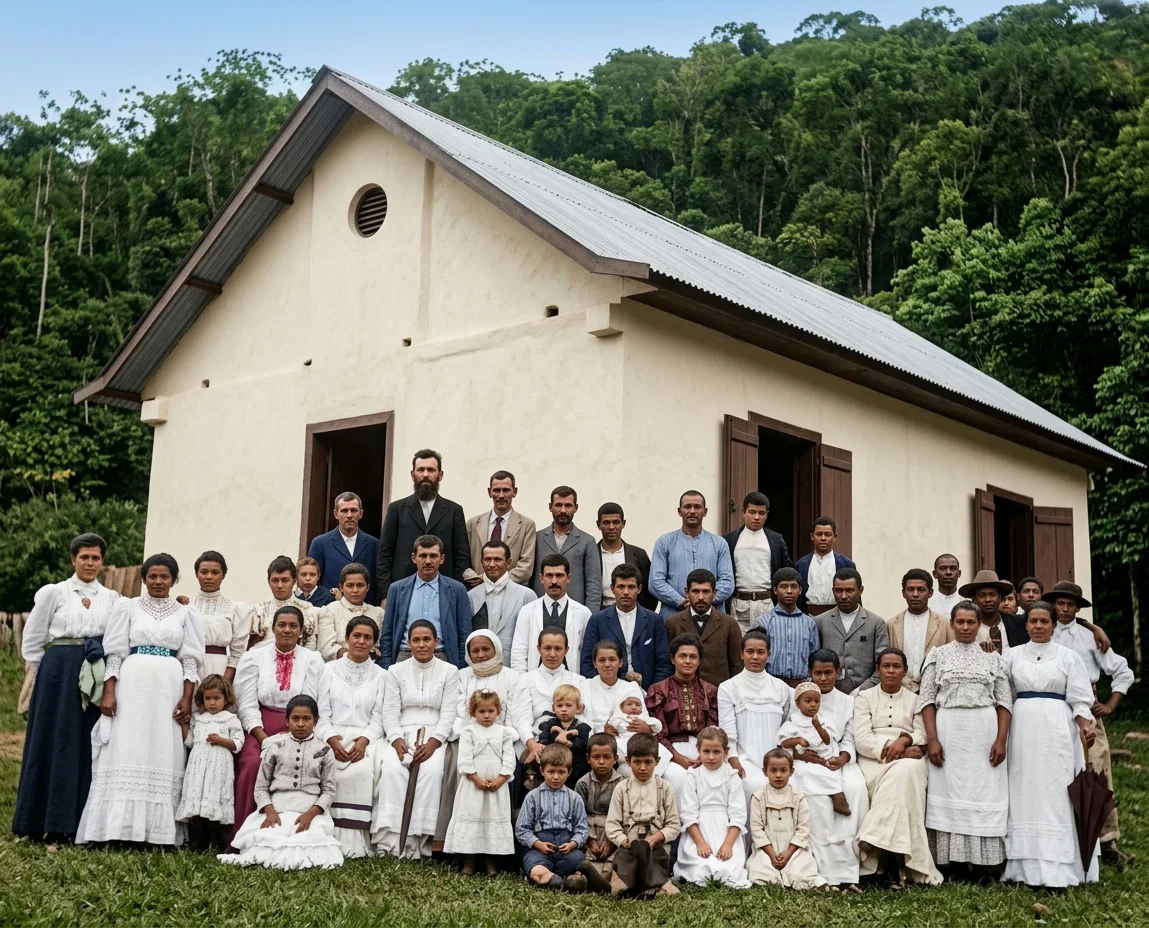
CHURCH-MEMBERS AND BUILDING AT MANTEIGA, BRAZIL
The church in Rio de Janeiro made considerable progress during the year 1912 in their tithes and offerings, besides adding a number of new members. Our hearts were gladdened when, on the twenty-sixth of April, three more precious souls went forth in baptism, which this time took place in the ocean, at the foot of the famous mountain Pao de Acucar.
The next day I went to the state of Espirito Santo, to visit the churches. With the small church on the Santa Juanna River, I had meetings for over a week, which were well attended, and appreciated by many. Later I visited the church at Manteiga, which I had the privilege of organizing a year ago. Though most of the members are new settlers, and therefore have but small incomes, they worked with zeal and earnestness to erect a neat chapel, with a seating capacity of at least one hundred. We had the dedication on the twenty-fourth of May, followed by the celebration of the Lord’s Supper. The church was not only paid for, but there were still fifty-five milreys in the treasury. Most of the meetings were conducted in the German language, though we had some also in the Portuguese. There was an unusually large attendance. At the close of the meetings we had baptism.
Most of my time I spent with the church at Serro Pellado. The brethren testified to the union and harmony which had existed among them during the past year. The first of June was a day of special blessing and rejoicing. All were glad to see six precious souls buried with their Lord in baptism, and then we had a meeting in which the Lord came very near. At the close the members gave, in cash and pledges, 1,020 milreys for the church building in Rio de Janeiro, which we intend to procure as soon as possible. The brethren at Serro Pellado will also have a church-school as soon as the teacher arrives, who is already under appointment by the General Conference. In this vicinity there are no government schools, and we hope much good may be done by opening this school.
On the eighth of June I went, in company with several other brethren, to visit the church on the Santa Maria River, but most of the meetings were held with an isolated member of that church about fourteen miles distant. Many came night after night from a distance of six or eight miles, and we trust that the seed sown will bring forth fruit unto life eternal. Two members were added to the church by baptism.
On the twenty-seventh of June I reached home again, and was glad to note the good interest developed by our two Bible workers, so that in a short time we expect to add several others to the church here. We intend to start tent-meetings in this city before long, and unless some other denomination acts quickly, ours will be the first gospel tent-meeting ever held in the capital of Brazil. There is a great work to be done, and we trust that with the help of the Lord all obstacles may be overcome and many bright jewels won for his cause.
Religion Is Constant Light
“RELIGION is not a candle, to be lighted and blown out at pleasure. It is not a garment, to be put on and off to suit the company we are in. It is not a flaming torch on the Sabbath and a dark lantern during the week. It is a ray of shining light which giveth light to all that are in a dark place.”
The Hakka Country
By S. A. NAGEL
S. A. NAGEL
JULY 2 I left Wai Chow for the north section of the Hakka country. I had long wanted to take this trip, for the larger half of the Hakka people live there, and I had never visited them. There are five large cities of these people, with their adjacent villages, the largest being the Ka-Yin-Chiu. The best-educated and wealthiest Hakkas live in this section. In fact, wherever you meet a Hakka, he will speak of Ka-Yin-Chiu as the capital city. Some of the finest homes I ever saw in China I saw there.
From Wai Chow I came by way of Hongkong to Swatow, as the most convenient and quickest way to reach this field is to go inland from Swatow. Here I left my family to visit with Brother and Sister Hills until I should return. Brother Hills had just finished his home, and it is very comfortable. The work among the Swatow Chinese is growing rapidly. Brother Hills has more than he can do, and should have some help at once.
Ka-Yin-Chiu is about one hundred and sixty miles from Swatow. This is a matter of only three or four hours’ ride in the States; but to make the trip, it took me five days going and four days returning. About the first thing one learns here is that “You can’t hurry the East.” It does try one, though, to travel so slowly under a July tropical sun.
Part of the way I traveled by train, part by steam-launch, and the last fifty miles in a small boat which was pulled along up-stream by men walking on the bank. This last fifty miles took three days, as the river is very swift. As I had never been over the road before, I had taken a native preacher with me as guide, expecting to leave him in charge if the work opened up there.
I found a good company of people at Ka-Yin-Chiu, who welcomed me to the best they had. I stayed with them five days, rented a chapel in the city, and the native preacher remained to teach them, so one more place in dark China has a light-center.
From this place I went over the mountains to Chin-Phin, a distance of thirty miles. Brother Anderson opened up a chapel there a year ago. I found the evangelist of good courage, with an earnest company of believers. The people were very happy to see me. I feel that from now on we should visit that field two or three times a year. It is a very expensive trip to take, and being so far from Wai Chow, it is hard to manage from that place. It would be better, to my mind, if a worker could move to that country and live there.
The truth is really getting hold of some of these Hakkas. Last pay-day at Wai Chow three things impressed me very much. I overpaid the chapel boy twenty cents. I did not know it, and imagine my surprise when he came bringing it back in the afternoon. Another worker, out of a salary of thirteen dollars,—six dollars gold,—put down five dollars tithe, most of it back tithe.
We had had no papers all the month, so one of my canvassers had nothing to do. It was not his fault that he had no papers, and I felt it right that I pay him part salary anyway. I gave him ten dollars. He paid one dollar tithe, so that left him nine—about four dollars gold. In the afternoon he came back and said that his heart was not right over taking so much money when he had not worked selling papers. He said he had not eaten nine dollars’ worth of food that month, and gave back four dollars to the mission. Such things show that God’s Spirit is working upon their hearts. I believe Jesus will find some ready to meet him in this land.
Siguatepeque, Honduras, Central America
By Karl Snow
KARL SNOW
We opened our school here the first of last February with eight pupils. The Lord has greatly blessed our efforts, and we now have twenty-four students. They are all Catholics except three.
The work is all in English, and we use our denominational books as far as possible. We are continually weaving the truths of the Bible into our work and they all seem to enjoy it. If we gave them straight Bible lessons, it would soon stir up prejudice against our work. From expressions the students make we can see that the seed is taking root in their hearts.
The following are some questions and answers concerning the Sabbath by a student who has been one and one-half years in our school. I copied them direct from his paper, and made no corrections:—
1. “What is the Sabbath?”—“The Sabbath is the seventh day of the week in which God rested.”
2. “In how many days did God make the world?”—“God made the world in six days and rested on the seventh, that was the Sabbath, and sanctified it.”
3. “Why did God sanctify the Sabbath?”—“Because that the Sabbath was the seventh day in which he rested and it was made to rest and to give praise to him.”
4. “What shall we do on the Sabbath day?”—“We must do nothing on the Sabbath day but praise and give thanks to God for his wonderful work.”
5. “If we obey his commandments, what shall we obtain?”—“We shall get the eternal life, the kingdom of heaven, and we shall dwell with our Heavenly Father.”
Our facilities are very meager as yet, but the Lord can bless little things. The natives come to us with all kinds of aches and pains. At first I had no forceps for tooth-pulling, so I used my gas-pliers, and they did very well. A friend in the States, learning what I was using, took pity on the natives and sent me a nice pair of forceps, so now I can be quite professional.
Mrs. Snow and I came here two and one-half years ago as self-supporting workers, and have kept in close touch with our brethren at Washington, which has been a great help to us. We have had to start small, but we feel that the Lord is leading and the work will grow.
I asked the students to each write an essay on Siguatepeque, and I will here quote a section from one just as it was written, so you can see how the students feel toward the school:—
“The English School is a mixed school, or a school for boys and girls. It is the better establishment of this country for persons who wish to learn the English language. The school the same as the town is going on, but not so slow as the town go. Our school began about two years ago with very few pupils and books, it have gone up so quick that the present number of pupils is twenty-four, it has plenty of books, and the number of our classes is altogether from eight to nine every day, and it is still so going on that in the next year I guess we shall have many advanced classes, and it may get to be the better educational center of this country according with the character of our teachers.”
I have not entered into details about our work or location, but merely told you that we are working here. Later I will give a general description of the country, its people, customs, etc., and tell more of our work. Think about the work in this field, and pray for its success.
God’s Responsibility for Our Work
“WHEN we give ourselves wholly to God, and in our work follow his directions, he makes himself responsible for its accomplishment.”
He Has Risen for Me
By J. J. Nethery
J. J. NETHERY
THERE’S a song on my lips,
There’s a song in my soul,
Though the waves of distress
Deeply round me may roll;
For I know whom I trust.
Though the way may be dim,
I shall safely go home,
If I cling close to Him.
CHORUS:
I shall not be afraid
When the dark grave I see,
For my Saviour has died,
And has risen for me.
There’s a light in my sky
Since the breaking of day,
When the seal rent in twain
And the stone rolled away;
For an angel spoke peace
To my spirit’s alarm,
“He has risen for thee,
There is nothing can harm.”
There’s a joy in my heart,
All the long, weary day,
For the storm overpast
And the clouds rolled away;
There’s a rose for each thorn,
And a gain for each loss,
Since my Saviour himself
Gained a crown by the cross.
Portland, Oregon.
North Carolina
By Page Shepard
WILMINGTON.—The church in Wilmington is steadily growing in grace and in numbers since Elder Scott's interesting gospel campaign last summer. The Lord wrought upon hearts to accept the message, and a goodly number was added to the little faithful company here. This season's effort seems destined to triumph gloriously, notwithstanding the faith-trying experiences encountered at the outset. The beautifully appointed tent is nightly crowded with persons anxious to hear the soul-stirring sermons and listen to the beautiful songs of Zion. A good increase in membership is expected.
The writer enjoyed a precious experience with the church at Wilmington, and found a people zealous of good works. The congregation is composed of a goodly number of young men susceptible to training for service in the work of the last gospel message.
The presentation of the message has stirred the multitude, and the wealthy classes have been reached through the Lord's faithful servants. May his Spirit continually strive with the souls now hearing the message, that they may accept before the invitation to the gospel feast is withdrawn from perishing souls.
PAGE SHEPARD.
Greater New York Conference
By Joseph L. McElhany
The territory of the Greater New York Conference comprises the city of Greater New York, Long Island, and seven counties of the State of New York. While the area is not large, the density of the population more than makes up for it. In the territory outside of the city live about one million people, which, combined with the population of Greater New York, makes a total of about six million. It can thus be seen that here is a population much greater than in some entire union conferences. The great masses of humanity of all nationalities in this conference present to us the greatest city problem we have in America. How to evangelize these multitudes with the third angel's message is a question of the greatest magnitude.
The recent session of the General Conference brought many changes to this conference. Elder R. D. Quinn, the former president, is now president of the Atlantic Union Conference. Of the ordained ministers who labored here before, only two remain. Others have come to take up the work, so that the ranks are now partly filled, and despite the fact that most of our workers are new to the field, we have had a successful summer's campaign. Nine tent efforts have been conducted, in which the English, German, Swedish, Danish-Norwegian, and Hungarian languages were used. The message has been preached with earnestness and power to thousands of people. Most encouraging results have attended the efforts of the workers. A goodly number have already taken their stand for the truth, and many others are deeply interested. In most cases the interest has been so great that strong hall efforts have been started to follow up the work. Several baptismal services have already been held, and in most cases there will be a second or third service to baptize those who are now making their decisions. On one occasion thirty-one souls were baptized from one effort, and probably as many more will soon follow.
We feel very thankful to our Heavenly Father for the blessings that have attended the work this summer. I have been greatly encouraged as our workers have come together for prayer and study, to see the real spirit of devotion to this work. There has been more thought given to seeking God's help and praying for the outpouring of the Holy Spirit than has been given to the other features of the work. The advertising and other methods of work have been along conservative lines, and in almost every case the attendance at the meetings has been splendid.
We ask an interest in the prayers of God's people that the workers set here in the nation's gateway may have large measures of blessing and power in laboring for the multitudes of this great city. Our local resources are limited. It seems there is little we can do, but we believe that when the Lord, through his servant, bids us proclaim the message once more with power in the East, he will in some way make it possible for us to carry out his instructions.
J. L. McElhany.
Georgia Camp-Meeting
By O. Montgomery
THE Georgia camp-meeting and conference were held at Fort Valley, Ga., July 30 to August 10. Elder N. V. Willess, who had very recently come to Georgia from Texas, had, with the assistance of some of the other conference workers, been conducting a tent effort previous to the camp-meeting, as the result of which quite an interest was created. There was a fair attendance from the town at most of the meetings. The attendance of our own people throughout the conference was small. I am informed that the meeting was not nearly so well attended as usual. However, the Lord was there to bless. A spiritual feast was enjoyed throughout by those who were in attendance. Especially were the meetings for the young people of a deep spiritual character, and several gave themselves to the Lord.
The visiting brethren from outside the conference were: Elders C. B. Stephenson, W. H. Branson, C. B. Haynes, T. H. Jeys, and Brethren W. H. Williams, V. O. Cole, R. Hook, Jr., L. D. Randall, and the writer.
Elder L. T. Crisler retired from active work, laying down the burdens of the presidency of the Georgia Conference, which have rested very heavily upon him for several months because of failing health. He had won the hearts of the people of Georgia, and it was with deep regret that they consented to release him. Elder Willess, of Texas, had been invited to take up the work in Georgia, and he was unanimously elected as president of the conference. We feel confident that as he leads out in the work in this conference, he will have the same hearty cooperation and support that Brother Crisler has enjoyed.
Practically all the other officers were reelected. Considering the small number in attendance at the meeting, the offerings to missions were good.
O. MONTGOMERY.
Among the Italians in Chicago, Ill.
By Ole Andres Olsen
In January, 1912, Brother Rosario Calderone came to Chicago from New York, and began work among the Italians. He has been alone in his efforts, and as would be expected, has met many difficulties and much opposition.
His plan of labor has been to hold meetings in two places,—at our church on West Erie Street and in the Swedish Mission hall on Oak Street,—both of which were favorable to the Italian communities. In connection with the meetings the greater part of the effort was put forth in personal work from house to house. At times street meetings have also been held with good results.
The Italians are, with few exceptions, Catholics, and considerable illiteracy exists among them. This makes the labor for them the more difficult; but notwithstanding the difficulties, there will also from the Italians be gathered a people to be numbered among the saved.
During the time Brother Calderone has been laboring in Chicago, eighteen or more have begun the observance of the Sabbath. A Sabbath-school has been organized, and regular Sabbath meetings have been in progress for nearly a year.
Sabbath, September 20, was a good day, and marked an interesting advance move in the work among these people here in Chicago. On this day, after careful preparation, eight dear souls, five brethren and three sisters, were buried with their Lord in baptism. All had been reared Catholics, but have now heartily accepted the present truth. I never met a more happy and hearty company of candidates than these. Two were baptized some time ago, but have left Chicago, one going to New York, the other to Italy; both are faithful to the truth.
After the baptism we proceeded to organize an Italian church, composed of ten members—these eight baptized, and Brother and Sister Calderone. Several others have already requested baptism, but we have felt that they are in need of still more instruction that they may the more intelligently enter the holy covenant and be established in the whole truth.
There was a goodly number of Italians present, who listened with profound15interest to the instruction and questioning of the candidates. The prospect is that soon others will unite with these who have covenanted to keep the commandments of God and the faith of Jesus. Brother Calderone was ordained elder of the church. A clerk and a treasurer were also elected.
Brother Calderone informs the writer that at present there are about thirty families, Italians, that are studying the truth. There is a great urgency for a lady Bible worker to devote her entire time to visiting and working among the families. We are earnestly praying that the Lord will give us such a helper. We shall be glad when the time comes for a church to be organized among the Poles, Hungarians, Bohemians, Slovaks, Roumanians, and others. May the Lord hasten the day.
Another forward step has been the starting of a small sixteen-page quarterly paper in Italian. The Italian Sabbath-schools have no lessons, and there was an urgent call for such lessons. So this little paper provides them, as well as some matter helpful to interest our Italian people. We trust this effort may prove helpful to the work, and a blessing to our Italian believers.
O. A. OLSEN.
Newspaper Publicity in Bermuda
By M. ENOCH.
For years I have been writing articles on present truth, and they have been coming before the public through the newspaper having the largest circulation here. In 1912, I began contributing articles to the Mid-Ocean, which is owned by the man who formerly owned another paper here, and he has granted me the privilege of using the columns of the Mid-Ocean just as he did in his other paper.
Nearly every week I meet people who tell me they are interested in my articles. Sometimes when I am riding on my bicycle, they stop me to say they are interested in the articles. An intelligent lady told one of our sisters that she read them all. And others report the same thing.
Some who had not thought of giving themselves to the Lord, who seemed to care only for the things of this world, have told me that they never took such an interest in the Bible as they have since reading my articles. Not long ago I visited a beautiful stalagmite-stalactite cave, and if you could have heard the owner and his wife talk of the signs in the heavens, etc., you would rejoice with me. They read every article I write, and are interested.
M. ENOCH.
The West Virginia Camp-Meeting
By B. G. Wilkinson
The annual meeting of the West Virginia Conference was held in connection with its camp-meeting, at Charleston, September 4-14. The attendance of our brethren was not so large as usual, being affected no doubt, as in the other camp-meetings of the Columbia Union, by the number of those who had attended the General Conference at Washington. But there was a goodly number present, and the spirit of the meeting was excellent. Harmony prevails among all the workers and throughout all the churches.
The attendance from the city was not very large, but the whole attendance combined was sufficient to tax the seating capacity of the church building in which the sessions of the conference and the public meetings were held. All felt that the work in West Virginia had made decided progress this past year. Looking back on the long history of our work in this State and on some of the unfortunate experiences to which the conference has been subjected in the past, the brethren of West Virginia feel that there are new days ahead of this little conference.
The reports of both the president and the treasurer of the conference and the tract society showed that the conference had made splendid gains this past year. Four tent efforts were held in different parts of the State the past summer, with most excellent results. There is now a good laboring force in the conference; a new class of people are accepting the truth, and the openings for presenting the message among the most solid elements of society are many.
Practically the same corps of officers was reelected to serve this coming year as had served the past year. Elder F. H. Robbins was again elected president of the conference, while Brother J. S. Barrows was elected secretary and treasurer of both the conference and the tract society.
The conference is well up in its tithe, and very little was behind at the time of the meeting on the Twenty-cent-a-week Fund, and this was practically made up by the gifts to foreign missions on the last days of the conference. The power of God was present in all the meetings. The reviving grace of the Holy Spirit was felt upon the hearts of the brethren present, and the last Sabbath especially witnessed a splendid reconsecration to God on the part of all present.
The laborers in attendance from outside the conference were Elders G. B. Thompson and D. C. Babcock, and the usual force of union conference men. Never was the outlook for the progress of the work in West Virginia brighter.
B. G. WILKINSON.
M. J. ALLEN
By M. J. Allen
Ontario
BRANTFORD.—As a result of our tent effort, just closed, eleven have been baptized and received into the church, and five others have begun to keep the Sabbath. The enemy is doing all he can to stop our work here. Some set fire to our tent while our meeting was going on, but did not succeed in burning it. They threatened to take my life if I did not take down my tent and move on, but we kept it up until the interests of our work indicated a change to a hall, where we continued our services.
I have begun meetings at one of the factories at the noon hour. I believe that the Lord has honest souls in this city who will accept this last message when they hear it. We are of good courage and expect to keep right on preaching the truth as long as there are those who will accept it.
M. J. ALLEN
South Carolina Camp-Meeting
By J. W. Manns
The South Carolina camp-meeting and fourth annual conference were held at Columbia, September 4-14. The location of the camp was all that could be desired. One of the encouraging features of the meeting was the splendid attendance on the part of the people of the city at the evening services. An excellent interest had been awakened, before the conference began, by Elder C. G. Manns and the workers associated with him.
In every service we could feel the presence of the Lord. A marked manifestation of the Holy Spirit was seen in the confession and putting away of sins, and in seeking a nearness to God and a reconsecration to his service.
The reports rendered by the various departments for the year were of an encouraging nature. One hundred and sixty dollars was pledged for the need of the work. The outlook seems decidedly favorable for an encouraging ingathering of souls to strengthen the church. Personally, I greatly enjoyed attending the camp-meeting in South Carolina. On the last Sunday of the meeting thirteen were baptized and added to the church. J. W. Manns.
The Georgia Camp-Meeting
By J. W. Manns
THE Georgia camp-meeting and the third annual session of the Georgia Conference were held at Savannah, August 28 to September 7. This gathering was the largest of its kind ever held in the State. From the first, there was a good spirit manifested. The attendance from the outside was good, and the blessing of the Lord was present throughout the camp.
All departments of the work made a good growth during the past year. Many important items came up for consideration, which will prove a blessing to the work. The president's report showed an excellent increase in tithes and offerings. Looking at the work from various points, we heartily thank God for the results of the past year's work in this city. As we look back on the past, we see the blessings of the Lord in a marked manner.
We are endeavoring to do all we can to help the people of Savannah to see the truth, as we believe it is soon to lighten the whole earth.
The subject of missions was considered. The Spirit of God was present in the meeting, and wrought a good work in the hearts of the people. Five hundred dollars was pledged for the need of the work in foreign fields. The future of the work in Savannah, among both colored and white, never looked brighter than it does at the present.
J. W. MANNS.
Mississippi Camp-Meeting
By N. B. King
We are gratified to report the manifold blessings that attended our camp-meeting, which followed a strong tent effort. As a result, six persons promised to keep all the commandments of the Lord, and others are anxiously seeking to learn the heavenly way.
There were about fifty campers on the ground including children. All seemed to be greatly benefited, and anxious to see the work of God prosper. Pledges were made to the amount of one hundred and fifty dollars for missions. Pledges also were taken to use seven hundred copies of the Harvest Ingathering REVIEW. We feel quite sure of seeing a company raised up in the little town of Hazlehurst. We beg an interest in your prayers for the work in our State. N. B. KING.