“Mother! mother!” cried little Willie, coming in upon me as I sat busily at my work, “I have lost my arrow in the grass, and can’t find it.” He was ready to burst into tears at his mishap.
“I am sorry, dear,” I said, as I went on with my work.
“Won’t you go and find it for me, mother?” he asked, with a quivering lip, as he laid hold of my arm.
“I am too busy,” I replied; “go tell Jane to find it for you.”
“Jane can’t find it,” said the little fellow, in a choking voice.
“Tell her to look again.”
“She has looked all over. Won’t you come, mother, and find it for me?”
The tears were rolling down his face, but I was busy embroidering a little linen sack I was making for him, and that seemed of more importance than the happiness of my child.
“There, there! Don’t be so foolish as to cry at the loss of an arrow. I am ashamed of you. Go look for it yourself.”
Willie went crying down-stairs, and I heard him in the yard until my patience gave out. “Ellen,” I heard him say, “won’t you make me an arrow? Here is a stick.”
“No, indeed; I have something else to do besides making arrows,” said cook.
I felt vexed at Ellen. She might have done it. If I were not so busy, I would make it myself, I thought; and I sewed on as before. Willie’s heart was almost broken, but I was not in a mood to sympathize with him. The loss of an arrow seemed a very trifling thing to me. “Willie,” I cried out of the window, “you must stop crying.”
“I can’t find my arrow, and nobody will make me one.”
“Go find something else to play with. Come, sir, you must stop this crying. I won’t have the noise.”
“I can’t find my arrow,” he said with a quivering lip.
“Well, crying won’t find it. Come up-stairs.”
Willie ascended to my room. “Now, don’t let me hear one word more of this. Take better care of your arrow next time.”
There was no sympathy in my tones, for I felt none. I did not think of his loss, but of the annoyance of his crying. The little fellow stifled his grief as best he could; and throwing himself on the floor, sighed and sobbed for some moments. Before long he fell asleep. How instantly do our feelings change toward a child when we find it is asleep! Tenderness comes in the place of sterner emotions. I put aside all my work, and taking Willie in my arms, laid him on my bed. Another deep sigh came from him as his head touched the pillow, and it was echoed in my heart. Poor child! the loss of an arrow was a great thing to him. I wished that I had put away my work for a few moments, and made him a new one. “What is a little time taken from my work.” I thought, “compared to the happiness of my child? I wish I could learn to think right at the right time. Dear little fellow!”
I stood for nearly five minutes over my sleeping child. When I turned away, I did not resume my work; for I had no heart to work on the little garment. I went down to the garden, and the first thing that met my eye was the arrow, partly hidden by a rose-bush. So easily found! How much would a minute have saved if it had been given at the right time! We learn too late, and repent when repentance does not avail.
The first notice I had of his being awake was his gratified exclamation at finding his lost arrow beside him. His grief was forgotten. In a few minutes he was out shooting his arrow again. But I could not forget the incident. I was serious for many hours afterward; for the consciousness of having done wrong, as well as of having been the occasion of grief to my child, lay with a heavy pressure upon my feelings. —Church Evangelist.
(Trinidad, W. I.)
By Mrs. E. W. Webster
FROM TRINIDAD.
BY MRS. E. W. WEBSTER.
(Trinidad, W. I.)
That “he shall turn the hearts of the fathers to the children” (Mal. 4:6) is a sign of the “great and dreadful day of the Lord,” which I believe is being literally fulfilled to-day. The Lord is laying upon his people, and upon philanthropists in general, a burden of soul for the children, in whom are bound up such possibilities for good or evil. As we see the multitudes of little ones on the streets of our city, who are born and bred in sin, vice, and degradation, the thought comes to us with startling force and reality, Soon these children must be saved or forever lost; for they must all stand or fall at Jesus’ coming. What can we do to save them? This question has been pressing home to our hearts.
For some time we have been holding children’s meetings on Sunday afternoons, gathering in as many as we can, teaching them of Jesus’ love, of his soon coming, and the word and law of God. We are trying to arm them with the truth, and to encourage them to be little missionaries to tell others of these things. One little girl said she told a young schoolmate of Jesus’ coming, and that she began to love her then. Our own little girl, who is five years of age, prays every day that Jesus will help her to be good first, so she can go all about helping the little children to be good, and to get ready for Jesus’ coming. Little do we know what a work the children may yet do in preparing hearts for the kingdom if they are rightly trained and instructed in the truth.
In our list of subjects for missionary meetings we include an occasional parents’ meeting, in which we try to impress upon all the responsibility, not only in regard to our own, but children in general, giving hints concerning their training and care. Great interest is manifested in these meetings. I know there are many who are very grateful for any help or instruction in this responsible and often very perplexing duty. We highly appreciate what has been given us in this line of late in the Home department of our dear REVIEW. We hope for more.
Most of our people know that the Testimonies furnish most precious instruction to parents in this work. I would like to recommend also, as helps, the “Social Purity Series” of leaflets published by the Good Health Publishing Company, Battle Creek, Mich., including such subjects as “The Training of Girls,” “Novels,” “Words to Mothers,” “Pitfalls for Our Boys,” etc.; also the booklets, “Child Confidence Rewarded,” “Teaching Truth,” and others, published by the Wood-Allen Publishing Company, Ann Arbor, Mich., which have been found exceedingly helpful to mothers in keeping their little ones from evil. The book entitled “A Study of Child Nature,” is also full of useful hints for parents and teachers. Having found these and other works such a help, I mention a few of them, that others who wish may secure a like benefit. Dear brethren and sisters, Jesus is surely coming soon. Let us be faithful to every trust, gathering in the young as well as the old to praise and glorify our dear Redeemer now and through a glad eternity.
JAPANESE WOMEN.
By Sophia B. Brunson
BY MRS. SOPHIA B. BRUNSON.
(College View, Neb.)
Wives of the lower classes are in many respects more fortunate than those of higher rank, since poverty has a tendency to place both sexes on an equality. The reason is probably found in the fact that they are both producers. The wife toils side by side with her husband; and without her labor, it would be difficult to support the family. Among the higher classes, though wives perform many menial tasks for their husbands, there are no avocations open to them whereby they can be of any assistance in bringing money directly into the family purse. The women of the poorer classes have much more freedom than their wealthier sisters, and often receive more consideration at the hands of the male members of the household. As a rule, the laboring man cannot afford a concubine, so that the wife is not annoyed with a rival. If she happens to be the brainier of the two, she has no more compunctions of conscience in regard to ruling her husband than have American women, and generally succeeds equally well.
Our hearts ached at the sight of the extreme poverty often met with in Japan. We lived on a hill overlooking the sea, in the beautiful city of Kōbe. Near the beach there were low places that the owners designed to render suitable for building lots, by filling them in with earth. This was brought from the mountains, in little carts drawn by men, who received only a few cents a day for their labor. They used to pass our house going for and returning with their loads. Frequently a man would be pulling the heavy cart filled with dirt, and a thin, half-starved-looking woman, with a scrawny infant tied upon her back, would be pushing. She not only bore the weight of the child all day, but strained every muscle to assist her husband in drawing the heavily loaded cart. But she, with her life of unending toil, was happier and more fortunate than many poor, dejected-looking women, covered with rags and filth, who wandered about the streets and begged. Numbers of these beggars are most horribly diseased; some of them are lepers in the last stages of the malady. When Christ was upon the earth, great crowds of such poor unfortunates went to him, and found cleansing for their souls and bodies. He has the same love and compassion for these miserable creatures343now that he had when they gathered about him in Galilee. Let us endeavor to emulate the example of our divine Master, by giving ourselves to the service of suffering humanity wherever we find it, whether it be clothed in the white complexion of the Caucasian, or robed in the dusky skin of the children of the Orient.
There is a class of women in Japan known as geisha, or dancing-girls. One often sees them upon the streets, dressed in gaudy colors, with their faces painted with cosmetics. A geisha is known by her attire; for respectable women in Japan dress in sober, quiet colors. She begins her career as a slave. Pretty little girls who are the children of very poor people are bought to be trained as singers and dancing-girls. They are taught etiquette, grace, polite speech, music, and dancing. When they are old enough to display their beauty and accomplishments to advantage, they are hired for entertainments and banquets. As a rule these fêtes are attended only by men, and the geishas bring their sparkling wit and social charms to add the enlivenment to the occasion that the wives and daughters in the Orient are not permitted to do. These poor girls are brought up to believe that the most important thing in life for them is to make themselves pleasing to the opposite sex. Such an education is not conducive to morality, and we cannot wonder that, as a class, they deem it far more desirable to dance well than to bear an untarnished reputation.
(To be continued.)
THE HOUSE OF MY PILGRIMAGE.
By Margaret J. Preston
'T is the “House Beautiful!” Its frescoed ceiling,
Studded with stars of light,
Is ever to my lifted gaze revealing
Visions of worlds so bright
That I am awed with wonder God should care
To make the pilgrim’s wayside inn so fair.
Its pillared mountains, draped in emerald glory;
Its tessellated floor,
Illumined with creation’s golden story,
And rich with such a store
Of lavish loveliness on every hand,
Too vast, too marvelous, to understand.
Light, color, fragrance, all beyond comparing;
Sweet melodies that make
The ear that listens overwhelmed, despairing,
Through very rapture ache.
So much of wordless beauty, grandeur, grace,
Just for sojourners’ brief abiding-place!
And wherefore? Is it that my heart should linger
Content as it has been,
Seeing with what adornment God’s own finger
Has hung the pilgrim’s inn?
That, with my senses satisfied through bliss,
I ask for no diviner home than this?
Nay, nay, not so! If earth’s seducing splendor
Can eye and ear engage
With such a full content as e’en to render
My house of pilgrimage,
With all its ills, so beautiful to me,
What must the “house of many mansions” be?
—Margaret J. Preston.
(Tahiti, Society Islands.)
By B. J. Cady
THE SOCIETY ISLANDS.—NO. 3.
BY MRS. B. J. CADY.
(Tahiti, Society Islands.)
The exact population of these islands is not known, but it is estimated at about twenty thousand. There are also several neighboring groups which are controlled by the same government, where the Tahitian language is extensively used, and in most of them the Tahitian Bible and other printed works are the only literature. Tahiti has nearly twelve thousand people, about four thousand of whom are in the city of Papeete.
Many of the natives lead a sort of gypsy life, going from island to island, or from district to district; for as a people they soon grow tired of one thing, and want a change. They delight in anything new and startling, and if they cannot have new experiences for themselves, the next best thing is to hear news of interesting things which have happened. One of the first questions we are greeted with when we meet a native acquaintance is, “Eaha te parau api?” which means, “What’s the news?” It is a great pleasure to a native to be able to gratify his questioner with a bit of news, and so he sometimes manufactures some.
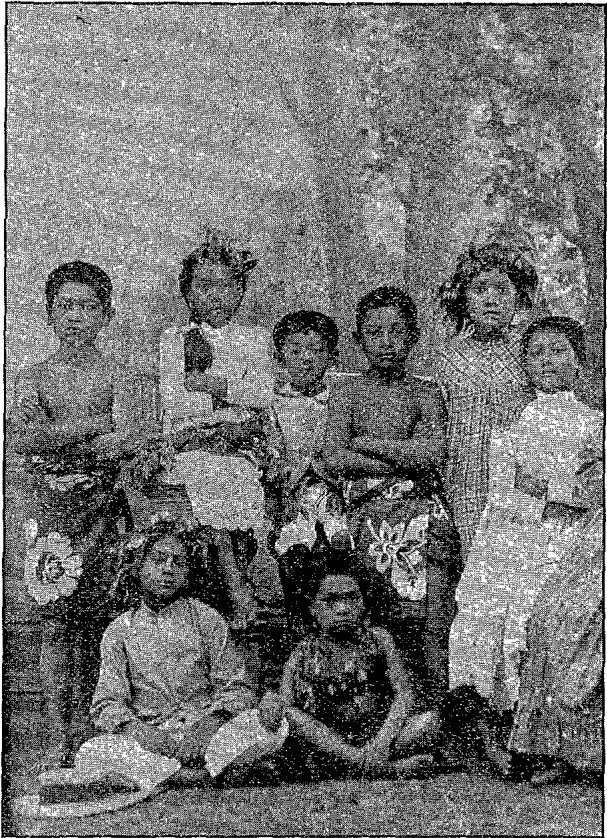
There is no word in the Tahitian language for home, and home is not to them what it is to us. More children are given away at birth to be brought up by the godmother or some relative or friend than are kept and brought up by the parents, and the children are continually going back and forth from one family to another, it being very seldom that all the children of a family are at home at the same time. The little girls do not have dolls, but they all like to hold the baby, and it is passed from one to another like a plaything. In fact, the baby is the plaything for the whole family, as well as the arbitrary ruler. But when he gets older, and can run around and play, he is allowed to entertain himself, which he proceeds to do by playing in the water of the lagoon or in the river for hours at a time, climbing trees and eating green fruit, whipping tops, walking on stilts, and in many other ways too numerous to mention.
Parents give little heed to their children, unless wishing their assistance, and the children have many idle hours in which to play and invent mischief. Where there are schools, most of them are put into school as soon as they are old enough; but they do not attend regularly, and leave while still very young, but few gaining an efficient knowledge of the French language. Though lacking in much of the most essential knowledge, they know many undesirable things of which our white children are entirely ignorant.
While young, they are expected to sow their wild oats, and then, when married, to steady down and unite with the church. The parents make the arrangements for the marriage of their children, and some are married while still very young. Often several families live in a house of one or two rooms, and as they sleep upon mats laid on the floor, they do not require much room for beds. They are never troubled for table-room; for they sit on the ground, and eat around a table-cloth of leaves. If the house is crowded, they eat outdoors. The food is seldom boiled, but is cooked in the native oven by means of hot stones; and as knives, forks, spoons, and plates are rarely used, a soup-bowl only being required by each person to hold the water or sauce which is taken with the fish and vegetables, there are not many dishes to wash. When through eating, each person washes his hands, rinses out his bowl, and puts it away to drain. Then the work is done, and they can enjoy a social chat, or lie down and take a nap. They sleep a great deal during the day, and often, immediately after eating a hearty meal, go and take a cold bath in the river. They seem to think it aids digestion to take either a bath or a nap right after eating, and that vigorous work would be a hindrance to digestion.
CHILDREN OF TAHITI.
While sitting in a group chatting, a cigarette is lighted at frequent intervals, and tossed from one to another, each one taking a few puffs at it. The women are just as much addicted to this habit as are the men, and the children all know how to smoke, sometimes imitating their elders by rolling up dried leaves and smoking them when they cannot get tobacco.
Meals are eaten very irregularly, and unless the man is working by the day, he usually does the cooking. The women do the washing and ironing, and make the hats, but they do not know what hard work is. Those living in the vicinity of Papeete take in washings for the white people, few of whom do their own laundry work; most white families also employ native or Chinese cooks. The clothes are carried to the river, and rubbed and pounded with a stick until clean. After being bleached, they come out looking fresh and white. The ironing is done with a large flat-iron, which is heated with charcoal that is kept burning inside the iron. The women are never in a hurry, but take time to visit while at their work, and the ironing is generally well done.
The houses of the natives are not tastily ornamented, but are quite bare and often grimy. To make up for the lack of curtains, the cobwebs and dust are allowed to accumulate for years upon the window-panes in some houses. No carpets are used here, but foreign matting and native mats instead. The native mats, woven from the leaves of the Pandanus palm, are neat and comfortable for a warm country. The floor is seldom painted, and when washed, is scrubbed with brushes made of cocoanut husks. After being rinsed, it is rubbed over with lime-juice. The juice whitens the wood, and makes the floor look very nice.
These people are very proud and have much dignity. Like some of their white brothers, they think much about what man will say, and have a great aversion to being ridiculed. Many are church-members, but their religious service is cold and indifferent, and there seems to be but little spiritual life among them. Their worship is more of a form than anything else. Yet we know that all that makes one nation different from another in knowledge or customs is its education and environments. God has a message for every kindred, nation, tongue, and people, and some will surely be saved from among this people.
CHILD STUDY A STUDY OF GOD.
By E. H. Mathewson
BY E. H. MATHEWSON, M. D.
(Chicago, Ill.)
The contributions on the subject of child study in late numbers of the Review have certainly impressed upon the minds of its readers the close connection that parents must have with God, in order properly to bring up their children. One thought brought out in the study of the Testimonies has led me to believe that few parents really appreciate the privilege which is given them in the care of children. That thought is this—the parent should bear the same relation to the child that our Heavenly Father sustains to us.
This being the case, how necessary it is for parents to know the principles of God's government! They must know them, and be able to make them a real experience in their lives before they will be able to use them in bringing up the child. The child should be treated with the same firmness, the same kindly consideration, mercy, and love, that our Maker shows to us in the plan of salvation. When we learn how God deals with the erring, then only will we know how to treat the child. God's method of treating rebellion is the true method of dealing with it in the child.
Godly parents have the grandest of studies and the grandest of experiences in the care of children. The better Christians, the better parents; the closer their connection with God, the better the children will be trained. The study of the child and of our method of dealing with him, is the study of God and his principles of government. So, then, the study in which parents should be most interested is the grandest and deepest of studies. We, as parents, should keep uppermost in our minds the thought that we are to bear the same relation to the child which God bears to us; and then, in order to be model parents, our one study and desire will be to be more like God.
Communion Bread
A subscriber writes to obtain a recipe for making unleavened bread for communion purposes. The formula is simple: Take one part of thin cream and three parts fine flour, mix slowly by adding the cream, a spoonful at a time. Knead thoroughly, and roll out the dough in thin sheets. Crease the sheets into half-inch squares, and bake on flat tins.
THE ABOUNDING GRACE.
By Uriah Smith
“Where sin abounded,” says the apostle, “grace did much more abound.” Rom. 5:20. This fifth chapter of Romans is a chapter of wonderful force and beauty. The first part of it deals with the inspiring theme of justification through faith, portraying most effectively our condition, both helpless and rebellious, and the great love of Christ in coming voluntarily to our relief, and opening before us the way of salvation. Then, beginning with verse 12, he shows how man has come to be in the condition he is in, and the relation of Christ, in his work of redemption, not to believers only, but to all men; that is, he shows what features there are in the plan of salvation which apply to all indiscriminately, to meet unfavorable conditions in which we have become involuntarily involved. It is concisely stated in the declaration that as by one man’s offense death reigned even over those who were not involved in Adam’s sin, so by the obedience of one, even Christ, the free gift of justification to life has come to all these; that is, to a resurrection from the death we die in Adam. (See verses 15–17.) He sets forth most beautifully the philosophy of the present state of things, showing how the grace of God has worked to meet the conditions of all, and take away from every one all ground of complaint that his destiny is to be decided by events for which he was not responsible.
Let it be noticed that the apostle, as was his custom, goes back to the beginning, to original conditions, and does not rest his argument on the circumstances of any subsequent and subsidiary dispensation. He begins with the sin of Adam on man’s part, and speaks of the provision that was made through Christ at that time. It is necessary to bear this fact in mind to apply correctly the statements made in the concluding portions of the chapter. Commentators speak of this as an important, but difficult, portion of Scripture. It is important, as it deals with a theme of such absorbing interest; but as to the difficulty, it strikes us that that does not exist when we look at it from the right point of view.
Paul not only begins in verse 12 with Adam, but his statements to the close of the chapter apply to the very time and circumstances of the transgression in Eden. This will be apparent by reference to the passages which refer to it. Thus, verse 12: “Wherefore, as by one man sin entered into the world, and death by sin.” What man was this?—Adam. When did sin enter by him?—When he transgressed in Eden. Verse 15: “For if through the offense of one many be dead.” What one?—Adam. What offense?—The sin in Eden. Verse 16: “And not as it was by one that sinned, so is the gift.” What one? and what sin?—The sin of Adam in Eden. Verse 17: “For if by one man’s offense, death reigned by one.” What man? and what offense?—The offense, or fall, of Adam in Eden. Verse 18: “Therefore as by the offense of one judgment came upon all men to condemnation.” To the same question raised here the same answer must be given; namely, the offense, or sin, of Adam in Eden. Verse 19: “For as by one man’s disobedience many were made sinners.” Whose disobedience? and when?—Adam’s disobedience in Eden.
Now there can be no possible question that the reference in all these cases is to the one sin of Adam in Eden when he ate of the forbidden fruit. And this prepares the way for the application of the next verse, where the subject is still continued, and the same time and event must be referred to. Verse 20: “Moreover the law entered, that the offense might abound.” What offense?—The sin of Adam in Eden. And when, then, did the law enter?—When Adam sinned in Eden.
Before answering a wrong application of this text to the giving of the law at Sinai, it will be well to consider what is meant by the law entering and the offense abounding. The law here is the moral law, because it is the one which Paul connects with sin, which is the transgression of that law. To “enter” means to come in, to make known one’s presence. It is the same word which Paul uses in Gal. 2:4 when he speaks of false brethren who “came in” to spy out their liberty. In what way, then, did the law come in, or make its presence known, in Eden at the time of which the apostle here speaks?
There is no reason to believe that previous to the entrance of sin into this world, man had the law in any other form than that of its two great principles implanted in the heart; namely, “Thou shalt love the Lord thy God with all thy heart; . . . and thy neighbor as thyself.” This would prompt one to every possible act of love and obedience to one’s Creator, and also to every possible act of good-will to one’s neighbor. But when sin had entered, and transgression had been committed, then it was necessary that the law should exist in another form, specifying these same principles in ten specific precepts, and hedging man in on every side: Thou shalt not do this, and thou shalt, or shalt not, do that. Now we can see what is meant by the expression that “the law entered;” and we can see why it entered, and how it entered.
Just so with the expression “that the offense might abound.” To abound means to be increased, to be augmented, to appear more full. And this is exactly what did happen with reference to Adam’s offense when the law entered. In specific form there existed only the one prohibition, “But of the tree of the knowledge of good and evil, thou shalt not eat of it.” Adam might have thought that he was transgressing only one command; but when the law entered, when its two great principles were expanded into its ten positive and negative precepts, then he could see that he had wantonly transgressed every principle of moral obligation. Thus the offense was made to abound, was made to appear in its true magnitude.
Another point should be noticed here, it comes in so naturally and so fitly; and that is, the abounding grace: “But where sin abounded, grace did much more abound.” Grace is favor; and what grace, or favor, appeared right at that time?—The glorious plan of salvation, the greatest exhibition of grace possible even to divine beings. When, by the entering of the law, the terrible act of man’s disobedience loomed up before the guilty pair in all its appalling magnitude, right there appeared an act of grace which overtopped even that, and “did much more abound;” the opening, through Christ, of a path to life, yea, even eternal life, from this apparently fatal catastrophe. Thus every declaration of the apostle, with this view, fits into a natural place, and comes in with most harmonious and beautiful consistency. But when we try to apply these declarations to the events at Sinai, we find no place for even the first foothold. The law was no better known there than it had been before. The people were tested upon it thirty-three days before they came to Sinai. Its being “set down in writing,” did in no wise enlarge it or make it more specific, so that it could be said then to have “entered;” we find no offense abounding there, or grace more abounding, so pre eminently over previous experiences as to justify those expressions as applied to that time. To detach verse 20, and apply it at Sinai, when all the previous verses on the same topic apply at creation, is like taking the last week of the seventy weeks of Daniel 9, as some writers do, and applying it over in the future, when the sixty-nine preceding weeks ended at the baptism of Christ. But when we let the argument all stand together, and all apply at the creation, the whole presentation of the apostle is harmonious and clear, and brings to the mind a most glorious and comforting truth. U. S.
SEEING AND BELIEVING.
By G. C. T.
To the doubting Thomas the Saviour did not deny the desired privilege of visible proof. He not only satisfied his eyes, but he called on him to reach out his hands, and by the sense of feeling confirm his wavering conviction. By these evidences the distrustful disciple was satisfied, his doubts were put to flight. He heartily acknowledged Jesus as his Lord and his God. While Jesus did not reject the man for the weakness of his faith, he showed what the divine conception of faith is by giving expression to that remarkable beatitude, “Blessed are they that have not seen, and yet have believed.”
To believe what we see is not faith. It is said by worldly science that knowledge comes to us only through the avenues of the senses, or that the only things we know are the things we see, or hear, or taste, or smell, or feel. But to these sources of knowledge the Christian adds another, or rather, he adds all these as supplementary to another avenue of knowledge, which to him is fundamental, and to which all the senses are tributary and secondary. That source of knowledge is faith. The Christian knows what he sees and hears and feels, only by faith. And if faith does not confirm the testimony of his senses, he acknowledges that which has been demonstrated thousands of times,—that sight may be mistaken, the ears and hands may deceive us, but the testimony of faith is unimpeachable. Faith knows.
The true groundwork of faith is not in what we have seen, felt, heard, tasted, of the natural or tangible things about us. It is true that visible things teach us of invisible things. It is true that the works of God teach us of God. But our faith in God must rest upon a foundation that is distinct from the testimony of natural things; not necessarily contrary to natural things, but independent of them. Human reasoning often exalts itself against the knowledge of God; but faith casts down such reasoning, and brings into captivity every thought to the obedience of Christ.345
When our Saviour taught his disciples of the Holy Spirit, he said, “Whom the world cannot receive, because it seeth him not, neither knoweth him.” The world does not know the Spirit of God because it cannot see him. What the world sees, it thinks it knows. What it cannot see, it will not receive. Paul says that “the natural man receiveth not the things of the Spirit of God: for they are foolishness unto him: neither can he know them, because they are spiritually discerned.” “But,” says Jesus to his people, “ye know him; for he dwelleth with you, and shall be in you.”
Christians must learn, before they can exercise a sound faith in God, that the testimony of their natural senses is not the safest guide to accurate knowledge. There is something that is far more reliable than the things we hear or see about us. There is a better guide than our own feelings. The soul that is anchored in faith to the word of God possesses a source of knowledge that is unquestionable, and the knowledge that we derive from that word is entirely beyond any question, even when our own natural senses arise to contradict it. The experiences of all whose lives we have read confirm this truth. Our own experiences have taught us, over and over again, of the deceptive character of our natural impressions and the impulses that are created from the things our senses tell us. He who is guided by these impressions will follow a devious road, and come to no good end. Often our judgment disputes the evidence of our senses, and upon investigation we prove the fallibility of our perceptions. But is there no infallible guide? Must we grope uncertainly by guess?—No; the Spirit of God has been provided to supply the place of teacher, guide, comforter, and unfailing counselor.
There are those who can, for a short time, walk the path of obedience and Christian experience in the light of their own conclusions. They walk by sight. They see, and therefore believe. But that is a short path. There soon comes a time when faith and feelings are brought into sharp conflict. All our natural impulses tell us to go in a direction exactly opposite to that which faith indicates. Shall we then stand like a bewildered traveler in a strange land, halting between two roads? Shall we decide to follow the guide? or shall we choose to be led by our convictions or inclinations?
The facts of faith are the only abiding truths that this world contains. The things that are seen are temporal. They will all pass away. Knowledge shall vanish away, because the things that we know by contact will pass away. But the unseen things of faith are eternal. The blessedness of faith is that its power and functions raise those who possess it out of the narrow and circumscribed region of sensual knowledge, into the infinite field of God’s eternal truth. To believe God is the very act that unites us and all our interests to God. The soul that fully and implicitly believes the word of God, trusting him with all the heart, is linked to the eternal Father. That soul will never be confounded. Those who choose to walk only by sight see but a very short distance in the future. They walk in a path the end of which they know not. Those who walk by faith, believing without seeing, believing whether they see or not, walk in the Light of the world. Its beams indicate a highway of holiness that runs through eternity.
Faith is not blind; on the contrary, with inscrutable gaze it sees the invisible. It looks through the eyes of God. It thinks the thoughts of God. It walks not in uncertainty, but treads with assurance in the path of the Master, in which have trodden the saints of all ages. It is a blessed thing to see, even with our natural eyes, the glory of God. But all glory is not of God, and faith sees with eyes that discern the true from the false. Then blessed are they that have not seen, or perhaps cannot see, and yet believe. G. C. T.