Your ShelfYour Projects

Review and Herald, Vol. 79, No. 20.

Marvel of Nations
Earlier text: Marvel of Nations

Come Up to the Help of the Lord

MRS. E. G. WHITE
As the children of Israel neared the borders of the promised land, Moses selected a man from each tribe, and sent them to view the land of Canaan, saying to them, “Get you up this way southward, and go up into the mountain; and see the land, what it is; and the people that dwelleth therein, whether they be strong or weak, few or many; and what the land is that they dwell in, whether it be good or bad; and what cities they be that they dwell in, whether in tents, or in strongholds; and what the land is, whether it be fat or lean, whether there be wood therein, or not. And be of good courage, and bring of the fruit of the land.”
After forty days the spies returned, bringing specimens of the fruit of the land. But all save two returned with a faithless report. “We came unto the land whither thou sentest us,” they began, “and surely it floweth with milk and honey. . . . Nevertheless the people be strong that dwell in the land, and the cities are walled, and very great: and moreover we saw the children of Anak there. And the Amalekites dwell in the land of the south: and the Hittites, and the Jebusites, and the Amorites, dwell in the mountains: and the Canaanites dwell by the sea, and by the coast of Jordan.”
The unbelief of the spies cast a gloomy shadow over the congregation; and the mighty power of God, so often manifested in behalf of his chosen people, was forgotten. The people did not wait to reflect. They did not reason that he who had brought them thus far would certainly give them the land of promise; they did not call to mind how wonderfully God had delivered them from their oppressors, cutting a path through the sea, and destroying the pursuing hosts of Pharaoh. They left God out of the question, and acted as if they must depend solely on the power of arms.
They were desperate in their disappointment and despair. A wail of agony arose and mingled with the confused murmur of voices. Caleb comprehended the situation, and, bold to stand in defense of the word of God, he did all in his power to counteract the evil influence of his unfaithful associates. For an instant the people were stilled to listen to his words of hope and courage respecting the goodly land. He did not contradict what had already been said; the walls were high, the Canaanites strong. But God had promised the land to Israel. “Let us go up at once, and possess it,” Caleb urged; “for we are well able to overcome it.”
Caleb’s words excited the anger of the ten spies, and they cried vehemently, “We be not able to go up against the people; for they are stronger than we. . . . The land, through which we have gone to search it, is a land that eateth up the inhabitants thereof; and all the people that we saw in it are men of a great stature. And there we saw the giants, the sons of Anak, which come of the giants: and we were in our own sight as grasshoppers, and so we were in their sight.”

Israel’s Sin and Moses’ Prayer

“And all the congregation lifted up their voice, and cried; and the people wept that night.” Revolt and open mutiny quickly followed; for Satan had full sway, and the people seemed bereft of reason. They cursed Moses and Aaron, forgetting that God hearkened to their wicked speeches, and that, enshrouded in the pillar of cloud, the Angel of God’s presence was witnessing their terrible outburst of wrath. In bitterness they cried, “Would God that we had died in the land of Egypt! or would God we had died in this wilderness!” With the utterance of their discontent, their bitterness grew, until they began to reproach God, saying, “And wherefore hath the Lord brought us unto this land, to fall by the sword, that our wives and our children should be a prey? were it not better for us to return into Egypt? And they said to one another, Let us make a captain, and let us return into Egypt.”
Cut to the heart by the rebellion of the people, feeling the enormity of their sin, “Moses and Aaron fell on their faces before all the assembly of the congregation of the children of Israel.” And again Caleb and Joshua tried to reassure the people. Above the tempest of lamentation and rebellious grief their clear, ringing voices were heard, saying: “The land, which we passed through to search it, is an exceeding good land. If the Lord delight in us, then he will bring us into this land, and give it us; a land which floweth with milk and honey. Only rebel not ye against the Lord, neither fear ye the people of the land; for they are bread for us: their defense is departed from them, and the Lord is with us: fear them not.”
But the congregation would not listen to the earnest entreaty. The unfaithful spies were loud in their denunciations of Caleb and Joshua, and the cry was raised to stone them. The insane mob seized missiles with which to slay these faithful men. They rushed forth with yells of madness, when suddenly the stones dropped from their hands, a hush fell upon them, and they shook with fear. God had interposed to check their murderous designs. The glory of his presence, like a flaming light, illuminated the tabernacle. All the people beheld the signal of the Lord. A mightier One than they had revealed himself, and no one dared continue his resistance. The spies who brought the evil report crouched, terror stricken, and with bated breath sought their tents.
Moses now arose, and entered the tabernacle. And God said to him, “How long will this people provoke me? and how long will it be ere they believe me, for all the signs which I have showed among them? I will smite them with the pestilence and disinherit them, and will make of thee a greater nation and mightier than they.”
Unable to endure the thought of Israel’s destruction, Moses pleaded: “If thou shalt kill all this people as one man, then the nations which have heard the fame of thee will speak, saying, Because the Lord was not able to bring this people into the land which he sware unto them, therefore he hath slain them in the wilderness. . . . Let the power of my Lord be great, according as thou hast spoken, saying, The Lord is long-suffering, and of great mercy. . . . Pardon, I beseech thee, the iniquity of this people according unto the greatness of thy mercy, and as thou hast forgiven this people, from Egypt even until now.”
And God said, “I have pardoned according to thy word: but as truly as I live, all the earth shall be filled with the glory of the Lord. Because all those men which have seen my glory, and my miracles, which I did in Egypt and in the wilderness, and have tempted me now these ten times, and have not hearkened unto my voice; surely they shall not see the land which I sware unto their fathers. . . . Say unto them, As truly as I live, saith the Lord, as ye have spoken in mine ears, so will I do to you: your carcasses shall fall in this wilderness; and all that were numbered of you, according to your whole number, from twenty years old and upward, which have murmured against me, doubtless ye shall not come unto the land, concerning which I sware to make you dwell therein, save Caleb the son of Jephunneh, and Joshua the son of Nun. But your little ones, which ye said should be a prey, them will I bring in, and they shall know the land which ye have despised.”

Israel’s History Our Admonition

For our admonition, upon whom the ends of the world are come, was this history recorded. How often the people of God to-day live over the experience of the children of Israel! How often they murmur and complain! How often they draw back when the Lord bids them go forward! The cause of God is suffering for want of men like Caleb and Joshua, men of fidelity and unshaken trust. God calls for men who will give themselves to him to be imbued with his Spirit. The cause of Christ and humanity demand sanctified, self-sacrificing men, men who will go forth without the camp, bearing the reproach. Let them be strong, valiant men, fit for worthy enterprises, and let them make a covenant with God by sacrifice.
Brethren, we must come up to the help of the Lord, to the help of the Lord against the mighty. Remember that the nearer we approach the time of Christ’s coming, the more earnestly we are to work; for we are opposed by the whole synagogue of Satan. We do not need feverish excitement, but that courage which is born of genuine faith.
We need greater faith in the progress of the cause of God. When the Lord gives us a work to do, let us not stop to inquire into the reasonableness of the command or the probable result of our effort to obey. Workers for Christ are never to think, much less to speak, of failure in their work. Though the outward appearance may be unpromising, energy and trust in God will develop resources.
If we restrain the expression of unbelief, and by hopeful words and prompt movements strengthen our own faith and the faith of others, our vision will grow clearer.
Be strong, and talk hope. Press your way through obstacles. God’s word is your assurance. Approach your Saviour with the full confidence of living faith, joining your hands with his. Go where he leads the way. Whatsoever he says to you, do. He will teach you just as willingly as he will teach some one else.
“Faith is the substance of things hoped for, the evidence of things not seen.” Have we not proved this in the past? As we moved out, trusting God’s promises, things unseen, except by the eye of faith, have become things seen. As we have walked and worked by faith, God has fulfilled to us every word he has spoken. The evidence we have of the faithfulness of his promise should check every thought of unbelief.
Often the Christian life is beset with dangers, and duty seems hard to perform. The imagination pictures impending ruin before, and bondage or death behind. Yet the voice of God speaks clearly, “Go forward.” Let us obey the command, even though our sight cannot penetrate the darkness. The obstacles that hinder our progress will never disappear before a halting, doubting spirit. Those who defer obedience till every shadow of uncertainty disappears, and there remains no risk of failure or defeat, will never obey.

What Is Love?

For others’ sake to longer wear The garment old, that they, more bare, May feel the warmth of robe you give, And have’a braver heart to live— Nor show that you yourself deny By any half-regretful sigh,— Herein is love.
For others’ sake to hush the moan, And speak in gentle, cheerful tone; For others’ sake to hide your tears, And keep unspoken all your fears; For others’ sake to be quite strong When sore beset by foe and wrong,— Herein is love.
For others’ sake to seek to bear The heaviest part of all life’s care; Nor show the weary ache and strain That falls on heart and soul and brain; But in it all to seem at rest, And not as standing any test,— Herein is love.
For others’ sake to make life sweet Though thorns may press into your feet; For others’ sake to walk each day As though joy helped you all the way, While in your heart may be a grave That makes it hard to be so brave,— Herein is love.
For others’ sake — this brought to earth The benediction of His birth; For others’ sake he suffered all That into human life could fall; For others flowed the crimson tide, For others he was crucified,— Herein is love.
— Mary McGee Snell.

Reorganization

The mind that men naturally have, the carnal, which is not subject to the law of God, is the mind of Satan. You said that that mind has to be annihilated before we can be brought into right relation to God, and stand subject to the law of God. All right, then. Here is the word that says it: “Let this mind be in you, which was also in Christ Jesus: who, being in the form of God, thought it not robbery [a thing to be seized upon, and held fast] to be equal with God; but made himself of no reputation [“emptied himself,” R.V.; “annihilated himself,” the French Version].” And that is precisely correct. He emptied himself, he annihilated himself, “and took upon him the form of a servant, . . . and being found in fashion as a man, he humbled himself, and became obedient unto death, even the death of the cross.”
Then you see the only way to self-government is annihilation of self. Jesus Christ set the example; he showed the way. Divinity can empty self, and still abide. Divinity can do it; infinity can do it; the finite cannot do it. We cannot comprehend it, because we are finite; but the Infinite can comprehend it, and can accomplish it. Yea, he has accomplished it.
Well then, let this mind be in you which was also in Christ Jesus, who annihilated himself. Then what does that say to you and me?—Let this mind be in you, which was in Christ Jesus, who annihilated himself. Very good. And when he annihilated himself, who appeared?—God—man on one side, and God on the other side, in the man. Then when you and I to-day choose the mind of Jesus Christ, which annihilates self, who will appear?—God, God manifest in the flesh—God on the one side, and the man, clothed and in his right mind, on the other side; and these two, God and the man, made one in Christ Jesus the Lord. As it is written, “He is our peace, who hath made both one, and hath broken down the middle wall of partition, . . . having abolished [annihilated] in his flesh the enmity, . . . for to make in himself of twain [God and man] one new man, so making peace.” Glory to God: that is true, and that is the only true self-government; and this is the only way to it.
God on the one side, and a man on the other, made one in Christ Jesus,—that is the ideal man, the divine-ideal man, the man of God, the God-man. This is accomplished through letting in the mind that is in Christ, which empties, annihilates self. When that mind is in us, self is emptied, self is annihilated, and the man, the true man, whom God created and set in this world to be better than he has always been, to be the expression of the mind of God,—that true man will appear. In man there is a true self, and there is the false self. The true self always empties self; the false self always exalts self. Think! when the prodigal son was off there herding the swine, and was so hungry that he was willing to pick up the husks from which the swine had sucked the juice, and see if he could not wring out some more, he “came to himself.” Aha! The divine word is, “He came to himself.” Always there is the true man in a man. There is a true self in a man,—the personality, the individuality, that God has created every man to be, to glorify him; for every soul that ever came into this world is in the design of God. And the divine destiny that God has set for every soul that ever comes into this universe, is that he shall be conformed to the image of God’s Son. There is a divine design in and for each soul. And in that lies man’s better self, the true self. But this other, the false, the selfish self, has taken the precedence. This other, the false, the selfish self, which is of Satan, has usurped the throne in man, and is reigning there against the man’s better self always, compelling the better self to drag along in the bondage and slavery of the evil self.
But, thank the Lord, men can be brought to the point where they will come to themselves, to their real, their better selves. Do not forget that when that man, sitting there watching the swine, “came to himself,” the first thing that he said was, “I will arise and go to my father.” Do not forget that the Father is the One whom the true man, that better self in man, will always recognize instantly as soon as ever he awakes, and opens his eyes, and comes “to himself.” So God sends you and me with the message of the glorious gospel of Jesus Christ to bring men to themselves.
And in the doing of this, by whatever means of ministration it may be that we can bring a man face to face with himself, and get him to come to himself,—O, we can always be sure that when that blessed moment comes, there is in his heart the blessed word, “I will arise and go to my Father.” So then, let this mind be in you which was also in Christ Jesus, who is the manifestation of that true self that annihilates that other selfish self.
Now I want you to see the end of all this: that annihilation is what must come anyway for that which is evil. As we were studying a while ago that subject of this so-called government which is not government at all, but only lawlessness, one brother spoke of it as anarchy. There is much professional anarchy abroad nowadays. Men are boasting of anarchy. What is it?—Opposition to government; destruction of government. And so they start out to destroy government by killing the man in position, the president, or the king, or whoever he may be. But all nations have made provision for another one to take the position of ruler as soon as one ruler has passed away.
Well, then, this man starting out to destroy government, begins by killing the head man of the government. Another one instantly succeeds, and there is government still. Then the anarchist must kill him. But another one instantly succeeds. Where will it stop?—He must kill the whole of mankind. Then he himself is left. Here he is, himself, alone. And he is opposed to government. Then, in order to be logical, he must repudiate government of himself; and to carry out his “principle” he must destroy himself. And he is the last one. He destroys himself. And that is annihilation. And that is what anarchy means. And that is just what opposition to government means. And by this it is perfectly plain that opposition to government is simply, and in the last analysis, opposition to self-government. And so the whole story is simply self-government or annihilation. And that is the story for the whole universe. I want you to see that.
Look: go back to the beginning. It was Lucifer who started this scheme of government by himself, without God. Just think of this. Lucifer started on that tack. What he intended is shown on the cross; for on the cross it was demonstrated that in his purpose in the beginning there was wrapped up the thought that he must be in the place of God, with God out of existence. We all know that he was to be like the Most High. “I will sit also upon the mount of the congregation, in the sides of the north: . . . I will be like the Most High.” But he intended to be like the Most High, not by sitting there alongside of the Most High; but he would be like the Most High, in the place of the Most High. And it was not intended either that the Most High should step down and occupy an inferior place; but that the Most High should simply be set aside utterly, be put out of existence. The cross of Christ demonstrates this; for that is what Satan did on the cross. Thus the cross was in the depths of eternity, as well as on Calvary.
Now, suppose that Lucifer had had his way yonder in the beginning of this course of his. Conceive God out of existence, and Lucifer reigning supreme in the place of God. How would he exist? He is not self-existent: he argues it, of course; but it is not so. God is the sole source of his existence. Then when he had put God out of existence to exalt himself, he would have simply put himself out of existence. And that would have been annihilation, the annihilation of the universe.
Then don’t you see that self—the self that chooses self and exalts self—means nothing at all but annihilation. Then the question is, for you and me and everybody else in this world, Shall we choose that self shall be annihilated, and we find our true selves, and our true place, and true self-government, in God? or shall we refuse to have self annihilated, and then be ourselves annihilated? Which shall we choose? Since we are wrapped up in evil, it is annihilation anyhow. If we do not choose it, we get it anyway. Ah, it is more than that; if we do not choose annihilation of self, we do choose annihilation of ourselves; for not to choose, is to choose. No man can get away from choice as long as his intelligence abides. And to refuse to choose is to choose to refuse to choose; and that is to choose. You see you cannot escape it. Then here we are.
What is your choice—self annihilation, or annihilation of self? That is the thing. Ah, we know the way: Let this mind be in you that was in Christ, who annihilated himself, and took upon him the form of a servant. And do not forget that that is in it, brethren. To-day as you and I choose the mind of Christ that annihilates self, bear in mind that each of us takes upon him “the form of a servant.” Let us thus humble ourselves, become obedient unto death, the death of Christ; crucified with Christ, nevertheless living, yet not we, but Christ living in us, and the life which we now live, live by the faith of him who loved us, and gave himself for us. He upon the throne, he in his rightful place, we in our right mind, come to our right self, choosing that the rightful One shall be upon his throne, and be the governor in our government, at our own free choice, constantly, freely chosen,—that is self-government, self-government with God—the choice ours, the power his; and the only governor, God, all and in all everywhere and forever.

Let Not Your Heart Be Troubled

O HEART so full of cares and fears, So heavy with the weight of years, So fretted, too, with unshed tears;
So void of hope, so much distressed, So restless, yet so craving rest, So seeking peace, yet so oppressed,
Lay down thy burden; cease thy strife; Remember Him whose blameless life With many a bitter woe was rife.
Each untold pang which rends thy breast; Each anxious throb, though unexpressed; Each yearning cry for promised rest;
Each care, too small for mortal sight; Each unrecorded daily slight; Each burden, whether grave or light,—
All, all are known to him whose might Can turn the darkness into light, Whose love can cheer earth’s dreariest night.
— Selected.

We Shall Shine as the Stars

G. B. THOMPSON
“And they that be teachers shall shine as the brightness of the firmament; and they that turn many to righteousness as the stars forever and ever.” Dan. 12: 3, margin. What an encouraging promise is this to those who engage in the labor of saving souls! The mightiest achievements of man, with all human greatness are ephemeral, soon passing into oblivion. The crown is not enduring.
But here is something which will last through eternal ages, and it lies within the grasp of all. Behold the stars! Kingdoms have arisen and passed forever from the earth, known only in the chronicles of the historian. But the stars have not changed. These burning gems which blaze in heaven’s dome are the same that Adam gazed upon in his Eden home. From the plains of Shinar, in all climes and in all countries, men have looked upon the same unchanging blazonry of the Builder of worlds. The Persians in ages past burned incense to the same heavenly family on the mountain tops. The psalmist gazed on the same shining worlds from the heights of Bethlehem. The same star guards the place of the mysterious north. Arcturus and his sons are still marching through the heavens as in the days when the Lord conversed with Job from the whirlwind. Orion and Pleiades remain unchanged among the ethereal host. There they stand, fixed and eternal, many of them millions of times larger than this atom of a world, separated in the silent and mysterious depths of space by incomprehensible distances. Time has marked the grandeur of earth with the odor of decay, and changed again and again its social and political events. But the stars are ever the same, marshaled in the fields of space as in the days of eternity.
And it is to these that the Lord directs us to look as a symbol of the enduring reward of the faithful pilgrims bivouacked on the battlefield. He calls us away from the fading laurels of earth to the enduring monuments in the sky, made by the hand of the Infinite, and says that we shall shine like these.
The humble, God-fearing missionary of the cross may make a failure as the world estimates profit and loss. But not so in the Lord’s estimation. We may sacrifice the comforts of home, for the love of souls, enduring poverty, ridicule, loss of reputation; but it will pay. When the fires of the last great day are consuming the earth, with all the glory of human achievements, when Lucifer and the fallen angels, with all the finally incorrigible, sink forever into the realms of the second death, the righteous will be saved to shine as the stars forever and ever. Yes, it will be forever. No pen can describe their brightness and their glory. “The wonderful things I there saw, I cannot describe. O that I could talk in the language of Canaan! then could I tell a little of the glory of the better world.” — “Early Writings,” page 15. Let us, like Abraham, lift up our eyes and view the stars in infinite space, and do the work of the Master faithfully, remembering that “they that turn many to righteousness” shall shine as the stars through eternal ages.

Crying Out to Save Others

“EVERY man who truly cries, ‘Save me,’ learns afterward to cry, ‘Save them.’”

Practical Hydrotherapy

Lesson XIV—Simple Baths

J. H. KELLOGG, M. D.
The modes in which water may be applied to the human body therapeutically are almost infinite in form and variety. It is proposed in this article to describe two procedures that are easily employed in the home.

The Immersion Bath

The full bath is administered in an ordinary bath tub, which may be of wood, copper, zinc, porcelain, or enameled iron; or a bath tub may be improvised in a number of ways. Portable tubs convenient for dwellings not provided with plumbing may be easily constructed. The first requisite is a frame of wood resembling in shape the top of an ordinary bath tub. To this support, rubber sheeting is attached in such a way that when the ends of the frame are placed on chairs or other supports, the sagging sheeting just touches the floor. Water may be conducted into the tub by means of a rubber hose attached to the water faucet. Well-oiled or painted ducking may be used in place of the rubber sheeting.
Perhaps, on the whole, the cheapest way, when it is necessary to improvise a tub, is to make one of ordinary lumber—whitewood, basswood, or pine boards, an inch and a half thick, and planed smooth on both sides. The tub should be about six feet in length, two feet in width, and a foot and a half in depth. The cracks may be calked with oakum. Such a tub can be made by a good carpenter in a few hours, and if kept well painted inside, may be used for a long time. When necessary for use for a fever case, the tub may be placed near the bed, and filled with water. The temperature of the water may be regulated by adding either hot or cold as needed. The prolonged cold bath will require the addition of ice or very cold water. The temperature of the hot bath, that is, a bath above the temperature of the body, may be readily maintained by the addition, from time to time, of jugs or bottles filled with boiling water, which does away with the necessity of so much dipping out and in of water. The patient’s head while in the bath should be supported by an air pillow, or other suitable means.

The Sponge or Towel Bath

This is a general hydriatic measure consisting of an application of water to the surface by means of a wet sponge or towel.
The requisites are a basin of water at the proper temperature, a large bath-sponge or coarse towel, Turkish towels, and a foot tub if the patient is able to stand erect.
The foot tub should contain water at a temperature of from 104° to 110°. With the patient standing in the foot bath, bending forward, his head, face, and neck are thoroughly and repeatedly drenched with cold water (50°) by means of a saturated sponge or towel. The attendant then applies the saturated sponge (60° to 70°; average 65°) first across the chest and abdomen, then the back, the arms, and the legs. The sponge should be applied with moderate pressure, and should be re-wet as often as emptied of water. The whole surface of the body should be gone over very rapidly.
The sponging being completed, a dry sheet is thrown about the patient, who steps out of the foot bath, and holds his feet in alternation over the foot bath, each two or three seconds, while cold water is poured over them. The patient is quickly rubbed dry, assisting himself as much as possible in the rubbing, so as to encourage reaction by exercise. After the bath the patient should take moderate exercise, or if unable to do so, dry friction should be applied.
The patient whose strength is at least moderately good may administer this bath to himself by means of a towel, following as nearly as possible the order just indicated as regards the application. The application to the back may be easily made by grasping the towel by its ends, throwing it over the shoulder, and making a seesaw movement.
To a patient who is unable to stand, this bath may be administered in bed. Care should be taken that the feet are not cold, and that the whole surface of the body is warm. The application, when the patient is reclining, is made in essentially the same manner as when in the standing position. A rubber blanket must be placed beneath him on the bed, and so arranged that the surplus water may run away into some proper receptacle, to prevent wetting of the bedclothing. The rubber sheet should be covered by a Turkish sheet, which for simple sponging with a well-wrung sponge may be sufficient. The patient having been undressed and covered in the bed, the attendant begins the application by first sponging the face and neck, then the following parts in succession: one arm, the other arm, the chest and abdomen, the front side of the legs, the back, the backside of the legs. No portion of the body should be exposed to the air except the portion under treatment, and this should be covered as quickly as possible after drying. From three to five seconds, not more, should be employed in the sponging of each part, the same length of time in rubbing the parts with the hands, and five or ten seconds in the drying and rubbing of each part.
The temperature of the bath and its duration depend upon the effect sought. If the desired effect is the reduction of temperature and the stimulation of vital resistance, water at a temperature of 60° or 70° should be employed, and a basin of water should be placed near the bedside, so that as much water as possible may be lifted in the towel or sponge and applied to the patient. Each part should be sponged and rubbed thoroughly, so as to induce good reaction; after the whole surface has been gone over, the application may be repeated as many times as is necessary to secure the effect desired. When employed for tonic effects, the amount of water should be small, the temperature low (50° to 35°), and the rubbing and spatting vigorous.
The whole body should be kept warmly covered, except the part being rubbed, in all cases other than those in which reduction of temperature is the object sought, and even in these cases so much exposure should not be allowed as to prevent reaction by the disturbing effects of evaporation.
The patient, if feeble and with defective circulation, should be prepared for the bath by an accumulation of heat in the skin in any convenient manner, as by the dry pack; that is, wrapping with warm blankets, with a hot bag to the spine and feet; by a hot-water bath; by hot-water drinking; or by a fomentation over the abdomen.
This bath is an excellent one for self-application when the patient is able to administer the treatment to himself at home. It may be employed every morning, on rising, with advantage. As the patient becomes accustomed to the application of cold water, more vigorous measures, such as a cold friction bath or cold immersion may be employed.
Hot sponging is sometimes advantageous in fever as a means of reflexly lessening the tendency to heat production; the water employed should be very hot (130° to 140°), and the application should be very rapidly made.

A Recipe

WOULDST thou be wretched? ’Tis an easy way: Think but of self, and self alone, all day; Think of thy pain, thy grief, thy loss, thy care,— All that thou hast to do, or feel, or bear. Think of thy good, thy pleasure, or thy gain, Think only of thyself,—’twill not be in vain.
Wouldst thou be happy? Take an easy way: Think of those round thee,—live for them all day; Think of their pain, their loss, their grief, their care, All that they have to do, or feel, or bear; Think of their pleasure, of their good, their gain; Think of those round thee,—it will not be vain.
— Selected.

A Visit to the Dead Sea

L. R. CONRADI
When one sees the Dead Sea from Jerusalem, he thinks he could reach it in one or two hours, but it took us fully five hours to make the journey by team. Before the German emperor visited Palestine, only a donkey and camel path led down the deep gorges to the Jordan Valley, but a good road was prepared before him. From Bethany to the Jordan we passed but two houses. The first house was near the Apostles’ Springs, so-called in honor of the supposed use the apostles and our Saviour made of these springs on their way to Jerusalem. The other place is called the Inn of the Good Samaritan. Aside from these two signs of an inhabited land, nothing else removed the feeling of desolateness save the casual appearance of a lone shepherd with his flock. The road descends three thousand feet in reaching the Jordan Valley, and at this low altitude, even in December, the heat was quite oppressive. The vegetation much resembles that of inner Africa.
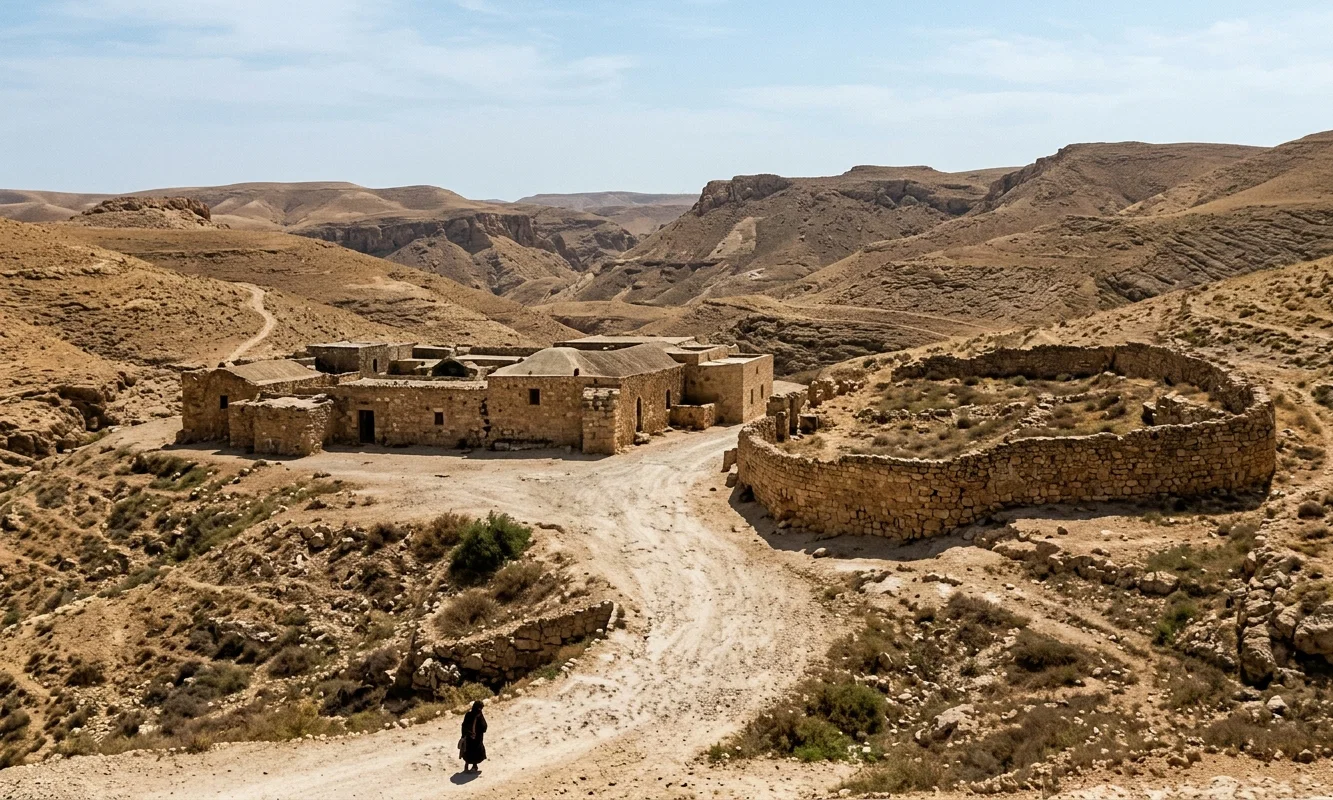
THE INN OF THE GOOD SAMARITAN
Repairing to the Dead Sea, concerning the peculiarities of whose waters we had heard so much, we took a bath, to test these qualities for ourselves. The water is so extremely salt that one can easily float on its surface, and if one gets a bit of it in his eyes, it causes extreme pain. On coming out of the water, one’s skin feels as if it had been oiled. We found many small Jordan fishes that had been cast dead upon the shore.
Again starting on our journey, by sunset we reached the Greek monastery, standing all alone in this uninhabited region. One of the monks who knew English, had been at our mission in Jerusalem, and another had inquired about it. They received us kindly, gave us supper, lodging, and breakfast, and would accept nothing whatever for their hospitality. As there is no other habitation here, this monastery does some good in sheltering the poor wayfarer. As physicians frequently recommend bathing in the salt water of the Dead Sea, it would be a blessing if some small, temporary institution could be erected there, affording shelter and treatment.
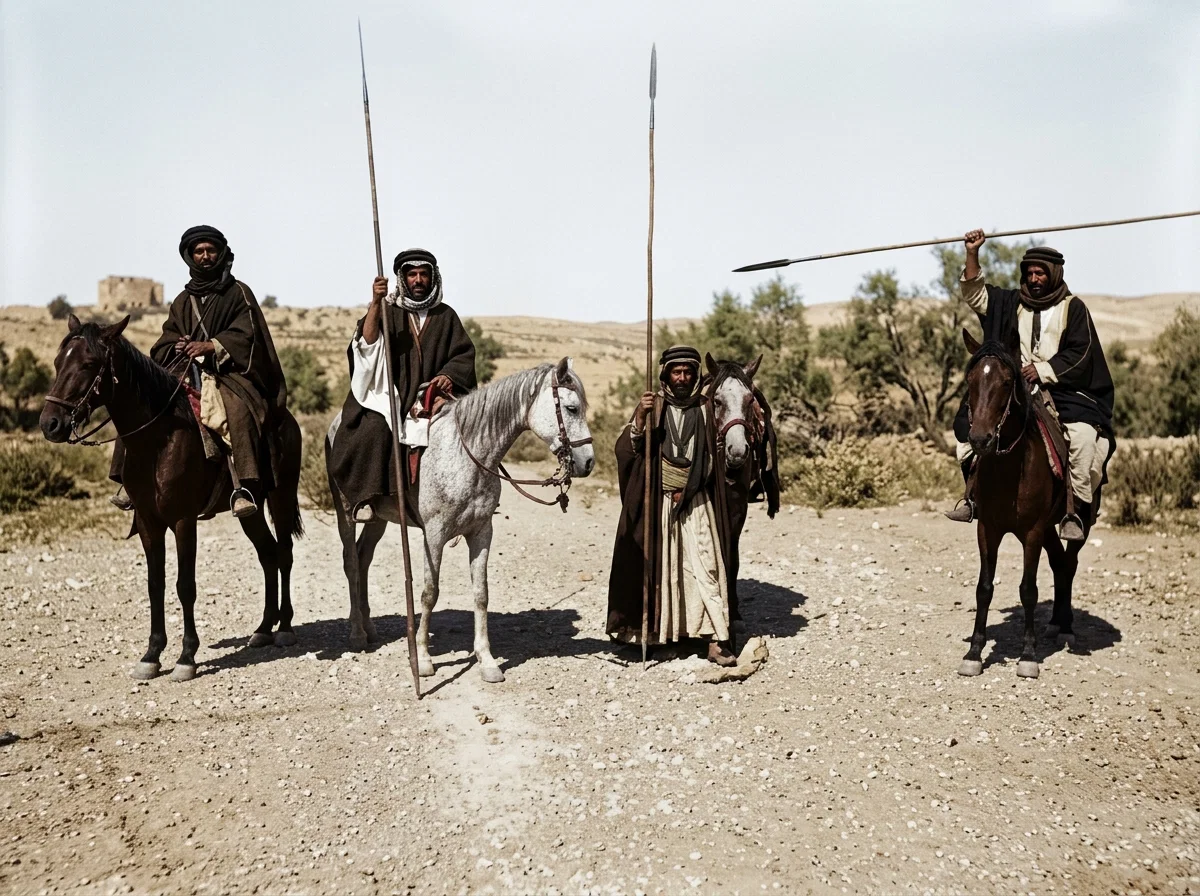
A GROUP OF BEDOUINS
A GROUP OF BEDOUINS
The next morning we walked on to New Jericho, a small Bedouin village. The site of ancient Jericho is said to be about half an hour farther up, near Elijah’s Well,—the clearest and best spring I saw anywhere in the Orient. The Bedouins are to Palestine what the Indians are to North America. I met a number of these people on their fine horses, heavily armed with their long lances. They dwell especially in the country across the Jordan, the mountains of Moab. We could see their camp fires. They are quite independent of the Turkish government; in fact, the Turks have little to say in the land east of the Jordan, where these wild tribes have dwelt from time immemorial. Their dwellings are light, waterproof, portable tents, made of black goats’ hair.
These black tents of Kedar are mentioned in Solomon’s Songs, 1:5.
On the way back to Jerusalem, the horses balked, and four of us walked up the hill to the Inn of the Good Samaritan, thus called because the incidents recorded in our Lord’s parable in answer to the question, “Who is my neighbor?” are thought to have taken place in this region. About midnight our team came up, and we proceeded by moonlight. En route, we saw a large hyena feasting upon the carcass of a camel. As we drew near, it retreated toward the mountain, but after we had passed, it returned to its meal.
By early morning we reached the city, where we were glad to find Brother and Sister Jesperson, and Sister Baumann, who had arrived safely from Basel. Brother Jesperson had come to take charge of the health institute, thus relieving Brother Krum for more active field work. We hope that under the present arrangement, the medical mission in Jerusalem may be the means of accomplishing much good, and bringing to many precious souls a knowledge of the truth for this time.
Continue reading: W. D. BURDEN