Your ShelfYour Projects

Signs of the Times, Vol. 22, No. 35.

A Good Conscience.—

Signs of the Times

Sep 3, 1896

Pacific Press Publishing Company · Oakland, California · Sep 3, 1896

A Good Conscience.—

“Conscience,” says Skeat, “is consciousness of good or bad.” Whewell says: “As science means knowledge, conscience etymologically means self-knowledge; but the English word implies a moral standard of action in the mind, as well as a consciousness of our own actions. . . . Conscience is the reason, employed about questions of right and wrong, and accompanied with the sentiments of approbation and condemnation.” Another authority (The Standard), says that “conscience has been regarded as the simple intuition or the immediate perception of right and wrong. . . . In its ordinary use the word covers everything in man’s nature that has to do with the direction and decision of moral conduct.”

The Scripture Use.—

While the word is used ordinarily with considerable latitude of meaning, the original term is akin to the definitions given above. “The inward faculty of moral judgment” is a definition that corresponds with the use of the word in John 8:9, “Being convicted by their own conscience.” May it not be said that conscience and will combined is that which God in mercy implanted in man after he fell? When man sinned, he yielded wholly to Satan; every power of his being, every member of his body, and faculty of his soul, became a slave of sin. Man was in harmony with sin, afraid of God, and fled from his presence. God in mercy placed within man enmity to sin and Satan (Gen. 3:15), with power to choose whom he would serve (Deut. 30:19). It is this in man which leads him to long for righteousness and holiness; to which God by his Spirit through his word constantly appeals.

Perverted.—

But, like all other good gifts of God, conscience may be perverted and may become evil. We read in the word of God of a “weak conscience” (1 Cor. 8:7, 12), “a good conscience” (1 Tim. 1:5), “a pure conscience” (1 Tim. 3:9), a “seared” conscience (1 Tim. 4:2), a “defiled conscience” (Titus 1:15), “an evil conscience” (Heb. 10:22). It matters, therefore, what kind of conscience we have. In a normal state, every one possesses a good conscience. If he always heeds its voice, it will keep acute, tender, responsive. If it be heeded a part of the time, and a part of the time neglected, it becomes a weak and vacillating conscience. If it be wholly unheeded, if its warnings and admonitions be trampled underfoot, it becomes hardened and seared, so that right or wrong makes but little impression upon it.

A Matter of Education.—

Conscience, therefore, is a matter of education. It is not an independent quantity, one which holds its throne and seat of authority uncorrupted. It is of itself a judge, which may be purchased, bribed, cajoled, corrupted, if the will of the man consent. It is like a clock or pair of balances.
We are guided continually by our clock, or watch, but we would consider it presumptuous and foolish to run year after year without comparing our timepiece with some standard authority. He is not an up-to-date druggist who will not from time to time test and adjust his balances. So conscience, in order to do us good service, must be a good conscience, as tested and educated by the standard.

What Is the Standard?—

Concerning this there should be no question among Christians. Primarily it is the law of the eternal God, as manifest in the teachings and life of Jesus Christ, and developed in the Gospel of his word. This law is perfect, and therefore eternal, unchangeable, infallible. (See Ps. 19:7; 111:7, 8; 119:138, 142; Matt. 5:17–19; Luke 16:17.) It is ever the same thing. It speaks the same thing to all generations of men. It condemns all; “for all have sinned,” transgressed its precepts (Rom. 7:7). It points out the well-known fact that man has corrupted his ways before God. His conscience has become weak and defiled, and in many cases “seared as with a hot iron.” Following the teachings of perverted consciences men have set up all manner of gods, and have worshiped self in every form. They have also devised all manner of evil against their fellows, because the consciences of their fellows were not like their consciences. In this they have recognized the need of an infallible guide, a perfect standard, but have selfishly made the mistake of setting themselves up as the standard, and condemning all those who will not submit. All persecution of the past resulted from eviland corrupted consciences, based on selfish and perverted standards. But conscience can not be compelled from without. It can not be forced by fetter or fagot, by chain-gang or stake. It is a tribunal above all earthly tribunals, but subject to God.

How Obtained.—

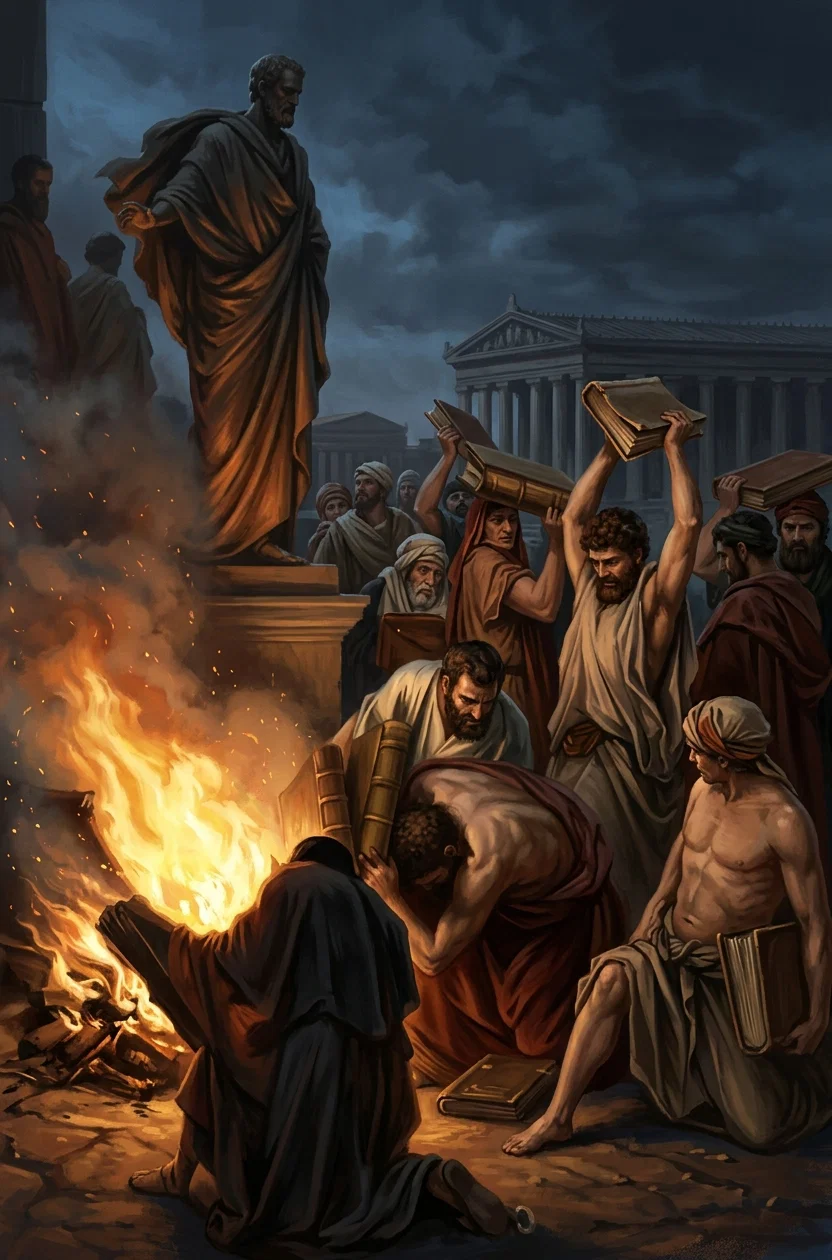
A good conscience may be obtained and kept only in God’s appointed way, and that is through Christ Jesus. So we read: “How much more shall the blood of Christ . . . purge your conscience from dead works to serve the living God?” In this text we have given the means of cleansing and restoring, the evil cleansed away, and the purpose for which the cleansing was done. It is the blood of Christ, his precious life given for us, in himself and in his word, that cleanses the conscience. It cleanses from dead works, that is, the works of sin wrought apart from God and his life. It cleanses the conscience, and gives life, in order that the living God may be served; for it is only by a conscience agreeing with God that he can be served acceptably. The results of such a change of conscience is illustrated in our picture. When Paul went to Ephesus, he found all classes. Many of the Jews and Greeks believed, but others were hardened. Here Paul wrought many miracles. Some of Satan’s agents among the Jews endeavored to discredit Paul’s work by imitating it, but the evil spirit overcame them, and God’s truth was vindicated, unwillingly, by the powers of darkness. Fear of God came upon many. Conscience was aroused. Evil deeds were confessed. Books of divination, in which were written the mummeries of the heathen religion, by which consciences had hitherto been educated, were brought together, piled up, and burned, to the amount of fifty thousand pieces of silver, “so mightily grew the word of God and prevailed.” See Acts 19:8–20. Here was a true change of conscience—a change wrought by the power of the Gospel of Christ’s life through his word. It needed no compulsion, no force of law, to change customs, overthrow the rule of the pagan religion, and prohibit the worship of the false gods. Had all this been attempted, it would not have changed the consciences of the Ephesians. But when the word of God entered, when the Spirit of God quickened the conscience, it was purified from the evil, purged from its works of sin unto death, and made alive unto God. It then became God’s monitor to the soul. He spoke through it, and the idolatry was put away, and the things which held them to sin were burned. Temporal and money value was not counted, eternal riches were at stake, and the sacrifice of the goods of the gods was made. What a blessed holocaust it was!

How Continued.—

How may the good conscience be held? This instruction is conveyed in 1 Tim. 1:19, “Holding faith, and a good conscience.” By holding faith, we hold the good conscience. As the purging of the conscience from dead works, the “heart sprinkled from an evil conscience,” came through faith, even so the maintaining of the good conscience comes through faith. “As ye have therefore received Christ Jesus the Lord, so walk ye in him; rooted and built up in him, and established in the faith, as ye have been taught.” Col. 2:6, 7. But faith comes by the word of God. (Rom. 10:17). The study, the reception, the application of the word of God to the heart and life of the individual, is the only means whereby a good conscience may be maintained. This is what Paul taught the Ephesians, who burned their heathen books when they accepted of Christianity. In his parting words to the elders he utters these words, which Christians ought to remember forever: “And now, brethren, I commend you to God, and to the word of his grace, which is able to build you up, and to give you an inheritance among all them which are sanctified.” Acts 20:32. God’s word alone received, eaten, digested, appropriated, assimilated, is all that will preserve a good conscience.

The Voice of God.—

Conscience has not inappropriately been called the voice of God in the soul; but it is so only when it speaks God’s word, tells God’s truth, brings God’s message. Once God’s voice was heard from heaven declaring his will. He wrote that voice with his own finger upon tables of the enduring rock. That law, expressed in the ten precepts, is the one Voice of God by which all other pretended voices of God are to be compared. It is the one Government Standard by which all other standards are to be gauged. It is only when our conscience speaks in harmony with this Standard that we are to recognize its authority. “To the law and to the testimony; if they speak not according to this word, it is because there is no light in them.” Isa. 8:20. Do not trust to conscience, unless back of it is a wholly obedient heart. “Unto the pure all things are pure; but unto them that are defiled and unbelieving is nothing pure; but even their mind and conscience is defiled. They profess that they know God; but in works they deny him, being abominable, and disobedient, and unto every good work reprobate.” Titus 1:15, 16. There are many voices calling; there are many deceptions of the enemy; and every heart which is not attuned to the heavenly music of God’s sacred law—his Voice to man—will be deceived. His word is true. Your conscience is true if it is in harmony with that word. Let that word decide the matter, whatever the feeling or the education. Let that word mold your conscience, not your conscience endeavor to mold the word, and thus shape your conduct to certain ruin. The law “is good;” let the conscience be made good by being brought through God’s means into harmony with its sacred precepts.

For Thyself.—

While we should be careful not to offend the conscience of the weak (and we know not who may be weak), we should remember that we are not to regulate others’ consciences. By no overt act of ours, knowingly, should we place a stumbling-block in the way of our brother. But we should never demand that he should live according to our conscience. By attempting this, rivers of blood have been shed, some of it flowing from the heart of the Son of God. Paul was conscientious when he persecuted Christians; but his conscience was evil. Jesus said that those who killed his followers would think that in that they were doing God service (John 16:2); but it is because they know not God or Christ. Let conscience be to you what God designed it to be. Keep it there by faithful study of, and submission to, his word. Keep it open to receive instruction by frequent prayer. Keep it tender by quick response to the calls of duty. So and only so shall conscience be to you a safe prompter and monitor of God, pointing you ever to God’s word.

THE LAW OF CHRIST.

The fourteenth chapter of Romans presents to us our duty towards those who are weak in the faith, and who have excessively conscientious scruples with regard to things that are in themselves of no consequence. We are not judges of one another, but must all appear before one judgment seat. If we have more knowledge than our brother, we are not arbitrarily to bring him to our standard, any more than he is to bring us down to his. Our greater knowledge rather throws upon us the responsibility of exercising the greater charity and patience. The sum of it all is contained in these verses: “For meat destroy not the work of God. All things indeed are pure; but it is evil for that man who eateth with offense. It is good neither to eat flesh, nor to drink wine, nor anything whereby thy brother stumbleth, or is offended, or is made weak. Hast thou faith? have it to thyself before God.”
From this we can see how naturally the next chapter continues with the

Duty of Helping One Another.

“We then that are strong ought to bear the infirmities of the weak, and not to please ourselves. Let every one of us please his neighbor for his good to edification. For even Christ pleased not himself; but, as it is written, The reproaches of them that reproached thee fell on me. For whatsoever things were written aforetime were written for our learning, that we through patience and comfort of the Scriptures might have hope. Now the God of patience and consolation grant you to be likeminded one toward another according to Christ Jesus; that ye may with one mind and one mouth glorify God, even the Father of our Lord Jesus Christ. Wherefore receive ye one another, as Christ also received us, to the glory of God.” Rom. 15:1–7.

Questions on the Text.

What ought the strong to do?
“To bear the infirmities of the weak.”
What ought such not to do?
“Not to please ourselves.”
What are we exhorted to do for our neighbor?
“Let every one of us please his neighbor.”
In what way are we to please our neighbor?
“For his good to edification.”
Who has set us an example in this respect?
“For even Christ pleased not himself.”
What scripture is cited to show this?
“The reproaches of them that reproached thee fell on me.” See Ps. 69:9.
For what purpose were the Scriptures of the Old Testament written?
“Whatsoever things were written aforetime were written for our learning.”
With what special object?
“That we through patience and comfort of the Scriptures might have hope.”
In view of the example of Christ, what exhortation is given?
“Now the God of patience and consolation grant you to be likeminded one toward another according to Christ Jesus.”
For what purpose?
“That ye may with one mind and one mouth glorify God.”
In concluding this portion of the subject, what exhortation is repeated?
“Wherefore receive ye one another.” See chapter 14:1.
How are we to receive one another?
“As Christ also received us.”
To what end?
“To the glory of God.”
THE verses composing this lesson supplement the instruction given in chapter fourteen, and are a continuation of that. Thus, that chapter opens with the exhortation, “Him that is weak in the faith receive ye.” The last verse of our present study is, “Wherefore receive ye one another,” etc.
How are we to receive one another? The answer is, “As Christ also received us.” This again emphasizes the statement that the apostle had not the slightest intention of in any way depreciating any one of the Ten Commandments when in the fourteenth chapter he said: “One man esteemeth one day above another; another esteemeth every day alike. Let every man be fully persuaded in his own mind.” For Christ did not in the slightest degree make any concessions in the commandments, in order to accommodate those whom he would receive. He said, “Think not that I came to destroy the law, or the prophets.” Matt. 5:17. Again, “If ye keep my commandments, ye shall abide in my love; even as I have kept my Father’s commandments, and abide in his love.” John 15:10. Christ’s commandments and those of the Father are the same, because he says, “I and my Father are one.” John 10:30. When a young man wished to follow him, he said to him, “Keep the commandments,” specifying the Ten Commandments. Matt. 19:17. Therefore it is evident that in making concessions for the sake of peace and harmony, no concession is to be made in respect to keeping the commandments of God.
THIS is still further shown by the exhortation, “Let every one of us please his neighbor for his good to edification.” We are never exhorted to aid a brother to sin, in order to please him. Neither are we exhorted to close our eyes to a brother’s sin, and allow him to go on in it without warning him, lest we displease him. There is no kindness in that. The exhortation is, “Thou shalt not hate thy brother in thine heart; thou shalt in anywise rebuke thy neighbor, and not suffer sin upon him.” Lev. 19:17. The mother who would be so fearful of displeasing her child that she would not stop it from putting its hand into the blaze, would be exhibiting cruelty instead of kindness. We are to please our neighbors, but only for their good, not to lead them astray.
GOING back to the first verse, we find this lesson still more strongly emphasized: “We then that are strong ought to bear the infirmities of the weak, and not to please ourselves.” “For even Christ pleased not himself.” Compare this with Gal. 6:1, 2: “Brethren, if a man be overtaken in a fault, ye which are spiritual, restore such an one in the spirit of meekness; considering thyself, lest thou also be tempted. Bear ye one another’s burdens, and so fulfil the law of Christ.” In bearing the infirmities of the weak, we are fulfilling the law of Christ. But to bear another’s burdens does not mean to teach him that he can safely ignore any of the commandments. To keep the commandments of God is not a burden; for “his commandments are not grievous.” 1 John 5:3.
CHRIST bears our burdens, not by taking away the law of God, but by taking away our sins, and enabling us to keep the law. “For what the law could not do, in that it was weak through the flesh, God sending his own Son in the likeness of sinful flesh, and for sin, condemned sin in the flesh; that the righteousness of the law might be fulfilled in us.” Rom. 8:3, 4.
ONE blessed thing in the service of the Lord is that he does not say, “Go,” but, “Come.” He does not send us away to labor by ourselves, but calls us to follow him. He does not ask anything of us that he does not himself do. When he says that we ought to bear the infirmities of them that are weak, we should take it as an encouragement, instead of a task laid upon us, since it reminds us of what he does for us. He is the mighty One, for we read, “I have laid help upon One that is mighty; I have exalted One chosen out of the people.” Ps. 89:19. “Surely he hath borne our griefs, and carried our sorrows.” “All we like sheep have gone astray; we have turned every one to his own way; and the Lord hath laid on him the iniquity of us all.” Isa. 53:4, 6.
THIS is what makes it easy to bear one another’s burdens. If we know that Christ bears our burdens, it will become a pleasure for us to bear the burdens of others. The trouble is that too often we forget that Christ is the Burden-bearer, and, being overpowered with the weight of our own infirmities, we have still less patience with those of others. But when we know that Christ is indeed the Burden-bearer, we cast our own care upon him; and then when we make the burden of another our own, he bears that too.
GOD is “the God of patience and consolation.” He is “the Father of mercies, and the God of all comfort; who comforteth us in all our tribulation, that we may be able to comfort them which are in any trouble, by the comfort wherewith we ourselves are comforted of God.” 2 Cor. 1:3, 4. He takes upon himself all the reproaches that fall upon men. “The reproaches of them that reproached thee fell on me.” Of the children of Israel it is said, “In all their affliction he was afflicted.” Isa. 63:9. The words of Christ are, “Thou hast known my reproach, and my shame, and my dishonor.” “Reproach hath broken my heart.” Ps. 69:19, 20. Yet in all this there was no impatience, no murmuring. Therefore, as he has already borne the burdens of the world in the flesh, he is fully able to bear ours in our flesh, without complaining; so that we may be “strengthened with all might, according to his glorious power, unto all patience and long-suffering with joyfulness.” Col. 1:11.
IT is this lesson that is taught us throughout all the Scriptures: “For whatsoever things were written aforetime were written for our learning, that we through patience and comfort of the Scriptures might have hope.” In the book of Job this is made manifest. “Ye have heard of the patience of Job, and have seen the end of the Lord; that the Lord is very pitiful, and of tender mercy.” James 5:11. In the writings of Moses it is as clearly set forth. Christ says: “Had ye believed Moses, ye would have believed me; for he wrote of me. But if ye believe not his writings, how shall ye believe my words?” John 5:46, 47. If the Gospel according to Moses be neglected, it will be of no use to read the Gospel according to John, because the Gospel can not be divided. The Gospel of Christ, like himself, is one.
FINALLY, “Receive ye one another, as Christ also received us, to the glory of God.” Whom does Christ receive?—“This man receiveth sinners.” How many will he receive?—“Come unto me, all ye that labor and are heavy laden, and I will give you rest.” How will he receive them?—“All day long have I stretched forth my hands unto a disobedient and gainsaying people.” And if they come, what assurance have they?—“Him that cometh to me I will in nowise cast out.” Let us learn of him; and remember that, wherever you may open the Scriptures, they are they which testify of him. E. J. W.

Sorrow Without Reform Is Fruitless

SORROW for having done amiss is fruitless if it issue not in doing so no more.—Bishop Horne.

The Unseen Fountain

LET all seen enjoyments lead to the unseen Fountain from whence they flow.—Haliburton.

CHURCH AND STATE IN ISRAEL.

THE only legitimate church and state national government ever established on the earth was that set up by the Lord himself when Israel was delivered from Egyptian bondage. In this the laws were dictated, not by any human monarch or Legislature, but by the Lord as absolute ruler. But even such a prestige as this does not show a people free from corruption, or prone to serve God. Even under the wise rulership of their all-wise King, the people went into idolatry, and finally became so corrupt that they repudiated the government which he had set over them.
“And the children of Israel dwelt among the Canaanites, Hittites, and Amorites, and Perizzites, and Hivites, and Jebusites; and they took their daughters to be their wives, and gave their daughters to their sons, and served their gods. And the children of Israel did evil in the sight of the Lord, and forgot the Lord their God, and served Baalim and the groves.” Judges 3:5-7.
When they at last rejected Samuel, whom God had appointed as judge over them, and clamored for a human king, it was that they might be like the other nations around them. Even hundreds of years under laws given direct from heaven had not inured them to a voluntary service of the Almighty God.
“And the Lord said unto Samuel, Hearken unto the voice of the people in all that they say unto thee; for they have not rejected thee, but they have rejected me, that I should not reign over them.” 1 Sam. 8:7.
The working of this theocracy was as near perfect as it is possible for such a government to be among sinful men; for God was the dictator. But then, as now, “the law was weak through the flesh.” Yet even in this theocracy there was the principle of non-interference between the church and the state. The Lord chose and set apart the tribe of Levi for the service of the sanctuary. Nor did the government support the church; for the Levites and the sanctuary service were supported by the tithes and voluntary offerings of the people. Of the seventeen political rulers from Moses to Samuel, the last of the judges, only three—Moses, Eli, and Samuel—were of the tribe of Levi.
After the rejection of the administration of the Lord through the judges, the separation of the church and state was still more complete, and this through the Lord’s direction. Saul, the first king, was of the tribe of Benjamin. At one time he essayed to officiate in the role of priest, and with disastrous result. The Philistines had come up against Israel, and Samuel had appointed to meet Saul and the army at Gilgal and sacrifice unto God before going to battle. Saul had at that time but a small army, and the men composing it were much afraid of the larger number of the enemy. While Saul tarried seven days for Samuel, his men were deserting him on all sides. Much disheartened, Saul became very impatient; Samuel was late in coming, and the soldiers continued to desert.
“And Saul said, Bring hither a burnt offering to me, and peace offerings. And he offered the burnt offering. And it came to pass, that as soon as he had made an end of offering the burnt offering, behold, Samuel came; and Saul went out to meet him, that he might salute him.” 1 Sam. 13:9, 10.
“And Samuel said to Saul, Thou hast done foolishly; thou hast not kept the commandment of the Lord thy God, which he commanded thee; for now would the Lord have established thy kingdom upon Israel forever. But now thy kingdom shall not continue; the Lord hath sought him a man after his own heart, and the Lord hath commanded him to be captain over his people, because thou hast not kept that which the Lord commanded thee.” Verses 13, 14.
Thus Saul lost the kingdom, and the succession was lost to his family, because he presumed in his political capacity to exercise religious functions for which the Lord had otherwise provided. Even tho Saul had been endowed with the gift of prophecy, and had been given a new heart, at the time of his anointing (chapter 10:1-13), he might not interfere with the Lord’s order concerning the conduct of his worship. Thus did the Lord most emphatically, in the affairs of men, put difference between civil and religious matters.
After Saul came David, and the scepter was transferred to Judah. From thenceforth, while no one outside of Levi might officiate at the altar, none could sit upon the throne who was not of the tribe of Judah. Even the Lord Jesus himself could not be a priest on earth, because he was not of the tribe of Levi (Heb. 8:4; 7:13, 14); and the prophecy of Jacob was, “The scepter shall not depart from Judah, nor a lawgiver from between his feet, until Shiloh come” (Gen. 49:10).
But we have another striking instance of God’s displeasure with an attempt on the part of a chief magistrate to dictate in religious matters. Uzziah came to the throne of Judah when he was sixteen years old. He had a long reign, fifty-two years. He began in the right way, “he did that which was right in the sight of the Lord.” He did great things for Judah and Jerusalem (see 2 Chronicles 26), “and his name spread far abroad; for he was marvelously helped, till he was strong.”
“But when he was strong, his heart was lifted up to his destruction; for he transgressed against the Lord his God, and went into the temple of the Lord to burn incense upon the altar of incense. And Azariah the priest went in after him, and with him fourscore priests of the Lord, that were valiant men; and they withstood Uzziah the king, and said unto him, It appertaineth not unto thee, Uzziah, to burn incense unto the Lord, but to the priests the sons of Aaron, that are consecrated to burn incense; go out of the sanctuary; for thou hast trespassed; neither shall it be for thine honor from the Lord God. Then Uzziah was wroth, and had a censer in his hand to burn incense; and while he was wroth with the priests, the leprosy even rose up in his forehead before the priests in the house of the Lord, from beside the incense altar. And Azariah the chief priest, and all the priests, looked upon him, and, behold, he was leprous in his forehead, and they thrust him out from thence; yea, himself hasted also to go out, because the Lord had smitten him. And Uzziah the king was a leper unto the day of his death, and dwelt in a several house, being a leper; for he was cut off from the house of the Lord; and Jotham his son was over the king’s house, judging the people of the land.” 2 Chron. 26:16-21.
The relations of civil government and religion are not only plainly enunciated in the word of God, but they have been emphatically illustrated in his dealings with his own peculiar people as a nation. He gave a set of laws for the civil government of the people (Exodus 21 to 23), and another set for the regulation of their worship (chapter 29 to 31 and 40). Various rules and regulations, both civil and religious, are also given in the book of Leviticus, but the nature of these laws, and the positions of those who are to execute them, are very plainly designated. Civil government is but a temporary arrangement made necessary by the entrance of sin into the world. It is a government of force for the control of the race, which refused to be governed by the love of God, during the probationary time when the Gospel of love and the eventual kingdom of love are being proclaimed to sinners. God has demonstrated by ancient Israel that civil government, even when administered by himself, is impotent for turning the hearts of men to him. For even under that system they sunk to the lowest depths of idolatry, and rejected his rule. Religion, true Gospel religion, is designed to bring men back to God. Civil government is ordained to control men, to regulate their relations toward each other in this life only; and the Most High “giveth it to whomsoever he will, and setteth up over it the basest of men.” Dan. 4:17. He also directs in the gathering of a people for his name, sending out for this purpose his own ambassadors, imbued with his Holy Spirit, to persuade men to be reconciled to God. The two systems must needs go side by side in the world, but their purposes are essentially different, and their lines of operation must of necessity be entirely separate. Any commingling must produce a discordant clashing detrimental to both. W. N. G.

The Curfew of Oakland.

The city of Oakland has a bell commonly called the curfew bell. It rings every evening at nine o’clock, at which time children under certain age unaccompanied by those older are not expected to be found upon the streets. This bell is particularly correct, inasmuch as it is regulated with scientific accuracy by Chabot Astronomical Observatory, in the city. The curfew becomes, therefore, a standard by which the people of the city regulate their timepieces. We do not remember ever to have been among a group of men when the bell rang without seeing those who heard the bell and had watches take out the watches and compare them with the standard. So man should do with his conscience, when the standard of God’s word speaks. We have heard men whose watch was wrong or doubtful, say, “Wait till the curfew to-night, and then I will correct it.” So conscience should wait on God’s word. When that speaks, listen. Do not regulate by some other man’s conscience, by some creed or church, or by the exigencies of trade, or the big end of a bargain, but always by God’s word. Keep that word in the heart; let the life be so in harmony with it that conscience shall ever echo its sublime moral standard, manifest in the life of Jesus Christ.
Continue reading: Answers to Questions