“All things are possible to him that believeth.” Mark 9: 23.
O the power, efficacy, and victories of living faith, that it is our privilege to enjoy! By living faith we may unite to our weakness the power of Him who made heaven and earth, who breaks the power of sin and Satan upon the soul, sets the captives free, and makes the weakest of mortals like David to meet the giants that would impede their progress on their way to the heavenly country.
Living faith opens to its possessor the treasures of divine knowledge and heavenly wisdom, sets before him a table of fat things upon which he truly feasts, and enables him to impart knowledge and wisdom to others, with humble and devout gratitude to Him from whom all blessings flow.
By living faith, heaven, its riches, glories, and happiness, are made near, and are enjoyed by sweet anticipation. By this faith the life, death, resurrection, ascension, mediation, and second coming of Jesus are made living realities; and by it even the doctrine of the incarnation of the Son of God in behalf of a fallen race, is made, in a special sense, reflective of divine wisdom, power, love, and condescension, and a means of drawing the soul to Jesus.
By this faith the scenes of the infancy, childhood, and manhood of Jesus, as predicted by holy prophets, and as related in the New Testament Scriptures, are, as it were, made to pass in panoramic view before us; and by it we receive Jesus as the promised Messiah, as the Saviour of the world, yearning after him with love that words can not express, and that God alone can implant in the soul.
By this faith we see Jesus living among men as our Exemplar, and passing over a road rougher and more thorny than that which mortals tread; and by it we see him dispensing to the people the words of eternal life, and bearing their sorrows, their infirmities, and their diseases, and say in our hearts, This same spiritual food is for us, and we would have this same Jesus bear our sorrows, our infirmities, and our diseases; and we know that he is willing to do this for us; for his great heart of pity and love is ever the same; it changeth not.
One thing which we observe in Jesus as we consider the events of his life, and which bears with it a mighty evidence of his Messiahship, causing faith in him to spring up in our hearts, and leading us to embrace him by faith as our Saviour, is the power to raise the dead. As we by faith see the dead spring to life and activity at his command, we recognize in him the divine “Word,” by whom “all things were made” (John 1: 3, etc.), and, by faith, cherish the hope that he will raise the righteous dead, and, for them, and for all the saints, “make all things new” and glorious in the fast-approaching day of God.
By faith we see Jesus, after his temptations and sufferings in man’s behalf in the wilderness and during his ministry, drink his final cup of suffering in the Garden of Gethsemane, and on his way from that garden to Golgotha, and, last of all, at Golgotha. We first follow him in Gethsemane, and hear the agonizing cries that he there pours forth to his Father as he lies prostrate, sweating great drops of blood under the heavy weight of our sins; and we say in our hearts, Jesus, we know that thou lovest us, and we embrace thee.
By faith we follow him from the garden to Calvary; we see him smitten, clad with the old purple robe, crowned with the crown of thorns, and made the subject of ridicule and cruel mockings; we see him forsaken even by his disciples, and fainting and falling while bearing his iron cross, and we involuntarily ask, Is it not enough? have we not sufficient proof of divine love? and has not divine justice been sufficiently honored and vindicated? only to be met with the sad but touching response, The cup must be drunk to its dregs; the divine, innocent Victim must be slain.
By faith we see Jesus, all worn and emaciated, cruelly nailed to the cross; we then see him lifted up by wicked and rough hands, and see him bleeding, suffering, and dying for us between two malefactors, while those who have thirsted for his blood mock and rejoice; and we think of his own prophetic words to Nicodemus, “And as Moses lifted up the serpent in the wilderness, even so must the Son of man be lifted up; that whosoever believeth in him should not perish, but have eternal life” (John 3: 14, 15); and the faith we already have is strengthened; and so as we read the repeated predictions of Jesus to his disciples and to others concerning his own death, especially the solemn one he made as he instituted the Lord’s supper (Matt. 16: 21–27; 26: 17–29, etc.); and the same effect is produced as we read the numerous prophecies of ancient seers concerning this event, and see that they even foretell such minute circumstances connected with the crucifixion as the following:—
The betrayal of Jesus (Ps. 41: 9, etc.); the piercing of his hands and feet (Ps. 22: 16); his enemies laughing him to scorn, shaking their heads, and saying, “He trusted on the Lord that He would deliver him; let Him deliver him, seeing he delighteth in him” (Ps. 22: 7, 8); their giving him gall and vinegar (Ps. 69: 21); their parting his garments, and casting lots upon his vesture, or coat (Ps. 22: 18); not one of his bones being broken (Ps. 34: 20; Ex. 12: 46; Num. 9: 12)—all of which, and much more that might be noticed, has met an exact fulfilment in the events connected with the death of our Saviour. See the accounts of the betrayal and last scenes of Christ’s life in the closing portions of the Gospels of Matthew, Mark, Luke, and John.
We watch the motions of Jesus as he hangs upon the cross, and wait to catch every word that falls from his lips. We see him the same meek and lowly Jesus that he was when he said, “Learn of me; for I am meek and lowly in heart; and ye shall find rest unto your souls.” Matt. 11: 29. Not a murmur escapes from his lips. He is as forgetful of self and as interested for others as he was during his ministry. He provides a home for his dear mother with the meek and beloved apostle who used to lean on his breast (John 19: 26, 27); prays for his murderers, asking his Father to forgive them, because they know not what they do (Luke 23: 34); gives the penitent, believing thief ground to hope that he shall be saved (Luke 23: 42, 43); cries to his Father, as he tastes death for every man, and feels himself forsaken of God, as the wicked shall be at last, “My God, my God, why hast thou forsaken me?” (Matt. 27: 46); and, finally, closes his life by manifesting his divine power through a voice that shakes the earth, rends rocks which have for ages defied the changes and convulsions of nature, and rends the veil of the temple from the top to the bottom. The enemies of Jesus are struck with terror, and honest souls, including the centurion who had the charge of the Roman soldiers on the occasion, exclaim, “Truly this was the Son of God” (Matt. 27: 50–54), etc.
And how can we, with this array of evidence—as Jesus is thus set forth as crucified before our eyes—refrain from concurring with these honest witnesses in the decision that Jesus is the Son of God? And still the evidence accumulates, inviting and increasing faith. For as the plan of salvation as revealed in Holy Writ is the ground of faith, so faith springs in the heart as that plan is considered in the light of those events upon which it is based and through which God speaks to fallen man, that he may truly believe and be saved. And as evidence increases and the plan of salvation is taken in more and more fully, faith increases.
(To be continued.)
A VEGETABLE MISSION.
By Nellie C. Andrews
BY NELLIE C. ANDREWS.
“I wonder what plan you girls will get hold of next?” exclaimed Will Marvin, as his sister finished telling their mother of a proposed flower mission. “That society makes me tired; you do nothing but talk just like a full-grown sewing circle.”
Before Ethel could make the angry reply trembling on her lips, their mother had restored peace by a few wise words.
“Well, maybe they do a little good,” admitted Will, who was in a teasing mood. “At any rate, it keeps the girls out of mischief.”
“If anybody needs to be kept out of mischief, I think it is you, Will Marvin,” began Ethel hotly.
At this point Mrs. Marvin hastened to turn the conversation into a somewhat different channel, by remarking, “If you would like them, Ethel, you may have some slips from my geraniums, so you may have some rooted plants as well as flowers to give away.”
“O, thank you, mother! I had not thought of that. I intend to raise pansies, verbenas, sweet peas, and ever so many flowers. Every one of the girls is going to have a flower garden.”
“And then my Lady Bountiful will go sailing down into Slumdom, and present the fragrant blossoms to the poor dear little Slumdomites, and say: ‘See here, my dear, what I’ve brought you. Go put them in a vase,’” mimicked Will.
From the expression on his mother’s face he concluded he had gone far enough with his teasing, for, altho nearly sixteen years old, he delighted to hector his sister. So he hastily asked, “Who is going to do all the work in your garden, Ethel?”
“I am,” replied Ethel stoutly.
“Now if it was something practical, I’d donate my services. Say,” a sudden thought striking him, “if you’ll raise vegetables, I will help you.”
“And I,” said their father, who had entered the room unnoticed, “will give you that part of the garden between the strawberry bed and the fence.”
“Thank you, father, I never dreamed of asking for so much land.”
“As Will is going to help you,” continued Mr. Marvin dryly, “I think you can manage to keep it in order.”
“We can raise ever so many flowers. Mother, will you help me make out a list?”
“See here,” interrupted Will eagerly, glad of a pretext to escape from the distasteful garden work it seemed that his teasing propensities had brought upon him, “no flowers, mind. You must raise vegetables, or I won’t help you.”
“O, let me have just a few flowers, Will!” pleaded Ethel.
“No, not one,” continued Will firmly—for, counting on his sister’s great love for flowers, he thought he saw a way of escape for himself from garden work.
Ethel hesitated. Ought she to give up her cherished plan? How could she? It was such an unheard-of thing to raise vegetables, when all the other girls were going to have such beautiful flower gardens. But then it would keep Will more at home. And this she knew was something that troubled both her father and mother of late.
This consideration had also presented itself to her mother, who now remarked: “Ethel, I think the plan a good one. I have no doubt your fresh vegetables will prove as acceptable gifts as a basket of roses.”
Impetuous Will, who prided himself on never going back on his word, was anxiously awaiting her decision.
At last it came: “We will raise vegetables.”
“And start a fresh-vegetable mission,” suggested Mrs. Marvin.
Heretofore Will’s gardening had been limited to walking about the grounds when the fruit began to ripen, the garden being looked after by Thomas, the man of all work, and Will groaned as he thought of all the work he had brought upon himself.
Mr. Marvin gave them the money for the seed, and suggested that they send for some catalogs. These proved very attractive, and many pleasant hours were spent in looking them over and in discussing the merits of the various vegetables. Their mother aided them in making their selection. The seeds were ordered, and came before the frost was out of the ground.
At last came the time for garden making. Will repented of his hasty offer more than once during the seed sowing, but, as Ethel said nothing about raising flowers, he kept his promise to help her. The weeds soon put in an appearance, and it took much of their spare time to keep their plot clean.
As the vegetables began to grow, both began to be enthusiastic, and Will looked as eagerly as Ethel for the day when the radishes and lettuce should be fit for use. Besides these two vegetables, their garden contained string beans, tomatoes, and early beets.
They had no trouble in finding to whom their offerings would be acceptable. They bought several small baskets in which to put their vegetables. These baskets, with their crisp radishes, fresh lettuce, golden beans, and, later, firm, smooth tomatoes, were highly appreciated by the poor who received them.
Poor little Jimmy Waite, a cripple, whose widowed mother was always given a basket, was overjoyed to find, one day, a dish of strawberries among the other good things. This was the gift of Mrs. Marvin. That lady, on learning of his pleasure, resolved that, as long as the berries lasted, Jimmy should have a dish. This, she said, was her contribution to the vegetable mission.10
The summer passed quickly, and Ethel felt repaid for her sacrifice. The work had been of great benefit to Will in more than one way, and both he and Ethel began to make plans for the coming year; for the vegetable mission, or, rather, the “V. M. Garden,” as Will called it, had come to stay.
An unexpected closing of the school Will attended gave him an opportunity to pass a short time at an uncle’s in the country. Just before his return, Ethel received a letter from him, in which he said:—
“I have told the folks here about your V. M. Garden. They thought it a pretty good joke on me. Harry said he wished he and Fred could do something of the kind. He thought we had more poor people in the city than they had in the country. Uncle John suggested that they gather some nuts, and he said he would pay the freight. So we got up a nutting party, and I guess your eyes will shine when you see all the hickory nuts and butternuts. They are for you to distribute this winter. Uncle John is going to send a barrel of apples also. I was real mean about those flowers last spring, Ethel. Next summer you can have all you want. I told Aunt Mary about it. She said we might buy a few hyacinth bulbs, and, after starting them, give them away. I mean to buy them for you when I get home, to make up for my meanness last spring.”—S. S. Times.
Frugality and Liberality
“FRUGALITY is good if liberality be joined to it.”
A Thankful Heart to God
By R. Lucas
A THANKFUL heart to God for his blessings is the greatest blessing of all.—R. Lucas.
NOBODY KNOWS BUT MOTHER.
By Anonymous
Nobody knows of the work it makes
To keep the home together;
Nobody knows of the steps it takes,
Nobody knows but mother.
Nobody listens to childish woes
Which kisses only smother;
Nobody's pained by naughty blows,
Nobody—only mother.
Nobody knows of the sleepless care
Bestowed on baby brother;
Nobody knows of the tender prayer,
Nobody—only mother.
Nobody knows of the lessons taught
Of loving one another;
Nobody knows of the patience long,
Nobody knows but mother.
Nobody knows of the anxious fears
Lest darlings may not weather
The storms of life in after years,
Nobody knows—but mother.
Nobody kneels at the throne above
To thank the heavenly Father
For that sweetest gift, a mother's love;
Nobody can—but mother.
—Anonymous.
A DOLL THAT SERVED THE GOVERNMENT.
Some Apache Indians had left the reserve, and some of our generals had had a great deal of trouble in trying to get them back. One day a little papoose—that is, a little Indian girl—three years old, strayed away from her father's wigwam. One of the soldiers found her, and took her to the fort. All day she was very quiet; but when night came, she sobbed and cried, just as any little white child would, for her mother and her home.
The soldiers did not know what to do with her; they could not quiet her. At last the commander in charge remembered that a beautiful doll had been sent from the east to the daughter of one of the officers. He went to this officer's house, and asked to borrow the doll for the little Indian girl at the fort. The doll was beautiful herself and was beautifully dressed. The little girl loaned it to the officer, and it was carried to the fort to the little Indian baby. It was placed in her arms, and she was made to understand that she could take it to bed with her. Immediately she stopped crying, and fell asleep with the beautiful doll closely held in her arms.
When morning came, she was radiantly happy the moment she opened her eyes and saw her beautiful little companion. She petted it, she rocked it, she talked to it, just as any little white child would. But now there came a new difficulty. The soldiers hoped, if they kept the little girl, that her parents would come or send for her, and they could enter into some negotiations with them to get them back on the reserve. But the father and mother of the little girl did not appear. It was a very serious thing for a lot of soldiers to have charge of a little three-and-a-half-year-old girl, and they were very greatly puzzled. Several days passed; and at last the soldiers decided that the little papoose must be taken back to her family, as they would not come for her. With her doll in her arms, she started with her protectors for the wigwam. When she reached the tribe with her doll, she created the greatest excitement.
The soldiers left the child with her mother, and returned to the fort. The next day the little papoose's mother appeared at the fort with the doll, to return it. She was received with the greatest courtesy by the soldiers, treated with great consideration, and made to understand that her little daughter was to keep the doll. The result was that the soldiers' kindness to the little girl, and their courtesy to her mother, created a revulsion of feeling among the wandering Indians, and led to negotiations which resulted in the Indians going back to the reserve—that is, the land set apart for them by the United States Government—without any trouble.—Outlook.
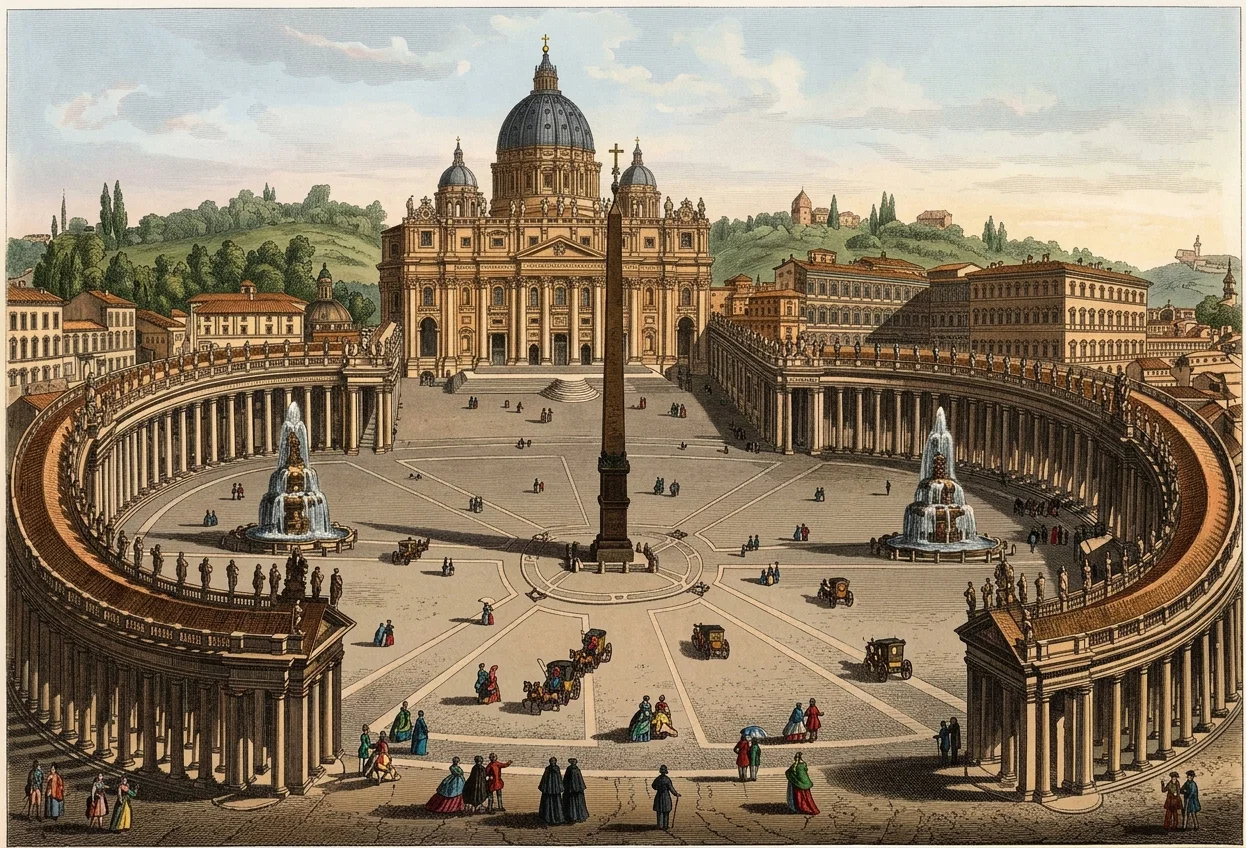
THE BASILICA OF ST. PETER'S, ROME.
The largest and most famous cathedral in Christendom is that of St. Peter's at Rome. For nearly three hundred years the completed building has been an objective point of thousands of visitors, and has been one of the means of making modern Rome celebrated.
In the year 306 Constantine founded in Rome a basilica over the reputed grave of St. Peter. This building was itself large and magnificent, but had fallen into decay when Pope Nicholas V., in 1450, resolved to erect a new and grand cathedral. He employed the architect Rosselini, who prepared extensive plans, but soon after the pope died, and the project was neglected for about a half century, when Pope Julius II. undertook the work. The services of another celebrated architect, by name Bramante, were secured, and a new design was executed, which is still in existence. The foundation was laid in 1506, and the work was actively pushed until the death of the pope, in 1513. Bramante, too, died the next year, and his work was put into the hands of Baldusarre Peruzzi.
The work of construction went on slowly, with many hindrances and changes in plans; for nearly every architect employed changed the plans to suit his own ideas. The plan of San Gallo, who followed Peruzzi, is still preserved. When San Gallo died, in 1546, the work fell to the great Michael Angelo, then seventy-two years of age. Under his administration rapid progress was made. The great dome was of his designing, and when he died, in his ninetieth year, he saw that part of the building nearing completion. The plans left by him were followed, and the dome finished mainly in accordance with them, in 1590, Sixtus V. being pope.
The plan of the building by Michael Angelo was that of a Greek cross, but this was altered to a Latin cross by the architect Carlo Maderno, under Paul V. The long task which had employed so many minds and hands was finished at last, and the cathedral was dedicated by Urban VIII., in 1626.
The cathedral is 613 feet long and 450 feet across the transepts. The arch of the nave is 90 feet wide and 152 feet high. The diameter of the dome is 195½ feet, and from the pavement to the lantern is 405 feet, and to the top of the cross is 434¾ feet. The façade is 368 feet long and 145 high. Five open arches lead into a great vestibule 439 feet long, 47 feet wide, and 65 feet high. In this are various statues and mosaics, among the latter the celebrated mosaic of St. Peter walking on the sea. This was preserved from the old basilica.
The walls of the interior of the cathedral are adorned with plates of the richest marbles, and copies of celebrated paintings in mosaic. The pavement is of marble of different colors, arranged in beautiful patterns. The dome is the finest part. It is supported by four great arches. Directly beneath the dome stands the high altar over the supposed grave of St. Peter. It is surmounted by a splendid bronze canopy. Beneath the high altar is the shrine, where 112 lamps continually burn.
Many noted monuments and statues adorn the building, some of them by Michael Angelo, Canova, and Thorwaldsen.
It would naturally be supposed that such a vast work would be a model of art, but it does not reach the standard in this respect; for too many plans were in part used, and thus conflicted with each other.—Methodist Times.
How Fast Sound Travels
Josh Billings was asked, “How fast does sound travel?” and his idea is that it depends a good deal upon the noise you are talking about. “The sound of a dinner-horn, for instance, travels half a mile in a second, while an invitashun to git up in the morning i have known to be 3 quarters uv an hour goin up 2 pair of stairs, and then not hev strength left to be heard.”
Keep Your Bible Open
“God can not open the windows of heaven very wide for the man who keeps his Bible shut.”
JAPAN
Dr. Dalton, in the Zeitschrift für Missionskunde, commenting on the rapid growth of the Sunday school in Japan, describes a session, opening with a hymn, sung to our Anglo-Saxon tunes. “You see easily that the children delight in the hymn; occasionally, also, no doubt, the spiritual song of the little Sunday scholars resounds in many a heathen house, so that the parents take up the words and melody. Then the leader offers a prayer, often, it seems to me, too long for the children, followed by the reading of the Scripture lesson, which is then explained by the teachers, both male, and often still more largely, female. These are mostly maidens of the people, who have themselves only lately been baptized, and who can not forbear speaking to the little ones of Him who has so wonderfully touched their own heart and brought it to a glow. I have often found confirmed the remark of one who knows the land, that ‘one can recognize in the features of the young female Christians the gracious, transfiguring refulgence of the day that has risen upon them.’” In one Sunday school Dr. Dalton was especially struck with two female helpers; here a young girl in somewhat inferior attire, somewhat distorted in form, but her features reflected unmistakably her devoted care for the childish group intrusted to her, and her warm affection for the Word of Life, which she was setting forth; and it was plain to see by the attentively listening children that she understood how to touch the spot in the children’s heart “where her word of the holy Friend of the children finds a good lodgment.” Yonder ten or twelve children around an old mother, by years, toils, and cares bowed sheer to the earth, and the little ones clustered around her as around a grandmother who is disclosing to her grandchildren a strange and wondrous story world.
The pictures distributed, Dr. Dalton remarks, are adapted to that love of nature which so eminently distinguishes the Japanese. Here the rising sun, on his edge a birdling thrilling his morning lay; the words are, “The kingdom of heaven is at hand; repent therefore.” There the snow-crowned Fujiyama, and on the azure heaven the words, “And tho I had all faith, so that I could remove mountains,” etc. Around another card twines a flowering cherry branch, on which little singing birds rock themselves, accompanying the Saviour’s words, “Behold the fowls of the air.” On another, around a nosegay of lilies, runs the inscription, “Consider the lilies of the field.”
The Zeitschrift happily remarks that the Buddhist imitation of the Sunday school is just such a sign of the impending collapse of Buddhism in Japan, as Julian the apostate’s futile attempts to introduce Christian usages and institutions into his decaying paganism was a sign of his despair. Conscious imitation only succeeds where the principles are the same; otherwise, it only hastens ruin. [Here is a fact that Protestants should heed in their rush to imitate the institutions of Rome.]—Missionary Review.
GIVE WHAT YOU WISH.
By Luella Clark
Do you wish for a kindness? Be kind.
Do you ask for a truth? Be true.
What you give of yourself you find—
Your world is a reflex of you.
For life is a mirror—you smile,
And a smile is your sure return;
Bear hate in your heart, and erewhile
All your world with hatred will burn.
Set love against love—every deed
Shall, armed as a fate, recoil;
You shall gather your fruit from the seed
That you cast yourself in the soil.
—Luella Clark.
THE NEEDS OF JAPAN.
By H. Luelle Jenkins
BY H. LUELLE JENKINS.
For three months we have been in this fair land of the “Rising Sun,” where flowers of surpassing beauty are in sad contrast with the crowds of little children which throng us everywhere, some physically blind, but all with the greater blindness of heathenism. Think what must be the influence of the mother who blackens her teeth to advertise that she is virtuous! God pity the children of such mothers! And remember that our lives at home are often quoted as standards. Foreigners object to the nudity of the Japanese, but the Japanese reply: “It is not so bad to go unclothed here as in America, where they wear ‘low and behold’ dresses. Our nudity is a case of necessity, yours of desire.”
Talk of the highly civilized condition of the Japanese! In one town, the headquarters of the army before embarking for China, 1,800 illegitimate births are reported within three months. At Nagasaki little girls are employed in coaling ships at an age when your little girls are at school. O mothers, you who have your sweet children, your happy homes, God help you to have a living interest in the children of heathendom! What were Japan’s future, however seemingly brilliant her prospects, while 2,000,000 of her women—ten per cent of her female population—are numbered with harlots, 1,000,000 of whom carry government commissions, while thousands of fathers and brothers are fed, clothed, and kept in idleness by means of the money secured by daughters and sisters engaged in this awful business? Some of the attractions of her famous shrines are unnamable, and most sacred groves are the scenes of practices inconceivably revolting save to one given over to lust. . . .
The hope of Japan is in the leaven of Christ, in her Christian sons and daughters. We strongly indorse the words of a missionary who said, “Our brothers and sisters are in India, Japan, and China, not because we are Methodists, Presbyterians, or Church of England Christians; not because it is a pleasant thing to leave home and native land; not because Chinese cities and tropical lands and Japan’s storm-swept islands constitute places of abode half so desirable as our home land, but we are here because a ray of light from the throne of God has penetrated the recesses of our minds, and we have been made to see and to feel as God sees and feels.” . . .
It is said, “The life of a good woman is a motor which gets its power from heaven.” We have realized this lately in observing the busy life of one frail missionary wife, who lives constantly under these shadows of heathenism. Beside having the care of home, she teaches school from 9 A.M. to 2 P.M., does all the sewing for herself and three boys, conducts a children’s meeting and a Sunday school of waifs from the street, visits among the women, and superintends the work of a Bible woman. She it was who introduced the making of book-marks, by the sale of which these native Christians might erect buildings in which to worship the true God in spite of the wrath of their heathen neighbors.—Gospel in All Lands.
ITEMS ABOUT MEXICO.
Some kind of religious performances are to be seen every day in the Roman Catholic Churches of Mexico. They are disgusting in their mummeries and impostures; they are absurd, ridiculous, a venal superstition. The prayers in an unknown tongue and in an indistinct tone, the fumes from the incense cup, the burning of candles on the altar tables, the tinkling of bells, the shaven head and flowing vestments, the tinsel, the altars, the miserable daubs and images of the Crucified One, Mary, the apostles, and saints, form a strange combination that goes under the name of religion. Its fruits are ignorance, superstition, and vice. The religious condition of Mexico is deeply deplorable. There is a great gulf between the millions of her people and the religion of Jesus Christ. Nothing but the simple and pure Gospel of the crucified Son of God can bridge it and save them.—Rev. Neill E. Pressly.
MARY and the saints constitute the Mexican pantheon. The living God is not known, and the Christ is afar off. Liberalism is the religion of the men who rule Mexico, while the Indians worship their Christian idols, and the women the Virgin’s form. The roulette wheel spins at the church fair, and bull and cock-fights afford Sunday delight. Apparitions of the Virgin are still discovered on the leaves of the maguey plant and worshiped. Idolatry is not forbidden by the Ten Commandments as given to the people by the church.—Rev. Robert E. Speer.
THE tactics pursued by the enemies of evangelical faith in Mexico are identical with those followed by Romanists elsewhere. They try first to terrorize, then to deny our religious belief, then they malign our morality, and when they have thus depreciated us, and inoculated their ignorant dupes with this virus of malice and hatred, the step is a short one for these to think that to kill would be doing God service.—Rev. William Butler, D.D.
THE evangelical churches of Mexico are meeting the three tests which every church must meet. They are reaching the poor; they are reaching the sinner; they have a place for the child. If they lack much that we possess, it must be remembered that they are emerging from a night which has lasted for three and a half centuries. They are moving ahead toward larger light.—Rev. R. E. Speer.
WHEREVER we would gain entrance for our faith among adherents of other religions, we are certainly bound, both in justice and prudence, to acknowledge all the truth and good we find already prevailing among them. For instance, the Japanese can unquestionably give us lessons in filial reverence, obedience, control over anger, moderation in our judgments of others. We are therefore bound to acknowledge this unreservedly to them.—Dr. Buss.
Mission Work in Wusih
Anna McGinnis Sykes, of the Southern Presbyterian American Mission, Wusih, Kiangsu Province, China, writes: “Just at present we are much interested in wearing Chinese clothes; have all adopted native costume in the last few weeks, and are delighted with the result. Our station is a new one, and we have only four church-members, but we believe them to be faithful. The first missionaries to settle in Wusih were inexperienced and paid too much for everything, and it will be years before we get the people rid of the idea that the ‘doctrine’ has some connection with ‘cash.’ The average Chinese thinks we pay anywhere from $3.00 to $20 a month to those who enter our ‘religion,’ and we could have any number for $1.00 a month, perhaps less, if we wished.”—Missionary Review.