REFERENCE STUDY: “Sketches from the Life of Paul,” pages 183-194.
OUTLINE OF TOPICS:—
Leaves Ephesus.
Stops at Troas.
Waits for Titus.
Enters Macedonia.
Liberality of Macedonian brethren.
Goes over “those parts.”
Enters Greece.
Visits Corinth.
Notes
The only information Luke gives us of this visit to Corinth is the brief mention in Acts 20:1-3. Other information must be gleaned from the writings of Paul.
Paul did not go to Corinth direct, but by way of Macedonia. He visited Troas, where he seemed to have had an anxious wait for Titus (2 Cor. 2:12, 13), who had been sent from Ephesus to visit the Corinthian church. We are not informed with certainty as to who were his companions on this journey, but Tychicus and Trophimus, both of whom were Ephesians, are mentioned as being with him at Corinth. Acts 20:4. For the biography of these two laborers look up the following texts: Acts 20:4; Eph. 6:21; Col. 4:7; 2 Tim. 4:12, 20; Titus 3:12; Acts 21:29.
Doubtless his sojourn in Macedonia was with the church at Philippi, where he and Silas were imprisoned, and the jailor and his household were converted. Without doubt his reception here was an affectionate one. He was joined here by Titus, and comforted with the favorable tidings which he brought concerning the condition of the church at Corinth. 2 Cor. 7:5-7.
From 2 Cor. 8:1-5; 11:9, we catch a glimpse of the liberality of the church at Philippi. This church was also a united church, as every liberal church is. Note the expression, “but first gave their own selves to the Lord.” The gift of ourselves takes precedence of all else.
The expression in Acts 20:2, “when he had gone over those parts,” indicated that the apostle went into some of the regions at least of northern Greece before entering Corinth. The details of this are not given, but it is evident that this great apostle embraced every opportunity to extend the gospel into new regions.
“It was autumn when Paul again visited Corinth. As he beheld the Corinthian towers and lofty citadel in the distance, the clouds that enshrouded the mountains and cast a shadow upon the city beneath, seemed a fitting emblem of the error and immorality which threatened the prosperity of the Christian church in that place.”
“As Paul thus approaches Corinth, how striking the contrast to the close of a former journey, when Saul, ‘breathing out threatenings and slaughter against the disciples of the Lord,’ drew near to Damascus. . . . Then he was entrusted with the sword of secular power, he was the agent of the Sanhedrin, the Jewish inquisitor, the exterminator of heretics, seeking victims to imprison, to scourge, or to stone. Filled with pride, he rode toward Damascus, with servants at his command to convey his prisoners to Jerusalem. Now he journeys on foot, with no outward tokens of rank or power, and no officers of justice to do his bidding.”
“There has been as great a change in the spirit of the apostle as in his outward appearance. . . . Now the proud, passionate nature of Saul has been transformed by the grace of Christ. His heart yearns for his most bitter opponents. The thought of causing them pain, fills him with sorrow.”
“Paul was accompanied to Corinth by a little band of fellow laborers, some of whom had been his companions during the months spent in Macedonia, and his assistants in gathering funds for the church at Jerusalem.”
“For three months, Paul stayed at Corinth. During this period he not only labored unweariedly for the church in that city, but he found time to look forward to wider missions, and to prepare for new conquests. His thoughts were still occupied with his contemplated journey from Jerusalem to Rome. To see the Christian faith firmly established at the great center of the known world, was one of his dearest hopes and most cherished plans.” G. B. T.
Young People's Society of Raiatea
By Mary Brown Beckner
We have been very much encouraged by reading the reports from many of our Young People's Societies, and thought you, in turn, might enjoy a report from our small band in the South Pacific.
At our conference meeting here on Raiatea last June, Elder Gates laid before us the importance of beginning the work here; but on account of rainy weather no organization was formed until a few weeks ago. We now have twelve members. Four of them are children under fourteen years of age, but they are willing to take part in our meetings. We meet every two weeks only, as our young people are scattered, and roads are very bad.
We have been studying the chapter in “Great Controversy” on “The Time of Trouble,” and I believe every one realizes as never before the importance of being ready for that time. We spend about fifteen minutes at the beginning of our meetings in learning new songs; and in connection with our other lesson we have some one read a good article that our leader has selected from the Review or INSTRUCTOR.
There is not much we can do here in the way of canvassing or giving out reading-matter, as there are but few who can speak English, but some of our young people can work among the natives, as they speak the language well.
All have said they were willing to do whatever their hands find to do, so we know much good will be done in some way, for the Lord wants willing servants who are not afraid to do anything they may find to do.
We want to be among the faithful who will be counted worthy of a place in God's kingdom.
MARY BROWN BECKNER, Leader.
Not Content With a Tithe
By George Muller
THE following deeply interesting particulars are recorded in the memoir of Mr. Cobb, a Boston merchant. At the age of twenty-three, Mr. Cobb drew up and subscribed the following remarkable document:—
“By the grace of God I will never be worth more than fifty thousand dollars.
“By the grace of God I will give one fourth of the net profits of my business to charitable and religious uses.
“If I am ever worth twenty thousand dollars, I will give one half of my net profits; and if I am ever worth thirty thousand dollars, I will give three fourths; and the whole after fifty thousand dollars. So help me, God, or give to a more faithful steward, and set me aside.”
To this covenant he adhered with conscientious fidelity. At one time, finding that his property had increased beyond fifty thousand dollars, he at once devoted the surplus seven thousand five hundred dollars.
On his death-bed, he said, “By the grace of God—nothing else—by the grace of God I have been enabled under the influence of these resolutions to give away more than forty thousand dollars. How good the Lord has been to me!”—George Muller.
Changed
By Cornelia Snow
THROUGH the winter they stood,
Shaken by many a storm,
Lacking beauty and grace
In both color and form.
A cluster of brown sticks,
All crooked, bare, and dry;
No loveliness have they
To please the passer-by.
But one joyous spring day
Wonderful changes are seen;
Behold the ragged bush,
Glowing in living green.
Marvel how it was done.
God's transforming power
Wrought through sunshine and shade,
Gentle dew and shower.
Impossible, one might say,
To whom the sight was new,
Out of such ugliness,
To spring beauty so true.
Wonder oft repeated,
Teach thy lesson again,
To cheer, comfort, strengthen,
The sinful hearts of men.
From the distorted soul,
God can surely erase
All disfiguring marks;
Make it blossom in grace.
CORNELIA SNOW.
April Rain
By Robert Loveman
It isn’t raining rain to me,
It’s raining daffodils;
In every dimpled drop I see
Wild flowers on the hills.
The clouds of gray engulf the bay,
And overwhelm the town—
It isn’t raining rain to me,
It’s raining roses down.
It isn’t raining rain to me,
But fields of clover bloom,
Where any buccaneering bee
May find a bed and room.
A health unto the happy,
A fig for him who frets—
It isn’t raining rain to me.
It’s raining violets.
— Robert Loveman, in Harper’s Magazine.
What One Boy Did
By Adele E. Thompson
“Don’t tell me that boys have no influence,” said the dark-eyed lady, with emphasis. “Why, I myself know a boy of twelve whose influence changed the manners of an entire hotel. Tell you about it?—Certainly. It was a family hotel on the seacoast in southern California, and almost all the guests in the house were there for the winter. We had become well acquainted, and—well, lazy, I guess is the best word for it. So we decided that it was too much trouble to dress for meals, and dropped into the habit of coming in just as we chanced to be, from lounging in the hammock, or fishing off the pier, or bicycle riding down the beach. Our manners, too, had become about as careless as our dress; we were there for a rest, a good time, and these little things didn’t matter, we said.
“But one day there was a new arrival. Mrs. Blinn, a young widow, and her little son, Robert, a sturdy, bright-faced lad of twelve as one often sees. The first time he came into the dining-room, erect, manly, with his tie and collar and dress in perfect order, escorting his mother as if she had been a princess, and standing till not only she, but every lady at the table was seated, we all felt that a breath of new air had come among us, and every one there, I think, straightened up a little. However, we looked at one another and nodded our heads as much as to say, ‘He won’t keep this up long.’ We were strangers, and in the familiarity of every-day life we did not doubt that it would soon wear away.
“But it did not. Rob was full of life, and active and busy as a boy could well be. At the same time, when, twenty minutes before meals, his mother blew a little silver whistle, no matter where he was or what he was doing, everything was dropped, and he ran in to make himself ready. And every time he came to the table, with his clean face and smooth hair and clothes carefully arranged or changed, he was in himself a sermon on neatness and self-respect, which, though none of us said much about it, we felt all the same. Then by and by one and another began to respond to the little silver whistle, as well as Rob; and one laid aside a bicycle dress, another a half-invalid neglige, till you could hardly have believed it was the same company of a few weeks before.
“It was the same with manners. Rob’s politeness, simple, unaffected, and unfailing, at the table, on the veranda, upon the beach, wherever you met him; his readiness to be helpful, his deference to those older, his thoughtfulness for all, was the best lesson,—that of example. As a consequence, the thoughtless began to remember, and the selfish to feel ashamed, and those who had been simply careless to keep themselves more in hand.
“And so, as I said in the beginning, in less than a month the whole atmosphere of that hotel had been changed by the influence of one boy, and the only one there who was utterly unconscious of this was Rob himself.”
This is truly a pleasant incident. We like to think of this boy who, because he was at heart a true little gentleman, drew what was kindly and courteous and gracious in those about him to the surface as by a magnet. In like manner it is possible for every boy to be so true and kindly and tender, so unselfish of action, so obedient to duty, so responsive to conscience, that, wherever he goes, he shall carry an inspiring atmosphere and influence with him; and whoever he meets shall, because of him, unconsciously be drawn to better thoughts and nobler living.—Adele E. Thompson.
A Sketch from Life
By Mary Wood-Allen
“ELLEN, give me some soap-suds, quick. Bessie and I are going to blow bubbles. Hurry up, now.”
Ellen only looked at the impatient little girl, and went on about her work.
“Quick, Ellen, I can’t wait.”
Ellen, who had lived long in the family, and knew that the mother desired her children to be civil to everybody, still paid no heed.
“I wouldn’t have such an ugly old hired girl,” said Bessie; “I’d tell my mama on her.”
Carrie looked surprised at these words from her little playmate, and then, turning to Ellen, said, quietly, “Ellen, will you please make us some soap-suds? We want to blow bubbles.”
“Sure,” answered Ellen, heartily, and soon with their foaming basin the little girls left the kitchen.
“What made you say ‘please’ to the hired girl?” asked Bessie. “My mama says it is a hired girl’s business to wait on us children.”
“My mama doesn’t think so,” replied Carrie. “And anyway, she always wants me to say ‘please’ to Ellen, just the same as to any one else.”
“Well, I wouldn’t,” asserted Bessie. “Think of saying ‘please’ to a servant!”
“Oh!” exclaimed Carrie, “I must tell Ellen that Jamie is wading in the gutter. Mama doesn’t want him to.”
“Jamie,” called Ellen, a minute later, “you must come in. Your feet are wet now, and your mother wouldn’t like you to get more cold.”
Jamie was too intent on his own pleasure to obey at once, and he continued his splashing.
Ellen, finding that he did not intend to mind, acted promptly, and bore him, struggling, into the house. As she set him down, he raised his hand and slapped her.
“Jamie,” exclaimed Carrie, who witnessed the deed, “I shall tell mama that you slapped Ellen.”
“Well, what if he did,” said Bessie, who had looked on approvingly, “she’s only a hired girl.”
This did not seem a valid excuse to Carrie, who reported Jamie’s misdemeanor to her mother.
Mrs. Weston called Jamie before her, and made inquiry as to his conduct.
“Well, she’s only a hired girl,” quoted Jamie in self-defense.
This was a new plea to be set up in Mrs. Weston’s household, and after a moment’s pondering, the mother asked, “What is a hired girl, Jamie?”
“Why, a cook.”
“Do you know that Cousin Louise is a hired girl?”
“Why, no, she isn’t. She’s a stenographer.”
“Doesn’t she get pay for her work?”
“Of course.”
“Then she is a hired girl. Any one who works for pay is hired. You wouldn’t want to work without pay, would you?”
“’Course not.”
“Then you hope some day to be a hired man, don’t you?”
“Papa isn’t a hired man;” this with positiveness.
“Yes, papa is a hired man.”
“But he’s a doctor.”
“So he is, but doctors are paid for their work, so they are ‘hired.’ The minister, the lawyer, the school-teacher, the engineer—all are hired to do their work. So you see there is no disgrace in being either a hired girl or a hired man.”
“But Ellen’s just a cook, Bessie says,” interpolated Carrie, who was a listener to the conversation. “She says a cook isn’t a lady.”
“Last summer I was our only cook for several weeks,” said Mrs. Weston, smiling; “was I any the less a lady?”
“’Course not,” asserted Jamie, positively.
“So you see the occupation, merely, does not make one a lady or the reverse. Now when one has treated a lady with impoliteness, what is the only thing to be done?” asked Mrs. Weston.
Jamie hung his head, and after a moment’s silence, said, hesitatingly, “’Polergize.”
“Yes, that is the only thing left for a gentleman to do. I will ask Ellen to come in, and you can apologize to her.”
“You do it for me,” pleaded Jamie.
“That would do you no good. You know that in slapping Ellen you did yourself more harm than you did her. It is for your sake, as well as hers, that the apology must be made.”
Jamie had been well-drilled in the idea of being a gentleman, and, after a little hesitation, rose to the ideal held up to him.
“All right,” he said, “I’ll ’polergize.”
The apology was made in all sincerity, and Ellen received it almost in tears.
“He didn’t hurt me,” she said to Mrs. Weston. “Sure, he didn’t need to make any apology.”
“Yes, he did,” replied Mrs. Weston. “He needed to for his own sake if for no other reason.6My boy must never feel that he can treat any woman unkindly. To treat all women with respect must be a part of his character.”—Mary Wood-Allen, in American Motherhood.
How to Make a Blackboard Drawing Instrument
By Edison Driver
So many of the young people of the INSTRUCTOR have made and are using the simple little enlarging instrument I described in the INSTRUCTOR of Dec. 13, 1904, that I will describe for them still another useful contrivance. This is also a drawing-machine, but it is larger, and is designed for use on the blackboard. How often we have seen some busy day-school or Sabbath-school teacher spend half an hour or more drawing a simple little picture on the board. It should have taken five minutes, perhaps ; but this line went wrong, and had to be redrawn, and then another line was wrong, and so on till the hour was gone, and the picture not a very great success even then.
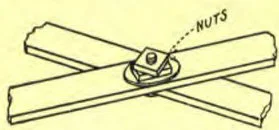
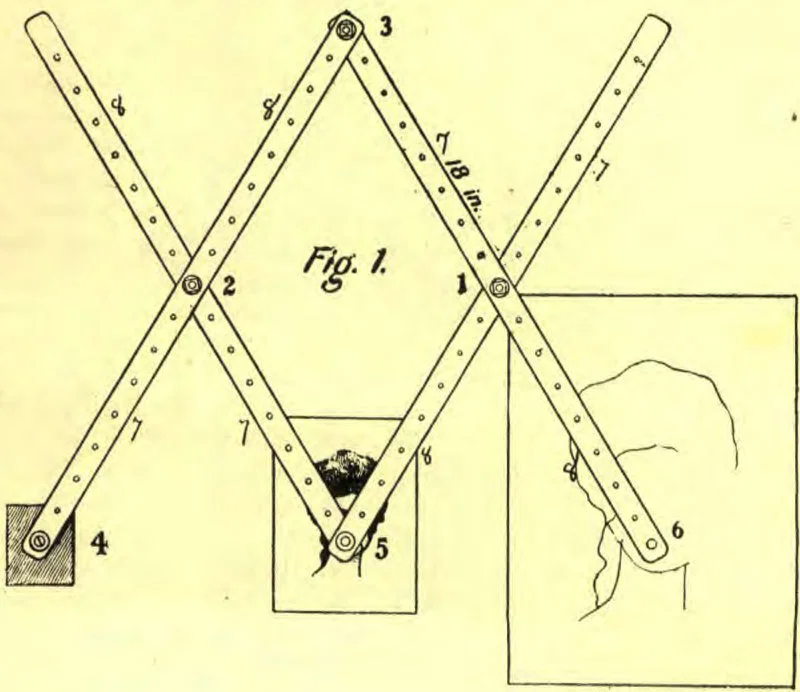
Joints 1 and 2
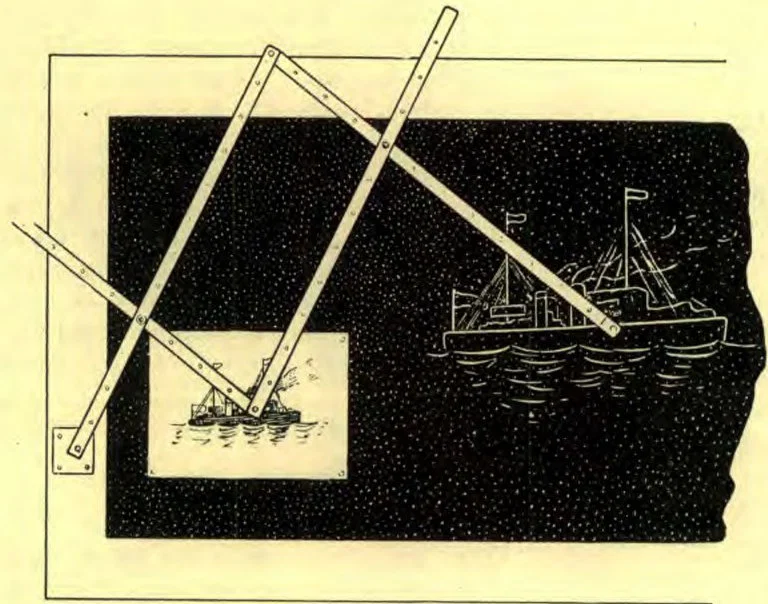
Now, let us all see how helpful we can be in overcoming this difficulty by constructing the simple drawing-machine which we will now describe. If careful attention be given to a few points, the home-made pantograph, as it is called, will do as good work as one costing five or even ten dollars.
Four bars of wood are needed for the frame. If you can get hard wood for the bars, that is the thing to do. You may make them large or small, but 36 x ½ x ⅜ inches is the commonly approved size where soft wood is used. Plane them smooth and square.
Bore holes in the bars an equal distance apart, two or three inches, and take special care to have them all in exactly their correct measured distance; don’t guess at it; for as I told you in describing the small pantograph, the opposite bars must work parallel to each other, or the copy or enlargement will be a distortion. The bars will work parallel if the holes are made right.
Chalk-Holder
No. 6.
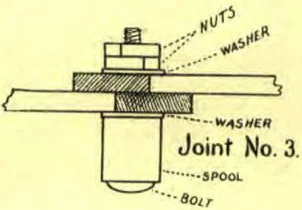
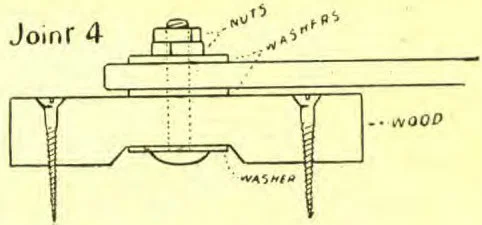
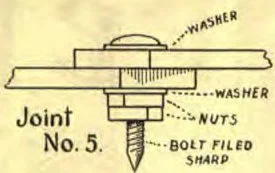
I have illustrated the joints that you will need. They are so designed as to be easily made, and yet they work smooth and true, and wear well. Notice that the principal feature is a short bolt, and that two washers and two nuts are used on each bolt.
HOW IT IS USED
NOT IN USE
One nut acts as a lock-nut, to keep the joint from loosening or tightening while in use. Simply screw the first nut down on the washer till the joint is tight enough, then screw the second nut down on the first tightly, to lock it, and keep it from turning. Be sure to make the holes in the bars so that they just fit the bolts; for they must not be loose and wabbly.
Joint 3 is so arranged that the smooth head of the bolt glides over the blackboard without catching and jerking. If it should leave a mark on the board, a small piece of cloth may be tied over the bolt head so that the cloth instead of the metal will rub.
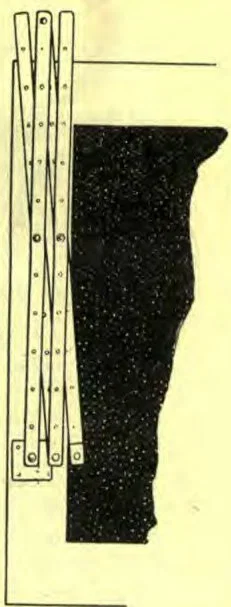
Joint 4 is the support of the pantograph. We have made it stronger than we did in the little instrument, because here it has a greater strain upon it. The block of wood to which it fastens is screwed to the wall on one side of the blackboard; thus it folds to one side when not in use, and is in no wise in the way.
Joint 5 has a longer, sharpened bolt, called a tracer, because it traces the outline of the original picture. In drawing, the operator does not watch his chalk crayon at all, but leaves it to take care of itself while he gives the closest attention possible to the tracing point. The tracer can easily be made sharp with a file, but it should have a smooth point that will not tear.
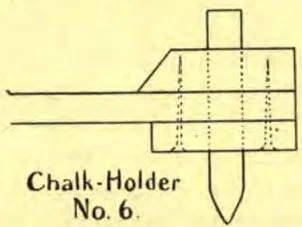
The chalk holder is fully described by the diagram. Keep the chalk well sharpened with a knife. If it fits too loosely in the holder, wrap it with a strip of paper.
The cost of making the pantograph should not exceed ten or twenty cents, especially if the wood bars can be made from something you find at home. Four good, straight-grained laths have been successfully used as bars.
Fig. 1.
How to Use a Pantograph
It is somewhat puzzling to a person unacquainted with the instrument to know how to use the pantograph, such as we have just described, for the purpose of copying or enlarging. I will therefore try to explain the difficult point.
Under the tracing point is tacked a picture to be copied. Your hand grasps the crayon or pencil, 6, and marks with it, while the eye watches carefully the motion of the tracing point. Don’t watch the pencil, but keep the tracing point on the lines that are to be copied.
Suppose you wish to make a large picture from a small one; all that you need to do is to change joints 1 and 2. For instance, you use the four holes marked 7 on the diagram. Don’t you see that will bring the point 5 nearer to 4, and at the same time put the pencil, 6, farther away, thus increasing the leverage, so that while the tracing point moves just a short distance, the pencil will move a long way, and of course make a long mark. Now, if you used the holes marked 8 for the joints, that would bring the tracing point and pencil quite close together, and the pencil would not move very much more than the point; and so there could not be much enlargement. Thus by using different sets of holes, different degrees of enlargement may be produced. Remember one thing always, and that is to keep the opposite bars of the pantograph parallel. I hope that many will find both pleasure and profit in the making and the using of the pantograph, for it certainly is a time- and labor-saving device.
EDISON DRIVER.
To Fathers and Mothers
By Mrs. F. V. Dorcas
Some months ago we decided to write to you as soon as spring-time came. We are sure you all will be ready to help us in our plan to revive the missionary garden idea. Will you not help us by interesting your children in this work? Give them a little garden spot, and plan with them how they may make the most of it. Give them seeds, and show them how to begin their work, and then keep an oversight of it while they are tending, harvesting, and getting it ready for the ingathering service in the fall. Encourage them to spend some of their time and strength in doing this special work for the Lord. It will not only be a help in creating a missionary spirit in their hearts, but will also be an educational factor in cultivating a spirit of industry and perseverance. If you can spare only one little strip of ground, let them have a row of something that they can take care of for the Lord.
Please do not fail to try this. We shall hope to see quite a sum for missions raised in this way. Watch and see if it is not a success in other respects as well.—Mrs. F. V. Dorcas, in Iowa Bulletin.
MEMORY VERSE: “Behold the Lamb of God, which taketh away the sin of the world!” John 1: 29.
“In those days came John the Baptist, preaching in the wilderness of Judea, and saying, Repent ye: for the kingdom of heaven is at hand. For this is he that was spoken of by the prophet Esaias, saying, The voice of one crying in the wilderness, Prepare ye the way of the Lord, make his paths straight. And the same John had his raiment of camel’s hair, and a leathern girdle about his loins; and his meat was locusts and wild honey.
“Then went out to him Jerusalem, and all Judea, and all the region round about Jordan, and were baptized of him in Jordan confessing their sins. But when he saw many of the Pharisees and Sadducees come to his baptism, he said unto them, O generation of vipers, who hath warned you to flee from the wrath to come? Bring forth therefore fruits meet for repentance: and think not to say within yourselves, We have Abraham to our father: for I say unto you, that God is able of these stones to raise up children unto Abraham. And now also the ax is laid unto the root of the trees: therefore every tree which bringeth not forth good fruit is hewn down, and cast into the fire. I indeed baptize you with water unto repentance: but he that cometh after me is mightier than I, whose shoes I am not worthy to bear: he shall baptize you with the Holy Ghost, and with fire: whose fan is in his hand, and he will thoroughly purge his floor, and gather his wheat into the garner; but he will burn up the chaff with unquenchable fire.
“Then cometh Jesus from Galilee to Jordan unto John, to be baptized of him. But John forbade him, saying, I have need to be baptized of thee, and comest thou to me? And Jesus answering said unto him, Suffer it to be so now: for thus it becometh us to fulfil all righteousness. Then he suffered him.
“And Jesus, when he was baptized, went up straightway out of the water: and, lo, the heavens were opened unto him, and he saw the Spirit of God descending like a dove, and lighting upon him: and lo a voice from heaven, saying, This is my beloved Son, in whom I am well pleased.”
“And this is the record of John, when the Jews sent priests and Levites from Jerusalem to ask him, Who art thou? And he confessed, and denied not; but confessed I am not the Christ. And they asked him, What then? Art thou Elias? And he saith, I am not. Art thou that prophet? And he answered, No. Then said they unto him, Who art thou? that we may give an answer to them that sent us. What sayest thou of thyself? He said, I am the voice of one crying in the wilderness, Make straight the way of the Lord, as said the Prophet Esaias. And they which were sent were of the Pharisees. . . .
“These things were done in Bethabara beyond Jordan, where John was baptizing.
“The next day John seeth Jesus coming unto him, and saith, Behold the Lamb of God, which taketh away the sin of the world. This is he of whom I said, After me cometh a man which is preferred before me: for he was before me. And I knew him not: but that he should be made manifest to Israel, therefore am I come baptizing with water. And John bare record, saying, I saw the Spirit descending from heaven like a dove, and it abode upon him. And I knew him not: but he that sent me to baptize with water, the same said unto me, Upon whom thou shalt see the Spirit descending, and remaining on him, the same is he which baptizeth with the Holy Ghost. And I saw, and bare record that this is the Son of God.”
Questions
1. What was John’s direct message to the people? What was he to do? What prophet had written of John? Repeat his words.
2. Where did John live? With what was he clothed? What was his food? Whom does God choose to do his greatest work? See James 2: 5; 1 Cor. 1: 26-28.
3. What did John ask the Pharisees and Sadducees? What did he urge them to do? What would it not be enough for them to say? What will be done to every tree that does not bring forth good fruit? What is meant by “fruits meet for repentance”?
4. How did John say he baptized the people? How did he speak of the one who would come after him? What great work would he do?
5. Who came to John to be baptized? What did John say to him? Tell how Jesus answered John.
6. When he had baptized Jesus, what did John see? What did he hear a voice from heaven saying?
7. After this who came to John? By whom were they sent? What questions did these men ask him? What did John tell them plainly that he was?
8. The next day whom did John see? What did he exclaim? Is He able to take away your sin? But what must all do who wish to have their sins taken away? 1 John 1: 9.
9. What did John now say to the people who were gathered about him? Had he known Jesus when he first saw him? What had he since seen? Why did this convince him that Jesus was the Christ? What positive testimony did John bear for Jesus? Verse 34.