The mass of our churches in this country are fast becoming a unit in practice; and the tendencies are fast working in the direction of church and state, and Roman power. Heathen practices and customs are becoming more and more common, and outward and worldly religion is more and more apparent than the inward religion of the heart, taught by Jesus Christ and the apostles.
Outward show, and appeals to the worldly element of the community has become the method adopted by nearly all of our churches to raise funds to do church work, and to carry on church and religious institutions. Church festivals and auction sales, suppers, etc., depend as much or more on the patronage of those outside the church as the members. It seems to make no difference how the money is obtained, only so that it is obtained. Sports and plays, and sometimes dancing, are entered into to draw the crowd. It is wonderful what a change has come over many denominations in these respects,—especially the Methodist and Seventh-day Baptists, both of whom were, fifty years ago, so outspoken against ungodliness, and mingling with the world. For example, we find published in the Evening News, of Plainfield, N. J., issue of June 22, 1888, the following:—
The Seventh-day Baptist's Fair! A good time for all, and profits of twenty-five dollars! The fair held in the chapel of the Seventh-day Baptist church Wednesday evening was well attended. The chapel was handsomely decorated with wreaths, ferns, and flags, while a combined flower-booth and lemonade-stand, the interior almost hidden under the abundance of ferns and flowers, occupied the center of the room. Miss —— and Miss ——, in classic Greek costumes, were kept busy serving out tasteful bunches of flowers and glasses of lemonade. The young ladies who satisfied the wants of their customers in the way of ice-cream and cake, were the Misses ——. Among those whose interest in the fair added greatly to its success were Mrs. ——, Mrs. ——, Mrs. ——. Over twenty-five dollars were realized.
Nearly all of the fifteen churches of this city advertise and hold these various entertainments, in order to raise funds, and as they say, “to hold our young people and congregation together.” In the same paper and issue, we find the following:—
The doll show at the Park Avenue Baptist church was begun this afternoon, and will be continued to-night.
Many persons, and some of the ministers, question the propriety of such proceedings; but the reply comes that “other churches do it, and it is no worse for us than for them.” “Times have changed,” they say. We must admit that fact. But has God changed? and has Christ’s religion lost its power in the church? Do we find any such method of holding the church together, in Christ’s example or teachings? or of raising funds to carry on the church, or for benevolence and the poor? Did he ever appeal to the world for aid? Did he not request his brethren to lay by in store upon the first of the week, as God had prospered them, for these purposes? and did he not urge them to come out from the world, and be separate? The church is fast becoming conformed to the customs and fashions of the world, and denominations are all the time becoming more loose in practical Christianity, more loose in faith and doctrine, more given to granting open communion to everything that takes on the name of religion. Both the First-day Baptist and the Seventh-day Baptist denominations used to believe and practice close communion; but now the S. D. Baptist church of Plainfield admits Sunday-keepers to their table, and are less strict than formerly in the observance of the Sabbath. Last Sabbath Bishop Vincent preached, in the absence of the pastor. The pulpit was nearly shut in with flowers. There was a continual stream of men, women, and children bringing in and arranging these flowers, for some time before the service. They looked very beautiful; but do these things tend to the conversion of the soul? The preacher treated upon an outward appearance of religion; while Christ’s religion was an inward religion of the heart, to the saving of the soul. What are the signs of the times?
CHRIST'S WORK.
By S. O. James
S. O. JAMES.
CHRIST'S work of saving souls from sin and sorrow, shame and death, is a work of love, begun immediately after the fall, and will go on until a mighty host of happy, joyful sons and daughters shall surround his throne, with hearts full of gratitude and with praise on every tongue. Jesus did not leave the guilty ones to despair in their unhappy condition. He might have done so, had he consulted his own ease and pleasure; but something must be done quickly, or Satan, the cunning, cruel, revengeful tempter, the proud, haughty, rebellious Lucifer, would triumph, and poor, wayward Adam and his companion, be left to eternal death. So the great plan was laid, and the work entered upon. What a mighty work it is! How far-reaching! What infinite patience it has required! Yes, and what wisdom and power, all that belongs to the divine character. So it is a work of wisdom, a work of power, a work of holiness, of patience, mercy, and truth. But the grand, moving principle, the one beautiful element which brings into its service every other attribute for its accomplishment, is expressed by one little word of four letters, and we call it LOVE; for “God so loved the world, that he gave his only begotten Son, that whosoever believeth in him might not perish, but have everlasting life.” In Romans 15, Paul calls him the God of patience, the God of hope, and the God of peace; yea, and how fitting! But we love to think most of all of that divine tenderness which so filled the soul of the beloved disciple as to lead him to exclaim, “God is love!”
THE LAW ABOLISHED.
By H. C. Giles
BY H. C. GILES.
It is often said and reiterated by opposers of present truth, “The law of God is abolished.” Let us compare this statement with a few texts of Scripture:—
1. The transgression of the law is sin. 1 John 3:4.
But suppose the law is abolished, then, since there can be no transgression of an abolished law, there is no sin. And apart from sin, death can have no existence, so that, too, must be abolished.
Thus one of two conclusions is unavoidable: either the Saviour has made a great mistake, and while abolishing the law and destroying sin, very unjustly allows death still to continue its ravages; or else antinomianism is untrue.
Cornville, Maine.
God's Writing in Nature: None Liveth to Himself
—God has written on the flower that sweetens the air, upon the breeze that rocks the flower upon its stem, upon the rain-drops that swell the mighty river, upon the dew-drops that refresh the smallest sprig of moss that rears its head in the desert, upon the ocean that rocks every swimmer in its channel, upon every penciled shell that sleeps in the caverns of the deep, as well as upon the mighty sun which warms and cherishes the millions of creatures that live in his light,—upon all he has written: “None of us liveth to himself.”—Sel.
BROIDERY WORK.
By Margaret J. Preston
Beneath the desert’s rim went down the sun,
And from their tent doors, all their service done,
Came forth the Hebrew women, one by one;
For Bezaleel, the master—who had rare
And curious skill, and gifts beyond compare,
Greater than old Miriam’s greatest were—
Had bidden them approach at his command,
As on a goat-skin spread upon the sand,
He sate, and saw them grouped on every hand.
And soon, as came to pass, a silence fell;
He spake, and said: “Daughters of Israel,
I bring a word; I pray ye hearken well.
God’s tabernacle, by his pattern made,
Shall fall of finish, though in order laid,
Unless ye women lift your hands to aid.”
A murmur ran the crouched assembly through,
As each her vail about her closer drew—
“We are but women! What can woman do?”
And Bezaleel made answer: “Not a man,
Of all our tribes, from Judah unto Dan,
Can do the thing that just ye women can!
The gold and broidered work about the hem
Of the priest’s robe—pomegranate knop and stem—
Man’s clumsy fingers cannot compass them.
The sanctuary curtains, that must wreathen be,
And bossed with cherubim—the colors, three,
Blue, purple, scarlet—who can twine but ye?”
“Yours is the very skill for which I call;
So bring your cunning needlework, though small.
Your gifts may seem, the Lord hath need of all!”
* * * * *
O Christian women! for the temples set
Throughout earth’s desert lands—do you forget
The sanctuary curtains need your broidery yet!
—Margaret J. Preston, in S. S. Times.
SOME SCENES FROM CHILD LIFE.
THE sun is shining on a pavement already white with heat, although the clock in the corner grocery says it is not nine o'clock. A group on the opposite side of the street attracts the attention from crisp vegetables and luscious fruit. The group consists of a grandfather, grandmother, a young father and mother, two young ladies who may be daughters of the older people, and, last, but by no means least, a sturdy boy of about three years, perhaps a little older. The boy was the center of the group, who, judging from baskets and wraps with which they were all loaded, were on their way to a picnic. However, at the moment the group was discovered, there was but slight prospect of their getting any further than the place they then occupied. The small boy refused to walk, letting his legs hang limp and powerless under him. The heat was almost unbearable, and each member of the party, with the exception of the frail, white-faced mother, had all they could carry. The father and one of the young ladies each took an arm of the boy and attempted to carry him between them, but he rebelled against the young woman's assistance, screaming, “Mamma! mamma!” who responded by kneeling in front of the child, and endeavoring to coax him. She was rewarded by a push and a slap on the cheek. The grandmother then knelt, and received a kick as powerful as the child could give. The father stood back, helpless at first, but finally determined to administer a little family discipline; but the young mother interposed, and saved the child from his just deserts, by kneeling down and taking him in her arms, and whispering to him. The result was that the young monarch walked along quietly for the remainder of the block, and joy and relief was in every face. When the curb was reached, the boy was seized by another mood or fit of perversity, and the whole scene was repeated. The family, perfectly helpless, stood in a circle about, waiting for the boy to decide what he would do. The father looked at his watch, discovered there was no time to spare, spoke to one of the young ladies, who grasped the boy firmly on one side, while the father took the other, and they started for the dock on a trot, with a purple, screaming, wriggling boy carried like a two-handled jug between them, the others following, distressed, anxious, and annoyed.
The elevated train stopped at a station near a popular ferry. There entered the car a refined and elegantly attired lady, attended by a very business-like looking man, dressed faultlessly, who held by the hand a boy of about four years in a velvet suit, with broad lace collar about the neck, and a fine, very broad-brimmed white straw hat on his head. They were evidently a family of more than moderate means. The boy jumped on the seat, and the father and mother sat on either side of him. The child slipped from the seat at once, and got up on a seat on the opposite side of the car. The father changed his seat, and sat down beside him; the boy pushed him, evidently not wanting him there; he protested, but the father did not mind, so the boy slipped over the arms of the seat, until three or four seats were between his father and himself. The car window was open, and the boy put his head out. Father and mother jumped; the father grabbed the boy, the mother grabbed the hat, and both were safe.
The boy wriggled himself out of his father's grasp, and the mother relinquished the hat. The boy stood, with flashing eyes, in the middle of the car, saying, “I ’ant to look out.” “It's not safe, Ralph,” said the mother. “You will lose your hat.”
“I don't care; I ’ant to look out,” reiterated the small boy. The father and mother exchanged glances, the mother meekly took off the boy's hat and sat down, the boy climbed back, looked severely at his father, as if to tell him to keep his distance, and then put his head out of the car window. The father most cautiously slipped from seat to seat, till he was within reach of the child's skirts, and then looked triumphantly at his wife for her approval. She smiled back and nodded, while the father was trying to get in reach of the child without his knowledge; the mother held her breath, fearing the child would discover the father's intention. When it had been accomplished, she sighed with relief; but the relief apparently was more that the attempt had been successful than at the protection afforded the child.
The father is a professional man, the mother a semi-invalid, the child a healthy young fellow of about seven years of age. They appear at the table of a family hotel. The first appearance is made at breakfast. The oatmeal is passed to the boy, who helps himself by heaping his saucer; the oatmeal is covered with sugar till it looks like a white mound; milk is poured over it till it runs over the edge of the plate; sugar is again applied, and the child begins to eat, spilling milk and sugar over the table-cloth and the front of his clothes; he uses his own knife to the butter, helps himself with his own fork to fried potatoes the second time; in fact, he ignores every law of propriety and decency at the table, though his father and mother give every evidence of good breeding. He roams the streets at will, and knows no law except his own will in any relation of life except one—he goes to bed at six o'clock invariably, as his mother likes to be able to go out in the evening, which she could not do, were the child allowed to sit up. She explains that she cannot keep a nurse. No one doubts her, unless one of Barnum's menagerie attendants could be obtained.
The sunshine seemed cruel when one thought of the horrible blackness that had settled down behind the tightly closed blinds. For days the neighbors had looked anxiously for some sign that the shadow was passing, but now all hope is gone. The shutters are tightly closed, and the long bow of white ribbon catches the morning sunshine; and we know just what we should find in the front room that for six years has been so full of a boy's life and pleasure. Why, it seems but yesterday that we had stood by the window trembling with joy at the thought of the bliss that had come to the neighbors over the way. There were tears then, and we are glad now that they were tears of sympathy, not tears of envy or rebellion because no baby's voice would break the stillness or disturb the order of our little home. How each morning a mental greeting was sent across the way to the dainty young mother and the sturdy blue-eyed boy! How eagerly we rushed across, at the first sign of welcome, and, kneeling beside the nest of lace and ribbon, smothered the ache of head and heart in our neighbor's joy and gladness! Six years since that morning, with its joy! Surely some backward ray must penetrate the horrible blackness. We look at the opposite window, almost expecting to see the shutters banged open, and the rosy, turbulent Carl at the window, the gentle little mother (who was always bewildered at her boy's strength of mind and body, never knew how to meet it, and was overshadowed by it), laughing and nodding behind him. But there are the closed shutters and the fluttering white ribbon in the morning sunshine!
All is over. A tiny, white-faced woman sits behind curtains that are never thrown back. There are no piles of dirt now on the front steps, nor velocipede turned over in the front area, nor roller-skates on the gate-post. There is a strange blackness about the house over the way. A tall man, with all life and spring gone from him, comes out of the front door mornings, and has not yet recovered from the habit of looking about for the boy who kept everything in disorder about him, who made life a breeze.
And I wonder if it might have been different, as I remember what our warm, dear friend, the physician said: “We might have saved him, if he had possessed the habit of obedience. We were helpless from the first, for he would not be controlled, nor do what was disagreeable.” I pray God that the white-faced little woman, with her patient smile, may never know what robbed her of her boy.—Christian Union.
OUR SUMMER SABBATHS.
By Margaret E. Sangster
“My religion is taking a vacation,” said a gentleman to his pastor, when the latter inquired concerning his recent absence from church and prayer-meeting. The weather was warm, the temptations to lassitude and inertia came with the season; and the man was frank enough to state the fact in his case, without excuse or subterfuge. His religion was on its vacation.
I once heard a minister in a country parish warn his boys and girls not to imitate the Sabbath-breaking practices of the “city people in our midst”—boarders in the farm houses and pretty rural homes, who went driving, riding, boating and fishing on the Sabbath, ignoring the call of the church bells, and setting a recklessly bad example to the community about them. Perhaps many of these attended church and Sabbath-school at home, where they were known; for there are consciences which become wonderfully elastic when only strangers’ eyes behold what their owners do. Perhaps they voted the simple sanctuary services dull, and deceived themselves with the sophistry that they could as really worship the Lord while strolling through green fields, or floating among the pond-lilies, as if they were sitting in a pew and listening to a sermon. But, whatever their process of reasoning, the effect upon those who surrounded them was unhappy. Their religion was on a vacation.
Seriously, while, during the excessive and tropically “hot spells” which descend upon our cities, there may be some necessary modification of our activity, it is an open question whether we gain anything by our lounging and fuming through our summer Sabbaths. As a rule, a church edifice, with windows and doors open to the possible breezes, is as cool and comfortable a place as one can find. The person in secular life, during the business hours of the week, who goes steadily onward from one task to another, has a distinct advantage over his neighbor who spends his time in mopping a perspiring face, clutching at a fan, and gulping quantities of iced water. He forgets himself and his discomfort, in attention to his work. So, on the Sabbath, when we are in our places listening to sermons, joining in the prayers and hymns, forgetting earthly cares in the consideration of that which is higher and better, we are physically rested and refreshed, and gain in strength for the daily endurance. One can hardly make a greater mistake than to fancy that a Sabbath spent in idleness, even under the orchard trees, and with a pretense of reading good books, will bring ease of body and relief of soul, as would the same time devoted to the customary religious observances.
We are in need of grit, pluck, genuine courage and back-bone, in our religious life. The trivial excuses, made unblushingly by men and women to themselves and others—can it be that they are offered to the Lord?—would not be accepted in any worldly business. “If you cannot be in your place promptly and regularly, your place will be470filled by another,” says the man at the head of affairs to his subordinates in the counting-room. “If you refuse to train with us, you will not be ready when the day of the race shall come, and we do not want to carry useless weight,” says the captain of the crew to the indolent oarsman. All through our business and our pleasure, runs this need of endeavor, and only they who strive are considered worthy. Can we afford, in the spiritual realm, to be less conscientious and persevering than in the material?
“For one man who reads the Bible,” somebody has said, “there are ten who read us;” and if we bore this more constantly in mind, we should not so often alienate those who might else become disciples. In vain is precept, if the life contradict the words. Every summer Sabbath sees vacant pews which ought to be filled, their very emptiness testifying to the lightly esteemed privilege which our fathers faced death to win for those who should come after them. The newspaper in the Christian home on the Sabbath, the novel read and discussed on that day, the secularization of holy time, the faint-hearted attendance upon religious services, are so many tokens to the world that we are only half in earnest in following the Master. The religion that can afford to take a vacation, would not be accepted as true religion, if tested by any earthly standard. Are we sure that it will pass, when judged in the court of heaven?—Margaret E. Sangster, in Interior.
DEPRESSING
In some households the wind is always “in the east,” and no one quite knows the reason. The causes, patiently traced, usually center in some one member. He may not have what is usually meant by a “bad temper,” and may go on, day after day, giving others little cause for active complaint against him. And yet his personal atmosphere is so depressing that the constitutionally sober are made melancholy by his presence, and the light-hearted find themselves deep in the blues. “I don't see why everybody complains of my manner,” once said a most estimable gentleman; “I'm sure I don't easily lose my temper, and I never say disagreeable things.” “Ah! but you always look as if you were thinking them, and that's worse,” answered a candid friend. Repressed criticism is, indeed, sometimes harder to bear than a frankly-uttered complaint.—Sel.
THE TRUTH IN OTHER LANDS.
By J. O. Collins
MELBOURNE AND ITS VICINITY.
The capital of Victoria is composed of more than a score of pretty suburbs, of which Melbourne proper is the center. Steam railways extend to all these, with trains leaving the city every twenty minutes during the day, and every half-hour during the evening. These suburbs are so closely connected that in some cases one passes out of one into another by merely crossing a business street. On some of the principal streets, the traffic is simply enormous, and one runs quite a risk of life or limb to cross at some of the busiest corners.
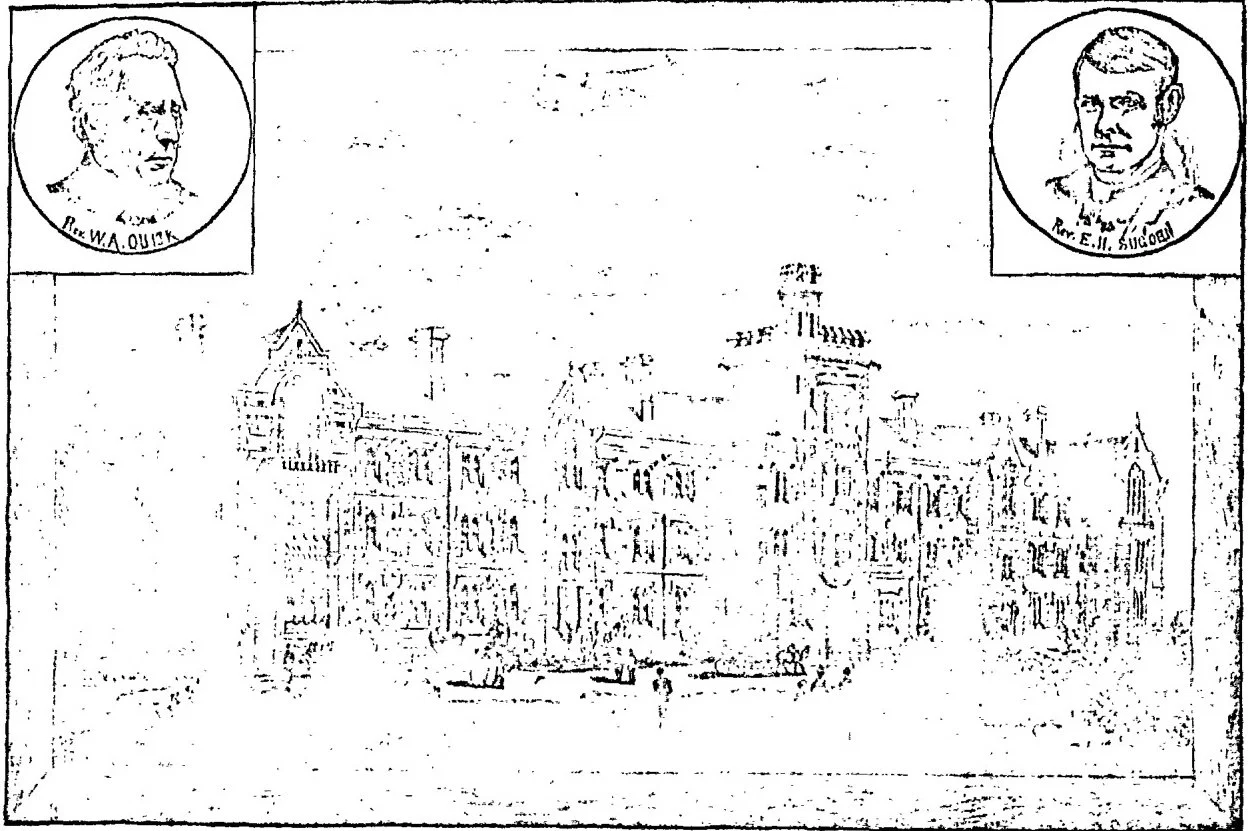
QUEEN'S COLLEGE, SOUTH YARRA, VICTORIA.
The changes of temperature in and around Melbourne, are at times very sudden. A bright, quiet morning is as likely as not to be succeeded by a cloudy, windy afternoon, with the dust almost intolerable. Again the day may be bright, and so intensely hot as to require an umbrella to keep off the sun, until the middle of the afternoon. Suddenly the wind veers round to the south, and blows nearly a gale; soon leaden clouds hang heavily overhead, and the rain pours in torrents, filling the streets with streams of water, which in some cases, rush along like a mountain current seeking its way to the sea.
For a city as large as Melbourne, the drainage system, as compared with that used in our own large cities, is very inferior. It is true that in some parts of the city large drainage sewers are laid along the streets, under the surface, but there are no pipes connecting with these from the houses. All refuse water is turned into a surface sewer in the yard, which carries it under the sidewalk into a gutter running parallel with the walk, and within two feet of the curbstone.
At certain distances from each other, there are iron gratings in the gutters through which the filth of these surface sewers finds its way into the main sewer underground. Even this arrangement for conveying away the refuse water, has been in operation but a short time, in many of the suburbs. Before the “deep drainage” was put in, the water was liable, in many places, to stand in the gutters for a day or two. On certain days men came along, armed with heavy, long-handled scrub-brushes, with which they pushed along the debris in the gutter until the proper amount was collected, when it was thrown just outside, and left to stew in the broiling hot sun, until the offal carts came along to receive, and bear it away. All this time, however, it sent out fumes that were anything but delightful to the inmates of the houses along the way.
With such a system of drainage in use, it is not strange that one's life is put in jeopardy every hot season, by the alarming prevalence of typhoid fever. Everything that can be provided for the relief of those who are attacked with this annual scourge is, however, conscientiously carried out by the authorities. The public hospitals are frequently filled to overflowing, and tents are erected in the adjacent grounds in order to supply the demands upon their resources. Most of the poorer classes avail themselves of hospital benefits when in any way disabled. In this way they manage to have the regular attendance of a physician, which they all would not otherwise be able to procure.
The hospital system in that country is excellent. Any one who in any way becomes disabled can be taken to a hospital for treatment, if he chooses. The expenses are made up by contributions from all the churches. Every year there is one Sunday set apart for this purpose, and designated “Hospital Sunday.” For weeks before the day arrives, large flaming placards greet the eye in every direction: “Remember Hospital Sunday,” and then the date is given. Consequently thousands of pounds are taken up on that day, and placed in the hands of the proper officers, to meet the expenses of the hospitals for the current year. At such times all the churches give cheerfully. Besides this, sections of the Salvation Army parade nearly every street on that day, begging of every one they meet, who they think will not be at some church.
The laws of Victoria require all children in the colony between the ages of six and fifteen to attend some school. If any attend a private or denominational school, and can produce evidence of the fact, that is satisfactory; otherwise, they must attend the State school. All the common branches of education, with military drill for boys, and needle-work for girls, are taught free. No direct religious instruction, whatever, is permitted in the State schools. When a child's name has once been entered on the school roll, he must, unless prevented by sickness, attend the required number of days, or his parents must pay a fine. Each teacher is supposed to report all delinquents to the court once in three months, when the parents or guardians of these are summoned before the magistrate to show cause for their ward's absence. For the first offense, five shillings ($1.25) is the fine; for the second ten, the third twenty, etc.
Some of the State school buildings are imposing-looking structures. In fact, all public buildings in that country are of the finest character, and are built to stand a thousand years, if necessary. As they appear when finished, so they will be found twenty, fifty, or a hundred years afterward. There is this difference of operation between the English and the Americans, in the matter of building. The Englishman takes plenty of time to mature his plans, and when he is ready to build, every contingency has been thought of and provided for; hence when the house is erected, it is completed. Not so with an American. He conceives an idea of building, and in an incredibly short space of time, his structure is reared; but just as likely as not, he immediately sees where an improvement might be made, and the next year he makes an alteration here and an addition there, and thus continues indefinitely.
The sketch accompanying this paper is a fair sample of the public buildings of Melbourne. This is a Wesleyan College, completed only a few months ago, and is located in South Yarra, one of Melbourne's prettiest suburbs. It is of cut stone, and situated in the midst of large and most beautifully laid-out grounds. The likenesses presented471are those of the two leading men in the enterprise, the older one being the president of the college.
Nearly every religious body represented in Victoria has its own schools, connected with the individual churches belonging to them. The school-building is usually erected on the same lot with the church, but in the rear of it. These are either supported by a general fund from the church, or upon the plan of private schools, each pupil paying so much per week for his tuition. While this is an advantage to all the churches adopting the course, the disadvantage is proportionately great to all those outside these circles; for it leaves the attendance at the State schools to be largely made up of children of questionable character. For a child whose mind is comparatively pure, to associate in school with this class, is but to quickly fill his mind with those things that are impure and wicked, and in a measure to destroy the child's chances for happiness here and hereafter.
Our own people there have seen the necessity for a school, whose interests they themselves might control. Some things have hindered such an enterprise. While they are generally poor, and scarcely able to maintain a school, yet there is no doubt in my mind that, had they the right man to take the responsibility,—a sound Christian, and a good teacher,—the entire membership of our people there would unite to give him their sympathies and support. Such a school is needed there, not only for the younger children of our people, but as a training-school for those who would, if they could have the opportunity, learn to canvass for our books and do missionary work.
There are some millions of people in that great country, and thousands are emigrating there every year from the Old World. There is not half being done for them that should be, for lack of facilities. Moreover, a large part of the population cannot be reached by public congregations, on account of the isolation of the farmers and stock raisers. These should have the truth, and scores of young people in Australia should now be in course of training, for the service of the Master.
There is no country in the world where larger results may be obtained by the canvasser and colporter than in Australia, and for this reason: From the highest to the lowest they are a reading people. They are especially fond of religious reading. Their decided taste for literature is seen in the public libraries in every town, where one may go and use the books freely. In Melbourne, the public library contains 125,000 books, covering nearly every subject ever written upon. Besides this, each suburb has its own library, with several thousand books in each.
Generosity prevails generally among the Australian people. They will give to the cause of God, in some instances when in actual need of the amount donated, to keep themselves comfortable. There are, of course, some exceptions to the general rule, but these, we are glad to say, are not very numerous. In the matter of purchasing books, their liberality is specially noticeable. This is particularly so among the country people, who are shut away from the great avenues of commerce and intelligence. These people, too, have time to study, that is not usually afforded to those in the cities. Their evenings are their own, and are generally improved in reading.
There are large opportunities for labor in that country in behalf of the truth. The work started there under great difficulties, some of which will be spoken of in the next of these articles; but there is now a prospect of its pushing ahead faster than it has ever done before. But there are yet large and populous districts in that country which have not even heard the sound of the third angel's message; and to extend the work to those, which should be done as rapidly as possible, will require greatly enlarged facilities. J. O. COLLINS.
Patience: A Poem on Bearing Life's Burdens
By American
My prayer is but for patience—strength to bear
Whatever of grief or weariness is mine;
Patience to watch the star whose light will shine
Above the unknown haven of my prayer,
Beyond regret or sorrow or despair;
Patience to feel that purposes divine,
Like threads of golden adamant, entwine
Among the chains that we are doomed to wear;
Patience to climb life's mist-enshrouded height
With doubtful steps, or, pausing by the way,
To wait the dawn of the o'erwhelming light
Whose rays shall sweep the heavy gloom away,
And show heaven's far-off country to my sight,
Bathed in the glow of God's transcendent light.
—American.
Training Children While They Are Children
—Whatever is done for a child, as a child, must be done while he is a child. Axiomatic as this truth is, it is not practically held as a truth by parents, teachers, or preachers, generally. Those who are responsible for the training of children, are inclined to feel that the most important period of a child's life is a little later on than now. Yet the time of times for the improving of a child's mind, and for the shaping of a child's character, is the present hour. He who fails to realize this is so far unfitted to have the custody of children.—S. S. Times.
THE BROOKLYN, N. Y., MISSION.
By J. E. Robinson
NOTWITHSTANDING the many difficulties experienced in laboring in Eastern metropolitan cities, still we can report some progress in this place. Soon after coming to this mission, we began holding three meetings each week in a temperance chapel, in South Brooklyn; these meetings continued through the months of March and April. As a visible result, several embraced the truth,—among them an entire family of seven. Even the younger children seem to delight in the service of the Lord, taking part in the prayer and social meeting. Those who have embraced the truth are firm, and show a very commendable spirit of sacrifice in supporting the various enterprises connected with the cause of truth.
All are much interested in the Sabbath-school work. During the past quarter their donations amounted to upward of twenty-one dollars, fifteen of which will be sent to the London mission. The church membership is thirty-one. The meetings are held in the mission parlors. Tithes paid during the last quarter amount to $103.51. May 1, the mission was removed from 264 President St., to our present quarters, 213 Grand Ave., which is more centrally located, and suits our work much better. We also make a saving of $300 annually in rent. This mission has suffered for want of experienced Bible workers and canvassers; but little has been done in the way of Bible work, to follow up the interest created by the sale of our books. We are now trying to bring up this branch of the work, and already many favorable openings for Bible work have been found among those who have purchased books, especially “Thoughts on Daniel and the Revelation.” Two sisters devote their entire time to visiting and reading with those who will listen.
Bro. Daniel Thomson still continues his work among the emigrants, having distributed 10,000 periodicals among them during the past nine months. Bro. C. R. Robbins devotes his time to selling our books on board ships visiting this harbor. His sales for nine months amount to $328.00, besides 5,305 periodicals distributed. He has visited 1,012 ships.
Bro. Geo. A. King is having good success with “Thoughts on Daniel and the Revelation.” During the past six months he has sold and delivered 130 copies of this work, and has 150 good orders for fall delivery. He has also taken upward of 100 subscribers for Good Health, and several for the Signs. Altogether, there has been nearly $2,000 worth of books sold, and 16,156 periodicals distributed, during the nine months just ended.
We are of good courage, and the outlook is encouraging for an ingathering of precious souls, saved from the maelstrom of vice which is fast engulfing these cities. We hope to be remembered at the throne of grace. If any of our brethren who live within reasonable distance, feel their hearts moved to donate something for the use of the mission from their farms or orchards, they need not hesitate for fear it will not be acceptable. Provisions are high, and many times none too fresh, when offered in the markets.