Just ten years ago the sixth of January, my wife and I came to Nashville, Tenn., to labor in the Southern field. The first year I was connected with the circulation department of the Southern Publishing Association, and my wife was on the medical staff of the Nashville Sanitarium. I was then called to the presidency of the Florida Conference, where we labored for five years.
During our stay in Florida, we had the pleasure of seeing the membership of the conference nearly doubled, and the funds for all purposes fully doubled. It was also our privilege to have an active part in founding the Florida Sanitarium, and to watch its growth for four years before our departure for another field. That institution has continued to grow, as has also the conference, and the future prospects of both are bright indeed.
We were called to like responsibilities in the Louisiana Conference, so we removed to New Orleans in 1912. Hereafter we remained for three and one-half years. During our stay in Louisiana five new church buildings were added, and one that had been purchased before our arrival was practically freed of debt. Of the five only one has any obligations against it.
A little less than one year ago, we came to the Cumberland Conference to take charge of the work in east Tennessee. Though this year has been filled with hard labor and with many perplexing problems connected with institutional work, it has been a most enjoyable one. We have become greatly attached to the field and to the people. We should be glad to continue in the work here, but we have been called to another field, and we feel that we should respond.
In harmony with the request of the General Conference, we shall soon be leaving for Cuba, to take up responsibilities in the general work of the Northern Latin American Mission; but before leaving, we felt that we should like to speak to our people through the columns of the REVIEW in reference to this field that has become endeared to our hearts by ten years of service.
I have attended meetings in every State south of Mason and Dixon’s line, and I am quite well acquainted with conditions in all these fields, and I know something of their needs. From my experience in the South, I have not found this field very different from those in the North, where I labored for fifteen years prior to coming here. In fact, the17line that once separated the North from the South seems to be rapidly vanishing, and we are fast becoming one people. To my mind there is no more difference between the North and the South than there is between the East and the West.
As we now disconnect with the work in this field, it is with very tender feelings for the South and for the Southern people. The progress in the work that I have noted above is but an index to the progress that has been made in all the conferences, and we shall continue to pray for the success of the cause in this great Southland. We desire also that our brethren for whom we have labored will follow us with their prayers, as we take up new duties in a new field and among a people speaking a language that is new to us.
R. W. Parmele.
Field Class Work at Redlands, California
By George B. Starr
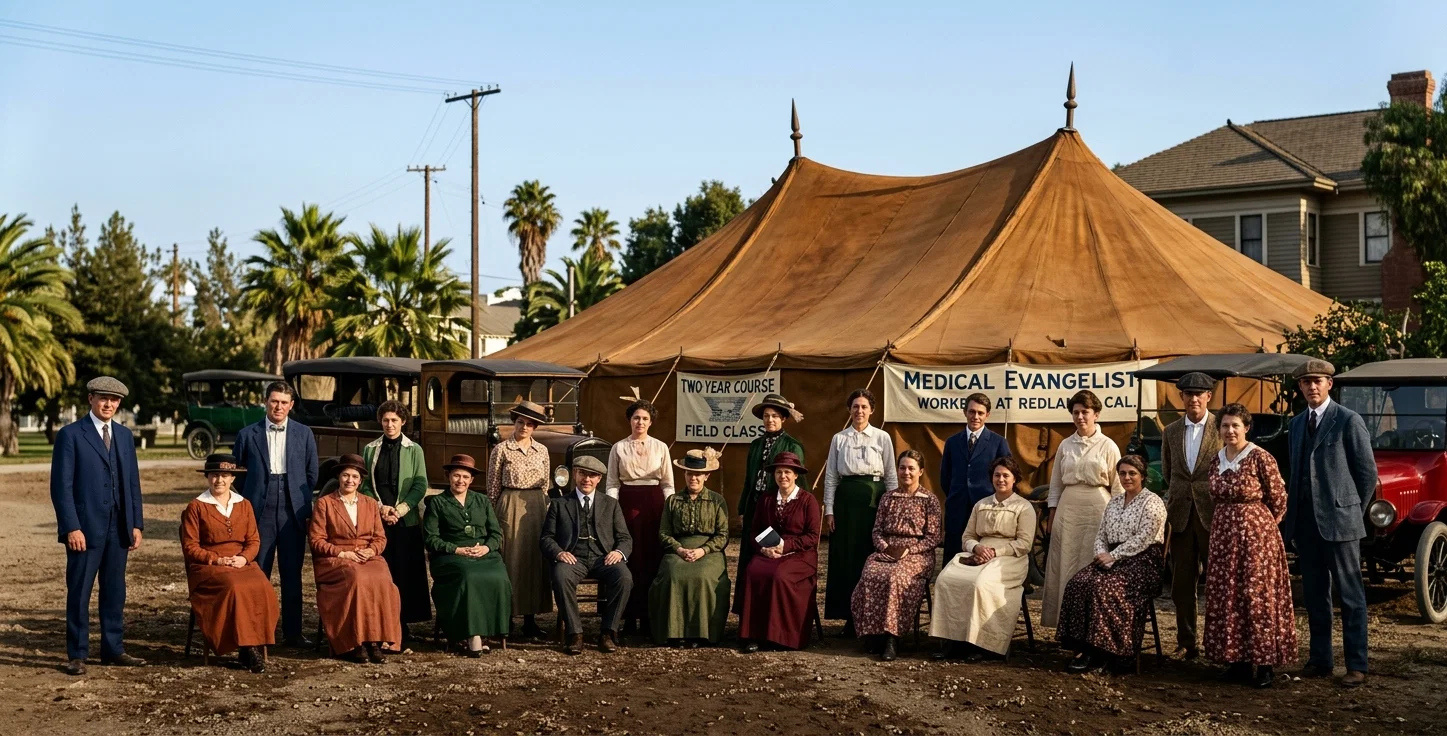
The two-year medical evangelistic class at Loma Linda this year numbers twenty-eight. They are mature persons, — licentiate preachers, Bible workers, canvassers, graduate nurses, and others. All of these are intent upon a speedy preparation for efficient work, largely in foreign fields.
To aid in the practical experience work of this class, a series of tent meetings has been conducted at Redlands, six miles from Loma Linda. The tent, which was fifty by seventy feet, and made of fine brown duck, was purchased by the churches of Loma Linda, San Bernardino, Colton, and Redlands, and presented to the conference for work in this district. The Lord prospered us in securing a most desirable location, and meetings were held for eight weeks, four nights each week, from September 19 to November 12. The meetings were conducted by the teachers and the class. Entrance to hundreds of homes was obtained, and many Bible readings were given. Publications were lent, sold, and given away. One man and his wife have begun to observe the Sabbath, and others manifest decided interest and conviction.
A marked spirit of quietness and serious attention was very noticeable throughout the meetings. The blending of the medical work and the evangelistic seemed to meet with general favor, and in some instances with special approval. A good attendance was maintained throughout. In fact, the interest was so good at the close that it was thought best to continue the meetings two nights each week, holding them in a Presbyterian church, centrally located, which we were able to rent at a reasonable price for the purpose. We intend to continue these services until the holidays, and possibly all winter.
The accompanying cut shows a portion of the class with the autotruck and automobiles, ready for their afternoon and evening work. The class has secured $67.07 for the Harvest Ingathering, and hopes to reach $100.
G. B. STARR.
MEDICAL EVANGELISTIC WORKERS AT REDLANDS, CAL.
Cassie Wilson-Dennis
By S. B. Horton
CASSIE WILSON-DENNIS was born in Georgetown, Mich., July 13, 1886, and passed away Aug. 2, 1916, at the sanitarium near Buenos Aires, Argentina, South America. Her parents were Sabbath keepers, and she was baptized at the age of eighteen. The next year she entered Emmanuel Missionary College, where she remained two years preparing for the Lord’s work. At the close of her second year at the college, a call was made for Bible workers for the city of New Orleans, and she was one of those who accepted the call. She and Miss Edna Walker went to New Orleans, and labored successfully in soul-winning for a year and a half.
Sister Cassie decided to attend the Foreign Mission Seminary at Washington, D. C., to prepare for work in some foreign field, and after spending a year at the seminary she sailed from New York, Nov. 20, 1911, for South America. April 3, 1913, she was married to Mr. Allen Dennis, a former schoolmate at the Washington Seminary, and both being acquainted with the Spanish language, they labored together successfully in soul-winning until the time of her death.
Besides her husband she leaves a father, mother, two brothers, and two sisters to mourn her seemingly untimely death. Of a sunshiny disposition, and loyal and devoted to the cause of her Master, Sister Dennis won friends wherever she labored. She was laid to rest in a beautiful cemetery near others who had fallen on the firing line. Elder W. W. Wheeler, of Diamante, Entre Rios, Argentina, had charge of the funeral services.
CASSIE WILSON-DENNIS
Memorial services were held in Bauer, Mich., in which Elder William Guthrie, president of the West Michigan Conference, Elder J. M. Wilbur, Miss Edna Walker, and the writer took part.
S. B. HORTON.
Spanish Honduras
By Chas. M. Paden
It does our hearts good as we see the Spanish people here taking their stand for the truth, for it seems that they have such a long way to come.
Our members have been very liberal in their Sabbath school contributions, but it seems to us that the tithe is not what it should be. The other day I received a very encouraging report from our Sabbath school at Lower Cays, Bonacca. They had a fourteenth Sabbath offering of $152.67, making a total offering for the quarter of $239.77. This school has a membership of nearly 140, but nearly two thirds of this number are children.
We certainly enjoyed our short visit over on the coast in August, though the weather was very hot. The mosquitoes are very thick there. The only comfortable place a person can find after dark is under his net. I contracted malaria while there, and have since had some trouble in getting rid of it.
Elder and Mrs. Isaac Baker are here at the mission home now. We are all planning to go to Bonacca in a few days, where we expect to hold a Sabbath school and young people's convention.
We are glad to know that our bookman, Brother Williams, is on his way here from Cuba. He is possibly over on the coast somewhere now, but the weather has been so rough for nearly two weeks that the boats have not been running between here and the coast. Just now we are having plenty of rain, with a nice cool breeze from the north. One of our native young men from Ruatan has been over on the coast for several weeks, working with our publications among the Spanish people. He has had very good success for a person who never had any experience in such work. We ask your prayers for the work here. CHAS. M. PADEN.
Honduras
By Isaac Baker
The message is slowly making its way on the mainland of the republic of Honduras. We have no great things to report, yet we rejoice to see a few taking their stand for the commandments of God.
The middle of last May, in company with one of the native brethren, I made a five days’ trip by mule into the interior, where for over a year one of our brethren has been giving the third angel’s message. Several persons began the observance of the Sabbath, and were faithful until severe trials came; then some went back into their former way of living. Others, however, remained steadfast. The people here have all been reared Roman Catholics, so have not been taught the Bible, but rather, to worship images, to honor relics, and to do what the priests say. All they knew about Protestantism was what they had learned through Catholic channels, so they did not see it in its true light. The result is they do not want anything that is Protestant, as they fear they will be defiled by it.
After we had been with them a few days, they seemed to have a little better opinion of us than when we first arrived. Quite a number began to come to listen to the singing, as the singing of hymns was new to them. They seemed to enjoy it, and most of them remained for Bible study. Near the close of our stay with them, six who had remained faithful from the time they first heard the truth, signed the covenant and were baptized. According to the last report, all were standing firm for the truth. Twelve others there and in near-by villages are observing the Sabbath. The brother who first took the message to them is still doing all he can to teach others also. We are praying the Lord to bless him in his efforts.
While I cannot say that I enjoyed the trip, I am willing to go again whenever it becomes necessary to do so. We had the privilege of baptizing nine on that trip, three at Mesica, near the coast, and six in Mangualle. All were Spanish-speaking people. On the way we passed several small villages where the truth should be presented, and the only way to do it is to support some one while he goes from place to place giving the message.
Later I made a visit to the islands for a few weeks, and then returned to La Ceiba to get things in readiness for the convention, which closed a little more than a week ago. We had a very profitable time during the convention. The18English-speaking people had their rally day the first Sabbath of the meeting, and the Spanish-speaking had theirs on Sunday. There was preaching in Spanish every night, and these services were attended by persons who understood Spanish, some of whom were not believers.
Elder J. B. Stuyvesant and his wife were with us during the meeting, and did most of the preaching. All appreciated their efforts, and were sorry when the time came for them to return to their field of labor in Guatemala.
On the last Sunday of the meeting a good company gathered at the river, about one-half mile from the town, where seven persons were baptized, five of whom are Spanish and two English. There are two or three others to be baptized soon.
We are now planning to visit the churches and companies on the islands before returning. This will take us about two or three months if we stay as long at each place as we should.
While Honduras is but a small place on the map, we trust our brethren and sisters will not forget the work here, and that they will remember us in their prayers.
ISAAC BAKER.
Cleveland, Ohio
By R. S. Lindsay
The Lord has greatly blessed the work done in Cleveland, Ohio, during the past two years. Our church members have rallied to the task of warning this great city of the things which are to come upon the world. Three tent efforts have been held. From September, 1915, to October, 1916, seventy-two persons received baptism and united with the church, while fifteen have been received on profession of faith, and fourteen by letter, making the total additions for that time one hundred and one. There are approximately fifty persons keeping the Sabbath who have not as yet fully taken their stand with us.
The large tent effort the past summer resulted in forty-six persons accepting the third angel’s message. The expense of this effort, which lasted seven weeks, was about four hundred dollars, and the donations totaled four hundred and nine dollars.
Our Harvest Ingathering goal is one thousand dollars, and we are glad to report that the spirit of zeal and earnestness on the part of our united membership is indicative of final victory. Thus far we have eight hundred dollars. We are of good courage, and feel confident that the onward march of the truth of God throughout the world-wide harvest field is an omen of the speedy triumph of the cause we love.
The interest that has been manifested in the Bible Year by REVIEW readers is greatly appreciated by the editor and by the Missionary Volunteer Department, for it is by the "word of his grace" that we are built up in the Christian life. Acts 20:32. The assignments will be run again this year, not in partial chronological order, as last year, but in consecutive order according to our English Bible. Short notes will also be given, which it is hoped may be of some help to the reader in securing a general and comprehensive knowledge of the Word of God.
It has been decided to outline a Bible Year for the Juniors which will omit portions of the Bible which are not so easily understood by children, and will make it easier for them to complete the reading in a year. The assignments and notes for the Junior Bible Year will be found in the Youth's Instructor.
Bible Reading by Books
Almost every Bible reader knows that originally its books were not divided into chapters and verses. The division into chapters was made in the early part of the thirteenth century, and the division of the chapters into verses was made after the art of printing had been invented, about the middle of the sixteenth century.
While these divisions are very convenient for reference, they have doubtless in many cases served to obscure the meaning. The books of the Bible are like other books in that there is an introduction, a development, and a conclusion. Every book of the Bible has an object, as well as a subject, and to really get its message one needs to read it through without reference to these artificial divisions. To stop at the end of a chapter or verse, often breaks the thought of the book, and hence obscures the meaning. While the Bible has many short, terse sayings, it is not a string of aphorisms (unless it be some parts of the book of Proverbs).
Topical study is all right after a comprehensive survey has been made, and when the general study is continued; but topical study alone, without much study of the contexts from which the texts are taken, is very likely to lead to misinterpretations. The person who studies this way only is likely to think of the Bible merely as a collection of texts to which he may go for blocks with which to construct a creed to his liking, or for ammunition with which to bombard an enemy.
The best understanding of the Word cannot be obtained by making topical study the first or only method. It is possible that under exceptional conditions the germ might be taken from the grain of corn, planted, and made to grow, but an all-wise Creator embedded it in the starch of the grain from which its early life should be nourished.
So we would earnestly recommend all our people to take up the reading of the Bible through during 1917. There are many professed Christians who have never read the Bible through. And while we give an assignment for each day, it is more with the idea of telling you at any particular date whether you are keeping up with the reading. We recommend the reading of a whole book at a sitting when possible. And if time will permit, a rereading will more than double its value to you.
M. E. KERN.
The Ministry of Money
By M. E. Kern
It was not the purpose of the officers of the Missionary Volunteer Department when the department was organized in 1907, to especially emphasize finances in the young people’s work. But the young people wanted to give, and different local and Union Conferences asked for missionary enterprises to support. Finally a North American Division goal was adopted, including a certain sum of money to be raised for missions; and working to a goal has proved to be a great blessing to our young people.
The Missionary Volunteer financial goal for the North American Division for 1917 is $35,000. This is more than the entire denomination donated to foreign missions in 1886, thirty years ago. Not only will the raising of this money greatly aid our foreign mission work, but in the raising of this money the young people are gaining an experience19in the principles and practice of Christian stewardship, which is of great value.
Children and young people need to be educated in this as in every other line of Christian life and work. This thought is well expressed in the following from the Epworth Herald:—
“Giving is a matter that demands careful education and constant supervision. The church needs today to teach right habits of giving which shall remain with children as they grow into manhood and womanhood. How is this to be done? In short, three methods may be suggested: 1. Supply material so that the right motives may constantly be appealed to. Here may be seen the great value of a study of missions. 2. Have children make definite pledges to give to definite causes which can be made to appeal to them. Pledges like this are good, because as soon as children come to deal with money in the business world, they must make pledges. It is businesslike to do it. 3. Keep a constant supervision until the habit of giving is formed. This means years of work, until the child reaches middle adolescence. We may then look for some results in greater giving in after-years.”
A uniform plan has been adopted for the education of all our Missionary Volunteers in the habit of systematic giving, and for reaching their financial goal. This is outlined in the Instructor of January 2. It has also been printed in Missionary Volunteer Leaflet No. 54, which will be sent free of charge, by the conference Missionary Volunteer secretary, to all Missionary Volunteer leaders and church elders. Every church officer and every one interested in the advancement of our Missionary Volunteer work should study this plan, and should lend his influence to the training of the young in systematic giving and in an appreciation of the ministry of money. M. E. KERN.
Field Notes
A NEW church building is in process of erection at Minneapolis, Minn.
ELDER J. R. PATTERSON reports the baptism of thirteen persons in Southern California during the month of October.
DURING the past quarter the membership of the Sabbath school in Moline, Ill., has grown from fifty-eight to seventy-five.
FIFTY of the seventy-one conferences in the North American Division have used more Harvest Ingathering papers than last year.
TWELVE have gone forward in baptism in Humboldt County, northwestern California, during the past month, and several others are keeping the Sabbath and studying various points of doctrine.
ELDER J. F. WRIGHT reports a successful tour among some of the Alabama churches. He visited the companies at Ashford, Dothan, Mobile, Fairhope, Summerdale, Silverhill, Pine Grove, and Stapleton.
REPORTING from central California, Elder E. H. Adams says: “It has been my privilege to baptize thirty-eight since coming to Fresno a year ago. Three of these were rebaptisms, and thirty-five united with the church at this place.”
WE are glad to note that Elder C. H. Edwards, of Providence, R. I., is recovering from his long illness sufficiently to undertake public labor again. He is holding a series of Sunday night lectures in the church in Pawtucket.
THE new church at Liberty Center, Iowa, was dedicated to the service of God the first Sunday in November. On the previous Sabbath five new members were taken into the church, three of whom had but recently accepted present truth. A series of special meetings is being conducted there.
“The Lord Himself”
By Annie Johnson Flint
It is not for a Sign we are watching,—
For wonders above and below,
The pouring of vials of judgment,
The sounding of trumpets of woe;
It is not for a Day we are looking,
Not even ‘the time yet to be
When the earth shall be filled with God’s glory
As the waters cover the sea;
It is not for a King we are longing,
To make the world kingdoms his own;
It is not for a Judge who shall summon
The nations of earth to his throne.
Not for these, though we know they are coming;
For they are but adjuncts of him
Before whom all glory is clouded,
Beside whom all splendor grows dim.
We wait for the Lord, our Beloved,
Our Comforter, Master, and Friend,
The substance of all that we hope for,
Beginning of faith and its end;
We watch for our Saviour and Bridegroom,
Who loved us and made us his own;
For him we are looking and longing:
For Jesus, and Jesus alone.
— Annie Johnson Flint.
Missionary Volunteer Department
M. E. KERN — Secretary
MATTILDE ERICKSON — Assistant Secretary
MRS. I. H. EVANS — Office Secretary
MDE. MACGUIRE
C. L. BENSON
J. F. SIMON — Field Secretaries
The Value of High Ideals to the Professional Nurse
By Emma Dinesen
(Paper read at the opening exercises of the Nurses’ Training School, at the Florida Sanitarium, Orlando, Fla., Thursday evening, Nov. 16, 1916.)
It matters not what profession or occupation or business a person may choose for his life work, if he does not have a mental conception of perfection, he will not reach the highest rung of the ladder of success. If the nurse does not enter the training school with a certain amount of enthusiasm, which daily grows more ardent, with greater zeal and love for the work, she would better consider well her calling to this profession. If it means nothing more to her than a life of drudgery, whereby she is able to collect a few dollars for her maintenance, she will find neither happiness nor success. Unwilling service, given only with thought of the financial compensation, will bring no thrill of joy.
The nurse with high ideals is bound to succeed. She will not be untidy about her person, nor in the care of the sick-room or her patient. High ideals will help her in the matter of etiquette toward her patients, the doctor, and her associates in the world outside, as well as in her professional work. She will be clean in word and speech, not given to slang, or repeating vulgar stories to her patients, which is not uncommon with many nurses. Her professional work will prosper, for she will read and study, thus keeping abreast of the new methods and the progressive spirit of the age. Addison said, “What sculpture is to the block of marble, education is to the human soul.”
If the nurse will, by much reading and study, endeavor to educate herself, not only in her profession, but in all lines wherever opportunity offers, she will become liberal in her views, with a deeper sympathy for all mankind. Her standard of perfection will not permit her to retrograde, but she will always be in the front ranks. She will not seek to escape hard work, but, health permitting, will always be ready for service wherever called. She will be a woman chaste and pure in all things, and although she may not become known to the world at large, she will be popular in her own little world; for some one has said, “No life can be pure in its purpose and strong in its strife, and all life not be purer and stronger thereby.”
On occasions like this, it is customary to recite the deeds of courage and heroism of the nurses who have won renown on the fields of battle. Their acts of devotion thrill our hearts. Just at this time, when Europe is passing through a great convulsion of conquest, it is of interest to remember that about sixty years ago Florence Nightingale organized the first nursing corps of women to go on the field of battle. By her wonderful genius and devotion, she glorified her sex and her calling. Another heroic figure in the history of nursing was Clara Barton. She was especially identified with the Red Cross Society, of which organization she was the first president. Florence Nightingale and Clara Barton will live forever in the grateful memory of the human family. They are heroic figures in the history of nursing, not only of the war periods, but also in the subsequent or scientific period of nursing. The luster about their names will never tarnish, but will endure as long as men and women are sick and need care.
The first institution for training nurses was founded in Kaiserwerth, Germany, in 1836. In 1840 Mrs. Fry founded a school in London. The first school for nurses in America was established in Boston in 1877. The first school for medical missionary nurses was established in Battle Creek, Mich., in 1883. The first class had a course of only one year’s study. The regular two years’ course began in 1884, and the first class was graduated in 1886. Later, the school started a three years’ course.
Since then schools have been started in different parts of this country, and also in foreign lands, where many noble young men and women have been trained to work for the sick and suffering. They not only give relief from pain and sickness, but by their beautiful Christian character and faithfulness to duty, they lead sin-sick souls to accept the Lord Jesus as their Saviour. Though no worldly honor has been bestowed on them, we know that when Jesus comes to claim his own, those who have worked faithfully will receive their reward.20
More is expected of the nurse today than ever before. The laity are better educated than formerly; to some extent the outside world has raised the standard of nursing, and we as medical missionary nurses must not fall short of that standard. Therefore it is essential that from the beginning of our training we should form high ideals: first, that the name of our Master be not dishonored, and that our own success be assured; second, that the public may have greater faith in the professional nurse, and less chance to criticize her.
Having chosen nursing for our vocation, we should give the best that is in us to those we serve, cheerfully and willingly. Let us follow the golden rule in daily conduct. If we do this, our life will, be not only useful, but happy; for happiness always follows right living, right thinking, and the faithful performance of duty.
EMMA DINESEN, R. N.
A Periodical with a Special Mission
By M. E. Kern
All over the world, our churches, large and small, are bound together by the ties of brotherhood. We believe the same truth, together we look for our Saviour soon to come, and we are all interested in giving the message to our neighbors and to the world. With this common faith and purpose, how natural that we should organize! It is an apostolic principle that everything should be done “in order.” Step by step God has led us into an effective church organization. We are not, however, to trust in the organization, but in the living God, who will make the church in all its parts an instrumentality for the finishing of his work. Over and over the Lord has admonished us to press together and unitedly do the work which he has committed to our hands.
We believe that one of the most effective measures ever adopted for increasing the efficiency of the church was the establishment of the Church Officers’ Gazette. With two pages of general matter addressed to ministers and church officers by the Division Conference officers, five pages full of most helpful missionary instruction and programs by the Home Missionary Department, and nine pages of programs and helps for our Senior and Junior Missionary Volunteers, the Gazette comes filled every month with that which will greatly aid our church officers in making their work a success.
A Missionary Volunteer leader tells how she struggled under the load of her responsibilities, sitting up nights to prepare studies and to plan her work, when she happened to see a copy of the Gazette which contained studies on the very subject she was planning, besides many practical suggestions and much helpful instruction to leaders. The Gazette has relieved her of the burden of preparing material for the programs, and given her time to spend in adapting material already prepared, and in working with and for her members. Then, too, she has the satisfaction of knowing that her company is keeping step with the great “army of youth” which is moving forward to victory.
Here and there we find a church which does not receive the Gazette. But such churches, like Adventists that do not take the REVIEW, are usually on the background. This article is an appeal to such churches to subscribe for the Gazette. Especially are we anxious for every company of Missionary Volunteers to have the benefit of this periodical, which has a special mission. We do not urge our people in general to take the Gazette, but we do wish every Missionary Volunteer leader and secretary to have it. The church elder and home missionary secretary should also have it. Money invested in something that will greatly increase the efficiency of the church, is money well spent.
The price of the Gazette is 50 cents a year. Two or more copies to one address, 35 cents each. Order through your tract society. M. E. Kern.
Medical Missionary Department
W. A. RUBLE, M. D. - - General Secretary
L. A. HANSEN - - Assistant Secretary
H. W. MILLER, M. D. - - N. Am. Div. Secretary
The Tender Ministry of Love
By Edith M. Graham
“Is not this the fast that I have chosen? to loose the bands of wickedness, to undo the heavy burdens, and to let the oppressed go free, and that ye break every yoke? Is it not to deal thy bread to the hungry, and that thou bring the poor that are cast out to thy house? when thou seest the naked, that thou cover him; and that thou hide not thyself from thine own flesh?” Isa. 58: 6, 7.
“Practical work will have far more effect than mere sermonizing. We are to give food to the hungry, clothing to the naked, and shelter to the homeless. And we are called to do more than this. The wants of the soul, only the love of Christ can satisfy. If Christ is abiding in us, our hearts will be full of divine sympathy. The sealed fountains of earnest, Christlike love will be unsealed.
“God calls not only for our gifts for the needy, but for our cheerful countenance, our hopeful words, our kindly handclasp. When Christ healed the sick, he laid his hands upon them. So should we come in close touch with those whom we seek to benefit.
“There are many from whom hope has departed. Bring back the sunshine to them. Many have lost their courage. Speak to them words of cheer. Pray for them. There are those who need the bread of life. Read to them from the Word of God. Upon many is a soul-sickness which no earthly balm can reach nor physician heal. Pray for these souls; bring them to Jesus. Tell them that there is a balm in Gilead and a Physician there.”—“Christ’s Object Lessons,” pp. 417, 418.
Here we have set before us some ways in which we may win souls for Christ. All around us are starved souls, who are hungering for the love of Christ, but do not know it. Christlike love and sympathy manifested to them by Christ’s followers will lead these people to him.
Each church should take a burden for the people living around it, and should plan for systematic house-to-house work. The lending of tracts is a good way to begin. As the members visit the homes, they should endeavor to establish a friendly acquaintance, and learn something of the circumstances of the people. If sickness is mentioned, inquiry could be made as to whether the invalid would enjoy a short visit. Flowers might be left later, or some little delicacy to tempt the appetite. A card with an appropriate promise of God could accompany the gift. Little attentions like these are usually received with gratitude.
In some cases it might be possible to give simple treatments that will relieve pain. Every Seventh-day Adventist should know how to give fomentations, foot baths, packs, and other simple treatments that require no appliances beyond those found in most homes. These will often give wonderful relief. They should never be given, however, when a doctor is in charge of the case, except with his consent.
Some chronic invalids, blind people, and others afflicted in many ways, may be found. All these greatly appreciate any evidences of loving interest they may receive, though they may not at first be very cordial; in some cases suffering has embittered them.
Chronic invalids enjoy visits. Conversation with them should be bright and cheerful, so as to direct their thoughts in hopeful channels. If possible they should be enlisted in some sort of service for others; nothing so cheers any one as to help some one else. They are usually glad to be supplied with good reading matter, and may enjoy being read to.
The blind also like to be read to, and arrangements should be made to have some one do this regularly. Study ways to brighten their lives, and thus lead them to give themselves fully to Christ.
Poor people will be found who need assistance. The best aid that can be given is to help them to help themselves. But some will need food and clothing before they can do anything for themselves. Some of the people in the community who are well off may be willing to give food and clothing when they know the case is a worthy one. Church members can become the medium for such help.
These are a few ways in which brightness may be brought into sad lives, and by which hearts may be prepared to receive the gospel message. Those whose hearts are full of Christ-love will find many other such openings.
EDITH M. GRAHAM.
How One Sister Learned Present Truth
By Lyle Shepard
ONE sister, in telling me how she received the truth by reading one of our books, related the following incident connected with it:—
“One day my husband attended an auction sale and purchased several different things. Among them was a large book. The book was entitled, ‘Thoughts on Daniel and the Revelation.’ I asked him why he bought that book, and he said that it was a nice large book with queer pictures in it. He had given but twenty-five cents for it, and thought it would look nice in the bookcase, if nothing more. The book was placed in the bookcase, and was untouched for a time; but later I became interested in it and read it, accepting the doctrine it taught.”
God has a care for his message-filled literature. If we are only faithful in its circulation, he will see that it falls into the hands of the honest in heart. Evidently the family that first purchased this book did not read it, or at least did not value it very highly, as they offered it for sale at an auction. It was not lost, however, but fell into the hands of one who was seeking truth. This sister is faithful and active, training up her children in the love of the truth. Let us be faithful in sowing the seed, trusting the Lord for the increase.