EVERY home has its nurse, though she may not be known by that title. Mothers and elder sisters generally act as home nurses, and it is with the object of helping these that this article is written.
There are various branches of nursing, one of which is surgical nursing. By emergency surgical nursing is meant the proper dressing and care of wounds and injuries of various kinds. The home nurse is often called upon to treat minor surgical emergencies, such as cuts, bruises, punctured wounds, burns, scalds, sprains, the bites of animals, stings, etc.
It has been said that the fate of an injured person depends largely upon the acts of the person into whose hands he first falls. There is certainly much truth in the statement, for trivial wounds are often made serious by bad management and unwise treatment. For example, the case is recalled of a slightly bruised leg which was transformed into an ugly, poisoned, suppurating limb by the application of kerosene. This remedy may safely be applied to the hide of a rhinoceros, but ought never to be brought in contact with delicate, bruised, or broken skin. One occasionally finds a piece of fat pork or a tobacco poultice bound on to a hot, red, swollen member; cabbage leaves are a favorite dressing in some quarters; dusty cobwebs are sometimes stuffed into wounds to stop bleeding; and a marble or stone has at times been bandaged in to keep a wound open. Of course all such unwise acts as these only complicate injuries and endanger lives. The first rule, then, for safety’s sake is, If you don’t know what to do, do nothing. But that is a poor rule to follow, for some one may bleed to death or die of poisoning from snake-bite, if you don’t know what to do. Learn, therefore, as quickly as you can, the right thing to do; and then—do it.
The great underlying principle in all modern methods of wound treatment is cleanliness—not simply ordinary cleanliness, but fire and boiling water cleanliness. Absolute safety and unvarying success in the treatment of wounds of all kinds lies in literally passing through the fire everything that comes in contact with the wound. The water used to wash a wound, the cotton cloths or other dressings bound upon it to stop bleeding and protect it, the scissors used to cut the cloths—these and all else should be boiled. Surgeons and surgical nurses boil all their instruments and dressings, and would boil their hands if they could, before bringing them in contact with wounds. The hands should at least be well scrubbed with soap, plenty of hot water, and a nail-brush that has been boiled.
The home nurse should have at hand a supply of soft, clean cotton or linen cloths. Cheese-cloth or gauze answers admirably. These may be kept free from dust and germs in a wide-mouthed glass bottle or jar with an over-fitting lid. A Mason or similar fruit-jar answers nicely. These cloths should be baked in the bottle after the lid has been partly screwed on. The heat of the oven sterilizes the cloths, making them ready for immediate application to a cut finger or other injured member. Those who prefer, may purchase small packets of sterilized surgical gauze or lint.
With such sterilized dressings at hand, any wound can be quickly covered with material which is surgically clean. This quick covering with clean cloths is a vital point in the first-aid treatment of wounds, as it seals the wound and prevents the entrance of germs from the air or through contact with soiled clothing and unwashed hands. It is the method followed on the battle-field in modern wars, with excellent results. After such a dressing has been snugly bandaged in place, if the wound is at all a serious one, the services of a surgeon should be secured. If this is impossible, the wound will soon have to be cleansed by the home nurse, and the following rules should be carefully observed:—
Boil the water with which the wound is to be washed for at least ten minutes. For a large wound, several gallons should be boiled, part being cooled as rapidly as possible by placing the vessel containing it in cold water.
While the boiled water is cooling, scrub several china or enameled bowls or basins with soap and hot water, rinsing with boiling water.
The nurse’s hands should next be prepared. To do this bare the arms to the elbows, and with a portion of boiled water in one of the sterilized basins scrub the hands and arms with antiseptic or good laundry soap, and the nail-brush previously boiled. Give special care to the cutting, cleansing, and scrubbing of the nail and crevices. Remove rings, if any are worn. After scrubbing for ten minutes, pour boiled water over the hands and arms to rinse off the soap. Finally, scrub the hands with sterilized cloth over which alcohol or methylated spirit has been poured by an assistant.
After being cleansed by the above method, the hands should be permitted to touch nothing except water, the inside of sterilized basins, and dressings and instruments which have been boiled. The outside of sterilized basins and the outside wrappings of sterilized dressings should be handled by an assistant. Soiled clothing and outside bandages should also be removed by an assistant whose hands have been washed in the ordinary way, and are not permitted to come in contact with the injured surface or sterilized materials.
The wound should now be cleansed by boiled water being poured over it, first as hot as can be borne, then cold, a half dozen or more changes from hot to cold being made. The water may be poured from a sterilized basin or jug, or allowed to flow over the wound from a piece of sterilized dressing held above the wound, but not brought in contact with it.
Do not mop or scrub the wound.
Splinters of wood, bits of grass or clothing, and other foreign matter should be picked out of the wound with sterilized forceps (tweezers) or scissors rather than with the fingers. Grease, soot, and dirt are best removed by wiping the wound gently with a piece of sterilized gauze previously moistened with turpentine.
If it is necessary to replace torn portions of flesh, these are best handled with the fingers covered with sterilized gauze. Never clip off pieces of skin or flesh that may seem almost torn away, as such parts may be valuable. No one but the surgeon can decide what parts should be removed.7
After the wound has been cleansed, cover it with a dozen or more thicknesses of dressing material which has been moistened and sterilized by being boiled. On top of this sterile wet dressing pile sterile dry dressings an inch or two in thickness, bandaging all firmly in place. The best and cheapest material for the dry dressings is sterilized cotton-wool, which may be obtained from any chemist.
Once covered in this way, it is important that the wound should be kept covered to exclude all dust and germs. When the patient’s condition is satisfactory, there being little or no fever or other unfavorable symptoms, this first dressing may be left in place for several days. Surgeons do not uncover their wounds for a week or more if all goes well.
In case the wound is infected, however, as shown by slight fever and inflammation of the wound with, later, more or less discharge, the dressings should be frequently changed and the wound cleansed with hot and cold boiled water after the manner already stated. At least twice daily a freshly boiled wet dressing should be bound in place on such a wound. Burns and wounds of all sorts heal more rapidly under a boiled-water compress than when treated by any other method.
Punctured wounds made by nails, thorns, bits of glass, pins, needles, etc., should be encouraged to bleed freely by the alternate application of hot and cold water. The offending object should be removed if possible, and the wound covered with a piece of boiled linen or other sterilized dressing. To remove a splinter or other imbedded object, boil the small blade of a pocket-knife, or pass the point several times through a flame to sterilize it; scrub the fingers and clean the nails which are to be brought in contact with the wound; slip the point of the knife-blade under the end of the splinter or other object, pressing the splinter firmly against the knife-blade with the thumb-nail, and draw the foreign object out. It may be necessary to enlarge the wound in order to reach the splinter.
To remove a fish-hook push the barbed point through, file or cut it off, and then withdraw; or cut off the ringed end and push the fish-hook right through. If the barbed point is pulled back through the flesh, considerable damage will be done.
Bruises should at first be covered with cold wet cloths, which are frequently changed. Later, very hot compresses may alternate with the cold.
Wounds made by the stings of ordinary insects are best treated by the application of ammonia, baking-soda, or table salt.
Cooranbong, New South Wales.
The Call to Duty
TIRED! Well, what of that?
Didst fancy life was spent on beds of ease,
Fluttering the rose leaves scattered by the breeze?
Come! rouse thee, work while it is called to-day!
Coward, arise — go forth upon the way!
Lonely! And what of that?
Some must be lonely; ’tis not given to all
To feel a heart responsive rise and fall —
To blend another life into its own;
Work may be done in loneliness; work on!
Dark! Well, and what of that?
Didst fondly dream the sun would never set?
Dost fear to lose thy way? Take courage yet;
Learn thou to walk by faith and not by sight;
Thy steps will guided be, and guided right.
Hard! Well, and what of that?
Didst fancy life one summer holiday
With lessons none to learn and naught but play?
Go, get thee to thy task; conquer or die!
It must be learned — learn it then patiently.
No help! Nay; ’tis not so.
Though human help be far, God is nigh,
Who feeds the ravens, hears his children cry.
He’s near thee whereso’er thy footsteps roam,
And he will guide thee, light thee, help thee home.
— British Weekly.
Pray and Work for God’s Kingdom
“If you do not wish for His kingdom, do not pray for it. But if you do, you must do more than pray for it; you must work for it.”
Thy Quest
By George Klingle
Be not afraid of aught but self and sin.
Be frank and fearless. Where thy foot hath been
Leave footprints firm and deep to lead the way
For other feet along time's treacherous day.
Turn on thyself the search-light ere thou sleep,
That no sweet-featured sin unbidden creep
Within thy soul's arena and abide
For one short night. Whatever may betide,
Keep clean the white page of thy inner life.
However keen the sword-blades and the strife
Of days when Sin lies wounded and apart,—
Go on to victory, wavering human Heart!
The goal is worthy of the race to run,—
There is a goal beyond time's changing sun,—
To conquer and to win, be this thy quest:
Fear naught but self, and sin within thy breast.
— George Klingle.
Skimmed Courtesy
“If you are going to give a pan of milk, don’t skim it first,” the old grandmother used to say; meaning, if you are going to do a favor, don’t spoil it by an ungracious word or manner.
Haven’t we noticed how much of this “skimming” goes on in ordinary family intercourse?
“Another errand? I never can go down-town without half a dozen commissions!” complains Bob, when his sister asks him to bring a book from the library. He never refuses to oblige her: he does not really count it an inconvenience; he only takes the cream off his kindness.
“Those gloves ripped again,” exclaims Mary, when John wants her to take a few stitches. “It seems to me they always need mending when I am in a hurry with something else.”
The children follow the fashion. Tommy shuts the door at Bridget’s request, but he grumbles at having to leave his top. Susie goes to the door when she is sent, but she departs with a protest that it is Tommy’s turn. Thus all day long people who love one another skim the sweetness from every service they render.—Home Herald.
Take It With You
“I HOPE you’ll have a pleasant time, son,” I said, as the latter was starting out to spend the evening.
“Thank you; I always do, for I take it with me,” was the reply.
And that is a great big secret. Most people wish to have a good time. And that’s right. But so many of them seem to fail. Why don’t they take it with them? They can; they should. The good time is in you. It is with you as to whether you have good neighbors and find pleasant people everywhere you go. The glory of the heavens, the gorgeousness of the sunrise and the sunset, the sweetness of bird songs, the beauty of waving trees and blooming flowers, the very goodness of God itself — all are in you, all depend on what you are, on what you have brought with you.
What kind of time do you want to have? It rests with you. Will you walk in clear light or stumble along in gloom? Will you be strong and joyous, or weak and sad? It rests with you.— Brotherhood Star.
Bible Exhibition at Nanking
In May, this present year, the first international exhibition of any sort ever organized in China will be held at Nanking. Various Christian missions are uniting to erect a building where the Scriptures and other literature may be exhibited. The British and Foreign Bible Society joins in this good undertaking, and will prepare a special Chinese edition of fifty thousand Gospels for free distribution to visitors from all parts of China. Besides this, two Bible colporteurs will work for the circulation of the Bible throughout the exhibition.
Self-Reliance
HENRY WARD BEECHER used to tell this story of the way in which his teacher of mathematics taught him to depend upon himself:—
“I was sent to the blackboard, and went, uncertain, full of whimpering.
“ ‘That lesson must be learned,’ said my teacher, in a very quiet tone, but with a terrible intensity. All explanations and excuses he trod underfoot with utter scornfulness. ‘I want that problem; I don’t want any reasons why you haven’t it,’ he would say.
“ ‘I did study two hours.’
“ ‘That’s nothing to me; I want the lesson. You need not study it at all, or you may study it ten hours, just to suit yourself. I want the lesson.’
“ ‘It was tough for a green boy; but it seasoned me. In less than a month I had the most intense sense of intellectual independence and courage to defend my recitations.
“ ‘One day his cold, calm voice fell upon me in the midst of a demonstration, ‘No!’
“ ‘I hesitated, and then went back to the beginning, and on reaching the same point again, ‘No!’ uttered with the tone of conviction, barred my progress.
“ ‘The next!’ and I sat down in red confusion.
“ ‘He, too, was stopped with ‘No!’ but went right on, finished, and, as he sat down, was rewarded with, ‘Very well.’
“ ‘Why,’ whimpered I, ‘I recited it just as he did, and you said, ‘No.’’
“ ‘Why didn’t you say ‘Yes,’ and stick to it? It is not enough to know your lesson; you must know that you know it. You have learned nothing till you are sure. If all the world says ‘No,’ your business is to say ‘Yes,’ and prove it.’”—Selected.
About My Father's Business
By Delwin Rees Buckner
DELWIN REES BUCKNER
SHIPS, freighted with their human
freight, may come,
But, dearest mother, do not look for
me;
For mine is pressing work where I
must be
Away from country, boyhood friends,
and home.
In life it may be we may clasp no more;
But, O, how great our privilege to be
Together through the long eternity,
Within the mansion on the other shore!
Lives daily — brief as fading summer
days —
To hopeless graves pass on with hasty
feet.
It is my duty, mother, then to warn
Those whom I can to leave their wicked
ways;
But — this life parted though we be
— how sweet
The hope to meet the resurrection
morn!
Ambato, Ecuador.
Incidents of Medical Mission Work Among the Abyssinians
By L. R. Conradi
L. R. CONRADI
DURING my recent stay in Eritrea, I visited the Swedish mission station at Bellesa, seven miles from Asmara. Here I made the acquaintance of Dr. Karl Winquist, the first medical missionary sent out by the Swedish Mission Society. As he has been laboring in this colony over twenty-five years, his long and varied experience will be of interest.
Sensing the great advantage of being able to work for both the spiritual and bodily welfare of mankind, the doctor, at his own request, was sent by the Evang. Fosterlands Stiftelsen, which has its headquarters at Stockholm, to Edinburgh, where he finished the medical course. In the summer of 1883 he was sent to Massawa, East Africa, and connected with the Swedish mission station at Monkullo, some fifteen miles inland. The Swedes conducted a home for both girls and boys there, in which various nationalities were represented — the Amhara, Tigré, Tigrene, Galla, Shamkalla, also the Kunama.
Previously to his arrival, the Mohammedans, who prevail in the coast district, had avoided the mission, but when they learned that a doctor had come from Europe, they began to flock to the station from all quarters. The two rooms available he used for an office and a meeting-room, while the veranda served as a ward for the sick. A few young natives, who had acquired the Swedish, were educated as nurses, while the doctor gave his principal attention to the study of the Tigré. In the summer of 1884 he spent several months at Cheren, where he had his hands full of work. The Abyssinian chief, Alula, who then resided at Asmara, had made quite a raid into this district, and many had been wounded and were in need of a physician. The Catholic mission at Cheren, having no doctor, also asked him to look after their sick.
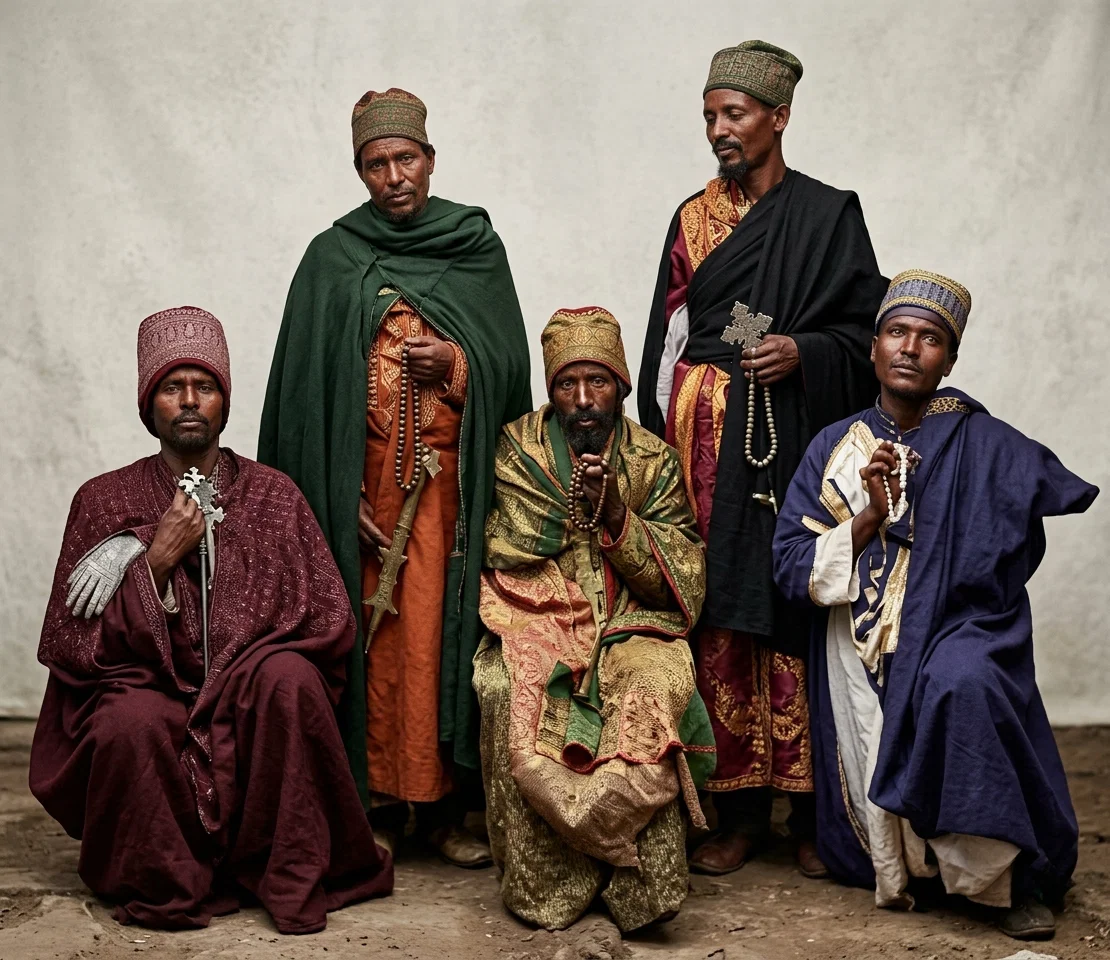
ABYSSINIAN PRIESTS
In the summer of 1885 Ras Alula sent messengers inviting him to Asmara, as he had many wounded ones in his army. Two Italian army physicians went up with him at the same time. Having some difficult cases to look after, the doctor would at times fall on his knees to ask help of the Great Physician. Ras Alula, hearing of this, chose him as his personal physician, but the doctor was obliged to taste the medicine first before he gave it to the ras. Alula became so well pleased that he wanted to retain Dr. Winquist, but was informed that he could consent only upon the condition that his fellow missionaries would be permitted to be with him. But as this permission must be obtained from the king, the doctor returned after two and one-half busy months.
In 1890 a great famine broke out in Abyssinia. Hundreds of people came down to the coast to obtain help. The cholera broke out, and there was no shelter for the sick. Through the assistance of willing friends at home, they were able to distribute a thousand loaves of bread a day, but that was as a drop in the sea. They put up some grass huts for the sick, some of whom lost their senses. Months passed ere some were fully restored. But the help rendered left grateful memories in the hearts of many, who called Monkullo, “The house of the world's Redeemer,” and some of these afterward united with the Swedish Church.
In 1885 the Italians took Massawa over from the Egyptian government. When King John, in 1889, became weakened by inner strifes, the Italians took Asmara and the whole province of Hamasen. Consequently a number of missionaries left the sickly lowlands and opened up stations in the highlands. But the doctor continued his medical mission work at Monkullo in two large grass huts during the cooler months, and in the hot season they went to the highlands and there continued their work.
In 1896, when the war was raging between the Abyssinians and Italians, nearly everybody around Massawa came down with fever. The doctor and his coworkers suffered severely from it, and in order to fully recover, he spent a year in Sweden after thirteen years of hard work. On his return, he began work at Bellesa. Here he soon found it necessary to take hold of the Tigrene language. Among his patients there was a Tigrene teacher, and thus he made good progress with his language study. During their temporary stay in the highlands, they had taken considerable pains to acquaint themselves with the people, with their manner of living and their ways of thinking. They found many of the young people anxious to learn to read. To meet this desire they first published a Tigrene primer at Monkullo. After further study, between the years 1899 and 1901, they printed in Asmara the four Gospels, a small catechism, and9Bible history. As the Tigrene had thus far not been committed to writing, the doctor had to overcome many difficulties. The result of ten years' hard work is that they have just finished the New Testament in the Tigrene, and I found him hard at work with his helpers translating the Old Testament also.
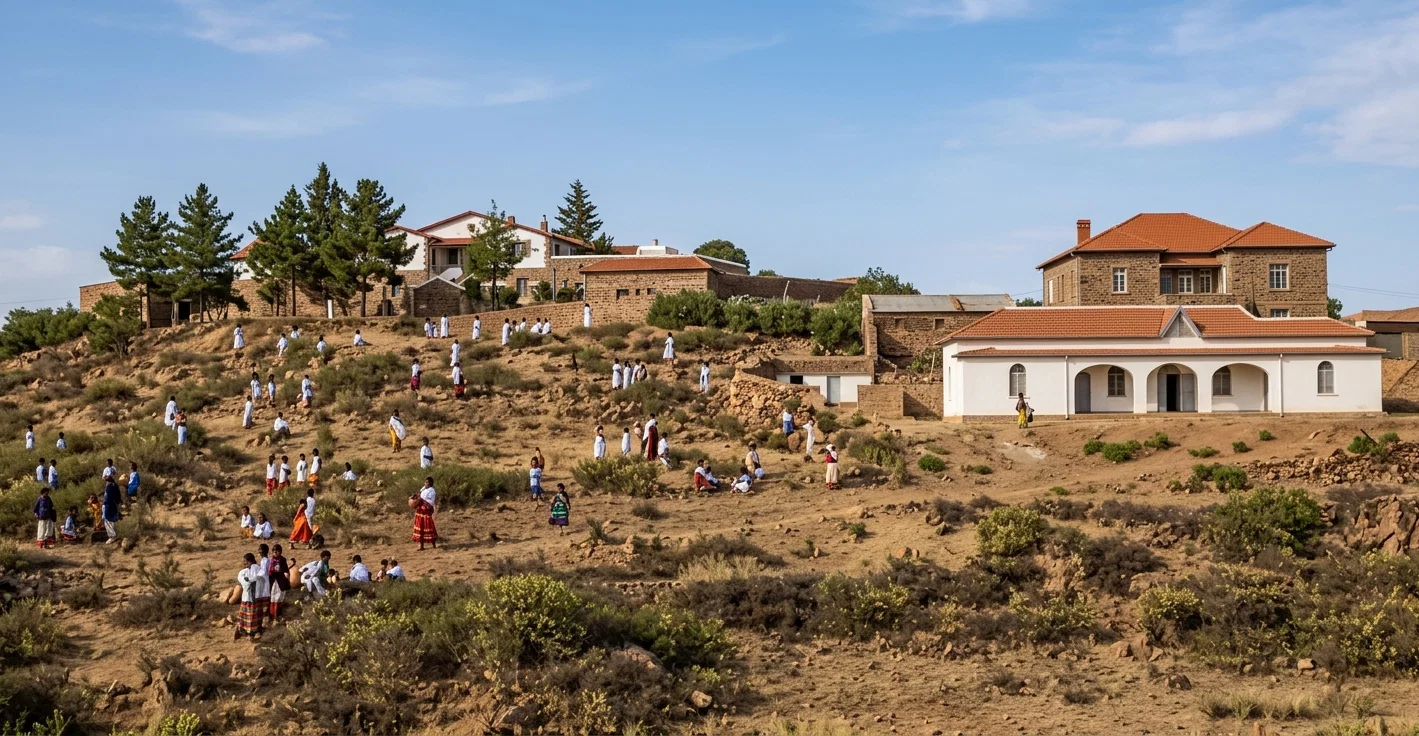
During this time they found it necessary to erect some permanent quarters for the sick who came to Bellesa. As their means were limited, a large one-story building was erected, and divided into different parts. From the picture it can be seen that the building is plain. One large room serves as meeting hall, and at times also as ward for the less ailing class of patients; then there is a ward for women, and one for men, an operating-room, a laboratory, a kitchen, and a provision-room. The hospital has room for twenty patients, and the cost of the buildings was only seven hundred dollars. The beds were made Abyssinian fashion, of stone and cement, and some mixture which gives them a glassy surface easy to be kept clean of insects. Since 1903 the doctor has had a Swedish nurse — a woman — to assist him in his work.
SWEDISH MISSION AT ASMARA
One of the native evangelists reads some part of the Bible each morning and evening, and offers prayer for the sick. They keep the Word of God in the different tongues, so that the patients can study for themselves. Many thus become acquainted with the precious truths of the gospel at the very time when their hearts are most willing to receive it.
An important question was whether the treatments should be entirely free. But as instruments, medicines, bandages, etc., are all expensive, and they had but a limited sum, they soon found it necessary to make a small charge. Many came applying for help, and quite a number of these only wanted to know whether they had any disease, but as soon as they made a nominal charge of ten centimes (or two cents), these last kept away, and only really sick people came. About twenty per cent of all the diseases were eye diseases, and next the cases of malaria from the lowlands. As the people are poorly clad, many suffer from colds. The mission workers have from 3,000 to 5,000 out-patients during the year, while in the hospital itself, they have about 130 annually. With the out-patients, the treatments given vary from between 10,000 to 20,000 a year. The present income is between $600 and $1,000 a year, which covers at least most of the expenses for medicine, etc.
As we went through this small, primitive hospital and saw the grateful faces of the patients, then went to the doctor's study-room and to the room where his translator was busy with the translation of the Bible, and then listened to the doctor's experiences as he has gone on muleback to visit the native houses, we could but realize that here was real medical missionary work — blending the healing of the body with the preaching of the word of life, yes, even providing the latter by translating it into the native tongue. During the twenty-five years, the doctor has been on furlough only once to Sweden. When I asked him why he returned only at the time when his own health was run down, he replied, “I could not leave the many sick.”
Above the hospital, is the doctor's simple home. His wife is a great help to him in translating, being the daughter of a Jewish missionary, and having been reared in Syria. Above his home the mission has a home for sixty girls, and a few simple schoolrooms. As the matron had been in England, she told us freely on what principle the school was conducted. The girls generally stay from two to three years, and while receiving instruction in their mother tongue and handiwork, are at the same time taught the Word of God. Many thus become Protestants. As the girls marry at a very early age, the mission workers have not succeeded as yet in securing good nurses, and there is not much prospect of their being able to use them as teachers. Thus the best the school can do is to educate good wives for the Protestant young men who are educated as teachers, evangelists, printers, etc., at the mission school at Asmara.
Mission work among the Abyssinians presents many difficulties, but here, as elsewhere, if the precious seed is sown with tears, it will bear fruit in time; and here, as elsewhere, true medical missionary work proves a mighty factor in bringing the gospel to the dark natives.
Dr. Winquist called on me in Asmara, November 25, when we had a long talk together about the “present truth,” and I gave him the Special REVIEW and some other periodicals. On December 4 he rode again to town, and the next day, we learned that he had suddenly passed away. So now he rests at Bellesa, until the great Chief Physician gives life indeed. Dr. Vasenius attended the funeral to represent the Seventh-day Adventist Mission.
Hamburg, Germany.
What Nurses Can Do in South America
By John V. Maas
JOHN V. MAAS
Almost from the beginning of our association with the work in South America, we have believed that the medical missionary branch would be most effective among these people, since they are very suspicious of any doctrine except the Catholic confession. So it is unnecessary to say we were made glad by the news that five trained nurses were coming, of whom two were allotted to Uruguay.
The writer at once went to Montevideo, to arrange for their services in that city, the capital, in which live one fifth of the inhabitants of the republic, with no representative of this message.
At our general meeting held January 28 to February 4 we were happily surprised by the arrival of Sister Fannie Brockman and Sister Kerr, who said they would join us in Uruguay. It was, however, deemed best for them to attend our training-school in Argentina for three months, to study the language. After a time, they accompanied Brother Hammerly, a trained nurse from Gland, Switzerland, and his family, to the city of Montevideo. The way has opened for them, and they have been recommended from one house to another to relieve the sick.
One day a rich estanciero (a man who owns a large tract of land) came to the city, from a distance of nearly two hundred miles, to find a good nurse to care for a case of smallpox. Miss Kerr accepted the call, having been recommended by friends of the man. While there two more came down with this disease. But the good Lord gave strength for the service, and blessed with healing. Thus in every case the people have interested themselves more or less in the truths we believe.
Just yesterday a brother came to my house who had passed a night at the neighbors of this estanciero, who told him that a young lady in the estancia was greatly interested in the truth. The people, however, have been very reserved, owing to the prejudice that exists. But the Christian example has been10most effective. Already we have been urged by persons from other cities to open this work, they promising their help and influence. Ladies are more sought as nurses than gentlemen. It might be said that Sisters Kerr and Brockman have been more than self-supporting since they began labor here, in spite of a strange language in a strange country with a strong opposing element. We hope others, for the love of humanity, will deem it a privilege to leave home land and friends to seek and save that which is lost. This field is white for the harvest.
Montevideo.
Nyassaland, British Central Africa
By S. M. Konigmacher
S. M. KONIGMACHER
Since coming to this field, and especially to this station, we have had a varied experience, which has been good for us. It was hard to lose our baby when we first came, because it was so lonely here. But now, as the work is growing, and the school is larger, time passes more rapidly.
We have been looking around for other sites for out-schools, and, by the blessing of the Lord, hope to secure three more, perhaps others. Day before yesterday one man came to ask for a school for his people, who live about thirty or forty miles from here. Thus the influence of the mission is spreading.
Our medical work here is not very extensive, yet we are called out sometimes. Yesterday a boy came to school with a temperature of 103°. One look told me that he was really sick. I took his temperature, and found he had fever. I gave him some salts, and told his companions to take the machila and carry him home. The native is very difficult to treat. He does not like to undergo our treatments; but we can give them sometimes. The other day a little boy came who had been bitten by a snake. I put into the wound the strongest disinfectant I had, and one of the boys cut it open, so that it bled freely. He is all right now.
The natives have the same idea as many people at home—that they must feed their people all the time. They will take a small child, a week old, and literally force the food down its throat with their fingers. One mother fed her one-day-old baby raw corn-meal gruel. It lived only three days. This is a custom. When this little one died, they wanted to bury it in their fashion; but I told the father that we bury our children nicely, just the same as grown people. I wanted to give the child a Christian burial. So my wife sent them over nice new white cloth to wrap it in; and on the way to the grave she found some wild sweet peas, which she plucked, and laid on the child. On arriving at the grave, we read those appropriate words in 1 Thess. 4:13. We had song and prayer. Then I placed some dry grass in the bottom of the grave, and the father laid the baby in, and I covered it with some more dry grass.
One day, while on my way to my nearest out-school, I came to a village where some women were mourning for a child which had died, dancing and crying to drive away the evil spirits. The village is very near my school. I had stopped there some days before, and had tried to administer treatments with my handkerchief and a hot brick. I asked the mother to bring the child to the mission, but she said she could not. It was very sick when I went over, and nothing but expert care, which was impossible in the village, would have saved it. I told the women who were dancing and mourning that that could not drive away the evil spirits, but that they were pleased with that way of doing, that only the Holy Spirit could drive away the evil one.
It was very difficult to get the consent of the chief of this village to allow me to put a school there, because I had been giving some pretty plain talks against their bier dances. After seeing the progress his sons were making at the mission, and after Peter, my head teacher, had talked to them, he consented, and we have an enrolment of more than fifty. I will have to send three teachers. God is surely blessing.
We are glad to hear of the good news from the General Conference, and to see the encouraging reports from other fields. With God's help and the prayers of our people at home, we hope to push forward in Nyassaland.
Blantyre.
R. W. MILLER
By R. W. MILLER
Singapore
R. W. MILLER
SINGAPORE is one half of the way around the world from New York City, and lies within two degrees of the equator. Here the sun rises at 6 A. M. and sets at 6 P. M. the year round. The hills are green, and tropical beauty is everywhere to be seen. The botanical gardens rival those of Java, which are accounted the finest in the world. It is a meeting point in the Orient, at the crossroads of travel. Located on a small island at the tip of the Malay Peninsula, with Burma and Siam to the north, Java and Sumatra to the south and west, and Borneo to the east, it is recognized as a strategic point in commerce and war, and as much so in its educational and religious influences on the populous lands adjacent.
Our hearts were made glad to know of the establishment of our work here. In a neatly constructed chapel located in a good part of the city, Sabbath-school with a membership of seventy, and one preaching service in English and one in Chinese, are conducted each Sabbath day, also a service every Sunday night. At the present time the actual adult following is about forty-five, with a lively interest on the part of many more. Brother and Sister G. F. Jones, who are in charge in Singapore, are energetic, and, while they have had opposition from every quarter, yet, by the grace of God, they are carrying the battle to the gates of the enemy. Each new convert is gained in the face of fierce opposition, and often considerable sacrifice to the individual. Many people of the city are convinced of the truth, but, shrinking from opposition and the loss of friends, are waiting. Now and then one of these takes a bold stand.
Up to this point our effort has been put forth chiefly among the Eurasians and Chinese. Among the Malay Mohammedans little or nothing can be accomplished, because of the evil spirits with which they are in constant communication, who warn them against the Christian missionary, and even threaten their lives; besides, these Mohammedans are very true to their faith, endeavoring to kill those of their number who embrace Christianity. Therefore, in the face of death these people are slow to answer the call of the gospel. It would seem that nothing short of apostolic power will ever reach them. Even medical endeavor among them accomplishes but little, because of the interferences of devils in a manner which I have heretofore not known.
How long will it be before this message will have finished its work? Angels of God are now holding the winds of strife till the sealing shall be accomplished; but at the present time in the Orient one hears much about the restlessness in the English and Dutch possessions. It is feared that soon the natives will rise against the whites. In China, only a few years ago, the Boxer movement demonstrated the true feeling of the masses against all foreign interests. The allied troops then humbled the disorganized forces of the yellow men; but with better organization and modern munitions of war, China, with her four hundred million people, is fast becoming a great military power. Soon the last great world battles will be fought, when blood will flow even to the horses' bridles, and the slain shall be from one end of the earth to the other. But prior to that, God's sealing will have been finished, and the rapidity with which the gospel of the kingdom is now going to every nation under heaven is in itself a sign of solemn interest.
Singapore.
Student Volunteers in Foreign Fields
The Student Volunteer Movement seems to have a deepening hold upon the student body of the country. The Intercollegian gives the names of 379 volunteers for work in the foreign field, 326 of whom had sailed during 1908. These volunteers are connected with forty-seven missionary agencies, and are to be found working in Africa, China, India, Burma, Japan, Korea, South America, Turkey, Alaska, Philippines, West Indies, Mexico, and Arabia. The total number who have sailed since the movement began is 3,861. These missionaries are connected with the Volunteer Movement, but it must not be supposed for a moment that they are the only volunteers. Many others are just as truly volunteers, although not connected with this body.—Missionary Review.