Your ShelfYour Projects

Signs of the Times, Vol. 14, No. 34.

DAVID'S DISTRUST
Earlier text: DID POPE LEO XIII. BLUNDER?

A SPECIAL PROVIDENCE.

PEOPLE used to say that Colonel Fordyce was the wickedest man in Sanford. I am not sure that this was true; but I do know that he gloried in the title, and that he exerted himself to keep up his reputation. His capacity for drink, brutality, and profanity was the talk of the town.
One crisp autumn morning he was returning home after a night's dissipation. The sweet morning twilight grew fainter and fainter, while the pale, rosy hues in the east deepened in color. The hoar-frost lay like fairy lace upon the ground, only to melt like magic with the first beams of the rising sun, and pervading all the air was that lovely silence of the dawn, which comes like a blessing from on high just before the world awakes to resume its duties and its cares laid aside during the darkness of the night. It was a Sabbath morning, but neither the thought of the day nor the sight of its beauty, touched the heart of Colonel Fordyce. Indeed, the contrast was so sharp between this gracious morning, fresh from the hand of God, and the man made in his Creator's image, but now so marred by sin that every trace of likeness was destroyed, that it would not have seemed strange if shocked nature had cried out at him as he passed along. His path led him near a little one-roomed cabin, where lived the village whitewasher, an old colored man, Uncle Jake by name, with Aunt Nancy, his invalid wife. They were old, childless, and poor. Can there be three sadder words than these? Uncle Jake had supported himself and his wife by his trade, but now, enfeebled by age, and crippled by rheumatism, he was unable to work, and starvation seemed very near. As the Colonel passed the cabin door, he caught the sound of Uncle Jake's voice apparently engaged in earnest conversation with somebody.
"I wonder whom the old fellow is talking to so early in the morning," thought the Colonel. His curiosity was aroused, and gently unlatching the door he pushed it slightly open and looked in. He saw Uncle Jake's bent and gnarled old figure seated in a chair which was drawn close beside Aunt Nancy's bed. Her hand was clasped in his, and their eyes were closed, for Uncle Jake was talking to Him who is invisible.
"O blessed Mahster," said the trembling old voice, "dou know how 'tis, but it's a kind o' comfut to tell dee about it. We's cold and hungry—didn't have nothin' to eat yes-t-day, nor night before last. I don' cayah 'bout myself so much, but pore Nancy—she's mos' gone. Ef she don' have somethin' to eat right soon, she'll go suah, an' 'pears like I couldn' stan' dat nohow—not to hey her go dat way Lawd—to starve to death." Here the trembling voice broke and was silent. Presently he resumed: "We can't help ourselves no moah. We ain't got nobody but dee. Dar ware Jim; dou knows how he died fightin' for freedom down to Fort Fisher. Den dar ware Bill—he dune tuk the fever five yeahs back, an' he's gone too, an' dar ware lil' Alice—sweet lamb—been dead dis thirty yeahs. We ain't got no moah children; we got nobody but dee. Oh, Lawd, dou who didst kindle a fire of coals on de seashore, and brile a fish dy own self for dy pore hungry 'ciples, feed us, for we's dy children too. Whar's de ravens, Lawd, phat fed 'Lijah? Whar's de angels what fly to do dy bidding? Ain't dar one of 'em can be spared to fotch us a few mossels? 'cause we's so powerful hungry."
The Colonel listened at first with a scornful smile at the "superstitious old beggar," as he mentally termed him, but gradually a gentler feeling warmed his miserable heart than had visited it for many a day. He knew old Jake well, he had known his boys too, they used to play together, ah, how long ago! And now their father and mother were starving to death not twenty rods from the Colonel's own door. The poor fragment of conscience which he had left aroused itself, and stung him for his inhumanity. He went home as fast as he could go. When he reached the door he entered quietly, and proceeded at once to pantry and store-room. Selecting two large baskets, he filled them with provisions, most of which had been prepared for the Sunday's table. In one he placed a roasted chicken, a part of a roast of beef, bread, butter, a bottle of milk, and some sugar. The other he filled with potatoes, rice, a dozen of eggs, and various other substantials. He glanced from one to the other when they were filled.
He took the baskets, one in each hand—not for years had he borne so heavy a burden—and, carrying them back, set them gently on Jake's door-step.
"I wonder if he's praying yet," he said to himself; he listened again, and caught one faint murmur, "Dy will be done."
He knocked on the door, slipped out of sight, and waited.
"What's dat?" said old Jake in a startled tone; "'pears like 'twas a knock. P'raps de good Lawd's done heard me at last."
He crept slowly and painfully to the door, opened it, and saw the two baskets sitting there.
"Nancy," he cried, his voice strong with joy and excitement, "de good Lawd's done drop two bahskets right down outen de sky onto our do-step. He must a done it hisself, honey," he continued, clinging to the doorpost, "I don't see no angels, an' I don't hear notin' 'cept one of Harry Perkinses doves a cooin'. Bless de Lawd, O my soul, an' forgit not all his benefits. Here's milk, honey," said he joyously, as he began to unload his treasure. "An' I declare, frash aigs, an' bread an' butter, an a roas' chicken. I'll hobble out an' get some chips, and bile the kittle—no—fust of all, I'll beat up an aig in milk fur you, an' then we'll have breakfast, an' see if we can't try and return thanks. Bless the Lawd; he ain't forgit us yit."
The Colonel turned homeward, exhausted by his unwonted exertions, and with a throng of hateful and embittering thoughts springing up to choke the little seed of goodness which had so strangely sprouted in his soul. He entered his beautiful home and greeted his wife with more than his usual irritability of manner, and, seeking his room, lay down upon his bed to rest. When he arose, weary and unrefreshed, he gave orders that on the morrow a full stock of provisions and fuel should be sent to old Jake's. "And see to it," said he to his wife with a scowl, "that in the future, as long as they live, they lack for nothing."
A few days after this he met the minister of the church which his wife attended. "Ah, Parson," said he, "I have a story to tell you," and he related the incident which I have just written. "And that," he concluded, "is the way this God of yours answers prayer. Poor Uncle Jake thought the baskets floated right down from Heaven, but he was disillusioned next day when my man John trundled a wheelbarrow load of things up to his door, and told him they came from me."
"Uncle Jake was not so much mistaken as you think," responded the minister quietly. "And you are right—that is the way my God answers prayer. It does not matter to him who is the special agent of his providence so long as his bidding is fulfilled."
"Well," said the Colonel in astonishment, "it is the first time I ever knew myself to act in the capacity you mention."
"And Uncle Jake," continued the minister, smiling slightly, "tells me that now he knows where the bounty comes from, he is surer than ever that it is the Lord's doing, for no one else he thinks could have influenced you to do such a generous deed; and he is going to pray every day as long as he lives, for the salvation of your soul, Colonel Fordyce, and I hope that his prayer will be answered."
"Humph!" responded the Colonel, and walked away without a word.
Shortly afterward Colonel Fordyce died of an illness caused by excessive dissipation, and only the God to whom Uncle Jake so trustfully prayed knows whether his prayer was answered.—Eleanor A. Hunter, in the Advance.

"ANSWER HIM SOFTLY."

Answer him softly. You cannot know In the depths below How sharp was the struggle, the fight he made Ere the price he paid, And yielded his soul to the tempter's power In a hasty hour.
Answer him softly; for it may be— Like the sturdy tree, Which tested, in many a storm, its strength, To be rent at length— He struggled full oft, and resisted well, Though at last he fell.
Answer him softly, lest you be tried On your weaker side, And fail, as before you so many have done, Who in thought had won; Fail, too, ere temptation had spent its force In its subtle course.
Answer him softly; for none can tell, When the storm clouds swell, Whose barque shall weather the tempest, or whose Its venture shall lose. Speak gently; the weakest may stand the gale, The stoutest may fail.
—G. N., in the Traveler.

WINE AND BEER DRINKING AND DRUNKENNESS.

DR. FELIX L. OSWALD, in Popular Science Monthly, says:—
"It is, indeed, a remarkable circumstance that in the home of the best wine grapes, in Greece and Southern Spain, drunkenness is far less prevalent than in Scotland, or in Russia Poland, where Bacchus can tempt his votaries only with nauseous vodka."
And commenting upon this statement, the Santa Clara Valley (Cal.) says:—
"To this very significant observation, from a great authority, it may be added that intemperance, in all grape-producing and wine-drinking countries, is far less than in the non-grape-producing, and rum, whisky, and gin-drinking countries. Therefore, all rational temperance men, like those of France and Germany, should advocate wine as a beverage, to the exclusion of distilled alcoholic liquors; and, like them, whenever it may be necessary, pledge the people against their uses in social life, as prone to lead to appalling abuses, such as now disgrace, in many nations, including our own, the civilization of the age in which we live."
The same claim is made for beer, namely, that it promotes temperance; but it has been shown time and again that the claim is equally fallacious in both cases. Alcohol creates an appetite for alcohol, no matter in what form it is taken, and it is for the alcohol which wine and beer contain that people drink them.
Palestine is a wine-producing country, and for years the statement has been persistently peddled that "Palestinian wine is so pure that it does not produce intoxication." Of course this statement is utterly absurd, for any wine which contains enough alcohol to prevent its souring will produce intoxication. Selah Merrill, D. D., LL.D., says:—
"While living in Jerusalem I observed this matter closely, and made many inquiries of persons who ought to know the facts, as physicians and officials of various kinds, and my conclusion is that, outside of the Mohammedan population, the use of liquor, in some form, is almost universal, and that among the Mohammedans themselves the evil is spreading rapidly. In America people drink liquor in places where it is sold, and go home drunk. In Jerusalem people buy liquor, go home sober, and drink in their own houses. A banker who had lived all his life in Jerusalem, and who had special opportunities for knowing the habits of the citizens, told me that two-thirds of the people of the city went to bed every night under the influence of liquor."
This, be it remembered, is in a country where "great quantities of wine are produced" not only for home consumption but for export; and there is good reason to believe that the people of Palestine are about as temperate as they are in other wine-producing countries. Indeed, it is highly probable that they are more so than the people of France or of the wine-drinking countries cited by the Santa Clara Valley. France consumes annually nearly thirty-nine gallons of wine per capita—very much more than any other nation, and drunkenness is increasing so rapidly that even her wine-soaked law-makers are becoming alarmed, declaring it a "public danger that demands attention."
In 1830 England tried the experiment of substituting beer for stronger liquors. Many thousands of beer shops were licensed, and an effort was made to induce the people to leave off drinking gin. The result was a larger consumption of spirits and a fearful increase in drunkenness and its attendant evils. Sidney Smith was a supporter of the bill, but after it went into operation and he had had opportunity to observe its practical workings, he wrote: "The new beer bill has begun its operations. Everybody is drunk; those who are not singing are sprawling. The sovereign people are in a beastly state." And so they are likely to be in every wine and beer-drinking country.
The claim was made years ago in California that the production of wine and beer would have a tendency to decrease the consumption of the stronger liquors, but who does not know that such has not been the case? Wine and beer drinking foster, or create, rather, an appetite for other and stronger liquors, and this is just as true in California as in any other country. Intemperance is on the increase in our State to-day, and it will continue on the increase as long as wine and beer are common beverages.
The experience of Switzerland is another case in point. That is one of the greatest wine-producing countries, but drunkenness was increasing so rapidly there that the Government found it necessary some two or three years since to enact very stringent prohibitory laws for the purpose of checking the evil. Belgium is one of the greatest beer-producing and beer-drinking countries in the world, and it is the very head-center of drunkenness. The popular drinks are beer, wine, and gin, and there is one dram shop to every forty-four of the population. San Francisco, in wine-producing California, comes second in the shameful list, with one saloon for every sixty of her population; while the State at large has one place in which liquor is sold for every ninety inhabitants—men, women, and children. And wine production in this State is only in its infancy. If the evil continues unchecked, how long will it be before drunkenness will be as common here as in Belgium?
Dr. Oswald's statement quoted in the outset of this article may possibly be correct so far as Russian Poland is concerned; but even if it were correct as to Scotland also, it would indeed be "a remarkable fact," for, in that case, Greece and Southern Spain must be exceptions to other wine-producing countries, and the sobriety of the people must be due to some cause or causes other than the fact of their being wine countries.
Californians see millions in the wine business, and a great many people regard as enemies of the commonwealth all who say aught against the wine industry. But a besotted people have never yet been a wealthy and a prosperous people, and, in the very nature of things, never can be; and while a few may grow rich by making their neighbors drunken, the State at large must, of necessity, grow poorer as drunkenness increases, as it is sure to do just in proportion as the production of wine increases. The real enemies of our noble State are these who for a little present gain are doing all in their power to reduce her to the condition of besotted Belgium.—Pacific Health Journal.

BE CONSIDERATE WITH THE CHILDREN.

A child enjoys himself more heartily, when he does enjoy himself, than an older person does. That everybody admits. A child suffers at heart more keenly, when he does suffer at heart, than does an older person. That is not recognized by everybody. A child's power of enjoyment is made a proverb. A child's power of mental suffering is hardly thought of by the world generally. . . .
Yet, as a matter of fact, and as a matter of course, a child's intenser sensitiveness gives it the same added power of suffering as of enjoyment; and the little ones about us have a harder time of it in the days of their childhood than we know anything about—save as we remember our childhood, and retain more or less of its freshness in our maturer years. We say that we "take things more philosophically as we grow older," which is only another way of saying that we grow tougher-hearted. But even if this be the case with ourselves, let us remember that the little ones who lack our measure of philosophy deserve, therefore, a larger share of our sympathy. It is good to have the light-heartedness of a child. It is hard to have the heart-racking sorrows of a child. Children deserve our love, and they need our pity. Moreover, because children are so sensitive, they demand considerateness of treatment from us all. It is a cruel thing to disregard a child's feelings. —S. S. Times.

AUTOSTEREOTYPE.

A NEW process of so-called autostereotypic printing, especially adapted for the reproduction of books and engravings, has lately been invented in Switzerland, and is already used with advantage in a large printing office at Zurich. The process will cheapen the reprinting of the works of foreign authors, since the type-setting and copying of engravings are saved, and an accurate stereotype plate is obtained directly from the original. It is a transfer process, in which a blank, composed of plaster of Paris, silicate of potash or soda, and phosphate of lime, is employed. The print to be copied is moistened in a solution of phosphate of soda in distilled water, alcohol, and acetic ether, and then transferred in the usual way to the plaster of Paris plate previously coated with a film of gelatine containing citrate of iron and ammonia. After the transfer (all the processes thus far having been conducted in a dark room) the plate is dried and exposed to direct sunlight for fifteen minutes. When taken out the places acted upon by the light will be found to be quite hard, while at the other places the plaster will be soft, and will fall off as fine powder as deep as the solution shall have penetrated, if brushed with a hard brush. The plate will then be ready to be stereotyped.—Public Opinion.

Godly Rule in the Home

WHEN home is ruled according to God's word, angels might be asked to stay at night with us, and they would not find themselves out of their sphere.—Spurgeon.

SECULAR.

—Civil war again threatens Madagascar.
—The new Chinese Exclusion Bill has passed the House.
—Henry Villard is said to be interested in an expedition to the south pole.
—Forest fires have recently destroyed a number of villages on the Italian frontier.
—A bill appropriating $200,000 for the suppression of yellow fever has passed the United States Senate.
—Three prominent citizens of Ogdensburg, N. Y., were arrested on the 23d inst. for smuggling opium.
—The much-talked-of Fisheries Treaty, from which so much was expected, has been rejected by the Senate.
—It is expected that the wheat crop of India will reach 260,000,000 bushels, of 62 pounds each. This is a large yield.
—There is said to be a marked falling off in the volume of objectionable immigration on several of the steamship lines noticed at New York. It is attributed in great part to the congressional inquiry which is now in progress there.
—Eight car loads of raisins were sold from a ranch near Woodland, Cal., on the 25th, at an advance on last year's prices.
—One of the periodic powder mill explosions occurred near Oakland, on the 24th inst. Five men were blown to atoms.
—A storm on the night of the 21st inst. caused damage in the upper Ohio Valley, to an amount exceeding a million dollars.
—August 20 exceedingly heavy rains were reported in various parts of the South. Considerable damage was done, especially at New Orleans.
—In a late type-writing match at Cincinnati the winner wrote 8,700 words in ninety minutes, an average of over ninety-six words per minute.
—A Vienna correspondent of the London Daily News writes that King Otto, of Bavaria, is sinking fast, his fits of insanity having become much more frequent.
—It seems not improbable that the rejection of the Fisheries Treaty by the Senate may result in considerable friction between this Government and Great Britain.
—General Boulanger has been re-elected to the French Chamber of Deputies in three several districts. It is thought that he will sit for the Department of the Nord.
—At a recent meeting of the shareholders of the Panama Canal Company in Paris, M. de Lesseps promised, on behalf of the directors, that the canal will be opened in 1890.
—At the recent competition for the Graham prize, Fredrick Ireland, a Detroit stenographer, wrote, on an average, 261 words per minute for five consecutive minutes. Others followed closely, at 257 and 253.
—It is asserted that the treasury surplus of $100,000,000, which only a few months ago seemed to trouble our statesmen so much, has dwindled to about $13,000,000. Just how it has all been used is not stated.
—The joint statement of the United States Senate and House Committees on appropriations, up to August 15, shows the grand total of appropriations to be $482,269,520.55, an excess of $64,054,730.81 over last year.
—It is reported that a syndicate, backed by Berlin capital, is secretly buying up all available timber lands in Minnesota and Wisconsin. Already vast tracts have been secured and others are being steadily absorbed.
—August 22 the steamers Oceanic and City of Chester collided in the Golden Gate, San Francisco, and the latter vessel sunk in about seven minutes from the time of the collision. The Oceanic was uninjured. Fifteen lives were lost.
—Governor Ross, of New Mexico, has called out a special force of fifty armed men, to appear at the sitting of the District Court, in Colfax County, next month. Many cases of ejectment against squatters are to be tried at that term, and serious trouble is expected.
—A vendetta has been declared between the Lea and John Good factions in the eastern part of Doña Ana County, New Mexico. One man has been killed on each side, and it is thought that an appeal will be made to Governor Ross to call out the militia, in order to still the disturbance.
—August 23 a large paper mill at Neenah, Wis., was destroyed by fire. When cold water was thrown on the boilers by the firemen they exploded with terrific force. Eighteen persons were killed by the flying debris, seven were fatally injured, and a number of others were injured less seriously.
—An irrigating reservoir, a magnificent engineering work of the fifth century, which had been partially destroyed, has been restored in Ceylon. It covers an area of 4,425 acres, or about seven square miles, from which water is taken to smaller distributing tanks more than fifty miles away.
—It is stated that the beautiful farm of the late Henry Ward Beecher at Peekskill is going to waste, none of his heirs having the means wherewith to carry on fancy farming the way Mr. Beecher used to do. This farm cost the great preacher about $300,000, and his executors would like to sell it for $80,000.
—August 21 the Atlantic Coast was swept by a most destructive rain and wind-storm, amounting in some sections almost to a cyclone. At Wilmington one person was killed and seven were seriously wounded; houses were blown down and trees were uprooted. Many other places also suffered severely. At Morgan City a steamer was wrecked. At Salem, N. J., a large number of buildings were destroyed. Damage was done as far west as Pittsburgh and Wheeling.
—President Cleveland has sent a message to Congress, asking for power to retaliate because of Canadian discrimination against American fishermen. He says that he wishes to close all American ports to Canadian vessels, and to prohibit the free transportation of Canadian goods in bond, through the United States.
—Dr. Gatling, the inventor of the gun which bears his name, has, it is claimed, invented a new method of making heavy ordnance, which will entirely revolutionize the entire system of manufacturing heavy missile-projectors now in vogue. Dr. Gatling's new invention is stated to be the casting of the heaviest ordnance in solid steel around a central core. The result is the production of a very much better gun at a reduction of about fifty per cent. over the old method.
—A dispatch from Trinidad, Col., August 25, says: "What may prove a long and bloody struggle opened to-day on the Maxwell grant at Stonewall, forty miles west of Trinidad. A sheriff's posse sent to keep the peace was met by armed settlers in numbers estimated at 200 to 500 men. The settlers demanded the arms of the posse, which demand was refused. The posse took up quarters in the Pooler Hotel, a large frame building. The settlers endeavored to force an entrance, when the posse opened fire. R. D. Russell, one of the oldest settlers, fell dead, and two or three other settlers were wounded." The settlers were both Mexicans and Americans, and the Mexicans were painted as if for war.
—A woman was recently arrested in San Francisco for procuring, by means of deceptive advertisements, innocent girls, for the basest purposes. The evidence against her seems to have been very strong, but for some unaccountable reason she was allowed to plead guilty to a minor charge, and thus escape with a fine. It is openly charged that her trial would have implicated a number of prominent men in San Francisco, and that is the reason why the case was disposed of as it was. A prominent paper published in that city says: "Evidently there was strong political influence back of her, which paralyzed the judicial machinery, and prevented the procurers from meeting the fate that she so richly deserved. The case is only one more added to the long roll of defeats of justice due to the vilest influences. Without influential backers this woman would have been sent to jail for six months, as the case against her was strong."

Obituary.

WEEKS.—Sister Rachel Weeks died of typhoid malarial fever after an illness of two weeks, at the residence of her son, in Sacramento, Cal., August 20, 1888, aged 68 years, 5 months, and 28 days.
Sister Weeks was born in Wilmington, Ohio, and came to California about twelve years ago. She was the mother of eleven children, and from their earliest recollection was a consistent Christian mother. Two sons and one daughter, all that remain of her children, also an aged and feeble husband, were at the funeral. These, with other near relatives, deeply mourn their loss. May her godly example and admonitory words never be forgotten by them. Sister Weeks became a Seventh-day Adventist about four years ago, and for her meek and quiet spirit was beloved by all. The little church in Sacramento will miss her much. She died happy in the Lord—said her lamp was trimmed and burning, and we believe she sleeps in Jesus, only to awaken in the morning of the resurrection to a glorious immortality. Sermon by the writer from 1 Thess. 4:13.
H. A. ST. JOHN.

HOME HAND BOOK.

-OF- DOMESTIC HYGIENE AND RATIONAL MEDICINE. By J. H. Kellogg, M. D.
Member of the American and British Associations for the advancement of Science, The Societe' D' Hygiene of France, The American Public Health Association, The American Social Science Association, The American Society of Microscopists, etc.
Contains over 1,600 Pages. Is Illustrated with 500 Engravings, Including 26 Full Page Colored Plates, and a Paper Manikin.
The "Home Hand Book" tells in plain, every-day language, how to preserve health, and if lost, how to regain it. It is, by far, the most important medical work for domestic use that has yet appeared, and is rapidly making its way into the homes of the Pacific Coast. It is written in the light of the most recent scientific investigation by a physician of large experience and acknowledged ability, and contains the most approved methods for the treatment of more than 600 diseases. It is the most complete work of the kind ever issued.
THIS BOOK IS SOLD ONLY BY SUBSCRIPTION. For sample copies, territory, and terms, Address, PACIFIC PRESS, Oakland, Cal.

RELIGIOUS.

—A colony of Russian Jews has been started in New Jersey, by the Jewish Alliance. The colonists have built a synagogue, which was dedicated with great rejoicings.
—Bishop Fallows, of the Reformed Episcopal Church, is said to have expressed the opinion that "the time has come for the setting apart of woman for the work of the gospel ministry."
—A Presbyterian missionary in India is credited with the statement that some of the best native Christian preachers come from the fakirs. He says some of the fakirs are outwardly pure, striving by painful austerities to work out a righteousness of their own.
—The annual report of the China Inland Mission for the past year gives the number of its stations at 64 in 15 provinces, with 65 out-stations, 110 chapels, 294 missionaries, 132 helpers, and 2,105 communicants. The number of persons baptized last year was 551. There are 66 organized churches.
—Forty Irish members of Parliament have signed a declaration to the Pope in which they tell him that they "can recognize no right of the Holy See to interfere with the Irish people in the management of their political affairs." Of course in so doing they have denied about everything which the Popes have always held dear.
—The Missionary says: "Hundreds of the natives of the South Sea Islands have sacrificed their lives in carrying the gospel to the heathen. From one church in the Havre group, sixty have been killed while acting as missionaries. Shall not these examples arouse many among us to do and venture all that the perishing may be saved?"
—The statement is made that the Greeks are showing great solicitude for the improvement of their priests. The reason for this seems to be that their eyes have been opened, and they see that the religious indifference manifested by the people is due to the fact that the priesthood occupies such a low plane intellectually, morally, and religiously.
—A Tract Society has been founded in Brazil for the purpose of providing Christian literature for the 3,000 Protestant families of the empire, as well as for others who can be reached by it. The Religious Tract Society of London will aid the work, and one of the most eminent scholars of Brazil, Gen. Couto Megalhaes, has given $1,000 towards this enterprise.
—The Swedish Lutherans have a college and seminary at Rock Island, Ill., which has an attendance of over three hundred pupils, and graduates annually about seventy-five students. They also have a high school and college at St. Peter, Minn., one at Wahoo, Neb., and another at Linchburgh, Kan., besides five orphan schools in operation.
—A wealthy brewer (brewers are all wealthy) has offered to build a cathedral in Liverpool at a cost of $1,250,000. Some of the religious papers object decidedly. They say he is not only a brewer but is owner of a large number of drink shops in Liverpool. The money he would put into the cathedral is, they say, "blood money," and it ought not to be accepted. It is recently reported, however, that Bishop Ryle has accepted the offer.

The Mt. Vernon Health Home,

MT. VERNON, OHIO.

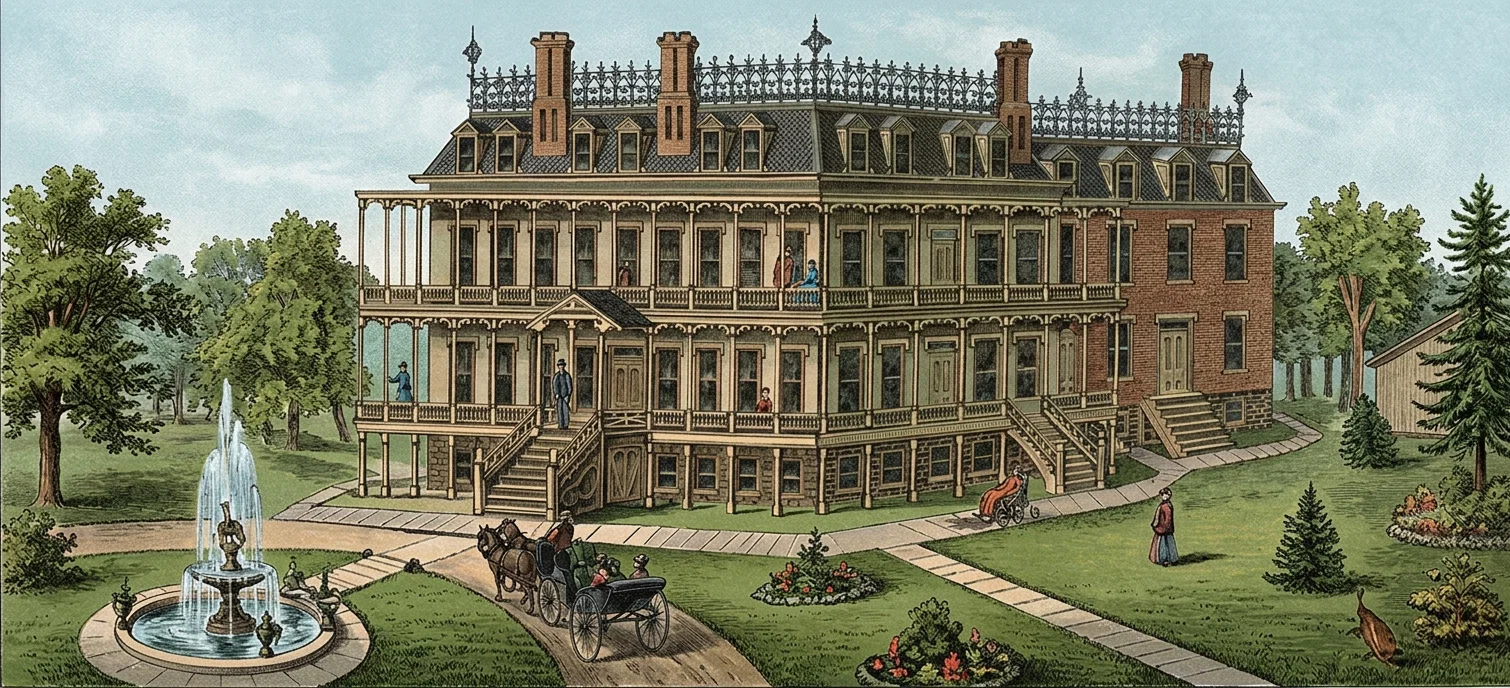
This institution offers unrivaled advantages to ALL CLASSES OF INVALIDS, both in winter and summer. It is situated on an elevated site, about one mile northeast of the beautiful little city of Mt. Vernon, Ohio. Spacious grounds about and in front of the Home are laid out in artistic lawns, with beautiful picturesque surroundings, which are but few of the natural advantages. The fine OAK GROVES in close proximity afford pleasant shade and a delightful place for out-of-door recreation in summer. From the roof and spacious verandas, and many of the private rooms, is obtained a delightful view of natural scenery of great variety. Some of the chief characteristics of this place are its dry atmosphere, clear sunshine, the remarkably even temperature, balmy breezes, absence from storms and high winds, the salubriousness of its climate, with absolute freedom from malaria.

RATIONAL TREATMENT.

No special method is relied upon exclusively. All remedies of established value are employed. In addition to ordinary remedial agents, such a system of baths will be employed as may be found in any well-regulated sanitarium. The Turkish, Russian, Electro-Thermal, Electro-Vapor, Hot Air, Vapor, Shampoo, Saline-Sponge, Vinegar-Sponge, Salt-Glow, Wet-Hand-Rub, and other miscellaneous methods: Nasal Douche, Oil-Bath, Inhalation of Oxygen, and Alkaline Bath. These Baths will be prescribed as are from time to time found necessary. Electricity, Manual Swedish Movements, Indian Club and Dumb-Bell exercises are also adjuncts. In fact, the most perfect facilities for thorough and scientific treatment of the sick are employed in this institution.
The buildings are commodious and pleasant, elegantly furnished and thoroughly warmed and ventilated by the most PERFECT SYSTEM OF HEATING AND VENTILATING ever devised. Every room is supplied with pure, steam-heated air, which is replaced by newly-heated fresh air every minute, thus preventing rebreathing the same air. In addition to the new building shown above, several fine cottages in close proximity are owned and used by the company for the accommodation of patients or boarders. The Home is abundantly furnished with hot and cold water, the supply being obtained from springs in the adjacent grove, which for purity is equaled only by that which is distilled. The benefits to be derived from such water for drinking and bathing purposes can scarcely be estimated. Scores of reliable testimonials can be adduced, if desired, showing the remarkable cures which have resulted from drinking and bathing in the water of these celebrated springs.
With all the foregoing advantages, thorough and judicious treatment and wholesome diet, most invalids who avail themselves of these advantages, rapidly recover. Our patients have the care of a regularly graduated physician, of several years' experience, who is assisted by lady and gentleman attendants of several years' experience in similar institutions. All invalids can rest assured they will be kindly cared for. For descriptive circulars, terms, and further particulars, address, J. S. MAXSON, M. D., or

THE HEALTH HOME, Mount Vernon, Ohio.

RECEIPTS.

NOTICE.—The change of figures on the address labels will be in all cases a sufficient receipt for money sent for the paper. If these changes do not appear in due time, and if books ordered by mail are not received, please notify us. All other business is acknowledged below.
  1. REMIT by Bank Draft, Money Order, or Express Order.
  2. If Postal Note or paper money is sent, register the letter.
  3. Drafts should be made payable to the PACIFIC PRESS, on New York or San Francisco banks. Those written on other banks cost us exchange.
RECEIVED ON ACCOUNT.—Neb T and M Society $50, Vt T and M Society $100.
CALIFORNIA T. AND M. SOCIETY.—Dist No 1 Healdsburg $40, Dist No 2 Vacaville $7, Dist No 3 Oakland $2.40, Dist No 8 Arcata $15.15.
CALIFORNIA CONFERENCE FUND.—Eugene Brown $5, A G Anderson $3.75, San Jose $29, Los Angeles $81.80, Geo Thatcher $2.50, Duarte $4.

THEY LIKE THE "SENTINEL."

THE following is a sample of the many encouraging letters received from time to time by the editors and publishers of the American Sentinel:—
"SOUTH ROYALTON, Vt., August 7, 1888.
"Editors American Sentinel: Last year my wife and I subscribed for the Sentinel, and its monthly visits have been so pleasant and profitable that we are not willing that our subscription should expire. Inclosed find money for renewal.
"By profession I am a clergyman: I have made Romanism a special study, and I think that I understand something about the National Reform movement. Its success would be in the interest of Romanism in this country. It seems to me that Protestants are asleep.
"Romanism has gained an important victory in Germany, but a greater battle is to be fought in this country, and a greater victory awaits the minions of Rome here unless the friends of religious liberty awake soon to the danger. But what can we hope for when men like Doctor Field are gravitating so rapidly Romeward? In the name of the right, I bid you Godspeed."

RAILROAD FARE TO THE OAKLAND CAMP-MEETING.

The arrangements that have been made with the S. P. Co. and the S. F. & N. P. R. R. are the same as those of last year.
People coming to the State camp-meeting at Oakland over any of the lines of the S. P. Co. will purchase a first-class ticket to Oakland, paying the regular fare, and at the same time presenting a certificate, which must be filled out and signed by the ticket agent. After these certificates have been indorsed by the secretary of the conference at the camp-ground, they will entitle the holders to return tickets at one-third the regular rate at any time up to October 5. These certificates can now be obtained free of charge by addressing Pacific Press, Oakland, Cal.
Where several persons are coming from the same locality, it would be well to request some one person to send for enough certificates for all.
Those coming over the S. F. & N. P. R. R. will call for camp-meeting tickets, and will receive round-trip tickets to San Francisco at the following rates:— Cloverdale to San Francisco and return - - $5 00 Healdsburg " " " " " - - 3 00 Santa Rosa " " " " " - - 2 75 Petaluma " " " " " - - 1 50
These tickets will be good from Monday, September 10, to Monday, October 8. Each person will be allowed to take 100 pounds of baggage free. Those coming via San Jose and intermediate points, should check baggage to, and get off at, the station at the foot of Market Street, Oakland. Those coming via Benicia should check baggage to, and get off at, Sixteenth Street Station. Teams will be in readiness to transfer baggage; and horse-cars for the transfer of passengers run direct from the depot to the grounds. C. H. JONES.

PACIFIC HEALTH JOURNAL

AND TEMPERANCE ADVOCATE.

A THIRTY-TWO PAGE MONTHLY MAGAZINE, devoted to the dissemination of true temperance principles, and instruction in the art of preserving health. It is emphatically

A JOURNAL FOR THE PEOPLE,

Containing what everybody wants to know, and is thoroughly practical. Its range of subjects is unlimited, embracing everything that in any way affects the health. Its articles being short and pointed, it is specially adapted to farmers, mechanics, and housekeepers, who have but little leisure for reading. It is just the journal that every family needs, and may be read with profit by all. Price, $1.00 per year, or with the 300-page premium book—“Practical Manual of Hygiene and Temperance,” containing household and cooking recipes—post-paid for $1.40.
Address, PACIFIC PRESS, Publishers, Oakland, Cal.
Continue reading: THE AMERICAN SENTINEL