THE extent of the walls of Babylon is variously stated; by Herodotus at 480 stadia, or furlongs, in circumference; by Pliny and Solinus at sixty Roman miles, or of equal extent; by Strabo at 385 stadia; by Diodorus Siculus, according to the slightly different testimony of Ctesias and Clitarchus, both of whom visited Babylon, at 360 or 365; and to the last of these statements that of Quintus Curtius nearly corresponds; namely, 368. The difference of a few stadia rather confirms than disproves the general accuracy of the last three of these accounts. There may have been an error in the text of Herodotus of 480 instead of 380, which Pliny and Solinus may have copied. The variation of 20 or 25 stadia, in excess, may have been caused by the line of measurement having been outside of the trench, and not immediately of the wall. And thus the various statements may be brought nearly to correspond. Major Rennel, estimating the stadium at 491 feet, computes the extent of the wall at 34 miles, or eight and a half on each side. The opposite and contradictory statements of the height and breadth of the wall may possibly be best reconciled on the supposition that they refer to different periods. Herodotus states the height to have been 200 cubits, or 300 feet, and the breadth 50 cubits, 75 feet. According to Curtius, the height was 130 feet, and the breadth 32; while Strabo states the height at 75 feet, and the breadth at 32 feet.—Foot-note in Keith’s “The Evidence of Prophecy,” page 396.
Babylon’s Golden Head
THE epithet “golden” [“head of gold”] is descriptive, for it is historically certain that Babylon was an “exactress of gold,” as it is rendered in the margin of our Bible [Isa. 14:4], beyond any other ruling city in the world. The wedge of gold and the embroidered garment found concealed in Achan’s tent eight centuries and a half before Daniel interpreted this dream, were brought from Babylon, the oldest city in the world, being richest in precious treasure. This was “the treasure-house of the kingdom,” wherein were deposited the spoils of conquest, and the accumulated tribute of subject states.—“An Historical Exposition of the Book of Daniel the Prophet,” by William Harris Rule, D. D., London, 1869, page 71.
Lessons from History
God would have us study the history of his dealings with men and nations in the past that we may learn to respect and obey his messages, that we may take heed to his warnings and counsels.— Mrs. E. G. White, in The Review and Herald, Nov 5, 1899.
Too Busy
THERE are thousands of mothers who are so overburdened with trying to meet the daily material wants of the family that there really seems to be no time for training their children's minds and souls. Let such consider the following incident:—
I have seen a woman who was absolutely ignorant of her children's habits of thought, who never felt that she could spare a half-hour to read or talk with them: I have seen this woman spend ten minutes in ironing a sheet (there were six in the washing), one hour in fluting and arranging the puffs of her little girl's “sweet white suit,” thirty minutes in polishing tins that were already bright and clean, and thirty minutes in frosting and decorating for tea, because “company was expected.”
When that mother, a good, orthodox Christian, shall appear before the great white throne to be judged for the deeds done in the body, and to give in her report of the Master's treasure placed in her care, there will be questions and answers like these:—
“Where are the boys and girls I gave thee?”
Answer.—“Lord, I was busy keeping my house clean and in order, and my children wandered away.”
“Where wert thou when thy sons and daughters were learning lessons of dishonesty, malice, and impurity?”
Answer.—“Lord, I was polishing the furniture, ruffling dresses, and making beautiful rugs.”
“What hast thou to show for thy life-work?”
Answer.—“The tidiest house, Lord,13and the best starching and ironing in all our neighborhood.”
O, these children! these children! the restless, eager boys and girls whom we love more than our lives! Shall we devote our time and strength to that which perisheth, while the rich garden of our child's soul lies neglected, with foul weeds choking out all worthy and beautiful growths? Shall we exalt the incidentals of life to the rank of a purpose, to the shutting out of that work whose results reach beyond the stars?
Fleeting, O mother, are the days of childhood! Speckless windows, snowy linen, the consciousness that everything about the house is faultlessly bright and clean, will be poor comfort in that day wherein we shall discover that our poor boy's feet have chosen the path that shall take him out of the way to all eternity.
—Christian Observer.
The Cigarette Evil
By Geo. Thomason, M. D.
THE terrible ravages of the deadly cigarette are becoming more and more apparent from year to year. They are such as to give good ground for the fear that the future welfare of the nation is greatly jeopardized. Those giving only casual study to the matter find overwhelming evidence that cigarette smoking is rapidly sapping the vitality and strength of our boys and young men.
Mr. Frank Swan, Honorable Secretary to the Boys’ Anti-Cigarette League, of Birmingham, England, who has given very extensive study to the subject, goes so far as to say, “A far greater danger is threatening the rising generation from cigarette smoking than from drink.” When the frightful consequences of drink are considered, it seems hardly possible that such a statement could be true; but abundant supportive evidence would seem to emphasize it. Over 100,000,000 cigarettes are sold weekly in the United Kingdom, in penny packets alone; 86,745,000 pounds of tobacco are consumed every year in England, entailing an expenditure of £25,000,000, or more than double what it was fifty years ago. During the last ten years cigarette smoking has increased one hundred fifty per cent in England. Cigarette smoking among the Germans has increased more than one thousand per cent in the last ten years. They annually consume more than four hundred tons of cigarettes.
Tobacco is, directly or indirectly, the cause of about eighty diseases, and is estimated to be responsible for twenty thousand deaths per annum in England.
Blindness is a well-known result of tobacco using, and is due to the paralyzing effect of tobacco on the optic nerve of the eye. It is not that this nerve is more sensitive to the influence of nicotine than the other nerves, but its results are more apparent. This same effect is produced upon other important nerves; for instance, those controlling the action of the heart. Every physician recognizes the condition known as “tobacco heart,” in which there is irregularity and palpitation, and which, sooner or later, proves fatal.
Tobacco heart is the most frequent cause of rejection from the army. When the Spanish-American War broke out, the rejection of volunteers for physical unfitness was three times as great as during the Civil War of 1860, and ninety per cent of those rejected were cigarette smokers. During the Boer War, in the Manchester district alone, eleven thousand men volunteered, of whom eight thousand were at once rejected as physically unfit, and only twelve hundred finally passed the doctors. The chief cause of unfitness was proved to be cigarette smoking as boys and young men.
Paralysis of the brain also occurs, as evidenced by deficient mentality, and even insanity. College professors and teachers all recognize the deteriorating influence of tobacco upon the student, physically and mentally. Professor Fiske, of Northwestern University, Chicago, made the observation that among three hundred students, of all the seventy-five students of the highest standing, only two per cent were tobacco users. In another school of five hundred pupils, the observation was made that the boys were inferior to the girls in general efficiency, and the cigarette was suspected. As the result of several months’ close investigation of twenty-six “cigarette fiends,” twelve were found to have poor memories, ten very poor; only four had fair memories, and not one of the twenty-six had a good memory. Twelve of the boys were in a poor physical condition, and six were practically physical wrecks; none were robust.
Dr. Forbes Winslow, an eminent authority on the subject of insanity, says that cigarette smoking, especially among boys, is a fruitful source of mental degeneracy. The head master of the King Edward VI School, at Chelmsford, declares: “A boy smoker is certainly a worse student than the ordinary boy, and is here always known or suspected from being at the bottom of the class or form, and is usually dull, dense, and generally stupid and indolent.”
One of the greatest of throat specialists, Sir Morell McKenzie, said that of all the forms of smoking, cigarette smoking is the most injurious to the throat.
Owing to the practise of inhaling, which almost universally goes with cigarette smoking, far greater injury results to the body than from the ordinary smoking. Smoking, as usually practised by others than cigarette smokers, allows the poisonous element to come in contact with only a limited surface, the lining membrane of the mouth and throat, probably less than a square foot; but when the smoke enters the lungs, as it does when inhaled, it comes in contact with fourteen hundred square feet of delicate membrane, the special function of which is to absorb and exchange gases. Only the thinnest possible membrane separates the blood from this poison-laden air inhaled into the lungs, and rapid exchange takes place, the blood is contaminated, and its living cells benumbed. All the blood in the body passes through the lungs every thirty seconds, and during this time makes a complete circuit of the body, so that the poison is thus transmitted to the most remote cell of the body.
Tobacco taints the breath, ruins the digestion, obliterates taste and smell, destroys the blood, injures the brain and nerves, depresses the heart, decreases the functions, deteriorates and contaminates every organ and tissue of the body, lessens vitality, and shortens life.
These are only a few of the poisonous effects of the cigarette upon the body. Neither cigarette nor any form of tobacco can be used by any who aspire to superior mental, moral, or physical vigor. — Geo. Thomason, M. D.
The Foot That Gets Tired
THE potter stood at his daily work.
One patient foot on the ground;
The other with never-slackening speed,
Turning his swift wheel round.
Silent we stood beside him there,
Watching the restless knee,
Till my friend said low, in pitying tones,
“How tired his foot must ‘be.”
The potter never paused in his work,
Shaping the wondrous thing;
’Twas only a common flower pot,
But perfect in fashioning.
Then slowly raising his patient eyes
With homely truth inspired,
“No, ma’am, it isn’t the foot that works,
But the one that stands gets tired.”
— Selected.
British Central Africa
By Joel C. Rogers
JOEL C. ROGERS
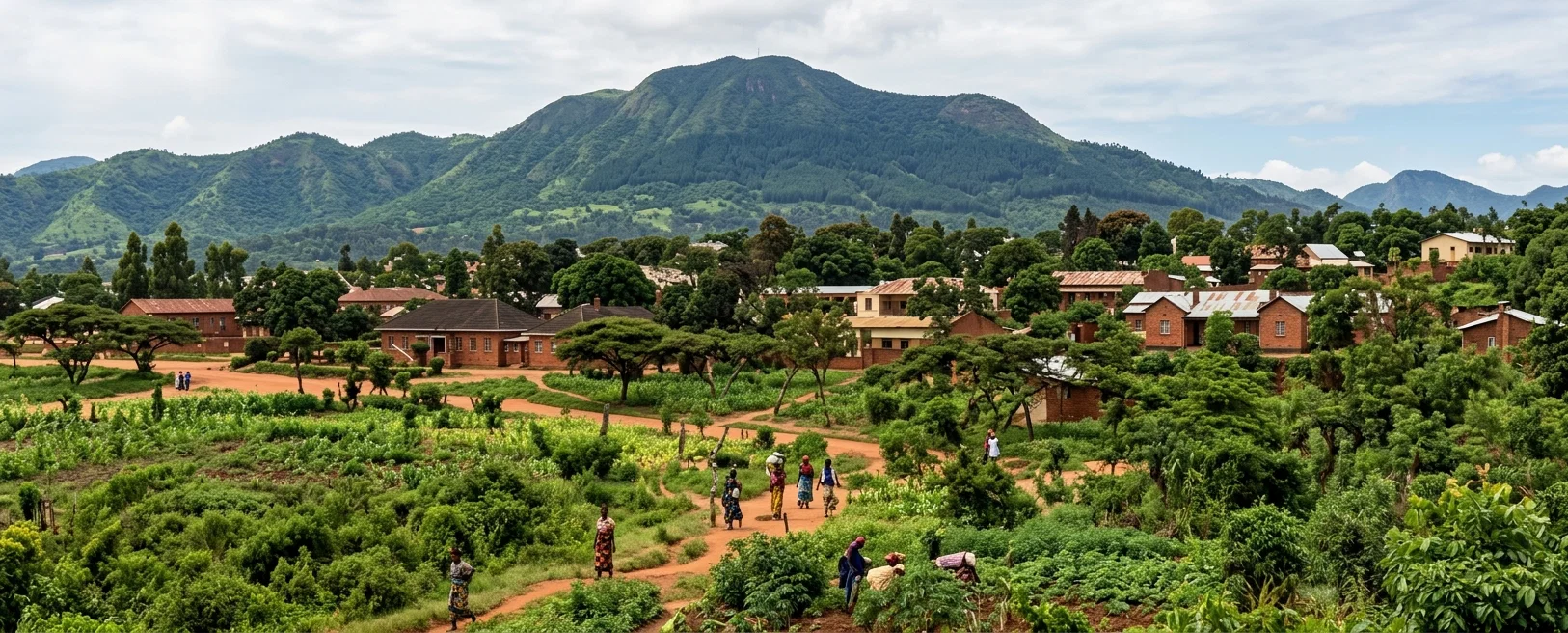
This country is commonly known as Nyassaland, being situated along the western and southern shores of Lake Nyassa. German East Africa joins it on the north and east, Portuguese East Africa on the east and south, and Rhodesia, or British Central Africa proper, on the west. The extent of the country is not great, being only equal to that of Ohio or Kentucky, while its population is about one million.
A VIEW OF BLANTYRE, NYASSALAND
Some characteristics of the country are unlike anything I have yet seen. Being in the tropics between nine and seventeen degrees south latitude, vegetation is abundant. Hills and mountains mark the landscape, the mountains being from two thousand to ten thousand feet above sea-level. Low-spreading trees cover these hills and mountains. The trees seldom reach a height of over fifty feet, or a diameter of more than ten inches. Their average size is considerably less. In the valleys and among the hills are many small streams, varying in size with rain or dry weather. On the banks of these streams grow some trees of larger size, which furnish valuable timber for all woodwork done in the country. The leading variety is commonly called mahogany. It takes a rich polish, resembling the dark cherry or walnut of the States. From this tree boards from twelve to twenty-four inches wide are made by native laborers with pit-saws. All white people of Nyassaland use brick for building, and this mahogany for woodwork. When visiting a large brick residence of a planter, the owner told me that every piece of woodwork, including doors, windows, veranda posts, archways, etc., was cut from one mahogany tree. Bamboo also grows along the streams. It is used extensively and for many purposes, the more common uses being for baskets and framework of native houses.
The grass of this land is phenomenal. Woe to the man who, being on a journey, is overtaken by night, and loses his way on the narrow native path. Heavy dew is almost sure to cover this grass. It grows in masses, and often falls in a great tangle. Much patience is required to make one's way through it, even in midday. The average height of this grass is about eight feet on ordinary soil; but if the soil is extra rich, it reaches ten feet. It requires no cultivation. It is less dense under trees, but in open places ten to fifteen tons could be cut from an acre. But it is never cut. It is everywhere, always, so no need of saving. Cattle do well on it, and it is all they require the year round. It is the sole roofing material of native huts, and often of the white man's house as well. Fortunately, it burns off in the dry season. Otherwise, the country would be very unhealthful.
In 1906 the returns of population for Nyassaland gave 976,641 natives, of which 535,528 were female, and 441,113 male. The number of European inhabitants was 611. These consist mostly of government officials, traders, and missionaries.
Considerable effort has been made to establish profitable planting industries. Of these, the principal are tobacco, coffee, and cotton. Rubber planting is now increasing, and will possibly replace some other staples. The cultivation of the soil is done by natives, with a short-handled hoe, solely. Indian corn is the one staple native food product. It is eaten in many forms, but mainly as a thick porridge, or as parched corn. Its native name is chimanga.
Blantyre is the principal town. Its site in the Shire Highlands is considered healthful, and its surroundings are rather beautiful. The white population numbers about one hundred, while thousands of natives live in villages near by. Blantyre is the trading center and mission center of Nyassaland. It had its beginning with the establishment of the Church of Scotland Mission in 1876. My wife and I recently visited this mission, where we were very cordially received. Dr. Hetherwick, for many years at the head of the mission, personally showed us about the place. The native14school has nearly four hundred pupils. A hospital for natives and Europeans is also maintained. While showing us the European ward, the doctor said, very kindly, "If you are ever sick,—which I hope you will not be,—you are to come here for treatment."
A railway will soon connect Blantyre with the Zambesi River, when Nyassaland will not seem entirely out of the world. We already have telegraphic connection with South Africa.
The interior postal service is good, though we get “home” mail only once in three weeks. The mail-bags are carried on the native's head. Our Cholo post-office, seven miles from the mission, is on the road from Chiromo,—the river port to Blantyre,—so mail comes to Cholo almost daily. There is also a daily service between Blantyre and Zomba, the government seat, forty miles away. Chiromo is about seventy-five miles from Blantyre.
Though this article is mostly descriptive facts, I trust it will be of interest to our people who support the missionaries in these dark lands, and especially to the young people who are studying missions and preparing to follow.
Cholo, Nyassaland, B. C. A.
The Way of Health
INACTIVITY leads to sickness and death. Exercise is the sure way of health, and the sign of vigorous life. We all know this well enough of our own bodies, but we do not always seem to remember that it is just as true of our souls. The reason why so many Christian people are lean or starving or dyspeptic in their religious life is simply that they do not exercise. An hour's hard work, every day, at some form of Christian service, would put them into a glow of returning life and vigor. Such service does not need to interfere with one's other work, either, but often it can go hand in hand with it, and always it increases one's efficiency in everything that is worth while. The home gymnasium of prayer and Bible study, and the open-air field of Christian athletics in every-day touch with our fellows, offer no excuse to any child of God to be a spiritual weakling. — Selected.
The Kind of Religion We Want
WE want a religion that softens the step and tunes the voice to melody and fills the eye with sunshine and checks the impatient exclamation and harsh rebuke; a religion that is polite, deferential to superiors, considerate to friends; a religion that goes into the family and keeps the husband from being cross when the dinner is late, and keeps the wife from fretting when the husband tracks the newly washed floor with his boots, and makes the husband mindful of the scraper and the door-mat; keeps the mother patient when the baby is cross, and amuses the children as well as instructs them; cares for the servants, besides paying them promptly; projects the honeymoon into the harvest moon, and makes the happy home like the Eastern fig-tree, bearing on its bosom at once the tender blossom and the glory of the ripening fruit. We want a religion that shall interpose between the ruts and gullies and rocks of the highway and the sensitive souls that are traveling over them.
—Helpful Thoughts.
Santalia and the Santals
By W. A. Barlow
—No. 1
W. A. BARLOW
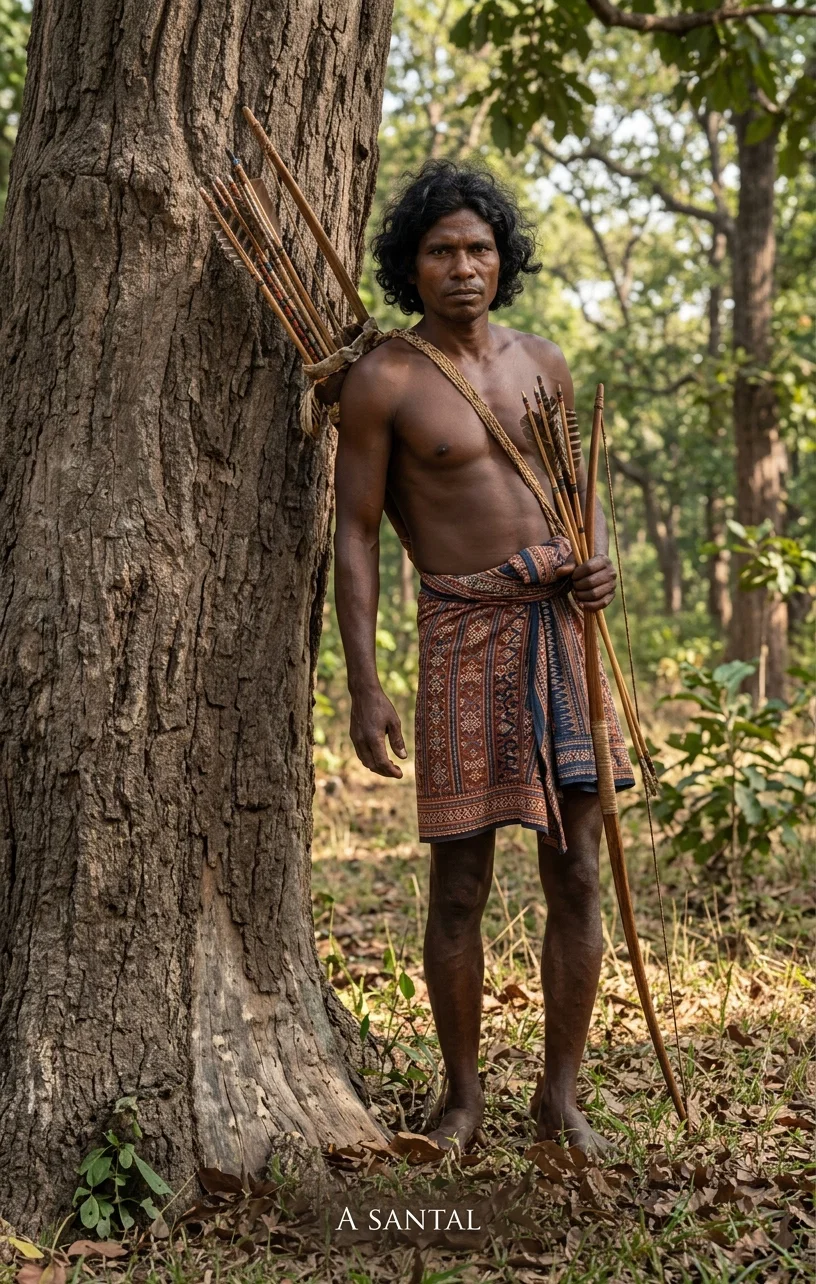
WHERE is Santalia? and who are the Santals? are questions to neither of which an altogether satisfactory answer can be given; for the boundaries of the Santal country are ill defined, and the origin and past history of the people are shrouded in obscurity. Santalia, or Santalisthan, is not exactly a geographical term, and on recent maps of India it may be looked for in vain. But it is a convenient expression, used to denote in the aggregate those parts of Bengal where the Santals live; and as the Santals have been in the past a migratory people, and still inherit a roving spirit, no clearly defined territory has ever been recognized as exclusively theirs. The district known as the Santal Parganas forms a sort of reserve for the Santals, where they are under special legislative protection; but in considerable portions of it few Santals are to be found, while they are settling in large numbers in other regions.
A SANTAL
Leaving out of account the tea-garden districts, in Darjeeling, Assam, Cachar, and Sylhet, to which large numbers of Santals have emigrated, we may say, roughly speaking, that the Santal country lies in the angle formed by the Ganges and the Hooghly Rivers, and mainly within the jurisdiction of the commissioners of Bhagalpur and Chota Nagpur, but with outlying tracts in Burdwan and Orissa. For the most part, the country we refer to is an upland region, diversified by hills (of which the highest, Paresnath, reaches an elevation of 4,479 feet), and is intersected by many rivers, which are usually expanses of yellow sand in the cold and hot seasons, but become swollen and rolling floods during the rains. Paresnath, the scene of one of the great annual Santal hunts, is sacred to the Jains; and is surmounted by one of their temples, and by twenty-three shrines, in each of which the last contact of as many saints with earthly existence before they passed into Nirvana is plainly discernible in the form of footprints impressed on marble slabs. Devout Jain pilgrims visit Paresnath from all parts of India. In former days before the railway made Darjeeling so accessible, the hill was used as a military sanitarium, and the officers’ quarters are still kept up for the convenience of visitors.
The rivers, which are not bridged except where they are crossed by the railway are often a serious obstacle to traveling in the rainy season. The more remote parts of the district are still covered with forest, but in those which are more thickly populated, and more especially along the railway lines and in the neighborhood of industrial centers, the timber has disappeared or is fast disappearing. This is much to be regretted, for not only does the forest afford a valuable reserve, for man and beast, in time of scarcity or famine, but its removal has a baneful effect upon the climate and rainfall. Nevertheless much of the forest still remains, to refresh the eye and protect the land from the burning rays of the sun. The tree which is most characteristic of the Santal country is the sal, sacred to the Santals. Of it their “sacred groves” (called the “Jaher”) consist. It is a tall, erect tree, with large smooth leaves, of which the leaf-plates, etc., are made. It is a good hard wood, which makes it extremely popular for building purposes. (I may say that the roofs and door frames of our Seventh-day Adventist missions at Simultala and Babolmohal are made from the sal-tree). The banyan is also common, whose spreading branches will shelter a small army. It was under the banyan-tree that we pitched our tent when starting the Seventh-day Adventist Santal Mission only a few years ago at Simultala, where Brother and Sister R. Cook, of Colorado Sanitarium, are now stationed while studying the Santali language. I am glad to say that they are making good progress, for which we thank God and take courage.
The cousin tree to the banyan is the pipal, sacred to the Hindu. The stately semal, or Indian cotton-tree, has a trunk buttressed like a fort, and bears huge red flowers often a foot in diameter. I might also mention the palas, a blaze of color when in blossom in the hot season; the palm, fit emblem of the righteous man; the mango with its delicious fruit, and the almost universally useful bamboo. These are the most common and remarkable of the trees of India. Even more economically useful than any of them is the mahwa. The flower of this tree is edible, and being rich in sugar, is fairly nutritious. It is called the famine tree by some. When in full blossom in March or April, the flowers fall from the tree in the early morning. One thinks of the manna when one sees the ground beneath the mahwa-trees almost covered with the whitish flowers, and the resemblance is enhanced when the people turn out to gather these carefully into baskets. They are dried in the sun, and may be stored for months. To many of the poorer class, it is for the time their staple article of diet, and there are few who do not use it to eke out their food supply. Even those who do not eat it themselves use it for feeding cattle. The fruit is also highly prized. The pulp of it is eaten, and from the kernel a fine bland oil is expressed.
Rice is the favorite crop where the land has sufficient moisture, but much of the higher land is not suitable for this form of cultivation. There the Indian corn is largely cultivated, and a most handsome and luxurious crop it is when it has been favored with the proper blend of sunshine and rain. Planted in June or July, it grows with amazing rapidity. When it ripens in August or September, one is reminded of Longfellow’s lines in Hiawatha:—
“And the maize-field grew and ripened,
Till it stood in all the splendor
Of its garments green and yellow,
Of its tassels and its plumage,
And the maize-ears full and shining
Gleamed from bursting sheaths of verdure.”
Simultala, India.
Sabbathkeeping Begins in Mexquitic
ELDER G. M. BROWN writes from Guadalajara, Mexico: “I have recently received word that the company of people with whom Brother Godinez has been meeting in the village of Mexquitic, near San Luis Potosi, has begun to keep the Sabbath. The leader is secretary of the court in the district, and quite an intelligent man. The company numbers ten or twelve adults, with about the same number of children.”
Danish West Indies
By H. C. J. Walleker
St. Thomas.—We are at last located in this city. Leaving New York August 24, we arrived here between twelve and one o'clock Sunday morning, September 1. As we could get no boat direct to this place, we had to go to St. Croix, and from there take a sailing schooner to this island, a distance of about forty miles. Taking it all together, we had a very pleasant trip, and we thank our Heavenly Father for his care and protection on our long journey.
After a few hours' rest at a hotel, we started out to look for a house, but it is hard to find a suitable one to live in here, and rent is very high. Sunday evening we found a house that we thought would do, but Monday morning when I went to see the agent, we found that it had been rented, but he said that he knew of a place that could be purchased for about one fourth its value. The owner had died about a year ago, and his widow was about to start for Europe. We went to look at the property, and found a really elegant place, located on a side hill where it is healthy, and where a fine view of both city and harbor is to be had. Everything was in good condition, so we bought the place and moved in that day. We are very comfortably situated. It seems to us that the Lord has kept this place for us, for it is the only desirable place we have seen. There is a block of ground with it, and it would rent for about twenty dollars. So we realize again God's loving care for us, and praise his name.
Charlotte Amalia is a small place of about ten thousand inhabitants, the majority of whom are colored. The officials are nearly all Danish, and as I can speak to them in their own language, they have shown me every courtesy that could be asked. So far, our denomination has not been recognized by the government here, and for that reason we can not even bury our own dead, nor perform the marriage ceremony for anybody. I have called on the acting governor and laid the matter before him, and presented to him the papers furnished by the General Conference and acknowledged by the Secretary of State, and also by the Danish representative at Washington. These papers must go to the king of Denmark with a petition signed by a goodly number of residents here before we can obtain recognition. We have formulated such a petition, and I have called upon many of the officials and business men, and so far they have all signed it, and spoken very highly of our work here. I have also called on the ministers of other denominations, and they have all likewise signed their names. If our denomination is not recognized in Denmark, this request may not be granted at all, but we hope for the best.
We have a small company of believers at Charlotte Amalia, St. Thomas; also a small church building, which is not quite finished. We are holding five meetings each week. Our Sunday night services are well attended, and there is a good interest manifested. I have now a class of five for baptism, who expect to go forward in this rite in about two weeks. Many have expressed a desire to obey and walk with us, but as yet they have not sufficient faith to cut loose, and come out into the liberty of Christ.
We have located on this island one of our native ministers, Elder J. H. Matthews, and together we are planning soon to visit St. John and Tortola, where there are a few Sabbath-keepers. A tent effort should be put forth at St. John, and St. Croix, and other places, as soon as we can have a tent to use. We see much to do on every hand, but there are few to do it.
There is an excellent opening here for a good, consecrated church-school teacher; and if some of our home churches could combine to support such a one here, at least in part, it would certainly be good missionary work.
We are well, and of good courage in the work, and are pressing the battle to the front, that in the glad day, fast hastening, we may come with rejoicing, bringing our sheaves.
H. C. J. WALLEKER.
West Philadelphia Tent Effort
By O. O. Bernstein
Thus far forty-three adults have accepted the third angel's message in West Philadelphia as the result of our tent effort this summer. The meetings still continue in the tent, which is heated with stoves. It is reasonable to hope that the number of new Sabbath-keepers will reach fifty before we take the tent down.
During the first nine weeks of this effort we had the help of three Bible workers, and from September 1 to 21 three additional Bible workers assisted.
Even with this number of helpers, we have not been able, in our personal work, to keep up with the increasing interest. Our collections have amounted to about two hundred dollars, one half of which has been used in advertising.
The Lord has been our help, and surely he is putting his hand to the work to cut it short. O. O. Bernstein.
Pennsylvania
By W. F. Schwartz
LOCK HAVEN.—Our tent effort which opened July 14, came to a close September 15. When we came here, there were only two Sabbath-keepers, but the labor of ten weeks has resulted in adding fifteen new Sabbath-keepers, for which we praise the Giver of all perfect gifts. Last week we had the privilege of baptizing eleven of this number, and others are expecting to be baptized soon.
A nice room, centrally located, has been rented, and is fitted up for church purposes. Meetings will be held every evening with the exception of Tuesday and Thursday evenings, and will be conducted by Brother E. W. Durkee, our licentiate, assisted by our colporteur, Brother J. S. Glunt.
There are also twenty-five families that are interested in the third angel's message, who are being labored with. Other interests have been awakened in the vicinity, which we know will add to this number, if worked with care. Some members just baptized have begun paying tithe, which has already amounted to twelve dollars.
Another item of interest is that two of the men holding very good positions, are allowed to keep the Sabbath and retain their positions. Surely the Lord is good and greatly to be praised.
W. F. SCHWARTZ.
Ecuador
By GEO. W. CASEBEER.
GUAYAQUIL.—The message is gaining a little footing here now. One more decided to-day to keep the Sabbath; so if he remains faithful, we shall have three. This seems a small number; but we thank God for these few, and we are confident that if we work faithfully in his strength, more will come in time.
Brother Davis and I are planning a trip through a large territory that we have not yet entered, and we hope to leave many seeds of truth which will bring forth fruit.
Recently there has been quite a revolutionary stir here; but now it seems to be over—until the next. There was a strong effort to overthrow the present president, whose policy is very liberal; but this has been defeated at every turn.
God help us quickly to call his people out! Pray for us, and especially for Brother Davis.
GEO. W. CASEBEER.
India
By J. L. Shaw
WE are having some interesting experiences in this field. Last Sabbath I was at Dehra Dun, where we had some excellent meetings. Brother and Sister Burgess are having good success in their work. One native brother was baptized, and another is seriously considering the same step. A number of others are interested. Brother John Last, who was baptized at Annfield several weeks ago, went to his home for a little time, but is back again. His whole soul seems filled with the advent message, and Dehra Dun has been greatly stirred by his preaching in the bazaars on the coming of Christ. He has composed a song, comparing our time with that of Noah, showing that we are living in the time just before Christ's coming. He sings this with power to the people who gather round him in large numbers and hear him preach and sing the truth. He has come up with me to Mussoorie, and I am taking time daily to go over different lines of truth with him. The rest of the time he spends preaching in the bazaars. This brother's earnestness is encouraging. It does seem that when India receives the message, it will be largely through her own sons and daughters. Our prayer is that this brother may be kept steadfast, and continue to carry the message to his people.
We expect to sing the jubilee song at the Mountain Mission Home at the time of dedication, as the thousand dollars needed to clear the debt will doubtless be in hand. The last Signs says that seven hundred and twenty dollars has been received at that office. We have received about a hundred dollars, and Brother Enoch has raised some, and no doubt more will come into the Signs office. We can then say that our first property in India is free of debt. God has been better to us than we had hoped; and we believe that he led in the selection of the location. J. L. Shaw.