“Mother,” said Edith Stanley, “the minister said this morning in his sermon that we could all do something for Christ; but I don’t see what I can do, do you?” And the child’s dark eyes half filled with tears.
“Yes, daughter,” the mother answered gently, “there is a great deal that a little girl can do. I sometimes think the little Christians do more for Him than older ones. Christ always knows when we are willing; and if we watch and wait, he will be sure to find something for us to do.”
And so on Monday morning, Edith went back to her plays, and her studies, and her school friends, hopeful and happy, trying to remember all the time to “watch and wait” for the work God was going to give her to do for him. But the days passed one by one, and the little maiden’s heart began to sink, for this week had been just like any other week, although she “had not forgotten, hardly a single time.”
Another Sabbath evening came. Edith and her mother were again having a talk. As her mother spoke of the sermon preached the Sabbath before, Edith suddenly burst into tears, sobbing, “Mother, He hasn’t given me any work to do for Him yet, and it’s a whole week that I have been waiting and watching as well as I know how.” Mrs. Stanley let her cry for awhile. But when she grew quiet, she asked, as if to change the subject,— “Edith, what was the end of that trouble between your two friends at school that you were so anxious about all last week?”
The little girl brightened up in a moment.
“Oh, but it’s all right now; didn’t I tell you? Well, you know, somebody told Mollie something that May had said about her that did not sound a bit kind, and it made Mollie very angry. We all knew that she loved May better than almost anybody in the world, but she said if May could talk about her in that way, she would never like her any more. Then somebody had to go and tell May what Mollie said, and May said that she had never spoken unkindly of Mollie that she knew of, but if Mollie chose to get mad, she might. She thought she could live without Mollie.”
“And so it went on, getting worse and worse, until they began to dislike each other so much that they had to ask the teacher to change their seats.”
“But,” added Edith, “I knew there must be something wrong about it; and so one day I told Mollie I didn’t believe May had ever said it, and I meant to ask her.”
“Mollie begged me not to. She said that May would think she had sent me to do it because she was sorry, and she was not one bit sorry.”
“But I did ask May; and when I told her what Mollie had heard, she thought it did sound rather bad, and she didn’t wonder at Mollie for getting mad if she heard it that way.”
“Then she told me what she really had said, and how she happened to say it. I went back to Mollie then; and when she heard about it, she said, ‘Why, that’s no matter at all if that’s what she meant, and I am sorry I made such a fuss over it. I don’t care if you do tell May I said so.’”
“So now, mother,” added Edith brightly, “they are just as good friends as ever, and they are not going to change their seats at all, and I am as glad as I can be.”
Mrs. Stanley was glad too, especially that her little daughter had acted as peacemaker.
“I think, Edith,” she replied, “that in just such little things as these we may do our Father’s will. ‘Blessed are the peacemakers,’ Jesus said. God is just as much pleased with us when we do the little things well, as he is when we do some great thing.”—Selected.
A STRANGE BIRD-HOUSE.
One warm spring day, long ago, two little sparrows flew into a busy London square, and lighted on a tree which stood in its fresh, green dress among the tall houses, and gave, with all its little, dancing leaves, a glad welcome to the small, brown strangers. They were looking for a good place in which to build a nest and set up housekeeping.
You would suppose they might have liked the country better, with its great stretch of blue sky and its miles of green grass.
But they were contented little birds, and did not think of leaving the noisy city.
There they sat among the leaves, chattering and glancing here and there and everywhere.
In the middle of the square stood a grand statue of the Duke of Wellington. Quietly he sat on his fine horse, and calmly he looked down on the rows of houses, on the waving trees, and the people streaming by.
Day and night, winter and summer, in sunlight and storms, there he sat, always the same, and very grand in his plumed hat and fine military dress.
He seemed to say, “Here I am above every one, and nothing can move me.”
The sparrows cocked their little quick, bright eyes at him, and wondered why he remained so still.
“He can’t be a live man on a live horse, or he would move a little,” said Mr. Sparrow. “I mean to go over there, and have a good look at him.”
“Oh, don’t, my dear!” said Mrs. Sparrow, fluttering with fear; “he might shoot you, you know.”
“Pooh!” said Mr. Sparrow, and he flew right across the street, and on to the statue.
He shook his wings, and chattered, and made little dives at the great man who towered above him; but his lordship looked straight ahead, and never even peeped out of the corner of one eye at the bold little fellow.
Then what should this saucy little sparrow do but fly on to the fine cocked hat, with its long plumes.
At this, Mrs. Sparrow, safe in her leafy bower, almost fainted away with fright. But finding that her little mate hopped, undisturbed, all over his lordship’s head, she took courage, and skimmed across the street, too; and soon they both were peeping and peering and chattering harder than ever.
They grew bolder every minute, and at last found a small opening under one of the drooping plumes; and in they darted, full of curiosity.
The poor, grand duke and his horse were quite hollow and empty; and the little birds at once decided that here was a fine place for their home, warm and dry, and far from prowling cats.
So there they lived, and reared their young ones; and nothing ever harmed them.
By and by more birds came there, and built their nests, and a family of starlings settled there very comfortably. Soon the old duke’s statue was full of the little, darting, noisy creatures.
At last, one day, some men came to take the grand duke and his horse away.
He was to be placed in another part of the city, where they thought he would look even finer.
What was their surprise when a large number of frightened birds flew out from under the duke’s plumed hat.
The birds flew away into the tree-tops, scolding noisily, and fluttering with anger and surprise. For they really had come to think that the great man, in all his splendor, belonged to them, and had been put there merely for a bird-house. They have not yet got over their astonishment and anger.
To this day, you may hear them quarreling and scolding about it all over London.—Christian Register.
Letter Budget.
LIZZIE WILLIAMS, of Allegan Co., Mich., a little girl ten years old, says she has two little sisters and a little brother, and they all keep the Sabbath with their mother. They have a family Sabbath-school of sixteen members, and her mother is superintendent.
We would like to know more of that family school.
ARTIE SPALDING, of Jackson Co., Mich., wrote in December: “I will be eight years old next January. I have two sisters, two brothers, and a little niece named Anna. We all think a great deal of Anna. I go to school, and study reading, spelling, writing, geography, arithmetic, music, and drawing. My average standing last term was 95. My papa has been very sick for a long time, but he is better now. One of my friends gave me a nice Oxford Bible for a Christmas present, because I like to read it so well. I tell the stories to my little brother June. I received other nice presents, but I like my Bible best of all. I like to read the INSTRUCTOR, ‘Sunshine and Golden Grain Series,’ and other good books and papers. At Sabbath-school I learn my lessons in Book No. 2. There are seven members in our class. I went to the Jackson camp-meeting, and attended most of the children’s meetings. Bro. Van Horn told us a great many nice things from the Bible. I write this letter myself; please print it. I want to be a good boy, so that when Jesus comes, I can live with him in the new earth. I send my love to the INSTRUCTOR family.”
It seems almost like having a visit from Artie himself to read his letter. His time must be pretty well occupied to carry along so many studies; surely he cannot have much time to plan mischief. Although it is well to improve one’s time in reading and studying good books, yet there is sometimes danger of overtaxing the brain by applying the mind too closely. Good physical exercise is needed every day, that the body may grow with the mind.
Here we give the names of a host of waiting ones who are longing to see their letters in print. Some of these little boys and girls attend Sabbath-school, and some have none to attend. All read the INSTRUCTOR, and we hope all are faithful in the every-day duties of life, thus “laying up in store for themselves a good foundation,” “that they may lay hold on eternal life.” By and by you will write other letters for the INSTRUCTOR. Try to make them real interesting. Some day when some nice thing happens that you think the other boys and girls would like to know too, just lay it up for your letter to the INSTRUCTOR. “How shall I save it?” do you ask? By noting it down in that memorandum book you made for that purpose so long ago. Well, here are the names: Clara Atwater, Steele Co., Minn.; Bessie Smith, Isabella Co., Mich., wants help to be a good boy; Anna E. Opple, White Co., Ind.; Annie Burlew, Ford Co., Ill.; C. E. Stimson, Dane Co., Wis.; Frances Harris, Monona Co., Iowa; Willie McKinney, Macon Co., Ill.; Anna Ward, Webster Co., Iowa; Jessie M. Bennet, Montcalm Co., Mich.; Effa M. Pond, Labette Co., Kan.; Blanche A. Cowles, Wexford Co., Mich.; Lottie Waller, Grant Co., Wis.; Effie M. Davidson, Auglaize Co., O.; Ina M. White, Windham Co., Vt., a neatly printed letter; Alice Valentine, Bates Co., Mo.; Nettie C. Warren, W. T.; Ruby A. Weeks, Macomb Co., Mich.; Floy Smith, Clinton Co., Mich.; Lillian Bolter, Hampshire Co., Mass.; Johnny E. Blake, Jackson Co., Wis.; Owen Bristow, no P. O. given; and Sadie Welton, no P. O. named.
Our letter box is not empty yet; but we don’t want you to stop writing. What we do want, is that you shall keep in mind when you are writing that you want to say something to interest or instruct somebody, and in a little time you will have made great improvement over your first letters.
MIRACLES
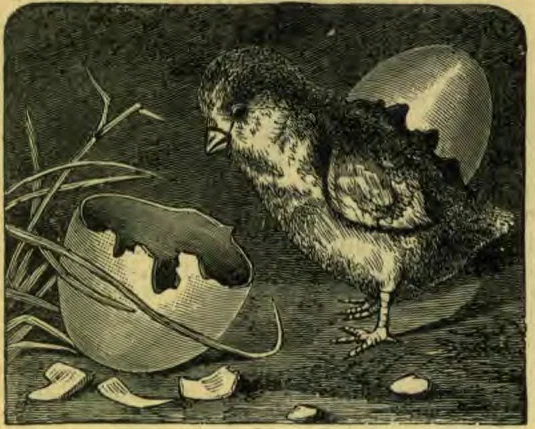
An egg a chicken! Don't tell me! For didn't I break an egg to see? There was nothing inside but a yellow ball, With a bit of mucilage 'round it all— Neither beak nor bill, Nor toe nor quill, Not even a feather To hold it together; Not a sign of life could any one see. An egg a chicken! You can't fool me!
“An egg a chicken! Didn't I pick Up the very shell that had held the chick— So they said; and didn't I work half a day To pack him in where he couldn't stay? Let me try as I please, With squeeze after squeeze, There is scarce space to meet His head and his feet. No room for any of the rest of him—so That egg never held a chicken, I know.”
Mamma heard the logic of her little man, Felt his trouble, and helped him as mothers can! Took an egg from the nest—it was smooth and round: “Now, my boy, can you tell me what makes this sound?” Faint and low, tap, tap; Soft and slow, rap, rap; Sharp and quick, Like a prisoner's pick. “Hear it peep, inside there!” cried Tom with a shout; “How did it get in, and how can it get out?”
Tom was eager to help—he could break the shell. Mamma smiled, and said, “All's well that ends well; Be patient awhile yet, my boy.” Click, Click, And out popped the bill of a dear little chick. No room had it lacked, Though snug it was packed; There it was all complete, From its head to its feet. The softest of down and the brightest of eyes, And so big—why, the shell wasn't half its size.
Tom gave a long whistle. “Mamma, now I see That an egg is a chicken—though the how beats me; An egg isn't a chicken, that I know and declare, Yet an egg is a chicken—see the proof of it there. Nobody can tell How it came in that shell; Once out, all in vain Would I pack it again. I think 'tis a miracle, mamma mine, As much as that of the water and wine.”
Mamma kissed her boy. “It may be that we try Too much reasoning about things, sometimes, you and I; There are miracles wrought each day for our eyes, That we see without seeing and feeling surprise; And often we must Even take on trust What we cannot explain Very well again. But from the flower to the seed, from the seed to the flower, 'T is a world of miracles every hour.”