The Youth's Instructor, Vol. LI, No. 31

Our Friends

The Youth's Instructor

August 6, 1903

Review and Herald Publishing Company · Battle Creek, Michigan · August 6, 1903

Our Friends

We marvel that the silence can divide The living from the dead. Yet more apart Are they who all life long dwell side by side, But never heart to heart.
What a blessing it is to have a friend! — one in whose companionship we throw off all restraint and feel at ease,—a faithful friend, whose caution or reproof is our safety; who feels with us, and for us, both in joy and in sorrow; who will guard, as sacred, our honor and reputation equally with his own; and will prove even more true and constant in times of adversity than in the days of our prosperity. Such friends,—and how very few they are! — we admit to the inner circle of our hearts and homes, knowing that they come for joy and peace and love and mutual helpfulness. They help us on our way, and rob the evil, lying all along our path, of many of its most cruel stings.
A true friend works with us, feels with us, prays with us, rejoices with us in our joys and successes, and mingles his tears with ours in sorrow and loss. The value of these “selectest friends” has been expressed with wonderful felicity by Robert Pollok in his “Course of Time,” in which he speaks of —
Friends, but few on earth, and therefore dear; Sought oft, and sought almost as oft in vain; Yet always sought; so native to the heart, So much desired, and coveted by all. Nor wonder thou—thou wonderest not, nor needst! Much beautiful, and excellent, and fair Was seen beneath the sun; but naught was seen More beautiful, or excellent, or fair Than face of faithful friend; fairest when seen In darkest day: and many sounds were sweet, Most ravishing, and pleasant to the ear; But sweeter none than voice of faithful friend; Sweet always, sweetest heard in loudest storm. Some I remember, and will ne'er forget,— My early friends, friends of my evil day; Friends in my mirth, friends in my misery, too; Friends given by God in mercy and in love; My counsellors, my comforters, and guides; My joy in grief, my second bliss in joy; Companions of my young desires; in doubt, My oracles; my wings in high pursuit. As birds of social feather, helping each His fellow's flight, we soared into the skies, And cast the clouds beneath our feet, and earth, With all her tardy, leaden-footed cares; And talked the speech and ate the food of heaven!
Would you have such a friend? Would you have many of them? If so, you must be such a friend. Love begets love, confidence begets confidence, kindness begets kindness, and he has friends who knows how to be a friend.
Why will we live so far distant from the fellow workers who are really very dear to us? Why are we so unresponsive and shy with our own home friends? Why not draw the tender chords of friendship a little closer to brothers and sisters, and so relate ourselves to them that they can be admitted to that inner circle? Why not?
At times of special revival, fathers and mothers, brothers and sisters, have often come to me with this request, “Will you speak to my son, my daughter, my brother or sister, with regard to their soul’s salvation? I know they want to do better, but I seem to have lost my influence over them.” Ah, what a sad confession! You have lost your hold upon him, when your close relationship ought to have made you the strongest possible instrument in the hand of God for his salvation.

Take Away the Stone

You have lost your influence; there is a stone in the way, between him and life, and you have placed it there. Jesus says, “Take ye away the stone.”
These words were spoken to the sorrowing sisters and friends as they stood weeping before the tomb of Lazarus. The young man whom “Jesus loved” was dead, and lay in the tomb before them, “bound hand and foot with grave-clothes.” Between him and life lay the stone upon the entrance of the cave. His friends had placed it there. Now the time had come for co-operation. Loved ones must do the part within their power. They rolled away the stone, Jesus gave the young man life, and they loosed him and let him go.
Dear reader, study the parallel at your own fireside. Your friend, your son or daughter, your brother or sister, is dead in trespasses and sins. He is in the pit, bound hand and foot with evil bands. You have lost your influence, you have erected a barrier, you have rolled a stone between him and life, and God waits, salvation waits,—all heaven waits,—for your co-operation. The Master’s own command to you comes ringing down the ages, “Take ye away the stone.” Will you do it? Will you be a faithful friend just now? Will you draw the cords of love a little closer, and be more to your loved ones? A word at this time may save them. Speak it. Do the kind act. Take away the enmity—the middle wall—the barrier to life; and God will thus make you a friend worth having, and he will give you friends worth living for.

Jesus as a Friend

But, after all, our earthly friends sometimes fail us. We rest in their love and faithfulness, yet we can not do so in absolute safety. Trusting in earthly friendship alone, we may some day be left friendless. Yes, this will most certainly be our lot. But Jesus never fails; and believing this, we love to sing that old-new song, “What a friend we have in Jesus.”
Read again the eleventh chapter of John, and there catch a glimpse of what Jesus is as a personal companion and friend. The home of Martha and her sister and Lazarus was a place where Jesus loved to dwell. He loved these friends when they were far away in sin; but when they opened their hearts and home to his salvation, the love became mutual—and mutual love makes the tie of friendship strong. He was theirs, and they were his. That love is told in the simple words, “Now Jesus loved Martha and her sister and Lazarus.” But he loves you, dear reader, the same as he loved them; therefore when you read this precious verse, always add the words, “and me;” and be not afraid to do it, for he wants you in the list of his most precious friends. He is yours. Why should you not be his?
Oh, the best friend to have is Jesus, When the cares of life upon you roll; He will help you when you fall, He will hear you when you call, Oh, the best friend to have is Jesus! E. R. PALMER.

In and About San Francisco—I

How a Great City Grew Up

LITTLE did the Franciscan Fathers, who in 1776 established a mission for the conversion of the Indians inhabiting the peninsula between San Francisco Bay and the Pacific Ocean, dream that they were laying the foundation of a great city. Little did the steel-coated Spanish warriors, who at the same time established there a military post for the protection of the mission, dream that the rebellious English colonies that were just then beginning their struggle for independence, would one day grow into a great nation whose western metropolis would cover the ground over which their horses grazed.
The Fathers won the love and confidence of the Indians, and the mission prospered. Occasionally a ship would anchor in Yerba Buena Cove, from the shore of which a bridle-path led to the mission settlement, two miles inland. The founders of the mission passed away, and younger men took their places and grew old. But still Yerba Buena was only a landing-place for those who desired to visit the mission. Other settlements sprang up around San Francisco Bay, and gained some little commercial importance, while San Francisco was still sand dunes and chaparral.
But in 1836 a Yankee trader landed at Yerba Buena Cove, and there erected a building and established a trading-post. Others followed, and the little village slowly grew. In 1847, when the name was changed from Yerba Buena to San Francisco, it boasted half a thousand souls.
In the following year, gold was discovered at Sutter’s Mill, and then San Francisco became a landing-place for the thousands of excited gold-seekers who rushed to the mines from all points of the world.
In the early part of 1849 the population of the little city had increased to two thousand, and in the latter part of the same year it was estimated at twenty thousand. “The days of ’49” were the days of the greatest rush to the gold-fields; but the following year added another fifteen thousand, and to the already overcrowded city of tents and board shanties. San Francisco drew its population from the entire world, and all were bent on the same errand,—the search for gold. No one left the city in those days except to go to the mines. Indeed it was quite impossible, for several years, to leave as most of the people came,—by water.
As soon as a ship landed in the bay, it was deserted by its crew, and often by its captain also. At one time four hundred ships rode there at anchor,—idle for lack of crews to man them. Labor of all kinds was in great demand, and commanded a daily wage equal to what many a man is now compelled to work a whole month for.
During the first five or six years of the great rush, men were so intent upon gold-getting that little attention was paid to the organization of the city government. Laws there were, a plenty; but the officials, like every one else in the city, were there for gold; and few of them cared whether the laws were enforced or not. Robbery, and even murder, was carried on with impunity by regularly organized bands of marauders, until life and property were no longer safe. Then the law-abiding citizens organized vigilance committees, and determined to rid the city of the lawless element.
A few murderers were seized, given a fair trial, and hanged; others were driven from the city; and in a short time, order was brought out of chaos. The vigilance committee then disbanded, and left the work of enforcing the laws to the regular officials; for the decided stand the people had taken for law and order had a salutary effect upon the officials, stirring them up to a more faithful performance of their duties. From that day to this the government of the city of San Francisco has been constantly improving.
The census of 1860 placed the population of the city at fifty-six thousand, and in the next ten years it nearly trebled. It is now estimated that it contains about three hundred and fifty thousand inhabitants. Thus has the little village of Yerba Buena grown, in a lifetime, into the great city of San Francisco. J. EDGAR ROSS.

Which Kind Are You?

THE Bible tells us that some are “set” for “helps,” while some seem only to hinder.
“I won’t stay here at home alone! I will go with you!” screamed “Philip, my king.” Papa and mama were to spend the day away from home, and aunty and the housekeeper were to remain at home. The parents thought it far better for the nervous little boy to stay with his gentle auntie, who would see that he was entertained and well cared for. The young monarch decreed otherwise, and so vociferous and insistent was he that mama weakly relented, and he won the day.
A little girl had chickenpox; she was not very sick, but had to remain home from school. Papa was away, so mama must attend to the store, nearly half a mile away. Of course mama’s heart ached because she must leave her little girl; but she was a brave mother of a brave daughter. The little maiden spent the day very serenely, with only her dollies, her kitty, and her bantams for company and amusement.
Another father, mother, and older brother found they must be away from home one day. The little boy, not yet eight years old, and the little girl, not yet four, must look after the home interests. There were over two hundred chickens of all sizes to be fed several times during the day, and watched to keep the hawks away, though many were protected with wire screen. The incubator must be attended to, and chicks removed to the brooder or house as fast as hatched. The calves must be fed, and the cows watched. The new wire fencing was on the ground, but not yet put up, and they loved to roam the fields if permitted. The children could take dinner at grandpa’s, a quarter of a mile away, through the woods, and go there two other times during the day. It looked like rain, and there was some thunder while they were eating dinner. The little boy said, “I must hurry to cover the hotbed, and put some of the chicks in,—and I must put the calves in the barn before the shower comes, too.”
Grandma asked if sister hadn’t better stay with her; but the little boy seemed to need this crumb of comfort, and grandma hadn’t the heart to deprive him of it. With quickened steps they turned their bright, brave faces homeward. Grandma’s heart ached to see the babies go; for the shower was coming soon—vivid lightning, heavy thunder, and a beautiful downpour of water.
Soon after it subsided, the children returned, much to grandma’s relief; though she felt that she was the baby, and they the little man and woman.
“We got the things all taken care of just as the shower came,” announced the little boy. “Yes, we got ’em all taken care of,” re-echoed the little girl.
“Were you afraid in the shower?” grandma asked.
“O, no! we weren’t afraid. It was pretty hard; but we just sat there and waited, and when it stopped raining, we came back,” they said, in chorus.
“No,” said grandma, “we never need be afraid in a thunder shower: it is the voice of our Heavenly Father, and he loves all his children, especially the little ones.” The next time things had to be looked after at home, the little boy decided himself that sister better stay with grandma, it was so wet, and he went bravely home alone.
When almost night, the little boy said, “Papa and mama may be late, and we’d better go home,—so as to get ’most all the chores done before they come.” And home they went—blessings on their dear young heads!
MARY MARTIN MORSE.

Say the Loving Words Now

YEAR after year, with a glad content, In and out of our home he went— In and out, Ever for us the skies were clear; His heart carried the care and fear, The care and doubt.
Our hands held with a careless hold All that he won of power and gold, In toil and pain. O dear hands that our burdens bore— Hands that shall toil for us no more— Never again.
O, it was hard to learn our loss! Bearing daily the heavy cross— The cross he bore; To say, with an aching heart and head, “Would to God that the love now dead Were here once more!”
For when the love that we held too light Was gone away from our speech and sight, No bitter tears, No passionate words of fond regret, No yearning of grief, could pay the debt Of thankless years.
O, now, while this kind love lingers near, Grudge not the tender words of cheer, Leave none unsaid; For a heart can have no sadder fate Than some one day to awake—too late— And find love dead!
— Harper's Weekly.

Heirs of Heaven Should Not Be Hid in Worldliness

It is unworthy of one born to a palace to set his heart on a cottage, to dwell there; and of one running for a prize of gold, to go off his way to gather the stones of the brook; but so much more is it unworthy of an heir of the kingdom of heaven to be hid among the stuff of this world when he should be going on to receive his crown. — Thomas Boston.

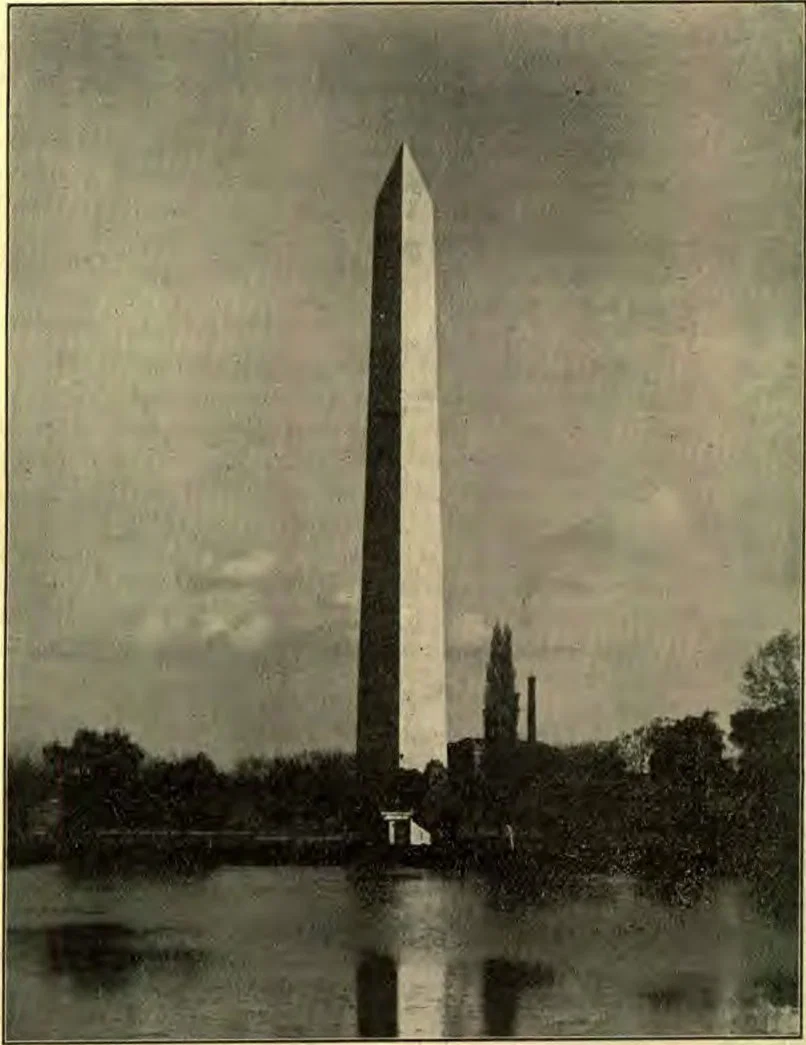
The Washington Monument

THE highest solid monument in the world is the famous Washington Monument, which is seen towering against the sky long before one reaches Washington. In the city its tremendous height confronts one at every turn, and has place in a thousand vistas—from the avenues and parks, from the Capitol, the White House, the hills of the Soldiers’ Home, the heights of Arlington, and from far down the river on the way to Mt. Vernon. Go where you will, the one prominent feature of the landscape is the monument. Seen at different times of the day, it has a new character for each new hour; its appearance changes with the varying lights, and with alternations of clear sky and cloud. In stormy weather it suggests a mountain peak standing immovable with the mists driving by.
THE WASHINGTON MONUMENT
The foundation of this giant obelisk is of rock and cement, and is thirty-six feet deep, and one hundred and twenty-six feet square. The monument is fifty-five feet square at the base, and thirty-four feet at the top; the walls are fifteen feet in thickness at the base, and eighteen inches at the top of the shaft. The height is five hundred and fifty-five feet, five and one-eighth inches. The total cost of the monument has been one million three hundred thousand dollars.
The interior is lighted with electricity, and an elevator carries visitors without charge, ascending every half hour. A stairway of nine hundred steps leads to the top; but not a large number care to attempt the ascent or even the descent. It is really a great undertaking.
A magnificent view is afforded from the eight windows which pierce the walls at the height of five hundred and four feet. Immediately below, and stretching away to the White House on the north and the Capitol on the east, is the beautiful landscape gardening of the Mall and the parks, the city beyond, and then the hills rolling away to the horizon. On an eminence in the northeast is the Soldiers’ Home; on the Virginia Hills, across the river to the west, is Arlington, the beautiful military cemetery; on the northwest is the Naval Observatory. The Potomac’s winding course may be followed for miles; and, on a clear day, one may discern in the western distance the mountains of the Blue Ridge in Virginia.
It was built as a memorial of the “Father of his Country.” The names of forty States and many societies that supplied a share of the money to pay for this mighty obelisk, are inscribed on special stones on the inside of the marble shaft—pure-white marble without and granite within, tipped at the summit with a pyramid of pure aluminum, visible from below only from a certain position, and then on a particular moment of the day, when it shines out like a brilliant star from the point of the monument. On this point are inscribed the words Laus Deo, “praise to God.”
Washington himself is said to have selected the site afterward adopted. The corner-stone was laid in 1848. In 1855 the shaft had attained a height of one hundred and fifty-two feet. Then, the funds being exhausted, the construction was suspended for twenty-three years, and was resumed in 1878. The monument was finished and dedicated February 21, 1885. The orator on that occasion was the venerable Robert C. Winthrop, who, thirty-seven years before, had delivered the oration at the laying of the corner-stone. The object and intent of the monument are impressively described in the following words uttered by the orator on the laying of the corner-stone in 1848:—
“Lay the corner-stone of a monument which shall adequately bespeak the gratitude of the whole American people to the illustrious father of this country. Build it to the skies: you can not outreach the loftiness of his principles. Found it upon the massive and eternal rock: you can not make it more enduring than his fame. Construct it of the peerless Parian marble: you can not make it purer than his life. Exhaust upon it the rules and principles of ancient and modern art: you can not make it more proportionate than his character.”
J. S. WASHBURN.

At Aunt Dorothy’s

THERE'S never a day when the curtains are low At Aunt Dorothy’s house — The curtains that drift with the whiteness of snow At Aunt Dorothy’s house.
Aunt Dorothy loves both the air and the sun, And sweetness and light fill the rooms, every one; And, look where you may, there is nothing undone At Aunt Dorothy’s house.
Who cares for the weather, when one is a guest At Aunt Dorothy’s house? Who cares for his worries, when one stops to rest At Aunt Dorothy’s house?
For all in Aunt Dorothy’s neighborhood know How calmly the years of her life come and go; And age hath the grace of the lilies that grow At Aunt Dorothy’s house.
It seemeth to us, so serene are the ways At Aunt Dorothy’s house, The angels must hallow the housekeeping days At Aunt Dorothy’s house. The wise and the happy, the kind and the fair, Do minister gladly and tenderly there, Make light of the burdens, a blessing of care, At Aunt Dorothy’s house. — Frank Walcott Hutt.

A Wonderful Night Song

If we had ears to hear and eyes to see, there is just as much to charm and instruct in an acre field and the brook that passes through it, as in the broad expanse of a continent with its mighty rivers.
We were rowing up a tide-water stream at midnight. My companion and I had exhausted our energy and enthusiasm in a three-hour drift down the river for shad, and had lapsed into silence. The only audible sounds were the harsh screeches of herons and cranes as our approach drove them from their feeding-ground at the water’s edge.
But, softly and with sweetness inimitable, the quiet midnight air bore to us the song of a bird, altogether foreign to the discordant notes of the night-feeding host. I rested upon my oars, and listened. Thrice was the sweet song repeated; then silence reigned.
We had gone scarcely a hundred yards when a similar song was wafted to our ears. Four different minstrels thus entertained us before we reached our landing.
A few nights later this experience was repeated, the music coming from the same points. During a third trip, I said to my companion, who had not been over the course before, “When we reach the point opposite that old willow, I have a sweet-voiced bird engaged to salute us.” My unseen midnight friend did not disappoint us, nor did his three comrades farther on.
I became so thoroughly interested in these strange sentinels and their unfailing challenges, that I improved an early opportunity by daylight to row along this shore and investigate. Of course, I had recognized the notes as those of the little marsh wren, whose nest is such a wonder of architecture, and whose voice is one of the sweetest of the feathered chorus.
The result of my investigations both surprised and delighted me. At each point where the night song had greeted us, I found a nest attached to the young reeds about three feet above high-water mark, and at once I connected the songs with these secluded little homes.
Just as darkness was approaching, I concealed myself in some neighboring reeds, and arranged with a companion to row up and down the stream. Each time, as the boat approached the point nearest to the nest, the wren, I presume the male bird, sat motionless upon a reed just before the door of his home; but, just as soon as the boat had passed a few yards beyond, he broke forth in his sweet song.
There was but one conclusion, and a sweeter impression of bird life and love I have never received. Our tide-water marshes abound in life. On all sides, swimming, creeping, and flying creatures are seeking their food. It seemed clear to me that this tiny bird, knowing that his mate within the covered home could not see the cause of the sound, but trembled as she heard it, just as soon as he saw that the intruder was not coming to destroy their peace, began his cheering song to assure her that the danger had passed. He was a midnight angel to the mother and her little ones, saying, “Fear not; for, behold, I bring you good tidings.”
From this new chapter in the great book of nature, I turned to open a still greater volume, and read of God, my maker, that he “giveth songs in the night.” How many of the glad utterances of his word are assurances to the trembling heart that we are delivered from him who is roaming about seeking whom he may devour!
Are we not constrained to adore him whose purpose of love sounds alike in the Gloria that greeted the shepherds and in the marsh wren’s Jubilate that comforted his trembling mate? — Forrest E. Dagger, in The Well Spring.

Items from the Field

CALIFORNIA has proved a fruitful field for our Young People’s Societies. Twenty organizations have been perfected there, having in the aggregate a membership of over three hundred. The members have been very active in missionary work. During the first three months of this year, they spent $141.94 in buying and distributing literature. Two young people’s conventions were appointed in that State for the month of July. Extended reports will be given later.
A Young People’s Convention was recently held at Cooper, Oklahoma Territory. There were over two hundred in attendance at this meeting, four churches being represented. The president of the Conference attended the meeting and assisted in the services. The program was prepared some time in advance of the convention, a committee consisting of one member from each church taking part. Important topics were considered relative to the work, and the meeting was pronounced a decided success.
A successful society has been organized in connection with Keene Academy. Miss Hattie Mosley writes: “Our first meeting was held February 7. We ordered our Membership Cards, and began with fifty members. A few have joined since, some have also gone away, and now since school is out, our society is not so large as it has been. We sent one hundred copies of the Life Boat to Rusk, and one hundred copies to the State prison at Huntsville, and ordered five hundred for our members to sell. We take a club of twenty Signs, putting ten of them in the paper rack at the Cleburne station, and the other ten are sent to names, the member handing in the name corresponding with the person who receives the paper. We have also been sending two dollars each week to Brother Roderiguez, a worker in San Antonio. We take the programs for our meetings from the INSTRUCTOR, and like them real well. A large number of our members will be away through the summer, but we hope to keep the society alive, and next year when the students return, we hope that we can all take hold and work together. We pray God’s blessings upon all Societies.”
The Hope Villa, Louisiana, young people seem to have solved the problem of the proper relation of the older members of the church to the Young People’s Society. The secretary writes: “The general interest is good. Parents, though not members, take a very active and encouraging interest.” L. F. P.

MRS. L. F. PLUMMER

ing that can restrain the joy, the enthusiasm, the full service, of the believer. Young people, “Awake, awake; put on thy strength.” The Lord is calling for the time, strength, and ability of the young men and women of this denomination. Do not delay. The King’s business requires haste; for it is to be completed in this generation.
In time of war, government ships frequently sail under sealed orders. Until they arrive at a certain place, neither officers nor men know where they are going, or what they are to do. Abraham’s faith led him to obey the call of God to go out of his own country, “not knowing whither he went.” Some of us may be called upon to take advance steps under “sealed orders.” The child of God does not question the future. He only asks to know present duty.

MRS. L. F. PLUMMER

A Smile and a Kind Word

It costs nothing to give them, and yet so many people act as if it did. Here is wealth that anybody with a loving heart may distribute without stint.
Not long ago a young Indiana schoolgirl won a fortune by a smile and a cheery word. Walking with her mother one day in Florida, she noticed an old, white-haired man sitting on a bench. His lonesome look appealed to her heart; and as the happy girl passed him, she smiled and asked if he was enjoying the sunshine.
The friendless old gentleman was attracted by the girl's sunny disposition, and sought an acquaintance with her family. Returning to the North soon after, the family heard no more of him until the official notification of his death came, with the information that he had left twenty-five thousand dollars for the little girl “who was kind to me.”
The story will not suggest to any one the idea of showing kindness with any thought of a reward. We all know it does not work out that way. But the incident does show how appreciative many a sad and lonely heart may be of only a smile and a pleasant word. Truly our young people may all be rich in this coin, which passes current in every corner of this sinful world. Let us let people know that loving the Lord Jesus does us good, and fills our hearts with kindly thoughts for others. W. A. SPICER.

THE WEEKLY STUDY

The Past and the Future

(August 9-15)
LET our closing study be a Bible reading based on the scriptures cited in the closing chapter of “Rise and Progress.” That chapter is a survey of the rise of the message, and of the work accomplished by the Spirit of prophecy throughout the rise and progress of the movement. I would suggest that one member study this chapter, and by a Bible reading, and perhaps the reading of an extract now and then from the chapter, set forth the past and future of the work which this people were raised up to do.
Let some member read, as a scripture portion, Ps. 44: 1-3; Rev. 7: 1-4, 9-17.
As young people let us remember that all our opportunities, and mercies, and gifts cost something. Jesus gave his life to bring them to us. The pioneers in this work put all their strength and means into the blessed service of proclaiming the message. By the preaching of this definite message in its simplicity this work was built up. Now it is for us also to put our all of time and strength and means into the carrying of the same definite message to all the world; and in our day we are to see all that the early pioneers looked for—the glorious ending of the message in the coming of Jesus in the clouds of heaven. Let us live for nothing else, for no other object in life is worth striving for. Whatever our occupation, by life and lips let us tell the message that God has committed to this people. W. A. S.

Dallas Young People's Society Jail Visits and Mission Plans

From Dallas, Texas

As our Young People’s Society is the second in the State, perhaps a report from us would help to encourage the young people in other places to start the same work. Our Society was organized Jan. 24, 1903, with a membership of eleven.
We meet alternately on Sabbaths with the church. Some have visited the jail every Sabbath afternoon, taking papers, holding a short service, and singing. The prisoners are interested, and several have expressed a desire to lead a better life.
Since our new election we have planned to meet every Tuesday evening. We expect soon now to be able to start mission Sabbath-schools in the city, and we hope that many souls may be saved through the efforts of our Society.
LENA RUST, Secretary.

“I am Ready”

“Thy servants are ready to do whatsoever my lord the king shall appoint.” 2 Sam. 15:15.
COMRADES, are we ready for the service of the King? With a willing, glad surrender, every talent let us bring; Whatever he appoints us, be our answer prompt and true,— We are ready now to do.
“Wherefore wilt thou run, my son, seeing that thou hast no tidings ready?” 2 Sam. 18:22.
Comrades, are we ready our allegiance to proclaim? Do we “run” with joyful “tidings” in the Saviour’s precious name? This sweet story of salvation that we surely love so well, Are we ready now to tell?
“Ready to distribute.” 1 Tim. 6:18.
Comrades, are we ready to distribute of our store in the Master’s gracious spirit? for he gives us more and more? For the sake of him who saves us,—he will bless our gifts, we know,— Are we ready to bestow?
“Ready to be offered.” 2 Tim. 4:6.
Comrades, are we ready, if we hear the tender call, “Come up higher,” to the mansions in the Father’s palace-hall? In our risen Jesus trusting, with a loving, child-like heart? Are we ready to depart?
“Be ye therefore ready also: for the Son of man cometh at an hour when ye think not.” Luke 12:40.
Comrades, are we ready for the coming of the King? Are we working, watching, praying, while our halleluiahs ring? Oh, the glory of his kingdom! All his might and majesty, Are we ready now to see?
— Young People’s Weekly.

Young People's Society Missionary Work Quickens Interest

A recent report from a secretary of a Young People’s Society says: “The interest is increasing. Each member is engaged in some line of missionary work. Thus we are trying to lead a life of real service.” If there is a Society in which the interest is dying, we commend to it the remedy here set forth. Let each member engage in active missionary work, and watch the rising interest.
The coming of Christ in this generation! How the heart thrills at thought of such a probability. And when the probability gives way to the actual promise that it shall be, there is nothing
Continue reading: A Pair of Doll's Shoes