It has always been, seemingly, a perplexing question to prepare articles on religious subjects for the secular press in such a way as to insure their insertion. Possibly, failures result, as a general thing, not so much from a lack, in the eyes of editors, of intrinsic value in the contributions themselves, as because of fatal defects in the composition and the arrangement.
If a few simple fundamental principles are understood and followed in writing on a religious topic for a secular, or news paper, it will seldom occur that the article will be declined. It is a fact that although hundreds of such manuscripts are yearly submitted to editors (said manuscripts often containing the very matter desired by them, which they would be glad to publish), only a few are ever accepted, or can be, because written in a manner which would make their use unprofitable or impracticable.
The writer must be brief — must study to be terse and laconic in the formation of every sentence — for two reasons: —
First, because a newspaper depends upon its advertising for its support, and an editor will not admit to the columns of his paper articles which, because of their length, may force him to trench upon his advertising space.
Second, because the advertising patronage depends upon the popularity of the publication with the reading public. To retain and increase the popularity of his paper is ever the uppermost thought in the mind of the editor. To this end, therefore, he seeks to present in each issue as great a variety as possible, of what he believes will prove acceptable matter. To accomplish this he is compelled to select short articles, that there may be many of them, that every reader may find something satisfactory to himself, personally. Therefore, as a rule, beyond a single leading article, all else is condensed to the fullest possible extent, unless of extraordinary value as news matter.
Because of these two facts, the most prominent and fundamental principle to bear ever in mind, when writing for newspapers, is this — to let each and every paragraph in the article be so complete in itself (or with those which precede it) that, if necessary, the editor can cut out all that follows any special paragraph, and still have as readable and interesting an article to publish as though the entire communication had been used.
But to enable one to prepare an article in such a manner, other fundamental principles governing the composition of newspaper stories must be understood and applied.
Any article appearing in a newspaper, other than editorial matter, is called, in newspaper parlance, a “story.” The construction of a newspaper story, however, differs radically from a story prepared for a literary publication; and it is mainly because writers on religious subjects, almost as a rule, fail to comprehend this difference, that their manuscripts are so persistently and generally declined.
Everything printed in a literary publication is to be considered from the story standpoint, invariably; but everything printed in a newspaper, including its editorials, is to be considered as, and is, news — pure and simple. Therefore a story written for a magazine must be written from a magazine-story standpoint, but a story written for a newspaper must be ever written, without any exception, as a news item — pure and simple.
More than this: it must be so written that the editor can condense down to a stickful or two, if necessary, yet retain its value as a news item, or that he can expand it, with flaming headlines, if he so desire, and the needs of the hour demand, without any rewriting or editing on his part.
Short stories in both magazines and newspapers deal with a single incident, or happening, giving the details which will enable the reader to fully understand the occurrence. The effort of the magazine writer is so to tell the story as to keep his reader ever in suspense, with his curiosity unsatisfied, until a climax is reached, and the real point at issue (concealed all along) is suddenly and surprisingly presented to the interested reader.
Not so the story writer for the press. He studiously avoids leaving his reader a moment in suspense. He aims to state the facts — present the climax — in the opening paragraph: then he follows with details. In the second paragraph the main items may be given, in a general way; in the next succeeding, more fully, and with added minor details; following these will come explanations, possibly criticisms and suggestions, if the subject warrant these, leaving the editor free to cut out whatever he wishes, and yet retain the “story” as a news item. Such an article, so prepared, one that can be cut to suit “space,” is not very likely to be declined.
Camp-meeting sermons, reported verbatim, and covering several sheets, closely written, are terrible apparitions to a busy and perplexed editor. A camp-meeting reporter ought to be able to restate the points of discourses so tersely as to give, briefly, in a single opening paragraph, as an item of news, the salient points of the arguments used. This will leave room not only for amplification in succeeding paragraphs, for the benefit of interested readers, yet giving the busy man the facts in a nutshell at the beginning, but will enable the writer to present the “news” of the camp in closing remarks — all so arranged that the editor can cut as he desires, yet leave the article intact as a valuable news item.
As the eye of a weary editor would catch the “newsy” opening and closing paragraphs, his O. K. would follow as he murmured, “Good stuff,” and framed his display head from the facts given in the opening and closing sentences of the contribution.
The Stronghold of Israel
By Emma Nulton
EMMA NULTON
“O THAT men would praise the Lord for his goodness, and for his wonderful works to the children of men!” How our hearts thrill with thanksgiving and joy as we read the reports of the work being done all over the vast harvest-field! How wonderfully the God of Israel is opening the way and leading his people upon the earth to-day as in ancient times, knowing full well that success depends now as then upon implicit obedience and unwavering faith and confidence! God’s promises are sure; they can not fail. They are so numerous and so great that often we stagger at their magnitude. Our part is simply to fulfil the conditions, placing ourselves in proper relationship to his divine will, and his blessings and care will follow as surely as day follows night. We know success is ours if we are true to him. Studying the life and downfalls of ancient Israel, we find them, while weak and helpless, seeking divine guidance, and willing—anxious—to obey and follow his precepts and commands. But with returning strength and prosperity would come self-reliance and a turning away from the instructions of Jehovah. Then how rapid and complete was their fall!
Nations have repeated, and are repeating, like history. In individual life, both past and present, how often a spiritual fall has quickly followed a time of prosperity and strength! With what words can such ingratitude to the Giver of all things be expressed! We wonder often why greater results do not attend our efforts. Far greater wonder is it that all prosperity is not withheld because of our lack of faith and gratitude.
As success marks our advance, O how greatly we all need divine guidance! How truly the leaders in Israel need to humble themselves before God that no seeds of human self-importance may spring up and grow.
With godly wisdom comes spiritual and physical strength. He is our strength and shield. Surely we have nothing to fear so long as we make him our guide in all the affairs of life, doing well the part that is ours to do, no matter how small and obscure; for our God is no respecter of persons; the most lowly are as precious as the great. Life is such a priceless gift! It must be well worth possessing under all circumstances, else an all-wise God would not give it to us. It is ours to do well our little part; and the Lord will give to each one his just reward.
Dockton, Wash.
Thanks for Everything
By Ellen Isabella Tupper
For all that God in mercy sends;
For health and children, home and friends,
For comfort in the time of need,
For every kindly word and deed,
For happy thoughts and holy talk,
For guidance in our daily walk,—
For everything give thanks!
For beauty in this world of ours,
For verdant grass and lovely flowers,
For song of birds, for hum of bees,
For the refreshing summer breeze,
For hill and plain, for streams and wood,
For the great ocean’s mighty flood,—
In everything give thanks!
For the sweet sleep which comes with night,
For the returning morning’s light,
For the bright sun that shines on high,
For the stars glittering in the sky,
For these and everything we see,
O Lord! our hearts we lift to thee,—
For everything give thanks!
— Miss Ellen Isabella Tupper.
The Deadly House-Fly
The total time required for a single generation — from eggs to adult — is ten days, and in this climate at least twelve or fifteen generations in the course of a summer. As each female lays from five hundred to one thousand eggs in the course of a season, her descendants — should they all live — would run up into figures beyond comprehension of the human mind — many billions of billions!
The favorite nesting place of the fly is in all forms of decaying animal or vegetable matter. After the eggs have hatched into maggots, these feed upon surrounding organic matter, growing rapidly, and finally reach the “resting” or “pupa” stage, from which bursts forth the perfect, full-grown, and fully developed fly.
Instantly upon emerging from the pupa — shell — the fly seeks food, and all things organic are “grist to his mill.” Alighting, perhaps, upon a heap of foul, decaying matter for his first meal, he will feast there for a while, besmearing his mouth parts, legs, and abdomen with thousands of germs, and then fly to the nearest dinner table, spreading these germs with perfect impartiality on sugar, bread, meat, butter, and milk.
Again: in addition to the bacteria left by legs, mouth, and body, he deposits his own intestinal excreta, in the form of a fly-speck, literally teeming with all sorts of contagion.
The number of germs upon the bodies of individual flies has been the subject of continual research by many scientists, and vary greatly. A nice, foppish fly — select in his menu — may carry around with him only two thousand or three thousand bacteria, but the average of four hundred fourteen flies examined by Esten and Mason last year was 1,222,570 a fly — the highest being six million six hundred thousand on one individual.
Milk is an ideal breeding place for all sorts of bacteria, especially if not refrigerated. One fly, covered with typhoid germs, falling into a dairy can of warm milk could develop, by the time the milk is delivered to consumers — say six hours — sufficient typhoid germs to infect one hundred families. Such cases are of record.
The following recommendations are culled from bulletins of the Chicago board of health, and are respectfully submitted: —
“Don’t allow flies in your house.
“Don’t permit them near your food, especially milk.
“Flies are the most dangerous insects known to man. Flies are the filthiest of all vermin. They are hatched in filth, live in filth, and carry filth along with them. Flies are known to be carriers of death-dealing disease germs. They leave some of these germs wherever they alight.
“Screen your windows and doors. Do it early, before fly time, and keep screens up until snow falls. Screen the baby’s bed and keep flies away from the baby’s bottle, the baby’s food, and the baby’s ‘comforter.’ Keep flies away from the sick, especially those ill with typhoid fever, scarlet fever, diphtheria, and tuberculosis. Screen the patient’s bed. Kill every fly that enters the sick-room. Immediately disinfect and dispose of all the discharges.
“Use liquid poisons, sticky fly-paper, and traps.
“Place either of these fly-poisons in shallow dishes throughout the house: —
“(a) Two teaspoonfuls of formaldehyde to a pint of water.
“(b) One dram of bichromate of potash dissolved in two ounces of water sweetened with plenty of sugar.
“To quickly clear rooms of flies, burn pyrethrum powder or blow powdered black flag into the air of the room with a powder blower. This causes the flies to fall to the floor in a stunned condition. They must be gathered up and destroyed.
“Sprinkle chlorid of lime or kerosene over contents of privy vaults or garbage boxes. Keep garbage receptacles tightly covered, and clean them every day.
“Sprinkle chlorid of lime over manure piles and other refuse. Keep manure screened if possible. It should be removed at least once a week.
“Pour kerosene into the drains.
“Clean cuspidors every day. Keep a five-per-cent solution of carbolic acid in them. Don’t allow dirt to accumulate in corners, behind doors, back of radiators, under stoves, etc. Allow no decaying matter of any sort to accumulate on or near your premises.” — Selected.
It Takes Courage
To speak the truth when, by a little prevarication, you can get some great advantage.
To live according to your convictions.
To be what you are, and not pretend to be what you are not.
To live honestly within your means, and not dishonestly upon the means of others.
When mortified and embarrassed by humiliating disaster, to seek in the wreck or ruin the elements of future conquest.
To refuse to make a living in a questionable vocation.
To refuse to do a thing which you think is wrong, because it is customary and done in trade.
To be talked about and yet remain silent when a word would justify you in the eyes of others, but which you can not speak without injury to another.
To face slander and lies, and to carry yourself with cheerfulness, grace, and dignity for years before the lie can be corrected.
To stand firmly erect while others are bowing and fawning for praise and power.
To remain in honest poverty while others grow rich by questionable methods.
To say “No” squarely when those around you say “Yes.”
To do your duty in silence, obscurity, and poverty, while others about you prosper through neglecting or violating sacred obligations.
Not to bend the knee to popular prejudice.— Success Magazine.
Kindly Silence
THE kindness of silence is something we might all bestow much oftener than we do. Granted that we do not indulge in scandal, that when we know of the distress and humiliation that has befallen a friend’s household in the wrong-doing of one of its members, we tell the tale only pityingly and with every extenuating circumstance, yet why tell it at all? If it were one of our beloved that had stumbled into sin and disgrace, if one dear to us had yielded to sudden temptation, if our home had been rent with bitterness and dissension, would not the first impulse, a right and natural impulse, be to hide the hurt and stain from every human eye? Should we not bless the friendship that so far as possible closed its eyes and sealed its lips, and that could be trusted not to repeat what it perforce had seen and heard? — Educational Messenger.
J. T. BOETTCHER
By J. T. Boettcher
Russia
J. T. BOETTCHER
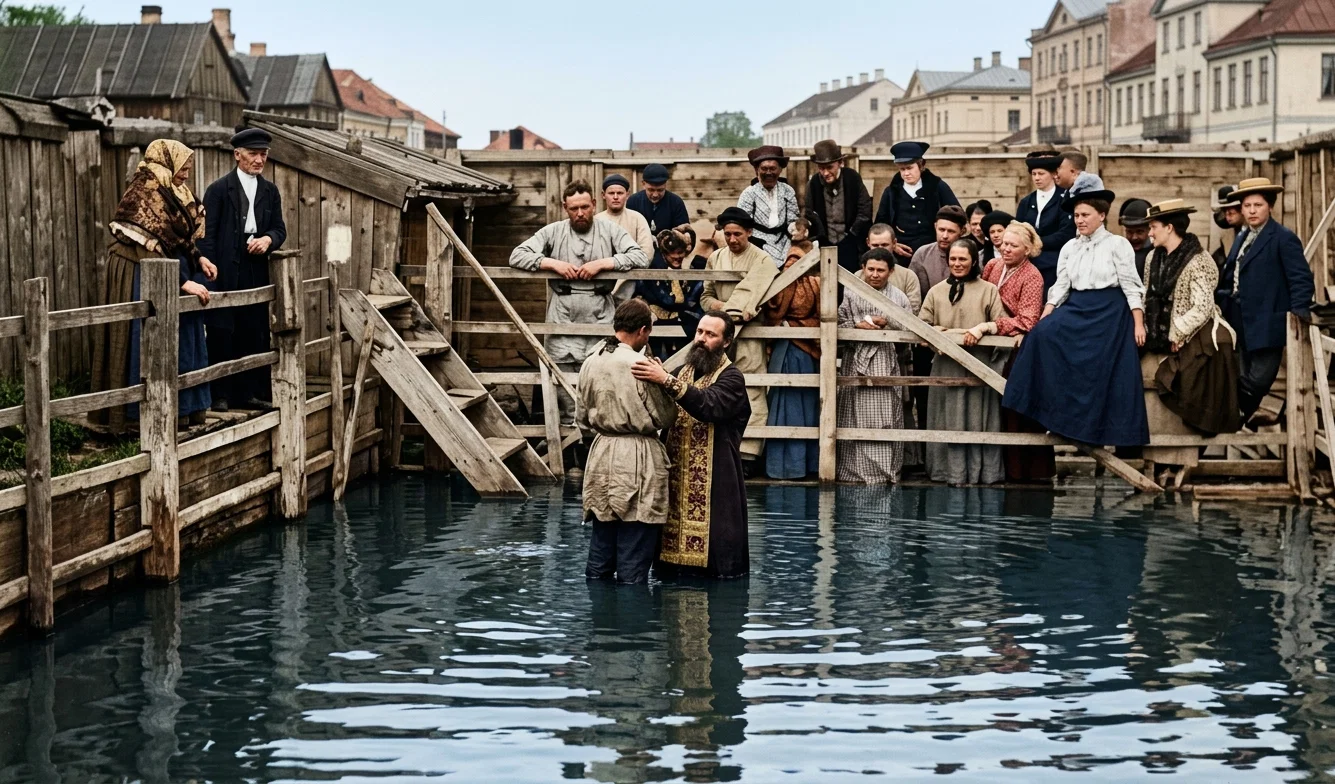
LETTERS from the Baltic Conference, Russia, tell of the work in that field. Brother J. Sprohge, the Lithuanian ordained minister, writes that he recently baptized twelve persons, and took in two on profession of faith, in the city of Mittau. Even though suffering physically, our brother has been able, through the help of the Lord, to prepare the candidates for baptism, and to administer this sacred rite. The accompanying illustration shows him with one of the candidates in the Aa River, and the others standing by looking on.
BAPTISMAL SCENE AT MITTAU, RUSSIA
A year ago we had no church at this place, but at present there are over forty members. Where we had to administer this rite secretly in former years, you may be sure that we are very grateful to our Lord that we can now conduct such a service openly, and accompany it with singing and prayer. This is a Lithuanian church, and they are in full harmony with the work of God for this time. German meetings are also conducted in this city, and in the near future a number of German believers will be baptized here. A police officer in the employ of the government, has the Sabbath free in Mittau.
Brother T. Schneider writes from Libau: “The Lord has been merciful to us, and helped us more than we could have asked. After four-months’ work, there are twenty-five ready for baptism, ten to be received on profession of faith, and five by letter. These will increase our church-membership to sixty-four. Among the thirty-five converts are ten men. Others hope so to arrange their business affairs that they may be with us at the next baptism, which we hope to have the thirtieth of May. Our meeting-hall will be much too small; but we believe that God, who has never forsaken us thus far, will help us in this also.”
Four months ago the police came while our brethren were holding meetings one Sabbath, and told them that they had no right to assemble, and wrote out a document for them to sign, stating that they would not meet again. Our brethren feared that the work of God would be hindered. On learning of the situation, I sent a worker to that place. We petitioned the governor and secured permission to open another meeting-place within two weeks after we had received notice to close. We have been holding meetings every evening in the week, and sometimes several times during the day. The people have crowded in until there was not standing room for another person. Corridors and adjoining rooms were all occupied. The Lord is certainly working mightily.
The Scandinavian Field
By L. R. Conradi
L. R. CONRADI
The annual meeting of the Norway Conference was held this year at Christiania, June 30 to July 4. It was preceded by a workers' meeting. Elders O. A. Olsen and J. C. Raft, Brother Nils Anderson, and myself reached Christiania June 28. There were quite a number of canvassers and workers assembled, and Brother Raft at once began giving instruction. There was also a good outside attendance at the evening services. In fact, last autumn and winter when Elder Raft held meetings in this city, there was as large an interest developed here as had ever been known during the history of our work in Christiania.
We spent some time before the meeting in carefully considering matters connected with the Christiania property. After the settlement years ago, there was still a mortgage of about twenty-five thousand dollars on the Christiania property. In fact, had we sold the property at the time, it would not have brought us enough to clear its indebtedness. As there was no possibility of selling the house, we had to plan carefully in order that the property might bring in the interest and taxes. The house needed repairs, the heating apparatus was dilapidated, and some of the printing-presses were out of order. We secured an exchange for two good presses, fixed up a new heating apparatus, and moved our treatment rooms into the old wooden building. We had previously been using rented quarters in an outside building for our treatment rooms.
The Norway Book Mission started with no capital, but now, through careful management for years, it has earned its capital. For the first four or five years after the change was made, there was a deficit of from six hundred to a thousand kroner, which the union conference had to make up, so that the Norway Conference (which was also embarrassed) and the book mission might have opportunity to recover. Although times have gradually grown better, yet we have tried in vain to dispose of the Christiania property—either as a whole or in part—for a reasonable price. Meanwhile, under the careful management of Brother A. C. Christensen, the book mission has developed a capital of thirty-one thousand kroner, more than one third of this being earned last year. The Health Home, under Brother Scott's management, has earned seven thousand kroner. The Norway Conference has not only paid its indebtedness, but, although paying two tithes to the union, it has gradually accumulated a capital of ten thousand kroner, making a total of forty-eight thousand for them all.
The steadily increasing patronage of the treatment rooms has made it possible for them to earn as much during the first six months of this year as they earned in the twelve months of last year, and so the brethren feel that there is urgent need for larger treatment rooms than can be operated in the basement of the old wooden building. It is proposed to convert the first floor of the corner brick building into treatment rooms, at a cost of about seven thousand kroner. The old wooden building stands on the front of a deep lot, but as the city will not permit us to move the wooden building to the back of the lot, we must either erect a new building at a cost of twenty-five to thirty thousand kroner, or make some changes in the corner brick building to give accommodations to the treatment rooms.
When the Norway brethren learned that their conference had, by careful management, secured half of the money necessary, and that the property now has a settled income, they felt that the time had come for the conference to take over the Christiania publishing plant, the title to which has heretofore been held by the General Conference Association. As14this was presented to the open conference, the delegates not only unanimously voted to take over the property, but they raised thirty-three hundred kroner more to put with three thousand kroner previously collected for the purpose of making the requisite changes in the building for the treatment-rooms, so that this work can be done without indebtedness.
All seemed indeed grateful to God that the time had come when they could take hold of this property anew. As they have no legal organization to hold the house, the conference selected a committee of seven (one of whom is the Scandinavian union president, and another the Norway Conference president) to create such an organization, take over said property, and pay off the second mortgage (twenty-two thousand kroner), held by the Hamburg Publishing House. It was a happy moment for all that another financial difficulty in the European field seemed to be so successfully solved.
As there had been a Swedish mission formed in the northern part of Sweden, it now seemed best that, beginning with Jan. 1, 1910, the Norwegian part of the Northland Mission be reunited with the Norway Conference, as it is more readily worked by Norway than in any other way.
Elder N. C. Bergersen and the other members of the committee were unanimously re-elected. A good spirit permeated all our deliberations. When our brethren were told of the great mission fields in Africa and elsewhere, they raised nearly two hundred kroner for Abyssinia.
The canvassing work has had wonderful prosperity of late. The canvassers' sales last year amounted to seven thousand dollars, while for the first six months of 1909 they have been more than for the twelve months of 1908. The sales of the Norway house in 1908 amounted to seventeen thousand two hundred dollars. There are now nearly one thousand Sabbath-keepers among the two million three hundred thousand people of Norway.
According to the testimony of many, this was one of the best meetings ever held in Norway, and we surely expect that the coming year will see still greater prosperity in this country than we have ever witnessed before.
The Need of Colored Medical Missionaries
By W. H. Williams
THE OAKWOOD SANITARIUM, HUNTSVILLE, ALA.
No work is more fruitful in soul winning than that of medical missionary work. With love and consecration, coupled with a thorough knowledge of the physical man, the medical worker finds easy access to the homes of rich and poor. No worker is better able to follow in the footsteps of his divine Master than the one who goes out in the name of the Lord to heal both body and soul. Experience has shown that in the home land as well as in foreign fields, the medical work is in all cases the best, and in many cases the only entering wedge for the gospel message.
The multitudes of negro people throughout the South are in crying need of gospel medical missionary work. Among the poor, and especially in the country, physicians are seldom called. Sickness is on every hand, and the services of competent nurses are in great demand. The Southern people of superior families cherish in fond remembrance the nurses who watched over them through their childhood and youth, and in time of sickness, when the childish feeling returns, they long for the sympathetic gentleness of the colored nurse. In fact, the representative white people of the South retain a traditional regard for colored nurses.
This condition gives to the nurse a rare opportunity to present the saving truths of the third angel's message.
We quote from Special Testimonies, Series B, No. 12X, just recently published, which sets forth the situation, and our duty as a people:—
“In no place is there greater need of genuine gospel medical missionary work than among the colored people in the South. Had such a work been done for them immediately after the proclamation of freedom, their condition today would have been very different. Medical missionary work must be carried forward for the colored people. Sanitariums and treatment-rooms should be established in many places. These will open doors for the entrance of Bible truth.”
“The Lord has instructed us that with our training-schools there should be connected small sanitariums, that the students may have opportunity to gain a knowledge of medical missionary work. This line of work is to be brought into our schools as part of the regular instruction. Huntsville has been especially pointed out as a school in connection with which there should be facilities for thoroughly training consecrated colored youth who desire to become competent nurses and hygienic cooks. Let us rejoice that the managers of our Huntsville school are now planning to carry out this instruction without further delay. Let us help them make Huntsville a strong training center for medical missionary workers.”
In compliance with instruction received, the Oakwood Manual Training School has erected a small, but neat sanitarium. The building is now waiting for furnishings, bath-room equipment, and medical appliances. No large work can be undertaken in the training of medical missionary evangelists, until after this small sanitarium (shown in the accompanying cut) shall have been completed and equipped.
In all our planning to reach the colored people of the South, we must act quickly, wisely, and heartily, for we are told that this work will be the first to close.
W. H. WILLIAMS.
Catholicism’s Spread in Japan
SPEAKING of that time when the Catholic religion began to spread in Japan, prior to its ultimate banishment from the empire by force of arms, William Elliott Griffis says: “The very idols of Buddha served, after a little alteration with the chisel, for the images of Christ. The Buddhist saints were easily transformed into the twelve apostles. The cross took the place of the torii, and was emblazoned on the helmets of the warriors and embroidered on their breasts. Nearly all the churches were native temples sprinkled and purified, and the new convert could use unchanged his beads, bells, candles, and incense, and all the paraphernalia of his old faith in the celebration of the new.”
The Arkansas Camp-Meeting
By Clarence Santee
THIS meeting was held at Fayetteville, Ark. The camp was located where large trees made a good shade, and gave an added influence of quiet to the grounds.
Elders W. A. Hennig and F. W. Spies were with us throughout the meeting, besides Elders W. W. Eastman and S. Sorenson, and the writer, from outside the State conference. Elder E. R. Palmer came about the middle of the meeting.
Elder Watts, the conference president, had all matters well arranged, and there was no breaking into the interest by any unfinished work. This is as it should be. Many times the first days of a camp-meeting have been so filled with camp work that the best results could not be attained.
From the first meeting, there was a manifest desire to learn more of the will of God, and instruction concerning personal duty and responsibility was a prominent feature. Regular meetings were held, in a separate tent, for the youth and children. The first Sabbath about twenty-five came forward to seek the Lord.
From day to day the interest deepened. The last Sabbath was an especially good day for the camp. From an attendance of about one hundred seventy-five, one hundred fifty arose for prayers for added strength to overcome known sins, and more than thirty came forward for special help. A large number of these were seeking God for the first time. At a special meeting later, thirteen applied for baptism.
The attendance was not so large as last year, but the spiritual influence of the meeting was excellent. Those who absent themselves from these annual feasts, lose one of the greatest means for strength, added courage, and final victory. Many testified that this had been, for them, the best meeting they ever attended.
At the closing hour of the last Sabbath, Elder Watts conducted a social meeting in which seventy-nine testified in fifteen minutes. I need not say that this was an interesting meeting, as forgetfulness of self and a desire to make room for others, always brings a blessing.
The business meetings of the conference passed off harmoniously. At the urgent request of the president and the secretary, they were relieved from office, so that they might devote their time to other lines of work. Their labors have been appreciated, and doubtless they would have continued in office if they had felt willing to carry the burdens for another year. Elder J. W. Norwood was unanimously elected conference president, and Brother C. J. Dart conference secretary and treasurer.
The last day of this good meeting, Brother Leslie Littell was ordained to the gospel ministry as a white laborer, and Brethren R. H. Deveraux and J. W. Dancer were ordained as colored ministers.
Throughout the meetings, Elder Hennig carried a series of lessons on true liberty, which were appreciated; while Elder Spies gave lessons on practical daily relations to God and his truth. Elder Palmer gave some very interesting lessons on the spread of the message, and the means God had used in bringing this truth throughout the world to its present standing.
Another mile-post has been passed in the Arkansas Conference, and the last one will soon be reached. May God richly bless both laborers and members in their onward journey.
CLARENCE SANTEE,
Pres. Southwestern Union Conf.
Mexico
By J. F. Blunt
TACUBAYA.—I am glad to report favorable conditions in Mexico. The people seem ready to listen to the truth, and I have enjoyed the privilege of working among them. Coming here nearly four months ago, just as Elder G. W. Reaser had returned to the States, and only a short time before Elder G. W. Caviness left for General Conference, I felt unequal to the duty of preaching to the people, owing to my inexperience in the language. But, remembering that the work is the Lord's, and not ours, I plunged into the earnest presentation of the wonderful chain of prophetic truth, so effective in tent work, and there was an immediate quickening of interest. Our Sunday and Wednesday night meetings more than doubled in attendance, and several persons began to observe the Sabbath, which obligation I made prominent from the first.
To accommodate a few Americans who became interested in the truth at our Spanish meetings, I began to speak Tuesday and Friday nights in English, and soon these friends acknowledged the obligation of the Sabbath, and one woman began to keep that day. A young man, just out of college, and his mother, here from Texas to study the language, also manifested deep interest and conviction of heart. They are thoroughly persuaded as to the Sabbath, and express no difference of sentiment on other topics. They say they purpose to subscribe for the Signs of the Times when they return home, and they have enjoyed our studies and our literature here.
Now Elder Reaser is with us, and he wants me to remain, at least for a time, in the city of Mexico, where we hope, at the conclusion of our special meeting and canvassers' institute, to hold a series of lectures in a better location. Our present quarters are difficult of access and unsatisfactory. I am confident we can secure large audiences, if we have the right place, instead of being on the second floor, far back from the street, and with a winding staircase as a further handicap. Pray for us and for the work.
J. F. BLUNT.
Camp-Meeting at Santa Cruz, Cal.
By Stephen N. Haskell
A LOCAL camp-meeting was held at Santa Cruz, July 29 to August 8. There was a good attendance, and the last Sabbath of the meeting over three hundred were enrolled in the Sabbath-school. From the beginning, the interest steadily increased.
It was necessary for Elders H. W. Cottrell and J. O. Corliss to leave in the midst of the meeting, and several others left also, so the laboring force was not large; but God manifested his power to restore both soul and body.
On the last Sabbath of the meeting, at the close of the forenoon discourse, about fifty came forward for prayers. Two of these were quite weak and feeble, and felt as if they had scarcely strength to go to the front seats, yet when they sat down upon the front seats, God instantly restored them soul and body. Others took their stand for the first time to keep the Sabbath, and the meeting lasted from eleven o’clock until two. The shout of victory was in the camp; several persons were prayed for and healed.
The last Sunday morning at eight o’clock small groups of our brethren and sisters could be seen in the different tents, pleading with God for special victory,—some for physical blessing, and some for spiritual liberty; some that their friends who were out of the truth might be reached by the Spirit of God. It was a wonderful scene, and God most signally blessed these companies.
During the camp-meeting there were $1,188.10 worth of books and periodicals sold; over three hundred fifty dollars’ worth of Sister E. G. White’s books were sold the last Sunday forenoon at the nine o’clock missionary meeting.
Eight or nine hundred dollars was16raised for the foreign missionary work. We consider this a very generous amount when we remember that our brethren in this section of the conference are not wealthy.
Santa Cruz is a place of resort for pleasure seekers during the summer. The sea-breeze made the nights quite cool, but during the day it was warm and pleasant.
There was no murmuring or complaining on the ground, and many who had attended most of the camp-meetings in California, expressed themselves as having never attended one where the spiritual interest ran higher than at this meeting; yet there was no excitement.
Our general camp-meeting will be held in some location around the Bay, and will begin the ninth of September. During our general camp-meeting a special session of the conference will be held, and many important interests will be considered at this meeting.