The Roman Catholic International Eucharistic Congress
The Eucharistic Congress at Montreal opened on the evening of September 6, with the reading of the Pope’s letter to Vincenzo Cardinal Vannutelli, appointing him papal legate to represent the Pope at the congress.
Following the address of Archbishop Paul Bruchesi, the organizer of the congress, four telegrams were read, two of them being messages from the cardinal legate to the Pope and the king of England, and the other two their replies to him. The telegram to the king thanked him for altering the coronation oath, and assured him of Catholic loyalty, while that to the Pope assured him that those in attendance at this congress laid their persons, labors, and intentions at the feet of “the vicar of Christ,” “the restorer of all things in Christ.” The legate further declared that this Eucharistic Congress demonstrated “for the first time the union of the world, ancient and modern, on religious ground with the Eucharist and the Papacy.”
Expressions heard throughout the congress showed it to be the hope and the undying purpose of the Papacy that through the glorification of the dogma of the Eucharist, or Mass, the whole world shall be brought to the feet of the Pope. This was distinctly set forth in the letter of the Pope, appointing the cardinal as his representative at this congress. He said:—
By this public manifestation the eucharistic bread, unhampered by space and division, will bind together the land which the seas divide, stimulate distant nations to proclaim and vindicate the glory of God the Saviour, and to honor with due loyalty and submission the center of Christian unity, to wit, Christ’s vicar on earth.
Through the influence of that sacrament, the Pope sees, in the future, the whole world honoring him—the center of Christian unity—“with due loyalty and submission,”—a world bowing at the feet of one man, who is to them “God on earth;” but who is, as the Bible declares, sitting in the place of God, and setting himself forth as God.
With that idea in his letter of instructions, the legate made that theme the key-note of his opening address, from which we quote:— Europe extends her hand to America, and this continent, in her sublime fervor, unites with the Old World to exalt together the greatest of the sacraments, under the supreme direction and with the encouragement of the supreme pastor of the church. . . . Then the universal pastor, taking under his charge these new and immense spiritual domains, will show to an astonished universe the Old and the New World realizing before the human race the universality of the church foreshadowed by our Saviour and his apostles. . . . It [the present congress] unites for the first time the Old and the New World in solemn praise of the Eucharist.
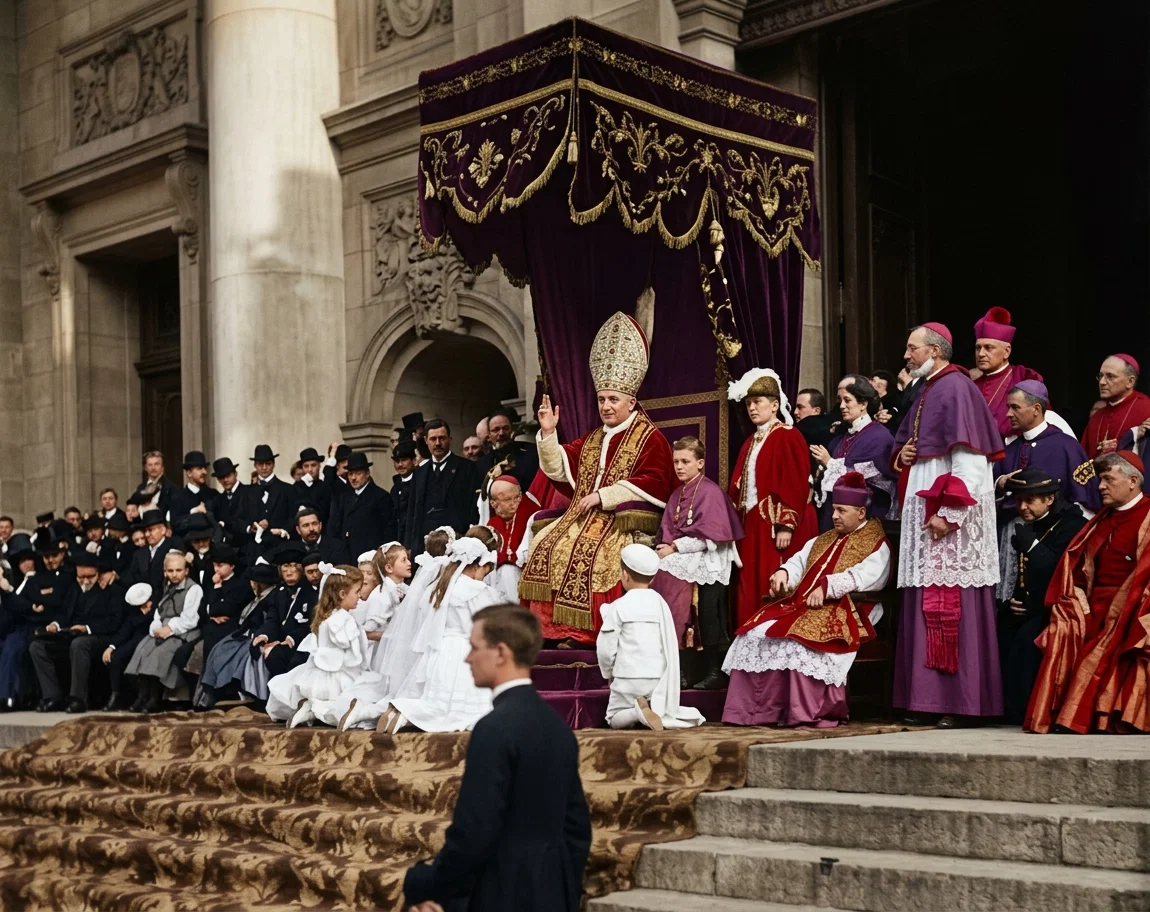
THE PAPAL LEGATE GIVING THE PAPAL BLESSING TO THE TWENTY-FIVE THOUSAND SCHOOLCHILDREN WHO MARCHED IN PROCESSION AND KNELT BEFORE HIM
In this eucharistic demonstration the Church of Rome sees a foreshadowing of the time when all the world will flock to her standard, acknowledge her supremacy, bow at her feet, worship at her altars, and loyally submit to her mandates; and wherever she has the power and the numbers which she was able to marshal in the province of Quebec she will see all that. The magnificent reception given to the cardinal legate and the dignitaries of the Church of Rome by the provincial government, is a sufficient guaranty of such homage. The government’s reception to the legate was given on the evening of September 7, in the great dining-room of the Windsor Hotel, and the list of invited guests included the highest dignitaries in both church and state. He had breakfasted with the premier of Quebec at noon; dined with the mayor of Montreal in the evening; sat for an hour while thousands knelt before him, one by one, to receive his benediction; and near midnight, when he withdrew from the government’s reception, thousands were still crowding the corridors of the hotel to catch a glimpse of him, or to receive at his hands the papal blessing.
It was the intention of those having the congress in charge that, when the day of the procession arrived, the 65th Canadian Regiment should march as a guard of honor to the papal legate while he bore the “sacred Host;” and there was much discussion in the press of Montreal over the matter, in view of the fact that the federal authorities had warned the commander of the regiment that it would be unlawful for the regiment to march as a guard of honor for any personage save a member of the royal family. Rome considers her representatives as ranking any member of any royal family, and therefore entitled to the most distinguished escort that can be procured. She desired the escort, and therefore, when the day of the procession arrived, the military escort was there, one of the most conspicuous adjuncts of the eucharistic demonstration.
This was another evidence of the fact that what Rome wants she gets, if she has the power, without regard to legality or illegality. That she wants it, is law enough.
Vigorous protests were made against this unprecedented act; but all were unavailing, as were also the protests against the course of the government in giving the papal legate such a reception as is accorded only to ambassadors of the highest rank. In the Montreal Witness of September 3, a Protestant states the matter in these words:—
It is with much surprise that I note the silence on the part of the press at the attitude adopted by the Dominion government authorities. The secretary of state in his official capacity is delegated7to meet the papal legate on his arrival, thus giving the visit of this dignitary an import of a national character, which goes far beyond the needs of the case. The papal legate is not an accredited ambassador from a temporal power, visiting the court of a friendly country in an official capacity, but is simply a dignitary of the Roman Catholic Church, acting in his ecclesiastical capacity. . . . Why should the Dominion of Canada, through its government, give to this church dignitary a position which is not borne out by his status as an ambassador?
That question was never answered, nor was another answered which asked why a military escort should be given the papal legate, when the government would not give a similar escort to Prince Louis of Battenberg, a member of the royal household.
As further evidence that the government was actually exhausting its storehouse of honors to pander to the papal appetite for pageantry and applause, we note the fact that the papal flag flew at the masthead of the government steamer which brought the papal legate from Quebec to Montreal, and the big gun in Dominion Square boomed out a welcome when the government steamer entered the harbor. There was nothing more that could have been done to honor the Pope and his legate, unless the government had actually turned the province over to the Pope in fee simple. And this was done in symbol when the premier of the province of Quebec knelt at the feet of the papal legate, and kissed his ring, the symbol of his authority. In that act the state bowed its knee and its head to the Pope in token of submission and obedience. That is what Rome expects one day to see done by every ruler in the world. Then will she truly fulfil the specification of the divine Word—“that great city, which reigneth over the kings of the earth.”
One of the most striking declarations made at this congress was contained in the statement of the papal purpose concerning the American continent. Said Cardinal Vannutelli, in his opening address:—
A great event was revealed at the end of the fifteenth century, which Providence reserved to itself to accomplish in modern times. The day upon which He permitted the discovery of America, God said to his church, as he had said to his divine Son: “I will give thee as a heritage all the nations of the earth; I will give thee the innumerable populations of these immense regions, and they will be added to those thou already possessest. . . . Scarcely two centuries and a half [since the establishment of Catholicism in Canada] before Catholic North America will see all these flourishing dioceses attached to the ancient hierarchy of the churches of the Old World.”
Then it was that he declared the universal pastor would show to the astonished universe that there was but one church in the world, and that the one whose visible head occupies the palace of the Vatican. When that church has won North America, she will consider her conquest of the world assured, if not practically complete. With America hers, she will possess “the balance of power;” and with that in her hands, she expects to be able to whip the world into line, and do all that lies in her heart to do.
A slight glimpse at the manner by which she expects to accomplish this was given by Father Terrence J. Shealey, S. J., of New York, in an address on “Retreats for Laymen,” in which he said:—
America is to be the battle-ground of the future, and Catholic laymen must do the fighting. The church can not arm them too early, so that they will be inspired to victory for the kingdom of Christ.
This declaration brings to mind another made at this same congress by Sir Lomer Gouin, the premier of Quebec:—
When the church teaches, we believe; when she commands, we obey; when she is attacked, we defend her.
And this adds significance to the declaration of Bishop Bruneault, of Nicolet, when speaking to an afternoon audience of women concerning the great company of workmen that was to meet in the Church of Notre Dame in the evening. He said:—
This evening the roof of this vast church will resound with the acclamations of an army of valiant soldiers, your brothers, your sons, your husbands, ready to shed their blood for the defense of their religion and their country.
When the shedding of blood is mentioned in connection with the propagation of a religion, it brings to mind the declaration of Cardinal Manning, of England, to the effect that he would plunge all Europe in blood if by so doing he could restore the temporal power of the Pope.
But the purpose of the Papacy for the subjugation of the world does not center on America alone. She has a more general purpose, which covers all the English-speaking countries of the world. Said Archbishop Bourne, of Westminster, England:—
God has allowed the English tongue to be widely spread over the civilized world, and it has acquired an influence which is ever growing. Until the English language, English habits of thought, English literature,—in a word, the entire English mentality,—are brought into the service of the Catholic Church, the saving work of the church is impeded and hampered. Each English-speaking nation can help in this great work,—England, Ireland, Scotland, the mighty United States of America, Australia, New Zealand, South Africa, and the British possessions in India. But the Dominion of Canada can at the present moment, owing to her long and deeply rooted Catholic traditions, render the greatest service of them all, and become a source of ever-increasing and unfailing strength to the universal church.
He stated that Pope Leo XIII had laid upon the order of the fathers of St. Sulpice the duty of continual prayer “that Great Britain might be brought back to the Catholic Church.” He recommended that the Holy See be petitioned to make this burden of prayer still more universal in its scope, “so that prayer might be offered asking that all the English-speaking races be brought to unity of faith and devotion to the Apostolic See.”
For more speedily accomplishing the object which Rome has in view, she is definitely planning a general revival throughout the entire ranks of Romanism, calling every layman into service.
It is interesting in this connection to note the Catholic Church’s estimate of Protestantism, as brought out at this congress. Said Bishop A. Thompson, of Nova Scotia, in the Windsor Hall meeting on the afternoon of September 7:—
The day appears to be not far distant when the religious systems that have departed from the ancient teaching will have become a thing of the past.
The work of the Higher Critic and the result of it among Protestant denominations, have given Rome good reason to conclude that Protestantism is disintegrating, and is no longer a formidable foe. She sees a foreglimmering of her conquest of the world in the movement toward Rome now going on in the Church of England. There was frequent reference to this at this congress.
Monsignor Bourne, archbishop of Angers, France, prophesied that the church would again come into her rights in France. He declared that the “persecutions” of the church there had done more for Catholic France “than had been accomplished during a century of cowardice and inaction.”
In the assistance of Protestants and their contributions toward the expenses of the Eucharistic Congress, Mgr. Paul Bruchesi saw an indication of the restoration of the world to the dominion of the Papacy. Speaking of this assistance, he asked:—
Is this the awakening foretold by many? Is it a step toward doctrinal unity? Are the old-time days returning? This is God’s secret.
The same idea of the Pope’s universal sovereignty was made plain in the Pope’s letter to the legate, in the legate’s telegram to the Pope, in the Quebec premier’s address before the legate, and in the sermon of Archbishop John J. Glennon, of St. Louis, Mo., who declared that in the thousands bowing at Catholic altars at that congress he saw reason to8hope that the church was coming into her own again.
What is indicated by this oft-repeated phrase, “the church’s own,” may be judged from the place occupied by the Pope’s envoy wherever he appeared in public at this congress. At every one of these public functions, the legate sat upon a throne, exalted above every other person present, even the representatives of the government,—a tangible illustration of the Pope’s claim to sovereignty over all the kings and peoples of this world. She is the ultimate authority. “When she commands, we obey,” said the Quebec premier; and “when she teaches, we believe.” Said Bishop McDonald, of Victoria, British Columbia: “I know that God has revealed it [the dogma of the Eucharist] because the church teaches it.”
The closing demonstration of the congress was the great procession of Sunday, September 11, which started at 1:20 P. M., and was not ended when darkness closed down over the marching hosts. The procession included religious orders and Catholic societies from all over the Dominion and the United States, and many individuals from far-distant lands. Practically every nation in the world was represented. The streets over which the procession passed were a moving mass of color, uniforms, banners, bands, badges, glittering swords and polished muskets, ecclesiastical robes of purple, scarlet, white, black, and brown. The cynosure of the whole parade was the papal legate, walking under a canopy of cloth of gold, and bearing in his hands the monstrance containing the consecrated wafer, which was supposed to be the very body of the Lord Jesus Christ.
Before the legate walked a number of flower boys dressed in blue and crimson silk, scattering roses in his path. At either side of the legate’s canopy walked the guard of honor, the regiment which could not legally march on this occasion. Behind the legate walked the cardinals in gorgeous robes of crimson silk, whose lustrous folds were held back by priests on either side. As the legate and his attendant left the street to pass up to the repository, where he was to close the congress by the celebration of Mass, he walked over a perfect carpet of roses. From the time that his party left the starting-point of the procession, the chimes of many belfries continued to peal out in honor of “the sacred Host,” which he was bearing, and the exploding bombs in Fletcher’s Field added their noise to the jubilation. The thousands of acolytes and altar boys in scarlet and white, and the three thousand priests in black and white, marching in under the glare of the electric lights, made a picture that will long remain with those who witnessed it. The mighty host fell upon their knees at the elevation of “the Host” in the hands of the legate, and the congress was finished.
What did it all signify? — A mighty movement on the part of the Papacy to bring to itself again the homage of the world. Every such demonstration means a great uplift to the Roman cause in whatever place it is held. It stands for the revival of Catholicism, and it indicates that the time is drawing near when the culminating conflict of the ages will break upon the world.
C. M. S.
A Profitless Christ
By J. N. Q.
NOT to be outdone by recent spectacular demonstrations of Protestantism, Rome has just conducted a eucharistic congress in Montreal, in which “outward show” held a prominent place. Rome is determined to crush Protestantism, and nothing will be left undone by her to accomplish this task. The chief purposes of the congress, according to the Washington Times—were the reading and discussion of papers in explanation of the central dogma of the Roman Catholic Church,—the real presence in the holy eucharist,—for the information of non-Catholics, and as a means of promoting among Roman Catholics a more intense devotion to the mass and to the blessed sacrament. The church takes this way of proclaiming to the world its unswerving belief in the central mystery of the Roman faith,—that Jesus Christ ever offers himself as a sacrifice on the altars of the Roman Catholic churches, and unceasingly dwells in its tabernacles. The sacrifice of the mass—the real presence—are the facts the congress proclaims.
The heathen had “gods many, and lords many,” but Rome’s belief of the real presence in the eucharist, places a Christ in every Roman church, and a lifeless Christ at that. Should we admit that the flesh and blood of Christ are present, and that Romanists partake of both, nothing will be gained; for Jesus said that “the flesh profiteth nothing.” A profitless business means bankruptcy; a profitless Christ means spiritual ruin. Romanists are being starved to death by this doctrine on which they place so much stress. How much better if they would turn to the Word of the Christ, and find in it “spirit and life.”
J. N. Q.
Note and Comment
The Book
THE following facts bear witness to the wonderful distribution of the Scriptures in these last days: “Bible societies of eight different nations reported the publishing last year of 11,378,854 Bibles. More copies of the Bible were sold last year than of any other hundred books of the world combined.”
_School Gardening_
By C. E. H.
THE school gardens of Washington, D. C., have been unusually successful the past summer. Not only have they been of value as an educational factor, but a large quantity of vegetables has been raised. We find the following report published in the Star of September 4:—
After laboring hard during the summer months with spade and hoe in the school gardens, hundreds of boys and girls of the city are now reaping the last of the fruits of their work. During the past week many loads of tomatoes, string-beans, Lima beans, lettuce, and other vegetables, have been carried away from the gardens. All those who have worked in the gardens have enjoyed the labor performed, and at the same time have gained much practical knowledge of truck gardening.
Nothing is better calculated to prepare students for after-life than a practical education in gardening. It is a step to be commended in educational work.
C. E. H.
The Baseball Craze—Its Meaning
By J. N. Q.
THE most indifferent can not fail to note the enthusiasm—may I not truthfully say craze?—which is everywhere manifested over baseball. Never in the history of the sport have such crowds attended the National League and the American League games as those present this summer. The minor leagues also have been well supported. Is this a healthy sign? or is it a sign of national degeneracy? This is a vital question; and in the current number of the Outlook, Mr. Ernest Thompson Seton has this to say:—
The personal interest in athletics has been largely superseded by an interest in spectacular games, which unfortunately tend to divide the nation into two groups,—the few overworked champions in the arena, and the great crowd, content to do nothing but to sit on the benches, and look on, while indulging their tastes for tobacco and alcohol. It is this last that is turning so many thoughtful ones against baseball, football, etc. This, it will be seen, is a reproduction of the condition that ended in the fall of Rome. In the days of growth, every man was a soldier; in the end, a few great gladiators were in the arena, to be watched and applauded by the millions who personally knew nothing at all of fighting or heroism. Degeneracy is the word.
There can be no very serious objection to a game of baseball, when it is played solely for the exercise thus obtained; but when interest is maintained not because of the health-giving benefits which may be derived from it, but solely because of the strife for supremacy, then baseball is purely an evil. Such a spirit is altogether foreign to our Lord and Master.
J. N. Q.
Life Sketch of Elder I. D. Van Horn
By A. G. DANIELLS
IN the midst of the camp-meeting held in Battle Creek, Mich., word came to us that our dear brother and fellow worker, Elder I. D. Van Horn, had passed away. Arrangements were made for the funeral services to be held in the Tabernacle. This gave a large number of his old friends who were at the camp-meeting an opportunity to be present, and to express to Sister Van Horn, and to the sons and other relatives, their great regard for him who had fallen, and their sympathy for those who were called to mourn. The services were conducted by the writer, who was assisted by a number of our late brother's former fellow laborers. The body was laid to rest in the cemetery at Kalamazoo, Mich.
The many friends of Elder Van Horn will be interested in the following sketch of his life, which was given at the funeral service:—
Isaac Doren Van Horn was born in Cato, Cayuga Co., N. Y., March 28, 1834. With his parents he moved to Michigan in September, 1844, and settled in Blackman Township, Jackson County, where he first heard of the soon coming of our Lord. Here and in Jackson, and in Albion College, his youth and schooldays were spent.
When teaching school twenty miles north of his home in the winter of 1859, he attended a series of meetings held in a schoolhouse by Elder Joseph Bates. After hearing two discourses, he decided to keep the Sabbath. Concerning him Elder Bates said in the REVIEW of May 26, 1859, when he with nine others was baptized: 'One of the number is girding up his loins, and lighting his lamp, and shaping his course to reach a station with the watchmen on the walls of Zion,—to join them in sounding the alarm in God's holy mountain,—to all the inhabitants of the land, and close up the final warning with the loud cry of the third angel's message.'
In the fall of 1863 Brother Van Horn began ministerial labor. In the spring of 1864, at a general meeting held in a tent on the site where the Battle Creek Tabernacle now stands, he was ordained to the work of the gospel ministry. Elder J. N. Andrews gave the charge, and Elder James White offered the prayer. After this he was sent into Gratiot County, Michigan, to labor in company with Elder R. J. Lawrence. D. M. Canright joined them as tent-master; and as a result of the effort one hundred persons accepted the truth that season.
In the following year another series of tent-meetings was held, in Tuscola County, where more than one hundred accepted the truth.
In April, 1865, he was united in marriage to Miss Adelia P. Patten. To this union were born three sons, Burt I. and Newman C., who still survive, and Charles Wesley, who is numbered with the blessed dead.
In December, 1873, Elder Van Horn was requested to make the Pacific Coast his field of labor. He remained in the West eight years, laboring in California, Oregon, and Washington. The blessing of God attended his ministry during this time, and two conferences of three hundred members each were organized.
For four years after his return from the West, he engaged with Elder George I. Butler in from twelve to fifteen camp-meetings in the summer season, and spent the winters laboring with churches in different places in Michigan. In 1889 he was chosen president of the Michigan Conference, which position he held for three years.
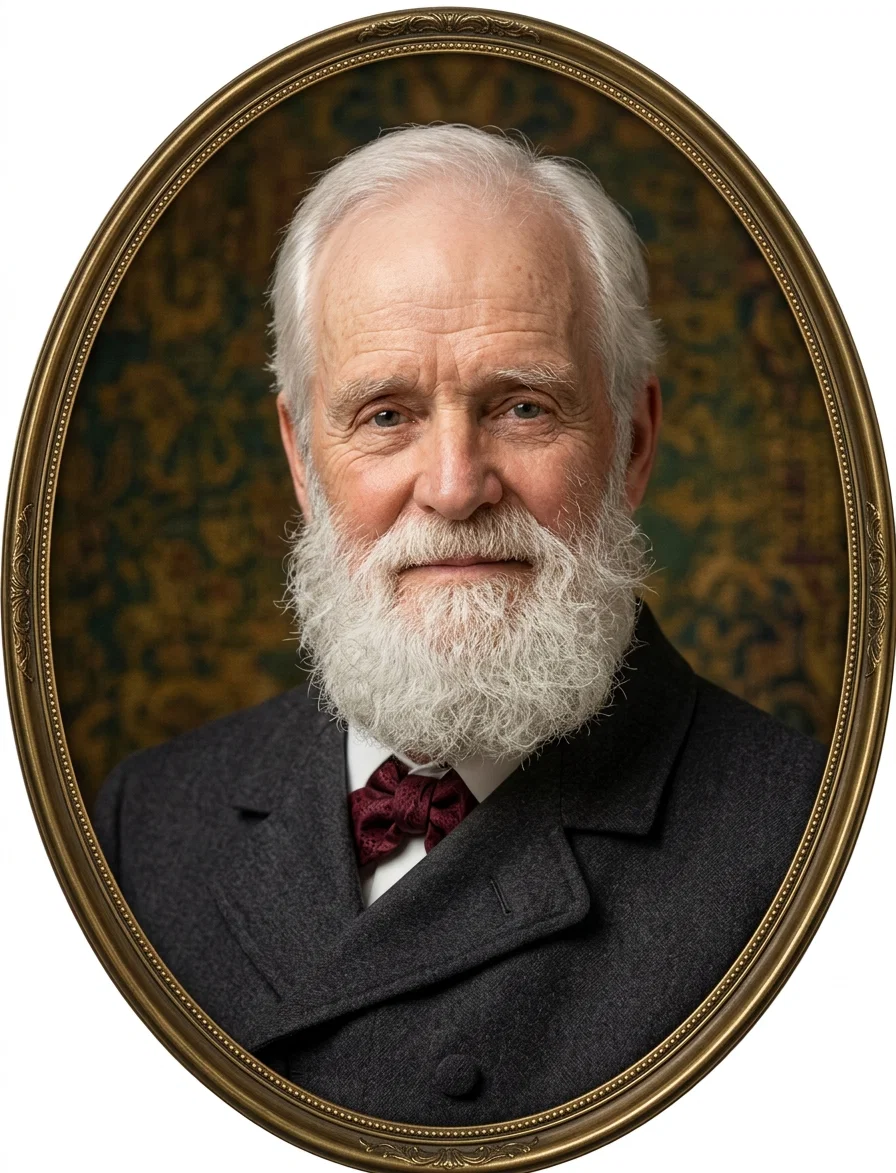
ELDER I. D. VAN HORN
In 1893 he was assigned to General Conference District No. 1, and labored and traveled extensively through eastern Canada and the Atlantic Coast States. His records show that from 1895 to 1898 his labors were bestowed upon forty or more places in Ohio and Indiana.
After closing his labors in Indiana in 1898, he was mostly engaged in church work in Battle Creek, with board meetings of the various institutions and missions, and in committee work, at the same time visiting the churches in Michigan in different places as opportunity afforded.
An attack of pneumonia in the winter of 1903 seemed to lessen his physical strength, but his usual courage and good cheer were manifest in his constant employment. In 1905, as age was coming on, he thought a portion of his time might profitably be spent in the country, and accordingly made the trial, but gave it up the following year.
His health continued to fail, and he could not engage in public labor. Two discourses—one on 'The Two Babylons,' given in the Tabernacle at Battle Creek, April 13, 1907, and the other on 'The Comforter,' given in Kalamazoo on May 19 following—were his last.
A few weeks later, one warm morning, as he was returning from a few hours' garden work, he was overcome by the heat, and fell prostrate on the lawn near his own door. This sad accident occurred on the seventeenth day of June, 1907. The prompt action of a physician, with assistance of friends, revived him when it seemed as if death had forever sealed his lips. The most careful attention was given him, and to the joy of his family and friends his physical strength soon returned; but the grief that seized them when they saw that their dear one was mentally unbalanced from sunstroke can not be described.
As he needed care that it was impossible for his family to give, he was for a time placed in the Michigan State asylum at Kalamazoo. On Oct. 17, 1908, he was taken to our sanitarium at Otter Lake, Lapeer Co., Mich., by the manager, Brother M. N. Dawson. To see him tenderly cared for by Christian friends, who loved him for what he had been and for what he had done, was a comfort to his family and friends in their deep sorrow. Here he lingered for a little more than twenty months.
On Monday, Aug. 22, 1910, at the age of 76 years, 4 months, and 24 days, the shadow of death came over him, and the kind hands that had ministered to his needs robed him for his final rest. We are met here to pay this last tribute of respect, and lay him away till the morning of the resurrection ushers in eternal day.
All who had the privilege of a close acquaintance with our departed brother will ever remember two very prominent characteristics of his life,—his earnest devotion to the cause of his Master, and his tenderness and sympathy for his fellow men. In his extensive travels and labors in this cause he deeply impressed all who came under his influence with these priceless attainments. His faith in the certainty of the triumph of the cause to which he gave his life never seemed to waver; and of him it may most truly be said, 'Blessed are the dead which die in the Lord from henceforth: yea, saith the Spirit, that they may rest from their labors; and their works do follow them.'
A. G. DANIELLS.
South Carolina Camp-Meeting
By Chas. Thompson
THIS meeting was held in Columbia, September 6-11, and was the first camp-meeting ever held for the colored people of this State. Elder Sydney Scott, with a corps of helpers, has been carrying forward an aggressive campaign in this city for several months. The Negro department of the State planned to make the camp-meeting a general gathering of the colored believers from the various churches and companies in the conference, and then bind off the effort of the summer. But instead, it was found that the camp-meeting was the beginning of a great interest, as hundreds came out each evening from the city, and gave marked attention to the message presented.
There were eleven family tents pitched on the ground, and occupied by about thirty-five campers, representing the churches at Spartanburg, Sumter, Florence, Greenville, Johnston, Charleston, and the believers at Batesburg, Wedgefield, Mullin, Ridgeway, and Summerville. In addition to the workers who were conducting the city effort, there were present Elder T. H. Jeys, president10of the conference, Elder M. C. Strachan, field secretary of the Southeastern Union Negro Mission, Brother A. L. Manous, the State missionary agent, and the writer.
The early morning hour was occupied in general instruction and praise meetings; and the nine-o'clock hour was spent in discussing plans for future work. The following resolutions were unanimously adopted:—
“1. We, the Negro believers of the third angel's message in the South Carolina Mission, in camp-meeting assembled, do hereby express our thanks to our Heavenly Father for his tender watch-care over us.
“2. Resolved, That we indorse the recent action of the General Conference, union conference, and local conference; in the establishment of the Negro Mission Department; and we pledge our loyal support to our local conference and mission department in the carrying forward of the great work of the gospel among the colored people.
“3. That we recognize the importance of careful and thorough organization among us; that we give our support to our regularly organized work; that we discountenance irregular and independent efforts; and that we encourage our people everywhere to pull in regular lines.
“4. That we recognize the voice of God in the call for homes for our missionaries; and that we indorse the plan for the raising of the $300,000 Fund.
“5. That we recognize the ten-cent-a-week plan, and endeavor to carry into effect its provisions.
“6. That we pledge ourselves to renewed diligence and faithfulness in paying tithes.
“7. That we encourage our young people everywhere to speedily prepare themselves for active service in this cause, and that we direct them to our denominational training-school at Huntsville, Ala.”
The five-o'clock hour was occupied by Brother Manous in presenting the book work, the needs of the field in this particular, and the blessings received by those who engage in scattering the printed page. At 11 A. M., also at 3 and at 8:15 P. M., preaching services were held. Elder T. H. Jeys carried a daily study on organization and church authority. On Friday evening the plan and purpose for raising the $300,000 Fund were presented, and in response $285 was pledged in a few minutes.
The Sabbath-school was one of interest. Seventy-six were enrolled, and it being the first camp-meeting Sabbath-school for the colored people ever held in the conference, all endeavored to set the pace for contributions. The collection amounted to $7.60, thus indicating that these believers wished to pass the copper and nickel age, and live in the silver time of the message.
Several gave their hearts to God for the first time, and all earnestly sought him for a deeper consecration and preparation for the work before them. Sunday evening twenty persons were baptized by Elder M. C. Strachan. The Lord blessed in this service.
On Sunday at eleven o'clock Elder Jeys, Elder Strachan, and the writer filled the three leading pulpits of the city churches (colored), and spoke the truth to several hundred people. The camp-meeting closed Sunday night with a strong and stirring sermon by Elder Sydney Scott on the Sabbath truth. Standing room at the big forty-by-sixty-foot tent was at a premium. It was estimated that between five hundred and six hundred persons gathered that night to hear the discussion of the Sabbath question.
The effort will continue indefinitely, and we confidently expect to see as a result a strong church organized in the capital city of South Carolina. May God give wisdom and help to the faithful workers in this department of our work.
CHAS. THOMPSON.
East Michigan Conference
By K. C. Russell
THE East Michigan camp-meeting was held in Jackson, August 11-21. The attendance of our own people was good during the latter part of the meeting, and the evening and Sunday services were well attended by the citizens of Jackson. The sessions were wholly devoted to spiritual and educational matters, conference business being attended to at another time.
The first Sunday afternoon a temperance rally was held, at which an ex-mayor of Jackson spoke briefly, together with a number of our own people. We believe this effort contributed in no small degree to the cause of true temperance, while at the same time it placed us squarely on the right side of one of the noblest of moral reforms. This position we are always glad to take when the movement is in no way linked with Sunday legislation, which makes it impossible for us to ally ourselves with it without compromise of principle.
It was gratifying to note the careful and earnest attention given to the different departments of the work now being systematically carried on. This is as it should be, if we wish to see the work well balanced, and our workers and people awake to every phase of this great message of truth. Special effort was put forth by those in charge of the tract and book work to make the display attractive, and the large sales gave evidence that the effort was not in vain. Surely no denomination can present to the public a more attractive and interesting set of books than we, and the soul-saving element in this literature is the chief matter of interest. This has all come about in God's providence, that a speedy work might be accomplished in heralding the truth of a soon-coming Saviour to all the world.
Another strong feature of this meeting was the success attending the efforts to secure good newspaper reports of the sermons and addresses. It is a great satisfaction to know that thousands who were not present at the services were nevertheless made acquainted with the proceedings, and became acquainted with the principles set forth in our meetings. We would urge that special attention be given to this matter when laying plans for our camp-meetings for the coming year.
Besides the regular conference laborers, there were present Elders A. G. Daniells, E. W. Farnsworth, A. Moon, and C. McReynolds, Dr. A. Allen John, Brethren J. B. Blosser and J. W. Mace, and the writer.
The people returned to their homes in the best of courage.
K. C. RUSSELL.
Christian Liberty
Reports, Notes, and Comments Pertaining to the Current History of the Rights of Conscience
Conducted by the Religious Liberty Bureau
K. C. RUSSELL Secretary
C. M. SNOW Corresponding Secretary
Refurbishing the Inquisition
ONE of our brethren in Ontario, Canada, received the following letter from the secretary of the Ontario Lord’s Day Alliance. This threat-breathing missive is thoroughly self-explanatory:—
“Dear Mr. —: Information has come to this office that you are accustomed to follow your weekly employment on the Lord’s day. This is contrary to the Lord’s Day Act, Section 5, which prohibits such work, and leaves you liable, under Section 13, to a penalty on conviction of from $1 to $40, and costs. It is also stated that you have people playing ball in your garden on the Lord’s day. This is a violation of C. S. U. C., cap. 104, Section 3, and leaves those who engage in such playing liable to similar penalty—Section 7 of same act. If one enjoys the protection of the law of the land, he ought to be willing to keep the law. To permit such violation of the law to go unchecked, would be to encourage lawlessness. Will you by return mail explain why you do such things on the Lord’s day, and thus violate the law? Will you let me know whether such violation will henceforth cease permanently, or continue? If it ceases permanently, the matter will be dropped; but if it continues, the matter must be handed over to the attorney-general, that the law may take its course. Under another cover, by this mail, I send you copies of these laws, that you may be duly informed of the position that you occupy.”