The Youth’s Instructor, Vol. 33, No. 48.

NOT TO BE MINISTERED UNTO

The Youth’s Instructor

Dec 16, 1885

S. D. A. Publishing Association · Battle Creek, Mich. · Dec 16, 1885

"NOT TO BE MINISTERED UNTO."

MISS PARKER drew her scholars closely to her. Tears glistened in her eyes. “This has been a precious lesson to-day,” she said. “How I wish that all of us might follow our Saviour this week! Though he was the majesty of heaven, he came to earth to be a servant to all men. He said he came, ‘not to be ministered unto, but to minister,’—not to be served, but to wait upon others. Shall we not try to follow his footsteps this week?”
“Well, but how can we?” said Lottie Stephens. “He could go out and heal the sick, and feed the multitudes, and say such wonderful things; but I’m sure we can’t do as he did.”
“Now think, Lottie; isn’t there a chance right in your own home to follow him every day? Some people have the idea that they must go into the public places to do good; but too many only run away from the very work the Master wants them to do. Ask the Saviour to open your eyes, that you may see the places where you can help others; and when you do see them, act just as Jesus would if he were in your place.”
Lottie walked slowly home, pondering upon the words of the lesson, “Not to be ministered unto, but to minister.” She was quite absorbed in her thoughts, when Tom Jones, the washerwoman’s boy, ran against her, and almost pushed her over. The force of the collision threw him into the sand.
“Don’t you know any better than that, Tom Jones!” exclaimed Lottie angrily, as she re-adjusted her hat.
Tom scrambled up; but his hands were bruised and bleeding. “Serves you right,” said Lottie; “you ought to look where you are going.”
“Oh! what shall I do?” sobbed Tom; “I’ve spoiled my best clothes, and mother will give me a whipping.”
Lottie knew Mrs. Jones; she was nervous and irritable, and had to work hard to earn a living for herself and Tom. “Do just as Jesus would if he were in your place,” flashed into Lottie’s mind.
“Look here, Tom,” said Lottie, “I’m sorry I was so cross. Of course you didn’t mean to run against me, and I’ll help you clean your clothes. Here’s a spring right by.”
Tom looked at Lottie in surprise, as she rubbed the mud from his jacket, and bathed his bleeding hands with her own white handkerchief.
“Why don’t you come to school now?” asked Lottie. “Oh! I can’t come any more,” said Tom, “‘cause I have to turn the washer. Mother’s got the rheumatiz, so she can’t.”
“Poor woman! And I’m sorry for you, too; but of course you try to make the best of it, don’t you?”
“Yes, I study my reading and geography at night and in the morning; but I can’t see through the ‘rithmetic at all.”
“Oh, I like arithmetic,” said Lottie. “I tell you what,” she added after a pause, “I’ll come over to your house after school, and help you.”
“Will you?” cried Tom. “You’re the best girl I ever saw. Maybe I can learn percentage, if you’ll help me, and then I can get a place in Mr. Brown’s store. He said he’d take me as soon as I got through percentage.”
It would be hard to tell which was the happier, Lottie or Tom, as they went home. “I do believe the Lord opened my eyes that time,” whispered Lottie to herself, “and I’m so glad I’ve found something to do for others. Now for my new library book. Good! it’s one of Mrs. Whitney’s; I do love her books so much,” and Lottie seated herself on the sunny porch. Her little brother and sister were romping up and down in a noisy game.
“Oh, do keep still!” exclaimed Lottie impatiently; “I want to read.”
“Won’t you read to us, please?” asked Ned. “We’ll keep still then, won’t we, Peggy?”
“Yes, indeed,” Peggy replied.
“Oh, don’t bother me; I don’t want to read out loud. This book is too old for you children. Go and play on the other porch.”
“Won’t you tell us a story, then?” persisted Ned. “I’d rather hear a story.”
“No,” said Lottie; “you go to the other porch, both of you.”
The two little faces were clouded a moment. “Wait till I’m big, and know stories; and I’ll tell the children all the stories they want. I’ll not keep them all to myself, Miss Lottie,” said Peggy. “Come, Ned, let’s go and play.”
The children were soon happy, but Lottie lost her interest in her book. “Not to be ministered unto, but to minister,” seemed written all over the pages. “Oh, pshaw!” thought Lottie, “it doesn’t mean that; the children are happy.” Then she heard her mother saying, “Children, won’t you be quiet? Mamma has a headache. Why didn’t you play on the other porch where I told you to?”
“Lottie told us to go away. She wouldn’t tell us a story, either,” said Ned.
Lottie’s face burned with shame. “Children,” she called, “come here; I’ll tell you a story now.”
Lottie had a rare and interesting way of telling stories. Now, as she told the story of Jesus walking through the streets and the fields, and how the children loved him, and the sick rejoiced to see him, her own heart was melted, remembering his untiring patience and love to others. The children’s faces glowed as she pictured Jesus riding into Jerusalem, and the people throwing the palm branches in his path, and the children shouting “hosanna.” “Jesus blessed the children, you know, and told them they might come to the kingdom of heaven,” said Lottie.
“Oh, if I’d seen Jesus,” said Peggy, “I wouldn’t have been afraid of him; he was so kind. I would have gone right up to him, and took hold of his hand, and kissed him. I wish I could kiss him now.”
“Well,” said Lottie, “he said if we were good and kind to others, it was just the same as being kind to him.”
“Does it mean we must be kind to everybody?” asked Ned.
“Oh, yes,” said Lottie; “wasn’t Jesus good to everybody?”
“Well, then,” said Ned, “I’m not going to call Solomon Reed ‘Red Head’ or ‘Pumpkins’ any more.”
“That’s right,” said Lottie, “we must try to do just as Jesus would if he were here. But there is the bell for dinner.”
“O Lottie! I think that story was so good, and I want to kiss you for it,” said Peggy. Lottie’s eyes filled with happy tears.
How many things she found to do for others that week! Father’s stockings had to be mended, mother’s cares lightened, grandma’s yarn untangled, the children’s lessons heard, Mrs. Jones’s house put to rights, Tom’s arithmetic made plain; and scores of little things that Lottie had not seen before had to be done. Mrs. Whitney’s book lay on the mantle all the week; but Lottie read a story from the leaves of every-day life. Not without many a struggle did she deny self and follow Jesus.
“Well, child,” said Mrs. Jones, “that liniment you brought me did me more good than anything I ever tried before; and your bonny bright face has just brought the sunshine right into our home; bless you!”
“Lottie,” said her mother, drawing her into her arms, “I saw this slip of paper in your room: ‘Not to be ministered unto, but to minister.’ Hasn’t that been your text this week?”
“Why! what makes you think so, mamma?”
“Oh, I’ve seen your thoughtfulness, and felt your gentle help; and I thank God for my daughter.”
“O mamma! I didn’t know it was so blessed to minister to others. You don’t know what awful selfishness I’ve found in my heart, but I do want to be like Him.”
“He is the chief of all, the one altogether lovely, Lottie. I’m so glad you’ve found his beauty.” But the sweetest of all commendations was when Lottie knelt to pray at the end of the week, and the peace of God was in her soul; for she knew she had pleased her Saviour in forgetting self, and remembering others. FANNIE BOLTON.

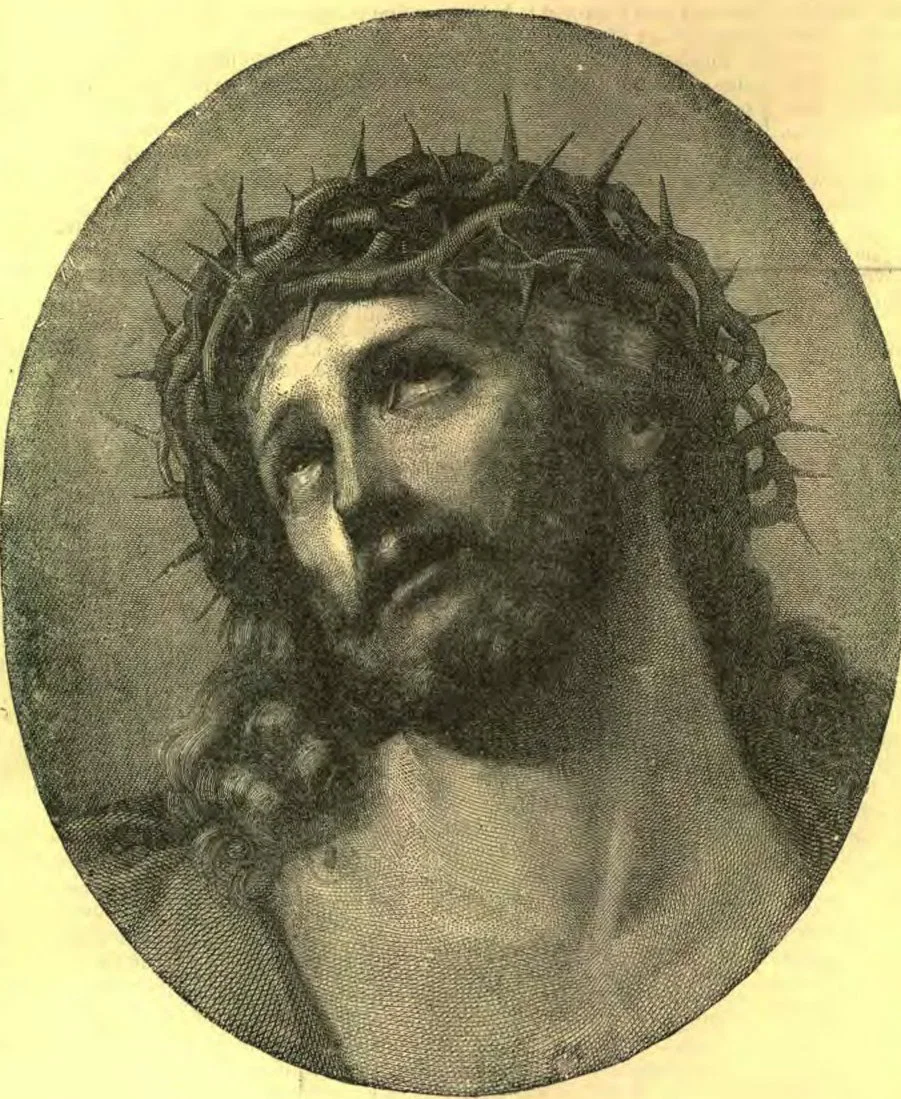
CHRIST CRUCIFIED.

“And when they had platted a crown of thorns, they put it upon His head.” Matt. 27 : 29.
“He was wounded for our transgressions, he was bruised for our iniquities.” Isa. 53 : 5.
Bound upon the accursed tree, Faint and bleeding, who is He? By the eyes so pale and dim, Streaming blood, and writhing limb, By the flesh with scourges torn, By the crown of twisted thorn, By the side so deeply pierced, By the baffled, burning thirst, By the drooping death-dewed brow, Son of man! ’tis thou, ’tis thou!
Bound upon the accursed tree, Dread and awful, who is He? By the sun at noonday pale, Shivering rocks and rending vail, By earth, that trembles at His doom, By yonder saints, that burst their tomb, By Eden, promised ere he died To the felon at His side, Lord, our suppliant knees we bow; Son of God! ’tis thou, ’tis thou!
Bound upon the accursed tree, Sad and dying, who is He? By the last and bitter cry, The ghost given up in agony; By the lifeless body, laid In the chamber of the dead; By the mourners, come to weep Where the bones of Jesus sleep; Crucified! we know thee now; Son of man! ’tis thou, ’tis thou!
Bound upon the accursed tree, Dread and awful, who is He? By the prayer for them that slew, “Lord! they know not what they do!” By the spoiled and empty grave, By the souls He died to save, By the conquest he hath won, By the saints before His throne, By the rainbow round his brow, Son of God! ’tis thou, ’tis thou! —Henry Hart Milman.

What Is a Failure?

I DON'T know how many of my readers are familiar with the names of the two French writers, Erckmann and Chatrian; but they are very famous in France and Europe, and pretty well known in all the civilized world. They write stories together; you will often hear of a book by “M. M. Erckmann—Chatrian,” showing that it was written by both together. Their stories are remarkable for purity and beauty. Some years ago the two had just finished a romance intended for one of the Paris papers. Before sending it to the printer, M. M. Erckmann—Chatrian re-read it together. A shade of disappointment settled upon their faces; the romance was not satisfactory, to the authors at least. “Shall I tell you what I think about it?” suddenly remarked Chatrian. “It is lame. We have made a mistake. This romance represents a considerable sum of money; after we have expended it, we shall be none the richer, and will have incurred the responsibility for a commonplace work. I am only too well aware that it has cost us much time and labor to cover these sheets with ink; but what avails it? One’s expectations cannot always be realized; and, just now that we are both in bad humor, let it be settled in this wise: You set out immediately for the Vosges for a much-needed rest. I, of course, am forced to remain in Paris; but before you go, let us burn every leaf of this manuscript, so that, hereafter, we may not be tempted to make use of it in any way.”
“Very well,” responded Erckmann; “to the stake with it at once.”
The doomed manuscript was thrown into the blazing grate, and when the last vestige had disappeared, the two authors shook hands warmly. Now what do you say to this; was it a failure? Yes, the story was a failure, no doubt, but it was that sort of failure that made these men good writers.
It is said by a certain writer, “Every failure is a step to success; every detection of what is false directs toward what is true; every trial exhausts some tempting form of error. Not only so, but scarcely any attempt is entirely a failure; scarcely any theory, the result of steady thought, is altogether false.”
Another writer says that when you have failed in any undertaking, the best way is not to recognize the fact. Indeed, to a brave man there is no such thing as failure. He is simply knocked down, and gets up and goes at it again. He knows it is no disgrace to make a big mistake, or a hundred of them. He tries again, and does the best he can as long as he lives. Even when a whole life seems to have been a failure, a wise man will know better. “If we read history, we will find that the failures have really advanced the world more than the successes. Columbus was a failure, Galileo was a failure, Savonarola was a failure. If those three men had at any time been gifted with second sight, and had seen the place they were to fill in history, it might have consoled them; but no doubt every one of them died of a broken heart, convicted in his own mind of failure.”
What is a failure? Not to do the best you can, is a failure. To dodge the work that belongs to you, is a failure. To get ahead of your neighbor by unfair means, or in any way to gain a point dishonorably, is the meanest kind of failure. Mistakes, misfortunes, accidents—don’t count against you; these happen to the best men; but a failure in pluck or in honesty—a failure in manhood, is something to cry over.—Treasure-Trove.

OUR NATIONAL MILITARY ACADEMY.

A SHORT time ago I had the pleasure of visiting our celebrated National Military Academy, and I thought some description of it might be of interest to the INSTRUCTOR readers. A military academy, you know, is a place where men learn to be soldiers, to be captains and generals; where they learn to build forts and take cities. This is where such great men as Grant and Sherman, Lee and Johnson, and hundreds more, got their training.
How many such schools has our nation, do you ask?—Just one, and only one; always remember that. Now, how many can tell where it is located? Those who have read the history of the United States ought to know that it is situated at West Point, New York. Where is that? Get your map, and look at the great State of New York, near the south-eastern point, where it reaches the Atlantic. Here is New York City, the metropolis of America. Here the Hudson, a large and majestic river, running down from the north, empties into the sea. Going up this river fifty-two miles north from New York City, you come to West Point. Just here the river, coming down from the north, turns east about a quarter of a mile, then gradually turns back west again, leaving a point of land like an elbow on the west side of the river. On this point the academy is situated.
All the country around West Point is hilly, such great hills that they are almost mountains, and covered with small trees, with here and there a few farms in the openings.
West Point Academy stands on quite a level piece of ground, about one hundred and sixty feet above the river. The whole tract of land owned by the government contains two thousand and one hundred acres. This is not all level; most of it is very rough and hilly, and covered with woods. But where the Academy buildings are, the grounds are beautiful, and kept in the neatest possible order. There are lovely walks, shaded by great trees; and grassy lawns, flower gardens, pleasant dwelling houses, and a number of large, costly, public buildings. Some of these are for the school-room, where the young men recite; for the library, containing about thirty thousand volumes; for the chapel; the boarding house; the barracks; etc.
This Academy was founded in 1802. Only young men between seventeen and twenty-two years of age, not less than five feet in height, with a perfectly sound body, and of good moral character, can be admitted. They must have a certain amount of education. They must agree to serve the United States eight years, unless sooner discharged. Only one person at a time can be appointed from each congressional district and territory. The examination is rigid, and the discipline of the school very strict. The course of study covers four years.
These military students are called cadets. They all wear a neat uniform, and are required to be very particular in regard to their dress. They present a fine appearance when on drill and parade. They march and maneuver just like a regular army. There were about three hundred students when I was there. All the expenses of the Academy are paid by the Government.
During the Revolution, West Point was an important place, since it commanded the Hudson River. The first fortifications were begun in 1775. General Putnam commanded here in 1778. General Washington himself made this his headquarters in 1779, and with La Fayette, afterward visited the place. Arnold, the traitor, took command here in 1780, and arranged with the British to betray the place and the army to them. If he had succeeded in his plot, the whole American cause might have been ruined. He just escaped with his life, while Andre, the British spy, was captured and executed.
The ruins of Fort Putnam are situated on a high bluff, just west of the Academy buildings, commanding the river above and below West Point. It furnishes a grand view of the surrounding country. The building of this fort cost $3,000,000, and two years’ work of the army. The massive walls are in ruins, and trees have grown up inside the fort. There are many interesting spots all around West Point, which have been hallowed by the footsteps of Washington, La Fayette, Knox, Green, and other revolutionary heroes, and have been associated with some of the most stirring events of our nation’s history.
D. M. CANRIGHT.

OTHER'S BURDENS.

I WAS a little bit of a girl when it happened, but I have thought of it all so often. We were going off on a picnic, and just ahead of me were two great girls, quite young ladies in my eyes, whom I knew a little and admired a great deal.
By and by one asked me to carry her lunch-basket a few moments. I don't remember why now, but I know she had some good reason.
I took it up; it was a pretty big basket, and, as I said, I was a little bit of a girl; and when she presently turned to take it again, I declined giving it up. Every few moments the girl repeated her offer, but I refused always, and tugged that great load all the way to the picnic grounds.
Why do you suppose I did it? Simply for this: over and over in my mind went the words, “Bear ye one another’s burdens,” and I felt I was keeping the command to the letter.
That night my arms ached, and I felt very tired. I also wanted a little praise, so I told my father and mother incidentally what had happened.
Mother said, surprised, “Why in the world did you do it?”
And father added, with a man's impatience, “You were excessively foolish, child, to make a pack-horse of yourself in that way!”
That word “pack-horse” has come back to me a thousand times. I should have defended the girl, of course, but I did not; I only felt grieved and shocked, somehow. Was that the way grown people looked at the dear Lord’s own command? What was wrong in the whole affair? What might have been different?
I wish now that I had gone to some one with my trouble; but children seldom do; and I puzzled over that incident often and often, until I had learned enough to see wherein the wrong lay.
I did make a “pack-horse” of myself absurdly, for the older girl was able and willing to bear her own burden. The smaller and weaker were the ones I should have helped; and I think the root of the whole matter lay in the fact that I wanted to help some one whose esteem and thanks were of consequence.
You see I did this to be seen of men, or I would have chosen the one to aid more wisely, and I would not have told of it afterward.
Ah, there it all was in a nutshell, and there it is now for you, children, to profit by.—The Child’s Paper.

SNOW GARMENTS.

The gnomes in heaven are busy; see how swift The fleecy raiment falls, and clothes in white All the bare, waiting world. The meadow bed Is spread with snowy sheets; the hill’s brown head Stands veiled and hooded in a graceful drift. And quick as winged things in eager flight, Soft dropping over twig, and branch, and stem, Come tiny, clinging cloaks to cover them, And make them fair and lovely in our sight. The birds fly here and there, amazed to see All this white wonder falling wide and free, Changing the face of Nature in its might! Poor, startled birds, they cannot even guess The meaning of the world’s new loveliness. —Mary Ainge De Vere, in Companion.

WHAT'S THE DIFFERENCE?

“It’s rotten clear through; it won’t bear us,” said Joe, surveying with an unbelieving look the mossy tree that had fallen across the brook at some unknown date.
“Why, of course it will,” insisted Tom. “It’s a regular old giant. I’ll risk myself on it, anyhow.”
Neither of the boys could swim, and they were in the middle of the dark wood in company with the old farmer with whom they boarded. They had come trouting; but the farmer was revolving in his mind some doctrinal thoughts called forth by a late neighborly discussion.
“There is a good bridge above here,” said Joe.
“Oh, nonsense!” cried Tom; “come on!”
Joe looked at the farmer. “Going over by that tree, sir, or round by the bridge?”
“Well,” said the farmer, “they say it does not make any difference what you believe, if you are only sincere about it. Tom thinks the tree is safe, and you don’t. There’s the difference. We ain’t all constituted alike. We must have different beliefs for different people. If each one is only honest and sincere in his belief, it don’t make any difference.”
The boys looked at him as though they thought he was crazy.
“Constituted!” echoed Joe; “what’s constitution got to do with it? Tom might believe that tree was a carriage road, and it would not make it so. If it isn’t safe, Tom’s thinking it is won’t make it so, will it, Mr. Bright?”
A twinkle came into Mr. Bright’s eye.
“Certainly, certainly, Joe. If he is only honest and sincere, that is all that is necessary. God is too good to let Tom suffer any harm, anyway.”
“Well, Mr. Bright,” said Tom, “I don’t know what you mean; but if I didn’t believe that tree was safe to cross on, I wouldn’t do it, of course. I’m willing to take my chances.”
“All right,” said Mr. Bright. “If you go over safely, Joe and I will follow.”
Tom turned toward the brook, and farmer Bright, throwing off his coat, said in a quick undertone to Joe, “Keep still! You can’t swim, but I can.”
Tom sprang quickly on to the tree, and with such force that he hardly knew his first step had snapped the bark which wrapped the fallen monarch. Fair and perfect in strength as it looked to Tom, it was held in shape only by its bark; and his second step was a headlong plunge through the crumbling mass into the brook.
Mr. Bright was not long in helping him, dripping, on shore.
“Much obliged to you for trying the bridge for me, Tom,” said Joe, mischievously. “I’ll take a ducking for you some day.”
“Now, Tom,” said Mr. Bright, “I suppose you would like some dry clothes; but Joe is out for a good time, and we don’t want to spoil it. Let’s just believe our clothes are dry, and it will all be the same.”
“O Mr. Bright,” said Tom, with a shivery laugh, “I honestly believed that tree would hold. Why didn’t you tell me it wouldn’t? I am wet to the skin, and I am going home.”
“Never mind me, Mr. Bright,” said Joe. “You and Tom have scared the trout off for one day. It’s no use fishing now.”
“Well, boys,” said Mr. Bright, “always remember that sincerity doesn’t save a man; he may be honest, and yet be in the wrong. Be very careful to find out whether what you believe is right or not, and stand by the right.”
Then they took the shortest cut home, crossing the brook by the legitimate bridge.—American Messenger.

Living Each Day as a Miniature Life

WHEN our devotion to the ideal is such as to lead us to live in a dreamy anticipation of the future and to neglect present duties, we may be sure that something is wrong. If we are in danger of getting into this condition, let us remember that every day is a miniature life, and so put whatever of noble thought or earnest purpose there is in us into to-day. If daily we do this, we shall find at the end of our life that we have thereby approached more nearly to our ideal than if we had spent our life with folded hands, dreaming beautiful dreams.

A QUAINT VILLAGE.

In a thriving section of country in North Holland, near the shore of Zuyder Zee and not far from Amsterdam, is the celebrated “Broek,”—a village which has long been famous for its oddities. First, everything about the place is in miniature, as if made for a race of tiny dwarfs; to which, add its queer architecture, its great display of bright tints, its wonderful gardens and chambers, and its unbounded rage for cleanliness, and you have the elements of its distinguished reputation. One writer has said, “Imagine the most childish extravagance to which the name of village can be given, and you will have a faint idea of Broek.” There are tiny houses and streets, tiny yards and gardens, tiny walks and arbors, tiny canals and bridges, tiny steps, gates, and lattices all through the town.
The small houses are of one story, and are rose-colored, black, gray, purple, and grass-green; and the roofs are covered with painted tiles, in squares of various colors. Stripes of two or three colors border the windows, which are of blue and red glass, and decorated inside with embroidery, fringes, and ribbons. The doors are carved, gilded, and painted very elaborately.
But the wonders are in the tiny chambers (“which are so many bazaars, each one of which would require a volume of description”), and in the gardens. The houses are all surrounded by small gardens, separated from the street by sky-blue palings. Mimic canals, about the width of the hand, apparently made for toy boats, separate the arbors from the tiny flower beds. The narrow walks are bordered with bushes of box, which have been cut back to diminish their size, and are shaped to represent ships, peacocks with spread tails, children with their arms stretched out, etc. The shade trees, too, in the same manner, are fashioned after different objects, and are twisted and dwarfed to make them curious and unnatural, while their trunks are painted a bright blue to the first branch. Scattered here and there about the gardens are miniature grottoes and cascades, chapels, temples, Indian pagodas, and painted statues, and automatic figures which bounce and spring from hidden places, performing a variety of curious feats.
An eminent traveler, who had visited the place, in writing of it afterwards, said:—
“The narrow streets are paved with tiny bricks of various colors, set edge-wise and combined in different designs, so that, at a distance, the street seems to be carpeted with Cashmere shawls.
“The village is so constructed that from no point can more than four or five houses be seen at one time; consequently, at every step, a new scene is discovered, a new combination of bright colors, a new caprice, a new absurdity. Fifty paces carry you around a house, over a bridge, through a garden, and back to your starting point.”
Although Hollanders, as a people, have always borne a reputation for neatness, probably no other town in their own country, or any other has carried the matter to such extremes as has this village of Broek. The same writer gives some interesting descriptions of Broek home-life, only a few of which we can notice, although all are quite entertaining. He at one time accepted an invitation to examine the house of a poor widow, and he thus relates what he saw:—
“The woman had only one room; but what a room! The floor was covered with clean matting; the furniture shone like ebony, and all the little points of metal here and there looked like silver. The chimney was a real temple, lined with colored tiles, and as clean and polished as if it had never seen a fire. She showed me the utensils for cleaning the room—enough to set up a shop; brooms, brushes, tooth-brushes, cloths, scrapers, dust-pans, pokers, shovels, feather brushes, aquafortis, Spanish white for the window-panes, Venetian red for the knives, coal-dust for the copper vessels, emery for polishing the iron things, brick for rubbing the pavements, and sticks for poking out the microscopic straws that get into the cracks of the floors. The bed, as in all other houses, was shut in a kind of closet in the thickness of the wall, and consisted of a mattress or two laid upon the lower part of the same wall—a suffocating bed, one would think, in summer.
“She gave me some curious information about the fury of cleanliness for which this village is famous. It is not long since an inscription to the following effect could be seen at the entrance to the village: ‘Before and after sunrise, it is forbidden to smoke in the village of Broek except with a cover to the pipe-bowl (so as not to scatter the ashes).’ It was also forbidden to go through the village in a carriage, or with sheep or cows, or any other animal that might soil the street. Before every house there was once a stone spittoon, into which smokers spat from the windows. The custom of being without shoes within doors is still in vigor, and before every door there is a heap of shoes and boots and wooden pattens.”
“It is true that every citizen who sees from his window a leaf or straw fall upon the pavement, comes out and throws it into the canal; but that they all go five hundred paces outside the village to dust their shoes, or pay boys to blow dust out of the cracks of the pavements four times an hour, as has been told, probably never happened.”
Distinguished visitors in Holland always take in Broek. It is related that the Emperor Alexander of Russia and Napoleon the Great were once there; and wishing to see the interior of a house, they were obliged, before entering, to draw on a pair of coarse woolen stockings, so that they should not soil the floors with their boots. This writer learned further that—
“In former times, the mania for cleanliness arrived at such a pass, that the women of Broek neglected their religious duties for it. The pastor of the village, after having tried unsuccessfully every means of persuasion in producing a reform, took another way. He preached a sermon, in which he said that every Dutch woman who should have faithfully fulfilled her duties toward God in this earthly life, would find in the other world a house full of furniture, utensils, and trifles various and precious, in which, undisturbed by other occupation, she could sweep, wash, and polish for all eternity, without ever coming to an end. The image of this sublime recompense, the thought of this immense felicity, infused such ardor and piety into the women of Broek, that from that moment they were assiduous at religious exercises, and never had need of further admonition.”
“Although the Broek of to-day is only a shadow of its former self, it still has many visitors. It was formerly a village of millionaires, who went there for the love of peace and quietness; but the desire for more agreeable surroundings drove away almost all the rich families from Broek, and those who remained allowed the old order of things to vanish. It has now about a thousand inhabitants, the greater part of whom make cheeses; the rest are shopkeepers, manufacturers, and artificers, living on their income.”

IMPORTANT BIBLE SUBJECTS.

LESSON 15.—RECAPITULATION.

[NOTE TO THE STUDENT.—Do not consider the lesson learned until you can give at least the substance of every text, with the correct reference for each. The references in black letters indicate those texts that should be committed to memory. A little diligent application each day will enable you to learn them, although this need not be considered a test of scholarship.]
  1. What part of the world’s history is covered by the prophecies of Daniel?
  2. By what five universal kingdoms was this period to be covered?
  3. By what symbols was the first of them represented?
  4. Which of these symbols best indicates the wealth and intelligence of this kingdom?
  5. Which best represents its prowess and dominion?
  6. How is the identity, or name, of this kingdom determined? Dan. 2:37, 38.
  7. When did this kingdom become connected with the people of God?
  8. How long after this did it exercise supreme power?
  9. How was its decline represented? Dan. 7:4.
  10. By what power was this kingdom subdued?
  11. How was the second great kingdom symbolized in the different visions?
  12. Which of these symbols best represented the union of two kingdoms in one?
  13. Which of them was most suggestive of its unyielding and aggressive character?
  14. When did this kingdom gain the ascendancy, and how long did it continue to be the leading kingdom of the earth?
  15. When, and by what power, was it overcome?
  16. How was the third kingdom symbolized in the different visions?
  17. What represented its division into four parts?
  18. What represented Alexander the Great and his remarkable career?
  19. What seems to suggest the celerity of his movements?
  20. How is the identity of the second and third kingdoms put beyond a doubt?
  21. How long did Grecia rank as a universal kingdom?
  22. When, and by what act, did the fourth kingdom become connected with God’s chosen people?
  23. How was the fourth kingdom symbolized in the different visions?
  24. How was its cruel and warlike character indicated?
  25. What showed that it was to be divided into ten powers, or kingdoms?
  26. When did this division take place?
  27. Show that the fourth kingdom must be Rome.
  28. What great universal kingdom is to succeed Rome?
  29. When is it to be set up?
  30. How was it symbolized in Nebuchadnezzar’s dream?

NOTE

Dates.—The Babylonian kingdom proper was founded B. C. 747, and became connected with the people of God B. C. 677 by the capture of Manasseh, king of Judah. In prophecy, therefore, it dates B. C. 677; it continued 139 years.
Medo-Persia became supreme B. C. 538, and continued to be the dominant power for 207 years.
Grecia conquered Persia in B. C. 331, and maintained its supremacy about 170 years.
Rome dates from its league with the Jews in B. C. 161, and in its undivided state continued until A. D. 483, about 644 years. In its divided state Rome has already continued 1400 years, and is to continue till the coming of our Lord, being represented by nations that are under the influence of the Papacy, and corrupted Protestantism,—the Mother of Harlots, and her apostate daughters.

TAKE IT BY THE FORELOCK.

MISS not the occasion; by the forelock take That subtle power, the never-halting time, Lest a moment's putting off should make Mischance almost as heavy as a crime.

HOW CUPS AND SAUCERS ARE MADE.

In the so-called “greenhouses” a large quantity of ware is drying, preparatory to being “fired.” This process is the crucial test of pottery. All the preceding operations have been carefully conducted with a distant view to this one. All the combinations of clay, flint, stone, or bone have been made with forethought of the kiln in which the ware will be partially vitrified. Earthenware and porcelain are only, as it is well known, less perfect forms of glass, or rather of glass in another stage of development. When the earthenware slip cups and saucers, mugs and jugs, are sufficiently dried, they are ready for the “biscuit” kilns, as they are oddly called, for the ware is not twice baked in them, nor is it good to eat. Some kinds of ware are submitted to the intense heat of the kiln three times, all twice—once in biscuit and once in glaze. When painting is introduced over the glaze, as in the old Sevres pate tendre and the various kinds of fine porcelain, there is a third firing. Before being placed in the kilns, all the articles thrown, turned, or molded are arranged in “seggars,” receptacles of coarse clay, very thick and strong, like deep pie dishes. Into these the various articles are packed with considerable skill, little triangles being placed between each to prevent their touching each other, and the seggars are next packed together in the kiln or oven, each seggar being lined at the bottom with a layer of rock sand. Piled one on the other, the seggars make a fairly compact column, and when the oven, some nineteen feet in altitude, is filled, the fire is applied. It will be understood that the fire by no means touches either the ware or the seggars in which it is enclosed. They are simply in an oven about to be raised to a tremendous heat. The firing is done by means of flues so arranged as to diffuse intense heat throughout the whole interior of the ovens. This firing is a ticklish operation, requiring the supervision of a skilled workman capable of going without sleep for some thirty-six or forty hours. At first the heat is applied gently for fear of cracking the ware, and the fireman has an anxious time of it. Little openings in the brickwork enable him to judge of the progress of his work. The heat of the biscuit oven during the last twenty-four hours is intense. As the ware has taken from forty to fifty hours in firing, so does it require an equal time to become cool.—The Interior.

A NATURAL ICE-HOUSE.

IN Breckenridge County, Ky., we are informed by the Elizabethtown News, three miles from Walker’s Mill, is one of the most remarkable natural ice-houses in the world, and a curiosity well worth traveling some distance to see. It consists of a cave, with an entrance about eight feet wide and twelve feet high. The temperature in this cave ranges about twenty degrees above zero the year round, and in the summer time the change is so great that it nearly freezes a person to death to go into it. Above the cave, on the hill, is located a considerable stream of water that makes its way in large drippings through the roof of this remarkable subterranean passage. These drippings congeal in the cave, and fall in solid lumps of ice from the ceiling. This freezing has doubtless been going on for years, as the cave contains thousands of tons of ice. Dr. H. C. Duvall, of Big Clifty, who had occasion to get some ice from this natural storehouse for a patient in the neighborhood, says that it is the purest and best ice he ever saw; and that, standing at the mouth of the cave, the falling of the ice can be heard like thunder in the distance.—The Christian Advocate.

HIGH-SOUNDING WORDS.

In Dr. Farrar’s interesting work on “Families of Speech,” he illustrates by examples the strange freaks which words are made to play in the languages of uncivilized peoples. Savages, like ignorant persons in civilized lands, are fond of high-sounding words, of which the following specimens are given:—
“Day” in Pawnee is shakoorooceshairet. In Katsknai, a language of Athabasca, in the north of this continent, the word for “tooth” is, khiotsakatakathasia, and that for “tongue” is such as we should think no one would wish to utter more than once or twice in his life. It is this: Khotzotkhlitzitkhlitsaha. “Star” in Chenook is thukhehkhaama.
“These are vocables,” as De Quincey says, “enough to split the teeth of a crocodile.”
The Mexicans are notorious for their long words. Their common address to a priest in the one word, Notlazomahinzteopixcatzin, which means, “Venerable priest, whom I honor as a father.” It sounds like a cat and dog preparing to fight.
A fagot is tatlotlalpistitentli; and if the fagot were of green wood, it could hardly make a greater splutter in the fire.—Youth’s Companion.
Continue reading: A SHY RACE