IN Sumatra there is a very singular race called the Kubus, who are too shy to mix with other races of the island, and dwell in the recesses of the forest. They are looked on as inferiors by the Malays, and thought to be only a little better than wild beasts. Such is their shyness that they will never willingly face a stranger. Their trade with the Malays is consequently carried on in a strange manner. The trader announces his arrival by beating a gong, and then retires from the place of rendezvous. The Kubus approach, put their forest treasures on the ground, beat a gong, and retreat. The trader returns and lays his commodities down in quantities sufficient, as he thinks, for the purchase of the goods on sale. Then he retires, and the Kubus reappear and consider the bargain. And so, after more withdrawals and approaches and gong-beatings, the respective parties come to an understanding, and carry off independently their bargains. The Kubus in their wild state do not bury their dead. They live on snakes, grubs, fruits, and the flesh of any deer or pigs they can slay. They are skillful spearmen, and throw stones with marvelous accuracy. They know of no state after death. —Selected.
KEEPING FLOWERS FRESH.
All that is necessary to keep flowers fresh is to keep them moist and cool. Instead of dipping flowers in water, they should simply be wrapped in a wet newspaper, which will keep them far fresher over night. A wet towel or napkin is too heavy, and will crush the blooms too much; besides, it would allow the moisture to evaporate too easily. Boston florists pack rosebuds in wet paper, and send them as far west as Chicago, or even St. Louis, where they are taken out even fresher than when they came off the bush.
Composition of Gold and Silver Coins
ALL the gold and silver coins of this country are composed of nine tenths of pure metal to one tenth of alloy.
FRANK'S MISTAKE.
“My shoe-strings always have knots in ’em. I never can find my slate-pencil.” And then Frank sat down on the floor and cried.
He cried two kinds of tears: one kind was because he was impatient; the other, because he was trying to be good, and had failed.
He let small things make him cross, such as a knotty shoe-string and a lost pencil; and he very well knew that
Jesus did not care to have cross disciples. When he got up that morning, he was very determined to “shine” for Jesus; but before he was ready for morning school, he was in gloom and tears. He wondered if Paul and all the rest of the good Bible people were pleasant all the time. “If they were,” he said, “their things must have been all right and not bothered; mine plague me.”
The whole day went wrong. He forgot and whispered at school, got angry with a boy on the play-ground, and dropped his new reader in the mud. So, on the whole, it was a sorrowful day; and Christ’s little disciple did not shine much.
He told over his sorrows and his mishaps to his mother that night, and she said she thought she knew where the trouble was.
This surprised Frank, and he asked what was the matter. She did not answer at once, but repeated very slowly, “Having therefore obtained the help of God, I continue unto this day.” “Having therefore obtained help of God, I, Paul, continue to preach Jesus,” it means Frank.”
Frank looked out of the window with a very sober face, but made no answer.
“Frank did not ask God to help him to preach Jesus at school, coming home, and at home; so he did not let his light shine,” said his mother.
Another long time was spent in thinking; and then Frank remembered he had not said any prayer that morning, and had not even asked God to help him, feeling very certain that he could be a good boy all by himself.
Have you ever made such a mistake?—Little Folk’s Quarterly.
A GREAT THOUGHT, AND WHAT CAME OF IT.
This was the great thought, “God sees me, and hears me, and knows all that I do.”
It was planted in the mind of a little child, not yet six years old, by a good lady who loved the little children, and gathered them around her to speak to them about the great God, and his love and care for little children.
The little child was the daughter of a rich man who did not know God; and what was still more sad, he did not believe that there was such a God.
Little Annie’s father would not let her go to Sabbath-school; but when her friend Hattie came, and begged that she might go to children’s meeting with her, he said, “The child is too little to be hurt by anything she will hear;” and so he let her go.
One day the good lady taught the children, “Thou God seest me,” and told them that this great God sees and hears and knows all things. It was all new to little Annie; and it made her feel very solemn, and yet very glad, for her teacher said that this wonderful Being knows and loves each little child. She went home, full of the great, wonderful thought, and said,—
“Papa, do you know who made you?”
“Oh, don’t talk any of that nonsense, pet,” he said.
“But, papa,” said Annie solemnly, “God made you, and he hears all you say, and knows all that you do.”
“There, there, that will do,” said her papa; and then the tea-bell rang, and soon the family were seated at the table.
Something happened at the tea-table that vexed Annie’s papa, and he spoke a dreadful word, so dreadful that I dare not tell it to you.
Annie laid down her knife, and said gravely,— “Dear papa, God sees you, and he hears you, and he knows all that you do.”
“Leave the table instantly,” said Annie’s papa, and the little girl obeyed without a word.
She went up to the beautiful parlor, and sat down in her little rocking-chair, and thought about the great God, who knows all things. And soon her papa came into the room, and began pacing back and forth, with a troubled look on his face.
Annie watched him a little while, and then she went to his side, and slipped her hand into his, and said softly,—
“Papa, God sees us, and he hears us, and he knows all that we do.” Then, folding her hands and looking up, she whispered, “Thou God seest us.”
This time Annie’s papa did not send her away, but he stooped and kissed her, and that evening he went to the church where one of God’s ministers was trying to get people acquainted with the Lord Jesus; and going to the altar, he asked God’s people to pray for him.
He became an earnest Christian from that hour, and always says that the good God sent his little Annie to lead him to the dear Saviour.—S. S. Advocate.
A WINTER SONG.
By George Cooper
THERE'S a song upon the air,
Heard above the trumpet blare
Of the storm, 'mid bleak and bare
Woodland mazes.
Ah! the icy winds may blow,
And hurl the heaping snow;
But in the earth below
Sleep the daisies.
There's a song within the heart,
Though its sunshine may depart,
Learn it whosoe'er thou art,
Till life closes.
Ah! the snows of grief may fall,
And the shadows may appall;
But beneath them, after all,
Sleep the roses.
—George Cooper.
An Egyptian Shadoof.
By W. E. L.
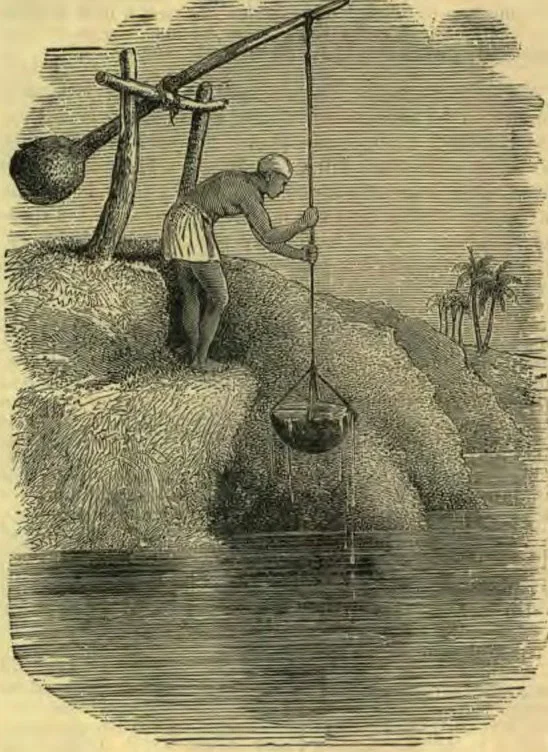
WHAT is this man in our picture doing, do you think? He seems to be very hard at work, dipping water up out of the river. You know he does not live in any country that you have seen; for off in the distance stand a group of palm trees. So you judge from that and the scanty clothing the man wears that it must be in some very warm country. And so it is.
This river that flows so smoothly and quietly along is the Nile; and that, you know, is in Egypt. In that part of the country where this man is at work, they have no rains. Just think what long, sunshiny days they must have, and such a blue, blue sky!
But the land would be parched and dry if it were not for one thing. Every year the river rises and rises till it comes way up over the high banks, and thoroughly waters the land. After awhile it goes down, leaving a rich coating of mud on the wet ground. Then the farmers sow the seed.
What makes the river rise in this strange manner? Way off at the source, hundreds of miles from its mouth, every year fall, oh, such hard rains! Of course the water from the country then runs into the river, and it grows to be a very large, swollen stream, drowning all the rich, low gardens, and making little islands of the houses. If it were not for this, the land would be only a desert, where no one could live. When we learn that the people did not know of the true God, it does not seem so strange that they should worship the Nile, since it was the cause of so many blessings to them.
But in the dry season the land would become parched if the people did not take some way to keep it watered. So all over the land they dig deep ditches, or little canals, and keep them filled with water from the river. And that is what the man in our picture is doing. At one end of the swinging pole hangs an empty vessel, and at the other is a great lump of Nile mud. He pulls down on the end where the vessel is tied, thus raising the heavy mud at the other end, and dips the vessel into the river. You may be sure it is not easy to move this great pole, and I should think he would almost break his back. He has to keep doing it all day long, for one bucketful would not go far toward filling the canal. This awkward machine is called a shadoof.
For hundreds of years the land has been watered in this way. It does not seem to have occurred to the people that there is any easier way to get the water from the river.
W. E. L.
The Habit of Regular Giving
GIVE constantly. The irregularity of beneficence is one reason of its irksomeness. Spasmodic exercise leaves a feeling of soreness in the unpracticed muscles. A little practice in the gymnastics of generosity will ensure a pleasant sensation to the giver. It is only by cultivating a habit of giving that one learns how much more blessed it is to give than to receive.
Letter Budget.
It is an unusual circumstance to have letters for the Budget from little boys and girls living in Battle Creek; but through the kindness of the teacher of the primary department of the college, we now have a few. In instructing her pupils to write out their thoughts on paper, the teacher encourages them to write letters for the INSTRUCTOR. Knowing how well you will like to read them, we will put all we have in this number of the paper. The first which appears is from a little girl whose father went as missionary with Eld. Haskell, away off in Australia. It is from—
FLORENCE B. ARNOLD, who says: “As I have not seen any letters in the INSTRUCTOR from Battle Creek, I thought I would write one. I go to school every day. My teacher’s name is Mrs. Kirby. We have a very pleasant school-room. I go to Sabbath-school, too, every Sabbath. I have a little sister. Her name is Mabel. My papa has gone to Australia. I want to be a good little girl, so I may be saved in the kingdom of God.”
LURA OWEN says: “I cannot write very well, but I will do my best. I am ten years old. I have two brothers and one sister. I go to school, and read in the Second Reader. I go to Sabbath-school, and study in Book No. 3. We have a large Sabbath-school. I like the school very much.”
BESSIE K. SMITH writes: “I thought a letter from Battle Creek, where the paper is printed and the editors live, would be interesting to the little friends who live far away. I live near the Tabernacle, and attend Sabbath-school there. I go to school at the College. I like my teacher very much, and am trying to be a good girl. I have a little sister. Her name is Nellie. I must say good-by for this time.”
LITTLE ELLA GOFF writes. She says: “I like to hear the stories read out of the INSTRUCTOR. I am seven years of age. I go to school, and read in the First Reader. I have a little sister. Her name is Mina, and her age is three years.”
CLAUDIE AMADON says: “I am a little boy nine years old. I go to Sabbath-school; and if I have my lessons, I always get an INSTRUCTOR. After I do my work, mamma gives me time to play. I play ball, and now that snow has come, I shall have lots of fun with my sled.”
Here is a letter written by a little boy from the “sunny South,” where it hardly ever snows. Very likely he is to have his first sled; and the little folks who have never seen much snow, can think just how he will enjoy it. The letter is from—
WILLIE LONG, who says: “My home is in Tennessee. I came up here to go to school. I think I am learning very fast. I hope to have a nice time when it snows. Mamma said she would buy me a sled large enough for brother and me to ride on. I hope to meet you all in the new earth.”
HERE is another letter from a little boy in Battle Creek,—CHARLIE P. WARNER. He writes through the post-office: “I am nine years old. I used to live in Corsica, Ohio, with my grandma, who was a Sabbath-keeper. I attended Sabbath-school with her. We had thirty members in our school. My grandma died last April. I miss her very much, because she was so kind to me. Now I live in Battle Creek, with my uncle and aunt. They are also kind to me. I go to the College primary school. I think the Lord is very kind to give me such a good home. I want to be a good boy, and meet my good friends in heaven.”
BERTHA JENSON, of Shelby Co., Iowa, writes: “As I had not seen any letter from this place, I thought I would write you a few words, to let you know how we are getting along. There are only four families here who keep the Sabbath, but we hope our numbers may be increased. Our Sabbath-school is held in a small house, which we rent, and which is quite convenient for such purposes. It is two miles from our home. We have only lived here since last August, and we did not keep the Sabbath until then. We are husking corn now, and we all help; I mean all of us children help papa. My own father died last fall. I am trying to be a good girl, so I may be saved.”
A good beginning has been made in your place, Bertha; now you have each to “let your light so shine before men, that they may see your good works, and glorify your Father which is in heaven.” This is the way to increase your members the most rapidly. Live Christ’s example every day. To do this, you will have to study his life, and watch against temptation, and pray very much.