The Youth’s Instructor, Vol. 64, No. 47.

Lightning Strikes the Loftiest Towers First

The Youth’s Instructor

Nov 21, 1916

Review and Herald Publishing Assn. · Takoma Park Station, Washington, D. C. · Nov 21, 1916

Lightning Strikes the Loftiest Towers First

It is the loftiest towers that are first struck by the lightning, and the tallest trees that feel most the fury of the blast.—Bishop Taylor.
On October 4, the French auxiliary cruiser “Gallia” was sunk by one torpedo. Of the Serbian and French troops aboard the “Gallia,” which was on her way to Saloniki, about 1,000 perished.
The monkey is the only animal known to science, except man, that can be given infantile paralysis experimentally. But the monkey never “catches” the disease. It must be artificially inoculated.
No amount of money could buy Polly Mulock from Mr. Corwin Mulock of Philadelphia. Awhile ago Mr. Mulock’s drug store caught fire in the night. “Fire! Store!” shrieked Polly, all alone downstairs.
An American Society has been organized for the purpose of raising $1,500,000 for the war orphans of France, as an expression to that country of America’s appreciation of her aid in the trying days of the Revolution.
During the twelve months that ended on September 1, California shipped eastward 44,517 cars loaded with citrus fruits—37,259 cars of oranges and 7,258 cars of lemons. The cars would make a train long enough to reach from Boston to Philadelphia.
Hold a simple magnet bar near a lighted incandescent lamp. If the current is alternating, the filament, that is the part inside the lamp from which the light emanates, will vibrate; if the current is direct, the filament will be attracted or repelled as the positive or the negative pole of the magnet is held near the lamp.
In eleven States the women will vote in the election on November 7. The Prohibition candidates are claiming a large percentage of their support. The reason is obvious. The women expect to vote for the candidates who are most representative of their ideals of good government and Christian living.
Many points of similarity between Abraham Lincoln and J. Frank Hanly are being pointed out by Mr. Hanly’s friends. Both were born in a little log cabin. Both had hard struggles in early life, and both became political powers through persistency and constant endeavor. The comparison is carried farther by recalling that President Lincoln abolished Negro slavery, and ex-Governor Hanly is running for President on the Prohibition ticket, and hopes to abolish slavery to strong drink in the United States.
It has been discovered in France that an excellent cement is one of the by-products of the manufacture of beet sugar. The scum that forms when the beets are boiled, and which has heretofore been thrown away, consists largely of carbonate of lime and water, and from 70,000 tons of beets treated, 4,000 tons of carbonate of lime is obtained; to this 1,100 tons of clay are added, the resulting product being 3,162 tons of excellent cement. The scum is pumped into large tanks, where it is allowed partially to dry. Finely divided clay is then mixed with it, and the mixture is thoroughly amalgamated by beaters for an hour and burned in a rotary kiln. The clinker is then removed and pulverized into cement.
All school-teachers in Hungary have received this memorandum: “The royal Hungarian minister for education requests all teachers to pay special attention in the coming term to the respect and honor due to our enemies; that no hatred or contempt should enter the minds of the children against the brave men with whom their fathers are in deadly combat; and that hate or contempt is not to be cultivated in the youthful minds.”
One inch of rain means that on one acre, water sufficient in quantity to fill more than 600 barrels of 45 gallons each, has fallen. This quantity of water would weigh more than 110 tons. Rainstorms frequently cover whole States, and often four or five inches of water fall during a single shower, in which case the total number of tons of water falling to earth is, of course, enormous.
Plate-glass insurance companies class windows with black lettering on them as “extra hazardous” risks. The explanation given is that a black surface absorbs the sun’s rays. Thus an unequal expansion is produced throughout the plate, and under the influence of a sudden gust of cold or any other quick change of temperature, a strain is developed which may break the glass.
King Haakon of Norway has approved an ordinance forbidding submarines of belligerent powers from traversing Norwegian waters except in cases of emergency, when they must remain upon the surface and fly the national flag. Any submarine violating the ordinance will, according to its provisions, be attacked by armed forces.
Once the bubonic plague was an annual visitor in the Philippines: it has not showed its head for seven years. Of the 35,000 lepers who once roamed the islands, only 3,000 remain, and they are concentrated in one settlement. And the annual death rate of the islands has been cut in half.

Papers Wanted

Mr. A. W. Spaulding, of Reeves, Georgia, principal of a school for training self-supporting Christian workers, desires copies of our papers for missionary work. He says:—
“Our young people here and our teachers, in their Sunday work around the country, could use a great many more copies of the INSTRUCTOR and Little Friend than we can obtain. Will you not insert a notice in the INSTRUCTOR asking friends to send us good clean copies? We are having some very interesting experiences, and the children’s and youth’s papers are more eagerly received by grown people generally than our missionary papers.”

Heavenly Treasure

EVERY coin of earthly treasure We have lavished upon earth For our simply worldly pleasure May be reckoned something worth; For the spending was not losing, Though the purchase was but small: It has perished with the using; We have had it—that is all!
All the gold we leave behind us, When we turn to dust again, Though our avarice may blind us, We have gathered quite in vain; Since we neither can direct it, By the winds of fortune tossed, Nor in other worlds expect it: What we hoarded we have lost!
But each merciful oblation, Seed of pity wisely sown— What we give in self-negation, We may wisely call our own; For the treasure freely given Is the treasure that we hoard, Since the angels keep in heaven What is lent unto the Lord.
—John G. Saxe.

Having Eternal Life

I. C. KILGORE

Man’s Elixir

SCARCELY a year passes without some one’s telling of a new scheme for lengthening life, so that we shall only need to eat, or not to eat, something, or do something in order to have many more days to our credit before we die.
It is not only now in the twentieth century that men have striven to prolong human life. Hundreds of years ago people told and wrote attractive stories about what one might do to enable one to live longer on the earth. They are so old that we actually do not know their origin; all that we do know is that they were handed down by word of mouth from generation to generation, and then were written so that we can read them.
The stories are called “myths,” “folklore,” and sometimes “fairy tales.” They tell of many things which made people live long, long lives,—magic rivers in which to bathe, herbs to eat, or something to wear on some particular part of the body. Everywhere and at all times, people have wanted to live long, the longer the better. Eternal life has been one of the chief phases of the religious beliefs of all mankind. The desire for eternal life, like the desire for self-preservation which prompts so many of our acts, is one of the deepest desires of the human heart.

Christ’s Elixir

Christ knew men. He knew how to deal with them and how to approach them in a way that would draw them to him, and so he often spoke of things that he knew they enjoyed hearing about. Many times he talked to them concerning eternal life, because he understood that it was one of the things in which they were most interested.
Christ’s method for gaining eternal life was different from any that his hearers had known before. He taught them that it was not a question of clothing or of eating or of ceremony, such as the Pharisees believed in, or of anything, in fact, that those people had ever advocated or that is advocated now, so far as I know. His elixir was unique.
Enduring life, Jesus said, can be got in only one way, a way which he explained to them beyond the possibility of misunderstanding: Enduring life is to know God.
Now here is a remarkable thing—to say that to know some One is eternal life; to have knowledge is to live forever. It must be that this knowledge of which the Saviour spoke is different from the knowledge we get at school. Such knowledge gives no promise of life forever. No one claims that it does. This knowledge is usually the kind that enables one to get along well in this life, helps him to make more money or to be promoted to a better job, or makes him more entertaining to friends. This knowledge ends with death.
And yet, knowing all this as the Saviour must have known it, he says there is a knowledge which is (actually is, not leads to, or brings) eternal life—the knowledge of God.
To know God is eternal life.

Knowing

One is not given credit at school for knowing a lesson until all parts of the lesson are understood and one is able to recite it without mistake.
A man does not know his trade or his profession until he grasps all parts of it and is able to use his knowledge efficiently. It takes a long time to acquire such knowledge.
One does not know a person the instant he is introduced to him. There is always first the introduction, then a period of acquaintanceship. After more or less time has elapsed, one may say, “He is a friend of mine;” and much later, “He is an old friend of mine. I know him well.”
An acquaintanceship can never become a friendship unless the two acquaintances are enough alike to understand and appreciate each other. There is always at least some one thing that the two persons must have in common, within themselves, in order to be really friends. One young man is given up unreservedly to a keen appreciation of every humorous incident he meets. It is inconceivable that this person should form a very close attachment for some long-faced person who neither can nor will laugh, however insistent the circumstances. What man or woman who loves art or music so passionately that the life is given to a study of the one or the other will be drawn with inseverable bonds to a cold, disdainful person who holds in contempt everything but one particular branch of science in which he himself finds enjoyment?
We understand, then, that friendship involves a mutual comprehension and appreciation, a similarity of belief, of likes or of dislikes, or something besides a mere triviality. This it is which makes possible the intimate knowledge of one by the other that is essential to friendship.
Now we are in a position to understand what the Saviour meant when he said, To know God is eternal life.
To know God means to have a close friendship with God; to understand and appreciate him as one friend understands and appreciates another. Impossible so to know God?—Hardly. Christ does not tell people to do things that are impossible. Friendship with God is no more difficult or impossible than friendship with a human being. But, like human friendship, it is impossible unless within us there are characteristics that are like those which God has. Having those, we can understand and appreciate him with no difficulty whatever.
One must next inquire what these characteristics are which one must have in order to be a friend of God, and how they may be obtained; for the answer to that is the key to this friendship.
The answer has already been given: “He that loveth not knoweth not God; for God is love.”
It is not strange that one who is godlike should live eternally. God lives forever; why should not his friends so live? Does it seem impossible to know God? It is not impossible. The mission of the Son of God in this world was to reveal his Father to mankind so that we could know and understand him. He has shown us the character of the Father, and he has shown us how to be like the Father.
With every moment, there comes the opportunity to apply and to reapply in ourselves Christ’s formula for eternal life. Perfect love—such do we have if we are godlike; and such do we have if moment by moment, hour by hour, one day at a time, we enter into and here and now enjoy the beginning of eternal life in ourselves. No wonder the beloved disciple could say, “He that believeth on the Son hath everlasting life.” Surely a new thought of life and inspiration and happiness is this that even now while I write or read, while I go about my daily commonplace duties, I may be partaking of that eternal life, the gift of God, promised to every one who will accept.
To know God, to love perfectly, is now and always enduring life.

Out of Weakness Made Strong

THE experiences marking the triumphant advance of the early Christian church from strength to yet greater strength, are today marking the progress of the advent movement, the main object of which is to gather out from every nation under heaven a people prepared for their Lord.
It was only a comparatively few brief years ago that Elder James White began pleading for a serious consideration of the world-wide proportions to which God’s remnant church was to develop.
“It is truly gratifying to witness the present progress of our cause,” Elder White wrote in a Review editorial, Aug. 26, 1873, a full year before the first Seventh-day Adventist missionary left the shores of America for a foreign field. “To learn that persons of moral worth and mind, not only of the American people, but those from other nations in our country, are joining our ranks, is very encouraging. . . .
“But when we consider the extent and magnitude of the work to be accomplished, as marked out in prophecy, the brief period in which it must be done, and how little, comparatively, is being done, we are forced to the conclusion that God requires of us broader plans and more vigorous efforts. It seems that the providence of God is far in advance of us.”
A fund of two thousand dollars had been raised for the establishment of a mission in Europe, and Elder James White proposed that Elder J. N. Andrews be spared for service abroad, and particularly for the special work of rendering assistance “in perfecting translations of our works” in the French and German languages, “to scatter throughout Europe.”
“We believe God has a special work for these last days,” declared Elder Geo. I. Butler a few weeks later, “and that work must go to ‘peoples, nations, tongues, and kings.’ It is world-wide. . . . Let us take up the good, rallying cry, ‘Courage in the Lord,’ and move on to final victory.”—Review and Herald, Nov. 4, 1873.
A week later, at the twelfth annual session of the General Conference, formal action was taken leading to the establishment of the European mission in Switzerland, although, to quote the language of the resolution, they must needs “move out by faith.”
Late in the summer of 1874, Elder J. N. Andrews set sail for his field. Upon reaching Neuchâtel, Switzerland, his temporary destination, he hastened to communicate with his friends in America, through the editorial columns of the Review. And how plainly do his first warm words of greeting, penned on missionary soil, reveal the heart of a wise zealot and of a man of God—the heart of a noble soul whose dependence was not in himself or in any inherent or acquired personal ability, but rather in the strength of the Omnipotent. To quote:—
“God has committed to the Seventh-day Adventists a work of immense magnitude and of vast importance. It is to give warning to the world of the near advent of Christ, and to teach the true preparation for that great event. Never was a greater responsibility committed to a body of men than that which God has given to this people. The time for this work is short. It can only be accomplished by the direct help of the Spirit of God. . . .
“We must set ourselves to this work as those who labor to save the perishing, and who think not of their own ease, or convenience, or comfort. God calls us to labor and not to faint. Let us respond to this call.”—Review and Herald, Dec. 15, 1874.
At that time, the denominational institutions numbered just four—the Review and Herald Publishing Association, the Health Institute of Battle Creek, Mich., the Pacific Press Publishing Association (founded that very year), and the Battle Creek College (also founded in 1874).
As regards the part our institutional work would yet play in connection with the proclamation of present truth, Elder Uriah Smith made bold to write editorially as follows on the same page with Elder Andrews’s thrilling rally cry, “To labor and not to faint:” —
“This preparation of the needed facilities in education, in health reform, and in the work of publishing, are the most faith-inspiring features this cause has ever been able to show.
“What more will be needed, we perhaps do not now clearly see. We only know that this work is the cause of God, and it will be accomplished. It cannot go back. The omnipotent hand of the God and Christ of our blessed hope is behind it. We know that that cause which represents in the earth the closing truths of the Word of God, and the finishing of the work of salvation among men, is no sham and slipshod affair, and will not be done in a corner. There are thousands of localities to be lightened with its presence, which do not yet so much as know of its existence. There are thousands of men to be raised up for the work of the harvest. There are tons of books to be produced. There are hundreds of thousands of dollars to be expended. Perhaps our present facilities must be doubled or quadrupled.”—Ib.
Many who in 1874 read these words in the columns of the Review, have lived to see today the development of a work, not twofold, or even fourfold, larger than that of upward of forty years ago, but a work that in many of its essential features is a full hundred-fold more extensive than was the work carried forward in those days when men were advancing by faith in the opening providences of God.
The pioneers connected with the advent movement laid broad foundations for a mighty work in the earth, and today that which was begun in weakness, by faith, and with much prayer, has become a world-wide missionary enterprise for the evangelization of the entire human race. Let us gather courage from the lessons of the past, and bring to glorious completion that which God has appointed us to do.
C. C. CRISLER.

Instant Salvation

A MESSENGER met me hurriedly as I was going out of church one Sunday morning, and begged me to cross the street to see a man who was said to be dying. I crossed the street, entered the sick-chamber, and drew near the bedside of the young man, a commercial traveler, who, while passing through the city, had been taken suddenly and seriously ill. I took him by the hand and said, “You are very ill.”
“Yes,” and with a pitiful look he added, “the physician says I have but a few hours to live.”
I said, “Are you ready?”
“Oh, no, no; I wish I had three weeks, and I could be ready.”
Said I, “My dear friend, let me show you that you only need three minutes in order to be ready, if you will do what God says.”
I then opened the Scriptures and showed him how God had laid our sins upon Jesus; and I said, “Now the word is, ‘Behold the Lamb of God;’ look unto him, even with your dying eyes, and say, ‘O Lamb of God, that takest away the sin of the world, have mercy on me!’ Cast your soul on him. Is that not plain?”
“But tell me how to do it.”
So I turned to the tenth chapter of Romans and read, “If thou shalt confess with thy mouth the Lord Jesus, and shalt believe in thine heart that God hath raised him from the dead, thou shalt be saved.”
“Now,” I said, “do you receive Jesus Christ?”
“I do, according to the best of my ability.”
“Then just open your mouth and confess it, and God says you can be saved.”
It was all done in a few brief moments.
At six o’clock I returned, anxious to hear from the young man. As I entered the house, I met the landlady, and asked, “How is he?”
“He is gone;” but she added, “I wish you could have been here and seen him die. I never witnessed such a triumphant death. It was amazing. After you went out, he sent for my husband, who had been for years a backslider, and had not prayed. He said to him, ‘I want you to kneel down by my bedside and praise God that he sent a man who told me how I could be saved in three minutes.’”
The poor man said, “I do not know how to pray.”
“But you must.”
And there, in spite of his protestations, he compelled this backslider to get down on his knees to praise God that he saved him in three minutes. It was a new life for him as well as the other.
Five years afterward I was called to preach in a strange place, and went much against my will; for I was so busy I did not see how I could go. In the course of my sermon I related the story of the young man who had been saved in three minutes. On the Saturday following I was asked to attend the funeral of a man who had died; and as I drew near the corpse and looked into his face, I said, “I know that man; I knew him fifteen years ago when, week after week, his Christian wife used to rise in my meeting and request prayers for her husband. For years I have not seen him; but here I am called to attend his funeral. And while I was talking a young man stepped up to me and said:—”
“I should like to see you a moment. I heard you preach last Sunday, and tell the story about a man who was saved in three minutes. When I got home I was so filled with it that I said, ‘I will go in and tell this sick man. I went in, sat down by his bedside, and just told the story as you had told it, about the young man who was saved in three minutes; and the gray-haired man said, ‘That is remarkable, is it not? I could do that.’”
He did just the same thing; he confessed Christ, sent for his family, and there with his dying breath he, too, confessed Jesus Christ, the Lamb of God.
And so God used that word twice, and I have told it the third time now. Perchance some careless one or some serious one, perchance some worldly one, perchance some thoughtful one, may just believe it, and in the silence of this hour lift the eyes to him who hung on the cross, and is now on the throne, and say, “O Lamb of God, I trust thee, I take thee!”—Selected.

Almost Home

I do not know how steep or sore The path that I must go, What crags defy, what storms assail, What lightnings beat, or wounding hail — But that He leads, I know.
I do not know how far my feet Must falter through the night, Or what it holds of friend or foe; But in the lull of storm he's near, His hand meets mine, his voice my ear; By baffling trails I cannot know, He bears me toward the height.
He knows—it is enough! And I, Though chill the night winds moan, Face e’er the rocky steep. But lo! Above the crags a star burns out, Flames slope, ravine; sight scatters doubt. Was it some brooklet murmuring low, “Dear child, we’re almost home”?
ELVIRA ANDREWS WEBBER.

A Missionary’s Prayer

WHITHER Thou sendest, Whither thou leadest, Thither my journey. Eastward or westward, Northward or southward, Dayward and nightward, Joyward or woeward, Homeward or starward, So it be theeward, Thither my journey. — C. K. Harrington, Japan.

Insect Carpenters and Masons

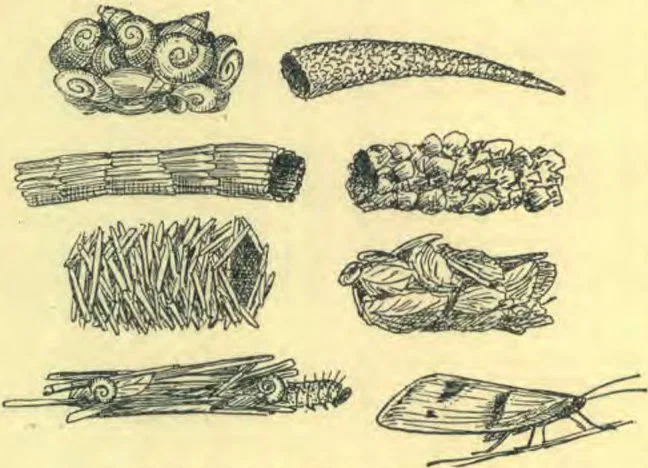
The young naturalist who lies face downward at the brookside, and with shaded eyes watches the busy life that there has its being, will see, in many places, little masses of small stones or bundles of small sticks, moving on the bottom of quiet pools as if they were alive. When out of the water they seem to be only groups of stones or clusters of sticks, motionless and dead. But they are the homes of living larvæ. By putting them in water or by pulling them apart, a whitish habitant is discovered—a larvæ which is a dainty morsel much relished by fish. Nature has provided it with an ingenious means of protection. The little caddis fly larva is an exemplification of the old saying that “necessity is the mother of invention,” since the little animal does not always build as his ancestors built, but adapts himself to the circumstances of a new environment and utilizes whatever material may be available. In some localities the cases are made of stones; in others, of short twigs; in still others, some of the little builders and mechanics bore out the interior of a slender twig or straw, and use the hollow as a protection against the enemy fish.
INSECTS THAT BUILD SUBMARINES
When caddis flies are placed in small aquariums, they extend the body out of the front of the protecting case and carry it as they crawl. But jar the receptacle, and the larva instantly retreats into its house. It is hardly possible to pull the little creature out of its case, except possibly from the smooth straw. It clings to its covering with peculiar tenacity by means of two hooks at the rear extremity of the body. So firmly is it anchored to the sticks, that violence will not dislodge it, unless the force is sufficiently great to pull the insect in two.
But the larva may be driven out by using a tiny toothpick with a blunt end, or by anything else of the kind that does not terminate in a sharp point. Push this into the rear of the case, and the little animal at once unhooks himself and hastens out to find a new home.
Usually the cases are straight, but sometimes they are curved, and a few spiral forms have been found, which closely resemble minute snail shells. The dweller in this rude retreat is a fisherman who not only builds a home of sand, but uses the sand to make a funnel-shaped trap faced by a silken net. The funnel is directed upstream. At the entrance the net has almost rectangular meshes, often in beautiful regularity, and appears much like a delicate spider web in the water. These ingenious contrivances are placed in the swiftest current, and in rapids between stones. Sometimes they are found in great numbers along the brink of a waterfall. The observer must look carefully to see the net, as it is usually obscured by the dirt that collects and adheres there in little masses. But if he is so fortunate as to find one recently completed, the netlike formation is clear and beautiful.
In some places, empty cases may be seen at the edge of the brook. Often they almost completely cover the rocks and the earth between them. In such instances the insects have emerged at the time of a freshet and the retreating water has left the cases stranded high and dry.—Edward F. Bigelow.

The Waxbills in Trouble

A MAN kept a pair of waxbills in his study, where they flew about at their pleasure, for the door of their cage was left open all day. Observing that they began to pick up material as if they were inclined to make a nest, the man got a quantity of such stuff as he thought might suit them, and scattered it about the room. They took what they chose; the hen bird began building, and went on busily and merrily for some days. Then the work came to a stop, and the man thought they had finished, for there was what he considered a tidy nest in a corner of the cage.
But the birds were uneasy about something. The hen twittered to her mate complainingly, and his answering chirps were doleful. At last the hen bird flew down to the man’s desk, faced him, spread out her wings and fluttered them, chattering at a great rate. Evidently she was in trouble of some kind and wished to tell him about it.
He went to the cage, examined the seed box and the water fountain, looked for traces of mice, peeped into the nest, but could not find anything amiss. The bird remained quiet while he was at the cage, but as soon as he reseated himself at the desk she chattered and fluttered her wings as before. At last it occurred to the man that possibly she desired some softer material than she had wherewith to line her nest. He went to another room, where there was a bunch of pampas grass, and returned with some of the downy tufts and scattered them on the desk. The bird pounced upon the stuff at once, and in a short time the nest was complete and to her liking.
This incident is not one of which I have heard or read. It happened to me.
How did the bird know that I was interested in her work and willing to help? How could she hope to make me understand what she wanted? Her action cannot very well be explained as due to inherited habit, for it is most unlikely that any ancestress of hers had ever been in similar circumstances. The best explanation seems to be that mother-love made her capable of extraordinary cleverness.—John A. Hamilton.

A White-Breasted Nuthatch

ONE winter morn, while walking in the park, The wind in fitful gusts the leaves swept on In skipping crowds across the close-cut lawn; The heaven above with lowering clouds was dark, And leafless trees, like masts of some old ark, Were gray, and swayed by moaning winds; since dawn Some feathery flakes on windy wings had gone. There, like an elf, upon an oak's rough bark, A spirit of the storm, I spied a bird, And headlong down the trunk he came. I stood. His eye so bold met mine, we neither stirred; The storm 'most broke his hold, but hold he would. "Auk-yauk! auk-yauk!" he said, and off he whirred, In trimmings white dressed up, that day so rude.
ELIZABETH MACHUGH.

Sounding for Shells

WHERE the tide of battle has ebbed and flowed, the soil of France is so full of projectiles that a French inventor has devised an electrical apparatus to find them. As soon as the thrifty French recover any portion of land from the invader, they return it at once to agricultural use, but before the soil is plowed it is necessary to find any sources of potential danger — in the form of unexploded shells — that may lie beneath.
According to the Edison Monthly, the instrument that they use is an adaptation of the Hughes induction balance. As described in the proceedings of the French Academy of Sciences, the apparatus is so sensitive that the operator can detect by sound, through the telephone, the presence of a fragment of shell, or even of a tin can. It is also possible from the nature of the sound to distinguish between considerable masses of metal and small fragments.
The instrument has two coils of large diameter, the windings of which are on wooden frames. As is usual in the induction balance, no metal of any kind is used in that part of the instrument. The two coils, attached to a handle, form an instrument with which the surface of the soil is explored and tested. As long as there is no metal present, the mutual induction of the primary and the secondary circuits is in a neutral state, with the result that the telephone remains silent. When fragments of shell are encountered, even if they lie at considerable depth, their presence speaks, as it were, through the telephone. It takes two persons about an hour to test thoroughly an acre of ground, but when the work has been completed, the farmer can be sure that there is nothing left there to endanger his life or blunt his plowshare.

Radium and Wireless

A YOUNG German near Berlin, when the war broke out, was conducting some interesting experiments with radium. He had a theory that “the presence of radium causes a definite and remarkable action upon a wireless station.
“The first experiments were carried on indoors, with an antenna consisting of a small wooden rod, upon which wire was loosely wound. With the receiving instruments adjusted, he placed a tube containing 50,000 units of radium salts near the wooden rod. Immediately he could hear the buzzing of distant signals which the apparatus was unable to detect otherwise.
“Encouraged by this success, he carried on his experiments, using a full-sized outdoor antenna, or aërial. With a delicate measuring instrument known as the galvanometer, he discovered that the presence of the radium tube near the aërial wires would cause an appreciable current of electricity to flow. But when the radium tube was attached to the wires at their midpoint, reception of signals was found impossible, even with the most sensitive of ear receivers.
“Technically speaking, it was found that the presence of radium under certain conditions shortened the wave length. That there is some definite relation between wireless, or Hertzian, waves and the electric waves, or “ripples,” emanated by that mysterious chemical, radium, has long been known. Exactly what that relation may be is a conclusion not to be drawn from these foreshortened experiments.”

Spiders That Get Men Out of Bed

A “TROUBLE-SHOOTER” is the man who goes out any time of day or night, in sunshine, snow, or thundering storm, and fixes the electric power, telephone, or telegraph wires when something goes wrong.
Down in the Argentine, for example, the trouble-shooters’ troubles are spiders. In the daytime these industrious insects spin their webs between the convenient telegraph wires, and when night comes the threads, fine as gossamer, become saturated with dew. Moisture makes an excellent conductor of electricity at high voltages, and the wires become short-circuited.
The trouble is so serious, according to Telephony, that the Argentine government has sent circular letters to the different telegraph administrations throughout the world, to ascertain whether any one else is having the same difficulty, and, if so, whether a means for counteracting it has been found.
Men armed with long brooms are sent out to sweep the wires; but, invariably, two or three days after the wires are swept clean, greater masses of web than ever accumulate.
When the weather is calm and dry, the trouble-shooters sleep peacefully, for the webs will not accumulate enough moisture to interrupt the service then. But these occasions are comparatively rare, owing to the immense area of the river Plate and its great evaporation.
Trouble-shooters have collected many sackfuls of the web. It smolders, but will not burn readily. The Argentine government hopes that some commercial use may be found for it.—Every Week.

Battles and Rainfall

MANY persons in Europe and many in this country have noticed the unusual rainfalls that have occurred in various localities since the beginning of the great war, and have wondered whether those and other anomalies in the weather could be caused by the tremendous gunfire in Europe. Meteorologists scout the idea. They say that, to cause rain, gunfire would have to be on a vastly greater scale than it has yet attained, and that all attempts to produce rain by bombarding the clouds have failed. In discussing the extremely heavy rainfall in England during the winter of 1914-15, Dr. H. R. Mill, director of the British Rainfall Organization, made the following statement:—
“The vastness of the work done by the quiet processes of nature, requires only to be realized in order to show the incalculable improbability that gunfire in France can produce a wet winter in England. Take the case of three and a half inches of rain that fell in excess of the average in December over 58,000 square miles of England and Wales. That quantity is 203,000 square-mile inches, or more than 13,000,000,000 tons. At winter temperatures, saturated water vapor would form about one per cent of the mass of the atmosphere that contained it; hence the minimum quantity of air that must have been carried over England and Wales in December, 1914, must have exceeded 1,300,000,000,000 tons. The amount of force required even to deviate the direction of moving masses of that magnitude is surely far beyond that which can be exerted even by nations at war.”—Youth’s Companion.

A Good Deed Is Never Lost

“A good deed is never lost. He who sows courtesy reaps friendship, and he who plants kindness gathers love.”
Continue reading: Learning to Swim