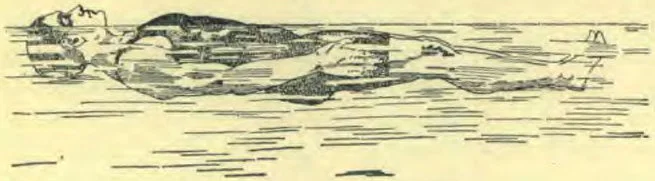
Back-Swimming. First, take the back-floating position: arms by the sides, legs straight, with the feet in line with the shin bones.
Second, turn the legs onto their sides, so that the knees point outward and the heels touch.
Third, draw the legs up toward the body, gradually flexing the knees and keeping the heels touching.
Fourth, bring the feet to right angles with the shin bones, at the same time turn the legs to the knee-up position.
BACK-FLOATING POSITION
Fifth, kick out to the sides with the soles of the feet, as if you were actually pushing against a wall.
Sixth, bring the feet to the stretched-back position and the legs together with force.
Seventh, repeat until thoroughly mastered, being very careful of the stretched-back position of the feet on their recovery.
Each delivery should urge the body forward at least half of its length.
The next move is to combine the arms and legs, which is done as follows:—
First, bring the arms up from the sides with the recovery or drawing-up movement of the legs. In doing so, glide them over the chest and face out as far in front of the top of the head as you can reach.
Second, turn the hands back to back, and with the straightened-out arms return them to the sides in unison with the leg kick.
In reaching forward for delivery, the arms should be kept close together, so that the palms of the hands touch as they pass over the chest and face. Likewise, the arms must be kept close to the body and not raised above it in their passage to beyond the head.
Never show the knees above the surface; this is very bad form.
Maintain the back-floating position all through the movements; that is, keep the head low in the water.
Synopsis
Take the back-floating position. While drawing up the legs bring up the arms, and, carrying them over the body, reach as far forward of the head as possible.
Deliver the strokes and repeat.
Another manner of taking the arm stroke is to raise the arms completely out of the water and thus carry them over the body and beyond the head, dropping them with the hands back to back into the water and making the delivery. The outer edges of the hands must cut the water, and care must be taken not to splash.
Considerable speed may be obtained upon the back by simply kicking the straightened-out legs up and down alternately, with the feet in the stretched-back position. Both arms should rest by the sides, and if employed at all they should only move from the forearm and the wrist. This movement is known as propelling with the hands, and is done by revolving the hands upon the wrists with a downward, inward, and upward action. The arms should never strike the surface at right angles to the sides.
The Chest Stroke
The chest stroke is similar to that taken upon the back, only that the position of the body is reversed.
The main features not to be lost sight of in this style of swimming are proper coördination of the arms and legs, proper breathing, and complete strokes.
Always bring the arms close into the sides at the conclusion of their delivery, and bring them well up under the chest for their recovery or forward push.
Chest-Swimming Stroke
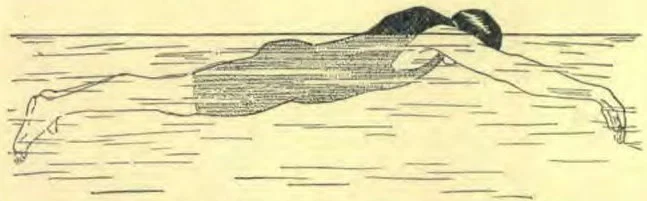
First, take the stomach-floating position.
Second, raise the face from the water and extend the arms forward of the head, palms of the hands touching.
Third, turn the hands and bring them back to the sides for recovery.
Fourth, when the arms in their backward movement are in a line with the shoulders and are ready to make their downward curve, the legs are well on their recovery.
Fifth, as the sweep of the arms is concluded, the legs will have kicked out so as to form the letter Y of the body.
Sixth, the legs come together with force as the arms shoot forward for delivery.
STOMACH-FLOATING, OR "DEAD MAN'S FLOAT."
Breathing. Inhale as the arms open out. Exhale as they come into the sides and shoot forward for their delivery. A splendid practice for beginners is to take one long breath, inhalation and exhalation, with each delivery and recovery of the arms.
Synopsis
Take the stomach-floating position.
Bring up the arms under the chest with the hands palm to palm.
Simultaneously with the advance of the hands draw up the legs.
Bring back the arms and kick out the legs.
While curving the hands in for the next recovery, bring the legs together.
— J. H. P. Brown, in "Modern Swimming."
Electrical Apparatus Speeds Congressional Roll Call Voting
For years Congress has realized that much time is wasted in taking roll call. Now B. L. Bobroff has set up an electrical apparatus that promises to save two months in time each session. A separate wire runs from every desk to a registering board, which is set up like a score board, and in plain view of all. The name of every member is listed, and is followed by two lights, of different colors, to denote “yes” and “no.” When a question is put to vote, each member presses a button on his desk, and instantly the proper light flashes on the recording board. The result is automatically tabulated and flashed on the board, as well as on the Speaker’s desk. A photographic record may be made in thirty-six seconds.
How to Make a Sewing Screen
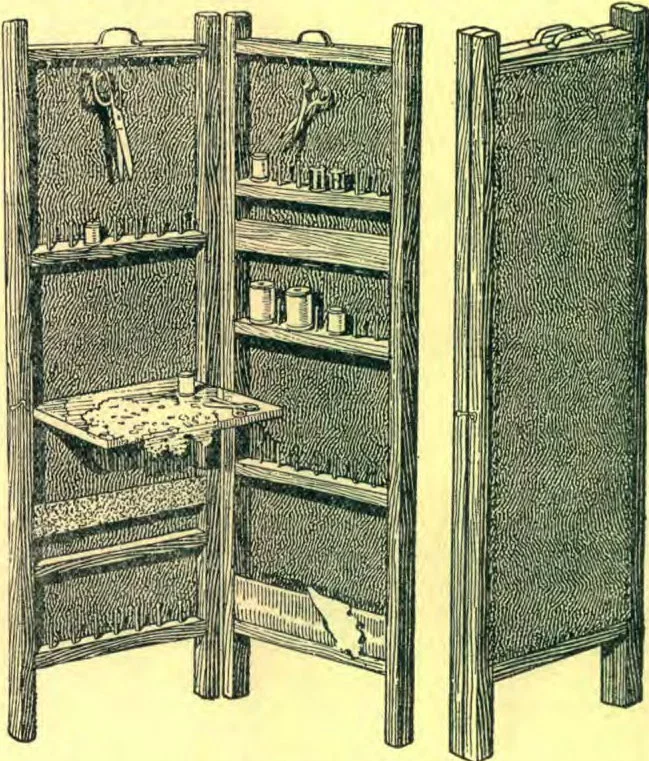
INSTEAD of a workbasket, with spools of thread, buttons, scissors, embroidery hoops, etc., all crowded into a small space, a screen can be used, which has a definite place for every article used in sewing. The spools of thread are kept on brass pegs; the silks in one place and the cottons in another. The scissors, pincushion, and emery ball are suspended from hooks. Patterns, embroidery hoops, buttons, etc., all have pockets where they are readily accessible and yet kept in good shape. Best of all, the screen is light and can be easily carried from one room to another, or onto the veranda. In sewing, a small shelf may be lowered for holding the work. With a few materials any one handy with tools can make this ornamental and useful piece of furniture. The materials needed are as follows:—
WOOD FOR FRAME
4 pieces 42 by 1½ by ¾ inches.
9 pieces 12¼ by 1½ by ¾ inches.
1 piece 12⅛ by 9 by ½ inches.
1 piece 12¼ by 3¼ by ¼ inches.
1 piece 12¼ by 1¾ by ¼ inches.
1 piece 12¼ by ¾ by ¼ inches.
LEATHER FOR COVERING
2 pieces 13¾ by 36 inches.
1 piece 13¾ by 8 inches.
1 piece 13¾ by 4 inches.
35 brass pins, 2 inches long; 4 short screws
2 hinges, and screws; 12 hooks
1 hook and eyebolt; 100 fancy tacks
2 handles, and screws; 50 nails
Select two of the longer or upright pieces, and on them indicate with a pencil the points for attaching the crosspieces. Suppose the left-hand side of the screen is to be made first. The upper edge of the uppermost crosspiece should be 1½ inches from the tops of the posts. The top surface of the next lower crosspiece should be 13¼ inches from the tops of the posts. The one next the bottom is 31½ inches from the top; and the under surface of the bottom piece is 4¼ inches from the floor.
On two of the crosspieces drive seven long brass pins an equal distance apart, as shown in the illustration, taking care to have their tops all even. It is better to drill holes slightly smaller than the pegs before putting them in, especially if the wood is oak or other hard wood. Into the under surface of the top crosspiece screw seven eyebolts, as shown.
Next, assemble the posts and crosspieces. Use fine wire nails, being careful not to split the wood. Strong, hot glue should be applied at the same time to secure greater strength. Before proceeding, allow the work to become thoroughly dry.
On the inside of each of the two upright posts, about ⅜ inch from the back edge and 22 inches from the top, insert a screw, allowing it to protrude about ¼ inch. Then, holding the shelf, which is the rectangular piece, 12⅛ x 9 x ½ inches, in position, with its upper edge just under these screws, locate the two points for its pivoting screws. This is clearly shown in the illustration. The pivoting screws will work more easily if the holes are first made with a slightly larger screw. The back screws hold the shelf in a horizontal position when it is being used. At other times, it can be raised to a vertical position between the posts.
The top and bottom pieces on the right side have the same location as those on the left. The second crosspiece is 10 inches from the tops of the posts. Just under it is attached the piece 12¼ x 3¼ x ¼. This piece does not need to be nailed; glue will answer. Attached to its under edge and projecting forward horizontally, is the narrow strip, 12¼ x ¾ x ¼. Attached to the front edge of this piece, and slanting forward obliquely, as shown in the illustration, is the piece, 12¼ x 1¾ x ¼. These three pieces should be nailed to one another with two or three fine wire nails, which can be readily concealed.
A CONVENIENT SEWING SCREEN
The third crosspiece on the right is 18½ inches and the fourth piece 27 inches respectively, measured from the tops of the posts. Before joining them to the uprights, they should be fitted with brass pins, as shown. The top piece should be provided with hooks.
Before proceeding farther, the various parts should be varnished, stained, or painted, according to individual taste. If the screen is to be used in a bedroom having white woodwork, white enamel may be used to advantage. If the woodwork is mahogany or oak, the screen may be finished to match. After the parts are thoroughly dry, the leather or other covering is put on. If leather is used, it should match not only the finish of the screen, but the color scheme of the room. If white enamel is used, a pretty chintz pattern is very effective as a covering, or silk may be used. In putting on the leather or chintz, be careful to stretch it tightly over the frame, gradually proceeding from top to bottom, inserting the tacks on both sides simultaneously. The edges should be folded in about ¼ inch; and the tacks should be driven into the middle of the frame. If silk is used, it may be shirred on a cord at the top and bottom, instead of being tacked. The two inside strips which form the pockets at the bottoms are attached by turning in their edges and tacking on the inside. The measurements given are large enough to allow for folding in the upper edges several inches.
Lastly, fasten two small brass hinges on the back, 7½ inches from the top and bottom, respectively. On the front, attach a hook and eyebolt, 18½ inches from the top, for holding the two parts of the screen together when not in use. On the top crosspieces fasten two brass handles, as shown. They should be near the front inner edge of the frame, so that they will come together when the screen is closed.—Popular Science Monthly.
For the Finding-Out Club
Bible Acrostic
1. WHAT nurse died and was buried under an oak?
2. Who in his lifetime raised up a pillar to be a memorial of himself, but was covered with “a very great heap of stones”?
3. Who refused to come at the king’s command to display her beauty, and was deposed from being queen?
4. Who was called the child of promise?
5. What Hebrew captive was raised to such a position that “the king thought to set him over the whole realm”?
The initials of the names will be the name of a man “after God’s own heart.”
MARY C. BURNHAM.
Answers to Questions in “Instructor” of October 3
Apostles—a-pōs’ ’lz
pessimistic—pēs-ī-mis’tik
despicable—dēs’pī-ka-b’l
grievous—grēv’ŭs
previous—prē’vī-ŭs
commandant—kōm-an-dānt’
noncombatant—nōn-kōm’bāt-ānt
acclimated—ā-klī’ma-tēd
automaton—ō-tōm’a-tōn
speedometer—spēd-ōm’e-ter
Allies (n)—ā-līz’
automobile—ō-to-mō’bĭl
valet—vāl’-ēt
chic—shek, e as in event
chiropodist—kī-rōp’o-dĭst
chassis—sha’sē, a as in ask
chauffeur—shō-fūr’
BESSIE MOUNT.
Answers to Questions in “Instructor” of October 17
1. President Monroe’s declaration to Congress was the result of American apprehension that the combination of European powers, known as the Holy Alliance, would interfere in South America to restore Spanish colonies, which had asserted their independence, to the crown of Spain.
2. The Battle of Waterloo was fought June 18, 1815. The British, Dutch, German, Prussian, and French armies took part.
3. The White House was built of Virginia freestone in 1792-99. It has been painted white since 1814 to hide marks of fire, only the walls being left standing after the capture of the city by the British in that year.
4. The high expansion of mercury and the wide range over which it is fluid render it especially valuable as a thermometric fluid.
5. The giraffe browses on trees, mimosas being its favorite. Its tongue is seventeen inches in length.
6. The United States paid $7,200,000 to Russia for Alaska in 1867.
7. The Republican party was organized during the years 1854 to 1856.
8. The Confederate dollar was worth only six cents in 1863.
9. Lafayette served the American army upon two conditions—that he should receive no pay, and that he should act as a volunteer.
10. The silk industry originated in China. Raw silk can be profitably brought to the market only in those countries where there is abundant and very cheap labor. The fact that China, Japan, Bengal, Piedmont, and the Levant are the principal producing localities makes this plain.
11. Henry Lee was called “Light-Horse Harry.”
12. Anaximander, Anaximenes, Pythagores, and Aristotle, early writers on geography, before Columbus believed the earth to be round.
The King of Outdoor Exercises
I LIVE in a suburb seventeen miles from our office. I began by getting off at intervening stops and walking home. I gradually increased the distance to four miles at night, and four in the morning. At the beginning of 1913 I resolved to walk ten miles a day throughout the year, so added a mile to lunch and back at noon.
I kept daily account of these miles, and if for any reason I fell short I would increase the distance the next day, even to doubling. Saturday afternoon I would sometimes walk the entire seventeen miles, and occasionally, I walked both ways, leaving home about four in the morning.
For my summer vacation I walked through Yellowstone and Glacier National Parks, averaging between twenty-five and thirty miles a day for the most part.
It took me some time to learn a few very simple secrets:—
To have shoes large enough and with broad toes.
To have always a destination.
To walk fast enough to perspire,—about four miles an hour.
To walk, walk, walk, the year round.
Whether hot or cold, dust, mud, or ice, rain or snow, day or night, I walked. There is a challenge in a storm: a zero wind when one’s blood is up feels as refreshing as a summer breeze, and the feel of the breeze at any time upon one’s glowing cheek is one of the many compensations.
Walking, in the fullest meaning of the word, is something of an art. Like other arts it requires patience and persistent effort at first, but with practice and experience the technic is acquired and the inspiration comes.
I enjoy this exhilarating hobby because—
Walking sharpens the appetite and aids digestion.
Walking contributes to sound sleep and makes one less susceptible to colds.
Walking brings color to the cheek and is a splendid tonic.
Walking stirs the circulation and distributes fresh blood to all parts of the body. In this way it tones up the entire system, and according to some authorities benefits even the teeth and eyes.
Walking brings most of the muscles into play, especially the largest, and without strain.
In a word, walking keeps one physically fit.— The Independent.
New Books of Worth
MR. NIXON WATERMAN'S books, “Boy Wanted” and “The Girl Wanted,” together with “Happy School Days,” by Margaret Sangster, are well worth reading by boys and girls. They make excellent gift books. These books sell for $1 each.
Order of Review and Herald, Takoma Park, D. C.
Watch Yourself Go By
Just stand aside, and watch yourself go by;
Think of yourself as “he” instead of “I.”
Pick flaws; find fault; forget the man is you,
And strive to make your estimate ring true.
The faults of others then will dwarf and shrink,
Love’s chain grow stronger by one mighty link,
When you with “he” as substitute for “I”
Have stood aside and watched yourself go by.
— Selected.
The Way of It
By Pauline Frances Camp
A LITTLE boy made him a wee snowball
And rolled it about in the snow;
And it gathered the crystals and clung to them all,
And oh, how that snowball did grow!
Oh, my!
You've made one, of course, so you know.
A little boy whispered a word one day
Unkind of some one he knew,
And each one who heard it repeated his way
The story, till oh, how it grew!
Oh, my!
And a heartache was caused by it, too!
Two little red mittens the small ball rolled
That grew in such a magical way,
And a little red tongue was the one that told
The tale that grew big in a day.
Oh, my!
Be careful, wee tongues, what you say!