Report from an Eye-Witness—In the Harbor of St. Pierre—Ancient Appearance of the City—Scenes and Incidents.
THE Dixie left New York at 9 o'clock on the evening of May 14, and at 3 o'clock in the morning of the 21st we sighted Mount Pelee. We were about twelve miles off shore at the time. The force of the second eruption, which started about five o'clock of the day before, had partially subsided; but the picture presented to us was an impressive one. Night was just giving way to gray dawn. The mountain was faintly silhouetted against the horizon. At its summit a bright glow was flashing a steady, yellow light into the heavens, and indicating that the old cauldron was still acting. Away above the top of the mountain lay a heavy fall of smoke, which curled up from the crater, and spread out like a huge umbrella, while from a thousand crevices on its sides columns of steam spurted forth.
As daylight advanced, the brilliancy of the picture faded, the golden glow died out; but even in the daylight the smoke and the steam continued to pour forth in a lazy sort of way, giving testimony of an immense reserve force which might manifest itself with renewed energy at any moment.
As we passed the harbor on our way to Fort de France, the town, or the ruins of the town, could hardly be distinguished from the gray film which lay over the water. Between 7 and 8 o'clock the Dixie arrived at Fort de France, and saluted several vessels in the harbor, including the French cruiser, Suchet, and the Dutch iron-clad, Konigin Reregentes.
There we also found the swift government tug, Potomac, to which Captain Berry transferred us as soon as the quarantine doctor had completed his examination, and the captain and Governor L'Huerre had exchanged mail. The Potomac immediately started for St. Pierre, having on board a large party of scientific men, as well as a number of correspondents and photographers. As we entered the harbor of St. Pierre, we could just distinguish the tops of the masts of one of the vessels which had been sunk by the violence of the storm.
In the city not a sign of life was visible. It looked like a relic of a thousand years ago, and this appearance of desolation was heightened by a closer inspection, after we had been landed in small boats. The air was stifling with the gaseous fumes from the volcano, which we could see above us, belching forth volumes of black smoke, and covering us with a coating of gray ashes. It was almost impossible to distinguish streets, so completely had the debris and ashes changed even the geographical aspect of the place. It was ashes, ashes everywhere. We waded through it as one would wade through snowdrifts.
Comparatively few of the bodies of the victims were visible, but occasionally we came across some of them. The odor which permeated the atmosphere, however, furnished indisputable testimony of their presence. Occasionally, as we plodded along, we would stumble over a skull, an arm, or a leg, and not infrequently we came across hideously distorted bodies. Every new encounter seemed more horrible than the one preceding.
One place we passed seemed to have been a bakery, and into one of the ovens a man had crawled, apparently thinking that at least there he would escape the avalanche. But even there the deadly sulphureted hydrogen found him, and asphyxiated him. Farther along we came across an immense bath, or a fountain, and here was another body, evidently that of a man who had jumped in there to escape the deadly hot blasts. But he, too, fell a victim. At another point along the roadway we came across a dead body lying in front of one of the little wayside shrines. Such gruesome incidents might be multiplied many times.
On this first expedition Lieutenant Wilner, executive officer of the Dixie, was my companion, the rest of the investigating party having broken up into many groups. Lieutenant Wilner is an enthusiastic photographer, and we were in the midst of our work when the whistle of the Potomac warned us that it was time to return. The commander of the Potomac had agreed to do guard duty from his point of vantage in the bay, and to summon us in case Pelee displayed any further signs of anger. In such an event we were to respond to a whistle, and make haste to the shore, there to embark with the least possible delay. As the heavy volume of smoke from the crater seemed to be increasing in density, we stood not upon the order of our going, but hastened with all possible speed.
Even if we had not been recalled, it is doubtful if we could have continued to work much longer than the hour we spent on shore, as we were almost stifled by the smell of gas, the odor from the bodies, the terrific heat, and the choking dust which we kicked up at every step. Before the recall sounded, however, we managed to get several good views.
The Potomac took us to Fort de France for the night, but early the next morning carried us back to St. Pierre, where we were given an opportunity for further investigation. During our researches we came across many fine specimens of jewelry and silverware; but these were not touched, as we had strict orders not to bring away any loot.
Our second day's sojourn was longer than that of the first, altho Pelee was still throwing up columns of steam and smoke, and giving forth threatening, rumbling noises. We were allowed to work about two hours before the whistle again recalled us. It would have been suicidal to have attempted to ascend Pelee, altho a party of the scientists subsequently accomplished this most difficult feat.
On our second day's trip we came across the ghastly spectacle of a number of negroes making a funeral pyre of the dead bodies, under the direction of some French officers from Fort de France. This crude process of cremation was employed because of the lack of better facilities, and because of the imperative necessity of disposing of these bodies in order to prevent a pestilence.
Heavy Stone Walls Like Cardboard.
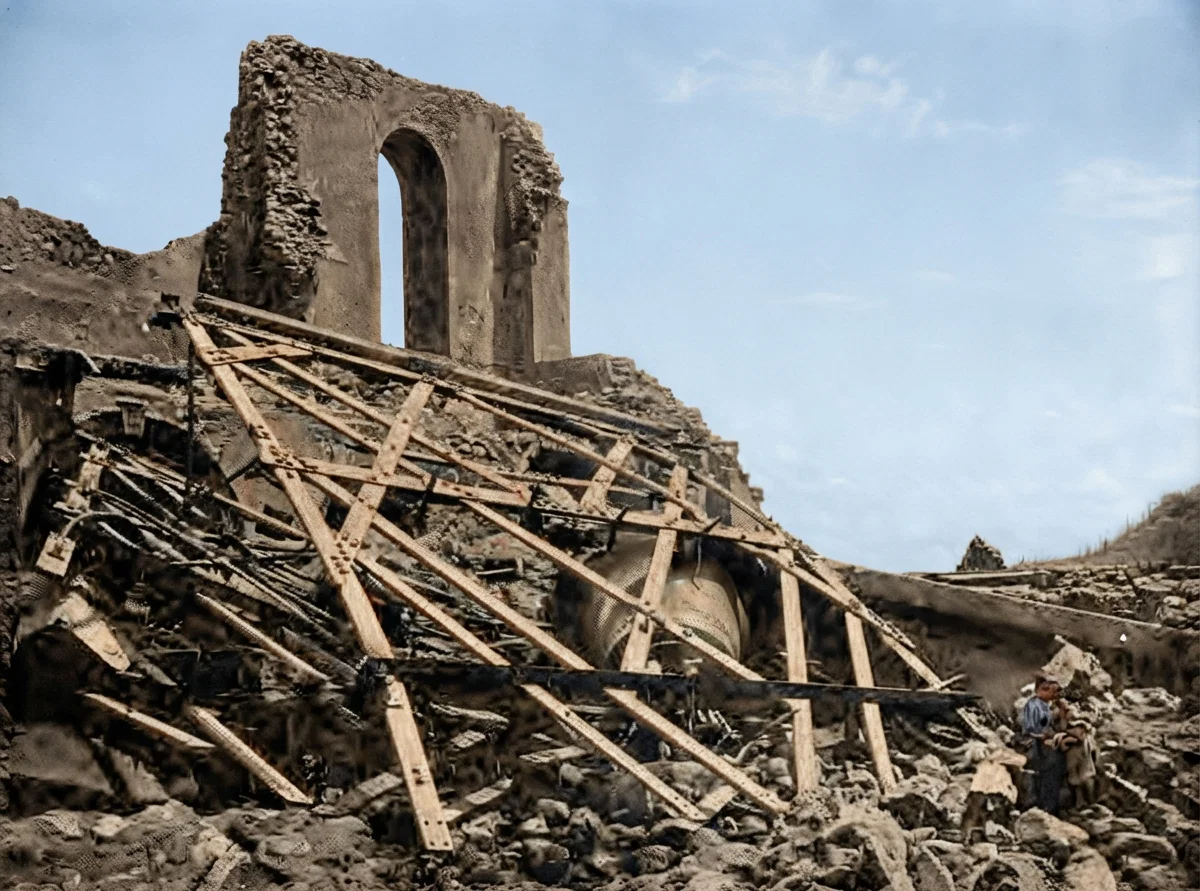
It is impossible to comprehend the awful force which must have been employed to destroy the city. The buildings were nearly all of stone, and in some cases the walls were several feet thick. These would have offered a long resistance to an ordinary bombardment, but to the force of the tornado they succumbed as if they had been built of the thinnest cardboard.
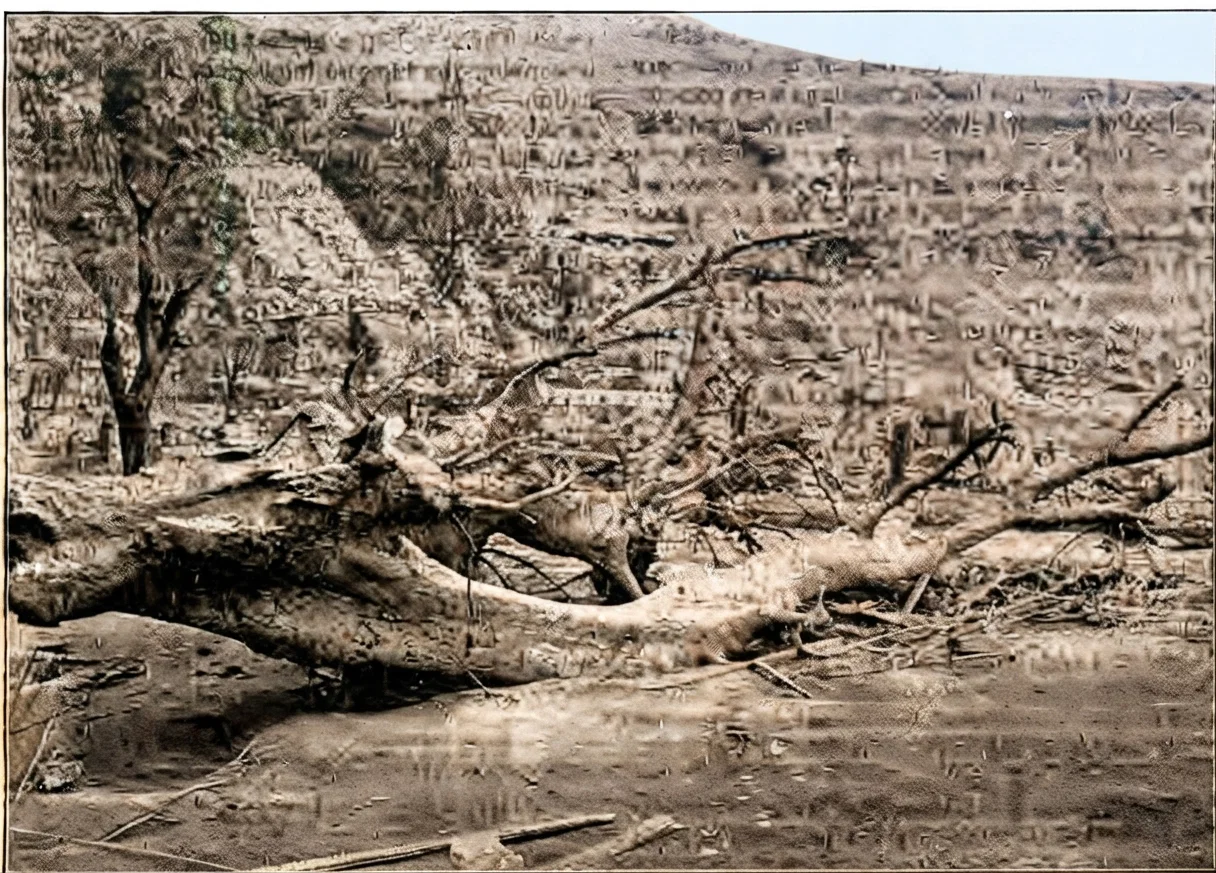
The town had formerly been beautified by several parks or plazas, in which were some magnificent specimens of tropical trees, but nowhere could we see a sign of foliage. The force of the tornado had torn these trees up by the roots, and whirled them in every direction. Occasionally one would be found which had offered a partial resistance to the blast, but in these instances its limbs had been torn off, and its foliage incinerated in the fiery furnace fed by the sulphureted hydrogen.
Death evidently came almost instantaneously to the people of St. Pierre. Apparently there was no protracted suffering. The noise of the explosion followed the flash of the volume of gas with the suddenness of a peal of thunder after a flash of lightning. In a moment 30,000 souls had been translated from life to death. Some persons in adjoining villages have attempted to describe in detail what they saw, but all such stories should, in my judgment, be accepted with the proverbial grain of salt. One might as well attempt a detailed description of the direction and spurs of a flash of lightning during a thunderstorm.
Ruins of Cathedral, Showing One of the Famous Chime of Bells. (See illustration on page 11.)
Pelee instantly killed its victims, and then proceeded to bury them by pouring down a shower of small stones and fine gray ashes. The first eruption occurred on the morning of May 8, and the second on the afternoon of May 20. The latter was more violent than the first. It shook to the ground such walls as had been left standing after the first shock, and added such a quantity of ashes that, with very few exceptions, all the bodies were completely buried. During our two-days' stay in St. Pierre, altho we visited all parts of the town, I do not believe we came upon more than a score of exposed bodies.
Leaving St. Pierre after this second trip, we returned to Fort de France, and immediately the Dixie started for Kingstown, on the island of St. Vincent, to deliver the balance of its stores for the benefit of the sufferers from the eruption of the Soufriere volcano. SAMUEL R. HONEY.
Adult Suffrage in Australia
An adult suffrage bill has passed both houses of the Australian Commonwealth Parliament, and is now a law. Under it all adults, without regard to sex, have the right to vote for the members of parliament in the six provinces constituting the federation, and it carries with it the right to sit in parliament if elected. Woman has thus been put on a political equality with man throughout the commonwealth.
MEN OR THINGS?
The Awful Influence of Some Features in the Present-day Education.
In an article in the Independent of June 12 by Charles M. Sheldon, author of "In His Steps," etc., is set forth some present tendencies of education in a most striking manner, yet true to the very letter. A weary minister needs a vacation, and he takes six weeks in visiting his old academy, college, and theological seminary, where he studied and graduated from thirty to twenty-five years before, spending two weeks in each place. After careful observation at each place, he talks with the principal of the academy, the president of the college or university, and the dean of the seminary.
Last week we gave the account of his visit to the academy, and his talk with the principal. In his visit to his college he found it greatly enlarged. "Beautiful solid stone structures had taken the place" of the former main building surrounded by its modest dormitories and recitation halls. The president of the college, or university, was comparatively a young man, who had just succeeded in persuading Mr. Gordon Roscoe to add $500,000 to the endowment fund, making $1,500,000 that Mr. Roscoe had given the college in all. Then followed a conversation along similar lines to that of the conversation with the principal of the academy, which we printed last week. The same questions were asked as to the methods, the luxurious surroundings of the students, the perverse moral standard set before them in the business methods of the great donor, Mr. Roscoe, and the defense of Mr. Roscoe as a Christian by the president, excusing his immoral business methods on the ground of expediency.
The minister then went to the seminary where he received his theological training. He found few men studying for the ministry; commercialism, drawing young men into business, was the reason given by the Dean. Upheavals in theology were the causes of many hesitating to enter the ministry. But notwithstanding all this, the Dean was greatly encouraged, because Mr. Roscoe had given an "endowment in connection with our university affiliation that will handsomely equip us for several years." The gift of $250,000 would enable the seminary better to equip itself, and connected with the university, and in the city, would bring larger views of life. Here follows the conversation in part between the Dean and the minister:—
"What do you think, Brother Dudley?"
"I think it is a very serious crisis for the seminary."
"Serious, yes—but very hopeful, don't you think? Of course the affiliation with the University is a radical step, but it is in keeping with the movement of the times, and will be a great thing for the seminary. Do you see any serious thing to criticize about it?"
The minister was silent so long that the Dean almost lost patience. At last the minister said:—
"I want to ask a question that may seem to you impertinent. It really is not so, but it will probably seem so."
"O, I am sure, Brother Dudley, that I shall not so regard it. Go on. I am interested to know what it is."
The minister rapidly gave a condensed account of his vacation experiences at his old academy and college. He recounted in brief his talk with the principal and the president concerning Mr. Roscoe's money-making methods, and the probable effect on the schools of accepting such money and making no protest against the process by which it was made.
"The question that I want to ask you is the same as that which I put to the principal and the president. What will be the effect on the life of the seminary and on the product it turns out, if you take Mr. Roscoe's money and keep silent about the unchristian practises that are true of his business operations? In other words, what sort of preachers will grow up out of a seminary that is supported in its physical equipment by a man who, tho' outwardly a Christian and a devout man, really breaks the Golden Rule in pieces and tramples on Christ's teachings as given in the Sermon on the Mount? How can the seminary escape the irresistible degradation of its high moral and spiritual purpose? How can the students in the seminary escape the influence of a teaching that must, after accepting such money, ignore all rebuke of such money-making methods?"
The Dean was so agitated by this unexpected question that he rose from his seat and paced up and down the room several times before he made any reply. Then he said:—
"Brother Dudley, do you suppose for one minute that I would accept the money of Mr. Roscoe if I believed the terms of acceptance meant the closing of my lips against unrighteous or unchristian business methods?"
"No, I do not like to believe you would knowingly do that. But what puzzles me is the fact that you and the seminary do accept Mr. Roscoe's gift and regard him as a Christian benefactor, knowing, as you do, the character of the methods he or his company pursue. Knowing all this, can the seminary, or will it, go on to teach the ethics of Jesus in business which necessarily will convict Mr. Roscoe and his company?"
The Dean paced up and down with many signs of agitation in his face and manner.
"I do not believe it is as serious as you think, Mr. Dudley," he finally said with a faint smile. "Just look at the number of colleges that have accepted Mr. Roscoe's money. Only last week the president of X University wrote me that Mr. Roscoe had come to their relief with a splendid gift of $300,000. The president of X is one of our finest types of earnest Christian men. He certainly has no compunctions about taking this money. Clearville Seminary is making an effort to get Mr. Roscoe's help in raising the long-standing indebtedness on the institution, and the prospect is that Mr. Roscoe will come to their assistance. If we are guilty of any unchristian conduct in taking Mr. Roscoe's money, we are certainly10in good company; for, as you know, there are scores of institutions that have been financially helped by them."
"But does that fact make his business methods any less worthy of censure?"
"But, Brother Dudley!" exclaimed the Dean eagerly, "are you not exaggerating unduly this matter? Is it possible for you to sift out the honest from the dishonest dollars that the business men in your own congregation pay into the church toward your own salary? Is it not a fact that in all probability some of the money that comes into your own hands is made in very unchristian ways?"
"I have no doubt that is so," replied the minister. "And it would be an absolute impossibility for me to separate the good money from the bad. But I do not keep silent in my pulpit concerning the unchristian or selfish money-making of my business men. And if I knew of any case as clearly wrong as that of Mr. Roscoe's company, I should consider it my duty to denounce it rather than encourage it by holding up the donor to the public view of my congregation as a type of Christian benevolence. This is the point I can not understand in connection with Mr. Roscoe's gift to academy, college, and seminary. You not only do not reserve the right to criticize his methods in particular as bad, but you actually set him before the students as a type of modern Christian rich man who is illustrating the noble habit of giving. It is the giving you emphasize as a great exhibition of benevolence; the making of the money does not enter into your consideration. So the question comes right back to where we began, and I see no escape from it; what will be the moral effect on the seminary if Mr. Roscoe is accepted, either tacitly or openly, as the type of Christian benevolence?"
"I am sure you must be misinformed concerning Mr. Roscoe's business methods," murmured the Dean. "All business is more or less involved in transactions that meet with opposition, especially from unsuccessful rivals. I have no doubt Mr. Roscoe has been assailed and misrepresented by his business enemies."
"Mr. Roscoe's company," said the minister, "has been guilty, according to well-established records in the courts, of crimes against the laws of the State. There are scores of individuals who have been financially ruined by him. He has, through his company, been guilty of the most unchristian practises in his business relations that I have no doubt he would be horrified to practise in his private life. These things are facts. They have been proved many times. Not to know them is to declare one's self as ignorant of one of the commonest facts in the commercial world. And I for one can not but look with the gravest concern upon the elevation of this man to a place where educational institutions have put him on a pedestal of honor because he has made enormous sums of money, and is giving a small portion of it to schools and seminaries and churches. The effect on our students in academy, college, and seminary will, I believe, be disastrous to their ethical life. It will lower the whole tone of spiritual definitions of conduct. It will greatly emphasize the already distorted valuation placed upon physical equipment in our schools. To have magnificent physical equipment in the shape of buildings, apparatus and endowment, and at the same time to lose the ethical standard or substitute for it a false conception of Christian benevolence, is to drag our educational institutions down into a material prosperity that is nothing more nor less than cultured paganism. The old idea of a college that consists of 'Mark Hopkins on one end of a log and a student on the other end' is a million times to be preferred to Mr. Roscoe's endowed institutions with their imposing buildings, long array of faculty, and immense crowds of students."
Reaching home, his wife tells him that he looks as tho he had been to three funerals. He tells her what he found, and the story closes with the following conversation:—
"Am I an old fogy, Sarah?" he asked.
"No, I do not believe you are," she answered vigorously. "But the world will think you are if you say anything about it. The age in which we live is magnifying material prosperity."
"I wonder," he spoke slowly, "if we have gained in real power, or only in things? Are we at a crisis in our educational life? At any rate the ethical standard is confused in the case of Mr. Roscoe. I am not an old fogy. What will be the product of the educational system that asks no questions concerning the making of money so long as it gets money?"
"It is easy enough to prophesy what the product will be," his wife replied. "It will be an educated paganism, a cultured heathenism, that will restore the worship of things, instead of demanding the worship of ideals."
"Then," said the minister, as he went into his study to prepare his sermon, "the sooner we get back to the Mark Hopkins kind of college the better for the republic. For I fear the present tendency means more serious consequences to our boys and girls than we dare to imagine. God save us from progress in things at the cost of the ideals of life!"
Reader, is this not true to life? Did not the minister's wife tell the truth? Is not the condition an awful one? In the light of the Word it means that we are in the last days. Read 2 Tim. 3:1-5.
The Glory Is Departed
By Editor
It seems pre-eminently fitting now (it was not a score of years ago) that the German Emperor should present a statue of Frederick the Great, and the President of the United States should accept it. If the government were not far on the road to imperialism, it would never have been offered. That it is offered and accepted shows that the old-time democratic spirit of the republic has departed. We are not condemning or justifying President Roosevelt; we are merely noting an incident in the long stretch from republican simplicity and principles. From the true American view-point of the last part of the eighteenth and the first part of the nineteenth centuries, the time since is rapidly painting in large letters upon the escutcheon of State and people, "Ichabod"—the glory is departed.
RIGHT SHALL RULE.
By J. A. Edgerton
SHORT is the triumph of evil,
Long is the reign of right;
The men who win by the aid of sin,
The nation that rules by might,
The party that lives by corruption,
The trickster, the knave, the thief,
May thrive for a time on the fruits of crime,
But their seeming success is brief.
Sneer, if you will, at honor;
Make virtue a theme for jest;
Reflect on the man who strives as he can
To seek and to do the best;
Make goodness a butt for slander,
And offer excuse for vice;
Proclaim the old lie, the corruptionist's cry
That every man has his price.
Yet know that the truth shall triumph,
That evil shall find its doom;
That the cause of right, tho subdued by might,
Shall break from the strongest tomb;
That wrong, tho it seem to triumph,
Lasts only for a day,
*While the cause of truth has eternal youth,
And shall rule o'er the world for aye.*
—J. A. Edgerton.
ECONOMIC VALUE OF BIRDS.
[From Chapman's "Bird-Life."]
THE economic value of birds to man lies in the service they render in preventing the undue increase of insects, in devouring small rodents, in destroying the seeds of harmful plants, and in acting as scavengers.
Leading entomologists estimate that insects cause an annual loss of at least two hundred million dollars to the agricultural interests of the United States. The statement seems incredible, but is based upon reliable statistics. This of course does not include the damage done to ornamental shrubbery, shade and forest trees. But if insects are the natural enemies of vegetation, birds are the natural enemies of insects. Consider for a moment what the birds are doing for us any summer day, when insects are so abundant that the hum of their united voices becomes an inherent part of the air.
In the air swallows and swifts are coursing rapidly to and fro, ever in pursuit of the insects, which constitute their sole food. When they retire, the nighthawks and whippoorwills will take up the chase, catching moths and other nocturnal insects which would escape day-flying birds. The flycatchers lie in wait, darting from ambush at passing prey, and with a suggestive click of the bill returning to their post. The warblers, light, active creatures, flutter about the terminal foliage, and with almost the skill of a humming-bird pick insects from leaf or blossom. The vireos patiently explore the under sides of leaves and odd nooks and corners to see that no skulker escapes. The woodpeckers, nuthatches and creepers attend to the tree trunks and limbs, examining carefully each inch of bark for insects' eggs and larvæ, or excavating for the ants and borers they hear at work within. On the ground the hunt is continued by the thrushes, sparrows, and other birds, who feed upon the innumerable forms of terrestrial insects. Few places in which insects exist are neglected; even some species which pass their earlier stages or entire lives in the water are preyed upon by aquatic birds.11
As destroyers of the seeds of harmful plants the good done by the birds can not be overestimated. From late fall to early spring seeds form the only food of many birds, and every keeper of cage-birds can realize how many a bird may eat in a day. Thus, while the chickadees, nuthatches, woodpeckers, and some other winter birds are ridding the trees of myriads of insects' eggs and larvæ, the granivorous birds are reaping a crop of seeds, which, if left to germinate, would cause a heavy loss to our agricultural interests.
THE CHILD
By Mary Wood-Allen
By Mrs. Mary Wood-Allen, M.D.
THE CHILD
By Mrs. Mary Wood-Allen, M.D.
V.—JUSTICE.
JUSTICE is represented as blindfolded and holding a pair of scales in her hand, indicating that she judges, not by appearances, but by an actual balancing of facts. Justice involves a comparing of relations, a recognition of what is due to two or more individuals. It is necessary to harmonious social life. Robinson Crusoe, alone on his desert island, had no call to exercise justice; but as soon as he was joined by his "man Friday," the need for justice began.
As the child is born into social life, he should early learn to become harmonious with it. As in early childhood he can not judge and compare, he must learn justice through his daily experiences. Very often he learns of it principally by experiencing injustice.
The difficulty in the way of treating a child with justice lies in the difficulty the adult finds in putting himself into the place of the child, and thereby coming to understand him. The standpoints of the mature and immature must be different, and it is unjust to judge the latter by the standards of the former.
The child not only lacks the experiences which would enable him to form the judgments upon which just conclusions should rest, but he has not the comprehension of language which will enable him always to understand what is said to him, or to express his ideas in words.
Very often unjust treatment of the child arises from these two facts. H. Clay Trumbull illustrates this through an incident. He had forbidden his little daughter to go to a forest near by. She disobeyed and was punished. Again she disobeyed with like result. The father began to think her very obstinate and talked severely to her. At length the child, with a puzzled face, said, "Papa, where is the forest? Is it anywhere near the woods?"
Are you sure that your child always comprehends what you ask of him? Do you always feel certain, when you punish him for disobedience, that he may not be wondering what it is that he has done?
Children are sometimes punished for impertinence when they have had no such feeling in mind. A little lad was watching his father intently, and at length spoke up impulsively, "Papa, you look just like a blockhead!" The father was offended, and whipped the child for impertinence. It afterward was seen that the child was only endeavoring to express a fact which he had just observed, and which he thought was a compliment to the father, namely, that his head looked like the model head of wood from which the older children at school were drawing, and which by them was called a blockhead.
One obstacle to just treatment of the child is the failure to recognize his individuality. He is now, even in his babyhood, as much of an individual as he will ever be, and possessed of the rights of an individual; that is, the right of personal opinion, property, and personal reserve.
As an adult, he will need to have opinions and decided views. He has them as a child. They are, of course, crude and often unwise, but he should be educated to wiser opinions, not punished for those which he has formed through ignorance, nor laughed at for their expression.
His right to property should be recognized. This is difficult where the child is an only one. None of the "grown ups" want his belongings, so there is no call for him to surrender them, and he grows up with an undue idea of his own importance.
In a family of children there is a constant opportunity for teaching the recognition of each other’s belongings, the injustice of taking without leave that which belongs to another. In order to teach this to the child, the older people should never seize his possessions and dispose of them without his consent. His sticks or pebbles or bits of paper are his treasures, and their wanton destruction means as much to him as the destruction of a watch or purse or pen would mean to the parent.
He should be taught to keep them in place; and when warned that if found out of place they will be destroyed, he can not complain of injustice if the promise is kept; but he certainly has a right to feel aggrieved if they are swept up and thrown away or burned simply because to the mother they seem to be "trash." And she need not wonder if, in turn, the child is careless and destructive of her property.
Along with the recognition of property rights should come lessons in the surrendering of rights at the higher command of love. There is a right of giving as well as of keeping; and while teaching justice, we must not forget to teach generosity. Macdonald says, "One of the grandest things in having rights is, that, being your rights, you may give them up."
The right of personal reserve is one of the most difficult things to recognize. We feel that the child belongs to us; but, in truth, he belongs to himself. We have him entrusted to our care to train, and we should not needlessly encroach upon his personality.
There is no more reason why the child should be compelled to kiss people than that the parent should. It is often said that children like men better than women; and I have sometimes wondered if the reason may not be that men are more apt to treat the child as an individual. Women pounce upon the little one with exclamations and overwhelm him with caresses, giving the child no chance to express himself. Whereas men are less demonstrative, and are quite apt to greet the child with some such phrase as, "Hello, old chap, how are you?" Thus giving the little one the feeling that he too is a person.
As a final word of suggestion in regard to justice, let me quote from Mrs. Aldrich, "We are not to instruct before we develop, and not to require belief when knowledge is possible."
THE NEW TEMPERANCE LAW IN ENGLAND.
WITH the beginning of the year the new law in relation to the selling of liquor to children has gone into operation, and there is already evidence of its effectiveness. Hitherto small children could be sent to the public house for beer or whisky, and too often the taste for liquor was developed by means of the surreptitious sips on the street or stairs. A special provision of the new law prohibits the selling of liquor to children under fourteen years of age, except “in sealed receptacles, in quantities not less than one pint, for consumption off the premises.” The penalty for infraction is a fine, for which the sender of the messenger is liable equally with the publican. To quote again from the law: “The expression ‘sealed’ means secured with any substance without the destruction of which the cork, plug, or stopper can not be withdrawn.” Naturally the English publicans are perturbed over this virtual cutting off of a valuable part of their trade.
Some idea of the immensity of the liquor traffic in England was given the other day by Mr. John Burns, the Socialist labor leader. According to his statement, it has taken the twelve million members of friendly societies fifty years to gather £40,000,000, and each year four times that sum is spent by Englishmen for liquor. The amount of money spent for liquor, betting, and sport represents an average of fifty days’ work for every laboring man in England each year.—Evangelist.
WHEN MRS. HAYES WON THE POINT.
The following story was one of those told by the late William M. Evarts, who was Secretary of State in the cabinet of President Hayes:—
"Speaking of diplomats reminds me that Mrs. Hayes, who was a staunch teetotaler, argued with me for an hour over the first dinner the President was to give to the foreign representatives. I tried to make her see that it would be no sacrifice of principle on her part to set wine on the table, but only the civility we always show to guests by recognizing their ways of living at home.
"I'm afraid," she declared, "that the ministers will have to make up their minds to be sociable with water."
"And I shocked her dreadfully by answering, 'Mrs. Hayes, I have never known people to be sociable with water except in a bath.'"
"Did Mrs. Hayes carry her point?" he was asked.
"Yes, indeed," he responded, with a dry chuckle. "She had the dinner as she wanted it, and the water flowed like champagne."— Ram's Horn.
A MOTHER'S REPLY.
ONE evening in a parlor at a summer watering-place the young people were dancing. One young lady was not taking part in the exercises.
"Does not your daughter dance?" asked another lady of this young lady's mother.
"No," was the reply.
"Why, how will she get on in the world?"
"I am not bringing her up for the world," was the quiet answer.
That young lady is now a woman, and the influence of her consecrated life is felt in many of the Christian interests of a great city.
But for what are you bringing up your daughters, dear mothers of other young girls? What aim have you for them? You brought them and gave them to the Lord in baptism. Were you sincere? Did you mean that they should indeed be 'lent to the Lord' as long as they live? Are you bringing them up for the Lord or for the world? What are your dreams and ambitions for them? What do you want to see them become?
Do you want them to shine in society, to 'marry well,' to live in wealth? Is that the vision that fills your soul when you think of them? Look on a little further. Life is short. Suppose your dream is fulfilled—is it anything more than a dream? What lies beyond? The curtain is drawn, and there is the hushed chamber of death. What do you want for your child then? The curtain is drawn again and eternity opens. What would your fond affection choose for her then? It is better to think matters of this kind through to the end.—Anon.
Scene Near Base of Mt. Pelee, Characteristic of Destruction of Trees. (See Article on Page 9.)