The Saloon, a National Evil, Demands a National Cure
By B. G. Wilkinson
By B. G. Wilkinson
THERE is need for some one to blow a trumpet in Zion, to sound an alarm throughout the mountain. A terrible scourge, worse than an invading army, is going and growing throughout the land. The saloon is a national evil, and demands a national cure. As long as it exists, it carries on a work of destruction—a work always accomplished more easily than a work of construction.
Here is a building standing within a block. It can be entered by an ordinary store of merchandise or it can be entered by a saloon. The ordinary storekeeper must advertise; the saloon needs no advertising. The ordinary storekeeper must labor, persuade, and toil in order to lift his customers to the high ideals with which he in his business is acquainted. With the saloon-keeper it is different. It is necessary for men to labor and argue in order to dissuade his customers from buying his wares, in order that they may not sink to the lower ideal. Thus that building, by the entrance of the saloon, sinks to the lower level.
What is the effect upon the barkeeper? He enters the door with a conscience. When he quits he has left conscience behind. He enters the dram-shop perhaps with a tender heart. He leaves it with a heart of stone. The preaching of the love of God melts down the hearts of men, and makes them tender; they receive hearts of flesh, which are open to the impressions of higher things. But the course of the saloon-keeper's life is to steel the soul against human misery, to push on fallen humanity into deeper depths of wretchedness and poverty.
What is the effect of the saloon upon that little object on the counter? It is a bottle. Ordinarily the bottle has been fused to make possible the preservation of vegetables, fruits, and other articles which might bless, all the year round, the home of man. But that bottle on the saloon counter has wrapped its glassy frame around a poison. Like the building in which it is, and like the man who hands it out, it has been corrupted by the saloon. It entered the service of rum a noble object; it comes out of it a soiled instrument. And like the poor wretch into whose hands it is passed, it is only fit to be thrown into the gutter and to close its career with a crash. It is gone. But what of the individual who received its contents? The father enters the door of the saloon an affectionate husband, a loving parent; he returns home a crazed fiend, to stab the wife of his bosom and to outrage the child of his love. Can any one say that the saloon is not an all-consuming fiend, a poison incarnate? It is a national evil, and demands a national remedy.
Let Us Educate and Agitate
With all its power, yet still there is hope. For, after all, in this world it is quality, not quantity, which counts. One man's brains are more powerful than a million head of sheep. The people of quality are against the saloon; for the saloon thrives in the mire of degenerating quality. How shall we meet this gigantic evil? Let us educate the people.
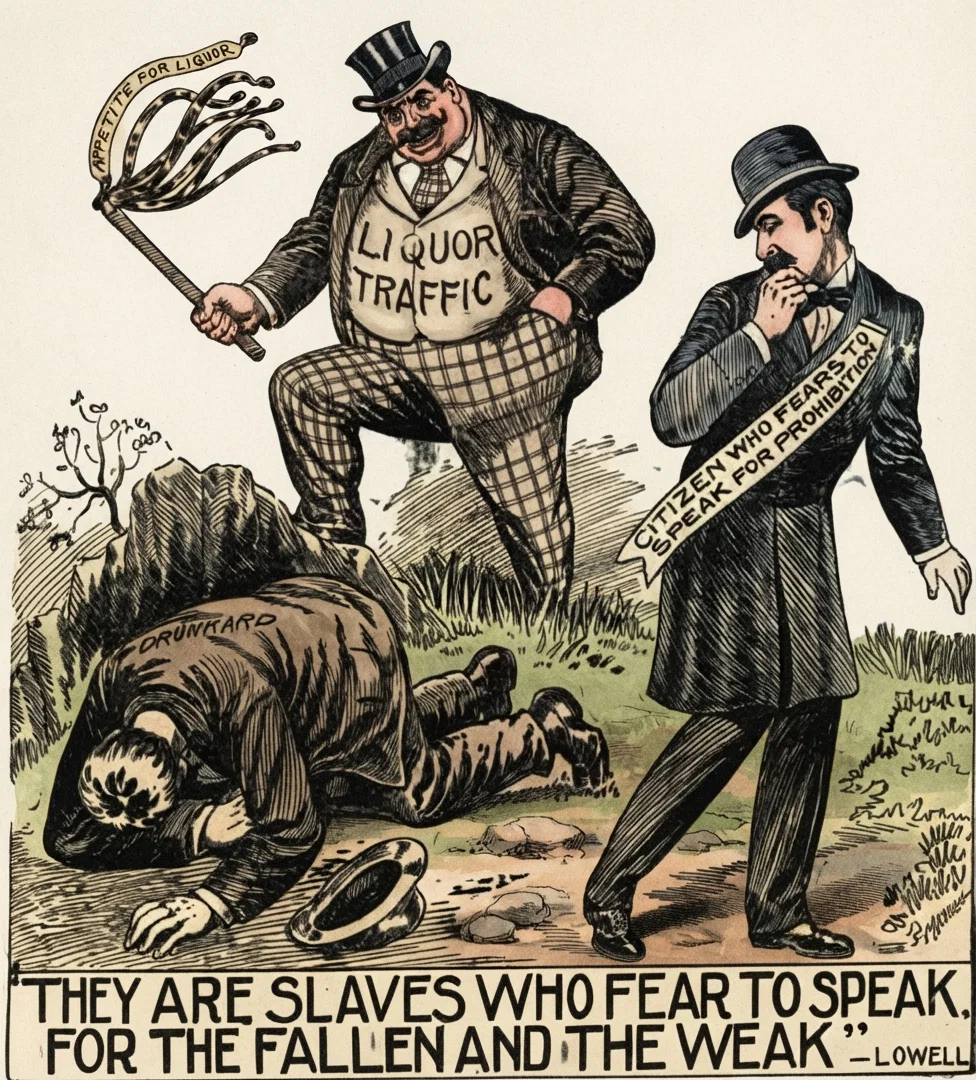
THEY ARE SLAVES WHO FEAR TO SPEAK, FOR THE FALLEN AND THE WEAK" - LOWELL
The saloon cries out for high license in order that it may have protection. But who is going to protect its victims? And who are its victims but the sovereign citizens of this land of liberty, wherein each man possesses as much freedom and opportunity as did ancient kings? Let us educate the common people, whose power of government the saloon would annihilate by seeking to destroy their self-control.
It is truly gratifying to know that in many of the popular decisions by vote of to-day, wherever the saloon has been victorious it has been victorious by only a small margin. This fact admonishes us that it is by our apathy and our abstaining from educating the people with greater energy that prohibition lost the day. We should seek to hold great temperance rallies, advertise them well, call out the people, and pour them full of the living facts relating to this great struggle. Agitate! Agitate! Agitate! It was agitation which shattered the great Louisiana lottery. First one State and then another refused to admit the operation of that gambling concern within their borders. Public conscience became aroused. And as its twenty-five years' charter in the State of Louisiana was about to expire, this towering lottery went begging throughout the different States, with a million dollars in its hand, for a chance to have somewhere to lay its head.
Effect of Alcohol
The knights whose errand to-day it is to overthrow King Alcohol must not forget their most powerful weapon—literature. Send forth everywhere the printed page. It drops within the mind a seed of thought which germinates, and germinates, until it becomes the conviction of the thinker. The printed page arouses no antagonism in the mind of the reader, which might be aroused if it were some person who stood before him, hectoring him into a belief. There was probably something more suggestive than impulse in the action of Luther when he threw the ink-bottle at the devil. Let us scale the courts of heaven, to bring down to earth, to blot out the spider-web of alcoholic ruin, more of that eternal ink which God Himself employs to blot out the sins of the human race.
Let us arouse the consciences of the people, make them acquainted with something that is better than the gratification of their carnal appetites, and reason will join with conscience in asking them to step forward to the front seat in the car of progress. Point out the dangers of the drug. When parents know that alcohol so changes the tissue cells of the little child as to prevent its normal growth, they will do to-day as did ancient Roman mothers,—they will withhold all fermented liquors from their children. When the adult learns, from the book of physiology, that every organic cell in his body has a little key which is called a "bond," which causes the cell to appropriate all newly digested food, and that alcohol destroys this "bond" and prevents growth, a powerful incentive will be created to shun and to destroy this detected destroyer. The book of physiology further tells us that in the system there exists a little substance known as an "antibody," whose function it is to meet and disarm little by little the poisons of some disease14which may be attacking us. To this defender also alcohol is a deadly antagonist. It destroys this little "anti-body," and leaves man more or less disarmed in the presence of assaulting disease.
The Better Way
How wonderful, then, in the light of these facts, is the value of God's Word! "Open Thou mine eyes," cried the psalmist, "that I may behold wondrous things out of Thy law." The glutton who sits down to the table and says, "There is no higher heaven than this," has no such experience as the psalmist. The most wonderful thing to him is the gratification of his carnal appetite. But tell him, demonstrate to him, the glories of the Word. When the divine Spirit clears his views, he will see and richly enjoy things more wonderful than those in which his carnal appetite seeks enjoyment. The advances of the alcoholic evil can be most effectually met by the sword of moral power. Like Paul, somebody will be led to acknowledge that the things he once loved he now hates, and the things he once hated he now loves. Somebody will then learn that there is transforming power in the Word.
One thing do not. Do not try to control the intemperance miasma by giving the Government complete control over strong liquor. It was tried in Russia, and with pitiful results. In order to restrict, regulate, and demolish the progress of intoxicating drinks within its borders, the Russian empire took over full control of the alcohol business. What was the result? The government itself fell a prey as easily to its seductive charms as did the men the State sought to elevate. So dependent became the government upon the revenues from the traffic, that on one occasion it requested the preachers of the State church to say no more against intemperance, lest the coffers of the city might suffer a shock. Five million dollars increase in revenue came to the empire, and they were pleased to have it keep coming. Therefore, punishment and exile to those scientists who reported to the International Temperance Congress at Vienna touching conditions within Czardom! And how pitiful it was to see 6,000 working men assemble and swear, out of political motives, to drink no more paternal whisky! California experienced somewhat the same history when for thirteen years it tried to control the liquor traffic. The population increased eight per cent during the same period in which liquor sales increased forty-one per cent, while the cost in crime increased three and one half times the income.
It Does Not Help in Taxes
In the next place, do not try to find comfort in high license. If the leech is sucking away our life-blood, what difference does it make whether he is permitted to continue because we squeeze out of him one drop or two drops? You say that high license will increase your revenues and lighten your taxes. Go around your neighborhood, if you will, and ask why it is that John Smith has lived twenty years in your neighborhood, and has property worth $15,000, on which the State may levy its taxes, while Sam Jones has also lived twenty years in the neighborhood, and has no property, but continually is an object of charity. Every one about you knows the reason. John Smith is a thrifty, industrious, sober man, but Sam Jones is a drunkard. Let us see then. How shall we best meet the saloon,—high license, low license, or no license at all?
I go out into the neighboring woods and capture fifteen vipers. I bring them home, the deadly, venomous, repulsive things! I put them into a box. Now what shall I do? Shall I bore fifteen small gimlet holes through which they might look out, and through which my child might look in? Or shall I bore fifteen medium-sized gimlet holes from which they might protrude their heads, but go no further? Or shall I take an auger and bore fifteen large-sized openings through which these vipers might come out to crawl around the house, and sink their deadly fangs into the flesh of my infants? Now, which do you advise me to do? I may tell you what I think ought to be done. The best thing is to take a hammer, open the box, and deal the deadly reptiles a crushing blow. Kill them dead, take them out, and bury them forever, beyond the possibility of a resurrection.
High license, low license, no license at all?—None and neither! Let us take the deadly saloon, whose fiery liquid is nothing less than a condensed stream of hell, and strike it a blow that will kill it dead, and then bury it forever, beyond the possibility of a resurrection.
The Magazine with the Message
By Editor
For March
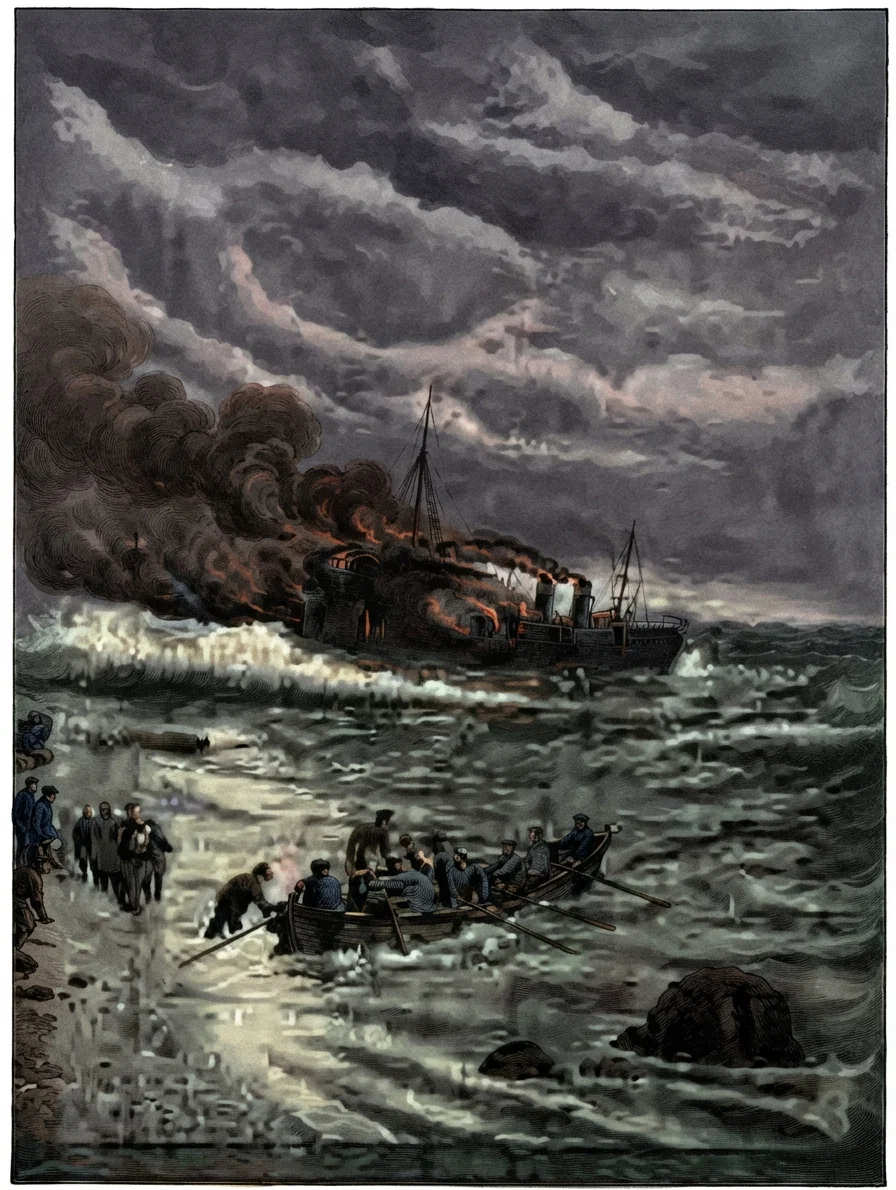
The cover design of the March Monthly, in three colors, depicts a mighty ship in flames. Two life-boats are putting out from the shore. The entire design typifies the dangers of the world to-day, and suggests a way of escape.
Saving Life — An article on this subject by the veteran editor of the SIGNS weekly, illustrated by the cover design and other graphic illustrations. The conclusions of this article are perfectly logical and more than appealing. Worthy of careful study.
Intensification — Our well-known writer, Mr. Frank S. Weston, writes an illuminating article under the above title. He shows how intensity is taking hold of every movement in the earth; that while evil and evil workers become more intense, righteousness and adherence to righteousness also become more intense; that the picture of a reign of peace on earth previous to Christ's coming is a fallacious doctrine is shown by this very fact; that the world will not change except in intensity; that the powers that have operated, will continue to operate, only with increased power. We hope the article will have a wide reading.
SAVING LIVES
Intensity of War Training — by A. O. Tait. Some forceful facts, figures, and pictures present this subject in a most telling manner.
Sabbath Queries — Under this heading, T. E. Bowen continues his articles, considering questions and answers on the all-important subject of the Sabbath.
The Threatening Future in This Country — Another almost startling article on conditions that threaten the peace and progress of the United States.
Glimpses of China — by F. E. Stafford, continued in this issue. The present world-wide interest in China and Chinese affairs makes these notes of thrilling import.
The Word Made Flesh — by Mrs. E. G. White. By special request we republish this contribution upon the divinity of Christ, instead of the regular serial from the pen of this same writer.
Other contributions of equal interest and value. Also Current Topics, Illustrations, Poetry, and our regular Bible Reading.
Your neighbors and friends need this issue of
The Magazine with the Message.
Address your tract society or
SIGNS OF THE TIMES
Mountain View, California
Underwood Standard Typewriter
QUALITY—NOT PRICE
In buying a typewriter the price should be the last consideration. There are many cheap typewriters on the market and many price cutters after business in the effort to survive. The UNDERWOOD is sold strictly on quality and is worth what you pay for it. It is a mechanical masterpiece, and in ease of operation, speed, accuracy and durability, is unequalled.
“The Machine You Will Eventually Buy”
133 Sutter St., San Francisco, Cal.
The Dollar Tract Package
By Mrs. F. A. Reynolds
APPLES OF GOLD
LIBRARY
Published by Pacific Press Publishing Association
No. 7 Mountain View, Cal. 1/2c each
HOW ESTHER READ HER BIBLE
BY MRS. F. A. REYNOLDS
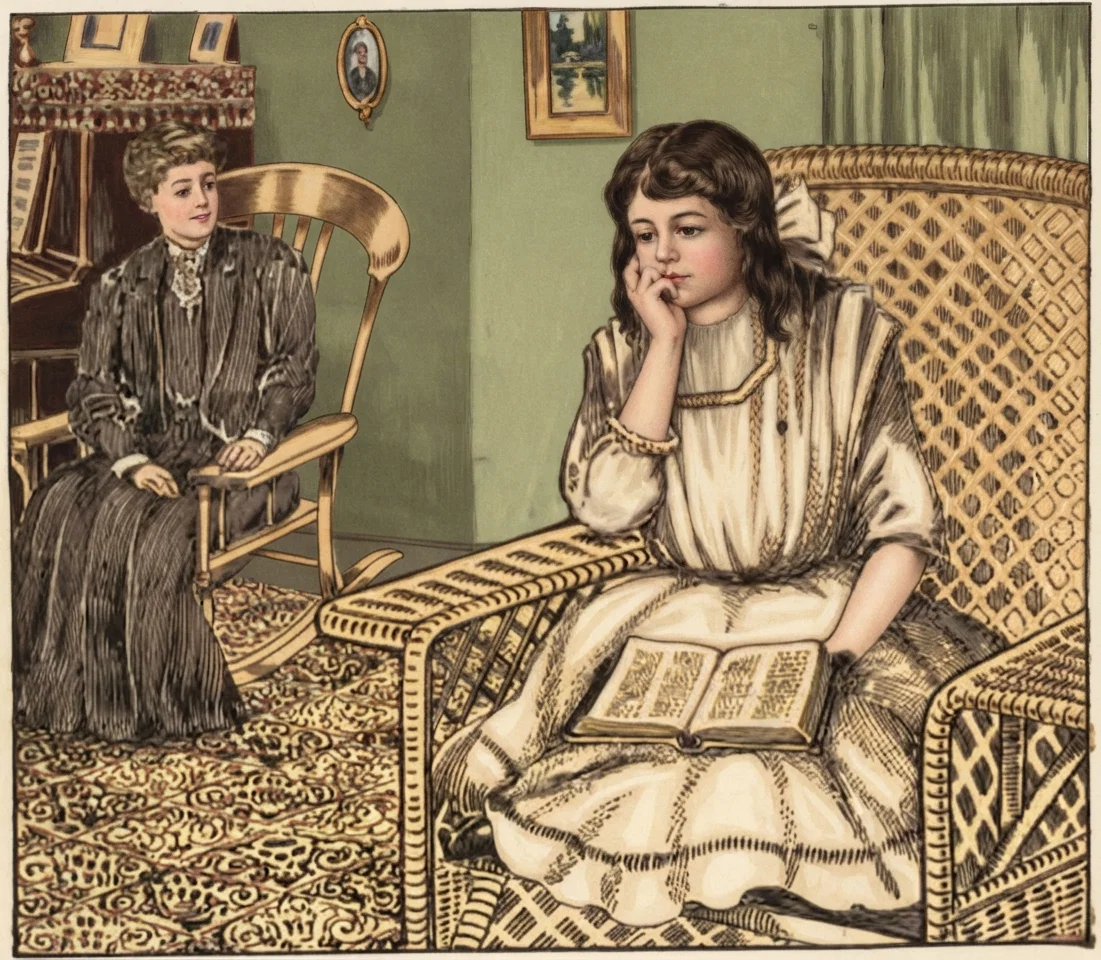
"I hope you have learned your lesson, Alice, dear."
MRS. LEIGH was the wife of a popular Congregationalist minister. She was a devoted Christian, and, so far as she had light, walked in it conscientiously. She had, when a girl, desired to be a
THE QUERIES raised by Esther, the little Indian maid, who so puzzled the minister and his wife into whose home she had been adopted as to cause them to search for what is truth, are in the minds of thousands now.
The story of Esther and her Bible study is leading many to a careful investigation of the Scriptures, as it did her foster-parents. It should be circulated by tens of thousands, together with the other tracts which have been chosen for the DOLLAR TRACT PACKAGE.
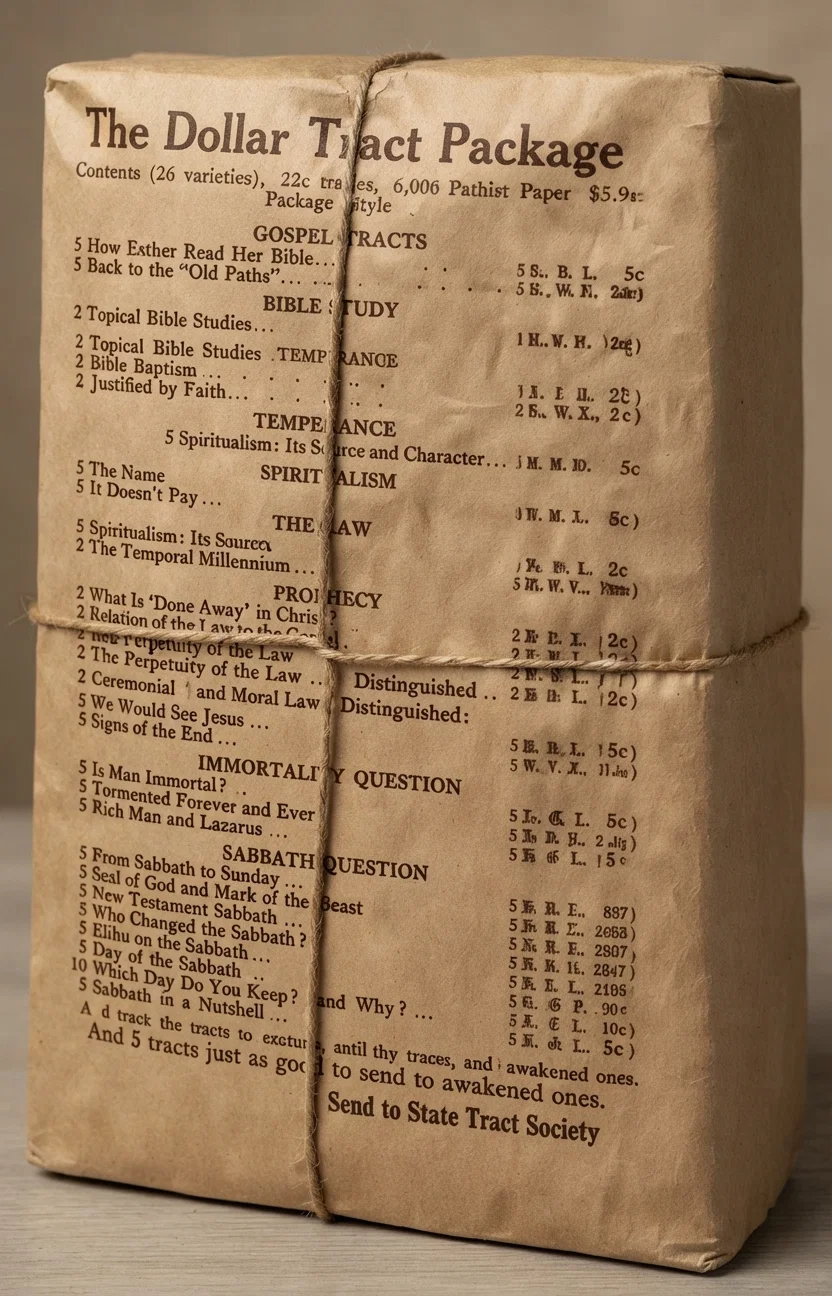
These have been so selected that the principal points of Scripture are covered, and a package gives the individual or family twenty-six varieties—twelve subjects—123 tracts—1,896 pages—to use in helping others. Read carefully the list:
No. Copies
5 How Esther Read Her Bible
5 Back to the "Old Paths"
5 Heralds of His Coming
5 Waymarks to the Holy City
The Law
2 What Is "Done Away" in Christ?
2 Relation of the Law to the Gospel
2 The Perpetuity of the Law
2 Ceremonial and Moral Law Distinguished
Second Coming of Christ
5 We Would See Jesus
5 Signs of the End
Immortality Question
5 Is Man Immortal?
5 Tormented Forever and Ever
5 Rich Man and Lazarus
Sabbath Question
5 From Sabbath to Sunday
5 Seal of God and Mark of the Beast
5 New Testament Sabbath
5 Who Changed the Sabbath?
5 Elihu on the Sabbath
5 Day of the Sabbath
10 Which Day Do You Keep? and Why?
5 Sunday in a Nutshell
These tracts will enable you, like Esther, to arouse those about you to search for the truth. Simply request the Dollar Tract Package, adding 25 cents extra ($1.25 in all) for mail or express charge. (Ask also for booklet "Fireside Companions," a complete tract directory, which is free.)
Order of your tract society or
# Pacific Press Publishing Association
Mountain View, California
Portland, Oregon
Calgary, Alberta, Canada
Kansas City, Mo.
1. One new yearly subscription and one renewal, or two new yearly subscriptions, sent at one time, $3.00.
2. Two new yearly subscriptions and one renewal, or three new yearly subscriptions, sent at one time, $4.00.
3. Three new yearly subscriptions and one renewal, or four new yearly subscriptions, sent at one time, $5.00.
Sample copies sent on application.
Weekly and Monthly SIGNS one year, combined, $2.25.
DATE OF EXPIRATION
By G. C. Hoskin
The SIGNS wrapper bears date of last issue due on your subscription. Unless renewed in advance, paper stops with expiration date.
If herewith is an order-blank, you will know you have overlooked sending renewal. You will not wish to miss a single issue. Back numbers often can not be furnished.
G. C. Hoskin, Circulation Manager.
IN THREE DAYS
SAN FRANCISCO
Overland Limited
TAKES YOU
To Chicago
ACROSS GREAT SALT LAKE
AND
HIGH SIERRA BY DAYLIGHT
Luxurious High-class Equipment
Electric Lighted Throughout
Pullman Drawing-room
Stateroom
Vestibuled Sleeping-cars
Careful and Attentive Dining
Service
Parlor Observation-car with
Library and Cafe
Ladies' Reading-room
Gentlemen's Smoking-room
Daily News Bulletins
Latest Papers and Magazines
Southern Pacific
Notice to Subscribers
By Editor
N. B. We send no papers from this office to individuals without pay in advance. When persons receive copies without ordering them, they are sent by other parties, and we can give no information in regard to them. Persons thus receiving copies of the SIGNS are not indebted to the office, and will not be called upon to pay for them. Please read the papers you may receive, and hand them to your friends to read.
The Digestible Value of Bananas
The "Journal of the American Medical Association" says that there is much misunderstanding among both physicians and laymen regarding the digestible value of the banana as food. The ripe banana is about one fifth sugar, soluble and easily digestible; the green, one fifth starch. Most of the remainder of the edible pulp is water. The difficulty comes when eaten too green, the raw starch being irritating to many. The fruit is said to be ripe when the skin has begun to shrivel and darken, but many reject it when the skin becomes darkened, thinking that it is "rotten." If not ripe, it should be cooked, the same as potatoes. The article closes by saying, "Experience shows that the thoroly ripe banana, or the less ripe fruit after cooking, is undeserving of the unfavorable reputation which it has won in certain quarters. It forms a useful addition to the dietary, richer in nutrients and far more delicious than some of its more expensive competitors."
Bible Versions Used
By Editor
Our authority is the Bible, the Holy Scriptures of the Old and New Testaments. When the Common ("King James" or "Authorized") Version or the American Standard Revised Version is used, the version will not generally be designated in reference. Any Bible quotation in this paper, therefore, differing from the Common Version, unless otherwise indicated, will be almost invariably from the American Standard edition of the Revised Bible, copyright 1910, by Thomas Nelson & Sons.
For further particulars, subscription rates, etc., see page 15.
God’s Boundless Mercy
There is no limit to God's mercy in Him; human hearts reject it or spurn it till they know it not. His mercy is for cleansing; men use it for license to sin till they become identified with sin and their case is hopeless.
The Unforgivable Sin
The only reason that the sin against the Holy Spirit is unforgivable is that it is unrepentable.
Contained in This Issue
By Editor
Question Corner
3680 — Questions of the Resurrection and the Bible; 3681 — Trine Immersion; 3682 — The Round World; 3683 — God's Rest, Heb. 4:8-10; 3684 — Camel and Needle's Eye; 3685 — To Egypt and Back; 3686 — A Book of Martyrs — 2
Our Bible Band — 2
General
A Lesson from the Life of Judas — 3
What Shall We Do with the Fourth Commandment? — 4
The Promises to Abraham — 5
Studies in Daniel — A Vision of Empires — 6
The Practical Life — 7
"Simon, Son of Jonas, Lovest Thou Me?" — 8
How Christ Emptied Himself — 9
Our Bible Reading
What the Coming of Christ Means to the Wicked — 9
The Outlook
The Imperial Durbar, Delhi, India — 10
Notes — 12, 16
Temperance
The Saloon, a National Evil, Demands a National Cure — 13
Poetry
Do You Know Him? — 4
The Tree of Life — 7
Divine Fellowship — 8
Longing for Home — 9
The Sabbath Question
The true and only solution of the Sabbath question lies between the soul and God, and the only law for settling the question is that of the Bible. That law is sufficient for the Bible believer. He not only has the immutable law of God; he has the faultless example of Christ Jesus our Lord.
Sunday Legislation
It is not a question of the right or wrong of the observance of a sabbath,—any sabbath day,—that is to be considered in Sunday legislation; but what right has any civil government to enforce a day of religious observance upon any person? The only original Sabbath law is a Bible law. The Sabbath is to be kept holy unto the Lord. But no civil law can compel a holy observance of the day or an acceptable observance of the day to God. This must be the free-will act of the observer. To compel this is to foster hypocrisy.
Ten Commandments Chart
By Editor
A chart of the Ten Commandments, representing love to God and love to man, has come to us, the arrangement of which is prepared by Mr. E. Edson. It is fitted to hang up in the home, printed in two colors — red and blue — with neat gold border. It may be obtained from the Southern California Tract Society, 417 W. 5th St., Los Angeles, California. Surely it is well always to meditate upon God's law, and this chart will help to see its beauty. It also contains other scriptures commenting upon the law and the Lord's Prayer.
Religious Liberty in Jail
By Editor
The matter of religious liberty is a live question nowadays. It crops up almost everywhere. It really comes into the very jails themselves. For instance, recently in Pittsburg, Pennsylvania, the editor of a Socialist paper was for a while made prisoner at the county jail, and has now brought suit against the warden, Mr. Lewis, for $10,000, alleging that last November, because he would not attend the religious services at the institution, he was kept in solitary confinement during those services, and at subsequent dates while in prison, he asserts that he was compelled by force to attend the services, and claims his rights of religious freedom guaranteed by the Constitution of the United States were violated. It would be worth while for the friends of religious liberty to see how this claim terminates, and how it is regarded by the courts.
The Great Divide
The Great Divide.—Exactly at the highest point of the divide of the Rocky Mountains, on the Crow's Nest Division of the Canadian Pacific Railway in British Columbia, is a hotel. When it rains in the mountains, the water which falls on the eastern slope of the hotel roof trickles down, joins a tiny rivulet which flows on, increasing by other rivulets, until its water mingles with the Atlantic; while the water falling on the other side of the roof flows westerly, and ultimately into the Pacific. It is just as narrow a line as this that decides the destinies of many lives. The change of a sixteenth of an inch in a rain-drop determines the place where it will ultimately come. The decision to do right in one of the smallest and seemingly inconsequential things of life may determine the entire character; at the great divide it seems such a little thing, but at the mouth of the foaming river it is altogether different. Would that every one bound for the kingdom of God could feel and know that every moral decision has within it the dividing line of character!
The Increase of Insanity
The "Journal of the American Medical Association" tells us that a special census of 372 institutions for the care of the insane was taken by the United States Census Bureau in 1910, showing that there were 187,454 inmates on January 1 of that year. A census taken in 1904 showed the number in institutions to be 150,151. From 1904 to 1910, six years, there was an increase of 10,981, or 22 1-10% of the number annually committed to such asylums. The number of insane in asylums per 100,000 of the population in 1904 was 186 2-10; in 1910 it was 203 8-10. Massachusetts has the largest proportion, 344 6-10 per 100,000 of population; New York a close second, with 343 1-10 per 100,000; but it is thought that this showing comes because there are more of the insane in such institutions in these States on account of their having better provisions for this class of patients. The increase in insanity is certainly not hopeful.
Religious Liberty for All
The true believer in religious liberty does not believe in religious liberty for himself alone, nor himself primarily, but for the other man, the individual by whatever name he may be called. In the development and maintenance and conservation of such a view the rights of all are conserved.
President Madero Receives a Bible
A representative committee of various Protestant denominations met with President Madero, of Mexico, together with the agent of the American Bible Society for Mexico, and a beautifully bound copy of the Spanish Scriptures, especially prepared at the Bible House in New York City, was presented to the president, bearing this inscription: "To the Señor President of the Mexican Republic, Francisco I. Madero, the American Bible Society and the evangelical pastors of this capital respectfully dedicate this Holy Bible. Mexico, the 8th of January of 1912."
Among other things, the president said: "I am exceedingly grateful for this gift you make me. You may rest assured that I appreciate it to its utmost worth. I hold the same belief as you concerning the value of its principles for the elevation of the people, inasmuch as I am sure that only through Christian morality are the nations uplifted."
He congratulated them on the good work that Protestantism had been doing, stated that the Mexicans have noble sentiments, but need enlightenment, and that he would work for this, and the Protestants thus working would coöperate with him in uplifting the masses of the Mexican people.
D. M. Ferry Seed Annual
By Editor
In securing garden seeds—flowers or vegetables—one wants reliable seed, true to name, seed that will grow. There are seed houses that are disappointing; there are seed houses that are reliable, and among these stands the old firm of D. M. Ferry and Company, of Detroit, Michigan. Their Seed Annual for 1912 is before us, a little late for California, as gardens are mostly in, but not too late for thousands of our readers in the East and North. The Seed Annual advertises all the old standard varieties, with some excellent new tested ones, and liberal terms are offered. Then, too, all packets are fresh every season, none are sent out the second season or carried over by the dealers.
Harvard Student Supports Anarchy
By Editor
Our great universities do not seem to be developing that desire for the old ideals in government that might be longed for. Just recently we were told that a Harvard junior, a grandson of Charles W. Eliot, Harvard's president emeritus, Samuel Atkins Eliot, Jr., by name, gave a dinner in one of the most fashionable Harvard restaurants, to Miss Emma Goldman, an anarchist; that he entered the restaurant with Miss Goldman on his arm. He announced himself in accord with Miss Goldman's ideas at a lecture on anarchy given by her in Cambridge, Massachusetts, December 3. At the conclusion of his remarks he was enthusiastically applauded by the students.
Kubelik’s Million-Dollar Violin
The great violinist, Kubelik, says that his violin has earned for him one million dollars, and he is now planning to spend much more of his time at home with his family in place of being away so much in giving concerts. Millionaires used to be hard to find, even among the "princes of finance;" but this man who is still comparatively young has made this great fortune all himself, by merely furnishing the highest grade of entertainment.
Tornado Strikes Shreveport Carnival
On the last day of the Mardi Gras carnival at Shreveport, Louisiana, February 20, a tornado came up suddenly, and quite a portion of the outskirts of the town was demolished, eight persons were killed, and forty or more were injured. The tornado appeared without warning, in the midst of the merrymaking, and it was with difficulty that many who were in the part of the town where the tornado was the lightest were able to reach shelter.