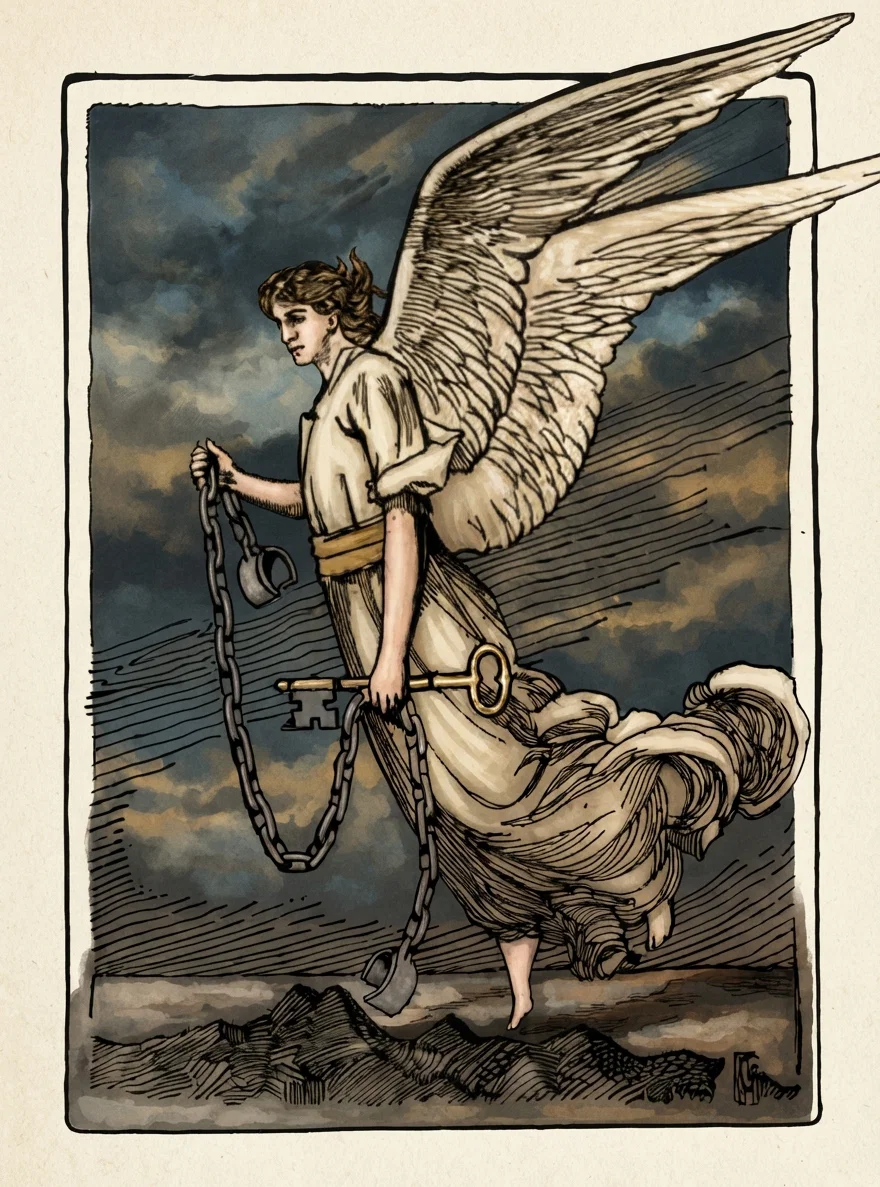
Chained amid Earth's Ruins—Doors of the Tomb Rolled Back
By Benjamin G. Wilkinson
The first of five strong articles by Dr. Wilkinson on the events of the millennium era appeared in last week's issue. This series is worthy of earnest study. Never in the history of the universe has there been anything like that era; never will there be afterwards. Where we spend the thousand years determines where we shall spend eternity. Next week the terrific devastations that will precede the millennium will be delineated.
The millennium is bounded on this end by the old earth rejected; on the other end, by the heavens and the earth newly created; on this side, by the resurrection of the just (as says John, "Blessed and holy is he that hath part in the first resurrection," "but the rest of the dead lived not again until the thousand years were finished"); on that side, by the inauguration of the new Jerusalem as the capital city.
With the opening of the millennium, the devil changes position. He loses his freedom. "And he [the angel] laid hold on the dragon, that old serpent, which is the devil, and Satan, and bound him a thousand years." Rev. 20: 2. The time has been long during which the peace of God's home has been disturbed. But with the opening of the millennium, the domestic unhappiness fomented by the incarnation of selfishness comes to an end with a large section of God's family.
Three Setbacks to Satan
The millennium opens with a decided shock to the devil's operations, and it is the third of a series of steps culminating in his downfall. First, at the creation of the earth, he was cast out of heaven. "I beheld Satan as lightning fall from heaven," said Christ. Luke 10: 18. Secondly, at the cross, he was hurled back from free range throughout the spheres, and from influencing other creations. "Therefore rejoice, ye heavens, and ye that dwell in them. Woe to the inhabiters of the earth and of the sea! for the devil is come down unto you, having great wrath, because he knoweth that he hath but a short time." Rev. 12: 12. Lastly, during this millennial era, he is so imprisoned that he shall "deceive the nations no more."
But this does not astonish the righteous; long ago, they had cast him out of their hearts.
Just now his time is growing short; then it will be run out. His existence will be prolonged through another thousand seasons, but his power to deceive will be removed. The instigator of all evil lies chained amid the ruins of his rage. Blessed millennium!
The hours of probation are few. The chances of salvation are diminishing. As the hours of the millennium draw on, there are not many more seats left for passage to eternity. Make your calling and election sure before it is too late.
Doors of the Grave Thrown Back
The bridge that spans the chasm of the millennium is a thousand arches long. One end rests on these old hills of sin, the other is thrown over to the heights of the new earth. On this side, one of the great pillars is the second coming of Christ. "For the Lord Himself shall descend from heaven," says Paul, "and the dead in Christ shall rise first." 1 Thess. 4: 16.
At His first coming, no widespread resurrection took place. He did not come for that. Then He came to confirm the promise made to the fathers. But so many lives, from Abel until now, have been hid in Him, that the hour which brings His return will also bring again from the dead those from whom transgressions have been turned away.
The doors of the grave will be thrown back, and the just will come forth. From all over the earth they will rise, clad in robes of fadeless immortality. Resplendent among them all, lighting up with streams of glory the caverns of infinity, will be the figure of Christ. The carnival of carnivals opens, and the millennium begins.
Their Position Unrivaled
THOSE among the living who approach the millennium with their eyes open hold a position unrivaled in history. First they are in the dark, then they are in the day. They pass through the transition period — days when they live in the agony of expectation. They will not be in the resurrection of the just, but already alive. With their own eyes they will see themselves, as mortals, put on immortality.
They have walked the streets of Boston, Chicago, Denver, New York — cities as they are now. Then they will behold a mystery. After having seen the devastating plagues sweep the earth, they will witness the glorious coming of Christ. Standing where once modern life swarmed, they will see the opening of the graves, and the resurrection of the righteous dead. Like so many tornadoes, as cataclysms and revolutions, the plagues sweep around them. How gladly can they hail the millennium! What valuable witnesses they will make forever of those days never to be forgotten! Therefore "we which are alive and remain shall be caught up together with them [the resurrected ones] in the clouds, to meet the Lord in the air." 1 Thess. 4: 17.
"Behold, I show you a mystery; We shall not all sleep, but we shall all be changed." 1 Cor. 15: 51.
"And I looked, and, lo, a Lamb stood on the Mount Sion, and with Him an hundred and forty and four thousand, having His Father's name written in their foreheads. . . . These were redeemed from among men." Rev. 14: 1-4.
Witnessed the Resurrection
"AND I saw as it were a sea of glass mingled with fire: and them that had gotten the victory over the beast, and over his image, . . . stand on the sea of glass." Rev. 15: 2. In chapter 13, John had seen this company, just prior to Christ's coming, in conflict with the beast and his image.
The twelve witnessed Christ's ascent to heaven; His descent from glory the one hundred forty-four thousand behold. In the final efforts of the prince of the air, they saw the invasion of death; in the immortal trump of Christ, they behold the millions resurrected to life. How glorious to belong to that noble band, that last great chosen company! No surrender can be too great; any price is cheap that will win us a place therein.
Let Him begin a good work in you. "He which hath begun a good work in you," says Paul, "will perform it until the day of Jesus Christ."
We Never Know
Two friends were driving along an avenue in a beautiful city. As they were admiring the fine homes surrounded by lovely trees and flowers, one man turned to the other, and said, "Every house in that row has its tragedy." Then followed a recital of some of the saddest of stories.
We never know. If we knew, we would not envy, and would be far gentler in judgment. We do not know the sorrowing heart, or perhaps the silent endurance of physical pain, that lies back of the cold, repressed manner of our friend. We do not see the tragedy of disappointed hopes and ambitions in the face of the man who asks for work. We do not comprehend the unspoken pleading for love and patience in the apparently incorrigible child whose attitude defies us.
We do not know the shame and despair of the drunkard, nor the brave fight he makes in his moments of freedom, when his hope springs up anew.
We never behold the secret sorrow of the girl who has given herself to shame, when the purity of her womanhood asserts itself, and with buried face and bitter tears she sits in the presence of her God.
We seldom realize the heroism of the old man who is forced to earn his bread in extreme age, facing, in pain and weariness, daily toil, the passing of his strength, and the grim presence of the angel of death.
We never know until we too have suffered; until sorrow, pain, mortification, and defeat have claimed us for their own. And in the battle, we sometimes reach that place of divine compassion and understanding of the hearts of others, where we would never willingly cause another pain, and would gladly help a fellow being in his hour of need.
ESTHER M. CARLSEN.
Sin Against God
"He who sins against man, may fear discovery; but he who sins against God, is sure of it."
Gripped by the Tempest of Nations
By Jean Vuilleumier
"I Am the Hammer of the Universe"
By JEAN VUILLEUMIER
SYNOPSIS.—This interest-gripping prophecy of the seven trumpets portrays the downfall of nations during the Christian era. The first article of the series, in our issue of August 29, gave a general view of this desolation as it began to unroll before the ancient prophet. The trumpets were shown to be the symbols of war, referring definitely to the mighty irruptions from the barbaric hordes that swept over the Roman Empire, dethroning her from the position of proud mistress of empires. The first trumpet symbolized the wars waged by the renowned Alaric and his victorious Goths. Hail, fire, and blood falling upon the earth is the prophetic description. Rome was pillaged, was humbled in the dust. The fulfillment of the second trumpet is found in the conquests of Italy and Africa by the Vandals under the terrible Genseric. His ravages were indeed like a mighty stone cast into the waters, causing wave after wave to beat upon the defenseless shore.
"AND the third angel sounded, and there fell from heaven a great star, burning as a torch, and it fell upon the third part of the rivers, and upon the fountains of the waters; and the name of the star is called Wormwood: and the third part of the waters became wormwood; and many men died of the waters, because they were made bitter." Rev. 8: 10, 11.
This language implies that the next judgment upon Christendom would be of short duration, like that of a meteor, but that it would bring untold suffering upon the populations of the empire.
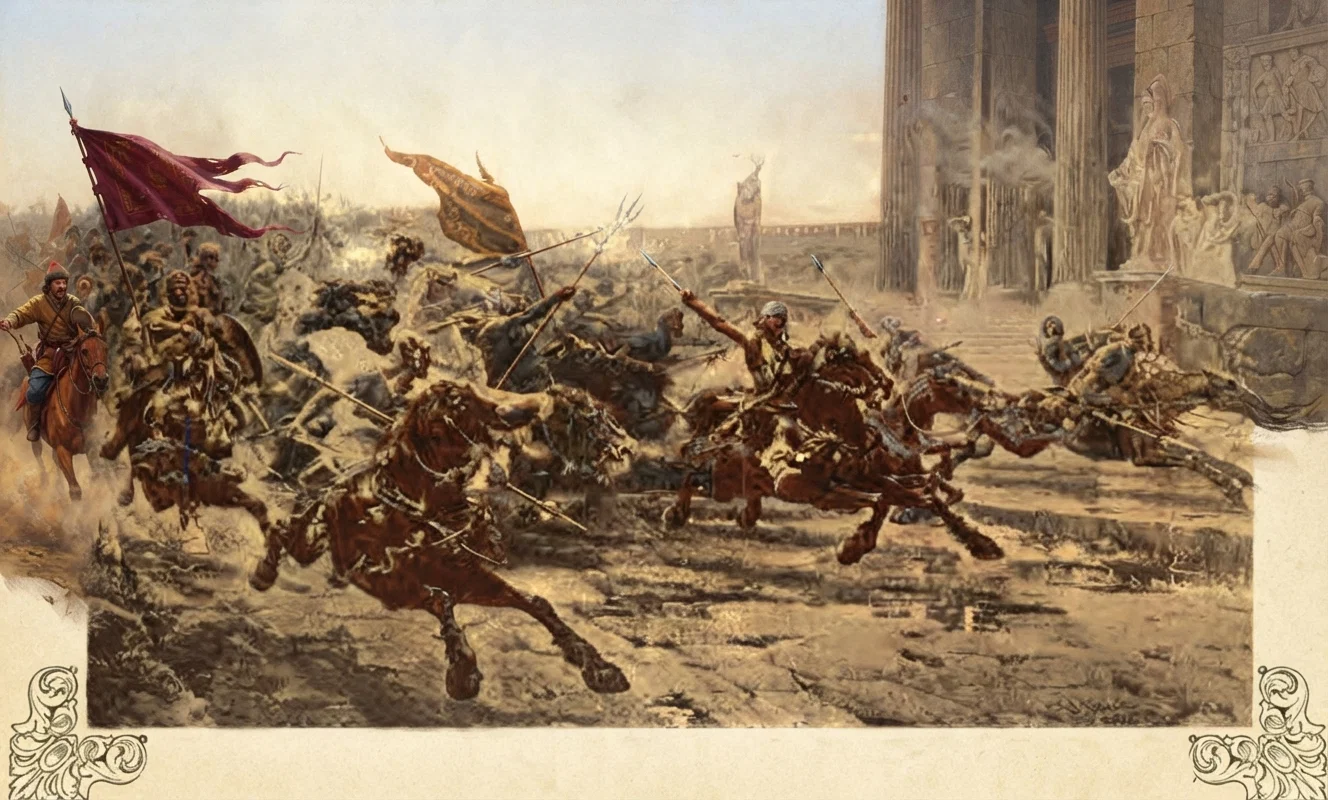
Toward the end of the fourth century, a nation unknown in Europe—the Huns—leaving the borders of China, and crossing the whole northern portion of Asia, a distance of nearly four thousand miles, dashed suddenly toward the northern shores of the Black Sea. The Goths, who were living there peacefully, fled in terror while the Huns were burning their villages and their harvests, and killing the men, the women, and the children.
Their language no one understood. Their name had never been pronounced in Europe. Says Jornandes, the Gothic historian, probably with the exaggeration of an enemy: "They put to flight, by the fear born of their ugliness, those whom they could not conquer by their courage. The yellowish color of their skin was repelling. Their face was a mass of flesh in which two dark holes marked the place of the eyes. They purposely defaced their own children in infancy, and their body was as hideous as their face."
Conquered by Ugliness
THEIR king Attila was short, with a large head, small, round, sunken eyes, and a flat nose. It is said that he was horrible to behold, and that he gloried in inspiring terror. "This man came to this earth to set his nation in motion and to make the earth tremble," says Jornandes again. "Frightful rumors preceded him, and scattered dismay all around." Attila called himself the scourge of God. He claimed that grass grew no longer where his horse had trodden.
In the very words of prophecy written four hundred years before, he said of himself: "The star is falling, the earth is trembling. I am the hammer of the universe." (Chateaubriand.) Disdaining royal pomp and comforts, he lived in a large wooden house, ate and drank in wooden utensils, while kings and ambassadors around him took their meals in silver and golden plates and cups.
"The kings and nations of Germany and Scythia, from the Volga perhaps to the Danube, obeyed the warlike summons of Attila," says Gibbon. "Day and night," says Ammien Marcellinus, quoted by Raffy, "the Huns seem to live on horseback. There they buy and sell, eat, drink, sleep, and hold council. . . . They give the charge or escape with the speed of lightning, and spread death all around. None of them know how to plow. They roam about space without home or hearth." "The Huns," says Chateaubriand, "were the last great nation summoned for the destruction of Rome; the other nations made a halt to wait for them."
Constantinople Ransomed
AND now the "great star, burning as a torch," is ready to fall "upon the third part of the rivers, and upon the fountains of the waters." A fearful shock, as that of a heavenly body striking the earth, awaits the fruitful valleys watered by the Rhine, the Danube, the Moselle, the Seine, the Loire, and the Po.
Deciding to punish the emperor Theodosius II, Attila crossed the Danube on all points at once with his innumerable army. Marching south, he defeated the Romans three times, took and razed seventy cities, burned the villages and the harvests, and either killed all the inhabitants or took them prisoners. Reaching Constantinople, he consented to withdraw for a ransom of six thousand pounds of gold and the promise of a yearly tribute of about two thousand pounds. This was in 447.
But the sorrows of Christendom had only begun. Four years later, in 451, leaving his "royal village in the plains of Hungary, Attila turned his face toward the West"; and after a march of seven or eight hundred miles, his myriads poured tumultuously across the Rhine and the Moselle. All the cities of lower Germany and Belgium were plundered, wrecked, or starved. Basel, Kolmar, Strasburg, Speyer, Worms, Mainz, and Treves fell into the hands of the invaders. Reaching Gaul, this "tempest of nations" overwhelmed every city, with the exception of Troyes and Paris.
The Unequalled Scourge of the Huns
THE vast army of Attila spread to the Atlantic coast, plundering and destroying everything. Besancon, Metz, Auxerre, Rheims, Langres, Toul, Laon, Tongres, Arras, were left in ruins. In Metz, the Huns killed everybody, including the children that the bishop had hastened to baptize. The city was set on fire. Salvian saw cities filled with corpses. The dogs and birds of prey, glutted with the putrid flesh of the dead, were the only living creatures to be seen.
The Thuringians, serving under Attila, hung up the children on the trees by the leg. They barbarously killed two hundred young girls, tying them by the arm to the neck of horses, which tore them to pieces. Others were bound on the ground and run over with chariots.
Where the Huns passed, famine remained to such an extent that fathers and mothers ate their own children. "The Huns," says Gaussen, "lived on cruelty." Nothing in this whole century equalled the scourge of the Huns led by Attila. Indeed, "a burning comet had fallen on the West," and was drying up all its beautiful "rivers" and "fountains of waters."
At Orleans, a Roman army, gathered by the clever general Aëtius, and composed of Visigoths, Burgundians, and Franks, forced the Huns to retreat, and a memorable battle took place on the large plains near Chalons on the Marne. The fate of Europe seemed6to tremble in the balance. For a while, the victory fluctuated, but finally it turned on the side of the Romans, or rather on the side of the Goths, the Franks, and the Burgundians, thus saving Europe from the enslaving rule of the Tartars.
Delivered the Death Blow
ALTHOUGH defeated, Attila was not conquered. The following year (452), he invaded Italy. Milan, Pavia, Verona, Turin, Aquileia, Padua, Treviso, Mantua, Cremona—in short, all the cities of Lombardy—opened their gates, and were plundered, and their population was massacred. Like Constantinople and Paris, Rome was saved from the anger of Attila. He threatened to return on the following year; but he died suddenly on the night of a wedding feast, 453.
The Huns were not intended to establish themselves anywhere on the ruins of the Roman Empire, but only to give it its death blow. As foretold by prophecy, this terrific meteor was to vanish in the night. "The inheritance left by the king of the Huns," says Chateaubriand, "had nothing tangible; it was only a sort of fiction or enchantment produced by his sword. The emblem of his glory once broken, everything vanished [italics ours]. The nations disappeared with the whirlwind which had brought them. . . . The reign of Attila was only an invasion," or, as Attila himself and the prophecy expressed it, "a falling star."
The third trumpet had sounded through Europe the peals of its thunder. Well might the godly survivors in those days have inquired, "What next?". An echo from the island of Patmos would have answered, "Four more trumpets are coming."
The Great Blunder
By George McCready Price
“Doubtless the most peculiar mixture of fact and nonsense to be found in the whole range of the natural sciences.”
The Great Blunder
Mixing Fact and Nonsense — Insulting Our Intelligence
By
George McCready Price
GEOLOGY is the only one of the natural sciences that professes to furnish demonstrated facts in plain contradiction to the fundamental doctrines of the Bible. And the alleged facts which are obviously antagonistic to the teachings of the Bible constitute what are regarded as the most basic truths of geology; namely, that the world is old beyond all computation; that life was not created some few thousand years ago, but has existed on the globe in successive ages covering millions and millions of years, and that various distinct types of life have occupied the globe one after another, the present set of plants and animals, including man himself, being but the last of an almost infinite series stretching away in ever narrowing vistas into the “great backward and abysm of time,” until lost in the measureless beyond.
Has Man Existed 500,000 Years?
THESE are the alleged facts of a highly respected modern science, upon which all modern enemies of the older views of the Bible now base their attacks. It is on these alleged facts that, as we have seen in previous articles of this series, Colonel Roosevelt constructs his astonishing pedigree of man, tracing him back through the so-called “ape-man of Java,” who, the colonel assures us, lived about 500,000 years ago.
We have already considered some of the archaeological aspects of this problem of the age of the human race; but it is the geology lying at the basis of this argument of our ex-president which we need to examine with especial care. For in all modern scientific discussions of this problem of how old is man, these successive geological ages are the ever present major premise, expressed or implied; and of course it is very easy for the evolutionist to find a suitable minor to fit it, and to draw from them almost any astonishing conclusion in any direction he may choose.
It is absurd for the friends of the Bible to spend their time bandying arguments with the evolutionist regarding the many minor premises that he may bring forward, when his major premise is itself directly antagonistic to the most fundamental facts regarding the first chapters of the Bible, and above all, when this major premise is really the weakest point in the whole evolution theory, the one tender spot that evolutionists never want to have touched at all.
The Long Series of Differing Types
BUT this is the very point that needs to be well understood. The supreme question of modern science, by all odds the most important problem before the scientific world, is this: “Does geology really prove that there has been a succession of different types of life on the globe in a definite order?”
Not only does the whole theory of organic evolution depend upon an affirmative answer to this question, but all the “advanced” views in theology and criticism, even the present popular methods of interpreting human history and of conducting political campaigns, depend upon the belief that there has actually been a long series of different types of life succeeding one another on the globe in a very definite and well ascertained order, this order being what is termed the fossiliferous series of plants and animals.
It Confounds Evolutionists
IN a former article, I suggested that the reader ask the first evolutionist or professional scientist how to prove, in strictly logical fashion, that when the Carboniferous plants now forming the coal beds of Pennsylvania were living in this locality, the Cretaceous coal plants of British Columbia were not yet in existence, and that only after the latter had been buried for uncounted centuries did the Tertiary coal plants of Germany and Australia come into existence. And I may even say that the reader is perfectly safe in offering a good round sum of money for the required logical proof, or even for any honest attempt at such logical proof, of these alleged facts; for I do not believe that any scientifically educated man in America or Europe would seriously undertake to furnish such proofs. He knows it can’t be done.
I could multiply testimony from such high class scientists as Huxley, Spencer, Nicholson, Suess, etc., candidly acknowledging that the reality of these relative ages has never been proved by geology, but that in all geological writings, these relative ages are merely assumed. There is in reality no way of proving one kind of fossil older than another, or older than the human race. For human remains are found fossil, just the same as the ancient relics of plant and animal life; and it is mere pseudo-science that would seek to say that these plants and animals lived and died ages before the human race appeared on the globe.
Mixing Fact and Nonsense
THE science of geology is in reality in a most astonishing condition, and is doubtless the most peculiar mixture of fact and nonsense to be found in the whole range of the natural sciences. In any minute study of a particular set of rocks in a particular locality, geology always follows facts and common sense; while in every general view of the world as a whole, or in any correlation of the rocks of one region with those of another region, it follows its absurd, unscientific theories. But wherever it agrees with facts and common sense, it contradicts these absurd theories; and where it agrees with these theories, it contradicts facts and common sense.
There is absolutely no scientific reason, not a ghost of a respectable argument, for arranging the fossils in any order whatever of alleged relative age. The current method of arranging the fossils in a definite series representing alleged successive ages is the most elaborate piece of nonsense that I know of in our modern world. That educated people still believe in it, is astonishing.
In the light of modern discoveries in geology — the details of which the reader can see in my “Fundamentals of Geology,” obtainable through the publishers of the SIGNS OF THE TIMES — these distinctions as to age have absolutely no foundation in objective facts, being merely a tradition surviving from the absurd and notorious “onion-coat theory” of a hundred years ago. And the fact that most educated people still implicitly believe in this theory of a definite age for each particular kind of fossil is a sad and instructive example of the effects of mental inertia.
The Trees Obscured the Woods
IT is simply another case of not being able to see the woods for the trees. Even more so than other scientists, each geologist tries to be a specialist. To resume the figure, he is intently occupied with a minute examination of the particular tree in front of his own nose, and very few of them ever rise sufficiently far above the trees to get a general7view of the woods as a whole. Or if any of them does take such a general view, he never dares to vary his description of the landscape very much from the classic descriptions of what the founders of the science a hundred years ago said the landscape ought to be.
But let us see what a broad general view of the whole mass of geological facts will show us.
The Sea Has Covered All
THE broad general fact is that we cannot go to any place of any considerable size without finding plain proofs that at some time the sea must have swept over the place or must have occupied the spot for a considerable time. The Alps, the Rockies, the Himalayas, the Andes—all the mountain ranges on earth, in fact—are largely made up of rocks formed in layers, manifestly laid down by water, in most cases sea water; for practically one and all of these mountains contain the remains of fishes or sea shells or other fossils, that must have been buried by moving waters, though now these localities are high and dry.
But we need not dwell on the remains of sea shells or fishes, as these subjects are not very familiar to most people. Let us deal with the huge animals that walk the earth, which are familiar to every child that ever saw a menagerie or studied geography. And let us begin at home, and here in the state of California. In the southern part of the state, near Los Angeles, are the wonderful La Brea beds, where skeletons of elephants, camels, tigers, huge sloths (megatheriums), and horses, with other huge creatures not now alive anywhere on earth, are found entombed as if piled in on top of one another rods deep, the bones being as closely packed together as sardines in a box, these deposits extending over an unknown number of acres, and extending down to wholly unknown depths. When these deposits were first discovered, the state university leased the ground for two years, and with only two or three workmen, took out some seven carloads of what they called good bones—that is, well preserved whole skeletons—while uncounted tons of other refuse bones are still lying scattered around the pits from which they were dug up. And at this rate, but a mere beginning seems to have been made in these deposits.
How Buried in Such Heaps
Now all these animals must have been buried here in some wholly different condition of climate and of land surface; for when the whites came to this part of California, they found the country merely a wide stretch of rolling desert, with a thin coating of grass, cactus, manzanita, and sagebrush covering the hills, and a few miserable, half starved coyotes roaming around among this stunted vegetation. Of the various animals mentioned above, the horse is the only representative now found living anywhere in America; and even it was introduced by the early settlers, for there was not a single horse to be found from Alaska to Patagonia when the whites first came here.
Why was it that all these animals had so mysteriously died out from all over a continent? The horse, at least, found parts of America very congenial; and when again introduced by the early settlers, it soon ran wild and multiplied exceedingly. That some very extraordinary event must have exterminated all these animals and buried their remains where we now find them, is as plain as any other scientific fact.
But we pass over to the parts of the Western Plains just at the eastern foothills of the Rockies, in Wyoming and Colorado; and again we find immense accumulations of the skeletons of prehistoric monsters that must have been buried by the thousands or millions, and covered by sands and clays spread out by running water. Their huge size is the astonishment of every schoolboy who has visited any of our large museums; while scientists themselves are amazed at the size of the bones, for they seem almost too big for muscles to move.
Yet even more remarkable still is the fact that these are by no means isolated examples, or conditions restricted to a few localities in America. In practically every part of the world, scientists have found very similar deposits of huge beasts in uncounted multitudes, evidently buried by sands and clays that were laid down by moving bodies of water, though in most cases where they are found, the localities are now high and dry, perhaps many hundreds of miles away from the sea, and thousands of feet above the sea level.
In China, India, North Africa, South Africa, and Australia, on the steppes of Russia and the pampas of South America, we find very similar conditions. And who will have the hardihood to offer to explain all these facts without saying that in the long ago, some great catastrophe must have overtaken our world, just as described in the Bible record of the Flood?
Insulting Our Intelligence
IT seems almost like a deliberate insult to our intellectual honesty for the evolutionists to ask us to believe that all these things occurred by now, small, local changes here and there, and that instead of all taking place at once, they took place one after another, by changes as slow as the alleged changes now going on around our seacoasts. Why should we be asked to discontinue the use of our faculties and to forget our common sense, professedly in the interests of science, merely because if we continue to use these faculties and this common sense, we can't help finding all over the globe just such plain evidences of what the Bible calls the Flood, the most stupendous physical event that ever happened to our old world?
But it seems almost a stranger situation when we see many of the professed friends of the Bible among the Protestant churches quibbling with the evolutionists about some minor detail, such as the variation of species or the exact 'age' of some piece of a human skull or of some flint arrowheads, when these large facts of geology, facts which every intelligent high school pupil ought to know, plainly confirm the record of the Bible.
'The book of nature and the written Word shed light upon each other.'
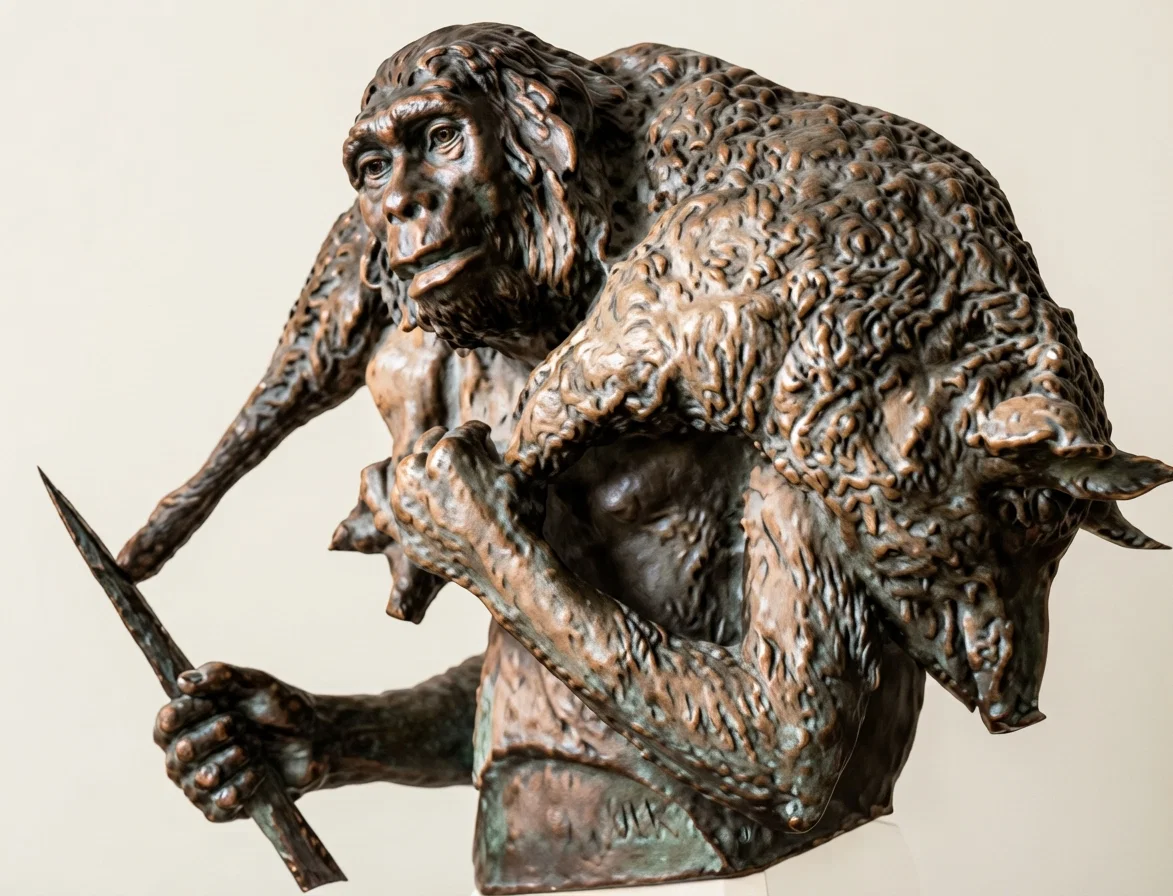
Restoration of the man of Heidelberg, by the Belgian artist Mascre, under the direction of Prof. A. Rutot, of Brussels.