Your ShelfYour Projects

Review and Herald, Vol. 88, No. 44.

A Song of Patience
Earlier text: GEO. B. THOMPSON

Extremes in Diet

In reviewing the special instruction which has come to Seventh-day Adventists regarding the principles of healthful living, one is impressed with its consistency. No extreme measures are advocated. Repeated instruction is given to take a sensible, consistent course in the choice and use of food products. Under the above heading, Mrs. E. G. White, in “Testimonies for the Church,” Vol. IX, pages 161-163, speaks as follows:—
Some of our people, while conscientiously abstaining from eating improper foods, neglect to supply themselves with the elements necessary for the sustenance of the body. Those who take an extreme view of health reform are in danger of preparing tasteless dishes, making them so insipid that they are not satisfying. Food should be prepared in such a way that it will be appetizing as well as nourishing. It should not be robbed of that which the system needs. I use some salt, and always have, because salt, instead of being deleterious, is actually essential for the blood. Vegetables should be made palatable with a little milk or cream, or something equivalent.
While warnings have been given regarding the dangers of disease through butter, and the evil of the free use of eggs by small children, yet we should not consider it a violation of principle to use eggs from hens that are well cared for and suitably fed. Eggs contain properties that are remedial agencies in counteracting certain poisons.
Some, in abstaining from milk, eggs, and butter, have failed to supply the system with proper nourishment, and as a consequence have become weak and unable to work. Thus health reform is brought into disrepute. The work that we have tried to build up solidly is confused with strange things that God has not required, and the energies of the church are crippled. But God will interfere to prevent the results of these too strenuous ideas. The gospel is to harmonize the sinful race. It is to bring the rich and poor together at the feet of Jesus.
The time will come when we may have to discard some of the articles of diet we now use, such as milk and cream and eggs; but it is not necessary to bring upon ourselves perplexity by premature and extreme restrictions. Wait until the circumstances demand it, and the Lord prepares the way for it.
Those who would be successful in proclaiming the principles of health reform must make the Word of God their guide and counselor. Only as the teachers of health reform principles do this, can they stand on vantage-ground. Let us never bear a testimony against health reform by failing to use wholesome, palatable food in place of the harmful articles of diet that we have discarded. Do not in any way encourage an appetite for stimulants. Eat only plain, simple, wholesome food, and thank God constantly for the principles of health reform. In all things be true and upright, and you will gain precious victories.
These principles must commend themselves to every reader. Let each study them for himself, and not for his brother.
F. M. W.

A Challenge to Seventh-day Adventists

J. L. SHAW
The great pagan cities of India, with their teeming multitudes of unwarned people, present a challenge to the faith of Seventh-day Adventists to-day. Into thousands of these strongholds of idolatry nothing more than one or two of our tracts, a paper, or a few books in the English language have found their way. Like brutes, deaf to God's message for this time, these people are hastening on to Christless graves.
For eight years and more the mighty city of Madras has been making its appeal for help to our people. Six years ago when we visited this populous and influential center of south India, our hearts were burdened with its silent cry of need, and we decided to send an appeal to the Mission Board and believers in the home land. Any lover of present truth seeing this city, with its beautiful parks, its wide extended area, many beautiful buildings, and hundreds of thousands of people going to and fro upon its streets, can but cry out for help. It is marvelous how these people have gotten hold of the English language. Everywhere we found people able to understand and speak English. We remarked at the time, “What an argument for help is this foremost Anglo-Saxon city of India!” No message of the Lord's soon coming has yet been borne by us within its borders. Lovers of the faith must know about it; and with what knowledge we had, the need was presented through our papers.
Four years passed by, and again we found ourselves at the home of a Seventh-day Adventist sister in Madras, the only representative of our people in the city. She had accepted the truth in Calcutta, and had come one thousand miles south to bear her witness for it. She told us of people who wanted to know more of the truth, and urgently entreated us for help, and wished us to promise to have a minister sent out provided she could raise money from interested friends for his transportation. Her petition for help for Madras was entered at the last General Conference, but no help has come, and now a lone canvasser in repeated letters continues the unanswered Macedonian call for help.
In Calcutta, the largest city in India, with a population of over a million, we have a small English church. For four years there has been no minister to continue the good work begun several years before. At the time of the last General Conference so great was the need of the English work in Calcutta, and so urgently did the little English church there press its claim for a minister for that city, that it appeared to us the most urgent and immediate call in the entire mission field. The call was therefore registered, and the Mission Board has made frequent and earnest efforts to find a man, and yet no one has been found.
The number of people who can be reached through the English language in India is continually increasing. The large cities are great centers of English thought and training, and yet our force of ministerial help for English work is depleted. There is no minister to proclaim the advent message to English-speaking audiences. In these cities and in all this land, with millions of people knowing English and able to help support our vernacular work, there is not one minister preaching the message in the English language. We ask with all earnestness, Is not such a condition a matter of concern to our ministers and our believers in other lands? It appeals to us as a very challenge to our faith. Are there not God-fearing ministers in more favored places at home who will respond to the need for English work in India?

New Guinea Mission

S. W. CARR
DURING the past year New Guinea has been brought prominently before the world through its mines and commercial interests. While there were but twelve women and less than one hundred men in Port Moresby and its vicinity on our arrival three years ago, the latest census shows the present population to be fifty-three women and three hundred men. The rubber boom is now over, and although there are quite a number of new faces, the departures equal if not exceed the arrivals.
Our mission is now becoming firmly established, and better known among both Europeans and natives. Several members of the federal parliament recently visited Bisiatabu, and expressed appreciation of what they saw.
A church was organized in July by Pastor J. E. Fulton, while on his way to the Indies; and when expected letters of transfer arrive, it will have a membership of seven. We are sorry it was necessary for Brother and Sister W. J. Smith to leave in January, but we are looking forward to the arrival of Brother Lawson, who was appointed to New Guinea at the last session of the Australasian Union Conference.
Through the liberality of our Sabbath-schools, money was donated to erect a small house in Port Moresby, and at the union conference it was decided that £400 be devoted to the building of a permanent mission house at Bisiatabu. The General Conference has since decided to bear the cost of this home out of the $300,000 Fund. How the message does make us one the wide world over!
We are glad to welcome Brother F. L. Chaney to Papua, to supervise the erection of these buildings, thus relieving the local workers of much anxiety and labor, at the same time giving them a valuable training in the work of building. This short experience gained in the mission field itself will, we believe, be a great help to Brother and Sister Chaney in all their future work.
The Port Moresby house has been completed and dedicated, and the trees at Bisiatabu are being prepared by ax, adz, and pit-saw for service in the house here. Application was made during the year to the authorities to have this property transferred to the Australasian Conference Association, but no reply has yet been received.
The total tithe and Sabbath-school and other offerings received amount to £53. We are glad, too, that the Motu tribe is soon to have part of the message in tract form in their own language.
We feel to praise God for the good degree of health enjoyed by the present mission family during the year. Among the European population there has been a heavy mortality, and many have had to leave Papua because of ill health.
The mission horses and mules have proved themselves most useful and a means of economy, and it is remarkable that there has been no damage to any goods in transit from Port Moresby to Bisiatabu by either breakage or rain.
Being absent in Australia attending the union conference, and subsequently busy with the building work, I have not been able to visit the distant island villages; but one of our native workers made a successful trip in January, and several from these tribes have visited Bisiatabu during the year, staying for days and sometimes weeks, working and becoming acquainted with the misineri taudia (missionaries), and with the truths they teach and try to practise.
Nine boys have been regularly employed, and daily instructed in Bible and singing, and recently in elementary reading and writing also. We thank God that something has been accomplished for them. One boy now conducts their evening worship. We hope he will be willing to remain with us another year, to become more fully instructed in the way, and better prepared to teach others. Six of the boys have now returned to their homes, their time of labor having expired, but we trust that the impressions received while here will be lasting, and that results will be seen in eternity.
While the work does apparently go slowly, let us remember the pit whence these poor people have been digged. Seeing their ignorance, darkness, and sin, it would seem hardly possible for them to comprehend the things of God. But their souls are precious in his sight.
"The chain that has been let down from the throne of God is long enough to reach the lowest depths. Christ is able to lift the most sinful out of the pit of degradation, and to place them where they will be acknowledged as the children of God, heirs with Christ to an immortal inheritance. Under the ministration of the Holy Spirit, the stupidity that makes their uplifting appear so hopeless will pass away. The dull, clouded mind will awake. The slaves of sin will be set free. Spiritual life will revive and strengthen. Vice will disappear, and ignorance will be overcome."

The Spirit of the Mob

The claim that this is a Christian nation, loses much of its significance in the light of the spirit which has dominated entire communities in different parts of the country during the last few weeks. In Pennsylvania with its traditional Northern conservatism, in Oklahoma with its claims of freedom and justice, as well as in the Southland, men and women have laid aside every feeling of humanity, and have vied with one another in their efforts to inflict punishment upon a poor unfortunate, though doubtless guilty, fellow being.
Now comes a ghoulish story from Georgia that tells of the death of an aviator, and how the people fought and struggled to obtain some relic of the accident. The presence of death was not sufficient to sober their judgment, the spirit of morbid curiosity controlled every other feeling, and the desire for a keepsake of the ghastly accident was uppermost in their minds. According to press accounts even the things worn by the aviator were fought over before life was extinct in the body. Such things are indeed revolting, and they indicate the spirit of the times upon which we have entered, and the scenes which will be enacted on this earth many times.
It is in the midst of such scenes as these that God is seeking to bring out a people who will know his peace, who will be so guided by his Spirit that their impulses and emotions will be brought under its control. For this keeping power let us devoutly pray; and that others may share it with us, let us earnestly labor.

Among the Indians

F. A. STAHL
We expect to move to Chucuito about July 3. We shall not take much furniture with us, for as yet we have no house in which to live. For the present, we shall live in an extra room that Brother Camacho has. Some land has been purchased, and we hope to have the buildings up soon,—a small house for the mission family, a small dispensary, and a tambo, or place where the Indian traveler may stop overnight. A school building will come later. Until then, we shall use the school building on Brother Camacho’s place.
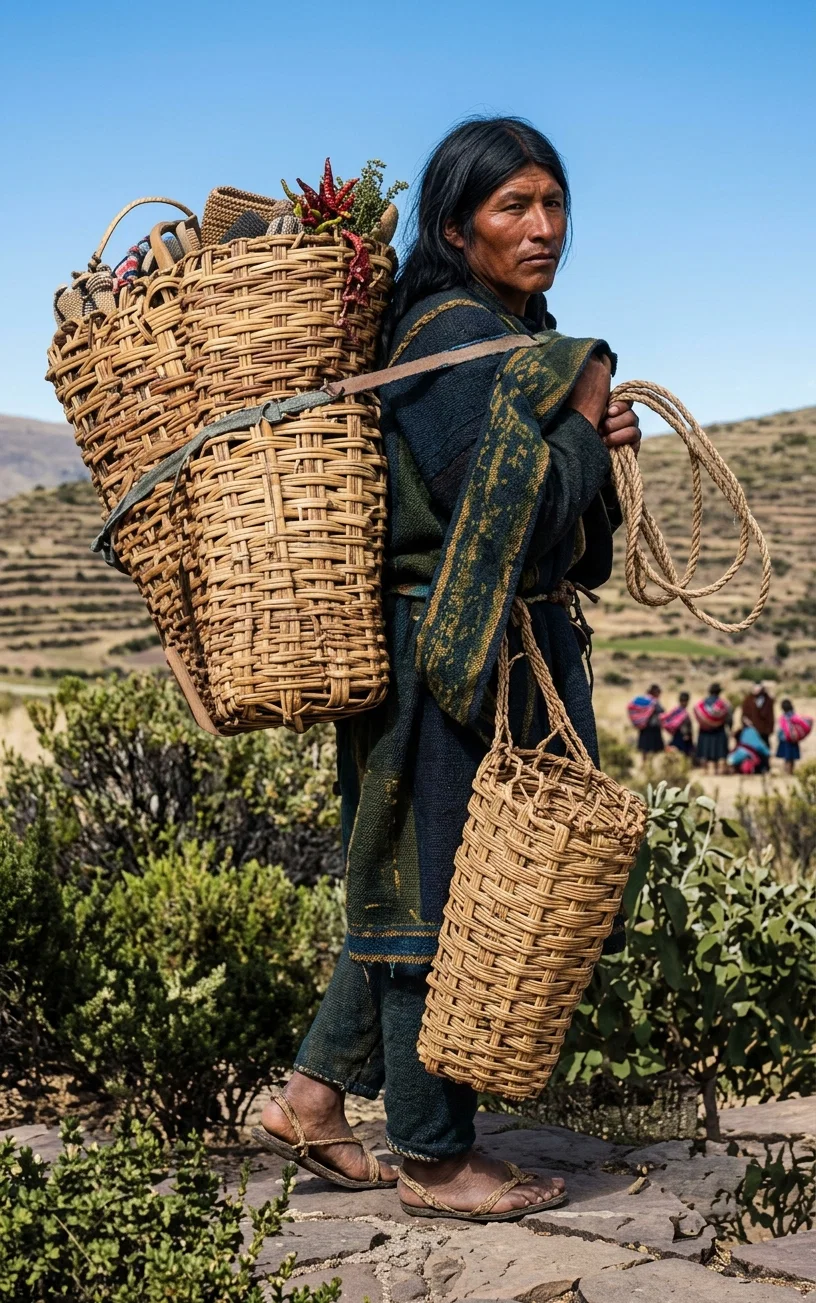
AN INDIAN CARRIER
AN INDIAN CARRIER
We do not want to put much means into one place, as there are other localities where a work of the same kind must soon be begun. While we were with the Indians this last time, a man came to us and offered a place for the same kind of work on his farm, some thirty miles nearer La Paz. There are over five hundred thousand of these Aymara Indians, and millions of the Quichuas, and we must lay our plans to reach them all with the gospel of good tidings.
If we ever decide to have a really large institution,—industrial school and sanitarium,—then the Yungas, the great garden of Bolivia, would be the place, as the land is very rich, and the climate fine.
The Indians in the Yungas differ in appearance from the high-altitude Indians, being of slender build, with sharp features; while the high-altitude Indians are thick-set, with broad face; but the language is the same. However, for the present it seems to us better to keep right out among the people, and do without large institutions, which involve much means, and tie up workers who could be out in the field.
I intend to leave my address with some of the most prominent people of Bolivia. In this way I may get a case of nursing here and there, which will serve to maintain the influence that has already been gained. Our trust is in the great God. He will prosper the work if we are only obedient.
La Paz, Bolivia.

S. M. KONIGMACHER

Nyassaland

S. M. KONIGMACHER

On my return from visiting our out-schools, I found a letter from Brother M. C. Sturdevant, asking me to send him two bricklayers to assist him in building their home. I immediately got on my bicycle and rode fifty miles to try to find the men, as we had none on the station at the time. I found them, and made necessary arrangements for their release, and, in a few days, they were ready for their long journey. So you see the world is not so large after all, when we in the heart of Africa can assist our brethren on another station. This is especially significant as it shows how the message is spreading. Then, too, the great desire of the native to learn is marvelous. Our out-schools have increased to forty-two, our native teachers and assistants to eighty. These schools are spread over a large territory. We have just found two new sites on the way to Brother Sturdevant’s mission.
Our creamery is doing well. The white workers have had exceptionally good health this year. Our crops, especially the cotton, are not very good, on account of the late rains.

A Mohammedan's Testimony

HERE is the testimony of a Mohammedan, Ibrahim al Khalil, who has found Christ in the third angel's message. He writes from Sohaj, Upper Egypt, as follows:—
“I am from the district of Mardin, in Mesopotamia. I spent the last twenty years in Lebanon and Beirut. About four years ago I learned about the third angel’s message, preaching it since five months, remembering, ‘Be thou faithful’ (Rev. 2:10) ‘in . . . least . . . also in much’ (Luke 16:10), and ‘that which ye have already hold fast till I come’ (Rev. 2:25), believing that ‘this generation shall not pass, till all these things be fulfilled’ (Matt. 24:34).”

Life More Abundant

FLORENCE WELTY MERRELL
I AM waiting before thee, my Saviour, I am seeking thy mind to receive. I am asking for life more abundant, Which is promised to all who believe. Thou knowest the absolute weakness That I would exchange for thy young strength. Thou knowest the life sin has shortened; Give me life unmeasured by length. O, give of thy fulness, my Helper! It can not impoverish thee. Give the love, joy, and peace of thy Spirit, Meekness, patience, and wisdom to me. And then if the earth is my mother, And I but a child of the dust, I can lovingly call thee my Father, And in thy great love place my trust. Boulder, Colo.

Retrogression, or Over the Devil’s Slide

FLORENCE WELTY MERRELL
Two women who were seeking to soothe weary nerves and regain lost energy and health were spending a few weeks at a watering-place on the Pacific Coast. After many places of interest had been visited, one day when wondering if they had seen all that was worth while, it occurred to them that there was one beach near by that should not be missed in their round of long, delightful strolls; so one morning they started, lunch basket and reading-matter in hand.
The objective point at this time was a wonderful ocean cave, not accessible except at low tide. To reach it and the ocean bed, which was exposed to view for a block from shore, they must go by way of the Devil’s Slide. This slide, a precipitous ocean cliff, was made passable by a series of long stairways. After the women had safely reached the bottom of these, they found themselves in a new world, interesting in the extreme.
The younger of the two was suitably dressed for the occasion, and was in the right mood to enjoy the rare sights which mother nature had lavishly displayed around them. But not so with the other woman; a different aspect of their surroundings appealed to her. There were slippery rocks grown over with seaweeds and long grasses; there were broad stretches of solid rock washed into sink-holes with crevices, over which one must step cautiously to keep dry-shod. She was already tired, and her feet were aching because of the uncomfortable shoes she had worn. Then, too, had not a tourist recently, in that very place, had a fall that resulted in a fractured bone? “It is too aggravating to think that I did not stay at home,” she said. “I should have known better,” etc.
For a few minutes the spirits of the two women clashed. The elder found fault with herself for coming; and the younger, who had been so happy, and just in her “element,” as the girls would say, censured her friend for complaining on such an otherwise perfect day.
The little gale blew over, but the consciousness of a lapse from their high standard of Christian living did not, thanks to the faithful Teacher ever by the Christian’s side; and as they slowly and wearily climbed back over the long, hard road to their cottage by the sea, that sweet sense of God’s approving smile and of a day without a regret was sadly lacking. Not much was said about it until the sacred hour for worship, and then the conviction came with such force as to compel a humble confession.
Were they not praying every hour of every day to be led by the Spirit of the Master? Were they not seeking to be always prompted by the best and purest motives? What did it all mean—this sudden revelation of an unsubdued spirit? How could it be that after many hours together in earnest prayer and Bible study, they should have this exhibition of unconquered human nature? They could not have believed that so trifling a circumstance could cause them such annoyance and sorrow. Then it occurred to them what it all meant.
They had been permitted to go down the “devil’s slide” to teach them a valuable lesson, and there, at the altar of prayer, it was all explained. The one had slipped on the rocks of murmuring, complaining, and unrest, instead of exercising forethought, and then enjoying the glories of the day; the other had failed as manifestly in uncharitable criticism, instead of pouring oil on the turbulent waters, thus soothing the agitated spirit.
Through the crucifixion of self, by tears of penitence and humble acknowledgment, they obtained forgiveness at the foot of the cross. They realized that the old man, the Adamic nature, must be crucified, and saw a deeper meaning in the words: “Buried with Him in baptism, wherein also ye are risen with him” (Col. 2:12), and together they sought the experience of conscious walking with the risen Christ. “If ye then be risen with Christ, seek those things which are above” (Col. 3:1); “that like as Christ was raised up from the dead by the glory of the Father, even so we also should walk in newness of life” (Rom. 6:4).
Satan may then rattle the dead man’s bones, as he slyly presents the temptation to return to the old ways of thinking and acting; but since he finds there no affinity for former conditions, and hence no response from the new being, he has to turn away in utter defeat; he is conquered.
As the two companions arose from that sweet communion, where, sitting at the feet of Jesus, they had been taught as never man taught, the peace of God filled their hearts. But the lesson was not completed until the next morning, when, while it was yet dark, one of them said: “He wakeneth morning by morning, he wakeneth mine ear to hear as the learned,” and out of the thick darkness came the still, small voice saying, “Count yourself dead.”
“How grateful we are!” they said. “When temptations come, we are to count ourselves dead, dead to the voice of the enemy, dead to all the vexing things that are flaunted in our very faces.”
“Reckon ye also yourselves to be dead indeed unto sin, but alive unto God.” “Count it all joy when ye fall into divers temptations.” And this course, followed in faith, will result in victory every time. “As ye have therefore received Christ Jesus the Lord, so walk ye in him.”
Boulder, Colo.

A Work for Our Sisters

MRS. IZA E. CLEMENT
It is said that “man's extremity is God's opportunity,” and those whose eyes are “anointed with the heavenly eye-salve” can see that the world's extremity is the opportunity of God's people; and the men and women who are seizing and improving these opportunities have most favorable and interesting reports to render.
The great temperance wave which is just now sweeping over the land affords a wonderful, and it may be the last, great chance for the enlightenment of many on the mighty truths of God's Word, and especially on the principles of religious liberty, a work of the utmost importance just at this crisis.
While the principles of total abstinence should be and are being defended and heralded from the desk by our leading brethren, still it is to our sisters that present-day opportunities direct their most heart-searching appeal, and vouchsafe their most brilliant promises. “Women may take their places in the work at this crisis, and the Lord will work through them. If they are imbued with a sense of their duty, and labor under the influence of the Spirit of God, they will have just the self-possession required for this time. The Saviour will reflect upon these self-sacrificing women the light of his countenance, and this will give them a power which will exceed that of men. . . . They can come close to the hearts of those whom men can not reach. Their labor is needed!” —“Testimonies for the Church,” Vol. VI, pages 117, 118.
The W. C. T. U., that mighty host of reformers and leaders in temperance work, the cream of all the popular churches, but unfortunately an ally of the National Reform Party, invites the cooperation of our sisters in suppressing that deadly evil, the rum traffic; and it is here that they may do a great work for God in presenting to these women the truths of the last message, and in making clear to them the true relation of Sunday laws to the principles of liberty as taught by the Word of God, enjoined by the Saviour, and enunciated by the Declaration of Independence.
Our brethren have contended nobly on the floors of legislative and assembly halls against the passage of Sunday laws; but the movement grows apace, and now the call comes from within and without our ranks for the assistance of our sisters. “Their labor is needed.”
Mrs. E. M. Stevens, temperance secretary of the College View church, has met with good success by undertaking a small work along this line.
April 29, 1911, she gave a temperance program which lasted about one and one-half hours, in the college chapel at College View. It consisted of readings, speeches, quartets, and solos, besides the leading feature, which was a most impressive discussion between twelve boys from fourteen to sixteen years of age, in which Uncle Sam gave the decision, sweeping the liquor traffic from the land.
This discussion was compiled from the utterances of the foremost orators and temperance workers in the world, and was so cleverly arranged as to appear like one great whole, and to make a most impressive appeal to all who heard it.
It was reported in the papers, and so interested the W. C. T. U. women of Lincoln that they requested that it be reproduced at Havelock, a suburb of Lincoln where temperance work was sadly needed.
This request was complied with, and on June 6 it was repeated there with the same success, and with complimentary notice from both College View and Lincoln papers.
Later, Mrs. Stevens was called upon to present the program at another church in Lincoln, which she did. The W. C. T. U. women of Lincoln and its vicinity were delighted with the work, and attended the next temperance program which Mrs. Stevens gave in the College View church, and they expressed great surprise when they learned that six hundred thirty-five persons signed the pledge that evening before the program was finished. Through this work, the way was opened for Bible readings with some of the leading workers of the organization.
Not only has Mrs. Stevens been requested to repeat her programs in Lincoln and surrounding suburbs, but requests for them have come from other States, attesting to their merits as temperance educators, and as potent factors in the development of character and talent in the youth who take part in their presentation. Thus they fulfil a threefold purpose,—strengthening the hearts and hands of the temperance workers; bringing them in contact with the third angel's message; and encouraging our youth and instructing them in these mighty principles of righteousness and truth.
This experience made youthful orators of no mean ability of the boys, some of whom had never before appeared in public. President Garfield used to say, “I always feel like taking off my hat to the possibilities in every boy I meet.” There are possibilities in every normal boy and girl in the world. All they need is development.
“Will our sisters arise to the emergency? Will they work for the Master?”
Any one desiring an outline of the discussion will be supplied with it by addressing, with stamp, Mrs. E. M. Stevens, College View, Neb.
College View, Neb.

Geniality

THE preacher said there is no place in heaven for sour people; nor is there really any place on earth, but there are some people who too often insist upon occupying such a place. They would not, if they knew how little they were liked. A person may show sorrow, and feel the pressure of a gloom upon his heart; but to be sour, crabbed, ill-natured, is to express a phase of disposition that is extremely disagreeable, if not disgusting.
To be sour is to find fault with everybody except one’s self. It is the worst side of egoism. It is being mad at the world. Nobody enjoys being that way. It is punishing one’s self in order to evoke sympathy, but it never works. Nobody cares for a sour person. One feels more like punishing him, if it were lawful to do so.
The opposite of this spleenful condition of soul is sweetness of disposition—a kindly temper turned toward the world. Such a disposition is worth a ton of gold. A man can do more business with it, make more friends, create more happiness, and insure happier homes than he can with almost any other grace. The genial man is always welcome. He is like a flower, a streak of sunshine, the song of a bird—he is in harmony with the beauty and joy of all things.
There was one time a sour man who resolved not to be sour that day. In everything he was agreeable and cheery. It was then he discovered a new world, a world that he never knew existed, where everybody was good and kind; where he met a smile, wherever he turned, and heard music in the voices of all about him. Surely the preacher was right—there are no sour people in heaven; nor on earth if heaven is there.
— Ohio State Journal.

Prosperity and Health

“BELOVED, I pray that in all things thou mayest prosper and be in health, even as thy soul prospereth.”

Sowing to the Flesh and Spirit

“Be not deceived; God is not mocked: for whatsoever a man soweth, that shall he also reap. For he that soweth to his flesh shall of the flesh reap corruption; but he that soweth to the Spirit shall of the Spirit reap life everlasting.”

The Better Way Through Example

“It is always better to help others to criticize themselves than it is to criticize them. They will believe in themselves; they are not likely to believe you. The way to bring about this healthy and helpful condition of self-criticism, with its accompanying desire for improvement, is to show by our lives, silently, the better way, while resolutely refraining from urging it on others. It was a high tribute paid to a Christian man, who is not now living, when one who had known him intimately said: ‘He never told me that I ought to do better, but I always came away from any conversation with him wanting to do better.’ If we would do this for others, let us seal our lips to criticism, and incarnate the better way in our lives.”

Every Day in the Week

THERE is a kind of domestic affection which is like a mountain stream—full to overflowing in the spring, and dry as dust in the summer. It is in contrast with the steady current of the river, fed from deep-hidden sources and good for all seasons of the year.
Of course there is something to be said in favor of each kind of devotion. “You shall tell me just what you prefer,” said a young husband to his wife. “Shall I bring you a rose every day, or two dozen roses once a month?” The little wife was actually puzzled by the question, and begged for time to consider it. Whatever decision the girl of twenty arrived at, one may guess that a woman of mature age would choose the priceless every-day-in-the-week flower.
The steady temper of mind which remembers little services and regards the small requests and minor tastes of members of the family makes for joy in the household. By the same token, the generous, heedless man or woman makes large demands on patience and loyalty.
“John is the best of husbands,” said his wife, “though it took me five years to get used to his virtues coming always like liquid from a narrow-necked bottle—steady by jerks. But it is a comfort to be sure that his nature is a large bottle, and full to the top.”
A little company of women were sounding the praises of their forebears. The grandfather of one of them had fought bravely in two wars. The great-uncle of another had taken two hundred passengers safely from a sinking vessel. One old lady was proud of her father’s victorious conflict with a pack of wolves on a Russian steppe. But a climax was reached when one young girl said: “My grandmother told me that she lived with my grandfather almost fifty years, and never had to remind him once that her kindling-wood basket was empty.”—Youth’s Companion.

We Shall Know Each Other

L. D. SANTEE
“But then shall I know even as also I am known.” 1 Cor. 13:12.
THERE is a thought that banishes my sadness When all the busy cares of day have fled, That all the resurrected friends in gladness, Called from the silence of their dusty beds, Will be the same when I again behold them, The same when I shall greet them by and by, The same when once again my arms enfold them, And with them journey to the home on high;
That in the wondrous change to the immortal, They are not lost to those that held them dear; But after we have passed through heaven’s portal, We’ll know them there as we have known them here,— The same fond eyes, though void of every sorrow; The same true heart, though free from every pain. My spirit thrills that on some glorious morrow, My loved ones I shall recognize again.
God will not take the ones who’ll walk in glory, And make them strangers in the world above; ’T would dim the sweetness of the wondrous story Did we not know the friends that here we love. But when we’re fashioned like unto the angels, And worship at Jehovah’s shining throne, We’ll raise a loud, a thrilling, sweet evangel, To feel that there we’ll know as we are known.
Moline, Ill.

G. W. ANGLEBARGER

Colorado

· DENVER.—At the close of our camp-meeting in Rocky Mountain Lake Park, Denver, August 17-27, quite a number of the neighbors and people in the city not of our faith expressed a deep interest in the truths they had heard, and wanted to hear further. In response to this request the conference committee asked Elder H. M. J. Richards, Brother Roy Hay, and myself to erect a tent just a little outside of the park, and continue the work. We have done this, and are glad to report that the Lord has greatly blessed in this effort. A good part of the time our tent has been well filled with interested hearers. We have two stoves in the tent, and the meetings are still in progress, having already continued over five weeks. Up to the present time about fifteen souls have taken their stand for the truth, among them an aged lady who is in her eighty-fourth year. She has been in the Christian race for many years, having had a part in the 1844 movement. At the close of a sermon on “The Seal of God and the Mark of the Beast,” when a request was made for those who believed the truths presented and who were willing to obey God and receive his seal, this elderly saint, with many others, held up her hand. As she raised her hand, she said with an earnest voice, “Lord, it has come to this.” We are hoping that many more will take their stand with us.

G. W. ANGLEBARGER

California and Utah

My last report was made August 6. Since that date I have been privileged to attend a few meetings with our people. From August 10 to 20 I was in the camp-meeting at Long Beach, Cal. Of this camp-meeting Brother W. C. White has made a report. There was one item in his report which I wish to notice. He spoke of the ready disposal of the five-dollar and one-dollar packages of tracts. The amount sold was about half as much as the whole stock of tracts and pamphlets in the Review Office in the spring of 1854.
In those days our tracts and pamphlets were first printed in the REVIEW, and then the type was made up into pages the same width as the REVIEW column, and an edition of 1,000 each, printed. The number in stock in the spring of 1854 was 2,000 pamphlets, and 3,000 tracts of 32 pages each. One pamphlet was “The Sanctuary,” 80 pages, by Elder J. N. Andrews. The other pamphlet was “The Two-Horned Beast,” 65 pages, by the writer. The three thirty-two-page tracts were by Elder J. N. Andrews, and their titles were: “Seven Reasons for Sunday-Keeping Examined,” “The Seventh-Day Sabbath,” and “The History of the Sabbath.” The latter has grown to a book of 548 pages.
In July, 1854, a tent-meeting was held in Shelby, Mich., on three Sabbaths and Sundays. In that series of meetings about thirty persons accepted the truth. On the three Sundays I made the first effort of our people to sell books to the public. The pamphlets were 10 cents each, the tracts 5 cents each; one of each, 35 cents. On those three Sundays I sold fifty dollars’ worth. Elder James White said, “Now we can do much more in getting our books to the people, for they will buy the books.” Before that the books and tracts were given away, and paid for by donations from our people.
While the brethren at Long Beach were talking up the sale of the tracts on the stand, and making an estimate that the pile was about half as much as the whole Review Office stock in 1854, in about fifteen minutes, and before I had a chance to report, the tracts were all sold, and the call was for more.
From Long Beach I went to Loma Linda, spending three days there. I spoke to a well-filled chapel on the Sabbath day. I was pleased to see the improvements in buildings and grounds that have been made since my last visit there, some fifteen months before.
From August 29 to September 6, I was with our people in the yearly meeting at Salt Lake City, Utah. It was pleasing to see the unity and good will of our people and the laborers, in this meeting. They are full of courage and confidence in the prosperity of the cause, as they unitedly press forward in the strength of Israel’s God. The tent-meeting, being conducted in Salt Lake, is the best attended of any effort made there.
Accompanied by Brother D. A. Parsons, we held a meeting on the evening of September 7, at Ogden, and on the 8th and 9th at Logan, with a company of Sabbath-keepers who did not have the privilege of attending the conference. The Lord blessed in speaking to the Utah people on the subject of his leading in this last, glorious third angel’s message.
J. N. LOUGHBOROUGH.
Continue reading: Burma, India