The literature on conditional immortality has just received a very valuable contribution in the publication of the first volume of a work entitled “The Problem of Immortality.” The author, Rev. E. Petavel-Olliff, D. D., of Geneva, now in Lausanne, Switzerland, is the well-known and learned champion of the doctrine of conditional immortality in Central Europe, but particularly among the French-speaking nationalities. This work, which is the result of the author’s extensive research and studies for the last twenty years, is evidently called to fill an important mission in the progress of Bible truth, especially among the cultivated classes. The author is confident, and well may be, that the diffusion of the doctrine of conditional immortality and annihilation, in the place of that of everlasting torture, is calculated to bring back to the pure gospel a large number of minds that the traditional dogma has alienated thereto.
My design in this article is not to give a review of this book. I simply wish here to translate from the first chapter of said work a few testimonies showing that many minds in France are turning toward religion, and that this would seem to be a favorable time to present before this nation a gospel pure from the adulterations which have made it loathsome to thousands and thousands of honest thinkers.
A well-known French poet, Mr. Francis Coppée, member of the French Academy, who had thus far in his writings paid little attention to religious questions, has recently published a poem which betrays anxious thought in that direction. The author tells how on one evening he visited in succession a socialist meeting and a Catholic church, and he was more indignant at the priest’s sermon than at the tirade of the communistic orator. Alas! the priest preached quite a Calvinistic doctrine, which goes back to Augustine. To the ransomed, he promised—
A distant paradise of fameless name,
To all others, a God of love and mercy,
Pitiless of human weakness, and ever angry
At one single mistake, held in reserve
An everlasting, monstrous doom of pain,
A horrid, senseless hell.
The poet concludes thus:—
I left the church with greater sadness still.
The stars were glittering above in splendor.
With inexpressible distress I looked
At the billions of those inhabited stars
Sending down to me their silvery rays.
Alas! alas! in these few short moments
I had witnessed both instinct and reason
In their wanderings, and sensed
The old despair of human thought.
Where are both law and faith divine?
What shall I hope and think and know?
No answer comes my hopeless soul to soothe;
Reason is bruised against its prison walls;
Justice is gone from this sad world.
Must man indeed be either slave or mutineer?
What first we take for truth is like
These fruits of beauty near the sea where Sodom lay,
Which, when tasted, are full of ashes black and gall;
The mind is like a ship,
And doubt is like a sea of endless depth.
Sad unto death before this glorious,
Starry heaven, I asked the silent Sphinx
If thus it was in all the stars.
The plaintive cry of the poet found the following echo in the article of a Paris journalist:—
We have no more chapel to bow down in, no more faith to hold us up, no more God to pray to. Our heart is empty. Our soul is longing for ideal and hope.
O you that are so happy as to believe in a sovereign Master, do beseech him to reveal himself to us; for we long to suffer and die for a belief and an idea.
Mr. Emile Faguet, one of the most eminent among the young generation of critics, recognizes the fact that this century ends, as it began, by a notable revival of religious thought, “by a quite vigorous return to the Christian idea.” Says he:—
After a long journey through the darkness of night, light which had been given up forever, has again appeared; our eyes are being raised toward the blanching morn, and the most discouraged ones among us confess that they had been hungering and thirsting after faith and hope. Since Luther’s exclaiming, “What is righteousness, and how shall I get it?” this longing after faith, the most imperious of all, has sent forth toward heaven many eloquent words.
Mr. Melchior de Vogüé tells that recently in St. Petersburg, two good-looking young men entered one of the radostatic religious meetings, and addressing the speaker in the pitiful tones of medicants, they cried in anguish: “Make me believe! Make me believe!” Let me tell you they are innumerable among us at this very time, the young men who ask to be freed from their skepticism.
On the other hand, Mr. Jules Lemaitre, a writer of note but not a believer, had studied the causes of this psychological phenomenon; his conclusions, being unbiased, are well worthy of consideration:—
We are brought to this turn, I think, by the bankruptcy of analysis, by the feeling of emptiness left in us by these processes of thought, and the enormous number of unexplained things which they leave after them. For these or for other reasons, it does seem that a melting down of the human soul is just taking place at the end of this century, and that we shall soon witness—who knows?—a revival of the gospel.
And so may it be!
Loyalty to Christ as the Stimulus for Evangelism
By James Gall
—In every age and every land the greatest and most constraining stimulus to labor and sacrifice in the cause of evangelism, is loving loyalty to Christ, a sensitive concern for his honor, enthusiasm for the coming of his kingdom, and a determination that his will shall be done on earth, even as it is done in heaven. —Rev. James Gall.
Seeing Dangers Versus Seeing Gains in Service
—How easy it is to see dangers in the path of right-doing! If only we were as ready to see the gains, as we are to see the risks of God's service, we should be more prompt in good than we are.—S. S. Times.
HOW FRANC TOOK NOTES.
By Maud Rittenhouse
(Concluded.)
FRANC did not return until late in the afternoon. “Such a lovely time!” she exclaimed radiantly. “Dearest little lunch at Dr. Leland’s cottage, and a delicious afternoon on the water! I rowed two miles, and have developed, besides muscle, a hearty appetite for those fresh berries and Marion’s light muffins.”
Already she had dropped into a seat at the table, and was pushing back her light sleeves that they might not dip into the butter or cream. Marion, flushed from the kitchen fire, brought in the hot, crisp muffins.
“That’s right, little girl,” said Aunt Laura to Franc; “you need to be strong in a country where cooks are as scarce as ostriches. I suppose you and Marion take turns about in the kitchen? You look better able to stand your day than Marion does hers.”
Franc looked quickly at her sister. “Oh, it is only where studies are concerned that Marion is not strong,” she said. “See what roses she has in her cheeks. And she loves such work, Aunt Laura. I don’t. It really doesn’t seem to be my forte.”
Aunt Laura stifled the indignant words that rose to her lips, and replied quietly: “A passion for hard work in hot weather is rather unusual, is it not? Has Beth also this craving for dishwashing and dusting? She seems to have been pretty busy, too.” Franc’s face grew a degree warmer, though the words were cool and slow.
“Aunt Laura doesn’t understand the differences in our natures,” she thought. Aloud she replied, “I feel it a duty to do mental rather than manual training, auntie.”
Auntie said no more, but inwardly she resolved that her pretty little niece should receive new ideas as to her duty before she left Lake Mac Tenlar. Mother Bayliss, when questioned as to Franc’s share in the work, answered leniently: “Oh, Franc is young, you know; just fresh from her books, and naturally a little thoughtless, perhaps. It will all come right in time.” “Indeed it will,” was Aunt Laura’s inward comment, “if my interest in the matter avails anything.”
The next morning she met Franc as that young lady, tennis-racket in hand, was starting off toward Dr. Leland’s attractive cottage. “More mental training, Franc?” she asked, and Franc did have the grace to blush as she answered: “Oh, well, one must be strong before one is able to do much mental work. Tennis is splendid exercise. Don’t you think so, auntie?”
“That I do!” Aunt Laura answered, heartily, “but there is something I so much wish you to do for me, Franc, if you are willing to give up the tennis for one morning.”
“Why, certainly,” Franc answered, with the quick, bright smile that came so naturally to her. “I should be ashamed to be too selfish to deny myself a trifling pleasure to serve you.”
Aunt Laura looked rather taken aback for a moment, by the prompt frankness of the reply. “Surely it must be gross thoughtlessness and some honestly mistaken ideas that make her so selfish,” she decided, and immediately formed her plan of the “something” she wanted done, a something to open the eyes of the blind little girl. “It is an odd request I have to make, Franc, but I believe I can trust you to do what I want done, and that without question. I want you to make faithful note this morning of all that Marion does and says—even her expression, when it is possible to get it without attracting her attention.”
“Why, how funny?” Franc exclaimed, involuntarily; “but you always did do such funny things, Aunt Laura. Written notes? All right. I am equal to it. In our lecture courses everybody admitted that I could do the fastest note-taking.”
“It is eight o’clock now,” Aunt Laura said, “and of course we lose a good deal of time, as Marion got up at six. But begin now.”
So Franc, with pencil and note-book, the latter hidden in a volume of poetry, took an easy chair between the dining-room and kitchen tents, and prepared to do some quiet observing. Well, there wasn’t much that she hadn’t seen before at different times. First, Marion scraping plates and carrying loads of dishes from dining-room to kitchen. Franc began to count the number of times she walked back and forth—eleven, she found, with dishes—before she came with a broom to sweep out the big tent. After that she fed the old watch-dog, and, calling Beth, began to wash dishes. Mother Bayliss wasn’t about. “Strange she isn’t helping,” Franc thought, but, peeping farther into the dining-room, she discovered that busy little woman sprinkling and folding the clothes—“a perfect mountain of them,” Franc thought.
But back to Marion. She had to move her seat a little to see better into the kitchen, where Marion washed the piles of dishes and pans. It was rather tedious, mechanically counting the plates and platters, and the number of times she lifted the heavy kettle to scald a panful of crockery. So Franc began to watch her face instead.
She had never noticed its looking so tired before. It seemed quite white, only when flushed with some sudden exertion or heat; and now and then she pushed back the stray locks from her forehead, as though their soft brush pained her. Franc noted it all diligently while Marion straightened the wood-box, filled the kettle, called Lon to bring water from the lake, washed the table and dish-towels, and swept the floor.
“Now she’ll sit down and rest,” Franc thought. But she didn’t. She went to the big ice-chest just outside the dining-room screen, and began to remove butter jars, meat, and milk pans, preparatory to washing it out. It made Franc tired just to watch her bending over and lifting the great things, and she felt relieved when the hard task was done; but, after all, it didn’t seem to make much difference, for that finished there followed something else just as hard. “Goodness! To see her lifting that heavy ironing-board and dragging it across the dining-room!”
“Don’t begin the ironing yet, dearie,” Mother Bayliss called. “Shell the peas first; that will rest you.”
“But, mamma, Beth or Lon can shell the peas as well as I, while the ironing—well, you know there is a great deal of it, and it is better to get it done before the sun gets higher, and while there’s a breeze from the lake.”
So Beth took the basket of peas and went out to a hammock under the birch trees, while Marion began at the top of the huge basket of clothes.
“Dear me! I didn’t know I had three white skirts in the wash,” Franc soliloquized, with something like real remorse. “Such fussy ones, too!” While she watched Marion straightening out the flounces and the points of lace and embroidery, and pressing the hot iron over them, Aunt Laura passed with broom and dust-pan toward the bedroom tents.
“Isn’t it nice that Marion loves it so—all this sort of thing!” she said in the most innocent way to Franc, and that rosy little note-taker began to feel an odd sensation about the region of her heart.
Marion had finished the three skirts, and had begun a long night-dress, when suddenly, unconscious that other eyes were on her, she pressed her hot hand to her tired back, and, with a little cry of pain or exhaustion, sank into a chair near her. In another instant, hearing Mother Bayliss coming with a second ironing-board, she stood again quickly, and began a cheery little song, while she pressed hard upon the tucks in the dainty gown-yoke.
“If I ever wear anything but untrimmed muslin again!” Franc said under her breath. It was the hardest note-taking she had ever done. Nothing in Dr. Hague’s lecture-room could have compared with it. She counted up the articles Marion had ironed, and held her breath at the sum total. That cunning blouse, which she had worn boating with Stella Cassell! The pretty wrapper, in which she had lolled one long afternoon in the hammock! And Marion ironed on with aching back and throbbing head, until time to fry the fish, which Ed had caught and dressed for dinner. Before Marion and Mother Bayliss had finished getting “that dreadful dinner,” the mist about Franc’s eyes made the lines in her note-book dim; and though she held to her promise, heroically, and watched her sister and wrote her notes until high noon, when that time had come she rushed headlong to her own tent corner, and cried as only a contrite little sinner could.
Aunt Laura was not surprised that Franc was late to dinner. Neither was any one else. Franc was often too engrossed in book or pastime to be prompt. The surprise came afterward, when a gay little bevy called to take Franc sailing, and she gratefully but decisively declined going.
“I mean to take a new kind of exercise this afternoon,” she said. “When Sarah gets about again, or we find a culinary treasure in the city, Marion and I will be more than glad to join in all the frolics.”
“Marion and I!” Marion, back in the dining-room, listened amazed. She to be included in Franc’s frolics? A moment later her amazement knew no limit, when sturdy “student Franc” marched her by both shoulders out to the hammock, where pillows and books and a cool breeze from the lake tempted to quiet and repose.
“There, mistress Marion, you can’t do that entrancing work one minute longer! I’d marshal mamma out after you, only that I’m too green not to need an overseer. After this, though, you uncomplaining darling, we’ll see if we can’t do some new problems in division.”
Marion didn’t see how she could stay there and rest, with mamma and Franc and Beth at work, and she meant to slip back at the first possible chance; but she stretched her tired limbs in the hammock with a sigh of utter content, and five minutes later Franc, in her big apron, peeping around the side of the tent, saw her sound asleep, the fresh, sweet breeze stirring the hair about her face, and swaying the hammock as gently as it did the cobweb hammocks swinging in the grass.
“I never was so tired in my life,” Franc said to Aunt Laura that night, “nor so happy. That note-book meant to mirror Marion, mirrored me instead. It made me see myself as I never did before, as I hope I never shall again. O Aunt Laura, did you see the great monster of selfishness I saw to-day, while I took those notes?”
Aunt Laura smiled. “I saw a little Undine discovering her soul,” she answered enigmatically.
“Anyhow,” Franc said soberly, “funny as it is, I never took a sail that gave me half the pleasure I found in missing that one to-day.”
Aunt Laura was silent a moment, then she said, with her firm hand upon Franc’s newly blistered ones: “You are beginning to learn the sweetness of an old, old truth, and the more you study it, the richer and happier your life will grow. You have heard the old proverb, dear. You may prove it each day that you live. ‘He that resisteth pleasure crowneth his life.’ Are you willing to try?”
Though Franc could not speak for the choke in her throat, the tears in her brown eyes answered for her, and Aunt Laura was more than satisfied.
—Maud Rittenhouse, in Interior.
Every Day Is a Little Life
—Every day is a little life, and our whole life is but a day repeated. Those, therefore, that dare lose a day are dangerously prodigal; those that dare misspend it, desperate.—Bishop Hall.
Finding Happiness Day by Day
—Looking ahead for happiness in this world has been compared to “bottling sunshine for next year’s use.” Taking comfort as you go on is the only way to make sure of it.—Our Hope.
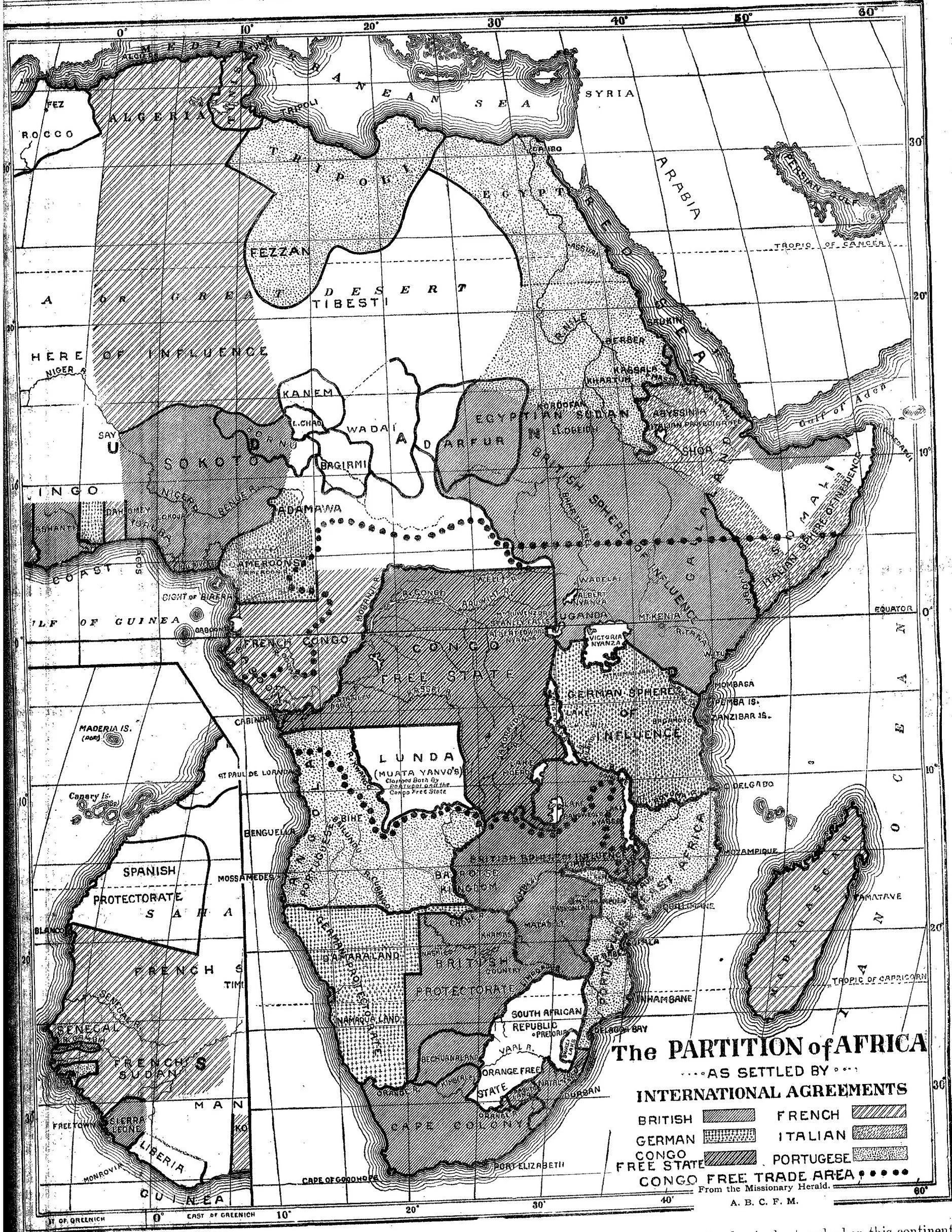
THE PARTITION OF AFRICA.
We give with this number a sketch map indicating the divisions of Africa as it has recently been parceled out by the European powers. Some boundaries are still unsettled. The Anglo-Portuguese Treaty has not been ratified, and just now a vigorous contest is progressing between England and Portugal in relation to the interior region, south of the Zambezi and west of Sofala, including Mashonaland and Manica.
In the whole of Africa there are 11,000,000 square miles of territory, of which only about two and a half million square miles remain unassigned to the protection of some foreign power. We find in the Mouvement Géographique some tables showing the extent of the present possessions of the various countries, including what are called their several “spheres of influence.” The following are the summaries in square miles:—
Portugal, 774,993. Congo Free State, 1,000,000.
Spain, 210,000. Italy, 360,000.
France, 2,300,248. Great Britain, 1,909,445.
Germany, 1,035,720.
Added to these are Egypt, Tripoli, Morocco, the Central States of the Soudan on the north, and the Orange Free State and Transvaal on the south.
The principal possessions of Portugal are Angola and Mozambique. France has Algeria, Tunis, Senegal and dependencies, the Sahara, and Western Soudan, part of the Gold Coast, Gaboon, and French Congo. Madagascar is also assigned to her, although her hold is by no means279complete. Germany has in Africa, in the Cameroons, 193,000 miles; in Damaraland, 385,000 miles; in East Africa, 450,000 miles. British Africa comprises her west coast colonies and the Niger, 445,000 miles; Cape Colony, Basuto, Zulu, and Bechuana lands, 500,000 miles; Natal, 21,000 miles; South Africa Company and Nyasaland, 500,000 miles; East Africa, 400,000 miles; Somali coast, 38,000 miles. It will be seen that France has the largest area, but much of her territory is desert, and, as the Mouvement Géographique says, “Every one will admit that, so far as value goes, England has no rival in Africa.”
May the day be hastened when this continent, thus divided up among the nations, shall acknowledge the sovereignty of Him who is King of kings!—Missionary Herald.
“THEY DIVIDED THE LAND.”
By P. T. M.
To the casual observer, it may appear that the partition of the African Continent among the European Powers is a political scheme, a mere matter of diplomacy, another step toward the making of the great greater, and the extermination of the weak. This is true so far as the Powers are concerned; but at the same time, the division of the realms of the savage hordes among civilized powers, is a most significant sign that the God of heaven is preparing to cut short his work in righteousness, and make a short work upon the earth. Nothing that has happened during the last decade in the political world, is of greater interest to the ambassadors of Christ than this.
Now, what possible relation can the division of a heathen continent among civilized powers sustain to the closing work of the gospel, to the evangelization of the world in the present generation? Let us go back in the history of missions. I desire to prove conclusively that prior to the year 1858, it was impossible for man to fulfill the command of God to preach the everlasting gospel to every nation, and kindred, and tongue, and people. But just as fast as man has realized his responsibility to fulfill that commission, nay, ten thousand times faster, God has opened the way so that the gospel heralds can proclaim their message of good tidings to earth’s remotest bounds.
Fifty years ago the prayer that ascended to heaven from the lips of every true follower of Christ, was, “Open the doors of the nations, O God, that the gospel may be preached to them.” It was not then, as now, “Lord, raise up faithful laborers, for the harvest-field is wide, and we cannot begin to fill the calls that come to us for help.” There were a few faithful souls who were ready to go, had there been any place to go to, and any way to get to it.
But how was it? Commencing in the Orient, at the “Sunrise Kingdom”—Japan—what could be done there? The Japanese had become so disgusted with the Christianity of the followers of Loyola—the Jesuits—who were the first missionaries to visit them, that in the sixteenth century the government set about to exterminate Christianity, root and branch. The Christians were massacred on every hand, and for years it was thought that there was not a follower of the God of heaven in all the realms of the Mikado. From the time of the aforesaid massacre and expulsion, Japan was hermetically sealed to the white man and his “devil religion.” To enter was to die.
We pass to China, the “Walled Kingdom,” on the soil of which no “foreign devil” dare put his foot, save at the risk of his head.
India was in the hands of the East India Company, whose officers would rather see the missionaries shut out, than open the doors to let them in. Well did these lovers of mammon, these men that would be rich, understand that the sunbeams of the gospel would pierce the clouded heathen mind, so that it would stand a fair chance in trade and everything else.
How was it with Africa? Her vast plains and forests, her mountains and vales, her lakes and rivers, were unexplored. True, David Livingstone had begun his work; but the results of it were not before the world as now.
The islands of the sea were inhabited by cannibals—no protection for missionaries there.
Look back now over these countries, and weigh the prospects of the gospel in any of them. Truly the picture was a disheartening one. No wonder the prayer arose to God, that he would “open the doors of the nations;” and well may the yearnings of the Christian hearts of those times and before, be expressed by the words of Xavier, immediately after his purpose to enter China had been frustrated, and his dearest hopes crushed to the ground: “O rock! rock! when wilt thou open to my Master?” But in 1858 the scene changes. Through the instrumentality of civil governments, God answered the prayers of would-be missionaries, and the doors of the nations were opened, so that the gospel, untrammeled by heathen laws to hinder its progress, could go to a thousand millions of the human race.
Hark to the voice of the Most High, and watch his stately steppings in what took place in 1858. I quote from a speech of A. T. Pierson’s:—
In that year, 1858, Great Britain, after 200 years of exclusion, made her treaty with Japan. In that same year China, by the treaty of Tientsin, threw open not only her ports, but her interior, and provided that any Chinese subject might embrace the Christian faith without molestation or persecution. In that same year India was transferred from the sordid East India Company to the British crown, and Victoria became empress of the Indies. In that same year the revolutionary changes in papal Europe laid the basis of Free Italy. In that same year David Livingstone sailed a second time for South Africa, to complete his pioneer path for missionaries. In that same year Benito Juarez, in Mexico, overthrew the monastic system, confiscated the estates and revenues of the papal church, and opened the way for Protestant missionaries to enter Central America. And in that same year Elizabeth Sale, of Helensburgh, Scotland, successfully penetrated the zenanas of Hindostan, and led the way in woman’s work for woman!
Was there ever such a year as 1858? Within less than twelve months, doors of approach were opened to from thirty to forty millions in Japan, three hundred to four hundred millions in China, two hundred and fifty to three hundred millions in India, including all her millions of women and girls.
O the wonderful power of God! Truly he has gone out miles before us in opening the way, and we are lagging in the rear.
What, then, has been accomplished for us in the partition of Africa? Just this: prior to the division of the land among the civilized powers of Europe, almost all over that great land, wherever he might go to labor, the missionary was at the mercy of the savage. Is it not so to-day?—No, a thousand times, no. Great Britain, Germany, France, or some other civilized power is responsible. Beneath their flags the gospeler can travel and labor in safety.
Formerly the Mohammedans overran large portions of Africa. They do so to-day, but their power is gone. Moslem rule meant the laws of the Koran; the laws of the Koran meant death to any and all who would dare to proselyte from the ranks of Islam. The Mohammedan may live in Africa yet, and practice his religion, but he may not do it to the injury of any other creed.
An exception to this rule may perhaps be found in the Turkish Protectorate. Turkey is a Mohammedan nation. For centuries she has possessed Tripoli, and has in no way benefited it. “Her tenure of Tripoli is a feeble one. Both France and Italy would like to appropriate the country, and one or the other will probably do so before long.”
Mohammedanism has not the hold it had some years ago. Said H. M. Stanley: “I will guarantee there will not be a Mohammedan south of the equator in the whole of Central Africa within five years from now.” Take the Mohammedans ruled over by the sultan of Turkey, by the shah of Persia, and by the khedive of Egypt, add them all together, and Queen Victoria rules over a greater number. Beneath her rule the missionary can work without molestation. This was not so a few years ago.
But what help will Roman Catholic powers like France and Portugal, who now own part of Africa, render to Protestant missionaries? Another question uproots this one—How strong is the hold of France and Portugal in Africa? France, as far as mileage is concerned, has a larger territory than any of the other Powers; but the most of it is worthless, uninhabited desert. As for Portugal, statesmen prophesy that her possession is only a temporary one. Refer to the map, and you will see that her lands are sandwiched in between those of Britain and Germany, or hard pressed by them on one side or the other. All this was planned by England and Germany, and it is probably only a matter of time till Portugal will be forced to surrender her rights to one or the other of these two nations.
From all of these facts we may conclude that the partition of Africa is as important an event in the nineteenth century conquests of Christianity, as was the dividing of Canaan among the hosts of Israel in the days of the “twelve tribes.”
The hand of God was in that division, and we believe we can see the hand of God in this one. Taking this as the basis of argument, what are our obligations as the true Israel of God? What was the former Israel told to do? “Thou shalt make no covenant with them.” But Israel did, and sad were the results. Her sons and daughters intermarried with the sons and daughters of heathen; together they offered up human sacrifices, and joined in all manner of heathen and ungodly wickedness, defiling the image of God, and obliterating as far as in their power lay, the sacred truths committed to them.
It is true that God commanded Israel to utterly destroy the inhabitants of the land, and to show them no mercy. This command never would have been given, had not the inhabitants of Canaan refused to acknowledge the Creator, when they saw all the signs and wonders he had shown prior to the giving of the command.
The injunction to the present house of Israel is: “Be ye not unequally yoked together with unbelievers: for what fellowship hath righteousness with unrighteousness? and what communion hath light with darkness?”
Then “rum treaties,” tobacco trade, and trafficking in human souls and bodies come under the ban of this injunction; and the voice of every true-hearted follower of the Master must be upraised against them.
This is the injunction; what is the command and commission?—“TEACHING THEM TO OBSERVE ALL THINGS WHATSOEVER I HAVE COMMANDED YOU.” It is not to kill, and spare not; but it is to “teach.”
It is not enough to discern the hand of God opening African doors. We must enter these wide open portals, and tell the sweet story of the cross, that has done so much for us, to Ethiopia’s dusky sons and daughters.
May God stir the hearts of his people in behalf of the African, both in this country and on his native soil. P. T. M.
Trim Your Lamp in Time
By W. Jackson
—Trim your lamp in time, that it may burn well in eternity.— W. Jackson.
THE COLUMBIAN EXPOSITION AND SUNDAY.
Ecclesiastics Heard From.
THE Independent is still anxious about the opening of the gates of the coming Columbian Exposition on Sundays. It has solicited the views of the leading ecclesiastics of the different churches of the country, and has received responses from ninety-seven which it publishes in its issue of April 23. As might be expected from those who are committed to the traditions and dogmas of popular theology, the great majority pronounce against having the gates open on Sunday. Where the surprise comes in, is in the fact that all do not so decide. But some of them speak in a way which will doubtless surprise their brethren.
Of six Roman Catholic archbishops, three are against opening, and three would open it afternoons; and of sixteen Roman Catholic bishops, four would close, eleven would open, and one is non-committal. Among the responding Protestant divines there is more confusion of sentiment in regard to the nature of Sunday, and why the Exposition should be closed on that day, and the effects which would follow.
We do not find any of the Catholics trying to muddle the fourth commandment of the decalogue into the Sunday institution; and one of them, Bishop J. L. Spalding, of Peoria, Ill., tells them plainly that Sunday is not the Sabbath. A few of the Protestants appeal directly to the Sabbath commandment, as the ground on which the Exposition should not be open on Sunday; but others sufficiently answer such a position. Thus J. J. Moore, D. D., Bishop of the African M. E. Zion Church, Salisbury, N. C., says: “I am emphatically in favor of the Exposition closing its gates on Sundays for the reasons that God sanctified the seventh day of the earth, or our Adamic world's beginning, or creation, and has set it apart thereby as a day of rest and religious devotion, and has commanded man to keep it holy.” From which he draws the conclusion that “they should preserve the sanctity of the Christian Sabbath [Sunday] for divine worship and rest.” But T. M. Clark, D. D., Bishop of the Protestant Episcopal church, Providence, R. I., says that many in the Episcopal Church would oppose the opening, “but not on the ground that it would be a violation of the fourth commandment, inasmuch as that prohibits work on the seventh [italics his] day of the week.” He thinks, however, that the “legal observance” of this day seems to have been set aside by St. Paul, and continues: “Neither would they base their objections on the assumption that the Sabbath has been transferred from the seventh to the first day of the week, . . . there not being any intimation of such a change in the New Testament, or any evidence to show that it was made in the early age of the Church, or that any one was ever authorized to do it, the word Sabbath not having been used to distinguish the Sunday, or Lord’s day, until a comparatively recent date.” Bishop C. Whitehead (Prot. Episcopal) Pittsburgh, Pa., thinks that on the whole, “more good than harm will be done by the opening of the gates of the Exposition on Sunday, after the hour of divine service, say at one P. M.” Bishop C. C. Grafton (same church), Fond du Lac, Wis., takes the Roman Catholic ground that the church changed the day. “She [the church] changed the day as given by God to Moses, from the seventh to the first day of the week.” At the same time he thinks the Exposition doors should be open Sunday after twelve o’clock, as, to use his own words, “it would only be in the interests of the saloons and theaters to keep them closed.” Others just as strongly argue that it would be in the interest of intemperance and immorality of every kind, to keep them open.
Chas. E. Cheney, D. D., Bishop of the Reformed Episcopal Church, Chicago, Ill., hits the “civil” Sunday plea, now so popular, a heavy blow between the eyes, when he says: “The moment that you take away from any man the plea that Sunday is a sacred day [italics his], on which labor becomes something offending his conscience, you take away from the laborer all defense against being required by the employer to work on that day.” The “civil” Sunday is simply a scheme to dodge the perplexing idea of “sacredness,” which cannot be shown from the Bible to pertain to Sunday in the least degree; but many, like Bishop Cheney, are not slow to see that without the idea of sacredness and some claims to bind the conscience, there is no hope for Sunday; and this is their embarrassment.
It is conceded that if the gates are open on Sunday, multitudes will throng the Exposition grounds. These, of course, will be persons who do not look upon Sunday in such a light as to consider it wrong for them to do so on that day. These are the only ones who would be affected by the closing. Now, how would it help the cause of morality among such, to be told that the managers do not think it proper for them to visit the Exposition on Sunday, and therefore they must stay out? They would be left to employ their time in some other way, but certainly not in any religious exercises. So it seems to us that the ministers who urge that the closing would be in the interest of the saloons, theaters, and beer gardens, have the best of the argument.
“KILLING BIRDS FOR DECORATION.”
By Editor
We are happy to join our voice in the chorus of condemnation of the barbarous practice mentioned below. Pride is bad enough considered simply in its own exhibitions; but when it inflicts untold suffering on the innocent songsters of the forest and grove, it deepens to a hideous hue its inexcusable guilt. We have heard of associations of ladies who make one condition of membership a pledge never to contribute to the support of the occupation of bird butchers, by wearing any sort of plumage as an article of ornament; and we honor them. Under the above heading, C. W. S., in The Vanguard, says:—
“Dead birds put dollars in the pockets of dealers, and they will stifle the sweet songs that gush from their throats, with no moral scruples whatever. The cruel and barbarous demands of fashion must be satisfied, though it demand the slaughter of millions of birds. This appalling destruction of our feathered songsters is an index to the demoralizing effects of fashion.
“Ornithologists say in their published report: ‘From carefully gathered statistics, it is proved that on the most moderate calculation 5,000,000 song birds are annually required to fill the demand for the ornamentation of the hats of American women. The slaughter is not confined to song birds; everything that wears feathers is a target for the bird butcher. In a single season 40,000 terns were killed at Cape Cod for exportation, and the swamps and marshes of Florida have been depopulated of their egrets and herons. In one month 1,000,000 bobolinks have been killed near Philadelphia, and from a single Long Island village 70,000 song birds were supplied in a short time to New York dealers for millinery purposes.’
“The Audubon Society is one outgrowth of the committee on bird protection of the American Ornithologist’s Union. They are doing much to protect the birds from a slaughter that is an insult to our civilization. A correspondent in the Audubon Magazine says:—
“Through my meanderings I watched closely for birds and deer. I saw but a few hundred birds, where formerly I had seen from 10,000 to 20,000. I met plenty of hunters with buggies and wagons loaded with bird plumes. The birds are killed at a season of the year when they are rearing their young. On passing the rookeries where the hunters had been a few days previous, the screams and calls of the young birds were pitiful to hear. Some were just fledged, while others were so young that they could make but little noise. But all must inevitably starve to death! I cannot describe the horror it gave me to hear the pitiful screams of dying little birds.”
“The Savannah News says: ‘The crane is pursued vigorously by the hunter, who finds a ready market for the plumage, as the snow-white feathers are popular with the women of fashion. Plumage dealers in New York have hunters regularly employed at a salary in the South, Florida, along the Atlantic and Gulf coasts of the peninsula, and all through the almost impenetrable lagoons and bayous of the Everglades, who keep up the warfare upon the birds of plumage and song all through the winter. And this fact has led to the agitation of the question whether a rigid law should not be passed to punish by fines and penalties all who are convicted of shooting any birds except those which are edible.’”