The Youth’s Instructor, Vol. 35, No. 4.

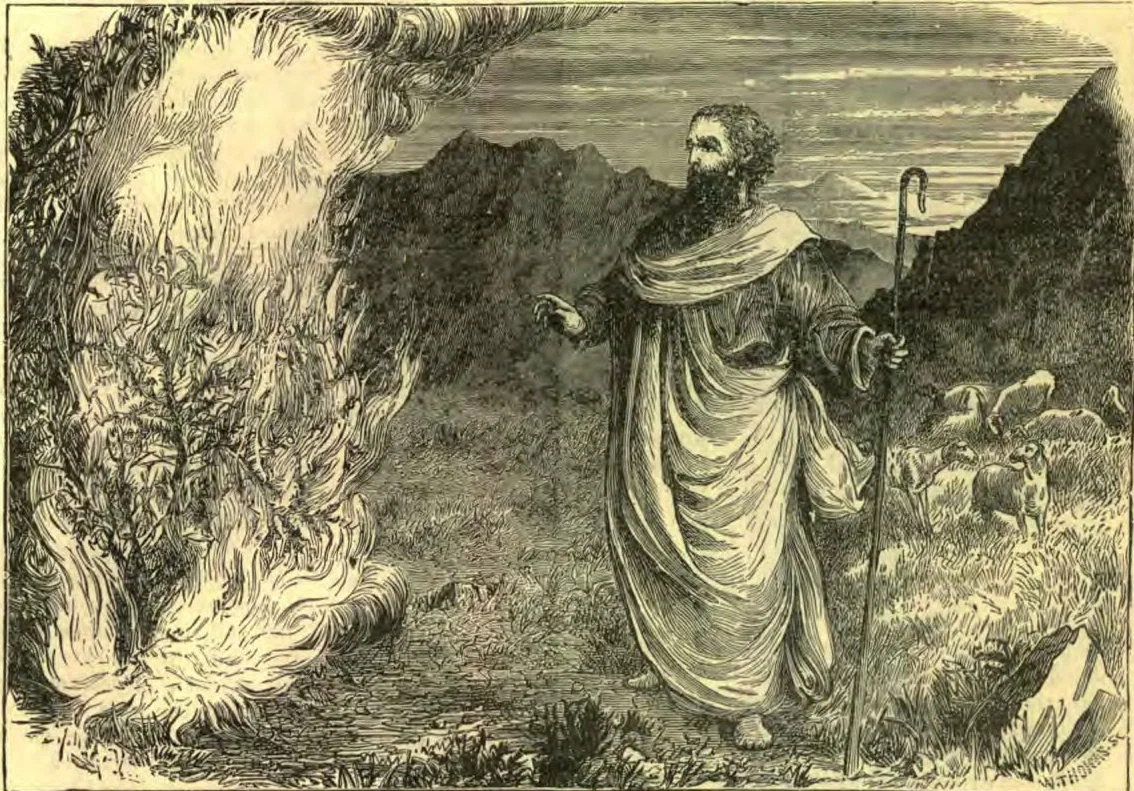
MOSES AND THE BURNING BUSH

The Youth’s Instructor

Jan 26, 1887

S. D. A. Publishing Association · Battle Creek, Mich. · Jan 26, 1887

MOSES AND THE BURNING BUSH.

Far away on Horeb's height, Horeb, holy mount of God, Moses watched by day and night, O'er his flocks in deserts broad. Forty years, in humble toil, With his shepherd's staff and crook, He had trod this lonely soil, Quenched his thirst in running brook, Slept beneath the open sky, Suffered weariness and pain, Often far from human eye And the happy homes of men.
Once in Egypt's crowded ways, He had led admiring throngs, Object of their loudest praise, Hero of their festive songs. For in all their learning great, Mighty and of chief renown, He was soon, as heir, to take Egypt's scepter, Egypt's crown. But he chose to love his Lord; From sin's pleasures turned away; Looked to Heaven for his reward; More than Egypt's wealth could pay.
And while in his desert home, Oft he thought of scenes gone by; Thronging memories would come, Of his former honors high. But his heart would oftenest feel, For a toiling race of slaves, Who beneath the oppressor's heel, Fast were filling Egypt's graves. These were all his brethren dear, Hebrews to their fathers true, Groaning on from year to year, Waiting for the promise due. And he wondered when the time Of that promise would draw nigh, When in their task-master's clime, They no more would toil and die; Wondered when the Lord his arm Would make bare in glorious might, To lead out his flock from harm, To a land of pure delight.
Thus he mused, when all around Suddenly a flash of light, Spreading over plain and mound, Burst on his astonished sight. As he turned in haste to know Whence the sudden brightness came, He beheld a bush aglow, With a furnace's fiery flame. And his soul was filled with awe, As he nearer still presumed, At the wondrous sight he saw; For the bush was not consumed. Crackling through the branches, played Tongues of fire that ceaseless burned; Yet no leaf was seen to fade, Not a twig to ashes turned.
But more wondrous than the flame, Came a voice that called aloud, From that burning bush his name, Like deep thunder from the cloud: Slow and solemn tones that shook, Vale and hill and mountain bare; And he durst no longer look; For he knew that God was there.
Then God bade him draw not near From the place whereon he trod; For 'tis fitting man should fear To approach too near to God. Nor should he thereon be found, With his shoes [upon his feet; For that place is holy ground Where God deigns our race to meet. Then he told him he had seen All the ills his people bore, And had come to judge between Them and those that pressed them sore. He had heard their plaintive cry, In broad Egypt's fields of woe, And had brought deliverance nigh, As he promised long ago.
“Therefore rise; lo, I will send, You to Egypt's cruel king: From his hand I soon will rend, by the judgments I will bring, All my people who have long Groaned beneath his cruel rod; And this soon shall be their song, ‘Lo, we're visited of God.’ Leave the flocks which here have been Daily objects of your care, While in exile you have seen, Forty years these mountains bare. You have now another flock, To lead forth and make them free, Till their foes no longer mock All the hopes they rest in me.” “Ah!” replied the man of God, “Who am I that I should go, With my simple staff and rod, To the proud king Pharaoh? Who am I that I should take Israel from that nation strong, And their yoke of bondage break, Forged by service hard and long?” But the Lord in peace replied, “I will surely be with thee, And upon this mountain side, You and they shall worship me. Where this bush is now aflame, When from Egypt they are brought, I'll reveal in power my name; For my promise faileth not.”
Moses, shrinking still, replied, “But my brethren will not hear; All my words will be denied, Failure only will appear.” “Go,” said God, “and I will give Signs to cancel every doubt; They shall know that still I live, By the wonders brought about. Take the rod now with thee found, Cast upon the earth the same”—Lo! it scarce had touched the ground, Ere a serpent it became, Reared its bold and hissing head, Coiled itself in awful grace, E'en till Moses feared and fled From the terror of its face. “Take it,” was the Lord's command, “To thyself as held before;” And it turned within his hand, To a rod and staff once more. “Now within thy bosom's fold, Place thy hand, with health aglow”—When he drew it forth, behold, It was leprous, white as snow. “Thrust it back,” said God again, “And my wonders see afresh;” And without one leprous stain, It became like other flesh. “With such signs as these to use, Make my name in Egypt known; If the first they should refuse, Others they will surely own.”
Thus did Moses; for the Lord Gave him strength with his command; And relying on his word, He commenced his mission grand. On Egyptian soil once more, Soon with earnest feet he trod, Stood proud Pharaoh before, And made known the word of God. Then he brought the judgments down Which should break their cruel chains, Made them feel Jehovah's frown, Made them writhe with direst pains, Till they let God's people free From their bondage fierce and sore. Then he led them through the sea To a land of goodly store. Thus God showed that though his flock Oft with ills are close beset, He is still their sheltering rock, He his word will ne'er forget.
In the burning bush we see, Of God's church an emblem true, Though the furnace hot may be, God will surely bring them through. Not the hosts of earth and hell, O'er his people shall prevail; And eternity shall tell, That his cause can never fail. If hard lessons must be learned, Let the Lord control our lot; So that like the bush that burned, We, though tried, may perish not. U. SMITH.

A HEROINE OF THE NORTH.

Near the head of the Gulf of Bothnia, in Sweden, lived, some twenty years ago, a simple peasant couple known as Hans and Kirsten Mathson. Maria Magdalena was their loving and obedient daughter, and for her a life of toil began right early. As soon as she was old enough, she led her father’s reindeer to the hills in the spring to find pasture, remaining with them until the autumn, and then spent the long winter in spinning and other simple household duties of the Lapp peasantry.
At that time most of the Lapps, living far from the great towns, knew little or nothing of the gospel of Jesus Christ. Hans and Kirsten Mathson, however, were Christians, and had a copy of the Bible in their humble home. Maria was early taught to read and love the blessed Book, and her young heart went out in tender love not only to the Saviour of sinners, but to the sinners whom he died to redeem. During the summer days, when she sat among the silent hills, deep, sweet thoughts stirred the heart of the simple peasant girl. She knew little about the great world, but she did know that here, in her little corner, there were great darkness and pressing need. How she longed to have the gospel made known to her own dear people! and how impossible it seemed that such a thing could be brought about! But it must be! God planted the thought deep down in the girl’s heart, and she pondered and prayed over it by day and by night.
At length, one day, like a swift flash of light, came the startling words, spoken in the silence of the loving heart—“Go to the king of Sweden. Tell him the story of your people’s need, and he will surely help.”
Maria was terrified at the thought. Clearly, that was impossible! But as the weeks and months went by, the message came again and again, until at last the brave girl accepted it as the very voice of the Lord, and set her face to do his bidding.
These were some of the lions in the way: Maria was only a poor, uneducated Lapp girl. She did not know the Swedish language. That must be learned. She must leave her parents, who could ill-afford to lose her help. She must travel on foot six hundred miles, over an unknown road. She had little or no money with which to undertake the journey.
But God called her! That was enough. For three years she toiled, with such helps as she could obtain, in learning the Swedish language. Then she won the consent of her parents, fastened on her Lapland skates, and began her toilsome and lonely journey.
Think of it, girls! As young, timid, home-loving, as you are, this maiden at the call of God, in the middle of a northern winter, crossed the icy plains of Lapland, seeking shelter by night among the peasants, a distance of six hundred miles through a strange country! Was she not a true heroine?
At Gefle she found a public conveyance bound for Stockholm; and here, as soon as her errand became known, she was warmly welcomed. Kind Christian hearts were stirred by her story, and a large sum of money was subscribed to establish schools among the Lapps.
At length the peasant girl was permitted to see the king. So successfully did she plead the cause of her poor people, relying only upon God for wisdom, that the king became greatly interested, and promised his protection and support to the mission.
And now Maria was ready to return to her home. Nothing could induce her to remain longer, though the greatest kindness and attention were shown her. She had obeyed God! He had made her work successful, and now her duty lay in the direction of home.
It was not long before Maria had the delight of seeing schools in active operation among her people, and Swedish colporters carrying the message of life throughout the thinly populated regions. Maria was of great help in setting these schools going; and then, when all was in working order, the simple, God-fearing maiden took up her home duties once more, and went out to the hills with her reindeer as before!
Once again, some years later, Maria made the long journey to Stockholm, to beg for the protection of her people from the unjust encroachments of colonists. The people knew whom they could trust with their interests, and the peasant girl was again their successful advocate at court.
As before, she met a cordial welcome at Stockholm, but nothing could keep her in the capital after her mission was accomplished. Maria knew that to truly serve and please God, is to be faithful to the work he gives, be it great or small.
Brave, tender, faithful heart! Loving much, and, therefore, daring much. Truly, the lowest place becomes the highest, where Love and Obedience walk hand in hand with Duty!—S. S. Classmate.

Sea Tales: Sailing Around the World and Keeping Time

SEA TALES.—NO. 13.

A FEW days afterward the vessel was in the same longitude as that of the city of New York, and hence it was then with us the same day and hour as with the people there. How muddling a thing this “keeping Greenwich time” is, to be sure! Only a few days before, we had to jump a day to catch up, and then could not, as the sailors express it, “fetch” the time within three hours of the New York clocks, yet by waiting patiently we would have reached longitude 75°, and been all right. Still, although correct according to New York clocks, we could not take our ease, but had to apparently live a little extra life each hour, as there were five hours yet to make up before reaching London. Going around the world in a sailing vessel would be fun if it were not for this terrible exertion to “keep up with the times.” Only one who has tried it can realize how difficult it is to keep track of the day of the week after “jumping a day” at 180 degrees. When we reached longitude 75° another curious thing happened. Starting from New York City, we had passed the longitude of New York, hence had sailed around the world. If my readers will open their geographies at the map of the world, and trace the track of my voyage, beginning at New York, following down between South America and Africa, around the Cape of Good Hope, then eastward past Australia to New Zealand, and so on, still eastward, around Cape Horn and up again, “homeward bound,” between South America and Africa, they will see that I have so far traveled around the world in the shape of a figure eight.
We were having strong winds, but not steady, accompanied by a dull, overcast sky and varying barometer. Frequent rain and hail squalls came, gales of wind that would send us along at the rate of fifteen knots for five minutes or so, and a stiff ten-knot breeze until the next squall. Finally the wind veered dead aft, and the mainsail was furled. Just as the men commenced hauling the sheet, two tremendous seas struck the vessel on the port side, one just forward and the other aft of the main rigging, and combining, glanced up within a few feet of the mainmast head, then dropped on the house. I was sound asleep, and awoke bewildered, unable to judge what had happened. The noise was terrific, and the vessel trembled as though she had struck a rock, then rolled twice with a quick, violent motion, that sent everything spinning and threw me out of my bunk.
The next day we had strong, squally southwest winds all day. In the afternoon the sea commenced “making up,” and a heavy gale passed to the southward of us. During the night squall after squall passed over us, some with rain, some with hail, and others with snow. Towards sundown the wind canted to the quarter, and the mainsail, reefed, was hoisted and helped to steady the brig, but occasionally she would give some spiteful rolls that made locomotion dangerous.
At daylight one of the fore and aft back-stays (that are made of six-stranded wire rope) was found to be in a bad condition, and was taken down for repairs. This stay had three of the strands broken, and had been in this shape for two or three years. Had it parted suddenly, the loss of the mast and its sails and rigging might have been the result. We were lugging sail heavily. Even Mr. Allen, who is naturally reckless, tried to get the captain to take off the mainsail at night, by pretending “not to like the looks of things on the lee quarter, sir.” The captain went on deck, but could find nothing in the appearance of the sky that looked unusually alarming. He afterwards told me that he intended to put up an additional back-stay to the main topmast, so that he could lug the top-gallant stay-sail. Before this he had had to haul it down, as it ran on a stay fastened near the top of the topmast, and might carry the mast away. That night there were three back-stays to the mainmast,—the usual one at the mast-head, one at the topmast, where the middle stay-sail stay came, and one at the top of the topmast where the strain of the top-gallant stay-sail came. All of these preventer stays came down on the starboard quarter, and were made fast to the rail on the quarter deck aft, near the bits. The vessel looked very odd with all these back-stays, and would make an English captain stare with astonishment at the manner the Yankee lugged sail.
The next morning the captain rigged up two extra sails, both of them fore and aft sails; one he bent between the main stay-sail and lower stay-sail (a sort of spring stay-sail); the other as a jib top-sail, on the royal stay. The brig had not done her “level best” for want of a royal; not that a royal would draw so much more, but because if a royal was set, the top-gallant would “go full.” As it was, the top-gallant was kept shaking most of the time, as the top square-sail must be kept only partially full in order to make the sails draw that are below it.
Shortly after breakfast, two whales “blowed” on the port quarter, and I had a good chance to see them distinctly. They were very large, over ninety feet long, and were so close that from the main-mast head I could trace their entire length. What monsters they are, yet how grandly graceful! It is so common to fancy an elephant to be the largest of living creatures that it is difficult to imagine anything more huge; yet the largest elephant I ever saw, including Jumbo, is no more to be compared with the whales I have seen than is a baby to be compared with a full-grown man.
About sundown Mr. Allen came into the cabin for the captain’s glass, as he saw approaching what was either a wreck or a dead whale. It proved to be the latter. Around and astern of it the sea was perfectly calm and smooth, although everywhere else the waves were very high. This was due to the long train of fat or oil that floated from the body, oil having the property of stilling the roughest sea,—a literal illustration of the Bible admonition to cast oil upon the troubled waters. Sea captains frequently throw oil over to still the waves following astern. Upon the body of the dead whale were hundreds of birds scampering about, which, with their white wings and long legs, looked, at a distance, like a lot of bare-footed girls, holding up their skirts while paddling in the water. W. S. C.

AFTER EIGHTEEN YEARS.

In the year 1881, on one of the Potomac steamboats, a singer of beautiful voice had just concluded the second stanza of the hymn,—
“Jesus, lover of my soul,”
ending with the words,—
“Cover my defenseless head, With the shadow of thy wing,”
when a stranger accosted him with the question whether he had ever been in the army. Then followed the explanation that eighteen years before, when the singer was on picket duty, this stranger had been selected by his captain to shoot the picket in order to prepare the way for an attack on the camp. He was in position, ready to fire on the picket as soon as he should step out into the light, when the voice of the picket fell on his ear,—
“Cover my defenseless head, With the shadow of thy wing.”
He could not shoot while those words echoed in his ear; the picket’s life was saved, and the attack was postponed. At the end of eighteen years the singer learned that God had answered that prayer instantly.
Oh, how the singer’s heart praised God and loved him for this revelation of his loving care, and of his immediate answer! True, the knowledge was eighteen years in coming, but when it came, how precious!”
This is but a foretaste of the last great day. When God shall reveal to us his wonderful dealings in the past, showing us how often he has answered prayer when we knew it not, and how foolishly we have grumbled because we could not see how he was shaping the answer, our heart will glow with joy, and praise, and love.
Oh, that our faith could reach forward to that day, that we could feel so sure of the explanations and revelations yet to come, as that our souls should rest securely on the expectation of that glorious time! This one thought would give peace and joy to many a troubled heart. In due time God will explain it all.
—Christian Observer.

For the INSTRUCTOR.

ONLY JESUS.

JESUS! Jesus! only Jesus! This the song my heart would sing; Naught of merit can I offer. “Simply to thy cross I cling.” Poor and needy, weak and helpless, “Child of sorrow and of woe,” I am longing for thy blessing, Only thee! O Christ! to know.
Only thee! O blessed fullness! In the Lamb for sinners slain, Heavenly light and glory cluster Round thy precious, holy name. Only Jesus! Blessed Saviour! Ever present, truest Friend! “Whom have I on earth beside thee?” Thou wilt love me to the end.
Only Jesus! Earthly treasures, Soon will moulder and decay; Only Jesus! Earth-born pleasures, With the moment speed away. But thy love, O Christ eternal, With the ages will endure; Thou wilt guard and guide me safely, To that ever-peaceful shore.
J. M. HOPKINS.

CREATURES OF IMPULSE.

We are all more or less creatures of impulse. We have sudden promptings to do good or evil, and by the cultivation of the heart and the education of the will these inspirations may all be trained to “lean toward virtue’s side.” We are apt to think that an inspiration is something with which we have very little to do; that it comes to us like a wind from heaven, moving our thoughts this way or that. To some extent this is so, but the humor of the man, his disposition, and his habits have much to do with his inspirations and his impulses.
The criminal has a natural inclination toward wrong-doing. He breaks laws as easily as he breaks locks. His impulses are all downward. His crimes are not always premeditated, but come to him like sudden inspirations.
The religious enthusiast has an impulse to do strange things in order to show his love for God. He fancies his inspirations are all heavenly, when frequently they are quite the opposite. He yields to his impulses, and is carried away by them. He becomes insane. There are morbid impulses, and there are healthy impulses; and it needs a wise, clear judgment at times to discriminate between the two.
There are persons who seem to lack inspirations. They have no generous impulses. They never offer to do one favor in return for the hundreds they receive. They feel that it is more blessed to receive than to give, and are like vines that twine their tendrils around themselves, and lead a purely selfish existence.
How delightful the homes are where all are ready to offer their services for the benefit of others; where hearts are filled with kindly promptings; where each wish is anticipated; where the daughters cheerfully aid their mothers without waiting to be asked; and where sons are the joy and staff of old age—an inspiration to youth to “do likewise”!—Sel.

THE MINISTRATION OF ANGELS.

LESSON 2.—CHRIST AND THE ANGELS.

1. WHAT are angels called in Luke 2:13?
2. How does John designate them? Rev. 19:14.
3. What does Paul call them? Eph. 3:15.
4. As God has shown order in all his works, and has ordained officers of higher and lower positions among his people here, should we not expect to find the same order among the angels?
5. Is not this implied in the Saviour’s words? Matt. 26:53.
6. Does not Paul teach that there are different orders among those in heaven? Eph. 1:20, 21; 6:12.
7. What order of angels is mentioned in Isa. 6:1-3?
8. Describe their appearance. Verse 2.
9. What other order is mentioned in Eze. 10:20?
10. By what were these represented in the earthly sanctuary? Ex. 25:18; 26:1.
11. Do the angels have names? Luke 1:19.
12. Who is Michael, the archangel?—The Lord Jesus Christ. Compare Dan. 12:1; Jude 9; 1 Thess. 4:16; John 5:28.
13. What relation does Christ sustain to the angels? —He is their commander. Josh. 5:13-15; Rev. 12:7.
14. Show this from Christ’s words. Matt. 13:41.
15. How much higher than the angels is the Son of God? Heb. 1:4-8.
16. Who created the angels? Col. 1:15-17.
17. Do the highest angels in heaven worship our Saviour? Heb. 1:6; Phil. 2:9-11.
18. What does this show as to the exalted character of the Saviour who died for sinners? Heb. 7:25, 26.
19. How does this show the wonderful love of God for fallen man?
20. What regard, then, should we have for the Saviour?

NOTES.

Legion.—“A body of infantry, consisting of different numbers of men at different periods, from three to five thousand. Each legion was divided into ten cohorts, each cohort into ten companies, and each company into two centuries.”—Webster. Jesus speaks of the angels as being composed of “legions” after the manner of an army. A “host” is the usual designation of an army. God is often spoken of as the “Lord God of hosts” (Ps. 59:5), that is, of the celestial armies. So the angels are called the armies of heaven. Rev. 19:14.
All this indicates just what we would naturally expect, that the angels are divided into companies and orders, with commanding angels over them, and Christ at the head of all. Wherever God’s rule is seen, whether in nature or in grace, there we find “law and order;” and we may be sure that the same is carried out in heaven.
The number of the angels.—Evidently the Bible does not design to give any definite idea as to the exact number of the angels. Such expressions as “a multitude of the heavenly host” (Luke 2:13), “an innumerable company of angels” (Heb. 12:22), and “ten thousand times ten thousand and thousands of thousands” (Rev. 5:11), convey the idea that their number is infinite. The population of this small planet, the earth, is over fourteen hundred millions. Then what countless millions of “the heavenly hosts” there may be in the great heaven where dwells the infinite God! Of the inhabitants of this earth, God says: “Behold, the nations are as a drop of the bucket.” “All nations before him are as nothing.” Isa. 40:15, 17. Here, the wicked seem to be vastly in the majority; there, as compared with the heavenly hosts who are loyal to God, doubtless they appear only as a drop in the bucket.

The Work of the Teacher.

The following, from the pen of T. E. Espin, D. D., of England, furnishes a hint, which it would be well for our Sabbath-school teachers to adopt; for we fear that no teacher who neglects this important means of winning the good-will and affection of those for whom he labors discharges his duty to his pupils or reaps the full reward that comes even on this earth to the worker for the Master:—
“The little ones belong to a lost race, and therefore stand in need of redemption. They are born into a world that is fallen too—that is full of temptation and corruption—and so need help and rescue if they are to escape from ruin in it. The Son of man came to bring this succor, that they for whom the angels are placed in trust might not remain lost. And how is this succor to be ministered? Not, of course, now by himself personally. That cannot be, for he hath ascended, and sits on the right hand of God. But it is to be done by those whom he, enthroned in heaven on high, sends forth for his work on earth beneath. He comes now to save that which was lost, but he comes through, by, in, his ministers.”
“And let it not be supposed that the task is one for the clergy only. So far as the scope of the text carries us, it is as much, or more, the task of the Sunday-school teacher; and the office of such teacher is emphatically a pastoral one. A true Sunday-school is emphatically a place for religious work. . . . The day school is established for the purpose of training and furnishing the head. The Sunday-school should not be regarded merely as the day school meeting on Sundays, but as an agency with its own proper and distinct aims and processes. The Sunday-school is the institution through which the Church influences and molds the hearts and the thoughts, the lives and the habits, of the children. ‘To save that which was lost,’ may well be a sort of motto for every Sunday-school—may well serve as a watchword and rallying cry for every band of Sunday-school teachers. . . .”
“If the work of the Sunday-school teacher be, then, in some aspects, of a pastoral nature, another thing follows. It will not all be done in Sunday-school. The clergyman is not supposed to have finished his duties when he descends from the pulpit. No more will you when your weekly school-hours are past and gone. Influence comes from personal knowledge, and if you mean to make full proof of your vocation, you must visit your children at their homes. . . . Parents are always ready to welcome one who takes an interest in their children. And you learn many a little thing about both parents and children which will prove useful to you to know from a visit such as this. Visit not only to look after absentees, but visit the homes of the regular scholars too. You can say a word of commendation—drop without offense a hint that may be opportune, say, about early hours on Sunday morning, for instance, as leading to regular attendance at your class; make a remark which will stir the parent up to take a more direct personal interest in what is being learned at the school, to ask a few questions in the home tasks, to give a little help in getting those tasks ready, and so on. It requires tact to do this kind of visiting well. But there is no ingenuity like love. A loving heart and an earnest spirit will either possess or acquire the necessary tact. Anyhow, you will often shoot at a venture in your Sunday teaching unless you know something of your children’s home life,—its temptations, drawbacks, circumstances.”

PIES OF “YE OLDEN TIME.”

The custom of providing roast turkey for the Thanksgiving dinner has prevailed so long that, although this food is served quite commonly at other times, it comes natural to associate it with the Thanksgiving festival. And so, with some, meat pies suggest the Christmas dinner; particularly is this so with English people. And you would not think it strange could you see some of the huge pies which were made in England for Christmas occasions more than a hundred years ago. Thinking the readers of the INSTRUCTOR will be interested in a description of these curiosity pies, we quote a few paragraphs about them from Harper’s Young People for Dec. 7. The writer says:—
“The hearty Christmas cheer of old was never shown more bountifully than in the wonderful pies that were the pride of every good housewife’s heart, and we find in a very ancient book that ‘every family against Christmas makes a famous pye.’ They were baked in long, deep dishes representing the manger in which the infant Jesus was laid, while the rich ingredients were supposed to have some reference to the offerings of the Wise Men.
“Some of these pies were of such enormous size as to make modern pastry sink into insignificance, while the substantial portion seems to have been more thought of than the sugar, plums, and spice. One that in 1769 was made by Mrs. Dorothy Patterson, a house-keeper at Howick, and sent to her master, Sir Henry Grey, is said to have contained two bushels of flour, twenty pounds of butter, four geese, two turkeys, two rabbits, four wild-ducks, two woodcocks, six snipes, and four partridges, two neats’ tongues, two curlews, seven blackbirds, and six pigeons. It measured nearly nine feet in circumference at the bottom, and weighed one hundred and sixty-eight pounds. To be served at table, it was fitted into a case on four wheels, and two men pushed it around from guest to guest.
“A still larger Christmas-pie, however, was presented by James, Earl of Lonsdale, to King George III.; for that contained two geese, two tame ducks, two turkeys, four fowls, six pigeons, six wild ducks, three teals, twelve partridges, three starlings, fifteen woodcocks, two guinea-fowls, three snipes, six plovers, three water-hens, one wild-goose, one curlew, forty-six yellow-hammers, fifteen sparrows, sixteen chaffinches, two larks, four thrushes, fifteen fieldfares, six blackbirds, twenty rabbits, one leg of veal, and half a ham, while the crust required three bushels of flour and twenty-eight pounds of butter. This huge specimen of cookery weighed three hundred and eight pounds, and had to be borne through London on a two-horse wagon.”

THE BELL-BIRD OF SOUTH AMERICA.

The American Agriculturist, describing an interesting South American bird, says:—
“The traveler in the tropical portions of South America is often surprised to hear the distinct and measured tolling of a bell, in localities where there is no settlement within many leagues. If he undertakes to follow the sound, and trace it to its source, he will be surprised to find that it proceeds from a bird, which, perched at the top of a lofty tree, utters its peculiar note, which so resembles the sound of a bell, as to make the name bell-bird appropriate and descriptive. The sound is said to be distinctly heard at a distance of three miles. The bird utters its note all through the day, even in the hottest portions, when the fierce heat has silenced all other birds. The bell-bird is noted for the great difference between the sexes in plumage. The male is white throughout, while the female is a dusky green color. The male bird has a curious appendage, in the form of a tube about three inches in length, attached to the base of the bill. This tube is jet black, dotted all over with minute downy feathers. Ordinarily, this tube hangs down on one side, but the bird is able to inflate it with air, when it stands erect. There are three other species belonging to the same genus with the bell-bird, the males in all being very different from the females. The male in one of the species is snow-white, with a large space of naked skin on the throat, and around the eyes. These naked places, during the breeding season, become of a fine green color. The bell-bird is about twelve inches long. It belongs to the same family (Ampelidæ) as our wax-wing, and the cedar-bird. In Australia, a country noted for its singular birds, and other strange forms of animal life, there is a bell-bird, but belonging to a different family from the South American species. The note of the Australian bird resembles that of a sheep bell rather than that of a distant church bell. When its note is produced, as it often is, by hundreds of birds all together, the effect is said to be most singular.”

SOME OLD RELICS.

In an old town in Delaware are preserved two or three curious relics of Revolutionary days, which bear a significant lesson to people of later times. One is a silver strainer, which Benjamin Franklin had made out of the first silver dollar that he ever earned. Another is a worn prayer-book, which also belonged to Franklin. In it is written the name of Betty Parker, a young girl to whom he gave it, with these words of advice:—
“Go to church constantly, whoever preaches. The act of devotion is your principal business there, and, if properly attended to, will do more towards mending the heart than sermons generally can do. Yet I do not mean that you should despise sermons, even if you dislike the preacher, for the discourse is often much better than the man, as sweet and clear water comes through very dirty earth.”
The other memento is of a very different character. It is a bullet covered with a thick coating of rust. At the battle of Brandywine, General Lafayette was shot, and fell.
“General, I am wounded,” he said to Washington, as he was carried past the chief.
“I am sorry for it,” was the reply.
“Sir, I am not sorry,” the young Frenchman answered, quickly.
The bullet had passed through the leg, and could be felt under the skin at the other side. No surgeon came to dress the wound. A woman named Bell McClosky cut out the bullet with her scissors, and bandaged the leg so skillfully that when the surgeon examined it, nothing more was needed. This woman was the wife of a poor soldier, who followed her husband to every battle field, and gave what help she could to the wounded and dying.
When Lafayette returned to this country in 1824, he visited Delaware, and received a splendid welcome, civil and military. But he did not forget the woman who had come to his help. Bell McClosky was brought to Wilmington and presented to him. She had preserved the bullet, and it is cherished by her descendants as the memento of a brave man and a good woman. —Youth’s Companion.

The Mechanics of Rapid Penmanship

A rapid penman can write thirty words to a minute. To do this, he must draw his pen through the space of a rod, sixteen and one half feet. In forty minutes his pen travels a furlong. We make, on an average, sixteen curves or turns of the pen in writing each word. Writing thirty words in a minute, we must make 480 turns to each minute; in an hour, 28,800; in a day of five hours, 144,000; in a year of 300 such days, 43,200,000. The man, therefore, who made 1,000,000 strokes with his pen was not at all remarkable. Many men—newspaper writers, for instance—make 4,000,000. Here we have, in the aggregate, a mark 300 miles long to be traced on paper by such a writer in a year.
Continue reading: ONE OF TROTTY'S DAYS