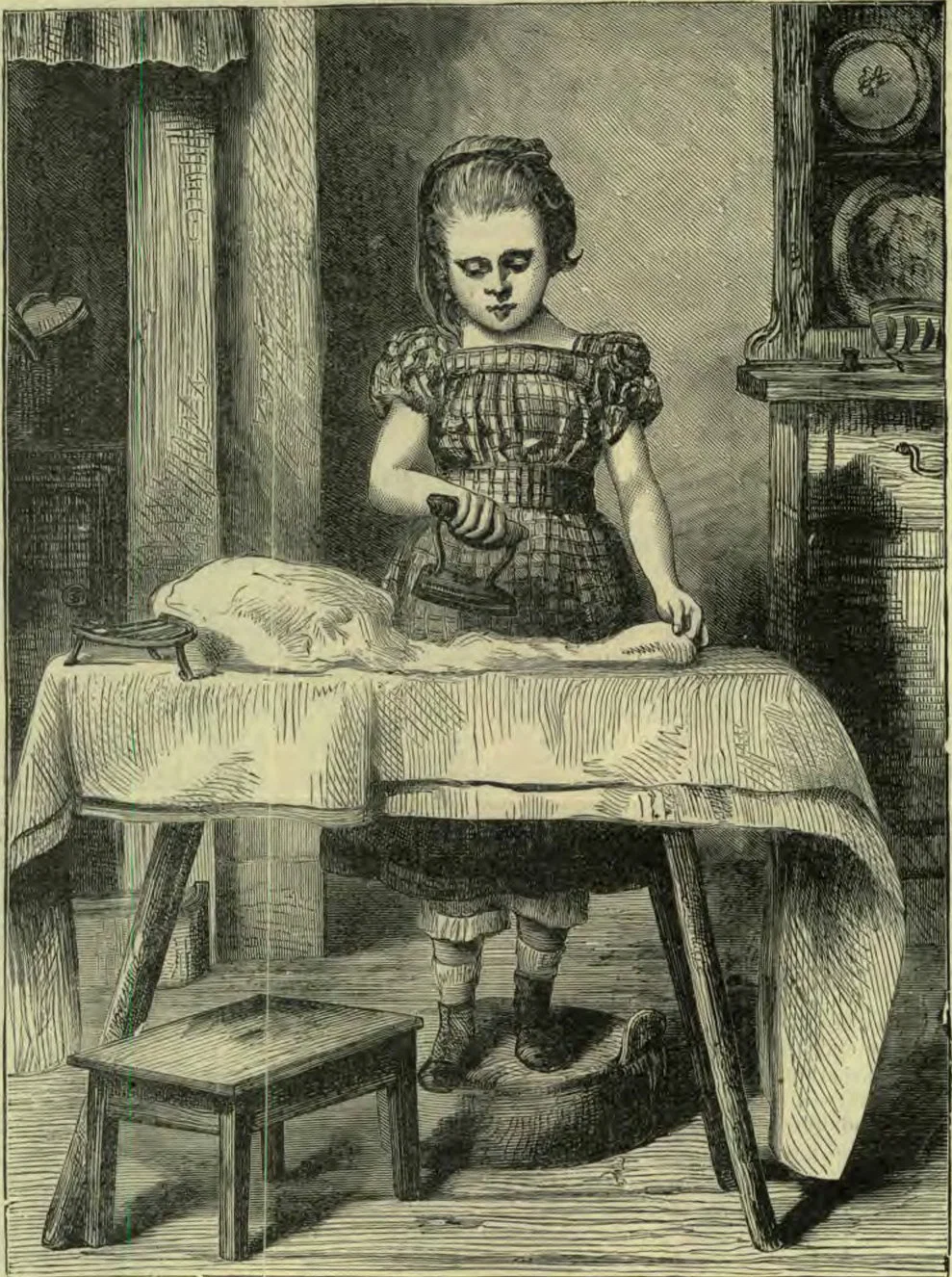
TROTTY BROWN had “days;” and this was one of them—days when everything went wrong, and everybody was cross. In the first place, she had got up late, and instead of the nice breakfast she hoped to find warming for her in the oven, everything had been dished up, and was as cold and uninviting as an hour's waiting could make it.
“O dear!” thought Trotty, as she hurried through her breakfast. “I wonder if anybody ever had such times as I have! It wouldn't have been very much trouble to keep this breakfast warm!” So she went on thinking herself a very much abused little girl indeed; and you may be sure it did not improve her temper any when, as she was putting on her cloak and hood to go to school, her mamma said, “Trotty dear, I think you will have to stay at home to-day, for I have such a hard headache that I cannot sit up, and there is no one to look after Teddy.”
Teddy was playing on the floor with his blocks, and hearing his name spoken, looked up with a coo of satisfaction. Trotty was usually a good playfellow.
“Well, I suppose I'll have to,” said Trotty, crossly, as she slammed the door together, and flung her wraps into a corner. “But I'll never get the prize in this world if I have to stay out, for Clara Nolin will get ahead of me, and then I just can't catch up. It's awful mean!” A pained look came into Mrs. Brown's eyes as she heard Trotty's naughty words; but she only said quietly, “I am sorry my little girl is obliged to stay away from school, and risk losing the prize; but I hope she will not forget there is a better prize to be won.” And then she left Trotty and Teddy, and went into the darkened bedroom to rest.
Trotty went to work to wash the breakfast dishes, but she was so slow about it that the little clock on the mantel chimed ten before she had them done.
Teddy had played with his blocks and ball till he was tired, and began to fret for Trotty to take him. “O Teddy! do keep still!” she exclaimed; “I can't stop to take you now. Here's the kitty; play with that,” and catching up Snowball, she gave her a toss toward Teddy.
Snowball did not fancy being awakened from a nice nap in that rude way; and when Teddy, baby-fashion, tried to make friends by pulling kitty's tail, she turned and gave him a long scratch.
Teddy gave a scream, and Trotty hurried to comfort him, for she was afraid her mamma would come out to see what the matter was, and would find how slow she had been. At last she succeeded, and Teddy fell into a troubled sleep.
It was all still now, and Trotty had nothing to do but think. She remembered the naughty words she said to her mother in the morning, and she began to feel very much ashamed. She wasn't such a bad little girl all the time. Indeed, she was usually good, and so willing to run on errands and help others that the family had nicknamed her Trotty. But she had some faults, and one of them was a quick temper.
As Trotty stood at the table ironing (for she could iron nicely for such a little girl), she grew sorry for her unkind words and made up her mind to tell her mamma so as soon as she woke up. Then she began to wonder what her mother meant when she said there was a better prize to win. The prize Trotty was working for was a beautiful story-book bound in blue and gilt, that was to be given to the scholar who should have the most perfect lessons, and the fewest tardy marks during the whole term. Trotty was sure there was nothing in the whole world that she wanted so much as that book, and that it was the very best prize that could be given.
Late in the afternoon Mrs. Brown came out looking pale and tired, but with her headache all gone. And after Trotty had told her how sorry she was, and had asked her mother's forgiveness, she drew her little chair up by her mother's side and sat down for their afternoon's talk. Every day, when Trotty came home from school, she and her mamma talked over all Trotty's hopes and troubles, and it was a great help to her.
“Now mamma,” began Trotty, “I can't make out what you meant when you said, ‘Remember there is a better prize to win.’ I'm sure that book is just the nicest prize there is, and I don't know of any other.”
“Well,” said Mrs. Brown, with a smile, “there are a good many things better worth the winning than that story-book. One of them is the approval of a good conscience. Your conscience, you know, is the little something inside of you that tells you when you have done right or wrong. But that wasn't just what I meant this morning. Get your Testament, and I will show you.”
So Trotty got her little red Testament. “Now turn to first Corinthians, the ninth chapter, and the twenty-fourth and twenty-fifth verses, and read what it says.”
After a good deal of hunting, Trotty found the place, and by stopping to spell out the hard words, at last read, “Know ye not that they which run in a race run all, but one receiveth the prize? So run that ye may obtain. And every man that striveth for the mastery is temperate in all things. Now they do it to obtain a corruptible crown; but we an incorruptible.”
“I don't believe I understand it very well,” said Trotty, with a puzzled look.
Mrs. Brown explained, “Paul was writing this letter to the Christians who lived in Corinth.” Then she got the map, and showed Trotty that Corinth was way across the ocean, in a country called Greece, and not so very far from the country where Christ was born.
“It was a large city,” continued Mrs. Brown, “but there were only a few people in it who believed in the true God. The Grecians were very fond of public games, and used to come at certain years from different cities to Corinth to play them together. There was boxing, and wrestling, and foot-racing, and many others. The young men who played in the games had to get ready by going through a long course of training. They had to be very careful to eat only what would make them strong, and that was not always the pleasantest kind of food; and they had to practice whether the weather was hot or cold, and often they got hurt. And they did all this so as to be called the strongest or the swiftest men in Greece, and to receive for a prize a wreath of pine branches.”
“I shouldn't think that was very much of a prize,” said Trotty.
“No,” said her mamma, “it wasn't; but Paul writes to these Christians about a better prize. He tells them that trying to be Christians is a good deal like running one of these foot-races. Good Christians must be temperate in all things, not only in what they eat, but they must learn to control the temper, and to grow as strong for good as these racers did for running. And then he tells them about a prize,—‘an incorruptible crown,’ that is, a crown that would last forever. The crown of leaves that was given to the footracers very soon withered and was useless; but this other crown is the bright, shining one of gold, which God will give to all who are saved in his kingdom.”
“I hope,” said Trotty's mother, as she rose to light the lamp, for it was getting dark, “that my little girl will try to win this prize, whether she ever wins any that are given at school or not.”
W. E. L.
Letter Budget.
Here is a letter from EFFIE and WILLIE DAVIDSON, of Auglaize Co., O. Effie says: “I am nine years old. I have one brother, and one sister. I knit and sold collars enough to buy me a Bible. I go to day school, and read in fourth reader. I go with my parents to Sabbath-school. I have a little bantam hen, and she is as white as the snow. She raised eight chickens, and I sold them for a dollar and a quarter, and then paid the tithe into the Sabbath-school. I am in Book No. 2, and my mamma is my teacher. We like the INSTRUCTOR very much. I am trying to be good, and want to meet all our readers in heaven.”
Willie says: “I am seven years old. I go to day school, where I read in second reader, and spell and write. I like to go to school. I go to Sabbath-school, and learn lessons in Book No. 1. I can say the ten commandments. I have two sisters, both older than myself. I have a nice dog, which I call Dash. I harness him and hitch him to my wagon, and he will pull a load of wood around to the kitchen for me. When there is snow on the ground, I haul in my wood on my little sled. I helped pa cut corn one day and a half last fall. I like the INSTRUCTOR, and the letters in it. This is my first letter to the Budget, and I would like to see it printed. I want to live so I can meet the faithful in the earth made new.”
EMMA WHEELER, a little girl seven years old, writes from Sullivan Co., Pa. She says: “I have a little chicken which I call Lamy. She used to have the rheumatism, and I cared for her, and now she is well, and will sit on my hand and pick at my teeth. I have a cat named Beauty. I learn my Sabbath-school lessons in Book No. 1.”