Pacific Press Publishing Company · New York · Feb 13, 1896
RELIGIOUS LIBERTY IN VIRGINIA.
Virginia, a State which has long stood second to none in guaranteeing liberty of conscience, seems about to enact additional Sunday statutes.
The text of the proposed “law” was published in these columns last week. It is designed to affect only railroad and steamship companies, but it violates the principles of the separation of Church and State, so ably advocated by Thomas Jefferson and James Madison, more than a century ago, just as truly as though it proposed to interfere with the individual citizen.
Human rights antedate all governments. They existed as soon as man was created, and are entirely independent of civil authority; and it seems strange that the legislators of any American commonwealth should entertain for a moment the idea that rights are conferred by the State; and yet such is the thought underlying all religious legislation.
The Declaration of Independence, written by Thomas Jefferson, presents the matter in its true light, namely, that men “are endowed by their Creator with certain unalienable rights,” and “that to secure these rights governments are instituted among men.”
Subsequently to writing the immortal Declaration, Mr. Jefferson wrote:—
Our legislators are not sufficiently apprised of the rightful limits of their power; that their true office is to declare and enforce only our natural rights and duties, and to take none of them from us. No man has a natural right to commit aggression on the equal rights of another; and this is all from which the laws ought to restrain him; every man is under the natural duty of contributing to the necessities of the society; and this is all the laws should enforce on him.
And again in the same letter Jefferson says: “When the laws have declared and enforced all this [natural rights and duties], they have fulfilled their functions; and the idea is quite unfounded, that on entering into society we give up any natural right.”
Mr. Jefferson very pertinently remarks that “the trial of every law by one of these tests would lessen much the labors of our legislators, and lighten equally our municipal codes.”
Tried by the rule stated by Jefferson, the Sunday bill now before the Virginia legislature will be found to far exceed the rightful limits of legislative power.
The late Alexander H. Stevens entertained views similar to those held by Mr. Jefferson. He said:—
In forming single societies or States, men only enter into a compact with each other—a social compact—either expressed or implied, as before stated, for their mutual protection in the enjoyment by each of all their natural rights. The chief object of all good governments, therefore, should be the protection of all the natural rights of their constituent members.
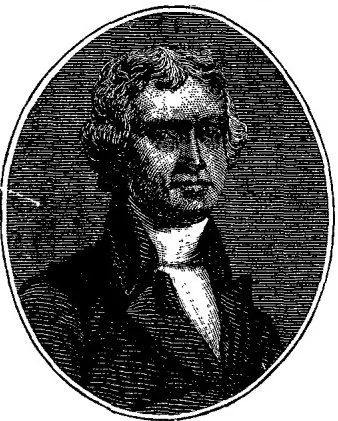
THOMAS JEFFERSON.
Upon entering into society for the purpose of having their natural rights secured and protected, or properly redressed, the weak do not give up or surrender any portion of their priceless heritage in any government instituted and organized as it should be.
In no other State have such questions been any more thoroughly discussed than in Virginia. “Early in the autumnal session of the legislature of 1785,” says Bancroft, “Patrick Henry proposed a resolution for a legal provision for the teachers of the Christian religion. In the absence of Jefferson, the opponents of the measure were led by Madison, whom Witherspoon had imbued with theological lore. The assessment bill, he said, exceeds the functions of civil authority. The question has been stated as if it were, Is religion necessary? The true question is, Are establishments necessary for religion? And the answer is, they corrupt religion. The difficulty of providing for the support of religion is the result of the war, to be remedied by voluntary association for religious purposes. In the event of a statute for the support of the Christian religion, are the courts of law to decide what is Christianity? and, as a consequence, to decide what is orthodoxy and what is heresy? The enforced support of the Christian religion dishonors Christianity. Yet, in spite of all the opposition that could be mustered, leave to bring in the bill was granted by forty-seven votes against thirty-two. The bill, when reported, prescribed a general assessment on all taxable property for the support of teachers of the Christian religion. Each person, as he paid his tax, was to say to which society he dedicated it; in case he refused to do so, his payment was to be applied toward the maintenance of a county school. On the third reading the bill received a check, and was ordered by a small majority to be printed and distributed for the consideration of the people. Thus the people of Virginia had before them for their choice the bill of the revised code for establishing religious freedom, and the plan of desponding churchmen for supporting religion by a general assessment.
“All the State, from the sea to the mountains and beyond them, was alive with the discussion. Madison, in a remonstrance addressed to the legislature, embodied all that could be said against the compulsory maintenance of Christianity and in behalf of religious freedom as a natural right, the glory of Christianity itself, the surest method of supporting religion, and the only way to produce moderation and harmony among its several sects. George Mason, who was an enthusiast for entire freedom, asked of Washington his opinion, and received for answer that ‘no man’s sentiments were more opposed to any kind of restraint upon religious principles.’ While he was not among those who were so much alarmed at the thought of making people of the denominations of Christians pay50toward the support of that denomination which they professed, provided Jews, Mahometans, and others who were not Christians, might obtain proper relief, his advice was given in these words: ‘As the matter now stands, I wish an assessment had never been agitated; and, as it has gone so far, that the bill could die an easy death.’”
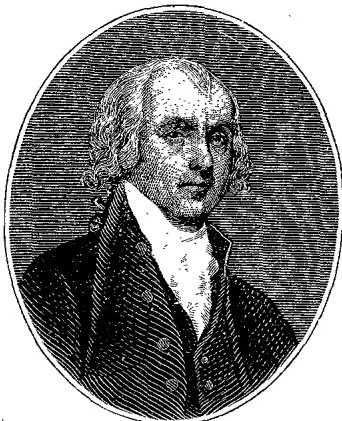
JAMES MADISON.
“The general committee of the Baptists unanimously appointed a delegate to remonstrate with the general assembly against the assessment, and they resolved that no human laws ought to be established for that purpose; that every free person ought to be free in matters of religion.” The general convention of the Presbyterian Church prayed the legislature expressly that the bill concerning religious freedom might be passed into a law as the best safeguard then attainable for their religious rights.
“When the legislature of Virginia assembled, no one was willing to bring forward the assessment bill, and it was never heard of more. Out of one hundred and seventeen articles of the revised code which were then reported, Madison selected for immediate consideration the one which related to religious freedom. The people of Virginia had held it under deliberation for six years; in December, 1785, it passed the House by a vote of nearly four to one. Attempts in the Senate for amendment produced only insignificant changes in the preamble, and on the sixteenth of January, 1786, Virginia placed among its statutes the very words of the original draft by Jefferson with the hope that they would endure forever: ‘No man shall be compelled to frequent or support any religious worship, place, or ministry whatsoever, nor shall suffer on account of his religious opinions or belief; opinion in matters of religion shall in no wise diminish, enlarge, or affect civil capacities. The rights hereby asserted are of the natural rights of mankind.’”
“‘Thus,’ says Madison, ‘in Virginia was extinguished forever the ambitious hope of making laws for the human mind.’”
It will be observed that the opposition to the proposed legislation for the support of teachers of the Christian religion was not from an infidel but from a Christian standpoint. Madison was himself “bred in the school of the Presbyterian dissenters under Witherspoon at Princeton,” and the Virginia Presbyterians and Baptists of that day were certainly not open to the charge of hostility to Christianity. The fight against the bill, supposed to be for the preservation of Christianity, was made wholly in the interests of Christianity and of God-given rights.
Mr. Madison’s first reason for opposing the bill was because “religion, or the duty which we owe to our Creator, and the manner of discharging it, can be directed only by reason and conviction, not by force or violence.”
His second reason was, “Because, if religion be exempt from the authority of the society at large, still less can it be subject to that of the legislative body,” whose jurisdiction, he argued, was both derivative and limited.
Mr. Madison’s third reason for opposing religious legislation in Virginia in 1785 is just as applicable to the legislation proposed now. “Who does not see,” he asks, “that the same authority which can establish Christianity in exclusion of all other religions, may establish with the same ease any particular sect of Christians?”
Equally pertinent would be the question now: Who does not see that the same authority that can require the observance of one Christian institution, may establish with the same ease any other real or supposed Christian institution and require its observance? There can be but one reason for hedging the Sunday about with legal restrictions and prohibitions, namely, its supposed sacred character; and who does not see that it would be just as legitimate for the legislature to guard or enforce in like manner any other institution of the Church?
Again, Mr. Madison, and those who joined with him in this memorial, objected to the “bill establishing a provision for teachers of the Christian religion” on the ground that it violated “that equality which ought to be the basis of every law.” This is equally true of the present bill. It violates equality because it requires in some degree the observance of a religious institution. Said Mr. Madison: “Whilst we assert for ourselves a freedom to embrace, to profess, and to observe the religion which we believe to be of divine origin, we cannot deny an equal freedom to them whose minds have not yet yielded to the evidence which has convinced us.” The present Sunday bill, like all such measures, takes no account of the right of every man not to observe Sunday.
Again, as pointed out in the fifth division of Mr. Madison’s memorial, the bill now before the Virginia Legislature, equally with the bill then under consideration, implies the right to employ religion as an engine of civil policy; and also to use the civil power to support and enforce religion.
As it is religious sentiment which demands such legislation as that now proposed in Virginia, so it is religious sentiment which enforces such legislation. In fact, by such laws the State simply clothes the Church with civil power, and within certain proscribed limits, makes it the “duty” of the magistrate to adjudicate religious questions and enforce religious discipline. And this is equally true of the Sunday “laws” already upon the statute books of Virginia. Section 3800 provides that:—
The forfeiture declared by the preceding section shall not be incurred by any person who conscientiously believes that the seventh day of the week ought to be observed as a Sabbath, and actually refrains from all secular business and labor on that day, provided he does not compel an apprentice or servant not of his belief to do secular work or business on a Sunday, and does not on that day disturb any other person.
Such an exemption is itself evidence of the religious character of the “law.” Thus even the attempts of legislators to do justice and to recognize the right of every citizen to worship God according to the dictates of his own conscience, show such legislation to be alike in flagrant violation of the Virginia Bill of Rights, of the “Act Establishing Religious Liberty,” and of the natural rights of man.
It is to be hoped, therefore, that the Legislature of Virginia will not only reject this present Sunday bill, but will make haste to repeal the various measures of religious legislation now upon the statute books of that State, and thus vindicate the principles so ably announced and defended over a century ago by Jefferson and Madison, the ablest statesmen of that day, and by Witherspoon, the Christian minister, educator, and patriot.
RELIGIOUS “LAWS.”
THERE is nothing more unchristian than a man-made religious “law.” Religious legislation is solely a prerogative of the Creator. When man presumes to enact such legislation he assumes to put himself in the place of God. His religious legislation, so far from being Christian, becomes from its very assumption to be such, actual blasphemy.
“Every word of God is pure; he is a shield unto them that put their trust in him. Add thou not unto his words, lest he reprove thee, and thou be found a liar.” Prov. 30: 5, 6. Religious legislation presumes to add to the words of God.
Every word of God is law. It is law because it is right, because it is truth, because it is just, and because it will certainly be carried into effect. And therefore any religious legislation by man becomes but a man-made addition to the word of God, and subjects its authors to the reproof of the Almighty, which will demonstrate them to be liars, and appoint their portion with the lovers of untruth.
“CASUAL OBITER DICTUM.”
From a legal standpoint the argument of the Christian Work, on page 53, is conclusive. Upon no sound principle of law can it be asserted that this nation has any religious character whatever. But as a matter of fact, not only the several States but the nation is influenced very decidedly by popular Christianity.
It was doubtless the purpose of the founders of this Government to make it purely secular; wholly separate, not only from any church but from religion as well; not opposed to religion, but simply having nothing to do with it, just as a business concern, while not hostile to religion, has no religious character.
According to the Declaration of Independence the sanctions of civil government are found in the existence of God-given, natural rights. But while this is true, there has been a disposition on the part of our courts to find the sanctions of our civil codes, not so much in the inherent rights of man, as in the religion of the people. Forgetting that other peoples knowing nothing of Christianity have had codes of manners fully equal to our own, learned judges have sought in the Christian religion that justification for the laws of justice which our forefathers declared to be self-evident.
Justice Brewer probably meant by his “casual obiter dictum” no more than he now professes; but it is, nevertheless, a step, and a long one, in the return journey to the judicial maxims of that period of the world when the State was the obedient servant of the Church.
Justice Brewer cannot recall his words; and if he could that would not greatly alter the facts, for as the decision shows, his conception of the sanction of government is wrong. Not the will of the people, or the intent of the law makers, but the eternal principles of justice is the touchstone to which such questions as that involved in the Trinity Church case should be brought.
Justice Brewer ought to have pursued a line of argument as broad, far-reaching, and comprehensive as the constitutional inhibition of any law prohibiting the free exercise of religion; one that would have covered the case of a Jewish rabbi, a pagan priest, or an infidel lecturer equally as well as that of a Christian minister. The alarming feature of the decision is that the reason beyond all others by which the learned justice “sustains” it, followed to its logical conclusion, would justify legislation friendly to Christianity and hostile to paganism, Judaism, or skepticism.
The court argued that such an interpretation as was sought to be put upon the Contract Labor Law was not admissible because51of the Christian sentiments of the people. He ought to have argued that such an interpretation was not admissible because of the fact that the Constitution, recognizing the inalienable right of every man to freely practice whatever religion his mind accepted, forbade Congress to make any “law respecting an establishment of religion, or prohibiting the free exercise thereof.”
The Constitution of the United States if adopted by China ought to safeguard in that land every right which it defines and guarantees in this country. To forbid a church or churches to secure pastors wherever they saw fit would be to prohibit “the free exercise of religion,” and would be just as violative of the Constitution, just as much beyond the legitimate power of Congress, in the case of a pagan priest as of a Christian minister. But to say the very least, Justice Brewer’s line of argument necessarily suggests the thought that had the prevailing religion of the country been pagan, or Jewish, instead of Christian, that interpretation by which it was sought to exclude a Christian minister might have been sustained!
It matters not that Justice Brewer differentiates between the people and the nation, and meant only, that owing to the Christian sentiment of the people the court could not suppose that Congress intended to enact legislation hostile to Christianity. The Constitution was designed as a check upon the very sentiment which Justice Brewer thus in effect assumes is supreme. Under the Constitution as our fathers made it, religious sentiment can never be crystallized into law in this country; but that is the very thing that Justice Brewer’s line of argument would invite and justify; for it necessarily follows, if his reasoning be correct, that the religious sentiment of the people, and not the Constitution is the supreme law of the land; or, in other words, that that instrument must be interpreted not by natural, inalienable rights, not by the principles of the Declaration of Independence, but by religious sentiment; and that that sentiment being Christian the supreme law must be Christian! The further conclusion is unavoidable, that if that sentiment were to change, if the people were to become pagans, the supreme law would become pagan, and Christian ministers might then be excluded without an iota of change in the written Constitution!
The truth is that the whole thought underlying Justice Brewer’s Christian-nation argument is wrong, and is not made one whit better by the fact that the particular words in question are “obiter dictum, having no judicial force whatever.”
SOME AMERICAN “LAW.”
A GENTLEMAN in this city obtained a verdict of six cents, recently, from a jury in the Supreme Court of this State against the Third Avenue Railroad Company, for the death of his two-year-old daughter. The attorney for the defendants, in speaking of the verdict, said:—
There have been several such cases in other States. Six cents seems a small sum for the life of a child, but it must be remembered that there are many chances against a two-year-old child, especially a female, being of any value, commercially speaking. She may die or be deformed or be rendered helpless in a thousand ways. All those things must be taken into consideration, and they evidently were considered by the jury.
The lawyer stated correctly the principles governing such cases. The pain and shock to the parents cannot be legally considered. Damages must be assessed only on the proved probable money value of the life. If however a man is subject to intense physical suffering he can recover damages for it. But the law provides for nothing of the kind in such cases as the one in question. As before stated, the only thing to be considered is the value of the life in dollars and cents. The law does not undertake to guard the feelings in such cases, or to compensate anybody for sustaining such a mental shock as is incident to the death of a loved one under such circumstances.
But the “law” is not always thus unkind. Corporations cannot be made to pay for the rude shocks to which fond parents are subjected by the careless killing or maiming of their children; but in some States, at least, we find an attempt to guard by “law” the religious sensibilities of the people. In Tennessee, anything which is likely to shock the “moral sense of the community” is punishable as a nuisance, and it is not even necessary to prove that anybody’s feelings were really thus shocked.
Even in the State of New York observers of the seventh day are only permitted to work on Sunday provided the labor is “done in such a manner as not to interrupt or disturb other persons.” Just how much or how little this means remains for the courts to say. But in view of the interpretation put upon similar laws in other States, it would seem only reasonable to suppose that this provision refers not only to physical disturbance, but to mental annoyance, in which case the “law” certainly guards religious sensibility more carefully in some respects than it does parental affection, or even child life.
MARYLAND HISTORY AND ROMAN CATHOLIC CLAIMS.
Cecil Calvert, the second Lord Baltimore and lord proprietary of Maryland, was a Roman Catholic, and for this reason Roman Catholics take great credit to themselves for what they call “the establishment of religious liberty in Maryland.” The Monitor, of San Francisco, in its issue of January 18, says:—
We were always inclined to believe that the early history of Catholic Maryland offers at the same time the most magnanimous example of Catholic tolerance and liberality and the most ungrateful specimen of anti Catholic bigotry. It will be remembered that when Calvert founded Maryland he threw open the colony to every sect and creed. The Puritan who fled from Virginian persecution found a welcome and secure home under the persecuted Baltimore. But when the royal house in England fell before the Covenanters the Puritans whom Calvert had sheltered turned on their host and established the reign of religious intolerance in his free colony. Baltimore reëstablished his authority and his first deed—the most glorious in our history—was to pass the famous act of religious toleration.
The fact is, as we have repeatedly shown, that the circumstances were such that Lord Baltimore could not do otherwise than to grant a good degree of religious toleration in his colony. England was at that time “Protestant” and Maryland was not settled by Roman Catholics but very largely by Protestants.
Of the landing of the first emigrants Bancroft says:—
Upon the 27th [of March, 1634], the emigrants, of whom at least three parts of four were Protestants, took quiet possession of the land which the governor had bought.
It is probable that the relative proportion of Catholics and Protestants in Maryland remained about the same, and though the government was in the hands of the lord proprietary, who was a Catholic, it would have been quite impossible for him, even had he desired to do so, to have denied toleration to so large a majority of his subjects.
Again Bancroft says:—
In the mixed population of Maryland, where the administration was in the hands of Catholics, and the great majority of the people were Protestants, there was no unanimity of sentiment out of which a domestic constitution could have harmoniously risen.
This was about the time of the conflict in England between the Parliament and Charles I., and Lord Baltimore had to look well to his rights in order to retain any authority at all. Leonard Calvert, the proprietary’s deputy, went to England in 1643 to consult with his brother, Lord Baltimore, about affairs of the colony. Claybourne was claiming Kent Island, and the Presbyterians, Episcopalians, and Puritans, who formed a large proportion of Lord Baltimore’s subjects, were restless under the authority of a Catholic, and were desirous of establishing Protestantism, so-called, as the religion of the colony.
In 1645, a petition was presented to the House of Lords, asking that the government of Maryland might be settled in the hands of Protestants. For some reason this petition was not acted upon, and “the politic Lord Baltimore,” says Bancroft, “had ample time to prepare his own remedies. To appease Parliament, he removed Greene [the Roman Catholic Governor], and in August, 1648, appointed in his place Wm. Stone, a Protestant of the Church of England.”
It was in April of the following year that the act establishing religious toleration, was passed. Bancroft says: “To quiet and unite the colony, all the offenses of the late rebellion were effaced by a general amnesty; and, at the instance of the Catholic proprietary, the Protestant governor, Stone, and his council of six, composed equally of Catholics and Protestants, and the representatives of the people of Maryland, of whom [only] five were Catholics, at a general session of the assembly held in April, 1649, placed upon their statute books” this act of toleration.
We do not deny that Lord Baltimore was a liberal minded man, or that he entertained charitable feelings toward Protestants. But even had such not been the case, his environment and the circumstances under which he received and held his charter were such that he could not well have taken any other course than that which he did take in granting to his subjects religious toleration. England was “Protestant” and the charter granted Lord Baltimore by Charles I., established in effect the Anglican Church as the church of Maryland. It gave the lord proprietary authority to found “churches and chapels, and places of worship in convenient and suitable places within the premises; and of causing the same to be dedicated and consecrated, according to the ecclesiastical laws of our kingdom of England.”
It will be seen at once that it was quite out of the question for Lord Baltimore to establish the Catholic religion in Maryland; he did the only thing that was possible for him to do under the circumstances to secure even toleration for those of his own faith: he established religious toleration for all who professed faith in Christ; and the fact that representative Catholics appeal to the history of Maryland,52in proof of the tolerant spirit of Catholicism, demonstrates the paucity of such evidence. That State seems to be the only spot of earth upon which Roman Catholics can base any plausible claim to having established religious freedom; and as we have seen, the facts of history do not bear out that claim even in this single instance. That a degree of religious toleration was established in Maryland was due not to the liberality of Rome but a combination of circumstances which Rome was not able to control.
(For a more exhaustive examination of this subject see the AMERICAN SENTINEL of Sept. 26, 1895.)
GOVERNMENTAL ACCOUNTABILITY.
WE take the following words from the Christian Statesman of January 25:—
The duty of serving the Lord is binding equally everywhere. Can it be that God has bound men by moral law every place but one? Can it be that he has left the great organization of government with its tremendous power and possibilities for both good and evil, unaccountable, without moral and organic power for its control? This is true if the folly of modern State philosophy be true, that religion has nothing to do with politics.
The above is part of an address delivered before the “National Christian Congress,” at Atlanta, Georgia, Dec. 19, 1895, by Rev. C. N. Donaldson. We respectfully take issue with the latter concerning what he affirms must be true from the standpoint of separation between religion and politics.
By the statement that religion and politics should not be mixed, it is not meant that politics should be conducted in an anti-religious or unrighteous manner, but that religious doctrines and institutions lie without the sphere of politics, and hence cannot properly ask for or be given political recognition.
The distinction between the two is simply this: The sphere of religion covers all thought and action pertaining to an individual’s duty toward God, and of necessity entirely excludes all human action in a representative capacity. The sphere of politics, on the other hand, relates only to the protection of individuals in the enjoyment of their rights, and is inseparable from that action in representative capacity which religion excludes.
There is a Christian principle, indeed, which should govern men in political action as in everything else; but that principle does not require that religious dogmas and institutions should have the support of the civil power. On the contrary, it requires the very opposite, since to give religion such “support” would be contrary to justice and a denial of the power and authority of God.
Christian principle in politics requires that an individual should act honestly and fairly to the best of his ability in making secure to all persons within the range of his action, those inalienable rights with which all have been endowed by their Creator. And as these include the right of an individual to think for himself and to act in harmony with his convictions of right and duty—so long as he invades no other person’s rights,—it is clear that religious legislation can have no support from the person who is governed by Christian principle in his political action.
Christianity means freedom—freedom to all persons to enjoy every God-given right and privilege, even those from which men have cut themselves off by sin. Christianity—the gospel—is the world’s great proclamation of emancipation; and those who would in its name restrict their fellowmen by putting their own religious ideas into the civil law, and enforcing them by the civil power, show themselves to be deplorably ignorant of what Christianity is.
FANATICAL ZEAL AND ITS CAUSE.
By Editor
Sunday evening, February 2, the City Vigilance League for the enforcement of Sunday observance, outdid itself by arresting a woman and her two little girls in a restaurant at No. 132 West Twenty-sixth street, and taking them, bewildered and terrified, to a police station, where, after a short detention, they were set at liberty. Speaking of the occurrence, one of the little victims said: “We were so frightened we did not know what to do. We tried to hide behind mamma, but a big man seized us by the arms and took us to the police station. They would not even let us be with mamma on the way. We don’t know what it was all about, for we cried all the time from fear, and finally, the big policeman in the station-house told us we could go. There were some men in tall hats who were dressed like gentlemen, and they told two big men to take us along. They held us by the arm all the way and hurt us because they squeezed so tight.”
It is true, the arrest was made by Mr. Theodore Dwight, and was discountenanced by the league officials when they heard of it; but Mr. Dwight is an agent of the league, and there is no evidence to show that he exceeded the limits of his instructions in making the arrest.
Public feeling has been considerably stirred by the incident, and some prominent officials of the city have expressed emphatic condemnation of the proceeding. Some of the expressions as quoted are as follows:—
Police Commissioner Grant: “I am glad at all times to have reputable citizens aid the police in the work of suppressing crime; but I do not approve of permitting the officers of any society to use our policemen in carrying on their alleged work in the interest of morality. I do not want to be understood as saying that the excise law shall not be enforced, but it should be done in a proper way, with no mean tricks resorted to by officers to make cases against inoffensive people.”
John B. Pannes, President of the German-American Reform Union: “This is an outrage on the personal liberties of the people, and similar occurrences will continue just so long as we are compelled to live under the present tyrannical system. Think of the liberty of many persons depending on a cracker,—for if the waiter had served a crust of bread or a cracker with the drinks ordered by these reformers, no raid could have been made, and these innocent persons would not have been molested. The affair was fanatical, outrageous, and unjust.”
Ex-Judge Alfred Steckler: “It was a most outrageous action that should be condemned by every one, and some means should be taken to put a stop to any further impositions on the people by such misguided individuals as Dwight. Words fail to express the indecency of such an outrage as dragging innocent little children to a police-station simply because they were with their mother in a restaurant where the liquor law may have been violated. The statutes give no one authority for such a proceeding.”
Excise Commissioner Julius Harburger: “It is one of the most outrageous attempts to hamper the personal liberties of the people that I have ever known. The continuation of such violations of individual rights endangers our republican form of government.”
This is probably the worst exhibition of “reform” fanaticism yet seen in New York under the present Sunday “law” of the city; but it is only a step beyond the proceedings taken in some other Sunday arrests which the SENTINEL has noticed.
We call attention to these things to point out the fact that the trouble is in the “law” itself. No good law operates in such a way. Misguided zealots do not overstep the bounds of justice, common sense, individual rights, and humanity, in seeking to enforce a proper statute, as do these “reformers” in their eagerness to stop Sunday business by the saloons, bake-shops, etc. And why this fanatical zeal on the part of the latter? Is it not because the “law” does honor to a religious institution—the Sunday sabbath—and thus appeals to the religious sentiment and arouses the religious zeal of a certain class of the people? Are not those who are foremost in securing the enforcement of the excise (Sunday) statute foremost also in their zeal for religion and for Sunday as the weekly sabbath? It must be admitted that they are. An excise law which applies merely to Sunday is a Sunday “law,” and a Sunday “law” is a religious “law,” as surely as Sunday is a religious institution. If temperance is the object sought, then let the saloon business be prohibited on all days alike.
The truth is, that a religious “law” is not law at all, and having no foundation in reason and justice, it is not strange that no proper way can be found of enforcing it, or that fanatical zeal is displayed under cover of its sanction.
Let legislation be enacted and enforced solely in the interests of the rights of the people, and such incidents as that to which we have referred will speedily become things of the past.