ONE of the most astonishing disclosures of the peculiar tactics pursued by the liquor men in their campaign against sobriety is found in the following from the Rev. John F. Hill, secretary of the Presbyterian Permanent Temperance Committee of Pittsburg, Pa. Mr. Hill writes:—
“The writer has before him a printed ticket handed him by a schoolboy in a neighboring town, who informs him that ‘lots of the boys get these tickets. They are passed ’round.’ The card reads thus:—
Of course there can be but one object in giving these cards to the boys: it is to awaken within them the passion for drink. What are we to think of a business which deliberately plans to debase childhood, and to prepare boys to become graduates of the saloon?
This is no exaggerated picture, drawn by “temperance fanatics,” as the saloon men would declare it. It is cold, hard brutal, un-American fact. The Christian Herald has seen the cards described by the Rev. Mr. Hill, and all he has stated is undeniably true. Nor is Pennsylvania the only State where such an outrageous propaganda of drunkenness is carried on. In Los Angeles, Cal., according to one of the local journals, there is a club, supported by the liquor interest, whose purpose it is to teach boys to drink. In Chicago, Mr. Hill asserts, there are on a single street twenty saloons, each of which has a children’s annex, where toys and juvenile books are spread to attract the little folks, and where “they are treated to sweetened wine.”—The Christian Herald.
Securing Obedience
“PAPA,” she cried. He was so absorbed he did not hear. She climbed on his knee and pushed her small, persistent self between the paper and its reader. “Papa,” she said, while she put both her hands on his cheeks, “Papa, won’t you please come outdoors with me and help me find some ‘little stones’? Mama wants them to plant Tinese bulbs in, and she won’t let me go after them down to the river alone. Dere isn’t any round the house but dreat big ones. Come.” The father put down his paper with a smothered sigh of regret, but took the small, plump hand in his own, and allowed it to lead him. Out in the hall, where he was slipping into an overcoat, I heard him discussing the chance of finding13“little stones” as eagerly as if politics and an evening paper did not exist. In fifteen minutes they returned with a basketful of pebbles, which the little maid carried gleefully to her mother. The father returned to his paper.
When he laid it down, I asked, “Why did you leave the newspaper you had been waiting for so eagerly to take Maisie to the river?”
“I’ll tell you,” he said; “that is our method of teaching obedience. If I ask my children to do any small duty, I expect to have it done without a word of demur. To teach obedience, the parent must obey as well as the child. When Maisie asked me to take her to the river, it was a weighty matter to her. I might have told her I was reading my paper and could not stop. That was what I wanted to do. It would not have been a good lesson. A four-year-old child would have remembered if I had turned her away and told her I could not lay down my paper. Perhaps tonight I might find her building a block-house, and tell her it was bedtime. It is disagreeable work to put the blocks away, and toddle upstairs before the tired eyelids begin to grow drowsy. Maisie would do it, though, without a murmur, simply because papa obeys her.
“It is the way we have brought up all the children,” he continued. “Our big boys and girls use judgment, as I do with them. If a task can wait half an hour, till an interesting book is finished or a game of tennis is played, I do not ask it done sooner. The children treat me in the same fashion. They know that when father or mother can possibly do what they wish, if it is reasonable and not selfish, their requests will be granted, and our time given them. There is mutual obedience that makes home a place free of selfishness and jars. It is harder to make little children understand the more convenient season. If Maisie had been ten years older, she would have waited for me to finish the paper before she suggested going to the river-bank. You see it is discipline on both sides of the house.”—Selected.
Prohibition and Good Times
KANSAS CITY, KAN., with a population of ninety thousand, ranks seventh in the list of manufacturing cities of the country. June 9, 1906, there were two hundred ten saloons there, and thirty days later every one had been closed.
After seven months the juvenile court of Kansas City reported an almost total suspension of demand for aid for dependent children. Children who formerly had to help a drinking father make a living for the family are now attending the public schools, and it has been found necessary to employ eighteen additional teachers.
The secretary of the associated charities of Kansas City has reported that although the population of the city is rapidly increasing, the number of cases of destitution is decreasing materially.
The lumbermen report that so many new buildings are being erected that it is almost impossible to supply the demand.
The timekeeper of one of the large packing-houses reports that the establishment can afford an increase of wages because of the efficiency of the men.—Kansas City Star.
Courage
BECAUSE I hold it sinful to despond,
And will not let the bitterness of life
Blind me with burning tears, but look beyond
Its tumult and its strife,—
Because I lift my head above the mist,
Where the sun shines, and the broad breezes blow,
By every ray and every raindrop kissed
That God's love doth bestow,—
Think you I find no bitterness at all?
No burden to be borne, like Christian's pack?
Think you there are no ready tears to fall
Because I keep them back?
Why should I clasp life's ills with cold reserve,
To curse myself and all who love me?
Nay,
A thousand times more good than I deserve
God gives me every day.
Dark skies must clear; and when the clouds are past,
One golden day repays a weary year;
Patient I listen, sure that sweet at last
Will sound his voice of cheer.
—Anon.
First Glimpses of China’s Religion
By R. F. COTTRELL
R. F. COTTRELL
Were the apostle Paul to pass through the streets of a Chinese city, he could say of this people as truthfully as of the ancient Athenians, “I perceive that in all things ye are very religious.” While it is a fact that in the Flowery Kingdom religion as well as civilization has long since passed maturity and reached decay, all the forms and ceremonies appear to be fully intact. The number of Chinese who have any real faith in their religion is probably very small; yet the majority are said to continue their multitudinous rites, feeling that they can not do harm, and that possibly they may accomplish good.
On the trip up the Yangtse our attention was called to the fact that all Chinese ships have a large eye painted in a conspicuous place near the bow. If interrogated as to the meaning of this, the reason oftimes given is, “No have eye, no can see.” It can not harm anything; it may keep them from accident; and this has always been the custom of their seafaring ancestors.
But a few steps away, on either side of our present location, are shops devoted exclusively to the manufacture and sale of paper houses, ships, toys, servants, food, tobacco-pipes,—in fact, nearly everything. A walk almost any fair day in the city will give the solution. These paper shams are taken out near the family burial plot, and there, by burning, are transported into the spirit-world for the service of the departed. As it has been said in China that all gods are dead men, and all dead men are gods, many are employed in the production of these articles.
On one occasion we saw a procession composed of well-dressed, respectable citizens. At its head were several boys beating great gongs; others carrying large quantities of firecrackers that were constantly in explosion. A number of priests followed, each burning incense; then came a beautiful closed car, carried on the shoulders of sixteen coolies, after which marched the citizens, each and all with slow and reverential pace. We were unable to discover whether or not the car contained an idol. On inquiry we learned that the influential men of that section of the city were out seeking peace and prosperity for the coming season. How we wished we might tell them of the Prince of peace, who brings peace that this world can neither give nor take away.
By the sounding of the gongs and the shooting of firecrackers we were hurriedly called to the street one morning. There we saw a beautiful ancestral shrine brought and set up in the shop front directly opposite our compound. Incense was burned, and worship was bestowed at various times throughout the day. Later we found that it was a time of special ancestral worship for the entire street; burning incense and other tokens of devotion were seen in every shop front and doorway.
In common with other Confucian temples, the one shown in the cut has been closed, except for one day in the year, to native as well as foreigner. The emperor has ever been considered the only one capable of worshiping heaven, and now Confucius has been promoted to that place in the pantheon where none but the royal personage is considered worthy to do him direct homage. So this temple, although magnificent in construction, is apparently left quite in solitude.
Ancestral halls and temples are numerous. The temple herewith illustrated covers several acres, and with its trees, ponds, shrubbery, and potted plants, is very beautiful. The inside view is of a most richly furnished room used for theatricals, the stage being shown at the further end. There seem to be theaters in connection with many temples. We could obtain but a glimpse of the other apartments, with their costly, imposing shrines and gilded ancestral tablets. These latter differ in size, but a simple tablet may be described as a board six feet in length, five inches in breadth, and one inch in thickness, with Chinese14characters on one or both sides. It matters not to which of the three religions of China a person may belong, all worship their forefathers, and every household has its ancestral tablet. Satan has plunged them far beyond the boundary line of truth respecting the filial conduct enjoined in the fifth commandment. In reality, this perversion of the divine precept, which defies the father at death, is the national religion, has the strongest hold upon the spiritual nature, and presents the greatest barrier to Christianity.
As I write these words, there sound out clear and strong on the evening air the drum-beats of the watchman who has begun his regular nightly rounds to scare away the demons; incidentally to drive away thieves and robbers, and to indicate the hour of the night by the nature and number of strokes. While in itself nothing has impressed us more strangely, or seemed more extremely hideous and heathenish, it likewise brings forcibly to mind that ancient figure of speech which has so direct an application to the present hour of earth’s history: “Watchman, what of the night? . . . The morning cometh, and also the night.”
Yes, “morning” and “night” both draw on apace. The long, dreary reign of sin and darkness is almost past. Already the sky is lighted with the bright beams of the “morning” which ushers in the glad, eternal day. Likewise earth’s day is nearly ended, and “night” prepares to draw her curtain over the scene. Should not the sound of China’s watchman, made in ignorance and superstitious fear, arouse the watchmen on Zion’s wall to sense the need, and send relief? With the great Missionary from the courts of glory let us say, “I must work the works of him that sent me, while it is day: the night cometh, when no man can work.”
Chang-sha, Hunan.
Sugar Headaches
T. M. ALLISON believes that many of the so-called “bilious” attacks are due to an excessive intake of sugar. The sugar standard of nature is the quantity found in milk. The excess taken in food (not alone as sugar, but also as starch, which in body metabolism becomes sugar) is converted into lactic acid, which irritates the terminations of the gastric vagus, and sets up the well-known but badly named “bilious attack,” with its distressing symptoms of “megrim,” of which the commonest is hemi-headache (generally referred to the left eye-ball, and relieved by pressure), together with vomiting, giddiness, and depression. The author says that if sugar were expensive instead of being cheap, there would be many less puzzling cases of headache for which eye-strain, heredity, and various other factors are assigned.
In Famine-Stricken India
By DELLA BURROWAY
DELLA BURROWAY
No doubt you who know that there is famine in India, have wondered if our Seventh-day Adventists have come in contact with it. I am sure you will be interested to know the conditions as they exist among the heathen about our Karmatar orphanage, and the work being done to relieve them; also something of the work done for the sick, and how God's blessing has attended our work.
Last year, because of very little rain, the rice crop was almost a failure. Consequently rice that usually sells at the rate of nine or ten seers (a seer is one and one-fifth quarts) for the rupee, this year sells at six or seven seers for the rupee. Then, too, when there is a good crop of rice, it has to be harvested, which gives the poor people work. Last year, not having this work, they have very little money with which to buy rice at any price.
Not being in the famine district, those about us have not been provided for. As we have gone among them to minister to their sick, we have found families of six or eight persons living on one pint of rice a day. This they cook into a soup, and it furnishes the only meal of the day. Little children cry from hunger. I asked them what they did for the children when they had no food. They said, “We give them water to drink.”
INTERIOR VIEW OF A CHINESE TEMPLE
We have appealed to our people here in India, and a sum has been raised to help these sufferers. We buy rice, and sell it at the price it could be bought for in other years. The people come to us with two pice (one cent), four pice, eight pice, to buy rice. Of course to those who can pay nothing, we give rice. Every Sunday we have from one to two hundred seated in our compound at one time, waiting for their weekly allowance. Many of them have become so thin that every rib in their bodies can be counted. After we give them the rice, we try to point them to the Saviour, and the new home where hunger will not be known.
One day in the crowd about our door we noticed four little children seated together who were mere skeletons. We talked with them, and learned that they were brothers and sisters whose father had deserted them, and whose mother was ill. Later we visited the family, and found them living in a tumble-down mud house, the mother ill in one corner, and her baby ill in another. The only furniture was a single bed. We did what we could for them, and told the eldest child (a boy of eight) to come to the house daily for rice.
I praise the Lord that I am now able to speak a few words to these people in their own tongue. As the sick come to us day by day, I try to use what I have learned, and God is blessing abundantly. I want to relate an experience I had in treating a sick child, and the blessing that attended my work. I am not a trained nurse, but God has seen fit to place me here, and has given me some wonderful experiences in treating the sick. This child seemed to have typhoid pneumonia, and was so ill that I despaired of its life. It was tossing from one side of the bed to the other, apparently unconscious. We were four miles from home, with a bath-tub, fomentation cloths, and very little experience for such a case. I ordered hot water, and we put the little one in the full bath. While the child was in the bath, suddenly a storm came up, and the temperature fell, perhaps twenty degrees. We had nothing to wrap the child in when we took it from the bath, but a few old rags that would scarcely cover the body. I knew if the child took cold and died, the entire village would censure us for giving the bath. As I held that little one in the tub, I realized my utter helplessness, and I prayed as I never prayed before. I clung to the promise, “Ask, and it shall be given you.” In a few minutes the child fell asleep in the tub. We carefully took it out, covered it with the rags, and sat down to watch. Again it began to toss, but I clung to the promise; and as we left the house, I told the parents that I thought the child would rest that night, and it did. From that very hour it began to mend, and to-day is strong and well.
Because of the scarcity of rain this year, cholera is raging all about us. In our immediate vicinity from four to five die daily. This terrible disease will carry off strong men and women in a few hours. I have visited many cases in the past few weeks, and by the help of God we have been successful in saving a few. We have a medicine which, if it can be taken in the first stages, will often check the disease, but after it has had two or three hours' start, nothing can be done. In one home five were carried out in a few weeks. I went into a home this morning, and was met by the aged father, who, moaning and striking his breast, said, “My only son is dead.” He led me in to see another member of his family, who had been taken ill in the night, and was then in the last stages of cholera. The mother of the home is also ill, and unless God works for her, she, too, will die. A daughter in this home has recovered with the help of the medicine and the blessing of God. We have tried to point them to the Burden-bearer, but they can think only of their grief. As we go among them, they fall at our feet and plead for help.
The Indians are a very superstitious people, and only we who are on the ground can realize the progress our manner of treating the sick has made in their midst. A few years ago, when we began work among them, we found their sick prohibited from drinking water. The patient might have a very high fever and beg for water, yet none would be given him. We visited patients who had not eaten15a mouthful in a week or ten days.
Almost without exception the sick were shut up in the little mud house without a breath of air. Instead of a good soap wash, the dirty body was greased with some foul-smelling oil. When we first attempted to give the soap wash, which is necessary in almost every case, the people would not permit it. “No, the patient will die,” they said. We had to allow the oil to be used after the wash, in order to get their consent to use water at all. At first a cold compress on the head in fever was forbidden. Now we are permitted to put it on the abdomen as well.
We have tried to gain their confidence by telling them we will do for their children just what we would do for our own. You will realize something of the progress we have made when I tell you that the people expect fomentations when they have pain, often having hot water ready for us when we arrive in their homes. One of our patients who has money has purchased from us fomentation cloths, hot bags, and enema fittings. Thus the confidence of the people is being gained, and the way opening for God's message to go. Although few can read, we always make it a point to supply with literature those who can read.
We are of good courage; for we believe that just as surely as these people have been won to our treatments, so surely will they be won to our Saviour. What we need is workers who will master these languages; for how can these people hear without a preacher?
Karmatar.
The Twenty-Ninth Session of the Denmark Conference
By Guy Dail
GUY DAIL
Thirty-one years ago the president of the General Conference received from Elder J. G. Matteson a letter containing the following words: “I think the time has come when I must get ready to go to Denmark to labor in the interest of the last message. . . . There are two hundred sixty Advent Tidendes that go to Denmark monthly. . . . We frequently receive favorable letters from Denmark, and some are keeping the Sabbath there.”
On June 6 of that year (1877) Elder Matteson landed in Denmark, and began to labor. He met much opposition. He had little means. Although there was an earnest interest in his meetings the following winter, at first only a few were able to break away, and take their stand. From that small beginning, however, the work has gradually developed until, at the end of the first quarter of 1908, there were eight hundred twenty believers, not to speak of the more than sixty who have been baptized since.
About ninety delegates represented all but one of the twenty churches in Denmark at their annual meeting held in Copenhagen, June 9-14. The Aalborg church, with a membership of fifty-two, was received into the conference; but as the members had moved away, the Sørring-Galten church was dissolved. The business sessions went off harmoniously. Of the resolutions that may be of general interest, we would refer to these:—
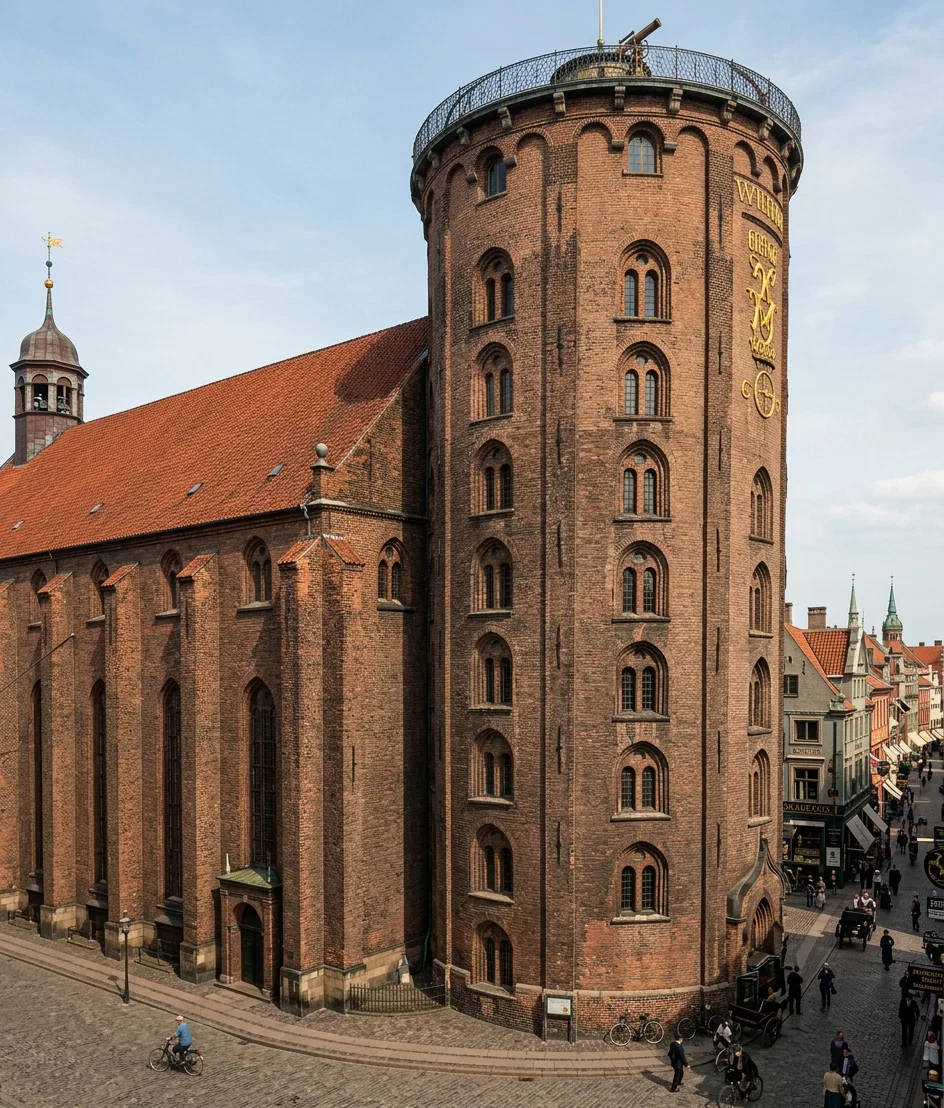
THE FAMOUS ROUND TOWER IN COPENHAGEN
1. That a chapel be erected at Skodsborg. Here is our largest European sanatorium. It has about one hundred thirty patients, and over a hundred helpers. But as our meeting-place here is only a small portable wooden building, seating about one hundred, almost any of the sanitariums we are operating in the Old World has better facilities to accommodate those who come together to hear the Word. Money and pledges amounting to 2,774 kroner were received toward this enterprise, but this is only a small part of what must be provided.
The finest people of Denmark, and leading men from Sweden and other lands, are among the guests of the Skodsborg Sanatorium; therefore to build a neat chapel there, and to furnish a good evangelical laborer to assist in presenting the message, as the delegates requested, are matters demanding earnest consideration, and as early a solution as possible.
One of Scandinavia’s great needs still continues to be a permanent union school. The Danish brethren feel this keenly, and they invited their delegates to the union meeting to be held in Orebro, Sweden, to do all they can to secure definite action looking toward the speedy establishment of such an institution. We were pleased to see the interest awakened by this educational question, and to meet several of the young men from America who are studying here to better fit themselves for the Scandinavian work.
The literature committee was asked to see to the preparation of small, cheap tracts to be widely circulated, on such topics as: Baptism; Not Under the Law but Under Grace; The Letter and the Spirit; The Two Covenants; Immortality; The Prophecies; Scripture References; etc. It was also recommended that a small stock of the Danish-Norwegian publications printed in the States be kept on hand by the Danish Publishing House. Hereafter the Danish Conference will grant licenses to its colporteurs, as is done in many other of the European fields where such strict laws are enacted by the government with reference to the sale of literature. There are twenty-four canvassers, who were granted permission to sell our publications at this conference. By a comparison we see that the sales of the Danish Conference amounted to $7,216 in 1904, against $13,663 in 1907, which was $3,178 more than in 1906.
A conference poor fund was started at the meeting, toward which ninety-two kroner were raised. This fund will be strengthened by a collection in the churches the first Sabbath of each quarter.
The Bible studies and the lectures of the visiting brethren,—L. R. Conradi, C. C. Jensen, N. C. Bergersen, and M. S.16Reppe,—as well as the assistance of the local ministers, and the health talks of the Skodsborg Sanatorium physicians, furnished meat in due season for the people.
The service Sabbath forenoon was especially blessed of God. A large number renewed their consecration to the Lord, and others made a start to serve him. In the afternoon, Brother Z. Sherrig was ordained, and following the ordination service, there was a good social meeting, in which nearly all present took part, as the congregation was divided up into sections. We should not neglect to mention the excellent music that was furnished at the meetings. There were about four hundred fifty in attendance at the largest gathering, on Sunday evening.
The tithe and offerings of the field show a good increase. Three years ago the tithe was $5,700, and the donations were $712. Last year the tithe was $8,122, and donations $1,612,—$412 more tithe, and $452 more donations, than the previous twelve months. One hundred persons were received into the church in Denmark in 1907, and there was a net gain of sixty-four in the church-membership.
Elder J. C. Raft was re-elected president of the conference, and Elder C. C. Jensen was chosen as vice-president. They are to be assisted by eight other evangelical workers, who labor among a population of two million six hundred thousand. All go forth to their work with better courage; for they have just attended the largest and the best meeting our people ever held in Denmark. They have more of the missionary spirit than before. The opening of the Abyssinian mission has been a help to the home work. The Sunday afternoon collection after the missionary talk of Elder Conradi, amounted to nearly one hundred sixty kroner.
Denmark is a promising field. We can but ask the brethren in other parts of the world to remember the cause here, where, small as the country may seem, there is still much work to be done, both by our ministerial and our institutional laborers.
Hamburg.
Self-Supporting Missionaries for Bolivia
By Ed. W. Thomann
CONSIDERING the need and conditions of the gospel work in Bolivia, I came to the following conclusion: If some of our faithful brethren in the States who have learned trades would come down here to this dark and neglected field, they might let the light of the threefold message shine at the same time that they were earning a moderate living by working at their trades.
For instance, if three young men who know how to make brooms would come, they might locate, one in La Paz, one in Sucre, and one in Cochabamba,—three of the principal cities,—and there they could make and sell as many brooms as they would need to maintain themselves, and also give Bible studies, distribute literature, etc., and serve as backbone to the companies of believers that might gather. Brooms are imported from the States and from Chile.
They would have to bring broom-corn seed, plant it, and do the work of broom-making from the very beginning. They would not make a great business out of it, but sufficient to give them and some of the new believers that might work for them, a modest living. I would be glad to give all the necessary particulars about the country and conditions, to persons who would desire to come to labor in that way in Bolivia. And I hope there will be such.
A self-sacrificing mechanic might also do a splendid missionary work, if he would go around from one little town to another, repairing sewing-machines, etc., and at the same time give literature to those who can read, and possibly sell some books, too.
Also shoemakers, or, better said, repairers, who know how to use that kind of leather glue or paste which is made and used in the States, could get work from the best people in the cities, and have many opportunities to spread the truth. There are plenty of shoemakers here; but the most of them do very ordinary work, and as far as I know, there are none who use or know how to use glue, or even know that it is used to mend shoes.
As the Testimonies are showing that our people in the States should spread over the world, going to places where there are no Adventists, I believe that a17few would do wisely to come to Bolivia. I mean not that they would make more money, or even as much, as in the States, by working at their trades, but they would at least support themselves, and, besides, they would be witnesses for the gospel truth, and that is what the Lord requires from us all.
Ed. W. Thomann.
Casilla 7, Cochabamba, Bolivia.
Canvassers’ Institute in Rio Grande do Sul, Brazil
By JOHN LIPKE
For some time we have seen the need of a revival in the canvassing work. Discouraging experiences with canvassers, the dropping of old methods, difficulties in shipping the books to the canvassers, time lost in waiting for books, and other matters not to be mentioned here, have contributed to the decline of the canvassing work, so that only two canvassers were left, and these worked only part of the time. During our last conference a field missionary agent was appointed, and we decided to hold a canvassers’ institute the following month with those who were willing to try. You will notice that I say “try.” A canvasser in this field has to meet peculiar difficulties not to be found in other fields.
We were indeed glad to welcome nine persons, three married and six single men at Taquary, to take part in the institute. Brother Brack and the writer gave the instruction. From the very beginning we received the blessings of God, the Holy Spirit being our instructor. We studied the Bible, the “Testimonies” on the canvassing work, the books they were expected to sell, and drilled each canvasser to give a fluent canvass of his book. Objections that a canvasser generally has to meet were also studied, and it was shown how he can meet such objections successfully.
As a lack of faith had hindered the work in the past, we gave lessons on faith, and showed that without fervent prayer a canvasser can not succeed. First we studied the life of the apostle Paul, who never lost sight of the aim the Lord had put before him. Like him the canvasser must steadily push forward, having as his aim the proclamation of the last message of salvation, overcoming all difficulties, trials, temptations, and persecutions by the power of God.
In studying the life of Jeremiah we considered the many difficulties he had to pass through, and how he was the faithful messenger of the Lord until the end. The experience of the twelve spies was also studied, showing that among those who call themselves Adventists are some who say that we can not succeed in the canvassing work, putting the difficulties before the canvasser. But every one of the canvassers should speak as did faithful Joshua and Caleb: “Neither fear ye the people of the land; for they are bread for us. . . . The Lord is with us: fear them not.”
Full of hope, faith, courage, and zeal, our brethren went out into the field. Five went out into the colonies in company with Brother Brack, who is going to remain with them until they do not need any more help. Years ago many books were sold in those colonies, but as we believe that where some of our books are sold, many more can be sold, we trust they will have good success.
Two went to the capital of our state, and one goes into the country, the most difficult field, where he had worked already a little with success. This brother is not afraid of the difficulties. He said: “I will keep on, even if I have to work four weeks before I sell a book.” Sometimes he will have to travel hours before he finds another house. Knowing all this, he went out gladly. We sincerely hope that this institute, and the sending out of these eight canvassers, will be the beginning of a new era in our canvassing work.
We know this truth must go, and the angels of God will accompany our brethren who have gone out to canvass. We look with interest for some good reports in the near future. JOHN LIPKE.
Spiritual Awakening in Manchuria
The Missionary Review of the World tells of a remarkable spiritual awakening in Manchuria, which it is believed is directly traceable to the religious revival in Korea. One of the missionaries, who had visited Korea, held a series of services for Christians in February. Special prayer-meetings were held for months previous in Liao-Yang and many surrounding out-stations, and when the missionary in charge began his meetings, the people were in a receptive spirit. After a prayer by one of the native elders who had been in Korea, the whole congregation was greatly stirred. Day after day from three to four hundred gathered together. Confessions were made and great blessings received. The missionaries write of it as a very sacred, awe-inspiring time, and yet joy-bearing for all in attendance.
Palestine
By W. C. Ising
DURING the month of June it has been my privilege to make a short visit through this field, affording an opportunity to get acquainted with the present situation and the needs. As the end is swiftly drawing nearer, the time has surely come when the work in this large field, comprising Syria, Palestine, Mesopotamia, and Arabia, with its approximate ten million population, should be more rapidly developed. Considering that the work has practically been started in only four places,—Beirut, Haifa, Jaffa, and Jerusalem,—and that there is a membership of only about twenty, including the workers themselves, it gives evidence of what there is yet to be done.
At Haifa, Sister Müller is laboring as nurse among the German colonists. I found her of good courage, although no definite result can be reported. I had the opportunity of visiting quite a number of the colonists, and holding interesting Bible readings with them, which, we hope, may lead to an awakening of an interest in the message.
At Jaffa there are at present four lay members who are doing their best in letting the light of the truth shine forth. We hope that this city may soon receive the help of a good worker. This is a very important city, it being the port of Jerusalem, with over forty thousand inhabitants. Oranges, wine, and other fruits, corn, oil, soap, and wool, are exported to the value of three million dollars a year.
This is the place, in Joppa, where King Hiram of Tyre sent the trees out of Lebanon in floats for the temple of Solomon. Here is also where the prophet Jonah attempted to flee from the presence of the Lord when he was told to go to Nineveh. From the apostolic days the house is still shown in which Peter is supposed to have lived during his long stay with Simon the tanner. Here he awakened Tabitha. When the time for the Gentiles had come, Joppa was the place where Peter had his vision from heaven to go to Cæsarea, to the house of Cornelius.
There are two families at Jaffa who seem interested in the truth, so there is a prospect of soon seeing an increase of the little company of believers. Through the death of our Brother Glenk, one of the German colonists, who was the elder of the Jerusalem-Jaffa church, the cause has lost a strong pillar in every respect. May the Lord soon fill his place. Our people are of good courage in the hope that their work and prayers may soon be rewarded by some fruits.
Our health institution at Jerusalem is having a good patronage at present, and our two workers (one brother and a lady nurse) are doing their best, and are of good cheer, notwithstanding the difficulties they must contend with. The misrepresentation of the gospel in many ways renders it much more difficult for the truth to compete with the corruptible methods of converting so-called “rice-Christians,” which are extensively introduced in Jerusalem. The true gospel, of course, can not compete with the same means.
It was very interesting to me, and must be considered as a sign of the times, that as a result of the Zionist propaganda, the Jews have been flocking into Palestine and Jerusalem from all parts of the world for the last few years. I met immigrants from Hungary, Russia, Australia, and other countries. In a confidential conversation with a Jew I was told that their aim is: Nationality, Language, and Land; and that Baron Rothschild is said to have already donated as much as one hundred million dollars for the purpose of re-establishing the Jewish nation. I was told that about sixty colonies have already sprung up throughout Palestine during the last few years. I was, in fact, very much surprised to find the city of Jerusalem so quiet on the Sabbath, which is due to the fact that the Jews, who are estimated at about fifty thousand of the approximate eighty thousand inhabitants, are controlling the commerce.
In Jaffa and Jerusalem we celebrated the Lord's supper, and encouraged one another to push forward, and improve every opportunity of building up the cause in this land. May the Lord bless our efforts to this effect.
W. C. Ising.