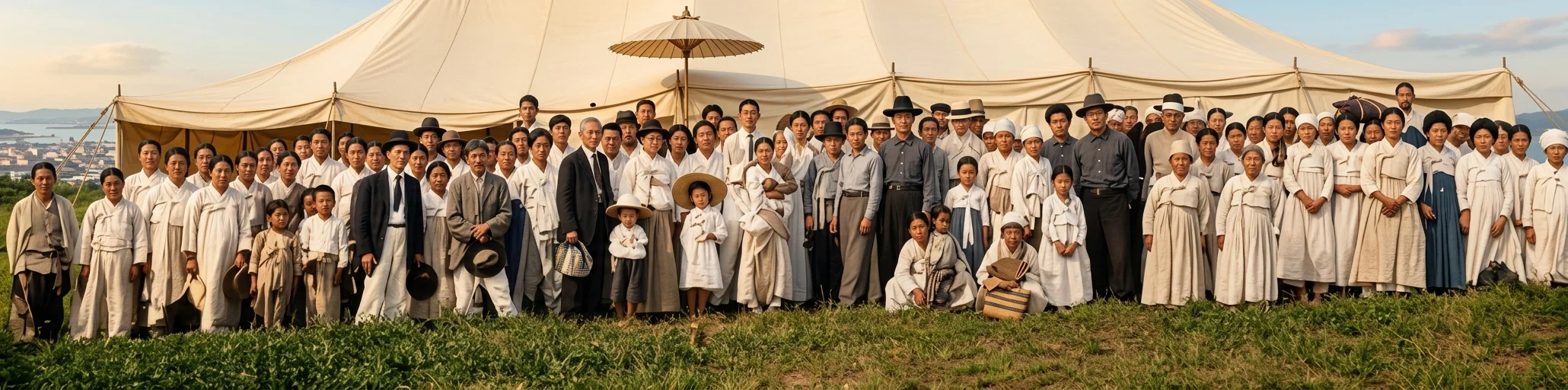
I had the privilege of attending the first camp-meeting ever held in Korea, or Chosen, the official name of the country now that it is Japanese territory.
The meeting was held at Chinnampo, on the west coast, about two hundred miles north of Seoul. Chinnampo is at the mouth of the Tatong River, about an hour's ride from Piengyang, where was fought one of the heaviest battles of the Japo-Chinese war.
The meetings were held in a tent, sixty by 28 x 56 feet, made by combining two meeting tents. The people lived in the church building owned by the mission, and in near-by houses, and many of the men slept in the tent. The foreign workers, fourteen in number, were accommodated in Japanese hotels. The tent was pitched in the edge of the city, on a hill overlooking the city and the bay; and although it was very warm during the entire ten days, yet there was always a fine breeze, which made it comfortable in the tent. The land upon which the tent was pitched is owned by our mission, having been purchased for a mission station. About 160 adults were present during the meeting, some of whom had walked over two hundred miles, supporting themselves while on the way and during the meeting by canvassing.
The usual camp-meeting program was followed, except that at the early morning service the foreigners were by themselves in the hotel, and the Koreans had the tent. These meetings for foreigners (we are the foreigners here) were times of great profit to us all as we sought the Lord together for help to do his work faithfully.
A regular business session was held each day, and all phases of the mission work received attention. As the result of the election of officers, C. L. Butterfield is superintendent; H. A. Oberg, secretary and treasurer; R. Russell, medical secretary; H. M. Lee, educational secretary; Mimi Scharffenberg, Sabbath-school secretary.
The report of the superintendent showed 107 baptisms during the present year. The regular monthly subscription list of their paper is 2,700, this number being reached during the nine months of the life of the paper, while 39,500 copies of regular and special issues have been sold during the past year.
The educational secretary reported sixty as the average attendance at the mission school, with prospects for a larger school the coming year, which opens August 23. Professor Lee will have charge of the boys' department, and Miss May Scott of the girls'.
FIRST SEVENTH-DAY ADVENTIST CAMP-MEETING IN KOREA, OR CHOSEN. HELD AT CHINNAMPO, WHERE WORK IN THIS COUNTRY WAS FIRST BEGUN, AUGUST 3-13. 175 SABBATH-KEEPERS PRESENT
The instruction given was of a practical nature, and different needs were given attention. In the evening the sermon was delivered in the native language. The tent was always well filled evenings, and many from the city stood outside and listened attentively.
The last Sabbath morning service will long be remembered by all present. After a rousing sermon by Elder W. R. Smith, in Korean, several men left the tent, one by one, while the meeting was still in progress, and on a hillside near by they together sought the Lord in a special manner, confessing their sins and asking forgiveness, until every man was free in Christ. At the same time a company of women were out on the other side of the tent doing likewise. The service in the tent continued until all could come together rejoicing in the Lord.
The meeting was a great success, and accomplished much good. Plans were laid to follow up the interest in Chinnampo, with a view to developing a church. It was felt that a new era had begun for the cause in Chosen, and the workers returned to their different fields of labor refreshed, and encouraged to press the battle to the gates, and to be true to their call to labor for souls for the Master.
It was a great pleasure to meet old acquaintances from the home land, and to engage in labor and share the blessings with the brethren and sisters in this great field.
HENRY DIRKSEN
By Henry Dirksen
Persia
HENRY DIRKSEN
THE brethren and sisters everywhere will rejoice to welcome Persia as the infant field into the large family of fields being reached by the third angel's message.
Coming from Baku, Russia, and passing hoary Mt. Ararat and the plain at its base, where Noah is said to have planted his vineyard, Brother Oster and the writer crossed the boundary-line, May 18, at Djulfa. While crossing the river that marks the boundary, a heavy rain descended, wetting but not injuring our belongings. We had no trouble at the Russian or Persian custom-houses.
We soon learned, however, the difference in traveling expenses in Russia and Persia. We paid ten dollars, third class, all the way across the great country of Russia, whereas we had to pay seven dollars by passenger automobile, the cheapest method of transportation between Djulfa and Tabriz, a distance of about seventy miles. We remained in Tabriz sixteen days, and then proceeded to Urumiah City.
Since we had to stop a little time at beautiful Lake Urumiah (marked on all maps of Asia), we decided to investigate the strange features of this body of water. It is twenty-five by one hundred miles in area, and is more salty than the Dead Sea, of Palestine. Not a single living thing is to be found in it. The water is shallow and very clear. Testing its swimming qualities, we found absolutely no effort necessary to keep above water. One simply can not sink.
We are now settled in Urumiah City, in the charming valley of the same name, and are studying hard to master the Azerbaijan-Turkish, spoken in this province. In the meantime we are forming friends among the foreigners here. People, manners and customs, sights and scenes, are different, of course, from those in either Russia or Germany. The climate is agreeable and healthful.13
We are surely glad to be able to say that ancient Persia, so often mentioned in Holy Scripture, and hitherto by us untouched, has now some representatives of the truth. Persia is nearly in the center of the Mohammedan population of the world. A difficult but interesting field is before us. Before our Saviour comes, even the Moslems must be warned. Pray for us.
Mother
By Orison Swett Marden
“All that I am or hope to be,” said Lincoln, after he had become president, “I owe to my mother.”
“My mother was the making of me,” said Thomas Edison, recently. “She was so true, so sure of me; and I felt that I had some one to live for; some one I must not disappoint.”
“All that I have ever accomplished in life,” declared Dwight L. Moody, the great evangelist, “I owe to my mother.”
“To the man who has had a mother, all women are sacred for her sake,” said Jean Paul Richter.
The testimony of great men in acknowledgment of the boundless debt they owe to their mothers would make a record stretching from the dawn of history to to-day. Few men, indeed, become great who do not owe their greatness to a mother’s love and inspiration.
How often we hear people in every walk of life say, “I never could have done this thing but for my mother. She believed in me, encouraged me, when others saw nothing in me.”
“A kiss from my mother made me a painter,” said Benjamin West.
A distinguished man of to-day says: “I would never have reached my present position had I not known that my mother expected me to reach it. From a child, she made me feel that this was the position she expected me to fill; and her faith spurred me on and gave me the power to attain it.”
It is a strange fact that our mothers, the molders of the world, should get so little credit and should be so seldom mentioned among the world’s achievers.
The world sees only the successful son; the mother is but a round in the ladder upon which he has climbed. Her name or face is never seen in the papers; only her son is lauded and held up to our admiration. Yet it was that sweet, pathetic figure in the background that made his success possible.
Many a man is enjoying a fame which is really due to a self-effacing, sacrificing mother. People hurrah for the governor, or mayor, or congressman, but the real secret of his success is often tucked away in that little, unknown, unappreciated, unheralded mother. His education and his chance to rise may have been due to her sacrifices.
The very atmosphere that radiates from and surrounds the mother is the inspiration and constitutes the holy of holies of family life.
“In my mother’s presence,” said a prominent man, “I become for the time transformed into another person.”
How many of us have felt the truth of his statement! How ashamed we feel when we meet her eyes, that we have ever harbored an unholy thought, or dishonorable suggestion! It seems impossible to do wrong while under that magic influence. What revengeful plans, what thoughts of hatred and jealousy, have been scattered to the four winds while in the mother’s presence! Her children go out from communion with her resolved to be better men, nobler women, truer citizens.
The greatest heroine in the world is the mother. No one else makes such sacrifices, or endures anything like the sufferings that she uncomplainingly endures for her children.—Orison Swett Marden, in Success.
Devotion to the Bible
Matthew Hale Smith, in his book, “Marvels of Prayer,” tells of a shipwreck, and of the rescue by Captain Judkins and the crew of the “Scotia.” Among the rescued was a lad, about twelve years old, who had lost everything.
“Who are you, my boy?” said Captain Judkins.
“I am a little Scotch boy. My father and mother are dead, and I am going to America to find my uncle, who lives in Illinois.”
“What is this?” said the captain, as he took hold of a rope that was tied around the boy’s breast.
“It is a piece of cord, sir.”
“What is that tied under your arm?”
“My mother’s Bible; she told me never to lose it.”14
“That’s all you saved?”
“Yes, sir.”
“Couldn’t you have saved something else?”
“Not and save that.”
“Didn’t you expect to be lost?”
“I meant, if I went down, to take my mother’s Bible down with me.”
“All right,” said the captain, “I’ll take care of you.”
Having reached the port of New York, Captain Judkins took the boy to a Christian merchant, to whom he told this story. “I’ll take the lad,” said the merchant. “I want no other recommendation; the boy that holds on to his mother’s Bible in such perils will give a good account of himself.”—Selected.
Let Us Be Kind
LET us be kind;
The way is long and lonely,
And human hearts are asking for this
blessing only—
That we be kind.
We can not know the grief that men
may borrow,
We can not see the souls storm-swept
by sorrow,
But love can shine upon the way to-day,
to-morrow,—
Let us be kind.
Let us be kind;
This is a wealth that has no measure,
This is of heaven and earth the highest
treasure—
Let us be kind.
A tender word, a smile of love when
meeting,
A song of hope and victory to those re-
treating,
A glimpse of God and brotherhood
whose life is fleeting—
Let us be kind.
— Selected.
South Russian Conference
By D. Isaak
D. ISAAK
We thank our Heavenly Father for protecting his children during the terrible cholera epidemic and other dangers. This field includes the governments of Bessarabia, Kherson, Ekaterinoslaf, Taurida, and the southwestern corner of the Don district. The population is about eleven million, made up of Russians, Germans, Jews, and others. Educational advantages are increasing, yet the greater portion of the people can neither read nor write.
The soil is very fertile, and the climate good. Crops seldom fail. Grains, vegetables, and fruits of all kinds are cultivated in abundance. Wheat, potatoes, cabbage, tomatoes, apples, grapes, and melons are among the main products. From its great mines, the earth also gives different kinds of coal, iron, and useful stone or rock. Great factories and mills have been erected here within the last few years, which are carrying on a large business, and are helping thousands of poor people to gain a livelihood. These are controlled largely by foreigners.
Crimea
The Crimea is the most famous health resort in Russia. Thousands come every summer to the cities of Eupatoria, Sevastopol, and Jalta for rest and various cures. Were a doctor to come here with two or three nurses and a cook, set up a health restaurant, bath-room, etc., work would be plentiful and success sure.
The Mission Work
With the help of the Lord, we have received 207 persons into the church in the last two years, and have organized four churches and two companies. The tithe has steadily increased.
With the Lord’s blessing, the work in Odessa, despite difficulties, has made a good beginning. At Ekaterinoslaf, Taganrog, and Berdiansk, where there are now young churches and a good interest, we plan to continue the work; but as we are very short of workers and means, we are obliged to let other cities, towns, and hundreds of villages remain waiting.
The interest in cities and villages is especially good. Doors and hearts are open. The Lord is our guide and helper. Our trust is in him. He must finish his work, and cut it short in righteousness.
There Is No Failure
IN God's world, for those who are in earnest, there is no failure. No work truly done, no word earnestly spoken, no sacrifice freely made, was ever in vain.
— F. W. Robertson.
Erysipelas: Its Causes and Treatment
By F. Fleetwood Taylor
Symptoms
PICTURE to yourself a bright red swelling, quite distinct from, and raised above, the surrounding skin, with surface smooth and shiny. At first it is small, but, if you watch closely, you will notice a great difference in a few hours; the discoloration seems to spread in all directions.
Now, just supposing you have the opportunity, touch the swelling, and you will find it is hot, tender, or even painful and “puffy,”—not firm like the surrounding tissues,—and if pressed with the finger, a small indentation remains.
Next, ask your imaginary patient how she feels. She will tell you she is very ill, has a headache, is disinclined to work or to eat; in fact, is sick at the sight of food.
The patient will further tell you she has not felt up to the mark for a few days, having had “a shivering fit” forty-eight hours before; or if it be a child who is ill the mother will exclaim, “O, yes; baby was in convulsions yesterday.”
This preliminary occurrence is nature’s warning to us that the patient has probably been exposed to some source of infection; and in a few days’ time, called—
The Period of Incubation
we shall know exactly what is wrong. Turning to our patient again, we must examine her more carefully. Most likely the rash is seen on the face, as this is the part commonly affected. We shall find in nine cases out of ten that the starting-point was a sore, cut, or wound. Or the origin may have been where the skin and mucous membrane join, as at the angle of the eye, nose, or mouth; or from a part of the skin roughened by irritating discharges from the nose or ear. Occasionally, the rash begins in the throat or nose, and shows itself afterward on the skin.
Frequently small blebs appear, which may unite into large blisters containing clear, yellow fluid. These break in time. Their contents dry up and form scabs, or crusts, which drop off as the inflammation dies down. Only if further infected through dirt and carelessness do sores result.
The most noticeable features of the case will be—
The Temperature
which rises rapidly, and continues high as long as the redness keeps on spreading. The pulse, however, is the better guide to the condition of the patient. Death seldom occurs if this disease be promptly treated, especially if it is uncomplicated with pleurisy or pneumonia.
During the attack the tongue becomes dry, foul, and in bad cases cracked and brown, while crusts appear on the lips and teeth. Delirium, or wandering of the brain at night, is not uncommon; and the nearest glands are always enlarged.
When the complaint is at its worst, the features are so swollen as to be unrecognizable; but all these symptoms gradually disappear on the fall of the temperature. Simultaneously the inflammation ceases to spread, the rash fades, the skin peels off, and in some cases there is a temporary loss of hair. If properly managed, the patient should begin to recover in from five to seven days, though with a bad constitution the fever may last two or three weeks or longer, especially if relapses occur.
Causes
Erysipelas is contagious, and is therefore due to what bacteriologists call “specific organisms”—minute cellular bodies arranged in chains like a string of beads. They are duly found in the lymph spaces and lymphatic vessels at the advancing margin of the rash, and have nearly always gained entrance to the skin through a cut or wound. There are, however, special circumstances, known as “predisposing causes,” which render people liable to this disease. Such are chronic alcoholism, diabetes, affections of the liver and kidneys; while personal hygiene plays a most important part, the exciting causes including bad or insufficient food, impure water, and lack of cleanliness.
There is little doubt that the infection is carried, not by the air, but by direct contact, i. e., by unwashed hands and dirty clothes. Insanitary surroundings, and accumulations of decaying vegetable or animal matter, favor the growth of the microbe. An eminent authority writes, “The presence of a dust heap near the window of a ward has been known to cause repeated outbreaks of erysipelas in the nearest bed.” Damp and cold weather seem to be specially associated with epidemics of this disease. Certainly it is most prevalent in spring and autumn, and now that the summer months have passed away all too quickly, it may be useful to us to know how best to deal with the complaint should we come across it.
Treatment
As its infectious nature has been explained, we must first isolate the patient, especially from those having wounds, or who are in delicate health. Keep her warm and comfortable in bed in a room with the window open three to six inches, and keep a little fire burning.
The bowels should be relieved at the beginning of the attack, and thereafter daily (if there be no natural evacuation), with the colon douche, or enema, of two pints of warm water.
The whole body should be sponged with tepid water night and morning—except the affected part, which should be bathed in water as hot as the patient can bear, softly and quickly dried, and dusted with flour from a dredger or through muslin. This protects the sensitive area from variations in temperature, and helps to form a scab, under which the new skin grows. If preferred, a cotton-wool mask may be made to cover the face and head. But poultices and cold applications only make matters worse.
While the fever lasts, the nourishment must be entirely fluid and of the simplest character—half a pint of cool milk and barley-water, with a few grapes or other fresh fruit, or a baked apple, every four hours from 7 A. M. to 7 P. M. Between these hours, if the patient is thirsty, let her sip boiled water, lemon-water, or water in which a piece of toast has been soaked. This regimen should be continued as long as the tongue is furred.
When the severe symptoms have subsided, we can add more milk, brown bread and butter, puddings, gruel, etc. During the period of convalescence, macaroni and stewed fruit may be allowed for dinner, or a vegetable stew nicely flavored and thickened with rice or pearl barley, besides the above-mentioned articles of diet.—F. Fleetwood Taylor, M. D.
Do You Pray?
LITTLE children, do you pray?
Do you thank the Lord each day
That he's kept you free from harm
By his strong and mighty arm?
For your home and parents dear,
For your friends both far and near?
For the blessings he doth give
That his children dear may live?
Do you ask him you to keep
When awake and when you sleep?
Child, the Lord is ever near,
Ev'ry little prayer to hear.
— Our Little Folks.
Praise and Kindness at Home
“Do not be niggardly of praise; it will inspire to better deeds and create an ambition for better living. Censure may utterly discourage the fallen, and certainly can never lift them up. Avoid giving all your smiles and politeness to the transient guest, the passer-by in the outside world. One of the most pitiful things I ever heard was the heart-broken wish of the little child of a man famous for beautiful manners in public: ‘O, wouldn’t it be nice if he would act that way at home!’ Sadder still is the case if the mother lets her ‘serving’ so cumber her that she has no time to be kind and courteous to the children.”
Life Sketch of Elder H. H. Wilcox
By J. W. Lair
At his home four miles south of Potsdam, N. Y., on the morning of Sept. 2, 1911, occurred the death of Elder H. H. Wilcox, in the ninety-second year of his age. He was born at Redfield, Oswego Co., N. Y., Oct. 3, 1819, and therefore lacked but thirty-one days of being ninety-two years old.
Elder Wilcox was married to Didean Miles in 1841. Her death occurred in 1892. To them were born three children, two of whom are still living, Malcolm Wilcox, of Iowa, and William Wilcox, of Hermon, N. Y. Lottie Wilcox Freeman, the only daughter, died about two years ago. From these sprang several grandchildren.
Elder Wilcox was married to Mrs. Eliza Anna McCuen, who lived but a few months after their marriage, falling asleep in the spring of 1895. In the fall of 1896 he was united in marriage to Mary A. Meacham, who has loved and cared for this faithful pilgrim during his old age and last sickness.
Brother Wilcox's religious experience began in the Methodist Episcopal Church. Later in life he became acquainted with the doctrines taught by Seventh-day Adventists through the missionary efforts of a lay member, and by reading tracts and papers which were placed in his hands by this brother. In 1889 he began publicly to proclaim his faith by lecturing on the prophecies. Being a shoemaker, he worked at his trade, then preached as long as his means lasted. Through the snow, rain, and storms of northern New York he traveled by foot in those early days, visiting the people in their homes, selling books, reading the Word, praying and preaching in schoolhouses, as the way opened.
Sept. 26, 1881, he was ordained to the gospel ministry by the Seventh-day Adventist conference. He has been a faithful minister of Jesus Christ, never failing to keep an appointment. He loved his work, he loved the people for whom he labored, and in turn he was loved by them.
Elder Wilcox was an instrument in the hands of the Lord of leading many to a knowledge of the third angel's message. Several of these are actively engaged in the proclamation of the message at the present time.
In his early experience as an Adventist, he was evidently a man of strong faith, being frequently called upon to pray for the sick. He has related some remarkable answers to prayer. He was a member of the New York Conference from the time of its organization. From the time he began to preach until his death, he sustained the relation of minister in the conference.
After his advanced age prevented him from engaging in active evangelistic labor, he continued to serve the churches of West Pierpont and South Russell with acceptance, his influence and instruction being of great assistance and encouragement.
During the past year Elder Wilcox was not able to go from place to place, yet he still retained the use of his mental faculties to a marvelous degree. At the annual conference held in Syracuse, Sept. 1-10, 1910, he bore a testimony of force and power, which was as clear and pointed as any he ever gave. His mind remained active and clear to the last.
ELDER H. H. WILCOX
It has been my privilege to make him frequent visits during the past year, the last being three days before his death. He spoke of his hope, and of the sure triumph of this message. He desired to live to see the Lord come, but was fully reconciled to sleep until the Life-giver comes. His strong constitution and great vitality combined with adherence to strict temperance principles, gave him a tenacious hold on life. He died of old age, and breathed his last as a child falling asleep. A large company attended the funeral services, which were held in the West Pierpont church. The discourse was based on Rev. 14:13. J. W. LAIR.
Northern New England Camp-Meeting
By W. B. White
This meeting was held at White River Junction, Vt., August 24 to September 3, and was attended by about two hundred fifty of our people from all parts of Vermont and New Hampshire, the two States that form the Northern New England Conference. Two years ago these fields united their interests, and concluded thereafter to walk together as one conference, and the union has been so pleasant and harmonious that we are sure they would not now dissolve it.
The camp was beautifully located about half a mile from the railroad station, on a wooded hill, and here about fifty family tents were pitched; a goodly number of near-by rooms were also occupied. Forty-five delegates represented the field; and an earnest, hearty, enthusiastic spirit seemed to pervade every session of the conference.
In order that more time could be given to the spiritual interests of the meeting, the delegates and most of the people assembled two days before the advertised date, and transacted the larger part of the conference business. This plan worked well and enabled our general laborers to give more time to spiritual interests. A few conference sessions were held during the regular meeting, for electing officers, granting credentials and licenses, and considering some matters of finance, but the pressure of business was greatly relieved by the above-mentioned plan.
The conference adopted resolutions urging that the Harvest Ingathering campaign be taken up with zeal and energy; that the action of the General Conference Council at Friedensau, recommending fifteen cents a week instead of ten cents a week per member for foreign work, be endorsed; that a fund be raised to assist small, struggling church-schools; that earnest attention be given to the French work in the conference; that new tents be purchased for evangelistic work; and that the worthy poor receive careful attention. All these and other resolutions were adopted heartily, and we believe with a spirit which means success for the work.
This camp-meeting was the largest held in this field for some years. New power and life is taking hold of the work in Northern New England. There is now in the field a strong, vigorous class of middle-aged workers, who are pushing the work into new fields, and fruit is beginning to appear. If these workers will now stand unitedly, keep close to God, and press hard the battle, great victories will be gained for the cause.
During the meeting about $600 was raised in cash and pledges for different departments of the work, and plans were laid which will call for a considerable sum of money from the churches the coming year. We believe our brethren will be liberal with the cause of God.
The most important feature of the meeting was the deep spiritual current which ran through the entire session. The power of God was present, hearts were converted, and backsliders were reclaimed. We doubt if any one left the ground without giving his heart to God, and this we believe is as it should be. God met with his people, and it was good to be there. Union, harmony, and love prevailed, and we certainly look for great things in the future from Northern New England.
The following persons were present from outside the conference: L. W. Graham and wife, of New York City; Elder R. D. Quinn, president of the Greater New York Conference; Elder H. C. Hartwell, president of the Massachusetts Conference; Prof. C. S. Longacre and Leon W. Cobb, of South Lancaster Academy; C. J. Tolf and M. M. Hare, representing the canvassing and young people's work; and the writer.
Elder W. H. Holden was again elected president, and Brother R. B. Clapp was ordained to the gospel ministry, his brethren feeling that he had given proof of his calling.16
Thus closed a good camp-meeting for Northern New England, and the brethren and sisters were full of faith and courage as they departed to their homes.
W. B. WHITE.
The French Department
By Ole Andres Olsen
Three Important Moves
We are glad to report progress in the French department of our work. At the South Lancaster Academy a French department has been opened, and now for the first time we can invite our young people from among the French in this country to a school where they can be instructed in their mother tongue, and obtain a preparation for some part in the Lord's work among their own people. Such an opportunity should have been provided long before this. Because of this lack we have lost much, and the work among the French in this country has suffered greatly. But now the way is open and opportunities are offered for the training of workers; and we sincerely hope that it may be fully appreciated and utilized.
In our visit among the French in Michigan, Wisconsin, and the East, as well as in Canada, we met with a large number of young people all the way from sixteen to twenty-five years of age that now should avail themselves of the opportunities afforded by our French school. Will our French-speaking people give this matter their most earnest consideration, and do all they can to encourage the young people to attend our French school? and will they give them such assistance as may be needed to help them to get started? Elders and other officers in our churches should take a special interest in this matter. Then, besides the young people, there may be those of more mature years that should attend. We are in sore need of earnest and faithful laborers for this great French field in America and elsewhere.
Another important move is the printing of a magazine in the French language, La Sentinelle (the Watchman), of thirty-two pages besides the cover. It is beautifully gotten up, and presents a very pleasing appearance. It is printed by the International Publishing Association, at College View, Neb. The issuing of this magazine in the French tongue should give a new impetus to the work among this people. Never before have our French-speaking brethren and sisters had such a beautiful paper filled with present truth to circulate in this country.
This affords an opportunity to revive the home missionary work; and as this magazine is offered on the same terms as the English, the way is open for self-supporting missionary work. We hope all our French-speaking people will take advantage of this opportunity with real earnestness. And not only our French-speaking people, but those who speak English, German, or one of the Scandinavian languages can take part in the circulation of this French magazine, and thus help on the good work.
We can also report another move of interest. At the biennial council of the General Conference Committee held at Friedensau, Germany, July 4-16, 1911, it was arranged for Elder John Vuilleumier to come to America to connect with the French work in this country. We now learn that he has arrived at Montreal, Canada. This is a valuable accession to our French work. Canada is an important French field, where we have a number of believers, who have proved themselves faithful; but as there has been no one to lead out in this tongue, the work has been somewhat at a standstill.
Elder Vuilleumier is a laborer of experience, and with his coming we believe we shall see a decided revival of the work among the French in Canada. With the French department at the South Lancaster Academy, the French magazine, and the reenforcement of laborers, we have reason to look for a decided forward movement among the French-speaking people in this country. May the special blessing of the Lord attend this effort is our earnest prayer.
O. A. OLSEN.
Northern Illinois Camp-Meeting
By William Covert
This meeting was held in City Park, Aurora, Ill., August 22 to September 3. It was attended from without the conference by Elders A. G. Daniells, O. A. Olsen, Allen Moon, J. J. Westrup, J. B. Blosser, Profs. H. R. Salisbury, M. E. Kern, and O. J. Graf, and Brother I. A. Ford.
The preaching and teaching were so practical and good that the people were filled with gladness as they listened. The remark was frequently made by tenters and visitors that the camp was the most beautiful they had ever seen, and the meeting the best they had ever attended. Of course our meetings should become better as we come nearer to the end and get into closer union with our Lord and the truth.
Thousands of dollars have been spent by the city in providing facilities and in beautifying this park. Nature has done much to beautify with hills and groves the fifty acres on which we camped; and the art of man has made walks and planted flowers and shrubs to please the eyes and lift up the hearts of all who behold them. And the grounds, with spacious dining-hall and electric lights, were given freely to our people for the twelve days of convocation.
About seventy tents were pitched, and all made for dwelling purposes were occupied, yet there were not canvas homes for all; so many people had to seek lodging in the city.
The weather was so fine that it seemed a constant smile from heaven almost every hour of the period. There we were made to know that God's people can abide under the favor of heaven without criticizing any one, and without murmuring at Providence.
It was estimated that 400 of our people were present at least a part of the time. Seventeen were baptized by Elder Magoon in the little lake upon the campground. Three new churches were received into the conference. The tithe for the year 1910 was $24,923.86, which was nearly nineteen dollars a member. The subscription book sales and the magazine sales were more than any previous year; I have not the statistics at hand, so can not report the exact amount.
The Tri-City Sanitarium reported that the institution had enjoyed the largest patronage of any time during its history. It had made substantial gain in its finances.
Since the graduating exercises, when eight nurses were graduated last spring, many of the physicians in the city have been bringing patients to the sanitarium. Some divine influence has enabled them to see that our nurses and our methods are just what the afflicted people need, so they have been keeping the house full of people.
Fox River Academy, located in this conference, having been remodeled and put in good condition of late, reported a full school for the past year, with a gain of $1,000 in its operations. Its prospect for the year just opening is very bright. The applications for places in the school next year are calling for all the rooms in the institution.
The proceedings of the annual conference passed off harmoniously, and the majority of those who filled offices of trust during the past year will serve the same good cause during the year to come. But the writer, who has served as conference president in Northern Illinois for the last six years, and who was first called to the conference presidency when the Indiana Conference was organized thirty-nine years ago, lays off the official burden of conference work now, and our dear fellow worker, Elder George E. Langdon, will put on the official harness in the Northern Illinois Conference.
We surely believe God will bless Elder Langdon's labors here, and that our people will sweetly cooperate with him as they have so kindly done with his predecessor.
I most sincerely thank the Lord that although I have just about completed my threescore and ten years, and have invested forty of these in labor for this good cause, I am yet able to labor in the ministry. Not this only, but I feel wholly disposed to push forward in the blessed way which leads to our Lord's second coming. We are assured that some who have been long in this way shall abide till his coming.