EVERY day there is a narrowing down of the chasm that so long has stood between Catholicism and the great so-called Protestant world. This tendency is being swiftly advanced by the church-federation movement. That movement, while having directly in view only the union of Protestant bodies, is bringing to light the fact that a strong sentiment exists, and is growing, for the union of Christendom in one religious body. Who will be recognized head of such a union, is a question not difficult of solution for the one who has made a study of those prophecies dealing particularly with the time of the end.
The patriarch of the Greek Orthodox Church, at Constantinople, has been carrying on an active propaganda to bring about the union of Christendom by uniting his own church “with those two grand and venerable offshoots of the Christian religion, the Roman and the Protestant Churches.” A theological professor of the Greek Church has published a book advocating the same thing. In this he takes up the various points which divide these three great bodies and the points on which they may unite. He reaches the conclusion that all may come together on the Nicene Creed. This professor and the patriarch of the Greek Church urge the religious bodies named to study their own characteristics in fraternal charity with a view to this union. Here is what the different bodies are to do in order to bring about the desired union: Protestants are to recognize tradition as of equal authority with the Scriptures; Calvinists are to accept the doctrine of the Real Presence in the sacrament; Roman Catholics are to give up the Filioque, and recognize infallibility in the universal Church, and to recognize Jesus Christ as sole head of the Church, and the pope as simply bishop of Rome; the Greek Church would recognize the validity of baptism administered by other churches, advocate union among all churches, and “show itself very liberal with regard to articles of faith not defined by the creed.”
Now, while this may not be the way in which the matter will finally work out, it certainly is significant in showing how the spirit of “confederacy” is springing up in all the world. A desire to unite in one body has taken hold of the people.9
Concerning this movement the Christian Work and Evangelist, the most influential organ of the Presbyterian denomination, has this to say:— “The genial spirit and honest intention of the Patriarch and those who are with him are beyond question, as is the evidence that these excellent people are far from realizing the significance of the concessions they ask. But we may echo their desire that ‘bishops and pastors of all the churches would regard one another as brothers in Christ, and would voluntarily engage in frequent fraternal correspondence regarding events in their respective fields, and that theologians would do the same, in order to peace and union of minds.’ And also that a modus vivendi should be established among all missions to the heathen, of whatever church, that the spirit of Christian brotherhood may be made manifest to them. We are seeking unity and federation among Protestants. When shall we be as large-minded as this Greek Patriarch, and include in our effort the churches of Rome and the East?”
There is nothing that takes with this age like the cry of liberality and large mindedness. It is that cry that is turning schools of theology into schools of infidelity; and the rapidity with which that change is now going on shows the power there is in that rallying cry. The strong drift of the popular tide toward church federation will soon make manifest the fact that that movement is to find its culmination in the federation of Christendom. It is a long step toward that consummation, and, as the extract above quoted indicates, the idea of that consummation is already in the air. Protestantism and Catholicism will soon clasp hands across the gulf that has so long separated them. The prediction that this would be was made years ago. We see now the beginning of that movement in which this prediction will find its fulfilment. Then will meet its fulfilment that scripture which reads: “And all the world wondered after the beast.” Rev. 13:3, 4. That never could be without a voluntary unification of the religious world under one system. That that system will be the Papacy, is abundantly proven in the books of Daniel and the Revelation. So, with all this evidence, we can not see the beginning of this movement without knowing what the end will be.
BAPTISTS AS NATIONAL REFORMERS.
By G.
At a National Reform Convention held in Lincoln, Neb., last month, Dr. Rowland, a Baptist minister of that city, reiterated the standing National Reform dogma that “the appointment of chaplains for legislative bodies, for prisons, and for the army and navy, and the use of the Bible in connection with the administering of the oath of office, and many other Christian customs, prove this to be a Christian nation.”
The speaker seems to have overlooked the fact that the maintaining of an army and navy at all—bodies of men armed with carnal weapons, upon which the government relies for defense—is positive proof that this is not a Christian nation. The Christian’s offensive and defensive weapon is the “sword of the Spirit, which is the Word of God.” The Christian’s weapons are “not carnal,” they are not the weapons of the world, for the reason that “we wrestle not with flesh and blood.” The true Christian is “endued with power from on high,” and the “whole armor of God” is “the breastplate of righteousness,” the “feet shod with the preparation of the Gospel of peace,” the “shield of faith,” the “helmet of salvation,” and the “sword of the Spirit.”
How, then, can a nation whose dependence for defense, as well as for aggressive warfare, is in an army and a navy, be a Christian nation? The President of this nation but recently asserted that the Monroe doctrine, which is declared by all political parties and upheld by most of the pulpits, can only be sustained by keeping an army and navy strong enough to enforce it. The Monroe doctrine is a leading principle of the nation, one of the few strenuous measures upon which all parties agree; but is it Christian? How about the Golden Rule? How about the instruction of Christ, “I say unto you, That ye resist not evil; but whosoever shall smite thee on thy right cheek, turn to him the other also”?
The continual clamor by the “powers that be” for an increase of the army and especially of the navy, is proof that this nation is being removed farther from the Christian standard as the years roll round. A retired officer of the navy is at this time touring the country advocating an enlarged navy, his purpose being to increase an already widespread sentiment in favor of such a policy.
Another speaker at the Nebraska convention was Dr. McAllister, who, being one of the original National Reformers, would, unlike the Baptist minister who preceded him, naturally be expected to take such a position as he is reported to have taken. Believing, as he does, that the church should have a controlling influence in shaping the policy of government, we are not surprised that he should argue that the foundation of civil government (the government of a Christian nation) “must be sufficient to bear up a structure that has power to punish by imprisonment and even by death.”
Of course this is true with reference to the legitimate function of civil government. But the National Reform idea is that all “Christian laws and usages” shall be made the law of the land. This fact gives the true indication of the National Reform theory that civil government should have the “power to punish by imprisonment and even by death.” This shows the extent to which the National Reform doctrine leads in the matter of enforcing religious dogmas by civil law.
As before stated, we are not surprised to see Dr. McAllister taking such a stand, for other leaders in the cause have openly avowed the death penalty for infidels and other persistent opponents of the Church-and-State scheme. But we have not yet become so used to seeing Baptist ministers standing on the National Reform platform as to take it as a matter of course. We are somewhat assisted in getting used to it, however, by the spectacle of another Baptist minister, Dr. Braislin, of Colorado Springs, who “welcomed” a National Reform Convention to that city, March 17. G.
In the Balkans
The power companies that are now taking water from the Niagara Falls to produce electricity, and the companies that have filed applications for permits to do the same, will soon, it is said, reduce the volume of the falls by at least one-fifth. At this rate, it will not be long until the greater part of the flow will be diverted, and the beauty of the great falls will be sacrificed to utility.
In the Balkans.—It is impossible to predict what may occur at any time in the Balkan States when an apparently insignificant act may precipitate a terrible conflict. The entire population of Macedonia, except the Bulgarians who are living there, are said to be armed and ready for an uprising. The revolutionists claim to have 100,000 men who will take the field the latter part of April. There is no doubt that war would now be in progress had it not been for the warning of Russia and Austria, and they are still trying to hold the threatened uprising in check. But Russia’s consul has been killed at Mitrovitza by an Albanian soldier, and Turkey has merely imprisoned the soldier for fifteen years, not daring to do more because the bodyguard of the sultan is composed of Albanians. His chief counselors also are Albanians. Russia is reported to regard the punishment of the Albanian soldier as almost equivalent to an insult. Under ordinary circumstances she would not be disposed to regard it as adequate reparation. She may accept it, however, in view of her desire at the present time to prevent hostilities. In the meantime a reign of terror exists in the Balkan States among the inhabitants themselves. Frequent massacres are reported on the part of both factions. A Bulgarian band is reported to have massacred all the inhabitants of a Mussulman village, numbering 165, with the exception of a very few who escaped by flight; and the Turks are reported to have massacred the inhabitants of one entire village. The Bulgarian minister of war has gone to the frontier to perfect arrangements for preventing further Bulgarian bands from entering Turkey, and the Russian and Austrian governments believe in their ability to prevent matters from coming to a crisis. On the other hand, the king of Servia has declared that fateful times are approaching and that Servia must be ready to strike at the proper moment. The Turks are massing troops in “Old Servia,” and King Alexander of Servia states that he will be compelled to do the same. The Albanians are holding as hostages the men sent by the sultan to pacify them. In view of the jealousies of the powers, the prospect of a war in the Balkans is regarded as a very serious matter.
America and the Powers.—A report from Washington states that Germany and Great Britain have proposed to the United States that it join them in a demonstration against the government of Guatemala to enforce a settlement of that country’s foreign obligations. Secretary Hay replied to the proposition, declining to join in the proposed action, but declaring it to be America’s purpose to guarantee to her citizens in Guatemala whatever benefits might be obtained for English or German citizens in that country by such action on the part of the powers named. At the International Agricultural Congress recently held in Rome, Italy, at which representatives of the various European governments were present, a proposition was put forward for a sort of confederation of European nations to check American competition. There was diversity of opinion on the matter, and it was finally decided to postpone action until the next congress.
Labor Items.—The executive board of the United Brotherhood of Carpenters and Joiners, which met in Indianapolis April 13, had booked for consideration 350 strikes in the United States. The great strikes of laborers in Holland have been declared off, the strikers having given up the fight. By a law just passed as an urgency measure, the whole military and naval power of the kingdom may be called out to prevent strikes on government railroads. The appellate division of the New York Supreme Court has decided that a labor union has no right to order its men to quit work where the only question at issue is the refusal of an employer to recognize the union or its representative. A St. Petersburg despatch of April 8 says that thirty persons were killed and a hundred injured during labor disturbances at Nijni Novgorod, Russia. The union labor leaders of Los Angeles are dissatisfied because no arrangement has been made for their review by President Roosevelt, on his approaching visit to that city. They have written to the President direct that they have been ignored, and desire him to review a parade of labor unions in the evening. On the other hand the secretary of the committee says there has been no ignoring of any one, as no civil organization has been invited to participate in the parade. He says the President had asked that there be no long parade, and that the public function be brief. The strike at the Gwin mine, at Paloma, Amador County, Cal., is said to be over, the superintendent conceding a nine-hour day. But he refused a raise of wages or to recognize the union. He will treat all classes alike. The people of the town had urged the men to go to work, and they would have done so, but the union would not agree to it. However, when the superintendent began making arrangements for a permanent closing of the mine, the employees came to him for terms. An attempt to unionize mill hands at Clovis, Fresno County, Cal., failed because the movement was opposed by half the employees and discouraged by the employers. The American mechanics at Hilo, H. T., have organized against the Asiatics, and petitioned the Legislature to license contractors and mechanics, and to issue such licenses only to citizens of the United States. The Association of Manufacturers, in convention at New Orleans, have devoted much time to a discussion of the labor question, and adopted a code of principles. They are not opposed to organizations of labor, but are opposed to boycotts, blacklists, and interference with the personal liberty of employers and employees. They also declare that “no limitation should be placed upon the opportunities of any person to learn any trade to which he or she may be adapted.” At Cleveland, Ohio, April 15, fifty striking firemen boarded a steamer from Duluth, and beat in a horrible manner three non-union firemen employed on the boat. In Vermont a manufacturing company has been awarded damages against strikers because of a boycott, and the property of the members of the union has been attached for the judgment. An appeal has been taken.
A race riot occurred in Joplin, Mo., on April 15. A negro had killed an officer, and a mob soon had him swinging to a telegraph pole; but this did not satisfy the fury of the mob, who practically took possession of the city, so far as order was concerned. The mayor and the police force were powerless to quell the riot. The mayor ran from corner to corner, and mounted boxes, arguing with the crowd to preserve the peace; but all authority was swept aside, and the mob drove the negroes into the negro quarter. Then the mob charged on the negro quarter, smashing windows and doors, and actually setting fire to a number of houses. The fire department turned out and the rioters sought to prevent the firemen from extinguishing the flames. In this they were partially successful, and several of the houses were consumed. The report states that “apparently a frenzy had seized the people, and the whole city was in an uproar.” Every colored person was driven out of the city. The increase of such scenes as this is a striking sign of our times. Violence is in the air, and the people are being taught more and more to resort to it in the accomplishment of their objects. It is seen in the boycotts, and in all the labor controversies, in robberies and frauds and embezzlements, in murders and unjust prosecutions; and we will see more and more of it as greed and cruelty increase in the service of self.
A new association was recently formed at Indianapolis, styled the American Association of Independent Merchants. The purpose of the organization is to protect non-union men who do not care to affiliate with unions, to encourage industry, economy, thrift, and honesty among its members; to maintain amicable relations between employees and employers; to assist its individual members in obtaining the highest wages consistent with the general good; to promote all forms of productive energy; to prevent all unjust discriminations against any person; to furnish favorable conditions for apprentices; to provide trade educations for members, and to compel labor unions to observe and respect the laws. The organizers are men who are connected with the non-union unions already in existence, and the idea of a national organization grows out of a request from employers and employees in many States that such a national organization should be formed. Similar articles will be filed in a number of States, and the non-union unions formed at Anderson, Muncie, Columbus, and other places, will be affiliated with the national body. And so the unionizing of hostile forces goes on. Instead of unionism bringing men together for mutual benefit and general harmony, it is bringing hostile organizations into battle array, setting them in order to strive for the mastery. Only a union with Christ, in charity for all, can effect a real “bond of peace.”
Extensive frauds have been unearthed in the administration of affairs in Porto Rico. Serious charges have been preferred against officials high in the service there. For some reason not satisfactorily explained there has been pressure from officials of the home government upon the officials of Porto Rico to stop the prosecutions in the matter. The insular police have taken possession of the city of Mayaguez and displaced the municipal police because of frauds in connection with the expenditure of a $200,000 loan, and a number of the city officials have been arrested. A Missouri grand jury has issued indictments against seven persons, some of whom are State senators, for bribery in connection with certain bills in the Legislature. Another get-rich-quick concern has been discovered in Chicago and its promoters arrested, but not until they had made many thousands of dollars by inducing people to buy stock in their concern. An investigation of the books of the Metropolitan Street Railroad Company, of New York City, is reported to have shown fraudulent transactions to the extent of $30,000,000. This money was reported from time to time paid out for work that never was done, or for the settlement of bills that had already been paid, and the money was then appropriated by those who made the fraudulent entries.
In the Philippines.—After three days’ fighting, the American forces in the island of Mindanao have captured the stronghold of the Moros. In the battle it is reported that 100 of the Moros were killed and many more wounded. Eleven Americans were wounded. The sultan of Bacolod has fled, and it is believed that this battle has put an end to regular armed resistance in that island. Bandit bands, however, are reported in operation in different parts of the Philippines, and there will probably be a continuance of such acts for many years to come.
BIBLE IN THE PUBLIC SCHOOLS.
The question is a live one, and the constant demand for it, oftentimes from secular papers, shows clearly the desperate feeling on the part of many over the moral condition of children generally. One California paper, in pleading for the Bible in the public schools, declares that “the only way some of the present generation would ever hear anything from its pages is to have it read to them in the public schools.” And this may be so; but the public school is not the place to teach it. The Tribune of this city has the following just comment upon this matter:—
The Bible is not excluded from the schools because there is anything wrong in reading it, but because its presence there raises an issue of creeds and creates religious dissension. Which Bible shall be read? The Catholic version differs from the Protestant version.
There is plenty of time to teach the Bible and inculcate other religious instruction in the churches and Sunday-schools, and around the family fireside, and parents who neglect their duties in this respect have no right to assume that the State should supply religious teaching, which must necessarily be sectarian and discriminatory.
In moral grandeur the Bible surpasses all other books. It is the noblest literature in any tongue. But it can not be taught in the public schools, because people can not agree upon the letter or the meaning of its text, and because some dispute its sacerdotal character altogether. Some accept one-half and reject the other half. Still others have books that they consider more sacred and more of a revelation of the purposes of the Divine First Cause in dealing with man. Our government is founded on complete freedom of conscience, and the system of free education which embodies the spirit of our institutions is constructed on the broad Catholic theory that all sects and beliefs are equal before the law if not in the sight of heaven. When the law undertakes to define what is false and what is true, it then becomes the instrument of oppression and persecution. If our contemporaries would more carefully read and study at home the example and teaching of the Man of Galilee they would be less inclined to force Bible readings in the public schools.
And all this is true as regards any religious dogma or institution.
SOCIETY
By Mary Wood-Allen
BY MARY WOOD-ALLEN, M. D.
Courtship.
Courtship primarily means courtesies rendered with the object of gaining favors. Secondarily it means the time when two young people pay each other especial attention previous to a declaration of love, more particularly a man's wooing of the one whom he admires and desires to win as a wife.
Courting then means being polite or courteous with the hope of obtaining something greatly desired. This being the case it is not surprising that during courtship the young people display their best manners, their most admirable qualities, and, without intending to be deceptive, or even realizing that they are, they may convey very erroneous impressions concerning themselves, more particularly if there has been no previous acquaintance.
A frank friendliness is very desirable as a prelude to a courtship. But even with the knowledge of each other which comes through such a friendship, there is need of a more perfect acquaintance if these two are to enter into the closer relation of marriage.
It does not matter in a mere friendship whether two people are absolutely sympathetic in their tastes and feelings, but it does matter in marriage. Two friends may be quite dissimilar in their likes and dislikes and rather enjoy the occasional arguments which may arise from this dissimilarity; but arguments and discussions in the daily life of two people who can not get away from each other with a feeling of perfect freedom to do as each pleases, are not conducive to happiness. It will do to “sharpen the countenance of a friend,” but not of a husband or wife.
It does not matter if the tastes of two people as regards reading are not sympathetic, if they read always apart from each other and ask nothing in the way of mutual appreciation. But when a man and woman sit at the same fireside the whole year through, and one goes to sleep while the other is reading Emerson or Browning aloud; or exclaims disgustedly, “Bosh,” when called upon to admire the writings of some noted author, there must result an intellectual alienation which will grow with time.
In a friendship it does not matter if one delights in the drama and the other never frequents the theater, but if the husband desires to go to the play and the wife has conscientious scruples against it, there comes a separation in the times of recreation which creates a breach between them in the hours when they should be happiest. It does not matter if one of two friends enjoys a symphony concert, and the other has no musical taste or delights only in “rag time” melodies; but such a difference of tastes in the home will be a drawback to the fullest happiness.
There may be much enjoyment in a friendship of intellect only when spiritual aspirations are not sympathetic, but this can not be so truly said of marriage. “Be ye not unequally yoked together.” No yoking together is so unequal as where one is a devout Christian and the other a skeptic or infidel. No home can be ideal where there is not harmony in belief and aspiration. It does not matter so greatly if the differences are only in denomination if the fundamentals of belief are harmonious; but the unity of home-life is destroyed if the beliefs of husband and wife are antagonistic. There can not be perfect identity of life, of unity, of feeling, between Catholic and Protestant, Evangelical and Unitarian, Sabbath-keeper and Sunday-keeper, Christian and unbeliever.
But why not let each go his own way, allowing the other perfect freedom in belief? You can do that in a friendship, but marriage is more than friendship. It must—to be a true marriage—be founded on congeniality of tastes, harmony of beliefs, sympathy in aspirations, identity of interests, community of purpose. Even if the two remain alone in their family life these things are necessary to a perfect union, but if children come into the home the imperativeness of these factors becomes greater. In order that children may develop harmoniously there must be absolute sympathy between the parents. Division even of sentiment is fatal to the most perfect home influence.
This time of courtship, then, is the time when the two should learn each other's true selves. There should be no hiding, no putting on. There should be a frank interchange of opinions on all vital topics, not arguments or discussions with the intention of converting each other, but an honest expression with the desire to know each other.
Instead of indulging in sentimentalities and coquetries they should converse together, read together, pray together if possible, and so come into the understanding of each other which will make it possible to form somewhat of a correct judgment as to the possibility of their living harmoniously in the closer relation of husband and wife.
There are many topics of thought, many fields of investigation, many problems of vital interest to humanity which they might discuss with interest and profit, and the truest courtesy of a courtship is to be entirely frank in the expression of beliefs and opinions. Nothing but future unhappiness can possibly be gained by withholding a knowledge of one's true self in courtship.
Among the subjects to be considered before the final decision, is the question of personal harmony. Each individual carries about with him a personal atmosphere, which, altho invisible and intangible, makes itself felt by all who come within its reach. This personal atmosphere may be very agreeable, or quite the contrary. It seems to depend upon physical conditions, rather than intellectual or moral states. Two people may be very congenial intellectually and yet their personal atmosphere be very antagonistic. Or they may have similar spiritual aspirations, but find that in each other's society they are not able to manifest them in actuality. Harmony of personal atmosphere is absolutely indispensable to a happy marriage.
A young lady once wrote me that she was engaged to a man whom she greatly respected and admired, and when he was not with her she thought she loved him, but she could not bear to have him approach her, and she asked what she should do. Would not this physical antagonism be apt to vanish after marriage?
From my observation of such cases I could not advise her to enter into life-companionship with one who already had an unpleasant influence upon her. If two people are the greatest of friends intellectually or spiritually, if their bodily presence seems to weary or irritate one or the other, it would be the part of wisdom to keep their association wholly on the friendly basis, retaining the right and power to avoid too frequent meetings. If such physical antagonism is discovered after marriage the only remedy is to recognize it, and, with loving consideration, avoid the too constant and too near association which usually maintains, and so avoid the causes of irritation. No doubt much marital unhappiness, or even divorce might be avoided if this matter were understood and due allowance made for a condition which does not depend upon affection, and which can not be changed by will-power.
THE CIRCULATION.
By A. J. Sanderson, M.D.
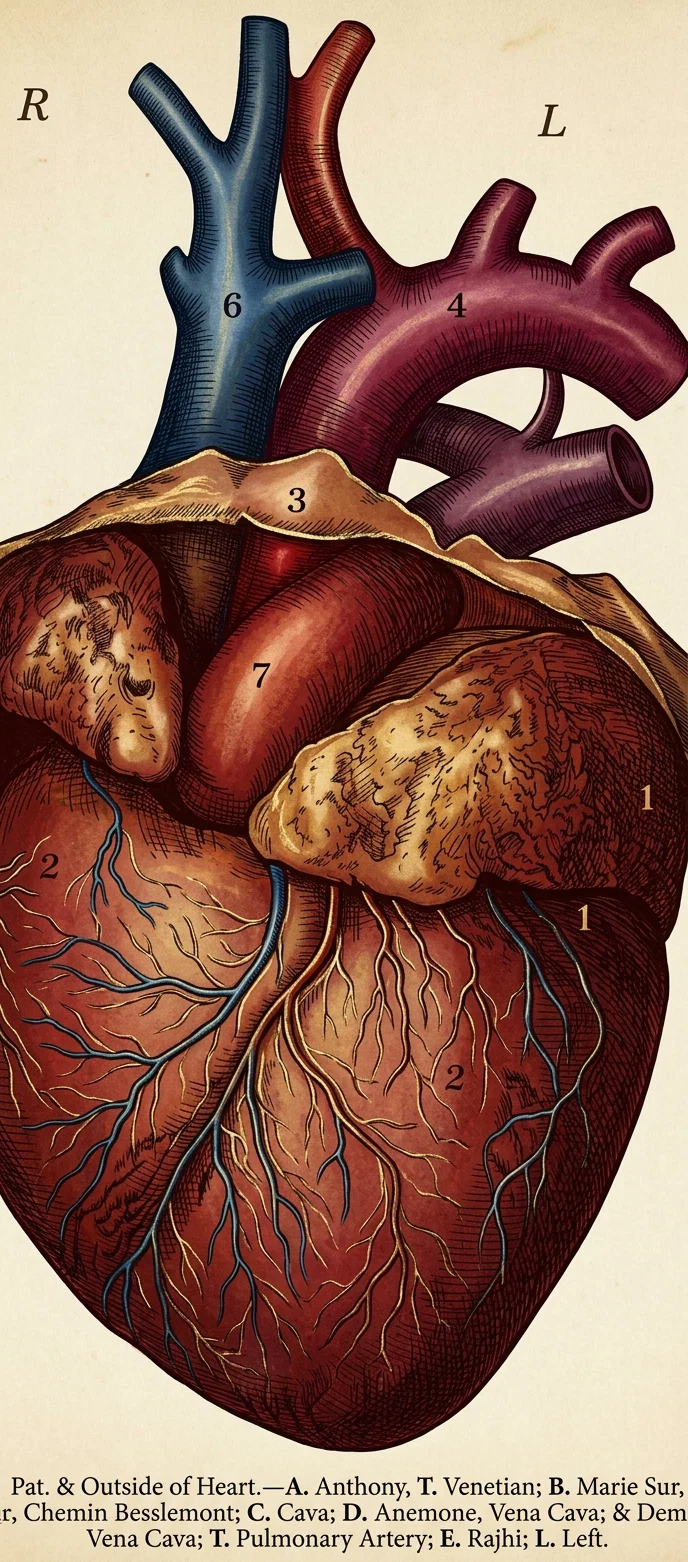
Blood is conveyed to every part of the body by means of tubes, an engine at the beginning of the circulatory system being the most active agent in propelling the current. The heart, situated at the left side of the chest, is the hardest working organ in the body. It is determined by physiologists that every time the heart beats it does a work equivalent to lifting three foot-pounds, or the amount of work required to lift one pound a foot high three times. Reckoning from this standpoint, we find that the heart, in beating seventy times a minute, would have to lift 210 foot-pounds every minute, and in an hour 12,600 foot-pounds, and in a day a little more than 150 foot-tons.
The heart walls are made of strong muscle, and the interior is divided into four chambers. The blood is received from the veins into the upper chamber on the right side; then it passes into the lower chamber or right ventricle, whence, by the contraction of this part of the heart, the blood current is forced out through the lungs. It then returns from these organs charged with a fresh supply of oxygen into the left upper chamber of the heart, and proceeds through the valves to the lower apartment, the left ventricle, from which, by a very strong muscular contraction, it is propelled throughout the body.
The structure of the heart is very interesting. It consists of a muscular tissue, the structure of which is peculiar to the organ, there being none like it in any other part of the body. This structure is bound together in all parts of the heart by connecting tissue. The part of the organ which does the most work naturally has the strongest muscle. To fortify and strengthen the organ still more, the inner chambers are covered by a large number of cords, or “heart strings.” These small pillars and posts are so arranged as to tie one part of the chamber to the other, fortifying its strength, and also running from the valves to the walls, so as greatly to strengthen these parts. The blood leaves the heart through one large artery, called the aorta; and from this it divides and subdivides until it runs into all the small arteries, and finally into the capillaries, which are found ramifying every tissue of the body except the cornea of the eye and a few other similar tissues; and these, because of their functions, do not allow11the presence of blood-vessels. The tissues of the arteries are elastic and have considerable contractile force which aids in the onward movement of the blood current.
The blood, after passing through the capillaries, is gathered up by the small veins, which flow together until they eventually come into two large veins, one from the head, neck, and arms, and one from the lower part of the body; and these enter the right side of the heart.
The circulation of the body is divided into three separate systems: The general system, which conveys blood to all parts of the body and brings it back; the pulmonary system, which takes the blood to and from the lungs, purifies it, and returns it freshly supplied with oxygen; and a third system, called the portal circulation. This latter gathers up the blood from all the abdominal organs except the kidneys, taking it from the stomach, intestines, pancreas, and spleen, and carries it through the portal vein till it enters the liver. Here it goes through a capillary system of blood-vessels, bringing it in contact with the liver cells, where important functions are performed. This blood is gathered up again after the liver has done its work, and taken back into the general circulation.
Thus this circulating system is shut off from the action of the heart by the intervention of a capillary system at both ends, making it more dependent on other forces. The action of the diaphragm, with the accompanying muscular movements, is very important for the maintenance of the portal circulation, and indirectly, for the regulation of a normal blood supply to the stomach, intestines, pancreas, and spleen. Proper chest expansion has much to do with pumping the blood from the circulation back to the heart.
By means of these perfect systems, every tissue in the body is ventilated, and every cell is supplied with food, drink, and oxygen; also the refuse of cell-work is carried away. When, through proper breathing, there is a normal quantity of oxygen given to the blood, and through abundant exercise and healthful conditions of the alimentary canal there is a free circulation and a full supply of food material, these renovating and renewing processes of the body go on in perfect order. But when these several conditions are not normal, there are always parts where there is poor work performed, and some of the chambers in the “temple of the body” are left unpurified, and like a cellar or back kitchen of the house, they become musty with mold and the accumulation of filth till the foundation of disease is laid.
Perhaps no place in the body is more subject to such a danger than the liver, being as it is, shut off by a separate circulation, and having to do a large part of the domestic cleaning for the house we live in. It often suffers from overwork; and when its supply of oxygen is scanty its functions are impeded and its great work of purification handicapped so that the body suffers, and disease within itself may generate. A. J. SANDERSON, M.D.
TRUE BEAUTY.
By Spencer
Men call you fair, and you do credit it,
For that yourself you daily such do see;
But the true fair, that is the gentle wit
And virtuous mind, is much more praised of me.
For all the rest, however fair it be,
Shall turn to naught, and lose that glorious hue;
But only that is permanent and free
From frail corruption that doth flesh ensue.
That is true beauty that doth argue you
To be divine, and born of heavenly seed,
Derived from that fair Spirit from whom all true
And perfect beauty did at first proceed.
Be only fair, and what He fair hath made;
All other fair, like flowers untimely fade.
—Spencer.
HOW DO YOU TREAT THE CHILDREN?
By Talmage
As the boys grow up make companions of them, then they will not seek companionship elsewhere.
Respect their little secrets; if they have concealments, worrying them will never make them tell, and patience will probably do the work.
Let the children make a noise sometimes; their happiness is as important as your nerves.
Allow them, as they grow older, to have opinions of their own; make them individuals, not mere echoes.
Remember that without physical health mental attainment is worthless; let them lead free, happy lives, which will strengthen both mind and body.
Bear in mind that you are largely responsible for your child's inherited character, and have patience with faults and failings.
Talk hopefully to your children of life and its possibilities; you have no right to depress them because you have suffered.
If you have lost a child, remember that for the one that is gone there is no more to do; for those remaining, everything; hide your grief for their sakes.
Impress upon them from early infancy that actions have results, and that they can not escape consequences even by being sorry when they have acted wrongly.—Talmage.