SELF-ASSURANCE will prove the downfall of many. Says the apostle, “Let him that thinketh he standeth take heed lest he fall.” It takes but little in the way of success to exalt the human heart. A successful business venture, the preaching of a sermon which elicits praise, the winning of a few souls, an unusual record in the sale of our publications, the attainment of a degree, — these and a multitude of other means may be used by the enemy of all righteousness to lead the human agent to feel that he in himself is sufficient for all things.
This is an age of the exalting of the human. It is believed by many that human salvation can be wrought out through eugenics; that by environment and education the soul can be refined and elevated; that every man may become his own savior. All this is false logic. Of himself, so far as human effort is concerned, man is without God and without hope in the world. He is lost and undone, with natural tendencies continually seeking a lower level. It is only as God implants in the human heart a spark of his divine enmity against sin, and only as the Holy Spirit seeks to fan that spark into a living fire and the individual responds to this work of grace, that the human soul can be regenerated. We cannot save ourselves by our own efforts. The most we can do is to consent to be saved; to allow God to work in us and through us, transforming us by his Holy Spirit. We may place our will on the side of God’s will, and to this extent cooperate with him; but of ourselves alone we are powerless to accomplish a single good thing.
We have no reason for boasting, for emulation, for pride. If we have done one good thing in our lives, it is because God has given us the power and the inclination to do it. All our successes are directly attributable to him and to his mercy. Our failures are due wholly to our own perverseness and sinfulness.
“Thus saith the Lord, Let not the wise man glory in his wisdom, neither let the mighty man glory in his might, let not the rich man glory in his riches: but let him that glorieth glory in this, that he understandeth and knoweth me, that I am the Lord which exercise loving-kindness, judgment, and righteousness, in the earth: for in these things I delight, saith the Lord.” Jer. 9: 23, 24.
Just as surely as others have backslidden through trusting in themselves, so we shall backslide if we trust in ourselves. Just as surely as others have separated from God by cherishing sin, so we shall come to that same separation if we cherish evil in our hearts. How strange it is that we cannot learn from the experiences of those who have gone before us. God has left a record of their experiences in the Word for our benefit. Peter followed the Lord afar off, and this led to his denial of the blessed Master. If we follow the Lord afar off in our experience, we shall be led to the place of denial the same as was Peter. David, although occupying a high and exalted station in the church of God, committed a terrible sin against God and his fellows, doubtless because for years before the outbreak of sin he had cherished in his heart the love of iniquity. King Saul of Israel was led to seek the life of David as a result of the spirit of jealousy which he had long cherished toward him. Jealousy in our hearts today, and the cherishing of impurity, will lead in our lives to the same disastrous results as they did in the lives of Saul and of David. We are no stronger than our fellows. We possess the same natural tendencies; and unless our hearts are renewed by the grace of God and we are upheld and kept by his power, we shall go down to ruin the same as others who have preceded us.
And this principle is true as applied to our relationship to this work and to this movement. In the past men have rejected some of the leading doctrines of the Seventh-day Adventist Church, believing that they still could stand for that which they recognized as truth; but they have failed. Some have rejected the spirit of prophecy. They have charged that human influence inspired the Testimonies. They have said, “We will reject this doctrine, but we will hold to the others.” But the result has been that in rejecting11one part of the truth they have been led eventually to allow the real spirit of the entire message to go out of their lives. Whatever may be our life work or whatever position we may occupy, the rejection of any cardinal feature of this movement will be attended by the same results in our lives. We need to be watchful in our experience. We need to take heed lest there be in any of us an evil heart of unbelief in departing from the living God. Says the apostle: “Exhort one another daily, while it is called Today; lest any of you be hardened through the deceitfulness of sin.” Heb. 3: 13.
The great war which is now being waged in Europe does not consist in a single battle. There will be a series of engagements and a number of victories and marches. There will be defeats and failures. The wave of battle will advance and recede. Victory will turn on the side of skill and endurance, greater numbers, more efficient armament, etc. The Christian warfare is in many respects similar. It does not consist of a single battle, but in a series of conflicts, a battle and a march, a conflict today and another tomorrow, and we shall be made “partakers of Christ, if we hold the beginning of our confidence steadfast unto the end.” The victory is not to him who wins today, but it is for him who wages the warfare to the finish; and in the conflict God is the captain of our salvation. He is our mighty helper. Unlike the commanders in human conflict, he has never lost a battle. If we keep close to him, loyal to his cause, submissive to his words, faithful and true to the principles of his kingdom, victory will be assured to us, and we shall effect a glorious triumph over all the forces of evil.
F. M. W.
Conversion
By G. B. Thompson
“Except ye be converted, and become as little children, ye shall not enter into the kingdom of heaven.” Matt. 18: 3.
THERE is no more important event in the life of an individual than the hour of his conversion. He is then in a special sense God’s “workmanship, created in Christ Jesus.” A new creation has taken place. The man is a “new creature: old things are passed away; behold, all things are become new.”
Everything indeed becomes new. It is a great experience when one awakens to the fact that, through all the past life, he has been making a mistake in the greatest and most important matters in life. Having seen the true goal and the real meaning of life, he is shocked to discover that in the main essentials of his life he has been traveling in the wrong direction, and has nearly missed the mark and made a failure of life.
He becomes conscious of the fact that he has been placing in the warp and woof of his character hay, wood, and stubble instead of the more perfect and enduring substance; and like the great apostle, he must count that all loss which he has perhaps most laboriously built up. He realizes that the structure which he has been building will needs be abandoned, perhaps destroyed altogether, and another temple, fit for the indwelling of the Holy Spirit, be reared. When converted, he is led to study the very foundation upon which he has been building, only to discover that it is one of great insecurity, and must needs be replaced by the only true foundation, which no man can lay — Christ Jesus. Remorse and deep regret fill the soul over the years that have been wasted, living on the husks and pods of sin, when he might have fared sumptuously at his Father’s table. This new creation changes the mind. The things upon which he once lavished his affections are now rejected as worthless. That which he once loved he loathes, and that which he once hated he loves. Instead of seeking after the things of this life, which soon perish, his great ambition becomes to perfect a character; to live a pure, holy life; to minister to the needs of suffering humanity about him; to live for others instead of himself.
This was the experience of the great apostle Paul. “What things were gain to me, those I counted loss for Christ. Yea doubtless, and I count all things but loss for the excellency of the knowledge of Christ Jesus my Lord.” Phil. 3: 7, 8.
That which seemed of most value to him when converted was that he might “know him, and the power of his resurrection, and the fellowship of his sufferings, being made conformable unto his death.” His aim in life now was to “press toward the mark for the prize of the high calling of God in Christ Jesus.”
Our great need is a deep conversion. There are many in the churches who are not really converted. Sin rules in their lives. They love the world and its pleasures. Questionable places of amusement and entertainment have an attraction for them; and as a result the heart is weaned from prayer and the love of God’s Word. The truly converted man will love to pray, to study the Scriptures, to talk of heavenly things. He will be wholly absorbed in the things of God.
“Saviour, Prince, enthroned above,
Repentance to impart,
Give me through thy dying love
The humble, contrite heart;
Give, what I have long implored,
A portion of thy grief unknown;
Turn and look upon me, Lord,
And break my heart of stone.”
G. B. THOMPSON.
Correctly Interpreting Prophecy
By I. H. Evans
WE are living in thrilling times. “Men’s hearts failing them for fear, and for looking after those things which are coming on the earth.” And today we see a literal fulfillment of the prophecy, “upon the earth distress of nations, with perplexity.”
Many great events will have their culmination in these days in which we live. Varied lines of prophecy, both political and religious, will terminate and reach their climax in the period known as “the time of the end.” It is the time when the work of the gospel will close; when the vials of God’s wrath will be poured out without mercy; when the scripture will be fulfilled which says, “And the nations were angry, and thy wrath is come, and the time of the dead, that they should be judged, and that thou shouldest give reward unto thy servants the prophets, and to the saints, and them that fear thy name, small and great; and shouldest destroy them which destroy the earth.”
As we enter the maelstrom of political and social commotion presaging the advent of our Lord and Saviour, anxiety, distress, and perplexity will be greatly multiplied. Those who have heard the message and have listened to the prophecies will be looking expectantly to our teachers for an interpretation of current events, and will be desiring literal statements prognosticating what is to be expected in the near future.
The public, anxious, perplexed, and irritated, will gladly listen to these statements regarding the order of events, especially when apparently built upon the interpretation of prophecy. It is an easy matter at such a time to venture beyond what is revealed, and to preach what the Word of God does not declare.
I once heard a minister say to a large audience: “I am going to make a prophecy. Take your notebooks and write it down; for I want every person within the hearing of my voice to take note of this. If what I prophesy does not come to pass, you will know that I am a false prophet, and that what has been taught in this tent is not truth.” Then he gave his prophecy, saying that the next president of the United States would be a Republican, and the one following would be a Democrat, when slavery would be reenacted by law, Sunday would be made the national Sabbath by Congressional action, and the end would come. Of course, all this prediction failed, except the election of a Republican president.
Why make such foolish statements, which bring only reproach upon the truth? Is it not becoming in these days of stress and peril to preach the word? to avoid extravagant statements? and to be careful to teach only what the Word of God reveals?
The ordering of events is not under our control. We are but men, human instruments. Outlines of prophecy are given in the Bible, but details are lacking. It is not for us to theorize and declare how God will work. Men who speak for God should speak only his word. They should neither add to it nor take therefrom. God’s Word is to be our guide. The prohibition of adding to and taking from the written Word12of God, or substituting therefor man’s theories, has not been rescinded by divine authority. Our strength and power must be in declaring only what the Lord reveals in his Word, and trusting the Holy Spirit to do its work upon the hearts of men when the Word has been truly preached in its simplicity. I. H. EVANS.
In Kafirland
By W. B. White
W. B. WHITE
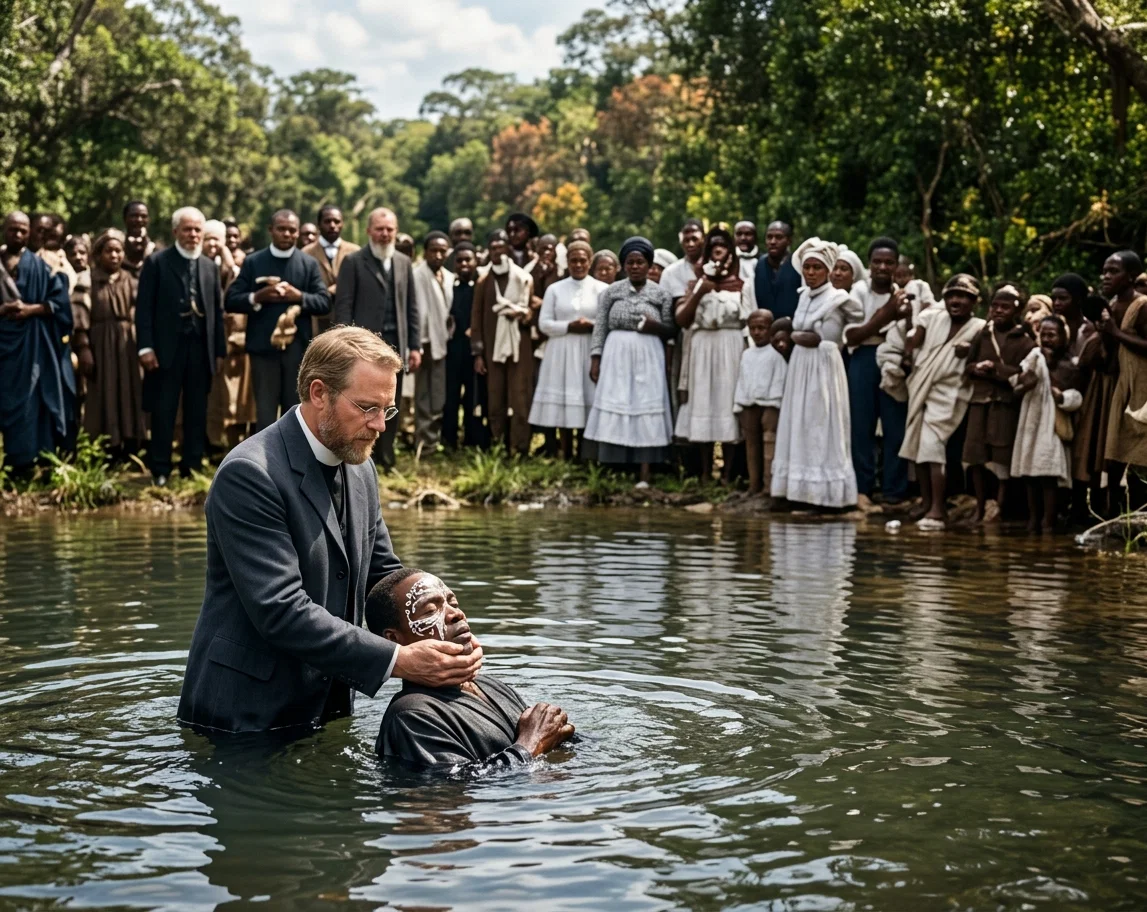
I HAVE recently had the privilege of spending a few days in Kafirland, down near the Indian Ocean, where we held quarterly meeting with our church at Maranatha, and also held a council of white and native workers to lay plans for the furtherance of the work among this numerous tribe. The Maranatha church has now about one hundred and thirty members, mostly natives from different parts of Kafirland. Our meetings were greatly blessed of God. The ordinances of the Lord's house were celebrated, our native brethren and sisters taking part in them. Thirteen received baptism. The accompanying cut shows a baptismal scene among this people. Those who received baptism were mostly adults, and some were prominent men among the Kafirs. All seemed to be intelligent with reference to the stand they were taking, and to be rejoicing in the truth.
BAPTISMAL SCENE IN KAFIRLAND,
SOUTH AFRICA
A superintendent has been selected for this part of the field, and a committee chosen to counsel over the needs of the work among the Kafir tribes. It is a pleasure to me to meet with this people, as they seem to appreciate greatly the efforts that we are putting forth for their betterment and upbuilding. God is working on many hearts in Kafirland today, and we expect much fruit among them. More attention will be given in the future to developing native workers, with a white superintendent. We feel sure that much more can be accomplished among the natives in this way than by white men speaking through interpreters.
We are glad that Dr. Harry Hankins will in a few months open up medical missionary work among the Kafirs. It is something of an experiment with us, but we are going forward to see what the Lord has for us in medical missionary work among this people.
We are greatly encouraged by what we see in every direction. The power of God is working on many hearts here in Africa, and we are glad to announce that since the first of October over one hundred among the whites and natives have received Christian baptism and united with the church. We are anxiously looking for ministerial help from the States, as we are very much in need of more workers in this field. Brethren and sisters, pray for us that the work of the Lord may be glorified and many souls brought to a knowledge of the truth in this land.
Hawaiian Islands
By F. H. Conway
F. H. CONWAY
The seventh of last October a company of twenty-one of our foreign missionaries arrived in Honolulu. We were met by our people at the pier. As we stepped off the gangplank, wreaths of flowers were placed about our necks as a token of Hawaiian welcome. After we were shown the beauties of the place, we partook of a splendid dinner that had been prepared for us.
Nineteen of this company of missionaries were booked for Japan, the Philippines, and China; and our people here were anxious to hear the experiences of these workers and to learn of the progress of the third angel's message in the fields far over the seas. The meetings at 2 and at 7 P. M. were precious seasons of refreshing to us all.
The next day when the ship steamed out of the harbor, a feeling of loneliness came over us, and we wished that some of these workers might have remained to help us warn the people in our mission.
Because of the lovely climate and the beautiful scenery, these islands are called the paradise of the Pacific. They are situated 2,100 miles southwest of San Francisco. The group is also called the crossroads of the Pacific, as most of the shipping for the Orient, Australia, and around the world touches here.
The form of government in these islands was monarchical until the last queen, Liliuokalani, was deposed by her subjects. Then, after a brief period of local republican government, the people appealed to the United States for annexation. By act of Congress in 1900 the islands became a part of the Union, under the name “Territory of Hawaii.”
The third angel's message was first proclaimed here in 1885, by Brother La Rue, who was also our first missionary to China. The first and only church was organized in Honolulu in 1896. We have a membership of forty-two in the islands. Four have been baptized since we came, and others will soon be ready to follow their Lord in this ordinance. Since the middle of last13January we have been conducting a Bible class for the training of our people to give the message to others.
The Lord is greatly blessing the efforts of our two magazine workers and one colporteur. The most of our people here are interested in the distribution of our literature, so our tract society work is growing nicely. We have placed over six hundred dollars' worth of papers, tracts, and books in the homes of the people since last October.
For the year 1913 our people here gave an average of $37 per member in tithes and offerings. This average would be a great surprise to our people in the homeland if they knew how poor are our people here.
We need more of our literature translated into the Hawaiian language, so they can read the message in their own tongue. We also need a good building for our training school. The place we are now fitting up for this purpose is a room fourteen by twenty-eight feet in the basement of a dwelling house. This is already really too small to accommodate our Sabbath-keeping children. There are other children who wish to attend, and when the time arrives for our school to begin, next September, we may not be able to care for all the children who wish to come.
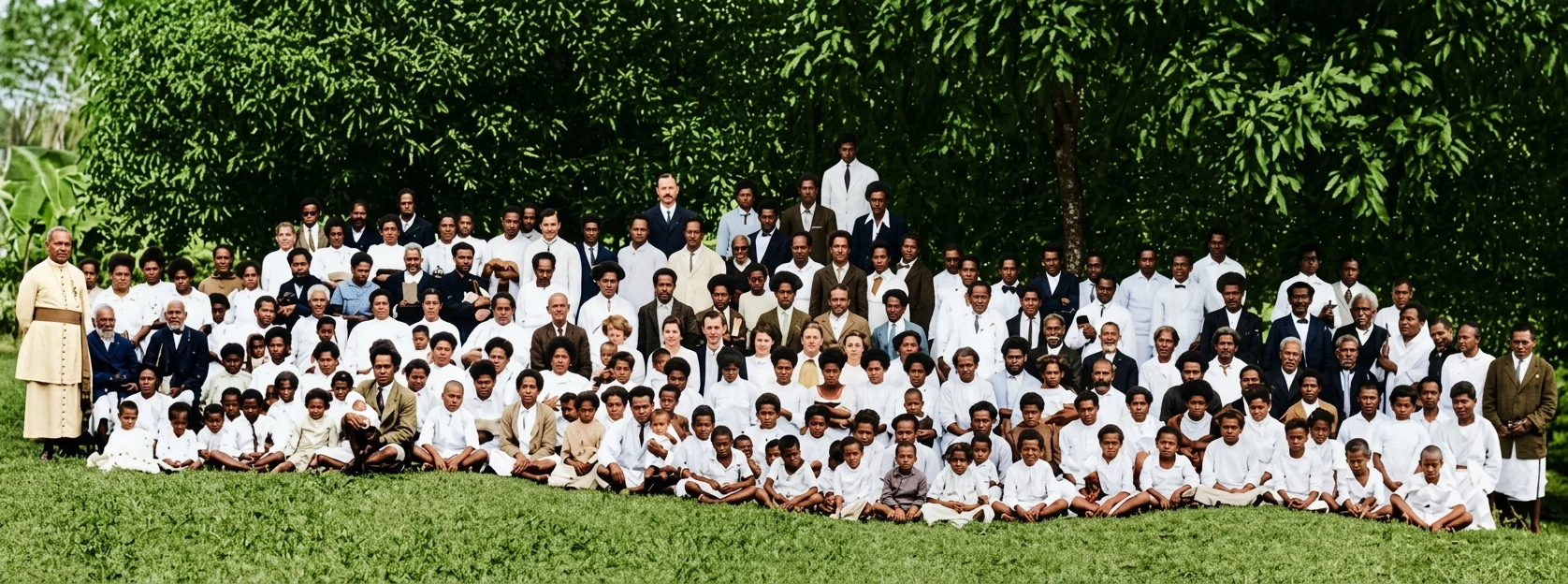
THE FIJI ISLANDS COUNCIL MEETING, WHERE BROTHER AND SISTER DANIELLS SPENT A FEW HOURS ON THEIR WAY TO AUSTRALIA
With two hundred thousand people, speaking a babel of languages and living on eight different islands, dotted over a range of several hundred miles, one can readily see that we have a difficult field to warn. We are praying for more workers and means, that the work of the third angel's message in these beautiful islands may keep abreast with this great movement throughout the world. We wish to be remembered at the throne of grace.
The Bondage of Women
We hear a great deal today regarding the so-called bondage of womankind. The militant suffragettes of England and their more gentle sisters in the United States are carrying on an earnest agitation for greater so-called liberty—the right of franchise, political freedom and its opportunities. We surely should not deny them this right if it were in our power, but we are wondering if there are not other forms of bondage from which they need quite as zealously to be seeking relief. There is, for instance, the bondage of fashion.
As never before in the history of mankind, fashion holds sway over the minds and bodies of the human race. Speaking of this, the editor of the Detroit Free Press makes the following sensible remarks:—
There was never a time when fashion was so arbitrary and exacting as at present, or when dress was so all-important and so expensive. “Out of fashion, out of the world,” accounts for the feminine feeling in the matter of dress; no woman wishes to be regarded as out of the world. Therefore the perfectly good garment of last season is voted “absolutely impossible” this year, not because it is worn, or shabby, but because it is not a 1914 model. Women of moderate means say, “There is no use buying expensive things, they go out of style so quickly,” but because of the perishable nature of what they buy they spend as much, eventually, as if they had bought the better goods at first. This results in waste by those who should not waste, and in endless worry over what should be subordinate. Husbands are harried, debts incurred, and homes made unhappy by this subservience to fashion’s sway.
Women believe they bring things about by their efforts and their views expressed through “resolutions” passed at their club meetings. They unquestionably have and do affect legislation. They occupy, creditably, many important positions, and exert an influence in social reforms and betterments. Why do they not conspire to rid themselves of this tyranny, so destructive and belittling? It has been said that if one hundred of the leading women of this country would “resolve” to dress simply, suitably, and becomingly, and would actually do so, Parisian couturieres would no longer sit up nights devising garments that hobble and deform the sex. With such an opportunity within their grasp, why not make use of it?
Searching the Ruins of St. Pierre
St. Pierre, Martinique, which was destroyed by the eruption of Mont Pelee in 1902, has never been rebuilt; but it is said that even yet the ruins are being searched for valuables. The place is under police control, and two or three streets have been excavated, but it is still a “city of desolation.”
An Industrial Mission, With Eleven Outschools
W. C. WALSTON, superintendent of Solusi Mission, our oldest and largest industrial mission in Rhodesia, near Bulawayo, reports:—
“The farm work and business occupy nearly all my time, and the school work Brother and Sister Wilson’s time. With three hundred acres to cultivate, and our school, we have plenty to do. During the past few weeks a number of new students have come in, and the prospect is we shall now have all we can accommodate. Our outschools are doing well. We have eleven at present, and calls for more which we cannot fill. We hope sometime to have more help and be able to do more evangelistic work among the natives. There is a great work to do here.”
The Annual Fijian Council
By A. G. Stewart
A. G. STEWART
Our annual council at Suva Vou, June 23-28, proved to be a most successful meeting. About two hundred of our people from many parts of the group were in attendance and enjoyed a real spiritual feast. We were pleased to have the assistance of Elder J. E. Fulton most of the time. His long experience in this field makes his visits very helpful in many ways.
We were also very glad that Elder A. G. Daniells, accompanied by Sister Daniells, Miss Hare, and Miss Shull, could visit us in the midst of our meeting and spend several hours while the steamer was in port. Elder Daniells spoke to a crowded church of mostly Adventists at the Sabbath evening service, June 26, on “The Progress of the Message.” His discourse was listened to with keen interest. After the service Elder Fulton joined the party, and they left for New Zealand, on their way to Australia.
The following day we had a most refreshing revival service, the whole congregation taking a definite stand on the Lord's side. Some returned who had wandered from the fold. The Lord came very near and helped us all. In the afternoon eleven were baptized, making twenty-two for the past year.
The reports from the field showed that the cause of present truth is making progress, and a number of calls are being made for the message to be proclaimed in new places. The school at Buresala has had a successful year. During the council three of its students were appointed to field work. Several other young persons expect to enter the school during the coming year. A very comfortable and serviceable home has been erected for the workers for the Indians in Fiji. It was dedicated during the time of the council. Sister Meyers has made many friends among these people during the past year by visiting among them, treating the sick, and conducting a small school. We feel sure that when more workers come, greater results will be seen. This is a most needy field, and the work for the Indians is a very difficult one.
We are all of good courage, and take up our work for the new year with fresh zeal, determined to accomplish more, by the Lord's help, in the future. We beg an interest in the prayers of his people.
On Regretting Our Mistakes
Probably the one thing that does the most to make men and women grow old and to wear out the springs of energy is the habit of turning over in mind what might have been. We brood over past mistakes and see how at some turning point we made a wrong choice, and then harass ourselves unceasingly by imagining what we should have gained if we had taken the other path. Somehow we cannot get the bright alternative out of mind, and its very brightness makes the conditions in which we live abnormally dark. Sometimes we doubt whether forebodings as to what may come do more to cloud and depress sensitive spirits than regrets for what might have been. But this is a case in which philosophy and faith should be permitted to have their say. Suppose you had made a better choice at that crisis; there is no certainty that you would have continued to make wise choices to the end of the chapter, and subsequent mistakes might have been as ruinous as the one you now deplore.
Furthermore, no amount of regret is going to bring back the lost opportunity. You have to take things as they are, and the very weakening of your powers through vain regrets will certainly prevent your making the best uses of your present opportunities. Above all, “it is not in man that walketh to direct his steps.” If there is a God, we certainly are in his hands, and the final issues of life are with him. Very often, even in this life, we come to see that what we deemed to be errors, were working out higher purposes of good. The faith that all things, even our blunders and mistakes, work together for good to those who love God, is not to be reserved for hours of devotion, but to be taken into the interpretation of daily life.— Selected.
Sabbath in the Home
By Eva Barber
EVA BARBER
“If thou turn away thy foot from the Sabbath, from doing thy pleasure on my holy day; and call the Sabbath a delight, the holy of the Lord, honorable; and shalt honor him, not doing thine own ways, nor finding thine own pleasure, nor speaking thine own words: then shalt thou delight thyself in the Lord.” Isa. 58:13.
In the scripture quoted above these two facts are brought to view concerning the Sabbath: First, it is the Lord’s day, his holy day; and, second, we are to call it a delight. When we honor it we honor him, and we are told how to make it a delight. All this is to be taught to our little ones. It is holy time, God’s holy day, and we should do nothing to mar its purity, its beauty, its holy character; and we are to help these same small girls and boys to call it a delight. This we surely can do with the grand system of truth which goes with Sabbath keeping. Childhood is none too long in which to teach the principles of truth to our children. God has given us a great field right in our homes. Every one of our homes is, or should be, a school where missionaries are trained. This is what our children will be if they fulfill the Lord’s purpose for them. So let the father and mother train each child that this thought may be his purpose, his plan. Let us pray and plan all the week to have a holy, pleasant, delightful Sabbath; not a day of hilarity, or sightseeing, but a pure, pleasant, welcome day in the home.
This will take planning where there are children ranging in ages from a babe to a youth in the early teens. But pray over the matter. The Lord can and will lead. Let us welcome the Sabbath as an honored guest, and be ready to receive it when it comes. Let worship be different from that on other days. Have the songs the children love the best. Have the reading something all will be interested in. Make frequent changes. Read verses in turn or in concert, or have a responsive reading if the children are old enough to take part. Children love to do, love to have a hand in matters that older ones are doing. Each one should select that which will suit the needs of his household best. There are many scriptures we can learn with our children. All children love the twenty-third psalm. The twenty-fourth can be adapted for a responsive reading. Let verses be well learned and repeated from memory, also the commandments and the books of both Testaments. One mother I knew would say “Genesis” and pause, then the little one would follow with “Exodus,” and in this way they would say all the books.
Bible stories are liked by most small children. If during the week a good Sabbath story comes to your home, leave it for Sabbath. Bible games are enjoyed by the older children. Sometimes give facts connected with some character, and let them guess the name. At other times give the first letter of a name and let them each have a certain number of guesses on who the person is that you have in mind. Prepare a box in which to keep the Sabbath books and cards, and whatever else you may have for use that day. Let all these things be stored away during the week. Have scrapbooks. A small magnifying glass helps to study subjects we may gather on our Sabbath walks. A field glass makes a walk more interesting.
These are a few of the many ways to make the Sabbath interesting to the children. They take time and work, but where is the mother who is not willing to spend time and strength in this way?
The father can also help in this home entertainment of the children. In fact, the father should share equally with the mother. Thus neither will be overburdened. He can sometimes take the children for a walk, and leave the mother free to rest or read as she sees fit. He can tell stories or sing or do other things to keep the children entertained and instructed. An older brother or sister can also be very helpful in this home work.
Home training is the greatest of missionary enterprises; for if it were well done, we should not have to mourn for so many who find the world more attractive than the Lord’s truth and work. Our homes are to be one of the greatest missionary agencies among us; so let us make them attractive and efficient for their part. While money alone will not do this, it will help. A love for the work, a fitness for it, will do much, especially a study of such literature as gives a good insight into child training.
Redlands Cal.
How Mother Managed
“You see how it is, my dear,” he said, taking her soft hand, which had never done very hard work, and patting it reassuringly; “I’m poor—only two hundred a year, dear, and we shall have a struggle to get along at first—”
“I don’t mind that in the least,” she interrupted, stoutly.
And he continued, “We shall have to come down to strict economy; but if you can only manage as my mother does, we shall pull through nicely.”
“And how does your mother manage, dear?” she asked, smiling at the notion of the mother-in-law cropping out already.
“I don’t know,” replied the lover, “but she always manages to have everything neat and cheerful, and something delicious to eat—and she does it all herself, you know, so that we always get along beautifully, and make both ends meet; and father and I still have plenty of spending money. You see when a woman is always hiring her laundry work done, and her gowns and bonnets made, and her scrubbing and stove blacking done, and all that sort of thing—why, it just walks into a man’s income and takes his breath away.”
The young woman looked for a moment as if her breath were taken away; but she wisely concealed her dismay, and being one of the stout-hearted of the earth, she determined to learn a few things of John’s mother, and so went the very next day to her house for a long visit. Upon the termination of this visit, one morning John received to his amazement a little package containing his engagement ring, accompanied by the following letter:—
“I have learned how your mother ‘manages,’ and I am going to explain it to you since you confessed you didn’t know. I find that she is a wife, a mother, a housekeeper, a business manager, a hired girl, a laundress, a seamstress, a mender and patcher, a dairymaid, a cook, a nurse, a kitchen gardener, and a general slave for a family of five. She works from five in the morning until ten at night, and almost wept when I kissed her hand—it was so hard and wrinkled and corded and unkissed! When I saw her polishing the stoves, carrying big buckets of water and great armfuls of wood, often splitting the wood, I asked her why John didn’t do such things for her. ‘John,’ she repeated, ‘John!’—and she sat down with a perfectly dazed look, as if I had asked her why the angels didn’t come down and scrub for her. ‘Why—John,’ she said in a trembling, bewildered way, ‘he works in the office from nine until four, you know,15and when he comes home he is very tired; or else—or else—he goes down town.”
“Now, I have become strongly imbued with the conviction that I do not care to be so good a ‘manager’ as your mother. If the wife must do all sorts of drudgery, so must the husband; if she must cook, he must carry the water; if she must make butter, he must milk the cows. You have allowed your mother to do everything, and all that you have to say of her is that she is an excellent ‘manager.’ I do not care for such a reputation unless my husband earns the name also; and, judging from your lack of consideration for your mother, I am quite sure you are not the man I thought you were, or one whom I should care to marry. As the son is, the husband is, is a safe and happy rule to follow.”
So the letter closed, and John pondered; and he is pondering yet.—Selected.
“Just Be Glad”
By James Whitcomb Riley
O HEART of mine, we shouldn’t worry so!
What we have missed of calm, we couldn’t have, you know!
What we have met of stormy pain
And of sorrow’s driving rain,
We can better meet again,
If they blow.
We have erred in that dark hour we have known,
When the tears fell with the showers all alone;
Were not shine and shadow blent
As the gracious Master meant?
Let us temper our content
With his own.
For we know not every morrow can be sad;
So, forgetting all the sorrow we have had,
Let us fold away our fears,
And put by our foolish tears,
And through all the coming years
Just be glad.
— James Whitcomb Riley.
Home Life
By Mrs. C. C. Lewis
Conducted by Mrs. C. C. Lewis, Takoma Park, Washington, D. C.
Through the columns of this department, hints will be given on all matters pertaining to the home life. Short articles and letters are solicited from home makers, telling of their everyday experiences,—their joys and sorrows, their failures and successes.