The Youth’s Instructor, Vol. L, No. 44

The World's Greatest Waterway

The Youth’s Instructor

November 6, 1902

Review and Herald Publishing Company · Battle Creek, Michigan · November 6, 1902

The World's Greatest Waterway
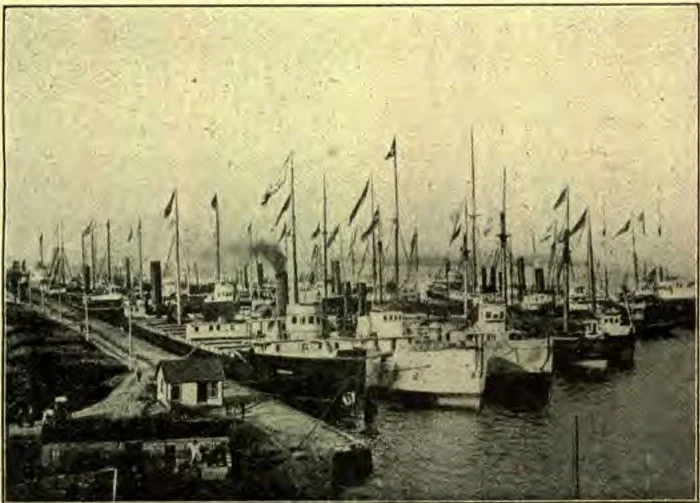
The city of Sault Ste. Marie, the oldest settlement in the State of Michigan, is situated on the St. Mary's River, between Lake Superior and Lake Huron. Jesuit explorers visited it in the summer of 1615, under Pere Joseph Le Caron, and still others in 1623, when missionary operations were begun. In June, 1641, a company composed of representatives of the church and of the government of Louis XIV, together with fourteen Indian chiefs, took possession of the Sault de Ste. Marie and all the surrounding country, under the French flag. The place was then known, and is still in the Indian language, as Pau-Wau-Ting.
During the early Indian wars the Sault became a strategic point on account of its growing trade in furs. The French monopolized the trade until the spring of 1761, when the whole Northwest passed under British control. This lasted until, by the Treaty of Ghent, in 1814, the territory was ceded to the Americans.
Situated, as it is, in close proximity to the Great Lakes, the settlement soon became an important fur-trading station. Governor Mason, in 1837, recognized the commercial possibilities of the place; and in order to overcome a fall of twenty feet from Lake Superior to St. Mary's River, called the attention of the legislature to the importance of building a ship canal. He accordingly approved of an act to appropriate twenty-five thousand dollars for this purpose in the same year. Surveys were made, and a plan for two locks was agreed upon, which were to be of the following dimensions: width of canal, 75 feet; depth, 10 feet; width of locks, 32 feet; length, 100 feet; depth, 10 feet. The estimated cost was $112,544.
BLOCKADE — WAITING FOR NAVIGATION TO OPEN
In May, 1839, the work of surveying was begun, but was brought to a sudden standstill by Lieutenant Rood, post-commander at Fort Brady, because the surveys were made through the military reservation. For fifteen years it remained untouched, during which time prominent men of the Upper Peninsula labored arduously to obtain aid from Congress. On August 26, 1852, a bill was approved, in which seven hundred and fifty thousand acres of land were appropriated to aid the State of Michigan in carrying on the enterprise, and in June, 1853, ground was broken for the canal. The writer is indebted to Mr. Chase S. Osborn, State Commissioner of Railroads, for the following important data concerning the locks:—
“The locks were made three hundred and fifty feet long, with thirteen feet depth of water. The actual cost of the canal and locks was $999,802.46. April 19, 1855, water was first let into the canal, and June 18 the first boat was locked through. These locks have now been replaced with one great lift, known as the Poe Lock. Work was begun on the construction of this lock in April, 1889, and the completed lock was placed in operation in midsummer of 1894. The cost of construction was nearly five million dollars.”
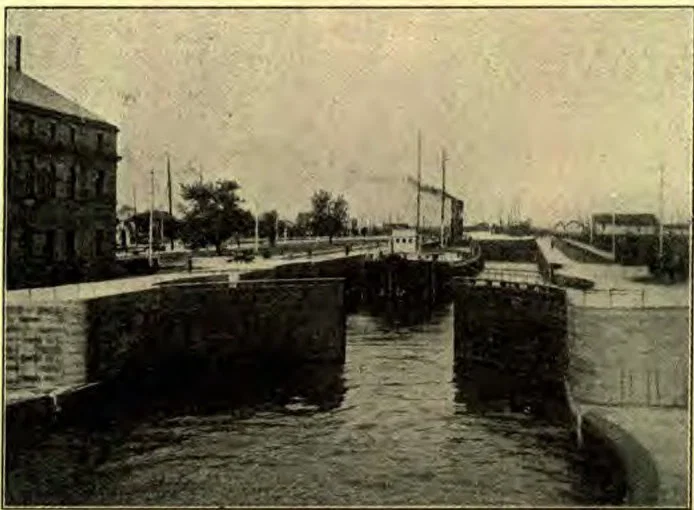
LOCKING A FIVE-HUNDRED-FOOT BOAT THROUGH THE POE
“October 20, 1870, the contract was let by the general government for the Weitzel Lock. This lock was completed and opened to navigation in 1881, at a cost of $2,405,000. The length of the canal is seven thousand feet. Its width is variable the least width being one hundred and eight feet at the point opposite the movable dam. The depth of the water when Lake Superior is at its average height, is sixteen feet. The chamber of this lock is five hundred and fifteen feet long, eighty feet wide, narrowed to sixty feet at the gates. The depth is thirty-nine and one-half feet. Its capacity is one million five hundred thousand cubic feet. The lift of the lock is eighteen feet; the depth of water on the miter-sills is seventeen feet. A guard gate is placed at each end of the chamber, making the length of the walls seven hundred and seventeen feet.”
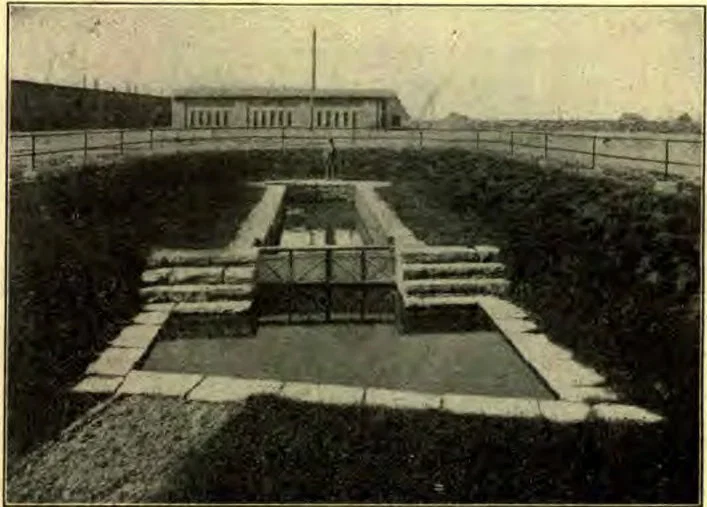
RUIN OF THE OLD CANADIAN LOCK
“There are 34,207 cubic yards of masonry, in the construction of which about thirty-five thousand barrels of cement were used, every barrel being tested. The water is let into the lock from culverts under the floor. The time consumed in emptying or filling the lock is about seven minutes.”
Every vessel passing through the locks is required to register the amount of tonnage. Stationed down the river some distance from the locks is an official whose business it is to watch for vessels coming upstream. Upon a vessel's approaching near enough for him to read the name with the aid of a field-glass, he steps to his telephone, calls up the power-house, gives the name of the vessel and the amount of tonnage, and asks to which lock he shall send it. Then through a trumpet he shouts to the pilot which lock to take. He is kept constantly busy sighting boats and passing them up-stream. The force at the locks is divided into three eight-hour shifts, who go on duty at 6 A. M., 2 P. M., and 10 P. M., respectively.
The “Soo” canal has been called the “world's greatest waterway” from the fact that more traffic is carried on here than upon any other water route in the world, the Suez Canal not excepted. During the seven months of navigation at the Soo, three times as much freight passes through the locks as at the Suez Canal for a whole year. In 1899 over 25,000,000 tons net of freight passed the Soo locks, valued at $281,000,000. In 1901 the tonnage amounted to 31,000,000 tons. It is expected that that of 1902 will reach 35,000,000 tons.
To be able to appreciate fully the vast amount of traffic carried on at the canal, one must see the mammoth vessels as they are locked up and down. A constant stream of great freighters, bearing iron ore, wheat, and lumber from Lake Superior to Lake Erie ports, passes through the locks. The United States Steel Corporation, which is only one of the great industries making use of this waterway, carries annually twenty million tons of ore from the mines of Lake Superior to the furnaces of Ohio and Pennsylvania.
Situated across the river on the Canadian side is another lock, which is distinguished as the longest in the world,—being nine hundred feet long by sixty wide. It is not so much used as the American locks, since its approaches do not afford so good a channel as the American locks. It is expected that the Canadian government will begin the construction of a new lock in 1903.
On the grounds of the Lake Superior Power Company, and near the Canadian lock, is to be seen what remains of the first lock on the western continent. It was built by the Northwest Fur Company to lock down the canoes of the fur-traders from Lake Superior, and destroyed by the Americans in 1812. Only the floor and foundations remain; but the ruin is carefully preserved, and is always of interest to sight-seers.
The route up the St. Mary's River has long been frequented by tourists in summer, on account of its beautiful scenery and cool, bracing air. The river is navigable up to the rapids by the largest vessels. Below the rapids the strait spreads out into a broad lake, inclosing large and beautiful islands, and having three distinct channels, which again contract into a narrow stream. Visitors often descend the rapids in a canoe by the aid of an Indian voyageur.
CAROLYN A. HATHAWAY.

The Goal

Ambition! Yes, I know its thrill— Ambition! Not for pomp of earth; No little prize my crave can fill; I have within what reaches forth Beyond the earth and sky and sea, To lay hold on infinity.
Ambition! Not with man to war, And win a fading victor crown. With mightier foes my battlings are; To cast high powers of evil down. My Captain, not of mortal fame, The Prince Messiah is his name.
Ambition! Aye, that will not cease Even when earth’s mightiest foe is slain, And all my heart, subdued to peace, Bows, loyal, to my Lord again. But newborn from the grave I’ll rise To more possessions in the skies.
—Selected.

The Story of Our Matabele Mission

The Arrival of the Missionaries

THE year 1895 marked a new era in the history of Seventh-day Adventist missions. Previously to the General Conference held in February of that year, our whole force of laborers in fields outside of the United States amounted to but ninety licensed workers. This, of course, did not include native or lay workers. During that conference no fewer than thirty recruits for the regions beyond were secured; and at the close of the month of June of the same year, fifty devoted men and women had sailed for different parts of the world. The fields thus strengthened or entered for the first time were Mexico, the Bahama Islands, British Guiana, Jamaica, Central America, Brazil, Argentina, England, Scandinavia, Polynesia, Australia, Matabeleland, Honolulu, and Newfoundland. The party for Matabeleland consisted of Elder G. B. Tripp and wife and son, of Virginia; W. H. Anderson and wife, of Indiana; and Dr. A. S. Carmichael, of North Dakota. All but the doctor set sail from New York, for their new and practically untried field, April 10, 1895. A voyage of twenty-eight days landed them in Cape Town; and two weeks later, when Dr. Carmichael joined them there, the journey toward Matabeleland was begun. This was May 22, and more than two months still lay between them and their new home.
Since our first party went into Matabeleland, the railroad had been extended to Mafeking. So now eight hundred and seventy miles of this journey was made on the train. But this occupied about three times as long as a similar journey would have required in the States. During the three days thus spent on the train, they were crowded into a compartment about six by eight feet in dimensions. Besides the party of six, all their hand-baggage also found a place in this small room; so that the change which awaited them at Mafeking was welcome. Reaching this point, the remainder of the journey must be made in a less modern style. Brother Sparrows from the mission farm met them there with two wagons and a cart. One wagon was drawn by sixteen oxen, and on the return trip carried seven thousand pounds of freight. The other was drawn by fourteen oxen, and carried six thousand pounds; while the cart, or two-wheeled conveyance, was drawn by four oxen, and carried the two ladies of the party, besides a thousand pounds of supplies. Almost seven weeks was spent in the overland journey. Varied were the experiences during this time; but that which absorbed their greatest attention was the prospect of the vast work before them.
Day after day, as they slowly traveled toward their destination, they were compelled over and over again to turn a deaf ear to entreaties for teachers from native chiefs. Every worker could have been left in a different village, and then all the appeals for help would not have been answered. But this was not to be permitted, as workers were needed at the farm, and could not be longer delayed.
Thursday evening, July 25, more than three months since the journey began from the New York Harbor, they reached the border of the mission farm, and at nine o’clock that evening they were but three hundred yards from the hut that had been built the previous year, which was to be their temporary home until houses could be erected. Here they were compelled to camp until morning, because the road was not broken any farther, and the many stumps in the way made progress impossible in the darkness. Glad to be so near home, they waited anxiously for the dawn.
Elder Tripp writes: “Early Friday morning we inspanned, and drove up to the hut; and as we looked around, it was truly a desolate place; yet beneath this desolation we could see great possibilities, and our hearts were uplifted in prayer to our Heavenly Father that he would develop these possibilities, and make them a place from which the glorious light of the message, now due to the world, might shine upon many now in darkness, that they might be saved in the coming day, and God’s name be thus glorified.”
“It being Friday, the only thing we could do was to pitch a tent, and get a few things unpacked to use on the Sabbath. When the Sabbath reached us, it found us tired, and ready to appreciate the rest it brought.”
“Sabbath morning dawned bright and clear, as every morning is supposed to do here from June to December, and at eleven o’clock we met for Sabbath-school. Some brethren who were here before us, and are settled on farms joining the mission farm, came in, and we had a good school. A number of natives were present, and were formed into a class and taught by Brother Sparrows. At 3 P. M. we met for worship, and had a very enjoyable time as we recounted the mercies of the Master; none were sorry that they were here, but rather glad to be used to bring within their reach a knowledge of those things which the people need so much. We were also made glad by receiving letters from friends left in the States, and our good papers. Upon the whole, this, our first Sabbath on the mission farm, was a season of refreshing to all, and at its close we felt to praise the Lord for all he had given us.” ESTELLA HOUSER.

The Things That Count

WHEN an army in active service feels that it must carry with it rocking-chairs, folding beds, and materials for five-course dinners, there is little likelihood of that army’s hurting the enemy, and no little likelihood of its getting into trouble itself. The comforts of life are all right in the quiet days of peace, if they can be afforded; but the man who thinks them essential to his existence is rather poor soldier material.
In the life campaign in which we all are enlisted there is need for the same understanding of what things are essential, and what are non-essential. To fight the good fight of life we need a few possessions, but the multitudinous equipment of ordinary existence is only what the Romans called impedimenta, or baggage. The less of it we take when on the march, or when engaged in active warfare, the better.
The list of indispensables is brief. We need in this life, first of all, to be in right relations with our Leader. Nothing else that we can buy or win in all the universe can take the place of peace with God. Without it we are not fit for fighting; it is the first great essential. Of course, having peace with God presupposes a clean life. The person who is not right in his own character can not possibly be right with God.
Given, then, as first requirement, a clean life in fellowship with its Lord, we find the next requirement to be love. To know love, the beautiful, pure, and unselfish love which the pen of inspiration writes as synonymous with God, is to possess the great prize of life. The man who has those whom he truly loves, and who love him,—a mother, a wife, or a less near friend,—may get along without everything else that this world can give him. But love is essential.
One thing more—opportunity to serve, which God never denies to anybody. We must have some work to do, some noble, unselfish service, to render to our kind and to our God. This is the last of the three parts of a true life’s indispensable equipment—peace with God, a true friend, and a chance to be helpful. All these fundamental requirements are within the grasp of anybody; having them, he can do without everything else.—W. T. Ellis.

No True Work Is Ever Wasted

“No true work since the world began was ever wasted; no true life since the world began has ever failed.”

Newspapers in China

One of the most convincing evidences of the great awakening that is slowly taking place in China is the development of the newspaper business. Rev. A. P. Parker, writing in the Chinese Recorder, says there are five daily papers published in Shanghai bearing Chinese names. Three of them have a daily circulation of ten thousand copies each, and the remaining two from four thousand to five thousand. They are filled every morning with matter very similar to that which appears in the metropolitan dailies of the United States, including foreign telegraphic news. There are also a number of journals styled “ten-day papers,”—issued every ten days,—which have quite an extensive circulation. They are devoted to agriculture, literature, and science. The Christian community is represented by four missionary monthlies.—Zion’s Herald.

Through the Needle’s Eve

TALL was my camel and laden high, And small the gate as a needle’s eye.
The city within was very fair, And I and my camel would enter there.
“You must lower your load,” the porter cried. “You must throw away that bundle of pride.”
This I did, but the load was great, Far too wide for the narrow gate.
“Now,” said the porter, “to make it less, Discard that hamper of selfishness.”
I obeyed, though with much ado, Yet still nor camel nor I got through.
“Ah,” said the porter, “your load must hold Some little package of trust-in-gold.”
The merest handful was all I had, Yet, “Throw it away,” the porter bade.
Then lo, a marvel! the camel tall Shrank to the size of the portal small,
And all my riches, a vast estate, Easily passed through the narrow gate!
— Amos R. Wells.

Music as a Reminder of Heaven

Music

Music is one of the reminders of heaven, and all true lovers of music have a strong incentive to gain that world where music has its home, and where alone it is heard in absolute perfection. Now people travel long distances, and expend much money, to gain the privilege of listening to accomplished singers or performers, or to hear some grand chorus. But what will be the rapture with which we shall hear the glorious hymn of redemption, sung by the numberless host of the saved, every voice being blended in perfect harmony, and animated with inexpressible gratitude!
Music exerts a powerful influence over the emotional nature. It is used to excite every phase of human feeling. The mother's soft lullaby brings over her little one the mantle of sleep. Among our earliest recollections are those homely songs that mother knew, and with which our eyes were nightly sealed. Think of the countless little restless hearts that have peacefully yielded to the sweet power of —
“Hush, my babe, lie still and slumber, Holy angels guard thy bed;”
Or,—
“There is a happy land, far, far away, Where saints and angels stand, bright, bright as day.”
Perhaps when the weary, patient mother had gone through her entire list, sleep had not yet come to her relief; and then we would insist, “Mother, sing Happy Land,” and the encores would be even more persistent than if she had been a prima donna.
In later years the influence of Christian song powerfully smoothes the path of life, and soothes the agitated soul. Stirring music arouses patriotism and warlike courage. Voluptuous strains of music fill the halls of frolic and vanity as well as the haunts of sin. Hatred or love, vengeance or pity, vice or virtue, lust or purity, war or peace, activity or rest, joy or mourning,—all are alike awakened and deeply stirred by the aid of music.
Since music is so powerful and versatile an agent, its influence over the life and character is a matter to be seriously taken into account. Because a bad use may be, and too often is, made of it, we are not therefore to eschew it. The perversion of anything becomes more dangerous in proportion to its power for good when rightly used. As wholesome reading develops the mind in good qualities, and as vicious reading undermines the character, so will the ennobling use of music uplift the soul; and so also will sin-tainted music seduce and captivate the heart with its unholy enchantment.
To the great mass of people, music is simply an amusement. A low but large class of musicians employ their talents for the sole purpose of tickling the ears of a thoughtless, heedless public. Those who make no better use of heaven-born harmony and melody than to gratify a craving for passing amusement greatly pervert this good gift. The proper use of music is to lead the soul and mind to purity and devotion.
No one can mistake the language of bird-song. Early in the morning, before they have received their daily food, or know whence it is coming, their little voices pour forth the songs of gratitude. In listening to them, our hearts are drawn out in love to God.
Young people should be careful in the use they make of music, to see that a right motive actuates them in singing or playing, and that a right spirit is breathed into their performances. Too often our sacred hymns and songs are sung with an accompaniment of laughter that plainly shows the absence of any sense of their character. “Be not deceived; God is not mocked.” The apostle says, “I will sing with the spirit, and I will sing with the understanding also.” Let every song or tune be an offering to God. Be it praise or penitence, hope or grief, thanks or petition, or only an outbreak of harmony, let it come from the heart, and it will reach the hearts of those who listen,—of the invisible angels as well as the hearts of our visible friends.
G. C. TENNEY.

A Harvest of Sweet Memories

Do you boys and girls realize how much your sunny youthfulness and freshness mean to the older members of the family?
There are a bright boy of fourteen and two girls a little younger in a house near by, who until this summer had never been away from home for longer than a day at a time. This year all three of them were sent off for a six-weeks’ vacation in the mountains.
“What a difference it makes in the whole house!” lamented the mother. “I actually can’t seem to settle down to anything!” And the grandmother, with a half-humorous groan, added from her invalid chair, “I don’t believe it’s been anything in the world but the absence of those children that’s made me feel so ill.”
Would the children find the return to the home nest rather tame and commonplace, I wondered, after this first flitting? And oh, would the dear grandmother find her joy less great than she expected when the home circle was again complete?
The other day they returned with the freshness of mountain breezes in their cheeks, and the sparkle of mountain lakes in their eyes. Home “tame” and “commonplace” to them? “It seems so lovely to be back, oh, so lovely!” was heard more than once, interspersed between rapturous descriptions of the “good times” left behind; and one little girl, nestling close to the big arm-chair, whispered, “I had the best time, only when I thought of you, grandmama, I wanted to cry!”
“Such sweet, sweet memories!” said one of two friends as they left the little group.
“Of what?” said the other, rather absently; “the mountains?”
“No, no, home memories! The kind those children are making every day. They don’t realize it now, but some day it will all come to them—some day when they have little flocks of their own. Then how glad they’ll be—how inexpressibly glad that they felt and appreciated the home love as they did—that their home-coming after six weeks could mean such unbounded delight to the grown people. Did you notice what comrades they are—the three generations? It’s an immense gain to the children, as well as to the older ones.”
“Yes, it is,” said the other. “And I saw a school-girl of such a different order the other day. She was telling my younger sister of some of her good times last summer, telling it in a breezy, girlish way with little breaks of laughter, when her father stepped in with a sympathetic smile on his own face. He touched her hair lightly as he passed. ‘What’s the fun?’ he asked.
“O, nothing but some happenings in the summer,” she responded, and she did not offer to repeat them. In fact, she fairly dropped out of the conversation while he remained in the room. I have never cared much for that girl since.”— Selected.

Don't Push!

• WE were on the wharf, and the excursion steamer was slowly approaching. Various uniformed officials had taken their positions where they could most effectually stem the throng of impatient humanity. “Don't push!” they shouted, “Don't push!” but not a whit the less they did push. Oh, how they pushed! Men and women, boys and girls, lunch-baskets and bicycles, all jammed in together. One thought uppermost in the minds of all—to get in the front rank, nearest the gangway. “Don't push!” the officers pleaded. “You will all get aboard. There is no hurry. Don't push!” They might as well have talked to a pack of wolves. Elbows to left of us, elbows to right of us, elbows behind us, hustled and jostled.
For, you see, those officers had not told the whole truth, and we all knew it. There was plenty of room on that boat, but not all the room was on the forward deck, nor was all the room on the shady side. There were seats enough, but there were not best seats enough. Those that hustled to the front would get comfortable places, where the breeze would play in their faces, where they could see on all sides, and where the sun would not beat upon them. Those that took their time to enter, and did not push their neighbors, would have to sit where the boat rocked the most, and the engines thumped the hardest, and the sun shone the hottest, and the view was the most restricted. That was why they pushed. And I—I—was first on the gangway, and got my pick of the places!
And then I began to be ashamed, and to bethink myself. “That I have this nice place is the reason why some one else hasn't it,—that tired mother, perhaps, with the fretful baby,—possibly that sick-looking young man. In fact, I could not have this place except at the expense of some one else's not having it.” I began to remember something about uppermost seats at feasts. I began to remember certain other sayings about chief places in synagogues. I was not after honor, but I was after another advantage, and the principle was the same. It was big I, and little you.
And since that humiliating discovery I have been wondering whether the greater part of our worldly push is not, under whatever one of a million disguises, simply to crowd ourselves into the best places. If Christ had been getting on that boat, I am absolutely certain that he would have been the last to cross the gangway. He would have helped that tired mother to get on among the first. He would have hustled that sick young man into the very front rank. He would have aided that father with his bundles. He would have been a support to yonder old woman. And he would be found, when the boat started, down on the lower deck at the stern, talking with some of the sailors.
We are certain that that is precisely the way our Master would go on board a boat. Why do not we, then, get on board in the same way, and especially why do we not use the same fashion on the great sea of life? More than half the success that is so loudly applauded among men is simply successful selfishness. More than half of the fortunes that are built up are reared on others' misfortunes. The seats at the bow are very pleasant—but the price may be far too high.—Caleb Cobweb, in Christian Endeavor World.

O Jesus, Thou Art Standing

O Jesus, thou art standing Outside the fast-closed door, In lowly patience waiting To pass the threshold o’er: Shame on us, Christian brothers, His name and sign who bear: Oh, shame, thrice shame upon us, To keep him standing there!
O Jesus, thou art knocking: And lo! that hand is scarred, And thorns thy brow encircle, And tears thy face have marred: O love that passeth knowledge, So patiently to wait! O sin that hath no equal, So fast to bar the gate!
O Jesus, thou art pleading In accents meek and low, “I died for you, my children, And will ye treat me so?” O Lord! with shame and sorrow, We open now the door: Dear Saviour, enter, enter, And leave us nevermore.
—Selected.

The Weekly Meeting

(November 9-15)
In the study of the great controversy between good and evil, we have passed over the period of papal supremacy and the days of Reformation. Just before us is the closing work of the judgment hour, and then the everlasting kingdom. Even now we are to press into the kingdom, and by earnest effort for souls hasten the day of the Saviour’s coming.
As young people we have a part to act. If it was a privilege to live in the days when great crises were revealed in the history of the great controversy,—as, for instance, in the days of the captivity in Babylon, when Daniel and his fellows witnessed for God’s truth, or in the days of the first advent or the times of the great Reformation,—much more is it a privilege to live now in the time of the final crisis. No youth of former times ever had so much to make them ambitious for God, and so earnest in effort, as have we.
The study in every meeting should be to help one another to a fuller consecration and to more efficient service. It is surprising, too, how good a meeting a little band may have, even with but a simple Bible study and social service, when each one comes to the meeting to receive help and to give it. A very interesting line of study is to be found in the story of the youth of Bible characters, following the development of character into the later years of manhood’s service. The characters of Bible times who were witnesses for God in manhood were generally true and loyal servants in youth. And their service was directed to something practical just at hand. Faithful in the every-day opportunities, they were loyal when great things were to be done.

The Youth Jesus

First of all, let us take the life that is the model for all, the life of Jesus. Three members (or one) might take the subject somewhat as follows, using these and other scriptures, and seeking for the practical lessons that must inspire our hearts to face the duties lying before us, and by the grace of God to grow into men and women of God:—
The Childhood of Jesus.— Luke 2; Matthew 2.
The Student Life of Jesus.— Deut. 6:4–9; Isa. 50:4, 5; Matt. 4:1–11.
Illustrative Incidents in His Ministry.— Luke 4:16–22; John 4; Matt. 15:21–32; Mark 4:3–8; Acts 10:38; John 18:37; Isa. 50:6–10.
“The child Jesus did not receive instruction in the synagogue schools. His mother was his first human teacher. From her lips and from the scrolls of the prophets, he learned of heavenly things.”
“Jesus worked to relieve every case of suffering that he saw. He had little money to give, but he often denied himself of food in order to relieve those who appeared more needy than he.”
“Jesus did not contend for his rights. Often his work was made unnecessarily severe because he was willing and uncomplaining. Yet he did not fail nor become discouraged. He lived above these difficulties.”
“He passed by no human being as worthless, but sought to apply the saving remedy to every soul. In whatever company he found himself, he presented a lesson that was appropriate to the time and circumstances. He sought to inspire with hope the most rough and unpromising, setting before them the assurance that they might become blameless and harmless.”
“His presence brought a purer atmosphere into the home, and his life was as a leaven working amid the elements of society.”—“Desire of Ages.”
The Revised Version of Isa. 50:4 is: “The Lord God hath given me the tongue of them that are taught, that I should know how to sustain with words him that is weary.” Christ could speak in his ministry as never man spake before, because he had been willing to receive teaching as never man had received it before. And as he studied, his aim was to help some one weary with the burdens of life and of sin.
Let there be a discussion of ways in which the young people can work in their community. Cases of need are to be sought out and helped; periodicals and books may be sold; and openings may be sought for cottage Bible studies. Talk over the question of service, and have some active campaign going. Report interesting experiences to the society, and have somebody send in an occasional report of these experiences and efforts for this department of the INSTRUCTOR.
It would be interesting, as we pass from the studies on the prophecies in Daniel, to have some one appointed to read a very brief paper this week on Influences Which Prepared the Way for the Great Reformation of Luther’s Day. Material for such a paper may be found in chapters 4, 5, and 6 of “Great Controversy,” Vol. IV.
W. A. S.

L. W. BUCKNER

From the Oakwood Industrial School

I AM a student at the Oakwood Industrial School, and am here for the purpose of becoming a worker in the cause of God; for there are broad fields which greatly need workers, and I think we who are young should prepare to enter them.
There are only forty-four students here yet, but as this is just the beginning of the term, we hope others will be directed here. It is our earnest prayer that the school may have good success, and that the students may be qualified for the great work God has for them.

L. W. BUCKNER

Continue reading: Working with God