MULTITUDES are vainly seeking happiness in worldly amusements. They crave something which they do not have. They are spending their money for that which is not bread, and their labor for that which satisfieth not. The hungering, thirsting soul will continue to hunger and thirst as long as it partakes of these unsatisfying pleasures. O that every such one would listen to the voice of Jesus, “If any man thirst, let him come unto me, and drink.” Those who drink of the living water will thirst no more for frivolous, exciting amusements. Christ, the well-spring of life, is the fountain of peace and happiness.
God bestows various talents and gifts upon men, not that they may lie useless, nor that they may be employed in amusements or selfish gratification, but that they may be a blessing to others by enabling men to do earnest, self-sacrificing missionary work. God grants man time for the purpose of promoting his glory. When this time is used in selfish pleasure and amusement, it is lost to all eternity.
The youth, as well as those of more advanced age, are accountable to God for their time, their influence, and their opportunities. They hold their destiny in their own hands. They may rise to the highest excellence, or they may sink to the lowest depth of depravity. Every person is a free moral agent, by his daily life deciding his future. What course, then, is it wisest for us, as rational beings, to pursue? Shall we live as candidates for eternal life, or shall we fail of fulfilling the great end of our creation?
In our character-building we must work in union with our Heavenly Father, our will conformed to his will. We are to work in union with him “who gave himself for us, that he might redeem us from all iniquity, and purify unto himself a peculiar people, zealous of good works.” Then why should we doubt him? Let us not stop, my dear young friends, with a work half done. Let us not rest satisfied before we receive a new and sanctified nature, in which will appear the fruits of righteousness. Those who stop short of this are Christians only in name. We are to make diligent work for eternity. Helping one another, and walking in all humility, we shall receive grace for grace.
Let the youth magnify the name of the Lord for his great goodness, his loving mercy, his tender compassion. They can magnify his name by revealing his grace through a well-ordered life and a godly conversation. And as they do this, the disposition is sweetened; irritability passes away.
To every young man and young woman I would say: Come to Jesus just as you are. With humility and contrition express to him your penitence. Make a vigilant, earnest effort to serve him, and perseveringly keep up this effort. Cherish constantly the spirit of gentleness and kindness. Cultivate sympathy—not for yourself, but for others; “in all things showing thyself a pattern of good works: in doctrine showing uncorruptness, gravity, sincerity, sound speech, that can not be condemned; that he that is of the contrary part may be ashamed, having no evil thing to say of you.”
“The Lord make you to increase and abound in love one toward another, and toward all men, even as we do toward you: to the end he may stablish your hearts unblamable in holiness before God, even our Father, at the coming of our Lord Jesus Christ with all his saints.”
MRS. E. G. WHITE.
Gladly, Little One
By B. F. M. Sours
LISTEN! listen! mother calls!
What will little daughter say?
Will she gladly skip along,
Or with pouting lips obey?
Daughter, be a little glow
Of bright sunshine all day long;
Fill with brightness all the home;
Thrill the happy hours like song.
Quickly answer mama’s call,
With a happy, smiling face;
Brush the table, dust the desk,
Deftly set the chairs in place.
If we do our duties well,
As ’neath light of Love divine,
Will the glory from above
On our humble labor shine.
B. F. M. Sours.
The Little Boy Who Was a King
By Aunt Betty
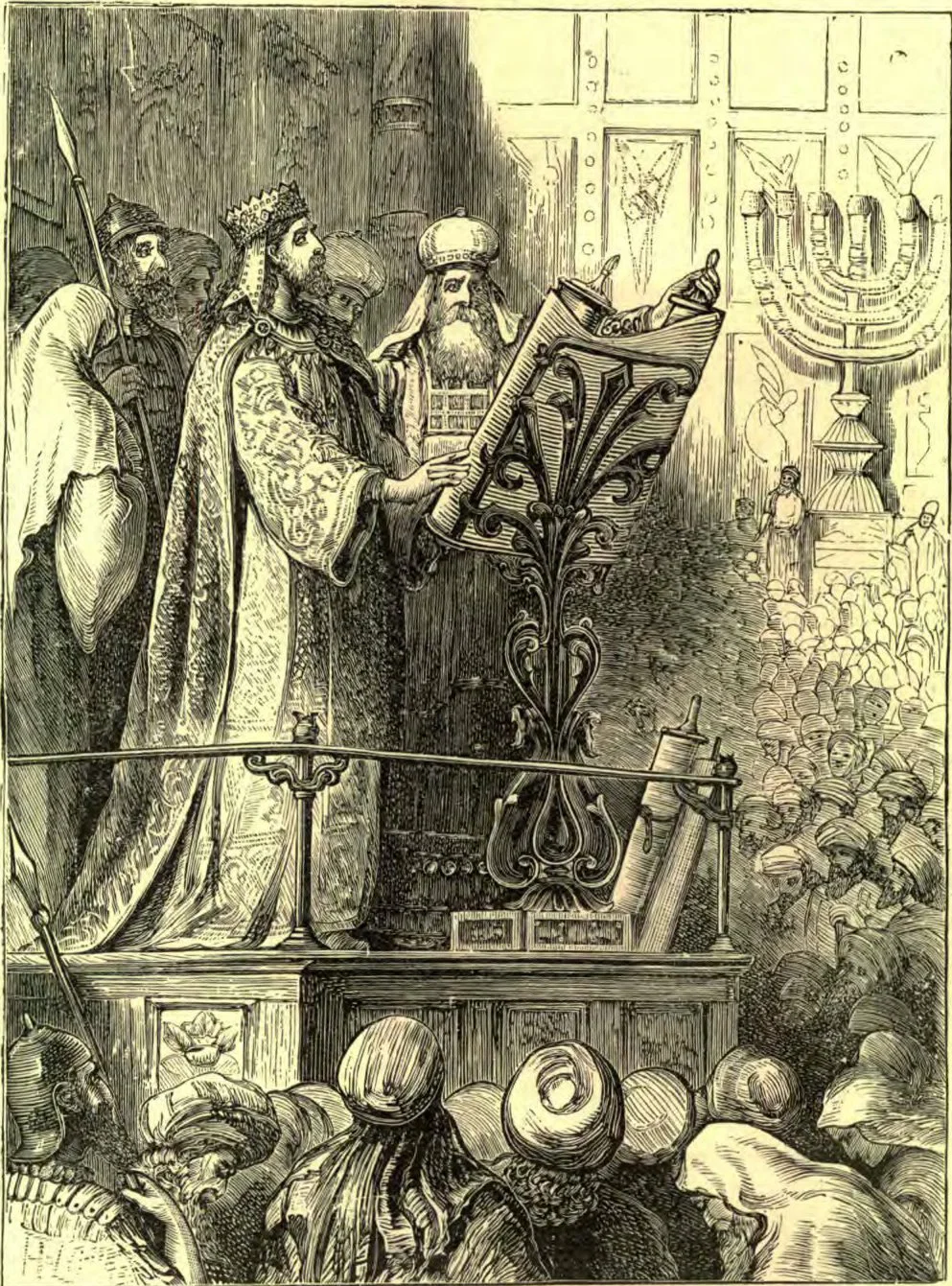
Long, long ago a little boy named Josiah was made king over Judah when he was only eight years old. He must have had wise teachers and counselors; for, although his grandfather “did evil in the sight of the Lord,” and “made Judah and the inhabitants of Jerusalem to err, and to do worse than the heathen,” and his father “trespassed more and more,” yet we read of this boy-king that “he did . . . right in the sight of the Lord, and walked in all the way of David his father, and turned not aside to the right hand, or to the left.”
During the reigns of his father and grandfather, the temple had been neglected, and was in poor repair; but when Josiah had reigned eighteen years, he gave instructions to Hilkiah, the high priest, that the money he had caused to be collected should be used to repair the house of the Lord. As they worked, Hilkiah found the book of the law, which had been lost, and gave it to Shaphan, the scribe, who read it, and brought it to the king.
“When the king had heard the words of the book of the law, . . . he rent his clothes;” for it foretold the plagues, the captivity, and the destruction that the Lord would visit on Jerusalem for her sins and for her idolatry.
Then Josiah, in his grief, sent messengers to Huldah the prophetess to inquire of her; and the Lord gave him this answer: “Thus saith the Lord, Behold, I will bring evil upon this place, and upon the inhabitants thereof, even all the words of the book which the king of Judah hath read: because they have forsaken me, and have burned incense unto other gods, that they might provoke me to anger with all the works of their hands; therefore my wrath shall be kindled against this place, and shall not be quenched.”
But to Josiah he said: “Thus saith the Lord God of Israel, As touching the words which thou hast heard; because thine heart was tender, and thou hast humbled thyself before the Lord, when thou heardest what I spake against this place, and against the inhabitants thereof, that they should become a desolation and a curse, and hast rent thy clothes, and wept before me; I also have heard thee, saith the Lord. Behold therefore, I will gather thee unto thy fathers, and thou shalt be gathered into thy grave in peace; and thine eyes shall not see all the evil which I will bring upon this place.”
Then Josiah gathered all the people together in the temple, and read to them the book of the law which had been found; and they made a covenant with the Lord to keep his commandments. And the people put away their idols, and there was held that year the greatest Passover Feast that had been held in Israel since the days of Samuel. This also occurred in the eighteenth year of Josiah.
But their repentance came too late to save Jerusalem; for “the Lord turned not from the fierceness of his wrath,” but said, “I will remove Judah also out of my sight, as I have removed Israel, and will cast off this city Jerusalem which I have chosen, and the house of which I said, My name shall be there.”
KING JOSIAH READING THE LAW
Josiah, the last good king of Judah, reigned thirty-one years, and was killed in battle with Pharaoh-nechoh, king of Egypt, at Megiddo.
AUNT BETTY.
A Wonderful Cupboard
Little Ruth had a discontented look on her face. She sat by the open window idly turning the leaves of the geography which she held in her hand.
“Oh dear me!” sighed she.
The sigh was so deep, and the little girl’s face so sober, that Aunt Anne glanced up from her work.
“What is the matter now?” inquired aunty.
“Oh, I’m so tired of learning these troublesome lessons, and every day just when I want to have a good time, mama will say, ‘Now, Alice, it is time for your lessons.’ What’s the use of studying so much, aunty?”
Aunt Anne was silent a moment, and then she said to the little girl, “Let me answer your question by telling you about a curious cupboard which I possess. It is not large, although it contains numberless little shelves, which have the singular property of expansion, — that is, becoming larger,— if things are placed upon them; and strange to say, although so small, it is impossible completely to fill it.”
“Why, I never remember seeing it,” said Alice, now thoroughly interested.
“You have seen the outside, as you will find when I have finished telling you about it.”
“How long have you had the cupboard, aunty?”
“Ever since I was born; and every day for thirty-five years I have been putting something into it.”
“Why, it must be a queer cupboard!” said Alice, with a puzzled look on her face.
“Yes; and another strange thing about it is that you can choose beautiful, useful articles, or ugly, worthless ones to fill it with. Now, if you had a cupboard like this, which would you place on its shelves?”
“Why, aunty, the pretty things, of course! I would never put anything ugly into a cupboard of mine, if I could help it.”
“Well, Alice, although I think as you do, yet sometimes I grew careless, and placed worthless articles on its shelves. And then, too, it is very difficult to remove anything after you have firmly placed it in position.”
“Why, this is the most curious cupboard I ever heard of!” exclaimed the little girl. “How I should like to see it!”
“What if I tell you that you are the owner of one yourself, Alice?”
“Surely you are joking, aunty.”
“No, indeed. Can you not guess its name? It is the brain, or mind. It has a place for6everything, and if we fill it with the beautiful, the good, and the true, we must begin when young to lay treasures upon its shelves. Day by day we add either good or bad to its store, although we may not always be conscious of what we are doing.”
“Do you remember what you learned at school the other day for a memory gem?”
“‘For the thoughts you do not speak
Shine out in your eyes and cheeks.’
There is a shelf for each of your studies, and if you learn that lesson in geography, you will fill a little more of the space for that particular study.”
“I understand now, aunty,” said Alice. “When I am studying, I will remember that I am filling my cupboard with useful and beautiful things.”
— Youth’s Companion.
First Lessons in Geography
By Floyd Bralliar
Lesson VII
“Thou covered it [the earth] with the deep as with a garment: the waters stood above the mountains. At thy rebuke they fled; at the voice of thy thunder they hasted away. The mountains ascend, the valleys descend, unto the place which thou hast founded for them.” Ps. 104: 6-8, margin.
As the earth was crushed, and the oceans were formed, the earth was forced up into folds near the edges of the ocean. These great wrinkles are very long. Those along the longest ocean are longer than those along the smaller oceans. Two of these great folds are almost ten thousand miles long. We call such a great wrinkle a Mountain System. But each of these great wrinkles is made up of many smaller, shorter ones, running side by side. These we call Mountain Chains, or Mountain Ranges. Between these smaller folds, or ranges, are Valleys. What is a valley? The whole scope of high country on which the mountain ranges rest is called a Plateau.
Before the mountain ranges were formed, and the ground was low, fish and animals of all kinds were there as elsewhere. But when the mountains were formed, many of these creatures were caught in the rocks, and held there. This is why we often find sea-shells and the skeletons of fish and other water animals in the rocks, even on the tops of the highest mountains. Trees and plants were also buried when the mountains were made, and have since turned either to stone or to coal.
As the waters rushed into the oceans, they washed great gorges in the soft earth and broken rocks of these mountains. Since then, rivers have followed these gorges. This action of the water washed away so much of the soil that the rocks that were once deep in the earth were laid bare. This is why the mountains are now so bare and rocky.
The waters had washed away the great forests that covered the world before the flood. These were now washed together in the low places in immense drifts, often covering the earth to a great depth for miles. The mud and earth were then washed over these by the crushing waters, and in the course of centuries they have changed into coal. If we examine coal with a magnifying-glass, we can see in it the grain that was once in the wood. We shall even find leaves and whole trunks of trees in the coal. By studying these, we can learn something about the kinds of trees and plants that grew before the flood. Dead animals were often mixed with these, and their remains are sometimes found in the coal.
The gold and silver and precious stones had been used by man to dishonor God, so they were allowed to be buried deeply in the earth. They are even mixed with the solid rock. Since the flood, men must work hard to get them; and then can find but little of them.
REVIEW.—When were our mountain systems formed? What is a mountain system? What is a mountain chain, or range? What is a plateau? How were gorges formed? Why are the mountains so rugged and rocky? How much coal was formed? Why do we find the remains of fish and animals in the rocks of the mountains, and in the coal? Why are the gold, silver, and precious stones buried deep in the earth? Why did God allow them to be placed there?
Lesson VIII
Before the flood, there were millions of shell-fish and other little animals that secrete lime. These, being heavy, were washed together, and their remains form our limestone. Your teacher will show you a piece. Some limestone was never mashed enough to break the shells, so we can see them in it yet. Sometimes shells were subjected to so much pressure that they were mashed fine. When they were heated, and cooled, they formed marble. After the flood, some of this stone was still soft, and birds and animals walked over it, and we can still see their tracks in the solid stone. Vast quantities of limestone are found in all parts of the world, though not often on the high mountains.
In other places, sand was washed together in great beds, and was mixed with muds of various kinds. This has since hardened, and formed our beds of sandstone. Sandstones are sometimes made up of gravel and hard pebbles instead of sand, and then they are often called “pudding-stones.”
As the waters returned to the ocean, they carried great quantities of soil with them. This soil was dropped in the lowlands, while the waters were gradually gathered into the lowest lands. In this way the deep, rich soil of the lowland plains was formed. The rocks and large stones were not carried so far as the sand and fine soil, and so, near the mountains, we find great regions where stones are mingled with the soil. The nearer one comes to the mountains, the more of these stones are found.
As we near the mountains, the land is higher for miles and miles than in the low plains. This higher ground is called Highlands. There are great highlands wherever there are great mountain systems. Before the flood, there was no part of the earth that did not produce abundantly, but now it is not so. When the flood had done its work, God caused a mighty wind to blow to dry up the waters. This wind blew with such force that the tops of the mountains were blown away in many places, and sand was carried over many of these highlands. If it does not rain on these sandy highlands, nothing can grow. A region where rain never falls is called a Desert. A desert is a lesson to us, to teach us the result of sin. A few useless plants grow scattered about over the desert; but they are of little value, and in many places even these are not found.
But even in the desert there are sometimes springs, or wells, of water, and about these, plants and trees may grow. Such a place is an Oasis.
REVIEW.—Were there shell-fish before the flood? What do they secrete to form their shells? How was limestone formed? Why do we sometimes find shells in limestone? How was sandstone made? How was the soil in our low plains formed? What are highlands? Why are their soils often stony? What are deserts? When were they formed? What is an oasis?
MEMORY VERSE: “Humble yourselves therefore under the mighty hand of God, that he may exalt you in due time.” 1 Peter 5:6.
(The chapter given as the Lesson Scripture is the lesson to be studied. Read this every day, and think over it until you know just what it teaches. Then the following notes, which should be read several times, will help to a fuller understanding of the lesson. Lastly, go over the questions carefully, and be sure that you can answer each in the words of Scripture.)
God called Abraham that he might make him a missionary and the father of a race of missionaries, through whom he could teach and bless all the nations. Although Joseph’s brothers sold him into Egypt through envy, it was really God who sent him there, because he wanted to make himself known to the people in that dark land of idolatry. When Joseph, through patient endurance of his trials, and faithfulness in doing all the duties that came to him, was quite prepared for the special work God had for him, the Lord opened the way for it to be done.
In the dream God gave to Pharaoh, he was showing him what he was about to do in Egypt, but Pharaoh could not understand without an interpreter. If Joseph had been kept in the high place he held in Potiphar’s household, he would not have had the opportunity to interpret the dream of Pharaoh’s butler, and so would not now have been made known to Pharaoh as one who was able to interpret dreams. Thus the dungeon into which he was unjustly cast was the way to the throne, although he did not know it. God, who sees the end from the beginning, and does whatsoever he pleases, is working out his own plan in the life of each one of his children, and if we trust in him, he will bring us to just the place for which he has fitted us.
God never brings judgment or trouble on the earth without sending beforehand a warning message, so that all who will may be prepared for it. We have seen that he did so before the flood, and before the destruction of Sodom and Gomorrah. And before sending the seven years’ famine, he sent Pharaoh a message that, if heeded, would save the world from starvation.
Joseph was very quick to think and to act. His work when he was set over Potiphar’s household, and again when the keeper of the prison left all things in his hand, had trained his mind to see quickly what was the best thing to be done. And now the Spirit of God that gave him the interpretation of the dream, showed him at once what was the right thing to do, and he told it to Pharaoh.
Joseph made Pharaoh understand that the wisdom he had was not his own, but that it came from the God who had sent the warning dream.351So Pharaoh spoke of Joseph as a “man in whom the Spirit of God is.” And as he saw that there was no man in Egypt like Joseph, he knew that the God of Joseph was far above all the gods of Egypt. Thus Joseph’s God was made known to all Egypt, and, as we shall learn next week, to all the other nations besides.
Riding in the king’s chariot, with all the people bowing the knee before him, what a change from Joseph’s prison life! Cast out by his brethren who hated him, he found that the way of trial led to the throne. Highly exalted, he became a prince and saviour, to give the life-giving bread to the people in the time of famine.
Questions
1. Why did God call Abraham out from the nations? What did he want his seed to do?
2. Who sent Joseph into Egypt? What purpose did he have in this?
3. How did God call Pharaoh’s attention to himself? Gen. 41:1.
4. Tell the two dreams that God gave to Pharaoh. Verses 2–7. How did he try to find out their meaning? Verse 8.
5. When none could be found to interpret the dreams, what did Pharaoh’s chief butler tell him? Verses 9–13. What did Pharaoh at once do? Verse 14.
6. Why did God give Pharaoh these dreams? What does he always do before he brings trouble on the earth? Give instances from our former lessons.
7. What did Joseph tell Pharaoh about the two dreams? Verse 26. Since the two dreams were one, why did God give it twice? Verse 32.
8. Tell the meaning of the dreams. Verses 29–31.
9. What advice did Joseph give to Pharaoh? Verses 33–36. What did Pharaoh think of it? Verse 37.
10. Who did he think was the best man to put over the land to do this great work? Why did he think so? Verse 38.
11. Where did Pharaoh set Joseph? Verse 41. What honor was shown to him?
12. How old was Joseph at this time? For what had all his trials been preparing him?
13. What was made known to all the Egyptians through Joseph’s work?
14. Compare this part of the story of Joseph with the experience of Jesus.
A Concert
By B. F. M. Sours
I saw the curtain rise,
The curtain of the dawn;
The audience was fast asleep,
And the stars were scarcely gone;
But lo! such minstrelsy!—
O bards! with subtle pens,
O art! with boasted schools,
Hear, hear, these grand “Amens”!
They caroled with a joy
That thrilled each little throat;
On warbled strains of song
Each spirit seemed to float,
When, as to heed their call,
The shadows slipped away,
And Love, from watching skies,
Sent the triumphant day.
O spirit! conflict riven
’Twixt darkness and the light,
Why linger in the shades
Still brooding o’er the night?
Up! like bird choristers,
Sing, sing, to heaven above,
Till breaks the joyous day,
The crystal day of love!
B. F. M. Sours.
VII — Changing the Law of God
(November 15)
LESSON SCRIPTURES: Inserted in Synopsis.
MEMORY VERSE: “Moreover also I gave them my sabbaths, to be a sign between me and them, that they might know that I am the Lord that sanctify them.” Eze. 20:12.
Synopsis
The little horn of the seventh chapter of Daniel was not only to speak great words against the Most High, and wear out the saints of the Most High, but the climax of his wickedness was reached in his attempt to change the law of God. All these things were given into his hands for a certain period: “A time and times and the dividing of time” (Dan. 7:25); “forty and two months” (Rev. 13:5); or “a thousand two hundred and threescore days.” Rev. 12:6. Reducing these different periods to days (a time; times, and the dividing of time representing three years and a half), we have 1260 days. But a day in prophecy stands for a year (Eze. 4:5, 6; Num. 14:34); so this time covers 1260 years. The beginning of this period was marked by the overthrow of the last of the three kings mentioned in Dan. 7:24; the Ostrogoths, which occurred in March, 538 A. D. This would make this period extend to 1798; but to make it doubly sure, it was to be marked at the close by the captivity of him who led into captivity; and in 1798 the pope, Pius VI, was taken prisoner by the French army under General Berthier.
The actual change made in the law of God by the little horn during this time may be seen by comparing the ten commandments, as changed by the papacy (see note ), with the commandments in Ex. 20:1–17. Every law, before it can be enforced, must bear the seal of the government issuing it. Now the fourth commandment, the one which the papacy boasts of having changed, is the one commandment in the decalogue which is to the ten commandments what a seal is to any law. It points out the author of the law, the extent of his dominion, and his right to rule. (See if you can find these facts in the fourth commandment.) The Roman Catholic Church not only claims to have changed the Sabbath from Saturday, the seventh day of the week, to Sunday, the first day, but boasts of this as a mark of her authority. See note .
There is another reason for this change, although the papacy may not see its full meaning. The Sabbath, based upon creation, is the sign between the Lord and his people. Ex. 31:17. He who created the world, afterward took our flesh (John 1:1–3, 14); and the very fact that he is the Creator, is evidence to us that he can redeem us from our sins, and create us new creatures in Christ Jesus; for the work of redemption is a creative work. Eph. 2:10. See Col. 1:14–17, R. V. So the Sabbath of the Lord is the sign of what Jesus is to those who believe on him. Satan has been using his influence against the law of God ever since his fall. He would destroy this evidence of God’s power, and so lead us to look to ourselves for redemption.
To observe the Sabbath truly, brings into the life of the believer the power and presence of the Saviour. But this is the experience about which we have already studied, justification by faith. So the Sabbath is, to the believer, the sign of justification by faith. You will now see what the papacy has done in substituting the first-day sabbath, the sign of its own power, for the seventh-day Sabbath, the sign of the power of God. It has put man in the place of God, tradition in the place of the word of God, justification by works for justification by faith; and as an evidence of its authority to do all this, it points to its power to change the Sabbath. Just as truly as the Sabbath is a sign of justification by faith, or the mystery of godliness, just so truly is the papal sabbath a sign of justification by works, or the mystery of iniquity.
Questions
What was the climax of the work of the little horn?
For how long a time were these things given into his hands?
What event marked the beginning of this period?
In what two ways was the close of the period designated?
What change has the papacy made in the law of God?
Give facts which show that the papacy admits having done this.
What significance does the Catholic Church attach to her power to make this change?
Of what is the Sabbath a sign to God’s people? Upon what is this sign based?
What does the fact that Jesus is the Creator prove to us?
Then what will the observance of the Sabbath really bring into the life of the believer?
What has the papacy done in substituting the first-day sabbath for the seventh-day Sabbath?
Then of what is the first-day sabbath a sign, in contrast with the seventh-day Sabbath?
Show that this would naturally follow the false doctrine of justification.
Notes
Bookkeeping at Home
The Quickest; the Best
A FULL course in “Fireside Accounting” by our correspondence method for $3.
One valuable feature given in the Examination Set is a Special Column Journal showing how the transactions common to any family may be accurately and easily recorded by the Double Entry method of bookkeeping.
A certificate is given when the course is completed.
Solicitors engaged on commission or salary. For particulars address—
FIRESIDE ACCOUNTING INSTITUTE, 29 N. Washington Ave., Battle Creek, Mich.
SOLID THROUGH TRAINS OF
WIDE VESTIBULE COACHES and PULLMAN SLEEPING CARS BETWEEN
Battle Creek and Chicago, Buffalo, New York, Philadelphia, Toronto, Montreal, Boston
Toronto, Montreal, Boston
For time-tables, descriptive matter, and information, apply to any representative of the company.
SENT ON THREE DAYS' TRIAL FREE! THE CO-RO-NA MEDICATOR CURES CATARRH
By E. J. Worst
TWO-THIRDS ACTUAL SIZE.
Head-Colds, Pains and Roaring in the Head, Partial Deafness, Sore Throat, HEADACHE, La Grippe, and all Diseases of the air passages by inhalation. The most perfect appliance ever offered.
SPECIAL OFFER.
For a short time I will mail to any reader naming this paper, one of my new improved CO-RO-NA MEDICATORS, with medicines for a quick home cure, on three days' trial FREE. If it gives perfect satisfaction, send me $1.00 (half price), if not, return it at the expired time, which will cost you only three cents postage. Could any proposition be fairer? Address,
E. J. WORST, 16 ELMORE BLOCK, ASHLAND, OHIO.
AGENTS WANTED.
EDITORIAL NOTE.—If you have the slightest symptoms of Catarrh, or are easy to take cold, you should send for a Co-Ro-Na on the easy terms offered. In writing be sure to name this paper.
Railway Accidents: Deaths and Injuries Last Year
RECENT statistics show that eight thousand passengers on railway trains lost their lives last year as the result of accidents, and over fifty thousand more were injured.
Signs by the Wayside
The summer-before-last oriole's nest that swings airily from the tip of a delicate twig of the giant maple near my window is visible again. I have been looking for it for days, as the leaves have yellowed and fallen, wondering if it would still be in its place, or if it had been torn from its anchorage by some of the storms that racked the great tree in the thunderstorm season. No; there it is, like an old friend, telling again the lesson of the love that placed it there, and the greater Love that taught the birds the wisdom to make this marvelous little dwelling, and fasten it so securely as not only to hold the nest full of active birdlings, but to endure the action of sun and rain and wind — sometimes gentle, often rough, but almost constant — for so many months.
Last April, as the tender young leaves unfolded, and hid the hanging cradle-nest, I knew that “spring was here, and summer on the way.” The children, frolicking up and down the walk with hoops and jumping-ropes, rejoicing in the freedom from heavy outer garments, knew it, too. The birds knew it as well as the farmer in his fields. All the world read the happy signs aright, and joyfully prepared for the summer.
Now the last leaves are gone. The white frost lies thick on the fields at night, the air has a decided nip, and the wind howls warningly around the corners of the house. The wise summer birds left long ago — even the robins are gone from the more northerly States. Up and down the streets pass the farmers' wagons, filled to overflowing with smooth potatoes, flaming apples, winter pears, and other fruits and vegetables, stopping here and there to unload their stores. Occasionally the sun casts away his gray covering, and beams genially on the brown earth — as warmly as in the days that promised summer. But no one is deceived. Winter is coming! A thousand signs proclaim it; all the world believes it.
As one observes these things,— the heed paid to signs concerning the weather, to the warning of a change of seasons,— the Saviour's words come to his mind with a new meaning: “Ye can discern the face of the sky; but can ye not discern the signs of the times?”
For the signs of the times are as easily read as the signs of the seasons. The sure word of prophecy has spoken definitely of the signs that would precede the second coming of Jesus to the earth, “with power and great glory,” and in all the world we see those prophecies meeting their fulfillment. Shall we not heed the signs, give the warning message, prepare to meet him with joy, and, with “our lights burning,” do our work faithfully, “like unto men that wait for their Lord”?
“Blessed is that servant whom the Lord, when he cometh, shall find so doing.”
Responding to the Call for Help
By Editor
WE are hoping each day that the next mail will bring word from some who have decided to help answer the call made in the issue of October 23. Have you forgotten what it was? Suppose you turn to page 8 of that number, and read again the appeal there made from our worker in Bridgetown, Barbados. And remember, too, the call for the India Mission Fund.